“My Plate”
Definition
MyPlate is a nutritional food guide, developed by the U.S. Department of Agriculture
(USDA), to help Americans become more aware of what they eat and to assist them in
making better food choices.
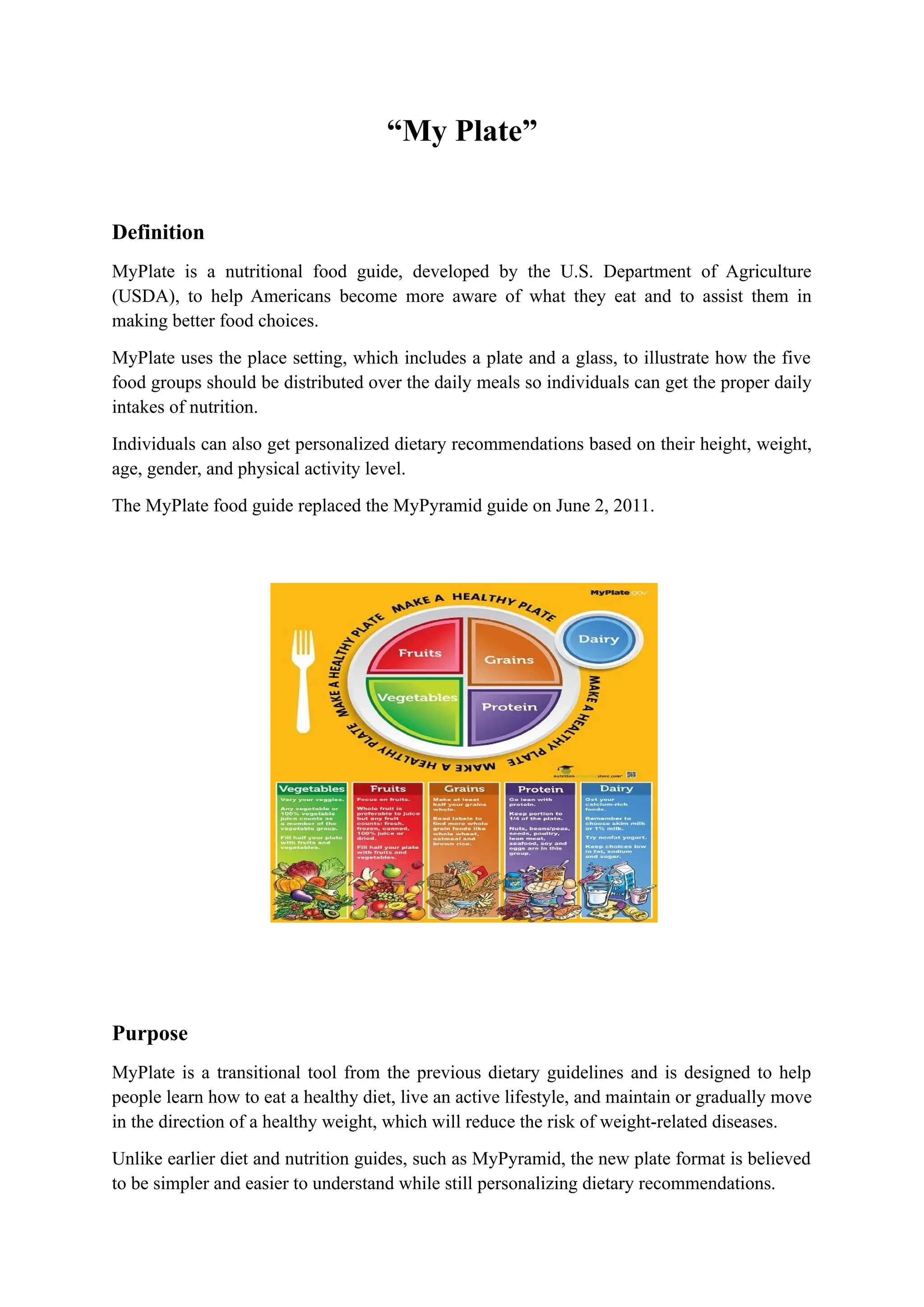
MyPlate uses the place setting, which includes a plate and a glass, to illustrate how the five
food groups should be distributed over the daily meals so individuals can get the proper daily
intakes of nutrition.
Individuals can also get personalized dietary recommendations based on their height, weight,
age, gender, and physical activity level.
The MyPlate food guide replaced the MyPyramid guide on June 2, 2011.
Purpose
MyPlate is a transitional tool from the previous dietary guidelines and is designed to help
people learn how to eat a healthy diet, live an active lifestyle, and maintain or gradually move
in the direction of a healthy weight, which will reduce the risk of weight-related diseases.
Unlike earlier diet and nutrition guides, such as MyPyramid, the new plate format is believed
to be simpler and easier to understand while still personalizing dietary recommendations.
Description
Dietary Guidelines for Americans are updated every five years with the eighth edition of
Dietary Guidelines for Americans 2015–2020 published in 2015.
Although dietary guidelines are written for health professionals, Myplate acts as a tool and
visual representation for individuals, nutrition educators, and the food industry to help
consumers build healthier diets. It offers a consistency of message if widely used.
Origins
More than 100 years ago, in 1894, the USDA published its first set of national nutrition
guidelines. The first food guide followed in 1916. In this guide, the author, a nutritionist,
introduced the idea of food groups. The five food groups defined in the food guide were milk
and meat, cereals, fruits and vegetables, fats and fatty foods, and sugars and sugary foods.
The guide made recommendations about eating food from each food group to remain healthy.
In 1941, the Food and Nutrition Board of the National Academy of Sciences published the
first recommended dietary allowances (RDAs). The RDAs were based on the amounts of
vitamins and minerals that were needed to prevent nutrient deficiencies and related diseases.
During World War II (1939–1945), certain foods such as butter and sugar were rationed, and
others were scarce. In response, the USDA published new nutritional guidelines to help
people eat a healthy diet during rationing.
The first pyramid graphic designed to explain the concepts behind the basic food groups
appeared in 1988. It was intended to show graphically that people should eat a variety of
foods in differing amounts from all of the four groups and consume only small amounts from
the fifth group of restricted foods. The need for physical activity was not illustrated anywhere
in this pyramid, nor was it shown in the 1992 version, called the Food Guide Pyramid.
MyPlate
MyPlate uses a meal place setting to illustrate the proper distribution of the five food groups
in a healthy diet.
The plate in MyPlate is divided into four main sections, with about 20% of the plate holding
grains, 30% covered with vegetables, 30% filled with fruits, and 20% containing protein-rich
foods. The fifth grouping is contained within a smaller circle in the shape of a glass or cup. It
represents dairy products such as a glass of low-fat or nonfat milk or a cup of yogurt.
The plate format is supposed to make it easier to determine appropriate serving sizes, by
portioning food according to proportions rather than measuring out individual servings (e.g.,
3 oz. Of chicken).
The MyPlate format also includes a number of informative messages that can be tailored by
population group such as:
 Find your healthy eating style.
 Focus on whole fruits.
 Make half your plate fruits and vegetables.
 Switch to fat-free or low-fat (1%) milk.
 Make at least half your grains whole grains.
 Vary your veggies.
 Vary your protein routine.
 Drink and eat less sodium, saturated fat, and added sugar.
 Drink water instead of sugary drinks.
 Be active your way.
Features no longer retained as part of MyPlate include the notion of discretionary calories and
the web-based tracker MyPyramid Tracker is discontinued. In contrast, the tool has been
tailored or personalized to meet the needs of an increased number of population groups such
as students or families.
Recommended intake
Grains
Wheat, rice, oats, barley, and cornmeal are common grains in the American diet. Less
familiar grains include buckwheat (also called kasha), amaranth, quinoa, sorghum, millet,
rye, and triticale. Pasta, bread, oatmeal, breakfast cereals, grits, crackers, tortillas, and other
foods made from grains are part of this group.
Grains are divided into two categories: whole grains and refined grains. MyPlate
recommends that at least half of the grains that an individual eats daily be whole grains. In a
whole grain, the whole kernel, including the bran and germ of the grain seed (not just the
endosperm), is used or ground into flour. Examples of whole-grain products include whole
wheat flour, cracked wheat (bulgur), brown rice, wild rice, whole cornmeal, oatmeal, whole
wheat bread, whole wheat pasta, whole wheat cereal such as muesli, and popcorn.
Refined grains have the bran, or seed coating, and the germ, or center of the kernel, removed
during processing. This produces softer flour and removes oils from the grain, which slows
the spoilage process and increases the shelf life of refined grain products; however, refining
also removes dietary fiber, iron, and B-complex vitamins. Products made with refined grain
often have B vitamins and iron added to replace some of what was lost by removing the germ
and bran. These products are labeled “enriched.” Examples of refined grain products include
white flour, degermed cornmeal, white rice, couscous, crackers, flour tortillas, grits, pasta,
white bread, and corn flake cereal. Some products are made with a mixture of whole grain
and refined grain flours to improve texture and taste but still retain some nutrients.
Vegetables
Any vegetable or any 100% vegetable juice is considered part of the vegetable group. This
group is subdivided into five different types of vegetables. MyPlate recommends that people
eat vegetables from all five subgroups over the course of a week. The subgroups are:
 dark green vegetables—spinach, kale, watercress, turnip greens, bok choy, broccoli,
collard greens, and similar vegetables
 orange vegetables—carrots, sweet potatoes, butternut squash, pumpkin, acorn squash,
and other types of orange vegetables
 beans and peas—black beans, navy beans, pinto beans, kidney beans, lima beans,
black-eyed peas, chickpeas, lentils, tofu (bean curd), and other types of beans and
peas
 starchy vegetables—potatoes, corn, fresh lima beans, green peas, green string beans,
and other starchy vegetables
 other vegetables—artichokes, cauliflower, mushrooms, bean sprouts, onions,
eggplant, peppers, tomatoes, celery, iceberg lettuce, and vegetables not in other
categories
Fruits
Fruits can be fresh, canned, frozen, or dried. One hundred percent fruit juice and fruit cocktail
also count as fruit. Commonly eaten fruits include apples, apricots, bananas, berries, cherries,
citrus fruits, grapes, kiwi, mangoes, melons, nectarines, peaches, pears, papaya, pineapple,
plums, prunes, and raisins.
Dairy
Nonfat (skim), low-fat (1%), reduced-fat (2%), and whole milk all contain about the same
amount of calcium, the most important mineral in milk, as well as the same amount of
vitamin D. Non-fat and low-fat milk are the preferred choices in this group.
Other foods in the milk group include yogurt, cheese, and desserts made with milk such as ice
cream and pudding. When foods such as ice cream, full-fat cheese, or sweetened yogurt are
chosen, the extra calories from fat and sugar should be subtracted from the daily discretionary
calories. People who are lactose intolerant can choose lactose-reduced and lactose-free
products. Cream cheese and butter contain only small amounts of calcium and are not part of
this group.
Protein
The protein group includes:
Although vegetarians and vegans can choose plant-based sources of protein, people who do
not eat meat need to make sure they are getting adequate amounts of iron.
The protein group contains several subgroups. People should try to eat less red meat and
more fish, poultry, and dried beans, pulses, and other alternative sources.
Meat should be trimmed of all visible fat and baked, broiled, or grilled. If fat is added in
cooking, it should be counted as oil or discretionary calories.
Foods to eat in moderation
MyPlate recommendations limit the amount of fats that can be eaten. Oils (such as olive oil)
are preferred over fats (such as butter). The guidelines recommend eating and drinking less
foods containing sodium, saturated fat, and added sugars. MyPlate guidelines also promote
daily physical activity.
KNOW YOUR OILS. Oils are liquid at room temperature, whereas fats are solid at room
temperature. Oils are preferred because they do not contain trans fatty acids (commonly
called trans fat). Diets high in saturated fat and trans fat are associated with higher blood
cholesterol levels. Oils come from plant sources and include olive oil, canola oil, corn oil,
safflower oil, and oil blends. Fats come mainly from animal sources and include butter, lard
(pork fat), tallow (beef fat), and chicken fat. Stick margarine and shortening are made of
vegetable oils that are treated to make them solid. Palm oil and coconut oil, although liquid at
room temperature, are not recommended because they are unusually high in saturated fat.
Avocados, nuts, olives, and some fish, such as salmon, are high in oils and are considered
healthier sources of fat because they are rich in unsaturated fatty acids and also provide
phytonutrients. Processed foods such as mayonnaise and salad dressings are oftentimes high
in oil but are usually not as healthy and can contain a lot of calories.
SATURATED FAT, ADDED SUGAR, AND SODIUM. For all age groups, MyPlate
recommends cutting back on foods and beverages high in added sugars, saturated fats, and
sodium to amounts that fit within healthy eating patterns. Numeric values are given for each
tailored checklist. For example, for a 2,000-calorie diet, individuals are advised to consume
less than 2300mg sodium, 22g saturated fat, and 50g of added sugar each day.
PHYSICAL ACTIVITY. MyPlate makes two recommendations about physical activity—
one for adults and one for children aged 6–17 years. Adults are recommended to be
moderately active at least 2-1/2 hours per week, whereas children ages 6–17 years are asked
to move at least 60 minutes each day in addition to their normal daily routines. An activity is
considered to be physical if it increases the heart rate. Movements, such as casual walking
while shopping, which do not appreciably increase heart rate, are not counted.
Precautions
MyPlate is designed for healthy people. It does not take into account special diets for people
who have diabetes, hypertension, gluten intolerance, or other allergies, or those who have
diseases such as cancer or acquired immune deficiency syndrome (AIDS) that alter the
nutrient requirements of the body. People with special conditions should follow the advice of
their healthcare providers.
Parental concerns
MyPlate is designed to apply only to children over the age of two years. Because they are
growing so rapidly, children younger than this age have special dietary needs, including the
need for more fat in the diet to ensure energy requirements are met. Parents of children age
two and younger should follow the dietary advice of their pediatricians.

My Plate: A Simple Guide to Balanced Nutrition

  • 1.
    “My Plate” Definition MyPlate isa nutritional food guide, developed by the U.S. Department of Agriculture (USDA), to help Americans become more aware of what they eat and to assist them in making better food choices. MyPlate uses the place setting, which includes a plate and a glass, to illustrate how the five food groups should be distributed over the daily meals so individuals can get the proper daily intakes of nutrition. Individuals can also get personalized dietary recommendations based on their height, weight, age, gender, and physical activity level. The MyPlate food guide replaced the MyPyramid guide on June 2, 2011. Purpose MyPlate is a transitional tool from the previous dietary guidelines and is designed to help people learn how to eat a healthy diet, live an active lifestyle, and maintain or gradually move in the direction of a healthy weight, which will reduce the risk of weight-related diseases. Unlike earlier diet and nutrition guides, such as MyPyramid, the new plate format is believed to be simpler and easier to understand while still personalizing dietary recommendations.
  • 2.
    Description Dietary Guidelines forAmericans are updated every five years with the eighth edition of Dietary Guidelines for Americans 2015–2020 published in 2015. Although dietary guidelines are written for health professionals, Myplate acts as a tool and visual representation for individuals, nutrition educators, and the food industry to help consumers build healthier diets. It offers a consistency of message if widely used. Origins More than 100 years ago, in 1894, the USDA published its first set of national nutrition guidelines. The first food guide followed in 1916. In this guide, the author, a nutritionist, introduced the idea of food groups. The five food groups defined in the food guide were milk and meat, cereals, fruits and vegetables, fats and fatty foods, and sugars and sugary foods. The guide made recommendations about eating food from each food group to remain healthy. In 1941, the Food and Nutrition Board of the National Academy of Sciences published the first recommended dietary allowances (RDAs). The RDAs were based on the amounts of vitamins and minerals that were needed to prevent nutrient deficiencies and related diseases. During World War II (1939–1945), certain foods such as butter and sugar were rationed, and others were scarce. In response, the USDA published new nutritional guidelines to help people eat a healthy diet during rationing. The first pyramid graphic designed to explain the concepts behind the basic food groups appeared in 1988. It was intended to show graphically that people should eat a variety of foods in differing amounts from all of the four groups and consume only small amounts from the fifth group of restricted foods. The need for physical activity was not illustrated anywhere in this pyramid, nor was it shown in the 1992 version, called the Food Guide Pyramid. MyPlate MyPlate uses a meal place setting to illustrate the proper distribution of the five food groups in a healthy diet. The plate in MyPlate is divided into four main sections, with about 20% of the plate holding grains, 30% covered with vegetables, 30% filled with fruits, and 20% containing protein-rich foods. The fifth grouping is contained within a smaller circle in the shape of a glass or cup. It represents dairy products such as a glass of low-fat or nonfat milk or a cup of yogurt.
  • 3.
    The plate formatis supposed to make it easier to determine appropriate serving sizes, by portioning food according to proportions rather than measuring out individual servings (e.g., 3 oz. Of chicken). The MyPlate format also includes a number of informative messages that can be tailored by population group such as:  Find your healthy eating style.  Focus on whole fruits.  Make half your plate fruits and vegetables.  Switch to fat-free or low-fat (1%) milk.  Make at least half your grains whole grains.  Vary your veggies.  Vary your protein routine.  Drink and eat less sodium, saturated fat, and added sugar.  Drink water instead of sugary drinks.  Be active your way. Features no longer retained as part of MyPlate include the notion of discretionary calories and the web-based tracker MyPyramid Tracker is discontinued. In contrast, the tool has been tailored or personalized to meet the needs of an increased number of population groups such as students or families. Recommended intake Grains Wheat, rice, oats, barley, and cornmeal are common grains in the American diet. Less familiar grains include buckwheat (also called kasha), amaranth, quinoa, sorghum, millet, rye, and triticale. Pasta, bread, oatmeal, breakfast cereals, grits, crackers, tortillas, and other foods made from grains are part of this group. Grains are divided into two categories: whole grains and refined grains. MyPlate recommends that at least half of the grains that an individual eats daily be whole grains. In a whole grain, the whole kernel, including the bran and germ of the grain seed (not just the endosperm), is used or ground into flour. Examples of whole-grain products include whole wheat flour, cracked wheat (bulgur), brown rice, wild rice, whole cornmeal, oatmeal, whole wheat bread, whole wheat pasta, whole wheat cereal such as muesli, and popcorn. Refined grains have the bran, or seed coating, and the germ, or center of the kernel, removed during processing. This produces softer flour and removes oils from the grain, which slows the spoilage process and increases the shelf life of refined grain products; however, refining also removes dietary fiber, iron, and B-complex vitamins. Products made with refined grain often have B vitamins and iron added to replace some of what was lost by removing the germ and bran. These products are labeled “enriched.” Examples of refined grain products include
  • 4.
    white flour, degermedcornmeal, white rice, couscous, crackers, flour tortillas, grits, pasta, white bread, and corn flake cereal. Some products are made with a mixture of whole grain and refined grain flours to improve texture and taste but still retain some nutrients. Vegetables Any vegetable or any 100% vegetable juice is considered part of the vegetable group. This group is subdivided into five different types of vegetables. MyPlate recommends that people eat vegetables from all five subgroups over the course of a week. The subgroups are:  dark green vegetables—spinach, kale, watercress, turnip greens, bok choy, broccoli, collard greens, and similar vegetables  orange vegetables—carrots, sweet potatoes, butternut squash, pumpkin, acorn squash, and other types of orange vegetables  beans and peas—black beans, navy beans, pinto beans, kidney beans, lima beans, black-eyed peas, chickpeas, lentils, tofu (bean curd), and other types of beans and peas  starchy vegetables—potatoes, corn, fresh lima beans, green peas, green string beans, and other starchy vegetables  other vegetables—artichokes, cauliflower, mushrooms, bean sprouts, onions, eggplant, peppers, tomatoes, celery, iceberg lettuce, and vegetables not in other categories Fruits Fruits can be fresh, canned, frozen, or dried. One hundred percent fruit juice and fruit cocktail also count as fruit. Commonly eaten fruits include apples, apricots, bananas, berries, cherries, citrus fruits, grapes, kiwi, mangoes, melons, nectarines, peaches, pears, papaya, pineapple, plums, prunes, and raisins. Dairy Nonfat (skim), low-fat (1%), reduced-fat (2%), and whole milk all contain about the same amount of calcium, the most important mineral in milk, as well as the same amount of vitamin D. Non-fat and low-fat milk are the preferred choices in this group. Other foods in the milk group include yogurt, cheese, and desserts made with milk such as ice cream and pudding. When foods such as ice cream, full-fat cheese, or sweetened yogurt are chosen, the extra calories from fat and sugar should be subtracted from the daily discretionary calories. People who are lactose intolerant can choose lactose-reduced and lactose-free products. Cream cheese and butter contain only small amounts of calcium and are not part of this group. Protein The protein group includes: Although vegetarians and vegans can choose plant-based sources of protein, people who do not eat meat need to make sure they are getting adequate amounts of iron.
  • 5.
    The protein groupcontains several subgroups. People should try to eat less red meat and more fish, poultry, and dried beans, pulses, and other alternative sources. Meat should be trimmed of all visible fat and baked, broiled, or grilled. If fat is added in cooking, it should be counted as oil or discretionary calories. Foods to eat in moderation MyPlate recommendations limit the amount of fats that can be eaten. Oils (such as olive oil) are preferred over fats (such as butter). The guidelines recommend eating and drinking less foods containing sodium, saturated fat, and added sugars. MyPlate guidelines also promote daily physical activity. KNOW YOUR OILS. Oils are liquid at room temperature, whereas fats are solid at room temperature. Oils are preferred because they do not contain trans fatty acids (commonly called trans fat). Diets high in saturated fat and trans fat are associated with higher blood cholesterol levels. Oils come from plant sources and include olive oil, canola oil, corn oil, safflower oil, and oil blends. Fats come mainly from animal sources and include butter, lard (pork fat), tallow (beef fat), and chicken fat. Stick margarine and shortening are made of vegetable oils that are treated to make them solid. Palm oil and coconut oil, although liquid at room temperature, are not recommended because they are unusually high in saturated fat. Avocados, nuts, olives, and some fish, such as salmon, are high in oils and are considered healthier sources of fat because they are rich in unsaturated fatty acids and also provide phytonutrients. Processed foods such as mayonnaise and salad dressings are oftentimes high in oil but are usually not as healthy and can contain a lot of calories. SATURATED FAT, ADDED SUGAR, AND SODIUM. For all age groups, MyPlate recommends cutting back on foods and beverages high in added sugars, saturated fats, and sodium to amounts that fit within healthy eating patterns. Numeric values are given for each tailored checklist. For example, for a 2,000-calorie diet, individuals are advised to consume less than 2300mg sodium, 22g saturated fat, and 50g of added sugar each day. PHYSICAL ACTIVITY. MyPlate makes two recommendations about physical activity— one for adults and one for children aged 6–17 years. Adults are recommended to be moderately active at least 2-1/2 hours per week, whereas children ages 6–17 years are asked to move at least 60 minutes each day in addition to their normal daily routines. An activity is considered to be physical if it increases the heart rate. Movements, such as casual walking while shopping, which do not appreciably increase heart rate, are not counted. Precautions MyPlate is designed for healthy people. It does not take into account special diets for people who have diabetes, hypertension, gluten intolerance, or other allergies, or those who have diseases such as cancer or acquired immune deficiency syndrome (AIDS) that alter the nutrient requirements of the body. People with special conditions should follow the advice of their healthcare providers. Parental concerns MyPlate is designed to apply only to children over the age of two years. Because they are growing so rapidly, children younger than this age have special dietary needs, including the
  • 6.
    need for morefat in the diet to ensure energy requirements are met. Parents of children age two and younger should follow the dietary advice of their pediatricians.