Extension is a Division of the Institute of Agriculture and Natural Resources at the University of Nebraska–Lincoln
cooperating with the Counties and the United States Department of Agriculture.
University of Nebraska–Lincoln Extension educational programs abide with the nondiscrimination policies
of the University of Nebraska–Lincoln and the United States Department of Agriculture.
continued on next page
Alice Henneman, MS, RDN
Extension Educator
Got some leftovers languishing in
your refrigerator? Or perhaps little bits
of foods that are almost past prime time
to eat. Read on if their next stop is likely
to be the trash can.
Give new life to still edible foods
with our gallery of delicious ideas. As
a general rule, use leftovers within 3–4
days.
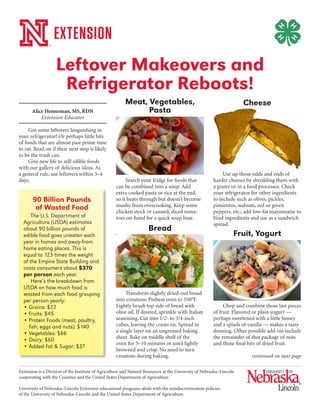
Meat, Vegetables,
Pasta
Search your fridge for foods that
can be combined into a soup. Add
extra cooked pasta or rice at the end,
so it heats through but doesn’t become
mushy from overcooking. Keep some
chicken stock or canned, diced toma-
toes on-hand for a quick soup base.
Bread
Transform slightly dried-out bread
into croutons: Preheat oven to 350°F.
Lightly brush top side of bread with
olive oil. If desired, sprinkle with Italian
seasoning. Cut into 1/2- to 3/4-inch
cubes, leaving the crusts on. Spread in
a single layer on an ungreased baking
sheet. Bake on middle shelf of the
oven for 5–10 minutes or until lightly
browned and crisp. No need to turn
croutons during baking.
Cheese
Use up those odds and ends of
harder cheeses by shredding them with
a grater or in a food processor. Check
your refrigerator for other ingredients
to include such as olives, pickles,
pimientos, walnuts, red or green
peppers, etc.; add low-fat mayonnaise to
bind ingredients and use as a sandwich
spread.
Fruit, Yogurt
Chop and combine those last pieces
of fruit. Flavored or plain yogurt —
perhaps sweetened with a little honey
and a splash of vanilla — makes a tasty
dressing. Other possible add-ins include
the remainder of that package of nuts
and those final bits of dried fruit.
Leftover Makeovers and
Refrigerator Reboots!
90 Billion Pounds
of Wasted Food
The U.S. Department of
Agriculture (USDA) estimates
about 90 billion pounds of
edible food goes uneaten each
year in homes and away-from
home eating places. This is
equal to 123 times the weight
of the Empire State Building and
costs consumers about $370
per person each year.
Here’s the breakdown from
USDA on how much food is
wasted from each food grouping
per person yearly:
• Grains: $22
• Fruits: $45
• Protein Foods (meat, poultry,
fish, eggs and nuts): $140
• Vegetables: $66
• Dairy: $60
• Added Fat  Sugar: $37
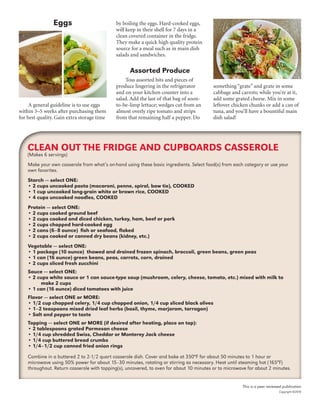
Eggs
A general guideline is to use eggs
within 3–5 weeks after purchasing them
for best quality. Gain extra storage time
by boiling the eggs. Hard-cooked eggs,
will keep in their shell for 7 days in a
clean covered container in the fridge.
They make a quick high quality protein
source for a meal such as in main dish
salads and sandwiches.
Assorted Produce
Toss assorted bits and pieces of
produce lingering in the refrigerator
and on your kitchen counter into a
salad. Add the last of that bag of soon-
to-be-limp lettuce; wedges cut from an
almost overly ripe tomato and strips
from that remaining half a pepper. Do
something “grate” and grate in some
cabbage and carrots; while you’re at it,
add some grated cheese. Mix in some
leftover chicken chunks or add a can of
tuna, and you’ll have a bountiful main
dish salad!
This is a peer reviewed publication
Copyright ©2016
Make your own casserole from what’s on-hand using these basic ingredients. Select food(s) from each category or use your
own favorites.
Starch — select ONE:
• 2 cups uncooked pasta (macaroni, penne, spiral, bow tie), COOKED
• 1 cup uncooked long-grain white or brown rice, COOKED
• 4 cups uncooked noodles, COOKED
Protein — select ONE:
• 2 cups cooked ground beef
• 2 cups cooked and diced chicken, turkey, ham, beef or pork
• 2 cups chopped hard-cooked egg
• 2 cans (6–8 ounce) fish or seafood, flaked
• 2 cups cooked or canned dry beans (kidney, etc.)
Vegetable — select ONE:
• 1 package (10 ounce) thawed and drained frozen spinach, broccoli, green beans, green peas
• 1 can (16 ounce) green beans, peas, carrots, corn, drained
• 2 cups sliced fresh zucchini
Sauce — select ONE:
• 2 cups white sauce or 1 can sauce-type soup (mushroom, celery, cheese, tomato, etc.) mixed with milk to
make 2 cups
• 1 can (16 ounce) diced tomatoes with juice
Flavor — select ONE or MORE:
• 1/2 cup chopped celery, 1/4 cup chopped onion, 1/4 cup sliced black olives
• 1–2 teaspoons mixed dried leaf herbs (basil, thyme, marjoram, tarragon)
• Salt and pepper to taste
Topping — select ONE or MORE (if desired after heating, place on top):
• 2 tablespoons grated Parmesan cheese
• 1/4 cup shredded Swiss, Cheddar or Monterey Jack cheese
• 1/4 cup buttered bread crumbs
• 1/4–1/2 cup canned fried onion rings
Combine in a buttered 2 to 2-1/2 quart casserole dish. Cover and bake at 350°F for about 50 minutes to 1 hour or
microwave using 50% power for about 15–30 minutes, rotating or stirring as necessary. Heat until steaming hot (165°F)
throughout. Return casserole with topping(s), uncovered, to oven for about 10 minutes or to microwave for about 2 minutes.
CLEAN OUT THE FRIDGE AND CUPBOARDS CASSEROLE
(Makes 6 servings)

Leftover Makeovers and Refrigerator Reboots

  • 1.
    Extension is aDivision of the Institute of Agriculture and Natural Resources at the University of Nebraska–Lincoln cooperating with the Counties and the United States Department of Agriculture. University of Nebraska–Lincoln Extension educational programs abide with the nondiscrimination policies of the University of Nebraska–Lincoln and the United States Department of Agriculture. continued on next page Alice Henneman, MS, RDN Extension Educator Got some leftovers languishing in your refrigerator? Or perhaps little bits of foods that are almost past prime time to eat. Read on if their next stop is likely to be the trash can. Give new life to still edible foods with our gallery of delicious ideas. As a general rule, use leftovers within 3–4 days. Meat, Vegetables, Pasta Search your fridge for foods that can be combined into a soup. Add extra cooked pasta or rice at the end, so it heats through but doesn’t become mushy from overcooking. Keep some chicken stock or canned, diced toma- toes on-hand for a quick soup base. Bread Transform slightly dried-out bread into croutons: Preheat oven to 350°F. Lightly brush top side of bread with olive oil. If desired, sprinkle with Italian seasoning. Cut into 1/2- to 3/4-inch cubes, leaving the crusts on. Spread in a single layer on an ungreased baking sheet. Bake on middle shelf of the oven for 5–10 minutes or until lightly browned and crisp. No need to turn croutons during baking. Cheese Use up those odds and ends of harder cheeses by shredding them with a grater or in a food processor. Check your refrigerator for other ingredients to include such as olives, pickles, pimientos, walnuts, red or green peppers, etc.; add low-fat mayonnaise to bind ingredients and use as a sandwich spread. Fruit, Yogurt Chop and combine those last pieces of fruit. Flavored or plain yogurt — perhaps sweetened with a little honey and a splash of vanilla — makes a tasty dressing. Other possible add-ins include the remainder of that package of nuts and those final bits of dried fruit. Leftover Makeovers and Refrigerator Reboots! 90 Billion Pounds of Wasted Food The U.S. Department of Agriculture (USDA) estimates about 90 billion pounds of edible food goes uneaten each year in homes and away-from home eating places. This is equal to 123 times the weight of the Empire State Building and costs consumers about $370 per person each year. Here’s the breakdown from USDA on how much food is wasted from each food grouping per person yearly: • Grains: $22 • Fruits: $45 • Protein Foods (meat, poultry, fish, eggs and nuts): $140 • Vegetables: $66 • Dairy: $60 • Added Fat Sugar: $37
  • 2.
    Eggs A general guidelineis to use eggs within 3–5 weeks after purchasing them for best quality. Gain extra storage time by boiling the eggs. Hard-cooked eggs, will keep in their shell for 7 days in a clean covered container in the fridge. They make a quick high quality protein source for a meal such as in main dish salads and sandwiches. Assorted Produce Toss assorted bits and pieces of produce lingering in the refrigerator and on your kitchen counter into a salad. Add the last of that bag of soon- to-be-limp lettuce; wedges cut from an almost overly ripe tomato and strips from that remaining half a pepper. Do something “grate” and grate in some cabbage and carrots; while you’re at it, add some grated cheese. Mix in some leftover chicken chunks or add a can of tuna, and you’ll have a bountiful main dish salad! This is a peer reviewed publication Copyright ©2016 Make your own casserole from what’s on-hand using these basic ingredients. Select food(s) from each category or use your own favorites. Starch — select ONE: • 2 cups uncooked pasta (macaroni, penne, spiral, bow tie), COOKED • 1 cup uncooked long-grain white or brown rice, COOKED • 4 cups uncooked noodles, COOKED Protein — select ONE: • 2 cups cooked ground beef • 2 cups cooked and diced chicken, turkey, ham, beef or pork • 2 cups chopped hard-cooked egg • 2 cans (6–8 ounce) fish or seafood, flaked • 2 cups cooked or canned dry beans (kidney, etc.) Vegetable — select ONE: • 1 package (10 ounce) thawed and drained frozen spinach, broccoli, green beans, green peas • 1 can (16 ounce) green beans, peas, carrots, corn, drained • 2 cups sliced fresh zucchini Sauce — select ONE: • 2 cups white sauce or 1 can sauce-type soup (mushroom, celery, cheese, tomato, etc.) mixed with milk to make 2 cups • 1 can (16 ounce) diced tomatoes with juice Flavor — select ONE or MORE: • 1/2 cup chopped celery, 1/4 cup chopped onion, 1/4 cup sliced black olives • 1–2 teaspoons mixed dried leaf herbs (basil, thyme, marjoram, tarragon) • Salt and pepper to taste Topping — select ONE or MORE (if desired after heating, place on top): • 2 tablespoons grated Parmesan cheese • 1/4 cup shredded Swiss, Cheddar or Monterey Jack cheese • 1/4 cup buttered bread crumbs • 1/4–1/2 cup canned fried onion rings Combine in a buttered 2 to 2-1/2 quart casserole dish. Cover and bake at 350°F for about 50 minutes to 1 hour or microwave using 50% power for about 15–30 minutes, rotating or stirring as necessary. Heat until steaming hot (165°F) throughout. Return casserole with topping(s), uncovered, to oven for about 10 minutes or to microwave for about 2 minutes. CLEAN OUT THE FRIDGE AND CUPBOARDS CASSEROLE (Makes 6 servings)