


Makeover
Your
Leftovers
Alice Henneman, MS, RDN
Carol Schwarz, MS, RD
Cindy Brison, MS, RD
Nancy Frecks, MS
Amy Peterson, MS, RD
University of Nebraska–Lincoln Extension
For more information:
ahenneman1@unl.edu • food.unl.edu
Download the handout that
goes with these slides and
gives more information and
recipes at:
http://bit.ly/recipes4leftovers
“Leftovers make you feel
good twice. First, when you
put it away, you feel thrifty
and intelligent: ‘I’m saving
food!’ Then a month later
when blue hair is growing
out of the ham, and you
throw it away, you feel
really intelligent: ‘I’m
saving my life!’ ”
- George Carlin, comedian
Photo credit: Pixabay.com
About 90
billion
pounds of
edible food
goes
uneaten
each year in
the United
States
Photo credit: USDA
That
amount
equals…
123 x the
weight of the
Empire State
Building
Photo credit: Pixabay.com
Oh my!
Photo credit: Pixabay.com
Raise your hand
if you toss from the
following food
groups at least a few
times monthly …
Photo credit: Pixabay.com
Source of photos: Used with permission by the Academy of Nutrition and
Grains Fruits Protein Foods Vegetables Dairy
Costs of food waste per food group
per person yearly
$22
Grains
$45
Fruits
$140
Protein Foods
$66
Vegetables
$60
Dairy
Added Fat & Sugar: $37
Information source: https://choosemyplate-prod.azureedge.net/sites/default/files/printablematerials/2015-LetsTalkTrash-2page.pdf
Food
tossed
is …
Photo credits: Garbage:“Trash Can” by Tom Magliery is licensed under CC BY NC SA 2.0 | Banana: Pixabay.com
Money
lost!
Money photo credit: Pixabay.com
Tossed food
costs
consumers
about $370
per person
yearly
Photo credit: Pixabay.com
Here’s how to save some of that money ….
Photo credits: Pixabay.com
Resources used to produce
uneaten food include:
• 30% of fertilizer
• 31% of cropland
• 25% of total fresh water
consumption
• 2% of total energy consumption
… and at the same time help the environment!
Information source: https://www3.epa.gov/region9/waste/features/foodtoenergy/food-waste.html | Photo credit: Pixabay.com
Food waste is a
major contributor to
municipal waste and
decomposes to
methane, a potent
greenhouse gas
Photo credit: “Food waste 2” by Nick Saltmarsh is licensed under CC BY 2.0
Information source: https://www3.epa.gov/region9/waste/features/foodtoenergy/food-waste.html
Reducing food waste helps
reduce food insecurity
• 42 million Americans, including
13 million children are food-insecure
• Reducing food waste by 15% could
feed more than 25 million Americans
yearly.
• Reducing the amount of food wasted
in the nation by 50% by 2030 is an
initiative launched by USDA and EPA
in 2015.
Information source: Feeding America: http://www.feedingamerica.org/hunger-in-america/news-and-updates/press-room/press-releases/usda-food-insecurity-report-reponse.html
National Resources Defense Council: https://www.nrdc.org/sites/default/files/wasted-food-IP.pdf
Photo credit: “Food waste” by Soli is licensed under CC BY 2.0
The following tips and recipes
will help reduce food waste at
home. Plus, they’ll save you
money, help the environment
and aid in food security!
WOW!
Photo credit: Pixabay.com
28 QUICK TRICKS
TO ADD NEW LIFE
TO LEFTOVERS
Foods with * indicate a recipe is provided
And … everything
includes basic
ingredients so you
don’t create new
leftovers making over
your leftovers!
Photo credit: Pixabay.com
GRAINS
Source of photo: Used with permission by the Academy of Nutrition and Dietetics
Use older
bread to make
croutons,*
bread crumbs,*
bread
pudding,*
stratas and
French toast*
Photo credit: Alice Henneman
1
Use leftover
rice in stir-
fried rice,
rice pudding
and rice
bowls
Photo credit: Pixabay.com
2
Heat leftover
pasta in a pan
with some
olive oil.
Sprinkle with
Parmesan
cheese.
Photo credit: Alice Henneman
3
Garnish for added pizazz!
Photo credit: Alice Henneman
FRUITS
Source of photo: Used with permission by the Academy of Nutrition and Dietetics
Freeze extra
lemon or lime
juice in ice
cube trays;
use for
flavored water
Photo credit: Pixabay.com
4
Roll citrus fruits
with your hand
on a hard
surface
before juicing to
get more juice
from them
Photo credit: Alice Henneman
5
Refrigerate ripe
bananas to
make them last
a few days
longer
Photo credit: Alice Henneman
6
Freeze lemon
slices in water
in cupcake
pans for …
Photo credit: Alice Henneman
7
… large,
flavored ice
cubes
Photo credit: Alice Henneman
Freeze washed,
peeled, bite-size
pieces of fruit for
smoothies*
Photo credit: Alice Henneman
8
PROTEIN FOODS
Source of photo: Used with permission by the Academy of Nutrition and Dietetics
Help prevent
“warmed over
meat” flavor:
• Use leftover
meats in
flavorful foods
• Cover with
liquids, sauce
or gravy
Photo credit: Alice Henneman
9
VEGETABLES
Source of photo: Used with permission by the Academy of Nutrition and Dietetics
Add chopped,
mature onions
directly to a
freezer bag
Photo credit: Alice Henneman
10
Freeze extra
bell peppers
in shapes
needed for
recipes
Photo credit: Alice Henneman
11
What was the
“secret
ingredient,”
languishing in the
refrigerator, that
was added to this
pasta sauce?
Photo credit: Alice Henneman
12
Purée extra
vegetables in a
blender or food
processor (about 1/2
cup per serving) and
heat with pasta sauce.
Possible additional
vegetables include
carrots, butternut
squash, red
bell peppers
and zucchini.
Photo credit: Alice Henneman
Freeze extra
tomato paste in
tablespoon-size
portions in an
ice cube tray.
Transfer to a
freezer bag.
Photo credit: Alice Henneman
13
What a great
way to get my
kids to eat more
veggies!
Photo credit: Pixabay.com
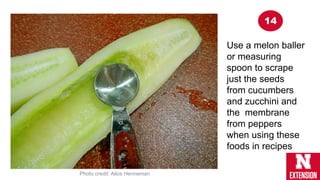
Use a melon baller
or measuring
spoon to scrape
just the seeds
from cucumbers
and zucchini and
the membrane
from peppers
when using these
foods in recipes
Photo credit: Alice Henneman
14
Freeze
chopped fresh
herbs in olive oil
Photo credit: Alice Henneman
15
Revive French
fries by heating
in a small
amount of oil in
a heavy skillet
over medium
heat
Photo credit: Alice Henneman
16
Which leftover fry would you eat?
Photo credit: Alice Henneman
Sauté chopped
cabbage
and onion in olive
oil, margarine or
butter over
medium heat until
tender; season
with salt and
pepper
Photo source: “Cabbage thoran” by goblinbox_(queen_of_ad_hoc_bento) is licensed under CC BY 2.0
17
DAIRY
Source of photo: Used with permission by the Academy of Nutrition and Dietetics
Freeze
Parmesan rinds
and add (frozen)
to a soup or stew
for extra flavor
Photo source: “Cheese” by Quinn Dombrowski is licensed under CC SA 2.0
18
Has anyone
tried that?
Photo credit: Pixabay.com
Make a cheese
spread with
odds and ends
of cheese, mayo
and foods like
chopped olives
and walnuts
Photo credit: Alice Henneman
19
Or, toss that cheese
on a recipe that
needs a little
something extra to
make it tasty!
Photo credit: Pixabay.com
• Need a cheese lower in sodium –
try Swiss cheese …
 54 mg sodium/ounce – about
1/3 the amount of sodium in 1
slice of bread
• Want a lower fat cheese –
try part-skim Mozzarella …
 4.5 gm fat /ounce – a teaspoon
of butter or margarine has
about 3.5 gm fat
 Also, check out other forms of
“reduced-fat” or “low-fat”
cheeses
Photo credit: Pixabay.com
If you feel adding cheese won’t fit into your diet …
Use vanilla
and fruit-
flavored yogurts
as a dressing for
fruit salads
Photo credit: Alice Henneman
20
COMBINATIONS OF FOODS
Source of photo: Used with permission by the Academy of Nutrition and Dietetics
Make a chopped
salad* with small
amounts of extra
fruits, vegetables,
nuts, cooked
eggs, etc.
Photo credit: Alice Henneman
21
Combine
leftover pasta
with other
foods; mix with
your favorite oil
and vinegar
salad dressing
Photo credit: Alice Henneman
22
• Create a parfait of
cookie crumbles,
pudding, and fruit
• Make shortly before
serving and keep
refrigerated
Photo credit: “Girl Scout Cookie Parfait” by Dennis Wilkinson is licensed under CC BY NC SA 2.0
23
Anyone
have
some
cookies in
the house
they might
try this
with?
Photo credit: “Girl Scout Cookies” by Marit & Toomas Hinnosaar is licensed under CC BY 2.0
Other?
Photo credit: Pixabay.com
Use these tests
to see if baking
powder or soda
still works (in
handout)
Photo credit: Alice Henneman
24
Fix lumpy gravy
by pouring it
through a sieve
or strainer
Photo source: “All-Purpose Gravy” by Kelvin Beecroft is licensed under CC BY NC SA 2.0
25
Coat
measuring
cups with
nonstick
cooking
spray before
measuring
sticky
ingredients
Photo credit: Alice Henneman
26
Add oil, vinegar,
herbs and spices
to an almost
empty jelly or
mayo jar to make
salad dressing
and shake. Use
about 1 part
vinegar to
3 parts oil.
Photo credit: Alice Henneman
27
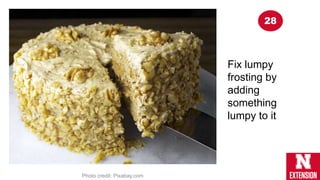
Fix lumpy
frosting by
adding
something
lumpy to it
Photo credit: Pixabay.com
28
Recipes
About the recipes …
• According to the U.S. Department of
Agriculture, part of a healthy diet is limiting
the amounts of added sugars, saturated fats
and sodium we consume.
• The following recipes have been chosen to
help promote or give substitutions that
support these recommendations and at the
same time provide important nutrients and
taste good.
• While saturated fat is kept at a minimum, to
further reduce saturated fat in a recipe calling
for a solid fat, substitute a soft (tub or
squeeze) margarine.
Old
Fashioned
Bread
Pudding
Photo credit: Alice Henneman
Roasted
Root
Vegetables
Photo credit: Alice Henneman
Homemade
Whole
Grain
Croutons
Photo credit: Alice Henneman
Roasted
Vegetable
Pasta
Photo credit: Alice Henneman
Clean the
Fridge
Chopped
Salad
Photo credit: Alice Henneman
Tasty
Microwave
Potato
Chunks
Photo credit: Alice Henneman
Mashed
Cauliflower
Photo credit: Alice Henneman
Roasted
Cauliflower
Photo credit: Alice Henneman
French
Toast
Photo credit: Alice Henneman
Bread
Crumb
Casserole
Topping
Photo credit: Pixabay.com
It’s the
Berries
Yogurt
Smoothie
Photo credit: Alice Henneman
Smoothie
recipes also
make great
ice pops!
Photo credit: Alice Henneman
Turkey Mashed Potato Soup Turkey Salsa Soup
Photo credit: Alice Henneman
Fiesta Rice
Skillet Dinner
Photo credit: MidwestDairy.com
MORE WAYS
TO PREVENT
WASTED
FOOD
More ways to PREVENT wasted food include:
• Reducing the size of a recipe
• Substituting a more common
ingredient
• Storing and preparing fruits and
vegetables to prevent spoilage
• Handling food safely so it doesn’t
go bad
• Interpreting food date codes
correctly
Photo credit: Pixabay.com
Can you answer these 10
questions on preventing
wasted food?
Materials giving more
information about these
and other ways to prevent
wasted food are in the
“Kitchen Helpers” section
of the related handout at:
http://bit.ly/recipes4leftovers
Photo credit: Pixabay.com
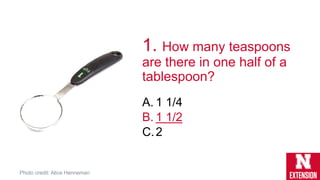
1. How many teaspoons
are there in one half of a
tablespoon?
A. 1 1/4
B. 1 1/2
C.2
Photo credit: Alice Henneman
1. How many teaspoons
are there in one half of a
tablespoon?
A. 1 1/4
B. 1 1/2
C.2
Photo credit: Alice Henneman
2. How much garlic
powder will substitute
for a small clove garlic?
A. 1/2 teaspoon
B. 1/4 teaspoon
C.1/8 teaspoon
Photo credit: Pixabay.com
2. How much garlic
powder will substitute
for a small clove garlic?
A. 1/2 teaspoon
B. 1/4 teaspoon
C.1/8 teaspoon
Photo credit: Pixabay.com
You (and your
friends!) may be sorry
if you got this
substitution wrong!
Photo credit: Pixabay.com
3. Should you
wash fruits and
vegetables before
refrigerating them?
A. Yes
B. No
Photo credit: Pixabay.com
3. Should you
wash fruits and
vegetables before
refrigerating them?
A. Yes
B. No
Photo credit: Pixabay.com
4. Which of these
foods should be stored
at room temperature?
A. Onion
B. Tomato
C.Pumpkin and
winter squashes
D.All of them
Photocredit:www.pachd.com
4. Which of these
foods should be stored
at room temperature?
Photocredit:www.pachd.com
A. Onion
B. Tomato
C.Pumpkin and
winter squashes
D.All of them
Store these foods at room temperature!
Tomatoes
Pumpkins and Winter Squashes
Bananas
Onions
Potatoes
(including sweet
potatoes)
Photo credit: www.pachd.com | Garlic: Pixabay.com
Garlic
Avoid leaving
produce in a
sealed plastic bag
on your countertop
Photo credit: Alice Henneman
5. Which of these fruits
will NOT ripen at room
temperature?
A. Peach
B. Orange
C.Avocado
Photo credit: Pixabay.com
5. Which of these fruits
will NOT ripen at room
temperature?
A. Peach
B. Orange
C.Avocado
Photo credit: Pixabay.com
Ripen these fruits on the counter;
then store them in the refrigerator!
Avocado
Plums
Kiwifruit
Peaches and
Nectarines
Pears
Photocredit:www.pachd.com
Store fruits in a separate
refrigerator crisper drawer from
vegetables at a refrigerator
temperature of 400F or lower
Photo credit: Alice Henneman
If you don’t have access
to commercial, food-
grade, perforated bags for
storing refrigerated fruits
and vegetables, poke
several small holes in a
food-grade plastic bag
Photo credit: Alice Henneman
6.How long will
food keep
safely in the
freezer at 0ºF?
A. About a year
B. Indefinitely
Photo credit: USDA/FSIS
6.How long will
food keep
safely in the
freezer at 0ºF?
A. About a year
B. Indefinitely
Photo credit: USDA/FSIS
Food stored
constantly at 00F
will always be
safe. Only the
quality suffers
with lengthy
freezer storage.
Photo credit: “Frozen Food Caroline's Freezer 12-9-09_0011_1101209” by Steven Depolo is licensed under CC BY 2.0
7. How long
should you store
leftovers in the
refrigerator?
A. 3 - 4 days
B. Up to a week
C.2 weeks
Photo credit: “Leftovers” by Ginny is licensed under CC BY SA 2.0
7. How long
should you store
leftovers in the
refrigerator?
A. 3 - 4 days
B. Up to a week
C.2 weeks
Photo credit: “Leftovers” by Ginny is licensed under CC BY SA 2.0
8. Is it SAFE to eat food
from rusted or dented cans?
A. Yes
B. No
C.Sometimes
Photo credit: Alice Henneman
8. Is it SAFE to eat food
from rusted or dented cans?
A. Yes
B. No
C.Sometimes
Photo credit: Alice Henneman
9. Is a food
immediately
UNSAFE after a
“best if used by”
date?
A. Yes
B. No
Photo credit: Alice Henneman
9. Is a food
immediately
UNSAFE after a
“best if used by”
date?
A. Yes
B. No
Photo credit: Alice Henneman
Over 90% (9 out of 10)
of Americans may
toss food too soon
Photo credit: Alice HennemanPhoto credit: Alice Henneman
Photo credit: Pixabay.com
New voluntary date labels
• Manufacturers have until July 2018 to
make the change
• 2 standard phrases
• “BEST If Used By” describes quality
where the food may not taste or
perform as expected but is still safe
to use
• “USE by” applies to the few products
that are highly perishable and/or
have a food safety concern over time
• Lead by Food Marketing Institute and
Grocery Manufacturers Association
Information source: Grocery Manufacturers Association at http://bit.ly/2lxTVtk | Image: Created by Alice Henneman
Some labels currently found on food products
10. Which is these
statements is FALSE about
freezing milk?
A. Frozen milk is used most
successfully in cooking
B. Frozen milk may become
separated and the texture
somewhat grainy when thawed
C.Freezing milk makes it
unsafe to drink
Photo credit: Microsoft PowerPoint images
10. Which is these
statements is FALSE about
freezing milk?
Photo credit: Microsoft PowerPoint images
A. Frozen milk is used most
successfully in cooking
B. Frozen milk may become
separated and the texture
somewhat grainy when thawed
C.Freezing milk makes it
unsafe to drink
Concluding with one
of the most frequently
repeated quotes about
leftovers …
“The most
remarkable thing
about my mother
is that for thirty
years she served
the family nothing
but leftovers. The
original meal has
never been
found.”
― Calvin Trillin
Photo credit: Pixabay.com
Questions?
Extension is a Division of the Institute of Agriculture and Natural Resources at the
University of Nebraska–Lincoln cooperating with the Counties and the United
States Department of Agriculture.
University of Nebraska–Lincoln Extension educational programs abide with the
nondiscrimination policies of the University of Nebraska–Lincoln and the United
States Department of Agriculture.
Reference to commercial products or trade names is made with the understanding
that no discrimination is intended of those not mentioned and no endorsement by
University of Nebraska—Lincoln Extension is implied for those mentioned.

Makeover Your Leftovers

  • 1.
  • 2.
    Alice Henneman, MS,RDN Carol Schwarz, MS, RD Cindy Brison, MS, RD Nancy Frecks, MS Amy Peterson, MS, RD University of Nebraska–Lincoln Extension For more information: ahenneman1@unl.edu • food.unl.edu
  • 3.
    Download the handoutthat goes with these slides and gives more information and recipes at: http://bit.ly/recipes4leftovers
  • 4.
    “Leftovers make youfeel good twice. First, when you put it away, you feel thrifty and intelligent: ‘I’m saving food!’ Then a month later when blue hair is growing out of the ham, and you throw it away, you feel really intelligent: ‘I’m saving my life!’ ” - George Carlin, comedian Photo credit: Pixabay.com
  • 5.
    About 90 billion pounds of ediblefood goes uneaten each year in the United States Photo credit: USDA
  • 6.
  • 7.
    123 x the weightof the Empire State Building Photo credit: Pixabay.com
  • 8.
  • 9.
    Raise your hand ifyou toss from the following food groups at least a few times monthly … Photo credit: Pixabay.com
  • 10.
    Source of photos:Used with permission by the Academy of Nutrition and Grains Fruits Protein Foods Vegetables Dairy
  • 11.
    Grains Fruits ProteinFoods Vegetables Dairy
  • 12.
    Grains Fruits ProteinFoods Vegetables Dairy
  • 13.
    Grains Fruits ProteinFoods Vegetables Dairy
  • 14.
    Grains Fruits ProteinFoods Vegetables Dairy
  • 15.
    Costs of foodwaste per food group per person yearly $22 Grains $45 Fruits $140 Protein Foods $66 Vegetables $60 Dairy Added Fat & Sugar: $37 Information source: https://choosemyplate-prod.azureedge.net/sites/default/files/printablematerials/2015-LetsTalkTrash-2page.pdf
  • 16.
    Food tossed is … Photo credits:Garbage:“Trash Can” by Tom Magliery is licensed under CC BY NC SA 2.0 | Banana: Pixabay.com
  • 17.
  • 18.
    Tossed food costs consumers about $370 perperson yearly Photo credit: Pixabay.com
  • 19.
    Here’s how tosave some of that money …. Photo credits: Pixabay.com
  • 20.
    Resources used toproduce uneaten food include: • 30% of fertilizer • 31% of cropland • 25% of total fresh water consumption • 2% of total energy consumption … and at the same time help the environment! Information source: https://www3.epa.gov/region9/waste/features/foodtoenergy/food-waste.html | Photo credit: Pixabay.com
  • 21.
    Food waste isa major contributor to municipal waste and decomposes to methane, a potent greenhouse gas Photo credit: “Food waste 2” by Nick Saltmarsh is licensed under CC BY 2.0 Information source: https://www3.epa.gov/region9/waste/features/foodtoenergy/food-waste.html
  • 22.
    Reducing food wastehelps reduce food insecurity • 42 million Americans, including 13 million children are food-insecure • Reducing food waste by 15% could feed more than 25 million Americans yearly. • Reducing the amount of food wasted in the nation by 50% by 2030 is an initiative launched by USDA and EPA in 2015. Information source: Feeding America: http://www.feedingamerica.org/hunger-in-america/news-and-updates/press-room/press-releases/usda-food-insecurity-report-reponse.html National Resources Defense Council: https://www.nrdc.org/sites/default/files/wasted-food-IP.pdf Photo credit: “Food waste” by Soli is licensed under CC BY 2.0
  • 23.
    The following tipsand recipes will help reduce food waste at home. Plus, they’ll save you money, help the environment and aid in food security! WOW! Photo credit: Pixabay.com
  • 24.
    28 QUICK TRICKS TOADD NEW LIFE TO LEFTOVERS Foods with * indicate a recipe is provided
  • 25.
    And … everything includesbasic ingredients so you don’t create new leftovers making over your leftovers! Photo credit: Pixabay.com
  • 26.
    GRAINS Source of photo:Used with permission by the Academy of Nutrition and Dietetics
  • 27.
    Use older bread tomake croutons,* bread crumbs,* bread pudding,* stratas and French toast* Photo credit: Alice Henneman 1
  • 28.
    Use leftover rice instir- fried rice, rice pudding and rice bowls Photo credit: Pixabay.com 2
  • 29.
    Heat leftover pasta ina pan with some olive oil. Sprinkle with Parmesan cheese. Photo credit: Alice Henneman 3
  • 30.
    Garnish for addedpizazz! Photo credit: Alice Henneman
  • 31.
    FRUITS Source of photo:Used with permission by the Academy of Nutrition and Dietetics
  • 32.
    Freeze extra lemon orlime juice in ice cube trays; use for flavored water Photo credit: Pixabay.com 4
  • 33.
    Roll citrus fruits withyour hand on a hard surface before juicing to get more juice from them Photo credit: Alice Henneman 5
  • 34.
    Refrigerate ripe bananas to makethem last a few days longer Photo credit: Alice Henneman 6
  • 35.
    Freeze lemon slices inwater in cupcake pans for … Photo credit: Alice Henneman 7
  • 36.
  • 37.
    Freeze washed, peeled, bite-size piecesof fruit for smoothies* Photo credit: Alice Henneman 8
  • 38.
    PROTEIN FOODS Source ofphoto: Used with permission by the Academy of Nutrition and Dietetics
  • 39.
    Help prevent “warmed over meat”flavor: • Use leftover meats in flavorful foods • Cover with liquids, sauce or gravy Photo credit: Alice Henneman 9
  • 40.
    VEGETABLES Source of photo:Used with permission by the Academy of Nutrition and Dietetics
  • 41.
    Add chopped, mature onions directlyto a freezer bag Photo credit: Alice Henneman 10
  • 42.
    Freeze extra bell peppers inshapes needed for recipes Photo credit: Alice Henneman 11
  • 43.
    What was the “secret ingredient,” languishingin the refrigerator, that was added to this pasta sauce? Photo credit: Alice Henneman 12
  • 44.
    Purée extra vegetables ina blender or food processor (about 1/2 cup per serving) and heat with pasta sauce. Possible additional vegetables include carrots, butternut squash, red bell peppers and zucchini. Photo credit: Alice Henneman
  • 45.
    Freeze extra tomato pastein tablespoon-size portions in an ice cube tray. Transfer to a freezer bag. Photo credit: Alice Henneman 13
  • 46.
    What a great wayto get my kids to eat more veggies! Photo credit: Pixabay.com
  • 47.
    Use a melonballer or measuring spoon to scrape just the seeds from cucumbers and zucchini and the membrane from peppers when using these foods in recipes Photo credit: Alice Henneman 14
  • 48.
    Freeze chopped fresh herbs inolive oil Photo credit: Alice Henneman 15
  • 49.
    Revive French fries byheating in a small amount of oil in a heavy skillet over medium heat Photo credit: Alice Henneman 16
  • 50.
    Which leftover frywould you eat? Photo credit: Alice Henneman
  • 51.
    Sauté chopped cabbage and onionin olive oil, margarine or butter over medium heat until tender; season with salt and pepper Photo source: “Cabbage thoran” by goblinbox_(queen_of_ad_hoc_bento) is licensed under CC BY 2.0 17
  • 52.
    DAIRY Source of photo:Used with permission by the Academy of Nutrition and Dietetics
  • 53.
    Freeze Parmesan rinds and add(frozen) to a soup or stew for extra flavor Photo source: “Cheese” by Quinn Dombrowski is licensed under CC SA 2.0 18
  • 54.
    Has anyone tried that? Photocredit: Pixabay.com
  • 55.
    Make a cheese spreadwith odds and ends of cheese, mayo and foods like chopped olives and walnuts Photo credit: Alice Henneman 19
  • 56.
    Or, toss thatcheese on a recipe that needs a little something extra to make it tasty! Photo credit: Pixabay.com
  • 57.
    • Need acheese lower in sodium – try Swiss cheese …  54 mg sodium/ounce – about 1/3 the amount of sodium in 1 slice of bread • Want a lower fat cheese – try part-skim Mozzarella …  4.5 gm fat /ounce – a teaspoon of butter or margarine has about 3.5 gm fat  Also, check out other forms of “reduced-fat” or “low-fat” cheeses Photo credit: Pixabay.com If you feel adding cheese won’t fit into your diet …
  • 58.
    Use vanilla and fruit- flavoredyogurts as a dressing for fruit salads Photo credit: Alice Henneman 20
  • 59.
    COMBINATIONS OF FOODS Sourceof photo: Used with permission by the Academy of Nutrition and Dietetics
  • 60.
    Make a chopped salad*with small amounts of extra fruits, vegetables, nuts, cooked eggs, etc. Photo credit: Alice Henneman 21
  • 61.
    Combine leftover pasta with other foods;mix with your favorite oil and vinegar salad dressing Photo credit: Alice Henneman 22
  • 62.
    • Create aparfait of cookie crumbles, pudding, and fruit • Make shortly before serving and keep refrigerated Photo credit: “Girl Scout Cookie Parfait” by Dennis Wilkinson is licensed under CC BY NC SA 2.0 23
  • 63.
    Anyone have some cookies in the house theymight try this with? Photo credit: “Girl Scout Cookies” by Marit & Toomas Hinnosaar is licensed under CC BY 2.0
  • 64.
  • 65.
    Use these tests tosee if baking powder or soda still works (in handout) Photo credit: Alice Henneman 24
  • 66.
    Fix lumpy gravy bypouring it through a sieve or strainer Photo source: “All-Purpose Gravy” by Kelvin Beecroft is licensed under CC BY NC SA 2.0 25
  • 67.
  • 68.
    Add oil, vinegar, herbsand spices to an almost empty jelly or mayo jar to make salad dressing and shake. Use about 1 part vinegar to 3 parts oil. Photo credit: Alice Henneman 27
  • 69.
    Fix lumpy frosting by adding something lumpyto it Photo credit: Pixabay.com 28
  • 70.
  • 71.
    About the recipes… • According to the U.S. Department of Agriculture, part of a healthy diet is limiting the amounts of added sugars, saturated fats and sodium we consume. • The following recipes have been chosen to help promote or give substitutions that support these recommendations and at the same time provide important nutrients and taste good. • While saturated fat is kept at a minimum, to further reduce saturated fat in a recipe calling for a solid fat, substitute a soft (tub or squeeze) margarine.
  • 72.
  • 73.
  • 74.
  • 75.
  • 76.
  • 77.
  • 78.
  • 79.
  • 80.
  • 81.
  • 82.
  • 83.
    Smoothie recipes also make great icepops! Photo credit: Alice Henneman
  • 84.
    Turkey Mashed PotatoSoup Turkey Salsa Soup Photo credit: Alice Henneman
  • 85.
    Fiesta Rice Skillet Dinner Photocredit: MidwestDairy.com
  • 86.
  • 87.
    More ways toPREVENT wasted food include: • Reducing the size of a recipe • Substituting a more common ingredient • Storing and preparing fruits and vegetables to prevent spoilage • Handling food safely so it doesn’t go bad • Interpreting food date codes correctly Photo credit: Pixabay.com
  • 88.
    Can you answerthese 10 questions on preventing wasted food? Materials giving more information about these and other ways to prevent wasted food are in the “Kitchen Helpers” section of the related handout at: http://bit.ly/recipes4leftovers Photo credit: Pixabay.com
  • 89.
    1. How manyteaspoons are there in one half of a tablespoon? A. 1 1/4 B. 1 1/2 C.2 Photo credit: Alice Henneman
  • 90.
    1. How manyteaspoons are there in one half of a tablespoon? A. 1 1/4 B. 1 1/2 C.2 Photo credit: Alice Henneman
  • 91.
    2. How muchgarlic powder will substitute for a small clove garlic? A. 1/2 teaspoon B. 1/4 teaspoon C.1/8 teaspoon Photo credit: Pixabay.com
  • 92.
    2. How muchgarlic powder will substitute for a small clove garlic? A. 1/2 teaspoon B. 1/4 teaspoon C.1/8 teaspoon Photo credit: Pixabay.com
  • 93.
    You (and your friends!)may be sorry if you got this substitution wrong! Photo credit: Pixabay.com
  • 94.
    3. Should you washfruits and vegetables before refrigerating them? A. Yes B. No Photo credit: Pixabay.com
  • 95.
    3. Should you washfruits and vegetables before refrigerating them? A. Yes B. No Photo credit: Pixabay.com
  • 96.
    4. Which ofthese foods should be stored at room temperature? A. Onion B. Tomato C.Pumpkin and winter squashes D.All of them Photocredit:www.pachd.com
  • 97.
    4. Which ofthese foods should be stored at room temperature? Photocredit:www.pachd.com A. Onion B. Tomato C.Pumpkin and winter squashes D.All of them
  • 98.
    Store these foodsat room temperature! Tomatoes Pumpkins and Winter Squashes Bananas Onions Potatoes (including sweet potatoes) Photo credit: www.pachd.com | Garlic: Pixabay.com Garlic
  • 99.
    Avoid leaving produce ina sealed plastic bag on your countertop Photo credit: Alice Henneman
  • 100.
    5. Which ofthese fruits will NOT ripen at room temperature? A. Peach B. Orange C.Avocado Photo credit: Pixabay.com
  • 101.
    5. Which ofthese fruits will NOT ripen at room temperature? A. Peach B. Orange C.Avocado Photo credit: Pixabay.com
  • 102.
    Ripen these fruitson the counter; then store them in the refrigerator! Avocado Plums Kiwifruit Peaches and Nectarines Pears Photocredit:www.pachd.com
  • 103.
    Store fruits ina separate refrigerator crisper drawer from vegetables at a refrigerator temperature of 400F or lower Photo credit: Alice Henneman
  • 104.
    If you don’thave access to commercial, food- grade, perforated bags for storing refrigerated fruits and vegetables, poke several small holes in a food-grade plastic bag Photo credit: Alice Henneman
  • 105.
    6.How long will foodkeep safely in the freezer at 0ºF? A. About a year B. Indefinitely Photo credit: USDA/FSIS
  • 106.
    6.How long will foodkeep safely in the freezer at 0ºF? A. About a year B. Indefinitely Photo credit: USDA/FSIS
  • 107.
    Food stored constantly at00F will always be safe. Only the quality suffers with lengthy freezer storage. Photo credit: “Frozen Food Caroline's Freezer 12-9-09_0011_1101209” by Steven Depolo is licensed under CC BY 2.0
  • 108.
    7. How long shouldyou store leftovers in the refrigerator? A. 3 - 4 days B. Up to a week C.2 weeks Photo credit: “Leftovers” by Ginny is licensed under CC BY SA 2.0
  • 109.
    7. How long shouldyou store leftovers in the refrigerator? A. 3 - 4 days B. Up to a week C.2 weeks Photo credit: “Leftovers” by Ginny is licensed under CC BY SA 2.0
  • 110.
    8. Is itSAFE to eat food from rusted or dented cans? A. Yes B. No C.Sometimes Photo credit: Alice Henneman
  • 111.
    8. Is itSAFE to eat food from rusted or dented cans? A. Yes B. No C.Sometimes Photo credit: Alice Henneman
  • 112.
    9. Is afood immediately UNSAFE after a “best if used by” date? A. Yes B. No Photo credit: Alice Henneman
  • 113.
    9. Is afood immediately UNSAFE after a “best if used by” date? A. Yes B. No Photo credit: Alice Henneman
  • 114.
    Over 90% (9out of 10) of Americans may toss food too soon Photo credit: Alice HennemanPhoto credit: Alice Henneman Photo credit: Pixabay.com
  • 115.
    New voluntary datelabels • Manufacturers have until July 2018 to make the change • 2 standard phrases • “BEST If Used By” describes quality where the food may not taste or perform as expected but is still safe to use • “USE by” applies to the few products that are highly perishable and/or have a food safety concern over time • Lead by Food Marketing Institute and Grocery Manufacturers Association Information source: Grocery Manufacturers Association at http://bit.ly/2lxTVtk | Image: Created by Alice Henneman
  • 116.
    Some labels currentlyfound on food products
  • 117.
    10. Which isthese statements is FALSE about freezing milk? A. Frozen milk is used most successfully in cooking B. Frozen milk may become separated and the texture somewhat grainy when thawed C.Freezing milk makes it unsafe to drink Photo credit: Microsoft PowerPoint images
  • 118.
    10. Which isthese statements is FALSE about freezing milk? Photo credit: Microsoft PowerPoint images A. Frozen milk is used most successfully in cooking B. Frozen milk may become separated and the texture somewhat grainy when thawed C.Freezing milk makes it unsafe to drink
  • 119.
    Concluding with one ofthe most frequently repeated quotes about leftovers …
  • 120.
    “The most remarkable thing aboutmy mother is that for thirty years she served the family nothing but leftovers. The original meal has never been found.” ― Calvin Trillin Photo credit: Pixabay.com
  • 121.
  • 122.
  • 123.
    Extension is aDivision of the Institute of Agriculture and Natural Resources at the University of Nebraska–Lincoln cooperating with the Counties and the United States Department of Agriculture. University of Nebraska–Lincoln Extension educational programs abide with the nondiscrimination policies of the University of Nebraska–Lincoln and the United States Department of Agriculture. Reference to commercial products or trade names is made with the understanding that no discrimination is intended of those not mentioned and no endorsement by University of Nebraska—Lincoln Extension is implied for those mentioned.

Editor's Notes

  • #5 (Read slide)
  • #6 About 90 billion pounds of edible food goes uneaten in the United States each year!
  • #7 That amount equals …
  • #8 123 times the weight of the Empire State Building!
  • #9 (Just show slide)
  • #10 Raise your hand if you toss food from the following food groups at least a few times monthly …
  • #11 Grains
  • #12 Fruits
  • #13 Protein foods
  • #14 Vegetables
  • #15 Dairy
  • #16 Here’s the cost of food waste per food group per person yearly.
  • #17 Food tossed is …
  • #18 Money lost!
  • #19 Tossed food costs consumers about $370 per person yearly.
  • #20 Here’s how to save some of that money …
  • #21 … and at the same time help the environment by helping save the resources used to produce the food. … (Then read slide)
  • #22 Food waste is a major contributor to municipal waste and decomposes to methane, a potent greenhouse gas.
  • #23 (Read slide)
  • #24 (Read slide)
  • #25 (Read slide)
  • #26 (Read slide) (NOTE TO PRESENTER: for the “Quick Tricks to Add New Life to Leftovers” slides you might ask the audience for further suggestions as you go through the different categories. )
  • #27 Let’s begin with the grains group.
  • #28 Bread, especially bread that may be getting a little dry, works well in bread crumbs, bread pudding, strata's and French toast.
  • #29 Rice bowls, puddings and fried rice work especially well with leftover rice.
  • #30 (Read slide)
  • #31 Add a little extra pizazz by topping the pasta with fresh herbs.
  • #32 Here are some specific suggestions for the fruit group …
  • #33 Freeze lemon or lime juice in ice cube trays. Transfer to freezer bags. Pop into water for flavored water. NOTE: It’s easier to remove frozen food from silicon ice cube trays and muffin pans than plastic trays or metal pans as silicon is more flexible.
  • #34 (Read slide)
  • #35 Refrigerate ripe bananas to make them last a few days longer. They may be brown on outside, but still a good color on the inside.
  • #36 (Read slide)
  • #37 (read slide)
  • #38 Freeze washed, peeled, bite-size pieces of fruit for smoothies. Place on baking sheet with sides and cover with plastic wrap. Transfer frozen pieces to freezer bags. Toss into smoothies.
  • #39 On to protein foods …
  • #40 Use leftover meat in flavorful foods such as barbecued meat dishes, chili and tacos to mask any flavor of “warmed over meat.” Plus, being covered by a sauce or gravy helps prevent further flavor changes in the meat.
  • #41 Next stop is vegetables …
  • #42 Add chopped, mature onions directly to a freezer bag. Lay flat to freeze. To separate the onions before use, give the bag a slight “whap” on the kitchen counter.
  • #43 Freeze extra bell peppers in shapes needed for recipes. Freeze for a few hours on a baking sheet with sides until hard. Transfer to a freezer bag.
  • #44 (Read slide)
  • #45 Puree the carrots or other vegetables in your food processor or blender and heat with the pasta sauce. Add about a 1/4 to 1/2 cup of vegetables per serving.
  • #46 Freeze extra tomato paste in tablespoon-size portions in an ice cube tray. Here’s a tip … it’s easier to pop them out of silicone trays. Transfer to a freezer bag. Adding a tablespoon or two of tomato paste to soups, casseroles and pasta sauce enhances the flavor of these foods with its concentrated, almost meaty taste. Some people just plop dabs of extra tomato paste on a baking sheet and then transfer them to a freezer bag when they’re frozen.
  • #47 (Just show slide)
  • #48 Easily scrape just the membrane part from peppers and the seeds from cucumbers and zucchini when preparing these foods to eat alone or use in recipes by using a melon baller or measuring spoon.
  • #49 Freeze chopped fresh herbs in olive oil for a quick, delicious addition to sauces and pastas.
  • #50 To revive leftover French fries, heat a small amount of olive or canola oil in a heavy skillet over medium heat. Spread fries in a single layer, leaving plenty of space around the fries. Otherwise, they’ll steam instead of sauté. Turn until all sides are evenly heated and crisp. Place on a paper towel to drain any extra fat.
  • #51 (Read slide)
  • #52 Sauté chopped cabbage and onion (about 1/2 head cabbage and 1/2 onion) in olive or canola in a skillet over medium heat until tender. Season as desired with salt and pepper.
  • #53 On to dairy …
  • #54 Freeze Parmesan rinds and add them while still frozen to a soup or stew for extra flavor.
  • #55 Has anyone tried that?
  • #56 Use up extra odds and ends of cheese by shredding them with a grater or in a food processor. Mix in your choice of ingredients, cut or chopped into small pieces; for example, add olives, pickles, pimientos, chives, walnuts or peppers. Add enough mayonnaise (regular or low-fat) to bind the ingredients together. Spread on your favorite bread.
  • #57 (Read slide)
  • #58 If you feel adding cheese won’t fit into your diet because you felt cheese was too high in sodium or fat, try these cheeses. (Then, read slide)
  • #59 Use vanilla and fruit-flavored yogurts as a dressing for fruit salads. Lemon flavored yogurt is especially nice on waldorf salads
  • #60 Next stop: Combinations of foods …
  • #61 Use leftover fruits, vegetables, nuts, cooked eggs and so on to make a chopped salad.
  • #62 Combine leftover pasta with foods such as boiled egg wedges or slices, bite-size chunks of cheese, chopped fresh vegetables and cooked dry beans. Mix with your favorite vinaigrette-type dressing. Refrigerate about an hour before serving to let the flavors blend.
  • #63 Prepare a pudding mix per package directions. Layer cookie crumbles, then pudding followed by fruit — such as berries — in parfait or wine glasses. Alternate as desired. Serve soon after preparation to prevent crumbles from becoming soggy. This parfait is made with crumbled Girl Scout Cookies.
  • #64 (Read slide)
  • #65 Here are more tips on some miscellaneous foods …
  • #66 Test baking powder for freshness by mixing 1 teaspoon baking powder with 1/3 cup hot water. If it foams vigorously, it still has rising power. To test baking soda: Place 1-1/2 teaspoons in a small bowl. Add 1 tablespoon vinegar. If it fizzes, then it will still help leaven a food. If it doesn’t fizz, use it as an odor catcher in the refrigerator.
  • #67 Fix lumpy gravy by pouring it through a sieve or strainer. Has anyone done this?
  • #68 Coat measuring cups with nonstick cooking spray before measuring sticky ingredients like honey, syrups and peanut butter. Has anyone tried this?
  • #69 Add oil, vinegar, herbs and spices to an almost-empty mayo, jam or jelly jar. Shake and use for a quick salad dressing. Use about 1 part vinegar to 3 parts oil.
  • #70 Fix lumpy frosting by adding something lumpy to it, such as chopped nuts or coconut.
  • #72 (Read slide)
  • #73 "Old Fashioned Bread Pudding" is a delicious way to add whole grain breads to your meals and to use up bread that is beginning to dry out. Spreading each slice of bread with margarine or butter and sprinkling it with cinnamon before cutting it into cubes makes every bite especially tasty!
  • #74 Roasting root vegetables adds a delightful sweet taste and is a delicious way to use up those last few vegetables lingering in your refrigerator or on your counter top. Cut vegetables into chunks similar in size so they will finish roasting at the same time.
  • #75 Making your own croutons is a tasty way to use bread that has dried out slightly. You’ll save money, too! Homemade croutons also are a terrific way to enjoy those last few slices of a special bread from the Farmers’ Market.
  • #76 Try this recipe if you have some of these vegetables in your kitchen that you need to use up: Cherry tomatoes, any color of bell peppers, zucchini, eggplant or asparagus.
  • #77 A chopped salad is known for containing small pieces of fresh produce, usually vegetables. You’re limited only by your imagination. Possibilities include onions, bell peppers, carrots, tomatoes, celery, lettuce, spinach, cabbage, zucchini, cauliflower, broccoli, kale, peas, radishes, cucumbers, cooked corn cut from the cob and zucchini. Chopped salads are a delicious dish for cleaning out your refrigerator. A chopped salad is easier to eat from a bowl with sides.
  • #78 Try this quick potato dish that can be made in your microwave.
  • #79 While the first half of a cauliflower often is eaten soon, sometimes the last half remains until it finally gets tossed. Try making mashed cauliflower to give a whole new personality to the other half of the cauliflower.
  • #80 As well as adding flavor to cauliflower, roasting also reduces the volume slightly. You may be surprised by how much you and family members eat when you roast cauliflower.
  • #81 Transform bread that is starting to dry out into tasty French toast.
  • #82 Use this bread crumb topping on any casserole that is baked without a lid. Make it with just three ingredients: toasted bread, extra-virgin olive oil and Italian seasoning.
  • #83 If you purchased a large carton of yogurt to save money, but it is becoming a permanent fixture in your refrigerator, try this quick smoothie recipe.
  • #84 As an alternative to smoothies, pour the smoothie recipe into molds and make ice pops!
  • #85 Give new life to turkey leftovers with these turkey soup recipes. They start with the same basic ingredients of 4 cups of low sodium chicken broth and 2 cups of chopped, cooked turkey.
  • #86 Cheese adds nutrition and flavor to recipes, and when combined with whole grains and vegetables, can help kids and adults eat more of these foods. Spice up your weekly dinner plans with this quick and easy, cheesy dish using turkey, rice and corn. Packing a decent dose of fiber, iron and calcium, this dinner is sure to become a family favorite all year round.
  • #88 (Read slide)
  • #89 (Read slide)
  • #90 (Read slide)
  • #91 Many recipes can be cut in half or thirds. Check the “Reducing the Size of Recipes” page in the related handout for more information on how to make a smaller amount of recipes.
  • #92 (Read slide)
  • #93 Refer to “Ingredient Substitutions” in the related handout for more substitutions.
  • #94 (Read slide)
  • #95 (Read slide)
  • #96 Wash produce before you use it, NOT when you bring it home! Wash hands before working with produce. Fresh produce has a natural protective coating that helps keep in moisture and freshness. Washing produce before storage causes it to spoil faster. Remember those berries that turned moldy after you washed and then stored them? For more information about handling fruits and vegetables, Check “How to Store and Prepare Fresh Fruits and Vegetables to Prevent Food Waste” in the related handout for more information.
  • #97 (read slide)
  • #98 (read slide)
  • #99 Some foods that taste best stored at room temperature include: bananas, garlic, onions, potatoes, sweet potatoes, tomatoes and winter squashes. Store them in a clean, dry, well-ventilated place, away from direct sunlight and away from areas where meat is prepared.
  • #100 Avoid leaving produce in a sealed plastic bag on your countertop. This slows ripening and may increase off-odors and decay from accumulation of carbon dioxide and depletion of oxygen inside the bag.
  • #101 (Read slide)
  • #103 Ripen these fruits on the counter, then store in the refrigerator.
  • #104 Fruits give off ethylene gas which can shorten the storage life of vegetables. Some vegetables give off odors that can be absorbed by fruits and affect their quality.
  • #105 Refrigerate fruits and vegetables in perforated plastic bags to help maintain moisture. This helps provide air flow and prevent growth of mold or bacteria. f you don’t have access to commercial, food-grade, perforated bags, poke several holes in a food-grade plastic bag.
  • #106 (read slide)
  • #107 (Read answer) Indefinitely!
  • #108 Food stored constantly at 0°F will always be safe. Only the quality suffers with lengthy freezer storage. Freezing keeps food safe by slowing the movement of molecules, causing microbes to enter a dormant stage. Freezing preserves food for extended periods because it prevents the growth of microorganisms that cause both food spoilage and foodborne illness.
  • #109 (Read slide)
  • #110 • Use cooked leftovers within 3 - 4 days. Discard any food left out at room temperature for more than 2 hours-1 hour if the temperature was above 90°F (32.2 ºC). • Place food into shallow containers and refrigerate for rapid cooling.
  • #111 (Read slide)
  • #112 Discard heavily rusted cans. Cans that are heavily rusted can have tiny holes in them, allowing bacteria to enter. Surface rust that you can remove by rubbing with your finger or a paper towel is not serious. You can keep these canned foods. If you open the cans and there is any rust inside, do not eat the food. Rust (oxidized iron) is not safe to eat. If a can containing food has a small dent, but is otherwise in good shape, the food should be safe to eat. Discard deeply dented cans. A deep dent is one that you can lay your finger into. Deep dents often have sharp points. A sharp dent on either the top or side seam can damage the seam and allow bacteria to enter the can. Discard any can with a deep dent on any seam. Source: USDA/FSIS. Shelf-Stable Food Safety. Accessed 2/19/2017 at http://bit.ly/2lk1UvO
  • #113 A "Best if Used By (or Before)" date is recommended for best flavor or quality. It is not a purchase or safety date.
  • #114 A "Best if Used By (or Before)" date is recommended for best flavor or quality. It is not a purchase or safety date.
  • #115 (Read slide)
  • #116 In a new industry-wide effort to reduce consumer confusion about product date labels, grocery manufacturers and retailers have joined together to adopt standard wording on packaging about the quality and safety of products. The new voluntary initiative streamlines the myriad date labels on consumer products packaging down to just two standard phrases.  “BEST If Used By” describes product quality, where the product may not taste or perform as expected but is safe to use or consume. “USE By” applies to the few products that are highly perishable and/or have a food safety concern over time; these products should be consumed by the date listed on the package – and disposed of after that date. The new initiative for common phrasing is led by the Food Marketing Institute (FMI) and the Grocery Manufacturers Association (GMA), the two major trade associations for retailers and consumer products manufacturing. Manufacturers have until July 2018 to make the change. As these standards are voluntary, there is no guarantee that every company will adopt them. In some states, there may be labeling regulations that preempt the industry standards. (Source: News Release, Grocery Manufacturers of America, 2/15/2017. Grocery Industry launches New Initiative to Reduce Consumer Confusion on Product Date Labels. Accessed 2/23/2017 at http://bit.ly/2moQea) .
  • #117 Currently, there are more than 10 different date labels on packages such as Sell By, Use By, Expires On, Best Before, Better if Used By or Best By. This can result in confused consumers discarding a safe or usable product after the date on the package These are some of the most common examples (read definitions on the slide) Date labeling is voluntary except federal regulations require a "Use By" date on the product label of infant formula. Consumption by this date ensures the formula contains not less than the quantity of each nutrient as described on the label. Formula must maintain an acceptable quality to pass through an ordinary bottle nipple. Except for infant formula, the usage date is selected by the manufacturer, packer or distributor of the product on the basis of product analysis throughout its shelf life, tests, or other information. It is also based on the conditions of handling, storage, preparation, and use printed on the label.
  • #118 (Read slide)
  • #119 While milk can be frozen; it may separate, or be slightly grainy when thawed. Frozen milk works best for cooking, but you may find it's still okay for drinking. If you are thinking about freezing milk for drinking, you might try freezing a small amount first to see how you like it before freezing a larger batch. Freeze milk in plastic freezer containers or special freezer-proof glass jars. Leave some extra space at the top since milk expands during freezing. If packaged in a wide-mouth container, leave 1/2-inch head space for pints and 1-inch for quarts. If packaged in a narrow-mouth container (such as jars), leave 1 1/2-inch head space for either pints or quarts. Frozen milk will maintain best quality in the freezer for about 3 months; but will remain safe after that if stored at 0 degrees F. Thaw milk in the refrigerator. Stir well before using. Plan to drink within two or three days. For more information about freezing milk and freezing cheese, see “How to Freeze Milk and Cheese” in the related handout.
  • #120 I’ll end what is probably the most frequently repeated quote about leftovers …
  • #121 (Read slide)
  • #122 Thank you!
  • #123 Questions?