Alice Henneman, MS, RD
ahenneman1@unl.edu ● http://food.unl.edu
University of Nebraska-Lincoln
Extension in Lancaster County
Save Time – Do More
with our FREE educational resources:
http://food.unl.edu/educational-resource
This publication has been peer-reviewed
May 2011, updated slightly March, 2016
Created with PowerPoint 2007
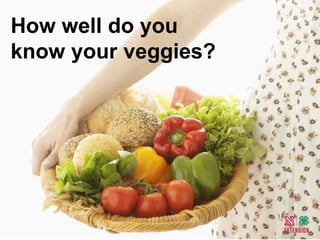
How well do you
know your veggies?
(based on a 2,000 calorie diet)
What counts as a cup-equivalent
(c-eq) of vegetables?
In general, 1 c-eq =
• 1 cup of raw or
cooked vegetables
• 1 cup vegetable
juice
• 2 cups of raw leafy
greens
Pick a variety of vegetables from
each DGA2015 vegetable subgroup
1-1/2 c-eq
a week
(based on a 2,000 calorie diet)
5-1/2 c-eq
a week
(based on a 2,000 calorie diet)
1-1/2 c-eq
a week
(based on a 2,000 calorie diet)
5 c-eq
a week
(based on a 2,000 calorie diet)
4 c-eq
a week
(based on a 2,000 calorie diet)
See if you can
guess the
following
vegetables ...
There is one from each
vegetable subgroup
Veggie 1
• Excellent source of protein, high in
dietary fiber, potassium, and folate
• Often eaten cold in salads or hot in
soups
• The type sold in the United States is
usually cream-colored and relatively
round
• Main ingredient in hummus
• NAME THAT VEGGIE!
Veggie 2
• The French called them “love apples”
• High in lycopene, an antioxidant that
may help lower the risk of certain
cancers and other conditions such as
cardiovascular disease and
osteoporosis
• Taste best when stored at room
temperature
• Botanically, they are a fruit
• NAME THAT VEGGIE!
Veggie 3
• High in vitamin A
• A dark green lettuce
• Had its start as a Mediterranean weed
• Has a long, loaf-shaped head of
sturdy leaves
• NAME THAT VEGGIE!
Veggie 4
• Contains phytochemicals that may
help reduce the risk of certain cancers
• Its four-petaled flowers bear a
resemblance to a Greek cross,
resulting in it frequently referred to as
a crucifer or cruciferous vegetable
• Mark Twain called this vegetable “… a
cabbage with a college education”
• Creamy white in color
• NAME THAT VEGGIE!
Veggie 5
• The leading vegetable crop in the U.S.
• A medium (5.3 oz.) skin-on serving has
just 110 calories
• High in potassium, a nutrient the
Dietary Guidelines for Americans 2015
recommend Americans increase in
their diet
• A model of this vegetable serves as
the basis for a toy named after it
• NAME THAT VEGGIE!
“Thank you” to the following
people (in alphabetical order)
for reviewing these slides!
• Cindy Brison
• Lisa Franzen-Castle
• Mardel Meinke
• David Palm
• Amy Peterson
• Karen Wobig
Reference
• U.S. Department of Health and Human Services
and U.S. Department of Agriculture. 2015 – 2020
Dietary Guidelines for Americans. 8th Edition.
December 2015. Available at
http://health.gov/dietaryguidelines/2015/guidelines
Retrieved March 2, 2016
Extension is a Division of the Institute of Agriculture
and Natural Resources at the University of Nebraska–
Lincoln cooperating with the Counties and the United
States Department of Agriculture.
University of Nebraska–Lincoln Extension educational
programs abide with the nondiscrimination policies of
the University of Nebraska–Lincoln and the United
States Department of Agriculture.

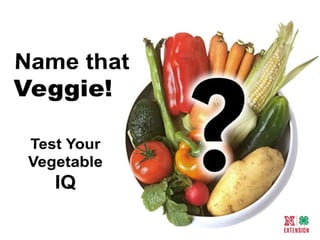
Name That Veggie: Test Your Vegetable IQ

  • 2.
    Alice Henneman, MS,RD ahenneman1@unl.edu ● http://food.unl.edu University of Nebraska-Lincoln Extension in Lancaster County Save Time – Do More with our FREE educational resources: http://food.unl.edu/educational-resource This publication has been peer-reviewed May 2011, updated slightly March, 2016 Created with PowerPoint 2007
  • 3.
    How well doyou know your veggies?
  • 4.
    (based on a2,000 calorie diet)
  • 5.
    What counts asa cup-equivalent (c-eq) of vegetables? In general, 1 c-eq = • 1 cup of raw or cooked vegetables • 1 cup vegetable juice • 2 cups of raw leafy greens
  • 6.
    Pick a varietyof vegetables from each DGA2015 vegetable subgroup
  • 7.
    1-1/2 c-eq a week (basedon a 2,000 calorie diet)
  • 8.
    5-1/2 c-eq a week (basedon a 2,000 calorie diet)
  • 9.
    1-1/2 c-eq a week (basedon a 2,000 calorie diet)
  • 10.
    5 c-eq a week (basedon a 2,000 calorie diet)
  • 11.
    4 c-eq a week (basedon a 2,000 calorie diet)
  • 12.
    See if youcan guess the following vegetables ...
  • 13.
    There is onefrom each vegetable subgroup
  • 14.
    Veggie 1 • Excellentsource of protein, high in dietary fiber, potassium, and folate • Often eaten cold in salads or hot in soups • The type sold in the United States is usually cream-colored and relatively round • Main ingredient in hummus • NAME THAT VEGGIE!
  • 16.
    Veggie 2 • TheFrench called them “love apples” • High in lycopene, an antioxidant that may help lower the risk of certain cancers and other conditions such as cardiovascular disease and osteoporosis • Taste best when stored at room temperature • Botanically, they are a fruit • NAME THAT VEGGIE!
  • 18.
    Veggie 3 • Highin vitamin A • A dark green lettuce • Had its start as a Mediterranean weed • Has a long, loaf-shaped head of sturdy leaves • NAME THAT VEGGIE!
  • 20.
    Veggie 4 • Containsphytochemicals that may help reduce the risk of certain cancers • Its four-petaled flowers bear a resemblance to a Greek cross, resulting in it frequently referred to as a crucifer or cruciferous vegetable • Mark Twain called this vegetable “… a cabbage with a college education” • Creamy white in color • NAME THAT VEGGIE!
  • 22.
    Veggie 5 • Theleading vegetable crop in the U.S. • A medium (5.3 oz.) skin-on serving has just 110 calories • High in potassium, a nutrient the Dietary Guidelines for Americans 2015 recommend Americans increase in their diet • A model of this vegetable serves as the basis for a toy named after it • NAME THAT VEGGIE!
  • 26.
    “Thank you” tothe following people (in alphabetical order) for reviewing these slides! • Cindy Brison • Lisa Franzen-Castle • Mardel Meinke • David Palm • Amy Peterson • Karen Wobig
  • 27.
    Reference • U.S. Departmentof Health and Human Services and U.S. Department of Agriculture. 2015 – 2020 Dietary Guidelines for Americans. 8th Edition. December 2015. Available at http://health.gov/dietaryguidelines/2015/guidelines Retrieved March 2, 2016
  • 28.
    Extension is aDivision of the Institute of Agriculture and Natural Resources at the University of Nebraska– Lincoln cooperating with the Counties and the United States Department of Agriculture. University of Nebraska–Lincoln Extension educational programs abide with the nondiscrimination policies of the University of Nebraska–Lincoln and the United States Department of Agriculture.