What is FAO?
Food and Agriculture Organization of the United Nations

    • founded in October 1945 as
      World Secretariat for Agriculture
      for Member Countries

    • largest special agency within the UN
      system

    • 192 members

    • ~ 4 000 staff members
FAO’s members and partners

  • 192 members (191 nations & the European Community)

  • national counterparts:
      – Ministry of Agriculture, Livestock
      – Environment
      – Health, Planning etc.

  • partners:
      – international conventions and bodies (OIE, CODEX, WHO,
        CBD, UNDP, WB, etc.)
      – regional organizations (EC, SADC, UEMOA, MERCOSUR, etc.)
      – CGIAR/ARIs/NARs
      – NGOs/CSO (WVF, WAAP, etc.)
      – private sector (IDF, IMS, IPC, IFIF, IFAP, EFFAB, etc.)
Food and Agriculture Organization of the United Nations
                                                          FAO


  4000 staff - 192 Members
Food and Agriculture Organization of the United Nations
                                                                      FAO
                                                          5 regional offices


  4000 staff - 192 Members
Food and Agriculture Organization of the United Nations
                                                                          FAO


  4000 staff - 192 Members
                                                          10 sub-regional offices
FAO
                                                                4 FAO/OIE Animal
                                                                Health Offices
Food and Agriculture Organization of the United Nations


                                                                   4000 staff - 192 Members
FAO
                                                                5 liaison offices –
                                                                136 country offices
Food and Agriculture Organization of the United Nations


                                                                    4000 staff - 192 Members
FAO’s global goals

  • reduction of the number of people suffering
    from hunger

  • elimination of poverty, increased food
    productivity, enhanced rural development
    and sustainable livelihoods

  • sustainable management and utilization of
    natural resources, for the benefit of
    present and future generations
FAO

• leads international efforts to defeat hunger
• acts as a neutral forum where all nations
   meet as equals to negotiate agreements
   and debate policy
• is a source of knowledge and information
• helps developing countries and countries in
   transition to modernize and improve
   agriculture, forestry and fisheries practices
   and ensure good nutrition for all
FAO’s core function
• monitor and assess trends in food security and
  agriculture, fisheries and forestry;
• generate, disseminate and apply information and
  knowledge, including statistics;
• negotiate international instruments; set norms,
  standards and voluntary guidelines,
• support the development of national legal instruments
  and promote their implementation;
• articulate policy and strategy options and advice;
• provide technical support and build capacity;
• advocate and communicate to mobilize political will;
• work in an integrated interdisciplinary and innovative
  approaches through strong partnerships and alliances.
FAO’s budget
• biennium 2008-2009 - US$ 1.8 billion
  – technical work
  – cooperation and partnerships including the Technical
    Cooperation Programme
  – information and general policy
  – direction & administration


• extra budgetary resources (48%)
FAO’s tasks

  • putting information within reach
     – knowledge network
     – analyse and disseminate data that aid
       development
n th
                  o
                /m
           isits
          v
    llion
  mi
1
AGORA provides a
                              collection of 1278
                              journals to institutions in
                              107 countries.


                                    n/
                                g/e
                          k. or
                     or
                   tw
             rne
          te
   .a gin
  w
ww
FAO’s tasks

  • sharing policy expertise
    – devising agricultural policy
    – supporting planning
    – drafting effective legislation
    – creating national strategies

    to achieve rural development and hunger
      alleviation goal
FAO’s tasks

• providing a meeting place for nations
  – neutral forum
  – FAO provides the setting where rich and poor
    nations can come together to build common
    understanding
FAO’s tasks

  • bringing knowledge to the field
    – thousands of field projects throughout the world
    – FAO mobilizes and manages millions of dollars
      provided by industrialized countries,
      development banks and other sources
    – FAO provides the technical know-how and in a
      few cases is a limited source of funds
Technical Cooperation Programme
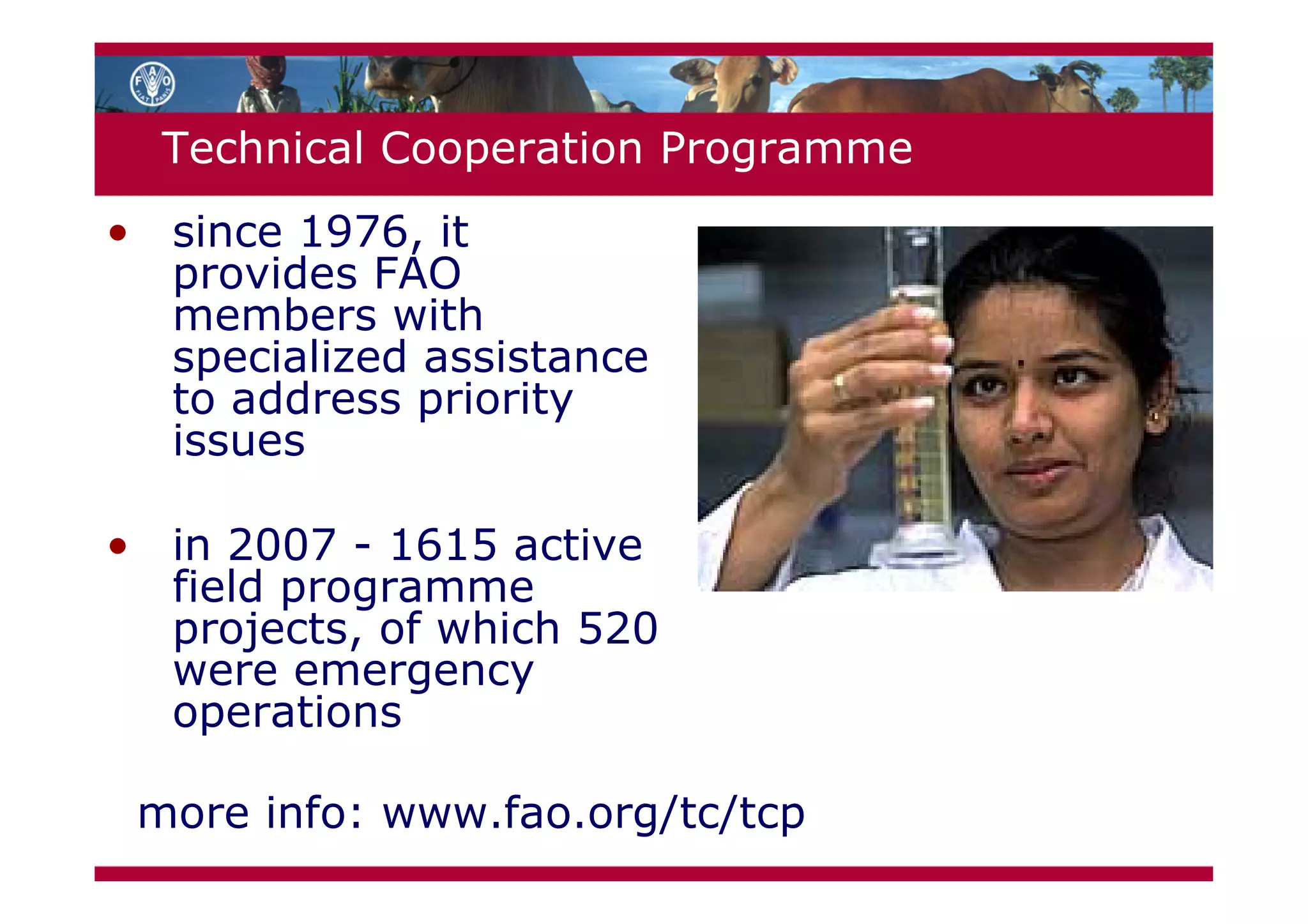
• since 1976, it
  provides FAO
  members with
  specialized assistance
  to address priority
  issues

• in 2007 - 1615 active
  field programme
  projects, of which 520
  were emergency
  operations

 more info: www.fao.org/tc/tcp
FAO’s organization
FAO is composed of eight departments:

• Agriculture and Consumer Protection;
• Economic and Social Development;
• Fisheries and Aquaculture;
• Forestry;
• Human, Financial and Physical Resources;
• Knowledge and Communication;
• Natural Resources Management and
  Environment and
• Technical Cooperation.
Agriculture and Consumer Protection Department


  It’s composed of 5 Divisions

  • Animal production and health
  • FAO/IAEA Joint division for nuclear
    techniques
  • Nutrition and consumer protection
  • Plant production and protection
  • Rural infrastructure and agro-industries
Animal Production and Health Division


  Themes of work:


  •   Animal Health
  •   Human Health
  •   Livelihoods
  •   Income Generation
  •   Genetic Resources
  •   Environment
/i
                                          en
                                       e/
                                    om
                                  /h
                              info
                         a ga
                  a g/
             g/
        o. or
    .f a m
  ww .ht
w ex
 nd
Animal Production and Health Division

                 approach to programme design
                                animals and livelihoods


                                    lic
                   Social Equity (poverty alleviation)
                                  b
                             l Pu
                            a ds
                           b o
                       G lo o
                            G
                                                          Veterinary
Sustainable                                                 Public
  Natural                                                   Health
 Resources
animals and land, water, air,                             animal health in
biodiversity, ecology                                     the wider context
Agriculture Production Service highlights

•    Animal Genetic Resources
•    Animal nutrition and feeding
•    Animal welfare
•    Food and feed safety, support to CODEX
     and its implementation, capacity building
•    Livestock Emergency Relief
•    Milk & dairy products/ meat and meat products
•    International Network for Family Poultry
     Development
•    Field Programme: e.g. poultry (Afghanistan),
    dairy (Mongolia, Afghanistan)
Collaboration with the private sector
representatives
 • International Feed Industry Federation (IFIF)
 • International Dairy Federation (IDF)
 • International Meat Secretariat (IMS)
 • International Federation for Animal Health
  (IFAH)
 • International Federation of Agricultural
   Producers (IFAP)
 • Safe Supply of Affordable Food Everywhere –
   SSAFE Initiative
 • International Poultry Council (IPC)
 • European Forum of Farm Animal Breeders
  (EFFAB)
Collaboration with the NGOs

• World Society for the Protection of Animals
     (WSPA)
•   Compassion on World Farming (CIWF)
•   the Brooke
•   Royal Society for the Prevention of Cruelty to
     Animals (RSPCA)
•   Humane Society International (HIS)
•   League for Pastoral People and Endogenous
    Livestock Development
•   Heifer International
•   Oxfam/Novib
l
                                                  .h tm
                                                re
                                            elfa
                                       a lw
                               a nim
                        a g/
                   g/
              o. or
      w   .f a
w   w
IDF/FAO/EC Joint
Animal Health and
Welfare Conference
(within the World
Dairy Summit 2009)
thank you

What is FAO?

  • 1.
  • 2.
    Food and AgricultureOrganization of the United Nations • founded in October 1945 as World Secretariat for Agriculture for Member Countries • largest special agency within the UN system • 192 members • ~ 4 000 staff members
  • 3.
    FAO’s members andpartners • 192 members (191 nations & the European Community) • national counterparts: – Ministry of Agriculture, Livestock – Environment – Health, Planning etc. • partners: – international conventions and bodies (OIE, CODEX, WHO, CBD, UNDP, WB, etc.) – regional organizations (EC, SADC, UEMOA, MERCOSUR, etc.) – CGIAR/ARIs/NARs – NGOs/CSO (WVF, WAAP, etc.) – private sector (IDF, IMS, IPC, IFIF, IFAP, EFFAB, etc.)
  • 4.
    Food and AgricultureOrganization of the United Nations FAO 4000 staff - 192 Members
  • 5.
    Food and AgricultureOrganization of the United Nations FAO 5 regional offices 4000 staff - 192 Members
  • 6.
    Food and AgricultureOrganization of the United Nations FAO 4000 staff - 192 Members 10 sub-regional offices
  • 7.
    FAO 4 FAO/OIE Animal Health Offices Food and Agriculture Organization of the United Nations 4000 staff - 192 Members
  • 8.
    FAO 5 liaison offices – 136 country offices Food and Agriculture Organization of the United Nations 4000 staff - 192 Members
  • 10.
    FAO’s global goals • reduction of the number of people suffering from hunger • elimination of poverty, increased food productivity, enhanced rural development and sustainable livelihoods • sustainable management and utilization of natural resources, for the benefit of present and future generations
  • 11.
    FAO • leads internationalefforts to defeat hunger • acts as a neutral forum where all nations meet as equals to negotiate agreements and debate policy • is a source of knowledge and information • helps developing countries and countries in transition to modernize and improve agriculture, forestry and fisheries practices and ensure good nutrition for all
  • 12.
    FAO’s core function •monitor and assess trends in food security and agriculture, fisheries and forestry; • generate, disseminate and apply information and knowledge, including statistics; • negotiate international instruments; set norms, standards and voluntary guidelines, • support the development of national legal instruments and promote their implementation; • articulate policy and strategy options and advice; • provide technical support and build capacity; • advocate and communicate to mobilize political will; • work in an integrated interdisciplinary and innovative approaches through strong partnerships and alliances.
  • 13.
    FAO’s budget • biennium2008-2009 - US$ 1.8 billion – technical work – cooperation and partnerships including the Technical Cooperation Programme – information and general policy – direction & administration • extra budgetary resources (48%)
  • 14.
    FAO’s tasks • putting information within reach – knowledge network – analyse and disseminate data that aid development
  • 15.
    n th o /m isits v llion mi 1
  • 16.
    AGORA provides a collection of 1278 journals to institutions in 107 countries. n/ g/e k. or or tw rne te .a gin w ww
  • 17.
    FAO’s tasks • sharing policy expertise – devising agricultural policy – supporting planning – drafting effective legislation – creating national strategies to achieve rural development and hunger alleviation goal
  • 18.
    FAO’s tasks • providinga meeting place for nations – neutral forum – FAO provides the setting where rich and poor nations can come together to build common understanding
  • 19.
    FAO’s tasks • bringing knowledge to the field – thousands of field projects throughout the world – FAO mobilizes and manages millions of dollars provided by industrialized countries, development banks and other sources – FAO provides the technical know-how and in a few cases is a limited source of funds
  • 20.
    Technical Cooperation Programme •since 1976, it provides FAO members with specialized assistance to address priority issues • in 2007 - 1615 active field programme projects, of which 520 were emergency operations more info: www.fao.org/tc/tcp
  • 21.
    FAO’s organization FAO iscomposed of eight departments: • Agriculture and Consumer Protection; • Economic and Social Development; • Fisheries and Aquaculture; • Forestry; • Human, Financial and Physical Resources; • Knowledge and Communication; • Natural Resources Management and Environment and • Technical Cooperation.
  • 22.
    Agriculture and ConsumerProtection Department It’s composed of 5 Divisions • Animal production and health • FAO/IAEA Joint division for nuclear techniques • Nutrition and consumer protection • Plant production and protection • Rural infrastructure and agro-industries
  • 23.
    Animal Production andHealth Division Themes of work: • Animal Health • Human Health • Livelihoods • Income Generation • Genetic Resources • Environment
  • 24.
    /i en e/ om /h info a ga a g/ g/ o. or .f a m ww .ht w ex nd
  • 25.
    Animal Production andHealth Division approach to programme design animals and livelihoods lic Social Equity (poverty alleviation) b l Pu a ds b o G lo o G Veterinary Sustainable Public Natural Health Resources animals and land, water, air, animal health in biodiversity, ecology the wider context
  • 26.
    Agriculture Production Servicehighlights • Animal Genetic Resources • Animal nutrition and feeding • Animal welfare • Food and feed safety, support to CODEX and its implementation, capacity building • Livestock Emergency Relief • Milk & dairy products/ meat and meat products • International Network for Family Poultry Development • Field Programme: e.g. poultry (Afghanistan), dairy (Mongolia, Afghanistan)
  • 28.
    Collaboration with theprivate sector representatives • International Feed Industry Federation (IFIF) • International Dairy Federation (IDF) • International Meat Secretariat (IMS) • International Federation for Animal Health (IFAH) • International Federation of Agricultural Producers (IFAP) • Safe Supply of Affordable Food Everywhere – SSAFE Initiative • International Poultry Council (IPC) • European Forum of Farm Animal Breeders (EFFAB)
  • 29.
    Collaboration with theNGOs • World Society for the Protection of Animals (WSPA) • Compassion on World Farming (CIWF) • the Brooke • Royal Society for the Prevention of Cruelty to Animals (RSPCA) • Humane Society International (HIS) • League for Pastoral People and Endogenous Livestock Development • Heifer International • Oxfam/Novib
  • 30.
    l .h tm re elfa a lw a nim a g/ g/ o. or w .f a w w
  • 32.
    IDF/FAO/EC Joint Animal Healthand Welfare Conference (within the World Dairy Summit 2009)
  • 33.