1
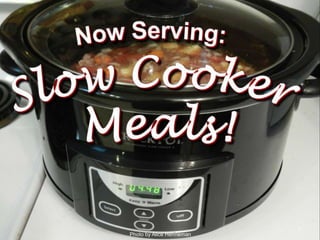
Photo by Alice Henneman
Julie Garden-Robinson, PhD, RD, LRD
Food and Nutrition Specialist
North Dakota State University Extension Service
Julie.Garden-robinson@ndsu.edu

Alice Henneman, MS, RD
Extension Educator
University of Nebraska–Lincoln Extension
ahenneman1@unl.edu
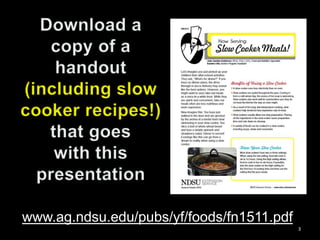
www.ag.ndsu.edu/pubs/yf/foods/fn1511.pdf
3

3
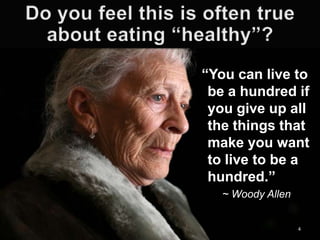
―You can live to
be a hundred if
you give up all
the things that
make you want
to live to be a
hundred.‖
~ Woody Allen

4
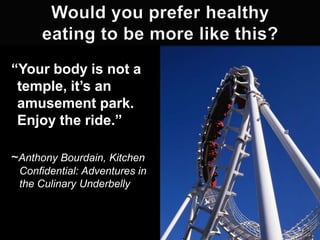
―Your body is not a
temple, it’s an
amusement park.
Enjoy the ride.‖
~Anthony Bourdain, Kitchen
Confidential: Adventures in
the Culinary Underbelly

5
Imagine this:
you have just
walked in the
door …

6
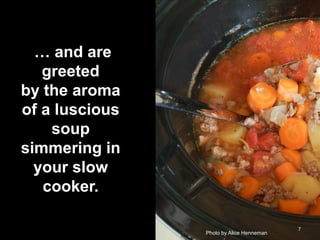
… and are
greeted
by the aroma
of a luscious
soup
simmering in
your slow
cooker.
Photo by Alice Henneman

7
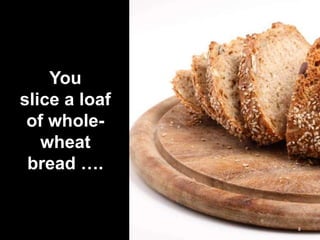
You
slice a loaf
of wholewheat
bread ….

8
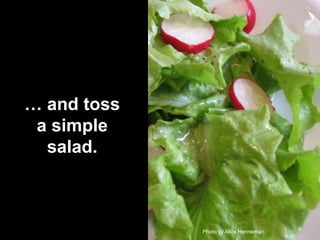
… and toss
a simple
salad.

Photo by Alice Henneman

9
10
Photo by Alice Henneman
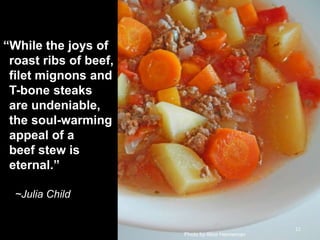
―While the joys of
roast ribs of beef,
filet mignons and
T-bone steaks
are undeniable,
the soul-warming
appeal of a
beef stew is
eternal.‖
~Julia Child

11
Photo by Alice Henneman
12
13
14
15
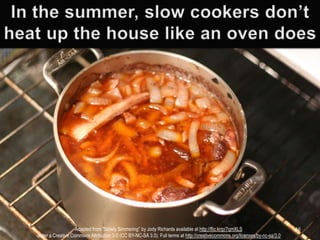
Adapted from “Slowly Simmering” by Jody Richards available at http://flic.kr/p/7qmXLS
under a Creative Commons Attribution 3.0 (CC BY-NC-SA 3.0). Full terms at http://creativecommons.org/licenses/by-nc-sa/3.0

16
17
Photo by Alice Henneman

18

18
19
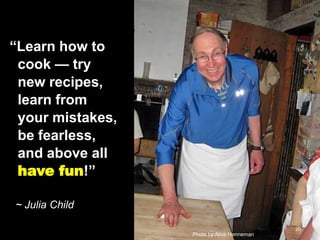
―Learn how to
cook — try
new recipes,
learn from
your mistakes,
be fearless,
and above all
have fun!‖
~ Julia Child
20
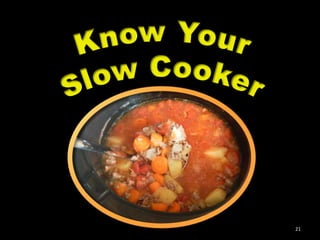
Photo by Alice Henneman
21
22
23
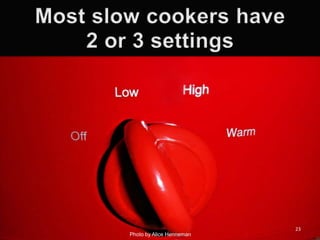
Photo by Alice Henneman
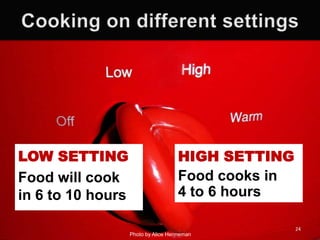
LOW SETTING
Food will cook
in 6 to 10 hours

HIGH SETTING
Food cooks in
4 to 6 hours
24
Photo by Alice Henneman
25
Photo by Alice Henneman
7

26
27
28
Photo by Alice Henneman
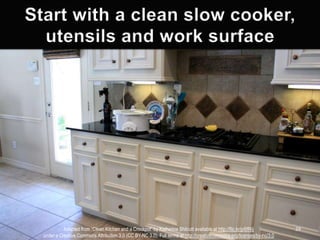
Adapted from “Clean Kitchen and a Crockpot” by Katherine Shilcutt available at http://flic.kr/p/6ff4ij
under a Creative Commons Attribution 3.0 (CC BY-NC 3.0). Full terms at http://creativecommons.org/licenses/by-nc/3.0

29
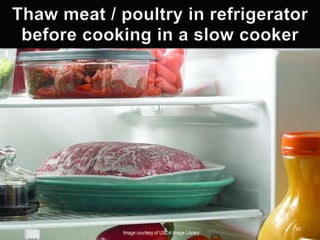
Image courtesy of USDA Image Library

30
Do not try to cook frozen meat or
poultry in a slow cooker. A slow
cooker may take several hours to
reach a high enough temperature
to destroy bacteria. Foods may
stay in the ―danger zone,‖
between 40 F and 140 F too long.
Bacteria multiply rapidly at
these temperatures.
31
32
Photo by Alice Henneman
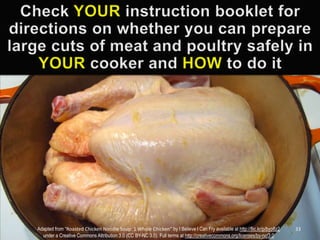
Adapted from “Roasted Chicken Noodle Soup: 1 Whole Chicken” by I Believe I Can Fry available at http://flic.kr/p/byo8z2
under a Creative Commons Attribution 3.0 (CC BY-NC 3.0). Full terms at http://creativecommons.org/licenses/by-nc/3.0

33
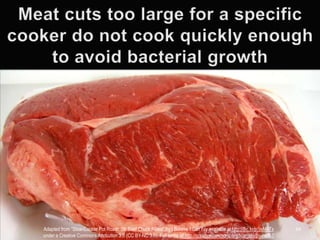
Adapted from “Slow-Cooker Pot Roast: 3lb Beef Chuck Roast” by I Believe I Can Fry available at http://flic.kr/p/9sM4Tx
under a Creative Commons Attribution 3.0 (CC BY-NC 3.0). Full terms at http://creativecommons.org/licenses/by-nc/3.0

34
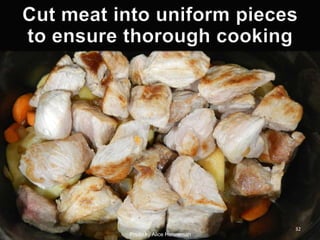
Slow cookers are available in
different sizes, so the instructions
will vary. If you cannot find the
instructions, you can cut the meat
into smaller chunks to ensure
thorough, safe cooking. Add the
liquid, such as broth, water or
barbecue sauce suggested in the
recipe and keep the lid in place
during cooking.
35
36
37
Photo by Alice Henneman
38
Photo by Alice Henneman
39
Photo by Alice Henneman
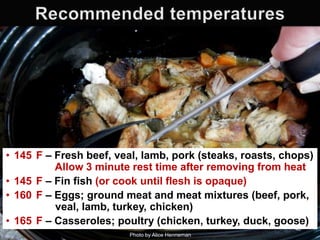
• 145 F – Fresh beef, veal, lamb, pork (steaks, roasts, chops)
Allow 3 minute rest time after removing from heat
• 145 F – Fin fish (or cook until flesh is opaque)
• 160 F – Eggs; ground meat and meat mixtures (beef, pork,
veal, lamb, turkey, chicken)
• 165 F – Casseroles; poultry (chicken, turkey, duck, goose)
40
Photo by Alice Henneman
41
Photo by Alice Henneman
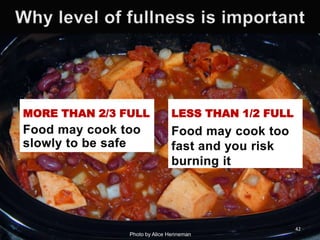
MORE THAN 2/3 FULL

LESS THAN 1/2 FULL

42
Photo by Alice Henneman
• Direct heat from
the pot
• Lengthy cooking
• Steam created
within the
tightly-covered
container
43

Photo by Alice Henneman
44
Photo by Alice Henneman
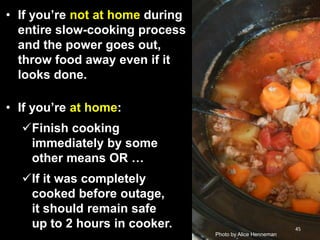
• If you’re not at home during
entire slow-cooking process
and the power goes out,
throw food away even if it
looks done.
• If you’re at home:
Finish cooking
immediately by some
other means OR …
If it was completely
cooked before outage,
it should remain safe
up to 2 hours in cooker.

45
Photo by Alice Henneman
1. Meat
2. Vegetables
3. Liquid

46
1. Meat
2. Vegetables
3. Liquid

47
1. Always thaw meat or poultry before
putting it into a slow cooker.
2. Fill a slow cooker between 1/4 and
3/4 full.
3. If the power goes out, the food in a
slow cooker will be safe several
hours if you leave the lid on.
48
1. Always thaw meat or poultry before
putting it into a slow cooker.
2. Fill a slow cooker between 1/4 and
3/4 full.
3. If the power goes out, the food in a
slow cooker will be safe several
hours if you leave the lid on.
49
50
51
Photo by Alice Henneman

52
53
Photo by Alice Henneman
Reheating leftovers in slow
cookers is NOT recommended
because foods may stay in the
―danger zone,‖ between
40 F and 140 F too long.
Bacteria multiply rapidly at
these temperatures.
54
55
Photo by Alice Henneman
56
Photo by Alice Henneman
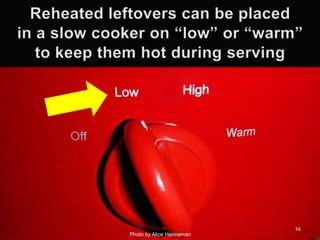
1. Slow cookers work well for
reheating leftovers.
2. Store leftovers in the slow cooker
insert in the refrigerator.
3. Reheat leftovers in a microwave or
on a stove to 165 F; then transfer to
a slow cooker on ―LOW‖ setting.
57
1. Slow cookers work well for
reheating leftovers.
2. Store leftovers in the slow cooker
insert in the refrigerator.
3. Reheat leftovers in a microwave or
on a stove to 165 F; then transfer to
a slow cooker on ―LOW‖ setting.
58
59
60
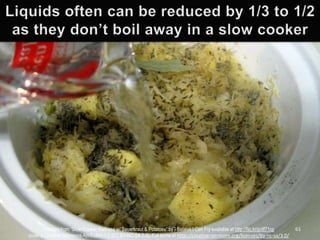
Adapted from “Slow-Cooker Kielbasa w/ Sauerkraut & Potatoes” by I Believe I Can Fry available at http://flic.kr/p/df71cp
under a Creative Commons Attribution 3.0 (CC BY-NC-SA 3.0). Full terms at http://creativecommons.org/licenses/by-nc-sa/3.0/

61
62
Photo by Alice Henneman
63
Photo by Alice Henneman
64
Photo by Alice Henneman
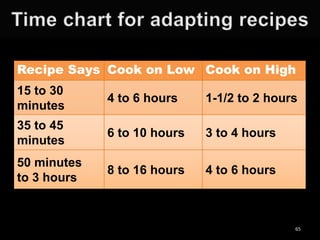
Recipe Says Cook on Low Cook on High
15 to 30
minutes

4 to 6 hours

1-1/2 to 2 hours

35 to 45
minutes

6 to 10 hours

3 to 4 hours

50 minutes
to 3 hours

8 to 16 hours

4 to 6 hours

65
―No matter what
anyone says,
my cooking is
excellent, even
the smoke alarm
seems to be
cheering me on!‖
~ Source Unknown
66
Photo by Alice Henneman

67
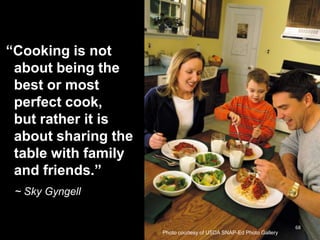
―Cooking is not
about being the
best or most
perfect cook,
but rather it is
about sharing the
table with family
and friends.‖
~ Sky Gyngell

Photo courtesy of USDA SNAP-Ed Photo Gallery

68
68
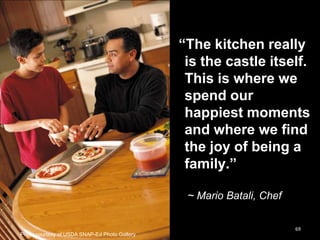
―The kitchen really
is the castle itself.
This is where we
spend our
happiest moments
and where we find
the joy of being a
family.‖
~ Mario Batali, Chef
69
Photo courtesy of USDA SNAP-Ed Photo Gallery
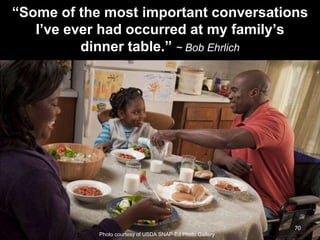
―Some of the most important conversations
I’ve ever had occurred at my family’s
dinner table.‖ ~ Bob Ehrlich

70
70
Photo courtesy of USDA SNAP-Ed Photo Gallery
71
We acknowledge the efforts of Kendra Otto,
former student intern at North Dakota State
University, for testing the recipes and
assisting with the writing of the handout.
―Thank you‖ to four Extension colleagues at
University of Nebraska–Lincoln and authors
of the NutritionKnowHow.org blog, who
reviewed this PowerPoint (in alphabetical
order): Cindy Brison, Audra Losey, Carrie
Schneider-Miller and Nancy Urbanec.
72
Reference to commercial products
or trade names is made with the
understanding that no
discrimination is intended of those
not mentioned and no endorsement
by North Dakota State University
Extension Service and University of
Nebraska–Lincoln Extension is
implied for those mentioned.
73
In accordance with federal law and U.S. Department of Agriculture policy, this
institution is prohibited from discriminating on the basis of race, color, national origin,
sex, age, religion, political beliefs or disability. To file a complaint of discrimination,
write USDA, Director, Office of Civil Rights, Room 326-W, Whitten Building,
1400 Independence Ave. S.W., Washington, DC 20250 or call (202) 720-5964
(voice and TDD). USDA is an equal opportunity provider and employer.
County Commissions, North Dakota State University and U.S. Department of
Agriculture ● NDSU is an equal opportunity Institution

Extension is a Division of the Institute of Agriculture and Natural Resources at the
University of Nebraska–Lincoln cooperating with the Counties and the
United States Department of Agriculture.
Nebraska–Lincoln Extension educational programs abide with the nondiscrimination
policies of the University of Nebraska–Lincoln and the
United States Department of Agriculture.
74

Slow Cooker Meals

  • 1.
  • 2.
    Julie Garden-Robinson, PhD,RD, LRD Food and Nutrition Specialist North Dakota State University Extension Service Julie.Garden-robinson@ndsu.edu Alice Henneman, MS, RD Extension Educator University of Nebraska–Lincoln Extension ahenneman1@unl.edu
  • 3.
  • 4.
    ―You can liveto be a hundred if you give up all the things that make you want to live to be a hundred.‖ ~ Woody Allen 4
  • 5.
    ―Your body isnot a temple, it’s an amusement park. Enjoy the ride.‖ ~Anthony Bourdain, Kitchen Confidential: Adventures in the Culinary Underbelly 5
  • 6.
    Imagine this: you havejust walked in the door … 6
  • 7.
    … and are greeted bythe aroma of a luscious soup simmering in your slow cooker. Photo by Alice Henneman 7
  • 8.
    You slice a loaf ofwholewheat bread …. 8
  • 9.
    … and toss asimple salad. Photo by Alice Henneman 9
  • 10.
  • 11.
    ―While the joysof roast ribs of beef, filet mignons and T-bone steaks are undeniable, the soul-warming appeal of a beef stew is eternal.‖ ~Julia Child 11 Photo by Alice Henneman
  • 12.
  • 13.
  • 14.
  • 15.
  • 16.
    Adapted from “SlowlySimmering” by Jody Richards available at http://flic.kr/p/7qmXLS under a Creative Commons Attribution 3.0 (CC BY-NC-SA 3.0). Full terms at http://creativecommons.org/licenses/by-nc-sa/3.0 16
  • 17.
  • 18.
    Photo by AliceHenneman 18 18
  • 19.
  • 20.
    ―Learn how to cook— try new recipes, learn from your mistakes, be fearless, and above all have fun!‖ ~ Julia Child 20 Photo by Alice Henneman
  • 21.
  • 22.
  • 23.
  • 24.
    LOW SETTING Food willcook in 6 to 10 hours HIGH SETTING Food cooks in 4 to 6 hours 24 Photo by Alice Henneman
  • 25.
  • 26.
  • 27.
  • 28.
  • 29.
    Adapted from “CleanKitchen and a Crockpot” by Katherine Shilcutt available at http://flic.kr/p/6ff4ij under a Creative Commons Attribution 3.0 (CC BY-NC 3.0). Full terms at http://creativecommons.org/licenses/by-nc/3.0 29
  • 30.
    Image courtesy ofUSDA Image Library 30
  • 31.
    Do not tryto cook frozen meat or poultry in a slow cooker. A slow cooker may take several hours to reach a high enough temperature to destroy bacteria. Foods may stay in the ―danger zone,‖ between 40 F and 140 F too long. Bacteria multiply rapidly at these temperatures. 31
  • 32.
  • 33.
    Adapted from “RoastedChicken Noodle Soup: 1 Whole Chicken” by I Believe I Can Fry available at http://flic.kr/p/byo8z2 under a Creative Commons Attribution 3.0 (CC BY-NC 3.0). Full terms at http://creativecommons.org/licenses/by-nc/3.0 33
  • 34.
    Adapted from “Slow-CookerPot Roast: 3lb Beef Chuck Roast” by I Believe I Can Fry available at http://flic.kr/p/9sM4Tx under a Creative Commons Attribution 3.0 (CC BY-NC 3.0). Full terms at http://creativecommons.org/licenses/by-nc/3.0 34
  • 35.
    Slow cookers areavailable in different sizes, so the instructions will vary. If you cannot find the instructions, you can cut the meat into smaller chunks to ensure thorough, safe cooking. Add the liquid, such as broth, water or barbecue sauce suggested in the recipe and keep the lid in place during cooking. 35
  • 36.
  • 37.
  • 38.
  • 39.
  • 40.
    • 145 F– Fresh beef, veal, lamb, pork (steaks, roasts, chops) Allow 3 minute rest time after removing from heat • 145 F – Fin fish (or cook until flesh is opaque) • 160 F – Eggs; ground meat and meat mixtures (beef, pork, veal, lamb, turkey, chicken) • 165 F – Casseroles; poultry (chicken, turkey, duck, goose) 40 Photo by Alice Henneman
  • 41.
  • 42.
    MORE THAN 2/3FULL LESS THAN 1/2 FULL 42 Photo by Alice Henneman
  • 43.
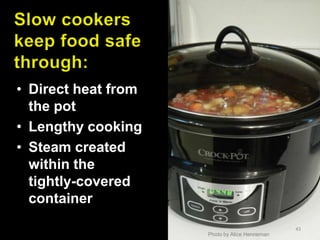
    • Direct heatfrom the pot • Lengthy cooking • Steam created within the tightly-covered container 43 Photo by Alice Henneman
  • 44.
  • 45.
    • If you’renot at home during entire slow-cooking process and the power goes out, throw food away even if it looks done. • If you’re at home: Finish cooking immediately by some other means OR … If it was completely cooked before outage, it should remain safe up to 2 hours in cooker. 45 Photo by Alice Henneman
  • 46.
  • 47.
  • 48.
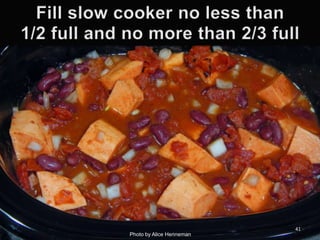
    1. Always thawmeat or poultry before putting it into a slow cooker. 2. Fill a slow cooker between 1/4 and 3/4 full. 3. If the power goes out, the food in a slow cooker will be safe several hours if you leave the lid on. 48
  • 49.
    1. Always thawmeat or poultry before putting it into a slow cooker. 2. Fill a slow cooker between 1/4 and 3/4 full. 3. If the power goes out, the food in a slow cooker will be safe several hours if you leave the lid on. 49
  • 50.
  • 51.
  • 52.
    Photo by AliceHenneman 52
  • 53.
  • 54.
    Reheating leftovers inslow cookers is NOT recommended because foods may stay in the ―danger zone,‖ between 40 F and 140 F too long. Bacteria multiply rapidly at these temperatures. 54
  • 55.
  • 56.
  • 57.
    1. Slow cookerswork well for reheating leftovers. 2. Store leftovers in the slow cooker insert in the refrigerator. 3. Reheat leftovers in a microwave or on a stove to 165 F; then transfer to a slow cooker on ―LOW‖ setting. 57
  • 58.
    1. Slow cookerswork well for reheating leftovers. 2. Store leftovers in the slow cooker insert in the refrigerator. 3. Reheat leftovers in a microwave or on a stove to 165 F; then transfer to a slow cooker on ―LOW‖ setting. 58
  • 59.
  • 60.
  • 61.
    Adapted from “Slow-CookerKielbasa w/ Sauerkraut & Potatoes” by I Believe I Can Fry available at http://flic.kr/p/df71cp under a Creative Commons Attribution 3.0 (CC BY-NC-SA 3.0). Full terms at http://creativecommons.org/licenses/by-nc-sa/3.0/ 61
  • 62.
  • 63.
  • 64.
  • 65.
    Recipe Says Cookon Low Cook on High 15 to 30 minutes 4 to 6 hours 1-1/2 to 2 hours 35 to 45 minutes 6 to 10 hours 3 to 4 hours 50 minutes to 3 hours 8 to 16 hours 4 to 6 hours 65
  • 66.
    ―No matter what anyonesays, my cooking is excellent, even the smoke alarm seems to be cheering me on!‖ ~ Source Unknown 66
  • 67.
    Photo by AliceHenneman 67
  • 68.
    ―Cooking is not aboutbeing the best or most perfect cook, but rather it is about sharing the table with family and friends.‖ ~ Sky Gyngell Photo courtesy of USDA SNAP-Ed Photo Gallery 68 68
  • 69.
    ―The kitchen really isthe castle itself. This is where we spend our happiest moments and where we find the joy of being a family.‖ ~ Mario Batali, Chef 69 Photo courtesy of USDA SNAP-Ed Photo Gallery
  • 70.
    ―Some of themost important conversations I’ve ever had occurred at my family’s dinner table.‖ ~ Bob Ehrlich 70 70 Photo courtesy of USDA SNAP-Ed Photo Gallery
  • 71.
  • 72.
    We acknowledge theefforts of Kendra Otto, former student intern at North Dakota State University, for testing the recipes and assisting with the writing of the handout. ―Thank you‖ to four Extension colleagues at University of Nebraska–Lincoln and authors of the NutritionKnowHow.org blog, who reviewed this PowerPoint (in alphabetical order): Cindy Brison, Audra Losey, Carrie Schneider-Miller and Nancy Urbanec. 72
  • 73.
    Reference to commercialproducts or trade names is made with the understanding that no discrimination is intended of those not mentioned and no endorsement by North Dakota State University Extension Service and University of Nebraska–Lincoln Extension is implied for those mentioned. 73
  • 74.
    In accordance withfederal law and U.S. Department of Agriculture policy, this institution is prohibited from discriminating on the basis of race, color, national origin, sex, age, religion, political beliefs or disability. To file a complaint of discrimination, write USDA, Director, Office of Civil Rights, Room 326-W, Whitten Building, 1400 Independence Ave. S.W., Washington, DC 20250 or call (202) 720-5964 (voice and TDD). USDA is an equal opportunity provider and employer. County Commissions, North Dakota State University and U.S. Department of Agriculture ● NDSU is an equal opportunity Institution Extension is a Division of the Institute of Agriculture and Natural Resources at the University of Nebraska–Lincoln cooperating with the Counties and the United States Department of Agriculture. Nebraska–Lincoln Extension educational programs abide with the nondiscrimination policies of the University of Nebraska–Lincoln and the United States Department of Agriculture. 74

Editor's Notes

  • #5 Beans may cause problems with gas for some people. Following are some tips to help prevent this.