

Nutritional Disorders in Chronic Illness 
MARC EVANS M. ABAT, MD, FPCP, FPCGM 
Head, Center for Healthy Aging, The Medical City 
Clinical Associate Professor, Section of Adult Medicine, Department of 
Medicine, Philippine General Hospital 
Visiting Consultant, Geriatric Center, St. Luke’s Medical Center 
Visiting Consultant, Department of Medicine, Manila Doctors Hospital 
Infirmary Geriatrician-Jesuit Healthcare System
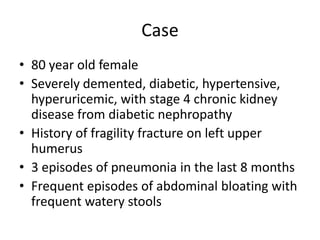
Case 
• 80 year old female 
• Severely demented, diabetic, hypertensive, 
hyperuricemic, with stage 4 chronic kidney 
disease from diabetic nephropathy 
• History of fragility fracture on left upper 
humerus 
• 3 episodes of pneumonia in the last 8 months 
• Frequent episodes of abdominal bloating with 
frequent watery stools
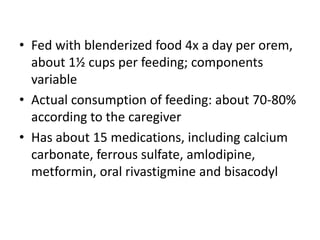
• Fed with blenderized food 4x a day per orem, 
about 1½ cups per feeding; components 
variable 
• Actual consumption of feeding: about 70-80% 
according to the caregiver 
• Has about 15 medications, including calcium 
carbonate, ferrous sulfate, amlodipine, 
metformin, oral rivastigmine and bisacodyl
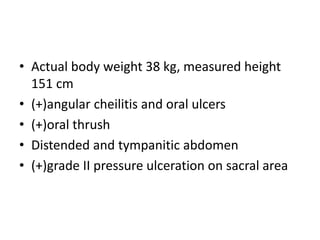
• Actual body weight 38 kg, measured height 
151 cm 
• (+)angular cheilitis and oral ulcers 
• (+)oral thrush 
• Distended and tympanitic abdomen 
• (+)grade II pressure ulceration on sacral area
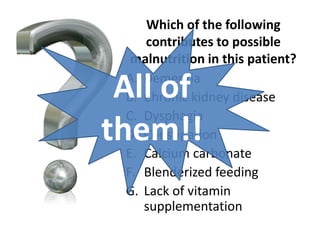
Which of the following 
contributes to possible 
malnutrition in this patient? 
A. Dementia 
B. Chronic kidney disease 
C. Dysphagia 
D. Constipation 
E. Calcium carbonate 
F. Blenderized feeding 
G. Lack of vitamin 
All of 
them!! 
supplementation
Outline 
• Prevalence 
• Approaching Nutritional Disorders 
– Calories and Nutrients 
– Hurdles along the Nutrition Pathway 
• Management
Prevalence 
• 181 subjects (98 women) aged 65 or older 
• the majority of subjects had a normal Body Mass 
Index (BMI), 
• 18.0% were underweight and 37.3% were 
overweight 
• 16.0% and 26.0% subjects had muscle wasting as 
assessed by low mid upper arm circumference 
(MUAC) and calf circumference (CC) 
• 41.4% subjects had hypoalbuminemia, 39.4% had 
anemia, and 23.4% had low total lymphocyte 
count. 
Health and the Environment Journal, 2010, Vol. 1, No. 2
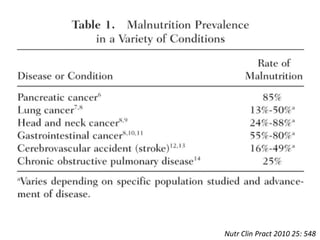
Nutr Clin Pract 2010 25: 548
Consequences 
• Increased morbidity and mortality 
– Pneumonia 
– Pressure ulceration 
• Increased rates of readmission 
• Increased rates of institutionalization 
• Increased length of hospital stay 
• Increased cost of care 
Nutr Clin Pract 2010 25: 548
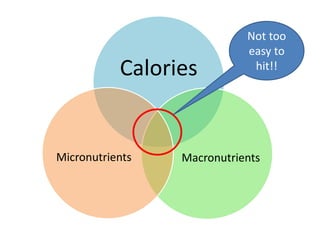
Calories 
Not too 
easy to 
hit!! 
Micronutrients Macronutrients
Dilemmas 
• Calories 
– How much to actually give 
– Guides to base caloric estimation 
• Macronutrients 
– Disease 
– Multiple co-morbiditiesdifficulty in striking a balance 
• Micronutrients 
– Disease 
– Not all can be measured 
– Not all have obvious clinical signs of deficiency or toxicity
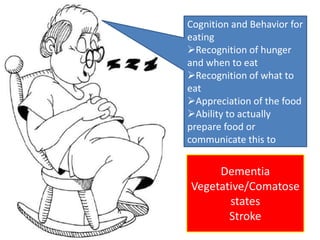
Cognition and Behavior for 
eating 
Recognition of hunger 
and when to eat 
Recognition of what to 
eat 
Appreciation of the food 
Ability to actually 
prepare food or 
communicate this to 
caregiver 
Dementia 
Vegetative/Comatose 
states 
Stroke
Drugs that can cause ANOREXIA 
• digoxin 
• phenytoin 
• SSRI’s / lithium 
• Ca++ channel blockers 
• H2 receptor antagonists 
/ PPIs 
• Any chemotherapy 
• metronidazole 
• narcotic analgesics 
• K+ supplements 
• furosemide 
• ipratropium bromide 
• theophylline 
• spironolactone 
• levodopa 
• fluoxetine
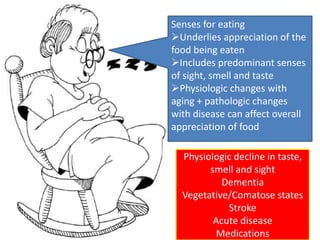
Senses for eating 
Underlies appreciation of the 
food being eaten 
Includes predominant senses 
of sight, smell and taste 
Physiologic changes with 
aging + pathologic changes 
with disease can affect overall 
appreciation of food 
Physiologic decline in taste, 
smell and sight 
Dementia 
Vegetative/Comatose states 
Stroke 
Acute disease 
Medications
Drugs can interfere with senses of 
taste and smell 
• More than 250 medications 
reportedly disturb gustatory 
sensation 
• More than 40 drugs reportedly 
disturb the sense of olfaction 
• A few of these agents have been 
objectively determined to affect 
these functions via experiments, 
clinical trials, or intensity scaling
Drugs That Interfere With Gustation (taste) and 
Olfaction (smell) 
Gustation 
• Allopurinol 
• Amitriptyline 
• Ampicillin 
• Baclofen 
• Dexamethasone 
• Diltiazem 
• Enalapril 
• Hydrochlorothiazide 
• Imipramine 
• Labetalol 
• Mexiletine 
• Ofloxacin 
• Nifedipine 
• Phenytoin 
• Promethazine 
• Propranolol 
• Sulfamethoxazole 
• Tetracyclines 
Olfaction 
• Amitriptyline 
• Codeine 
• Dexamethasone 
• Enalapril 
• Flunisolide 
• Flurbiprofen 
• Hydromorphone 
• Levamisole 
• Morphine 
• Pentamidine 
• Propafenone
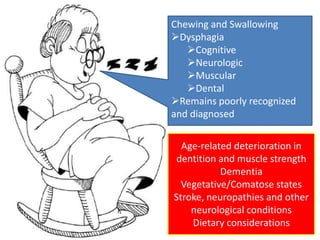
Chewing and Swallowing 
Dysphagia 
Cognitive 
Neurologic 
Muscular 
Dental 
Remains poorly recognized 
and diagnosed 
Age-related deterioration in 
dentition and muscle strength 
Dementia 
Vegetative/Comatose states 
Stroke, neuropathies and other 
neurological conditions 
Dietary considerations
Stages of Swallowing 
• Oral 
– Weak tongue and jaw muscles 
– Uncoordinated movement 
– No movement 
• Pharyngeal 
– Weakness or paresis of muscles 
– Uncoordinated movements 
• Esophageal 
– Weak peristaltic movements 
– Esophageal spasms 
• Primary condition 
• Secondary to pain (e.g. in reflux esophagitis or ulceration)
Dysphagia Prevalence 
• As much as 15% in the elderly population 
• As much as 37.6% in community-dwelling 
elderly 
Clinical Interventions in Aging 2012:7 287
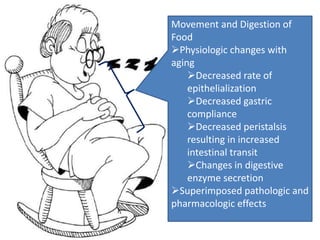
Movement and Digestion of 
Food 
Physiologic changes with 
aging 
Decreased rate of 
epithelialization 
Decreased gastric 
compliance 
Decreased peristalsis 
resulting in increased 
intestinal transit 
Changes in digestive 
enzyme secretion 
Superimposed pathologic and 
pharmacologic effects
• Obstruction of GI tract 
– Malignancies 
• Impairments in mucosal integrity and function 
– Atrophic gastritispernicious anemia 
– Lactose intolerance 
• Deficiencies in digestive enzyme secretion 
– Chronic pancreatitis 
– s/p cholecystectomy 
• Altered gastric motility 
– Diabetic gastroparesis 
– Chronic constipation and fecal impaction 
– Drug effects (e.g. morphine, calcium channel blockers) 
• Altered gastrointestinal capacitance and transit 
– Gastrointestinal reconstruction (e.g. bariatric surgery or 
Roux-en-Y procedures)
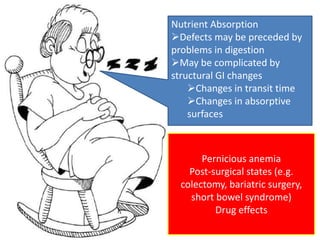
Nutrient Absorption 
Defects may be preceded by 
problems in digestion 
May be complicated by 
structural GI changes 
Changes in transit time 
Changes in absorptive 
surfaces 
Pernicious anemia 
Post-surgical states (e.g. 
colectomy, bariatric surgery, 
short bowel syndrome) 
Drug effects
Drug-nutrient interactions 
• Many of the aforementioned drugs and others 
interfere with the absorption of various 
vitamins and minerals 
• Examples: 
Antacids- Vitamin B12, folate, iron, total kcal 
Diuretics- Zn, Mg, Vitamin B6, K+, Cu 
Laxatives- Ca, Vitamins A, B2, B12, D, E, K
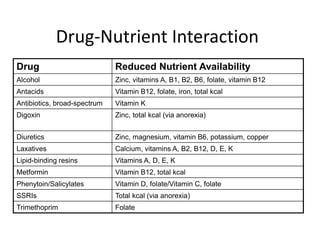
Drug-Nutrient Interaction 
Drug Reduced Nutrient Availability 
Alcohol Zinc, vitamins A, B1, B2, B6, folate, vitamin B12 
Antacids Vitamin B12, folate, iron, total kcal 
Antibiotics, broad-spectrum Vitamin K 
Digoxin Zinc, total kcal (via anorexia) 
Diuretics Zinc, magnesium, vitamin B6, potassium, copper 
Laxatives Calcium, vitamins A, B2, B12, D, E, K 
Lipid-binding resins Vitamins A, D, E, K 
Metformin Vitamin B12, total kcal 
Phenytoin/Salicylates Vitamin D, folate/Vitamin C, folate 
SSRIs Total kcal (via anorexia) 
Trimethoprim Folate
Overall Nutrient Metabolism 
Related to my physiologic 
changes 
Kidneys 
Liver 
Changes in body fat and 
water percentages 
Chronic disease necessitating 
dietary modification 
Altered nutrient utilization as 
a result of disease states
Dietary Modifications in Chronic 
Illnesses 
• Non-dialyzed chronic kidney disease 
– Protein requirement: as low as 0.6g/kg of protein 
– Low potassium, low phosphorus, low purine 
• COPD patients 
– Low carbohydrate diets previously ordered 
– Calories directly related to carbon dioxide output 
vs. high-energy expenditure state 
• Liver cirrhosis 
– Low protein diets, branched chain amino acids
Management 
• comprehensive geriatric management 
• an interdisciplinary approach 
• multimodality interventions
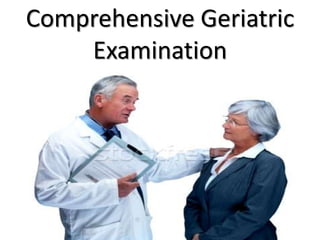
Comprehensive Geriatric 
Examination
• Detailed History 
• Physical and 
Neurological 
Examination 
• Cognitive Evaluation 
• Behavioral/Emotional 
Evaluation 
• Functional Evaluation 
• Environmental 
Evaluation 
• Social Evaluation
• Physical manifestations of nutrient 
deficiencies in the older patient may be 
difficult to detect (particularly vitamin 
deficiencies) 
• Deficiencies usually occur in combination 
(both as caloric, macro and micronutrient 
deficiencies) 
• Toxicities may be even more difficult to detect
Diagnostics 
• CBC 
• FBS, kidney, liver and thyroid function tests 
• Albumin (interpreted cautiously) 
• Lipid profile 
• Urinalysis 
• 12-L ECG, CXR, 2D-echo 
• Fecalysis 
• Inflammatory markers? 
• Vitamin assays? 
• Calorimetry? 
• Other specialized tests?
Interdisciplinary Approach 
• Primary physician/s (Geriatrician, Internist, Family 
Physician, Others) 
• Neurologists 
• ENT specialists 
• Gastroenterologists, Surgeons 
• Physiatrist 
• Physical, Occupational, Speech and Swallowing 
Therapists 
• Nurses 
• Nutritionist 
• Pharmacist
Multimodality Interventions 
• Medical interventions 
• Drug reviews and monitoring 
• Nutritional Management 
• Physical, Occupational, Swallowing and 
Speech Therapy 
• Artificial Enteral Feeding 
• Parenteral Feeding???
Nutritional Management 
• Dietary Prescription 
– Tolerance 
– Adequacy of prescription and response 
• Use of nutritional supplements 
– Tolerance 
– Cost vs. benefit
Therapy 
• Individualized approach 
• Challenges 
– Assessment 
– Intervention application 
– Response and limitations
Artificial Enteral Feeding 
• Nasogastric feeding 
• Gastrostomy (PEG or surgical) 
• Enterostomy
Summary 
• Nutritional disorders are common in chronic disease 
• Aside from viewing nutritional disorders as those 
affecting calorie, macronutrient and micronutrient 
intake, it can be viewed as to the level along the 
nutrition pathway at which these develop 
• Medications play a significant part in nutritional 
disorders 
• Comprehensive geriatric management, an 
interdisciplinary approach with multimodality 
interventions are needed
Nutritional disorders in chronic diseases

Nutritional disorders in chronic diseases

  • 1.
    Nutritional Disorders inChronic Illness MARC EVANS M. ABAT, MD, FPCP, FPCGM Head, Center for Healthy Aging, The Medical City Clinical Associate Professor, Section of Adult Medicine, Department of Medicine, Philippine General Hospital Visiting Consultant, Geriatric Center, St. Luke’s Medical Center Visiting Consultant, Department of Medicine, Manila Doctors Hospital Infirmary Geriatrician-Jesuit Healthcare System
  • 2.
    Case • 80year old female • Severely demented, diabetic, hypertensive, hyperuricemic, with stage 4 chronic kidney disease from diabetic nephropathy • History of fragility fracture on left upper humerus • 3 episodes of pneumonia in the last 8 months • Frequent episodes of abdominal bloating with frequent watery stools
  • 3.
    • Fed withblenderized food 4x a day per orem, about 1½ cups per feeding; components variable • Actual consumption of feeding: about 70-80% according to the caregiver • Has about 15 medications, including calcium carbonate, ferrous sulfate, amlodipine, metformin, oral rivastigmine and bisacodyl
  • 4.
    • Actual bodyweight 38 kg, measured height 151 cm • (+)angular cheilitis and oral ulcers • (+)oral thrush • Distended and tympanitic abdomen • (+)grade II pressure ulceration on sacral area
  • 5.
    Which of thefollowing contributes to possible malnutrition in this patient? A. Dementia B. Chronic kidney disease C. Dysphagia D. Constipation E. Calcium carbonate F. Blenderized feeding G. Lack of vitamin All of them!! supplementation
  • 6.
    Outline • Prevalence • Approaching Nutritional Disorders – Calories and Nutrients – Hurdles along the Nutrition Pathway • Management
  • 7.
    Prevalence • 181subjects (98 women) aged 65 or older • the majority of subjects had a normal Body Mass Index (BMI), • 18.0% were underweight and 37.3% were overweight • 16.0% and 26.0% subjects had muscle wasting as assessed by low mid upper arm circumference (MUAC) and calf circumference (CC) • 41.4% subjects had hypoalbuminemia, 39.4% had anemia, and 23.4% had low total lymphocyte count. Health and the Environment Journal, 2010, Vol. 1, No. 2
  • 8.
    Nutr Clin Pract2010 25: 548
  • 9.
    Consequences • Increasedmorbidity and mortality – Pneumonia – Pressure ulceration • Increased rates of readmission • Increased rates of institutionalization • Increased length of hospital stay • Increased cost of care Nutr Clin Pract 2010 25: 548
  • 10.
    Calories Not too easy to hit!! Micronutrients Macronutrients
  • 11.
    Dilemmas • Calories – How much to actually give – Guides to base caloric estimation • Macronutrients – Disease – Multiple co-morbiditiesdifficulty in striking a balance • Micronutrients – Disease – Not all can be measured – Not all have obvious clinical signs of deficiency or toxicity
  • 12.
    Cognition and Behaviorfor eating Recognition of hunger and when to eat Recognition of what to eat Appreciation of the food Ability to actually prepare food or communicate this to caregiver Dementia Vegetative/Comatose states Stroke
  • 13.
    Drugs that cancause ANOREXIA • digoxin • phenytoin • SSRI’s / lithium • Ca++ channel blockers • H2 receptor antagonists / PPIs • Any chemotherapy • metronidazole • narcotic analgesics • K+ supplements • furosemide • ipratropium bromide • theophylline • spironolactone • levodopa • fluoxetine
  • 14.
    Senses for eating Underlies appreciation of the food being eaten Includes predominant senses of sight, smell and taste Physiologic changes with aging + pathologic changes with disease can affect overall appreciation of food Physiologic decline in taste, smell and sight Dementia Vegetative/Comatose states Stroke Acute disease Medications
  • 15.
    Drugs can interferewith senses of taste and smell • More than 250 medications reportedly disturb gustatory sensation • More than 40 drugs reportedly disturb the sense of olfaction • A few of these agents have been objectively determined to affect these functions via experiments, clinical trials, or intensity scaling
  • 16.
    Drugs That InterfereWith Gustation (taste) and Olfaction (smell) Gustation • Allopurinol • Amitriptyline • Ampicillin • Baclofen • Dexamethasone • Diltiazem • Enalapril • Hydrochlorothiazide • Imipramine • Labetalol • Mexiletine • Ofloxacin • Nifedipine • Phenytoin • Promethazine • Propranolol • Sulfamethoxazole • Tetracyclines Olfaction • Amitriptyline • Codeine • Dexamethasone • Enalapril • Flunisolide • Flurbiprofen • Hydromorphone • Levamisole • Morphine • Pentamidine • Propafenone
  • 17.
    Chewing and Swallowing Dysphagia Cognitive Neurologic Muscular Dental Remains poorly recognized and diagnosed Age-related deterioration in dentition and muscle strength Dementia Vegetative/Comatose states Stroke, neuropathies and other neurological conditions Dietary considerations
  • 18.
    Stages of Swallowing • Oral – Weak tongue and jaw muscles – Uncoordinated movement – No movement • Pharyngeal – Weakness or paresis of muscles – Uncoordinated movements • Esophageal – Weak peristaltic movements – Esophageal spasms • Primary condition • Secondary to pain (e.g. in reflux esophagitis or ulceration)
  • 19.
    Dysphagia Prevalence •As much as 15% in the elderly population • As much as 37.6% in community-dwelling elderly Clinical Interventions in Aging 2012:7 287
  • 20.
    Movement and Digestionof Food Physiologic changes with aging Decreased rate of epithelialization Decreased gastric compliance Decreased peristalsis resulting in increased intestinal transit Changes in digestive enzyme secretion Superimposed pathologic and pharmacologic effects
  • 21.
    • Obstruction ofGI tract – Malignancies • Impairments in mucosal integrity and function – Atrophic gastritispernicious anemia – Lactose intolerance • Deficiencies in digestive enzyme secretion – Chronic pancreatitis – s/p cholecystectomy • Altered gastric motility – Diabetic gastroparesis – Chronic constipation and fecal impaction – Drug effects (e.g. morphine, calcium channel blockers) • Altered gastrointestinal capacitance and transit – Gastrointestinal reconstruction (e.g. bariatric surgery or Roux-en-Y procedures)
  • 22.
    Nutrient Absorption Defectsmay be preceded by problems in digestion May be complicated by structural GI changes Changes in transit time Changes in absorptive surfaces Pernicious anemia Post-surgical states (e.g. colectomy, bariatric surgery, short bowel syndrome) Drug effects
  • 23.
    Drug-nutrient interactions •Many of the aforementioned drugs and others interfere with the absorption of various vitamins and minerals • Examples: Antacids- Vitamin B12, folate, iron, total kcal Diuretics- Zn, Mg, Vitamin B6, K+, Cu Laxatives- Ca, Vitamins A, B2, B12, D, E, K
  • 24.
    Drug-Nutrient Interaction DrugReduced Nutrient Availability Alcohol Zinc, vitamins A, B1, B2, B6, folate, vitamin B12 Antacids Vitamin B12, folate, iron, total kcal Antibiotics, broad-spectrum Vitamin K Digoxin Zinc, total kcal (via anorexia) Diuretics Zinc, magnesium, vitamin B6, potassium, copper Laxatives Calcium, vitamins A, B2, B12, D, E, K Lipid-binding resins Vitamins A, D, E, K Metformin Vitamin B12, total kcal Phenytoin/Salicylates Vitamin D, folate/Vitamin C, folate SSRIs Total kcal (via anorexia) Trimethoprim Folate
  • 25.
    Overall Nutrient Metabolism Related to my physiologic changes Kidneys Liver Changes in body fat and water percentages Chronic disease necessitating dietary modification Altered nutrient utilization as a result of disease states
  • 26.
    Dietary Modifications inChronic Illnesses • Non-dialyzed chronic kidney disease – Protein requirement: as low as 0.6g/kg of protein – Low potassium, low phosphorus, low purine • COPD patients – Low carbohydrate diets previously ordered – Calories directly related to carbon dioxide output vs. high-energy expenditure state • Liver cirrhosis – Low protein diets, branched chain amino acids
  • 27.
    Management • comprehensivegeriatric management • an interdisciplinary approach • multimodality interventions
  • 28.
  • 29.
    • Detailed History • Physical and Neurological Examination • Cognitive Evaluation • Behavioral/Emotional Evaluation • Functional Evaluation • Environmental Evaluation • Social Evaluation
  • 30.
    • Physical manifestationsof nutrient deficiencies in the older patient may be difficult to detect (particularly vitamin deficiencies) • Deficiencies usually occur in combination (both as caloric, macro and micronutrient deficiencies) • Toxicities may be even more difficult to detect
  • 31.
    Diagnostics • CBC • FBS, kidney, liver and thyroid function tests • Albumin (interpreted cautiously) • Lipid profile • Urinalysis • 12-L ECG, CXR, 2D-echo • Fecalysis • Inflammatory markers? • Vitamin assays? • Calorimetry? • Other specialized tests?
  • 32.
    Interdisciplinary Approach •Primary physician/s (Geriatrician, Internist, Family Physician, Others) • Neurologists • ENT specialists • Gastroenterologists, Surgeons • Physiatrist • Physical, Occupational, Speech and Swallowing Therapists • Nurses • Nutritionist • Pharmacist
  • 33.
    Multimodality Interventions •Medical interventions • Drug reviews and monitoring • Nutritional Management • Physical, Occupational, Swallowing and Speech Therapy • Artificial Enteral Feeding • Parenteral Feeding???
  • 34.
    Nutritional Management •Dietary Prescription – Tolerance – Adequacy of prescription and response • Use of nutritional supplements – Tolerance – Cost vs. benefit
  • 35.
    Therapy • Individualizedapproach • Challenges – Assessment – Intervention application – Response and limitations
  • 36.
    Artificial Enteral Feeding • Nasogastric feeding • Gastrostomy (PEG or surgical) • Enterostomy
  • 37.
    Summary • Nutritionaldisorders are common in chronic disease • Aside from viewing nutritional disorders as those affecting calorie, macronutrient and micronutrient intake, it can be viewed as to the level along the nutrition pathway at which these develop • Medications play a significant part in nutritional disorders • Comprehensive geriatric management, an interdisciplinary approach with multimodality interventions are needed