Mixing Food and
Medicine
Presenter: Rasheed Perry
MPhil Student
Introduction
 Drugs can affect and be affected by food
 Patients must be assessed individually for the effect of:
 Food on drug action
 Drug on nutritional status
 Drug nutrient interactions are of greatest potential significance to
those in poor nutritional state
 Proper planning of meal & drug schedules is necessary
Introduction
• Drug - Any chemical substance, natural or
manmade (usually excluding nutrients, water, or
oxygen), that - by its chemical nature - alters
biological structure or functioning when
administered and absorbed
Introduction
• Food - Edible or potable substance consisting of
nutritive components such as carbohydrates, fats,
proteins, essential mineral and vitamins, which
when ingested and digestion sustains life,
generates energy, and provides growth,
maintenance, and health of the body.
Therapeutic Importance
Therapeutically important interactions are
those that:
—Alter the intended response to the medication
—Cause drug toxicity
—Alter normal nutritional status
Therapeutic Importance
• Patient with chronic disease
• Elderly
• Fetus
• Infant
• Pregnant woman
• Malnourished patient
The People Perspective:
Food vs Drug
The People Perspective:
Food vs Drug
• Both Food and Drug are often classified
as separate entities but the truth is they
are alike in many ways.
• Health
• Survival
• Treatment
• Prevention
Drug-Food
Interactions
Food Intake
• May affect food intake by:
• Decrease or increase appetite
• Interfering with taste (altered/diminished taste
sensation)
• Leaving an unpleasant aftertaste - allopurinal
• Causing sore mouth – many cancer drugs
• Dry mouth
• Nausea &/vomiting
Examples of Drug Categories That May
Cause Loss of Appetite
• Antiinfectives- Metronidazole (Flagyl)
• Antineoplastics - Valstar
• Bronchodilators - Theophylline
• Cardiovascular drugs - Nifedipine
Examples of Drug Categories That May
Cause Loss of Appetite
Taste Buds
Taste aversions develop because
of Dysguesia.
Zinc depletion is one of the
causes.
Zinc is used in the repair and
replacement of taste buds.
Drugs bind to zinc
in saliva reducing
availability
Considerations: Foods that
improve appetite and nausea
Beef
is high
in zinc
Citrus fruits
remove
unwanted
tastes
Fibre absorbs stomach
acids and gastric irritants
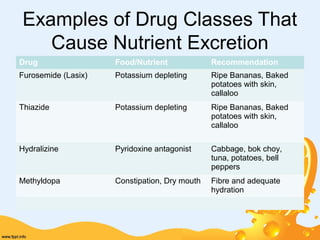
Examples of Drug Classes That
Cause Nutrient Excretion
Drug Food/Nutrient Recommendation
Furosemide (Lasix) Potassium depleting Ripe Bananas, Baked
potatoes with skin,
callaloo
Thiazide Potassium depleting Ripe Bananas, Baked
potatoes with skin,
callaloo
Hydralizine Pyridoxine antagonist Cabbage, bok choy,
tuna, potatoes, bell
peppers
Methyldopa Constipation, Dry mouth Fibre and adequate
hydration
Acid Suppressing Drugs and
Antacids
Anciphex, Nexium, Prevacid, Pilosec, Protonix, Tagament, Zantac,
Pepcid and others
Classified as:
H2 antagonists: antagonizes histamine (H2) receptors on gastric
mucosal cells and reducing production and secretion of acid.
Proton pump inhibitors block the acid-transporter pump on the
luminal surface preventing acid from entering the gastric lumen.
Acid Suppressing Drugs and
Antacids
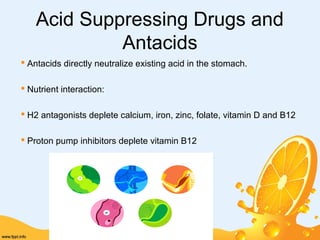
 Antacids directly neutralize existing acid in the stomach.
 Nutrient interaction:
 H2 antagonists deplete calcium, iron, zinc, folate, vitamin D and B12
 Proton pump inhibitors deplete vitamin B12
Acid Suppressing Drugs and
Antacids
• Calcium – Milk, Callaloo, cheese
• Iron – Callaloo, liver, chicken
• Folate – Beans, Lentils, lettuce
• Zinc – seafood, beef, nuts, callaloo
• Vitamin D – Milk fortified, Tuna, Sardines
• B12 – Chicken, Pork, Peef
Analgesics
Cause nausea, vomiting and GI upsets
When oral intake is permitted, giving the medication along with food
can minimize these side effects
Salicylates (Aspirin) – increases urinary loss of ascorbic acid,
potassium and amino acids.
Diet should emphasize potassium and ascorbic acid.
Anti-Hypertensives
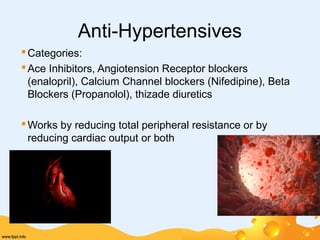
Categories:
Ace Inhibitors, Angiotension Receptor blockers
(enalopril), Calcium Channel blockers (Nifedipine), Beta
Blockers (Propanolol), thizade diuretics
Works by reducing total peripheral resistance or by
reducing cardiac output or both
Anti-Hypertensives
• ACE Inhibitors deplete zinc
• Calcium channel blockers and thiazade diuretics deplete
potassium
• Beta blockers deplete coenzyme Q10
• Diet should be supplied with
• Adequate potassium: Bananas, potatoes, callaloo
• Q10: beef, poultry, herring
Anti-Hypertensives
 Diuretics: Lasix, Microzide (HCTZ), Zaroxolyn, Aldactone, Diamox
and others
 Nutrient Interactions:
 Depletion of Zinc, magnesium and potassium
 Potassium sparing diuretics deplete folic acid.
Cholesterol Lowering Drugs:
Statins
Lipitor, Crestor, Pravaschol, Zocor, Lescol, Mevacor and
others
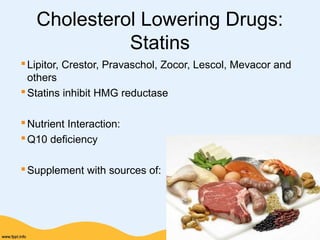
Statins inhibit HMG reductase
Nutrient Interaction:
Q10 deficiency
Supplement with sources of:
Oral Hypoglycemics
• Biguanides: Metformin ( glucose
production in liver and Insulin sensitivity)
• Sulphonylureas: Diamicron MR ( Insulin
Production)
• Thiazolidinediones: Actos ( Insulin
sensitivity)
• DPP-4 Inhibitors : Januvia ( inhibits
DPP- 4
Oral Hypoglycemics
• Nutrient Interaction:
• Vitamin B12 and Folate deficiency
• Supplement with sources of:
B12 Folate
Shell fish Beans
Beef ( highest in liver) Callaloo
Fish (highest in mackerel) Lentils
Fortified cereal Avocado
Antianxiety Agents
• Benzodiazepines enhance the effect of the
neurotransmitter gamma-aminobutyric acid (GABA) at
the GABAA receptor, resulting in sedative, hypnotic
(sleep-inducing), anxiolytic (anti-anxiety), anticonvulsant,
and muscle relaxant properties.
Antianxiety Agents
• Can cause drowsiness which interferes with food
intake
• Alprazolam and choldiazepoxide can stimulate
the appetite and lead to weight gain.
• Diazepam, lorazepam and oxazepan can cause
constipation, diarrhea or dry mouth.
Antianxiety Agents
• Nutrient interaction:
• Endogenous melatonin depletion
• Increase in metabolism of Vitamin D, reduction in Ca+ uptake
• Supplement Diet with sources of
Vitamin D:
Sedatives
• Sedation may lead to reduced food intake.
• Cause nausea
• Propofol
• a lipid based sedative that contains 1.1 kcal per milliliter
and can provide a significant amount of energy from fat.
• When propofol is provided to acutely stressed clients,
enteral and parenteral formulas must be adjusted to
avoid overfeeding.
DeChicco et al, 1995
Marijuana
• Recently decriminalized
• THC and CBD most studied cannabinoids.
Drugs available
• Dronabinol – used to treat appetite loss in patients living
with HIV/AIDS
• Nabilone – used to treat nausea and vomiting in patients
undergoing chemotherapy.
Haney et al, 2007
Marijuana
• Nutrition
Carbohydrates - fructose, galactose, arabinose, glucose, mannose, rhamnose,
sucrose, maltose and raffinose, cellulose, hemicellulose, pectin, xylan.
Fats - Linoleic acid (53–60% of total fatty acids), linolenic acid (15–25%), and
oleic acid.
Proteins – Edestin
(Brenneisen R, 2012)
References
• Brenneisen R (2012). Chemistry and Analysis of Phytocannabinoids and Other
Cannabis Constituents. Retrieved from:http://www.medicinalgenomics.com/wp-
content/uploads/2011/12/Chemical-constituents-of-cannabis.pdf
• Caribbean Food and Nutrition Institute (1994). Clinical Nutrition: Food – Drug
Interactions. Caribbean Food and Nutrition Institute.
• DeChicco R, Matarese L, Hummel A.C, Speerhas R. , Seidner D, Steiger E.
(1995). Contribution of Calories from Propofol to Total Energy Intake. Retrieved
from
website:http://www.sciencedirect.com/science/article/pii/S0002822395004386
References
• Haney M, Gunderson E.W, Rabkin J, Hart C.L, Vosburg S. K,Comer
S.D and Foltin R.W. (2007). Dronabinol and Marijuana in HIV-
Positive Marijuana Smokers Caloric Intake, Mood, and Sleep.
Retrieved from
website:http://www.safeaccess.ca/research/pdf/HaneyTHCCannabis
HIVAIDS2007.pdf
• Merk Manual (2016). Drug information. Retrieved from website:
http://www.merckmanuals.com/professional/appendixes/brand-names-of-s

Drug Nutrient Interaction

  • 1.
    Mixing Food and Medicine Presenter:Rasheed Perry MPhil Student
  • 2.
    Introduction  Drugs canaffect and be affected by food  Patients must be assessed individually for the effect of:  Food on drug action  Drug on nutritional status  Drug nutrient interactions are of greatest potential significance to those in poor nutritional state  Proper planning of meal & drug schedules is necessary
  • 3.
    Introduction • Drug -Any chemical substance, natural or manmade (usually excluding nutrients, water, or oxygen), that - by its chemical nature - alters biological structure or functioning when administered and absorbed
  • 4.
    Introduction • Food -Edible or potable substance consisting of nutritive components such as carbohydrates, fats, proteins, essential mineral and vitamins, which when ingested and digestion sustains life, generates energy, and provides growth, maintenance, and health of the body.
  • 6.
    Therapeutic Importance Therapeutically importantinteractions are those that: —Alter the intended response to the medication —Cause drug toxicity —Alter normal nutritional status
  • 7.
    Therapeutic Importance • Patientwith chronic disease • Elderly • Fetus • Infant • Pregnant woman • Malnourished patient
  • 8.
  • 9.
    The People Perspective: Foodvs Drug • Both Food and Drug are often classified as separate entities but the truth is they are alike in many ways. • Health • Survival • Treatment • Prevention
  • 10.
  • 11.
    Food Intake • Mayaffect food intake by: • Decrease or increase appetite • Interfering with taste (altered/diminished taste sensation) • Leaving an unpleasant aftertaste - allopurinal • Causing sore mouth – many cancer drugs • Dry mouth • Nausea &/vomiting
  • 12.
    Examples of DrugCategories That May Cause Loss of Appetite • Antiinfectives- Metronidazole (Flagyl) • Antineoplastics - Valstar • Bronchodilators - Theophylline • Cardiovascular drugs - Nifedipine
  • 13.
    Examples of DrugCategories That May Cause Loss of Appetite Taste Buds Taste aversions develop because of Dysguesia. Zinc depletion is one of the causes. Zinc is used in the repair and replacement of taste buds. Drugs bind to zinc in saliva reducing availability
  • 14.
    Considerations: Foods that improveappetite and nausea Beef is high in zinc Citrus fruits remove unwanted tastes Fibre absorbs stomach acids and gastric irritants
  • 15.
    Examples of DrugClasses That Cause Nutrient Excretion Drug Food/Nutrient Recommendation Furosemide (Lasix) Potassium depleting Ripe Bananas, Baked potatoes with skin, callaloo Thiazide Potassium depleting Ripe Bananas, Baked potatoes with skin, callaloo Hydralizine Pyridoxine antagonist Cabbage, bok choy, tuna, potatoes, bell peppers Methyldopa Constipation, Dry mouth Fibre and adequate hydration
  • 16.
    Acid Suppressing Drugsand Antacids Anciphex, Nexium, Prevacid, Pilosec, Protonix, Tagament, Zantac, Pepcid and others Classified as: H2 antagonists: antagonizes histamine (H2) receptors on gastric mucosal cells and reducing production and secretion of acid. Proton pump inhibitors block the acid-transporter pump on the luminal surface preventing acid from entering the gastric lumen.
  • 17.
    Acid Suppressing Drugsand Antacids  Antacids directly neutralize existing acid in the stomach.  Nutrient interaction:  H2 antagonists deplete calcium, iron, zinc, folate, vitamin D and B12  Proton pump inhibitors deplete vitamin B12
  • 18.
    Acid Suppressing Drugsand Antacids • Calcium – Milk, Callaloo, cheese • Iron – Callaloo, liver, chicken • Folate – Beans, Lentils, lettuce • Zinc – seafood, beef, nuts, callaloo • Vitamin D – Milk fortified, Tuna, Sardines • B12 – Chicken, Pork, Peef
  • 19.
    Analgesics Cause nausea, vomitingand GI upsets When oral intake is permitted, giving the medication along with food can minimize these side effects Salicylates (Aspirin) – increases urinary loss of ascorbic acid, potassium and amino acids. Diet should emphasize potassium and ascorbic acid.
  • 20.
    Anti-Hypertensives Categories: Ace Inhibitors, AngiotensionReceptor blockers (enalopril), Calcium Channel blockers (Nifedipine), Beta Blockers (Propanolol), thizade diuretics Works by reducing total peripheral resistance or by reducing cardiac output or both
  • 21.
    Anti-Hypertensives • ACE Inhibitorsdeplete zinc • Calcium channel blockers and thiazade diuretics deplete potassium • Beta blockers deplete coenzyme Q10 • Diet should be supplied with • Adequate potassium: Bananas, potatoes, callaloo • Q10: beef, poultry, herring
  • 22.
    Anti-Hypertensives  Diuretics: Lasix,Microzide (HCTZ), Zaroxolyn, Aldactone, Diamox and others  Nutrient Interactions:  Depletion of Zinc, magnesium and potassium  Potassium sparing diuretics deplete folic acid.
  • 23.
    Cholesterol Lowering Drugs: Statins Lipitor,Crestor, Pravaschol, Zocor, Lescol, Mevacor and others Statins inhibit HMG reductase Nutrient Interaction: Q10 deficiency Supplement with sources of:
  • 24.
    Oral Hypoglycemics • Biguanides:Metformin ( glucose production in liver and Insulin sensitivity) • Sulphonylureas: Diamicron MR ( Insulin Production) • Thiazolidinediones: Actos ( Insulin sensitivity) • DPP-4 Inhibitors : Januvia ( inhibits DPP- 4
  • 25.
    Oral Hypoglycemics • NutrientInteraction: • Vitamin B12 and Folate deficiency • Supplement with sources of: B12 Folate Shell fish Beans Beef ( highest in liver) Callaloo Fish (highest in mackerel) Lentils Fortified cereal Avocado
  • 26.
    Antianxiety Agents • Benzodiazepinesenhance the effect of the neurotransmitter gamma-aminobutyric acid (GABA) at the GABAA receptor, resulting in sedative, hypnotic (sleep-inducing), anxiolytic (anti-anxiety), anticonvulsant, and muscle relaxant properties.
  • 27.
    Antianxiety Agents • Cancause drowsiness which interferes with food intake • Alprazolam and choldiazepoxide can stimulate the appetite and lead to weight gain. • Diazepam, lorazepam and oxazepan can cause constipation, diarrhea or dry mouth.
  • 28.
    Antianxiety Agents • Nutrientinteraction: • Endogenous melatonin depletion • Increase in metabolism of Vitamin D, reduction in Ca+ uptake • Supplement Diet with sources of Vitamin D:
  • 29.
    Sedatives • Sedation maylead to reduced food intake. • Cause nausea • Propofol • a lipid based sedative that contains 1.1 kcal per milliliter and can provide a significant amount of energy from fat. • When propofol is provided to acutely stressed clients, enteral and parenteral formulas must be adjusted to avoid overfeeding. DeChicco et al, 1995
  • 30.
    Marijuana • Recently decriminalized •THC and CBD most studied cannabinoids. Drugs available • Dronabinol – used to treat appetite loss in patients living with HIV/AIDS • Nabilone – used to treat nausea and vomiting in patients undergoing chemotherapy. Haney et al, 2007
  • 31.
    Marijuana • Nutrition Carbohydrates -fructose, galactose, arabinose, glucose, mannose, rhamnose, sucrose, maltose and raffinose, cellulose, hemicellulose, pectin, xylan. Fats - Linoleic acid (53–60% of total fatty acids), linolenic acid (15–25%), and oleic acid. Proteins – Edestin (Brenneisen R, 2012)
  • 32.
    References • Brenneisen R(2012). Chemistry and Analysis of Phytocannabinoids and Other Cannabis Constituents. Retrieved from:http://www.medicinalgenomics.com/wp- content/uploads/2011/12/Chemical-constituents-of-cannabis.pdf • Caribbean Food and Nutrition Institute (1994). Clinical Nutrition: Food – Drug Interactions. Caribbean Food and Nutrition Institute. • DeChicco R, Matarese L, Hummel A.C, Speerhas R. , Seidner D, Steiger E. (1995). Contribution of Calories from Propofol to Total Energy Intake. Retrieved from website:http://www.sciencedirect.com/science/article/pii/S0002822395004386
  • 33.
    References • Haney M,Gunderson E.W, Rabkin J, Hart C.L, Vosburg S. K,Comer S.D and Foltin R.W. (2007). Dronabinol and Marijuana in HIV- Positive Marijuana Smokers Caloric Intake, Mood, and Sleep. Retrieved from website:http://www.safeaccess.ca/research/pdf/HaneyTHCCannabis HIVAIDS2007.pdf • Merk Manual (2016). Drug information. Retrieved from website: http://www.merckmanuals.com/professional/appendixes/brand-names-of-s