
ULCERATIVE COLITIS
KRITIKA GUPTA
INTRODUCTION
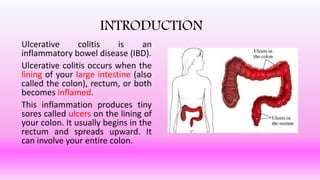
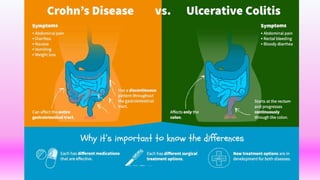
Ulcerative colitis is an
inflammatory bowel disease (IBD).
Ulcerative colitis occurs when the
lining of your large intestine (also
called the colon), rectum, or both
becomes inflamed.
This inflammation produces tiny
sores called ulcers on the lining of
your colon. It usually begins in the
rectum and spreads upward. It
can involve your entire colon.
WHO GETS UC?
• 3.1 Age Group
The majority of patients with UC are in the
age group of 30-40 years at diagnosis. It
begins most commonly between the ages of
15 and 25. A second peak of onset is the 6th
decade of life.
• 3.2 Gender Influence
Ulcerative colitis is slightly more common in
males, while Crohn’s disease is more
frequent in women.
• 3.3 Stress
long-term perceived stress increases the risk
of exacerbation over a period of months to
years.
DIETARY RISK FACTORS FOR DEVELOPMENT OF UC
High intake of meat, particularly of red meat and processed meat
•Jowett et al., 2004
High alcohol intake
•Jowett et al., 2004
High sulphur diet
• Jowett et al., 2004
High intakes of mono- and polyunsaturated fat and vitamin B6
• Geerling et al., 2000
Highest relative concentrations of arachidonic acid in adipose tissue
• De Silva et al., 2010
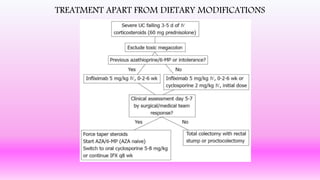
TREATMENT APART FROM DIETARY MODIFICATIONS
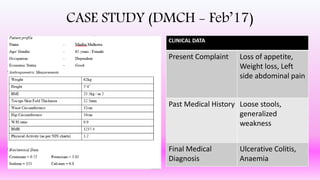
CASE STUDY (DMCH - Feb’17)
CLINICAL DATA
Present Complaint Loss of appetite,
Weight loss, Left
side abdominal pain
Past Medical History Loose stools,
generalized
weakness
Final Medical
Diagnosis
Ulcerative Colitis,
Anaemia
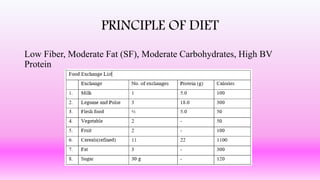
PRINCIPLE OF DIET
Low Fiber, Moderate Fat (SF), Moderate Carbohydrates, High BV
Protein
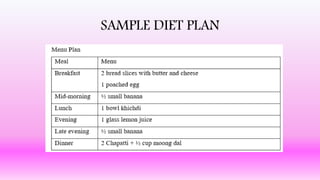
SAMPLE DIET PLAN
CONCLUSION
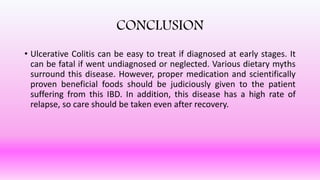
• Ulcerative Colitis can be easy to treat if diagnosed at early stages. It
can be fatal if went undiagnosed or neglected. Various dietary myths
surround this disease. However, proper medication and scientifically
proven beneficial foods should be judiciously given to the patient
suffering from this IBD. In addition, this disease has a high rate of
relapse, so care should be taken even after recovery.
NUT 530 RDA 2010 Kritika Gupta, Kiranpreet Kaur 11

Nutrition in Ulcerative Colitis

  • 1.
  • 2.
    INTRODUCTION Ulcerative colitis isan inflammatory bowel disease (IBD). Ulcerative colitis occurs when the lining of your large intestine (also called the colon), rectum, or both becomes inflamed. This inflammation produces tiny sores called ulcers on the lining of your colon. It usually begins in the rectum and spreads upward. It can involve your entire colon.
  • 3.
    WHO GETS UC? •3.1 Age Group The majority of patients with UC are in the age group of 30-40 years at diagnosis. It begins most commonly between the ages of 15 and 25. A second peak of onset is the 6th decade of life. • 3.2 Gender Influence Ulcerative colitis is slightly more common in males, while Crohn’s disease is more frequent in women. • 3.3 Stress long-term perceived stress increases the risk of exacerbation over a period of months to years.
  • 4.
    DIETARY RISK FACTORSFOR DEVELOPMENT OF UC High intake of meat, particularly of red meat and processed meat •Jowett et al., 2004 High alcohol intake •Jowett et al., 2004 High sulphur diet • Jowett et al., 2004 High intakes of mono- and polyunsaturated fat and vitamin B6 • Geerling et al., 2000 Highest relative concentrations of arachidonic acid in adipose tissue • De Silva et al., 2010
  • 6.
    TREATMENT APART FROMDIETARY MODIFICATIONS
  • 7.
    CASE STUDY (DMCH- Feb’17) CLINICAL DATA Present Complaint Loss of appetite, Weight loss, Left side abdominal pain Past Medical History Loose stools, generalized weakness Final Medical Diagnosis Ulcerative Colitis, Anaemia
  • 8.
    PRINCIPLE OF DIET LowFiber, Moderate Fat (SF), Moderate Carbohydrates, High BV Protein
  • 9.
  • 10.
    CONCLUSION • Ulcerative Colitiscan be easy to treat if diagnosed at early stages. It can be fatal if went undiagnosed or neglected. Various dietary myths surround this disease. However, proper medication and scientifically proven beneficial foods should be judiciously given to the patient suffering from this IBD. In addition, this disease has a high rate of relapse, so care should be taken even after recovery.
  • 11.
    NUT 530 RDA2010 Kritika Gupta, Kiranpreet Kaur 11