



(When to Refer to a Geriatrician)
MARC EVANS M. ABAT, MD, FPCP, FPCGM
Head, Center for Healthy Aging and Section of Geriatric Medicine
The Medical City
Outline
• Who is the geriatrician?
• What can a geriatrician
bring to patient care?
Disclosures
• Received honoraria for lectures
from: Nestle, Getz Pharma,
Sanofi Pasteur, The Medical
City
• Received honoraria for clinical
trials from: Novartis, Bayer
• Received travel grants and
support from: Nestle, Abbott,
Bayer, The Medical City
The Geriatrician
primary care doctors who have additional specialized training in treating
older patients
coordinate overall care with other physicians and guide the patient in making
treatment choices
manage all the health issues of an older patient, designing care plans to deal
with the whole person
https://www.hopkinsmedicine.org/health/healthy_aging/healthy_connections/specialists-in-aging-do-you-need-a-geriatrician
https://www.everydayhealth.com/senior-health/going-to-a-geriatric-specialist.aspx
https://www.aarp.org/health/conditions-treatments/info-2016/geriatrician-geriatric-doctor-physician.html
Education Committee Writing Group (ECWG) of the American Geriatrics
Society recommends that undergraduate students should be trained
profoundly in the 13 most common geriatric syndromes
dementia inappropriate prescribing of
medications
osteoporosis
depression incontinence sensory alterations including hearing
and visual impairment
delirium iatrogenic problems immobility and
gait disturbances
falls failure to thrive
pressure ulcers sleep disorders
What can a
geriatrician
bring to patient
care?
• Management of older person with
multiple co-morbidities and complex,
interacting problems
• Management of a peculiar clinical
manifestation in the older person
• Frailty and failure-to-thrive management
• Polypharmacy management and
medication rationalization
• Discharge planning
• Continuity of care including home care
• Palliative care
• Institutional care
Comprehensive
Geriatric
Assessment
Medical
History
Physical
Functional
Behavioral
Emotional
Environmental
Spiritual
Social
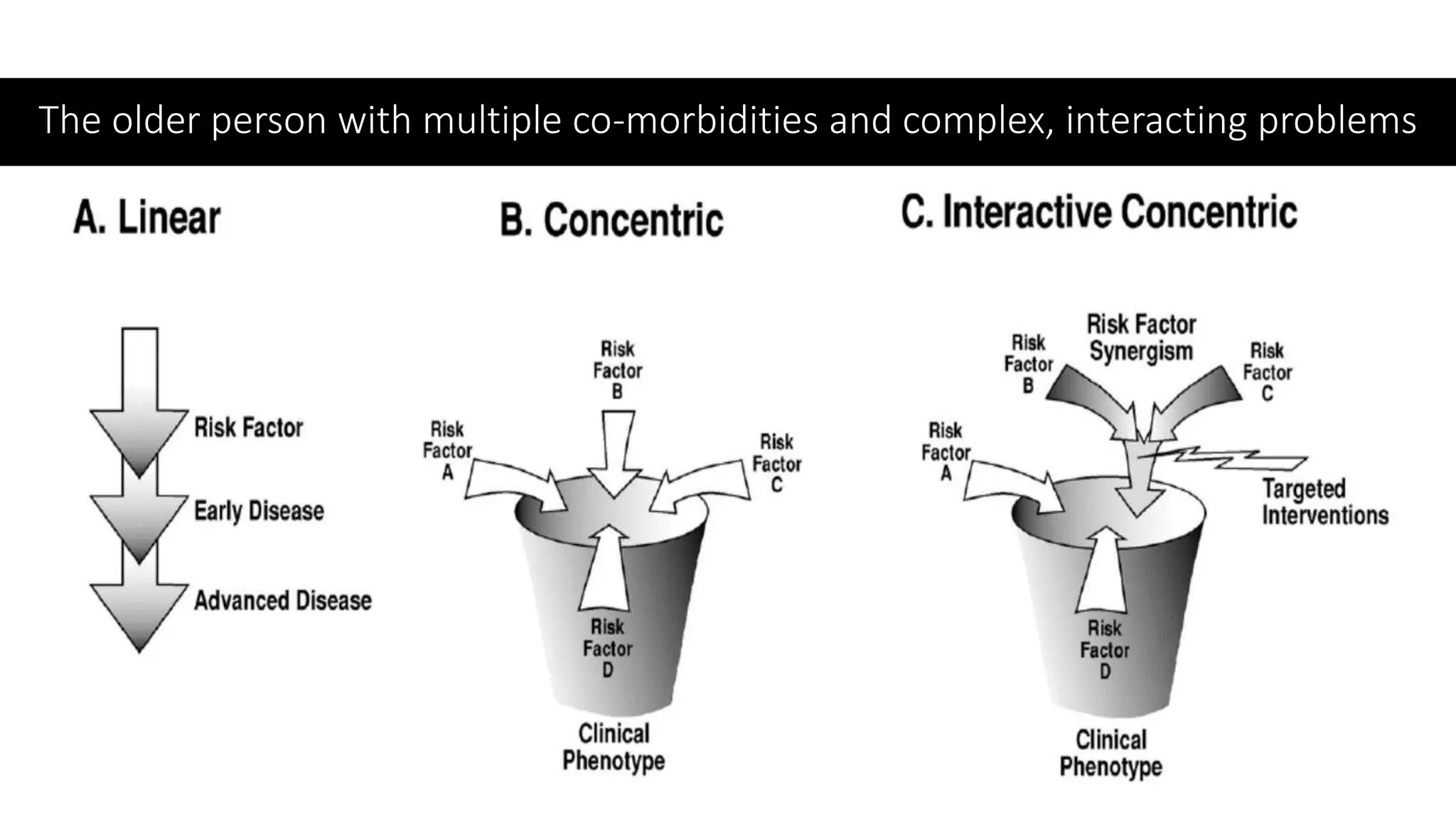
The older person with multiple co-morbidities and complex, interacting problems
Geriatrician’s role
• Management of most conditions in
the elderly
• Coordination of care, especially if with
need for more complex care
• Prioritize and stratify management
based on patient-centered goals
• Cure
• Palliation
• Quality of life
• Mobilize appropriate resources
Management
of a peculiar
clinical
manifestation
in the older
person
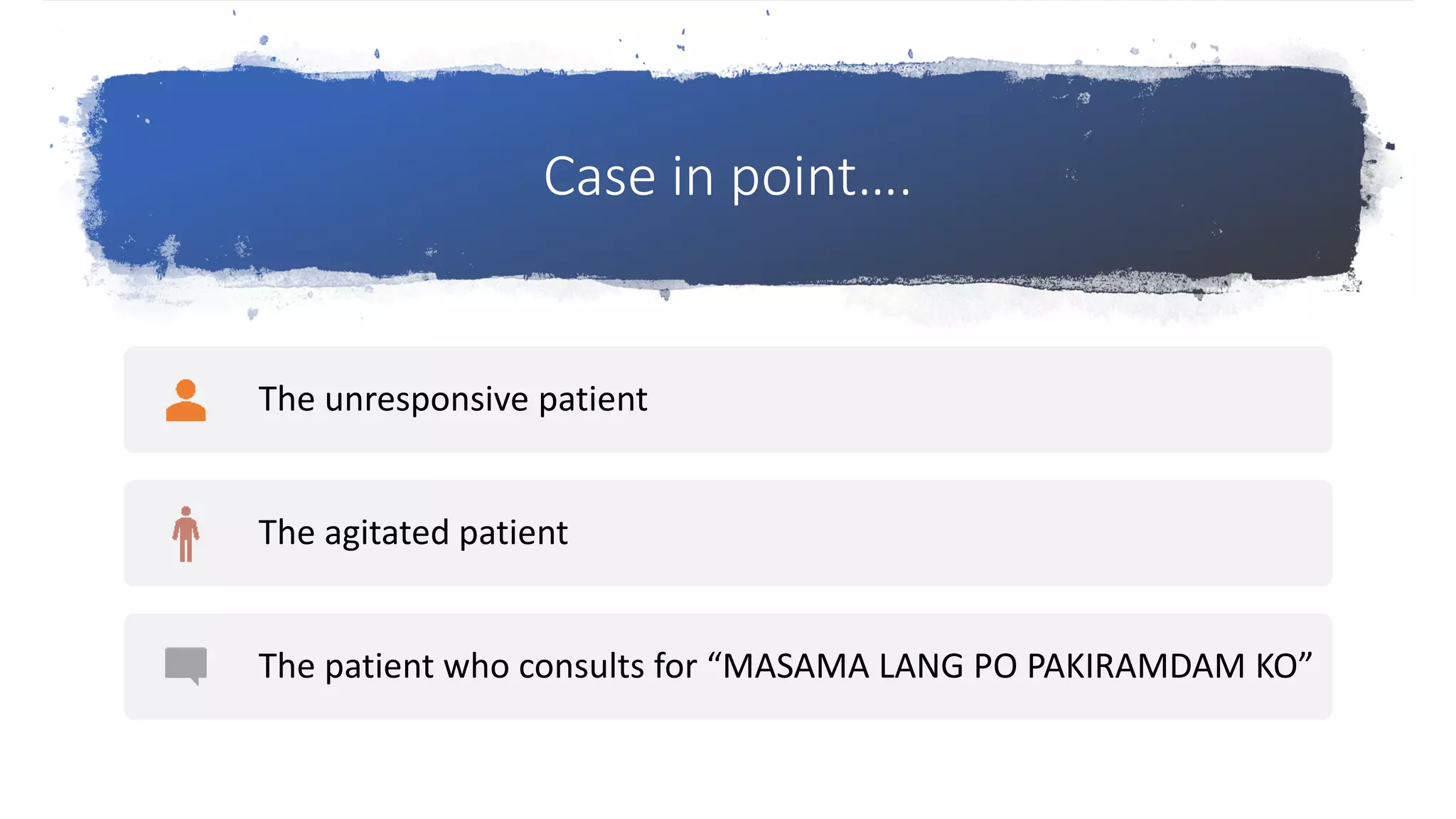
Case in point….
The unresponsive patient
The agitated patient
The patient who consults for “MASAMA LANG PO PAKIRAMDAM KO”
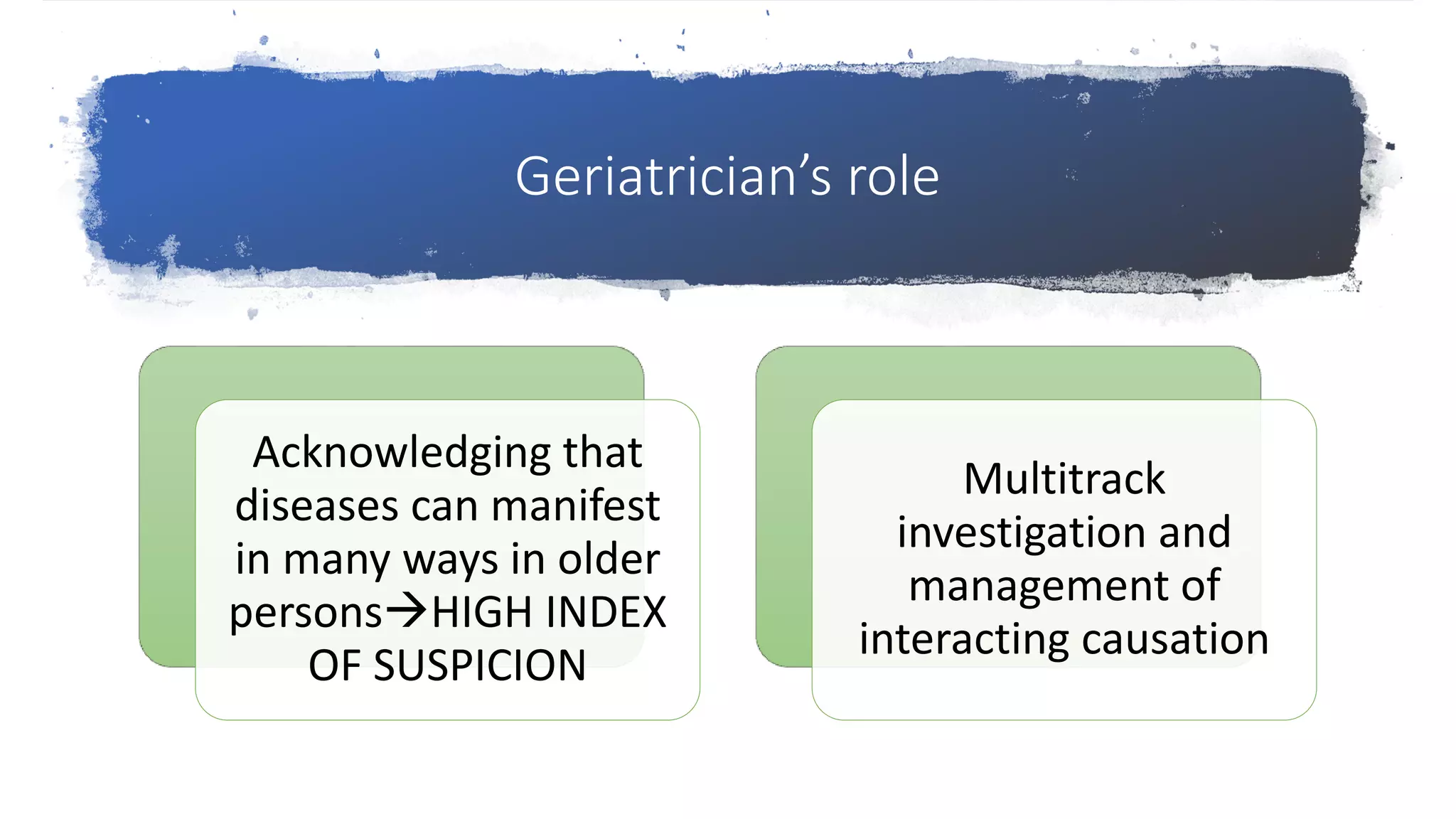
Geriatrician’s role
Acknowledging that
diseases can manifest
in many ways in older
personsHIGH INDEX
OF SUSPICION
Multitrack
investigation and
management of
interacting causation
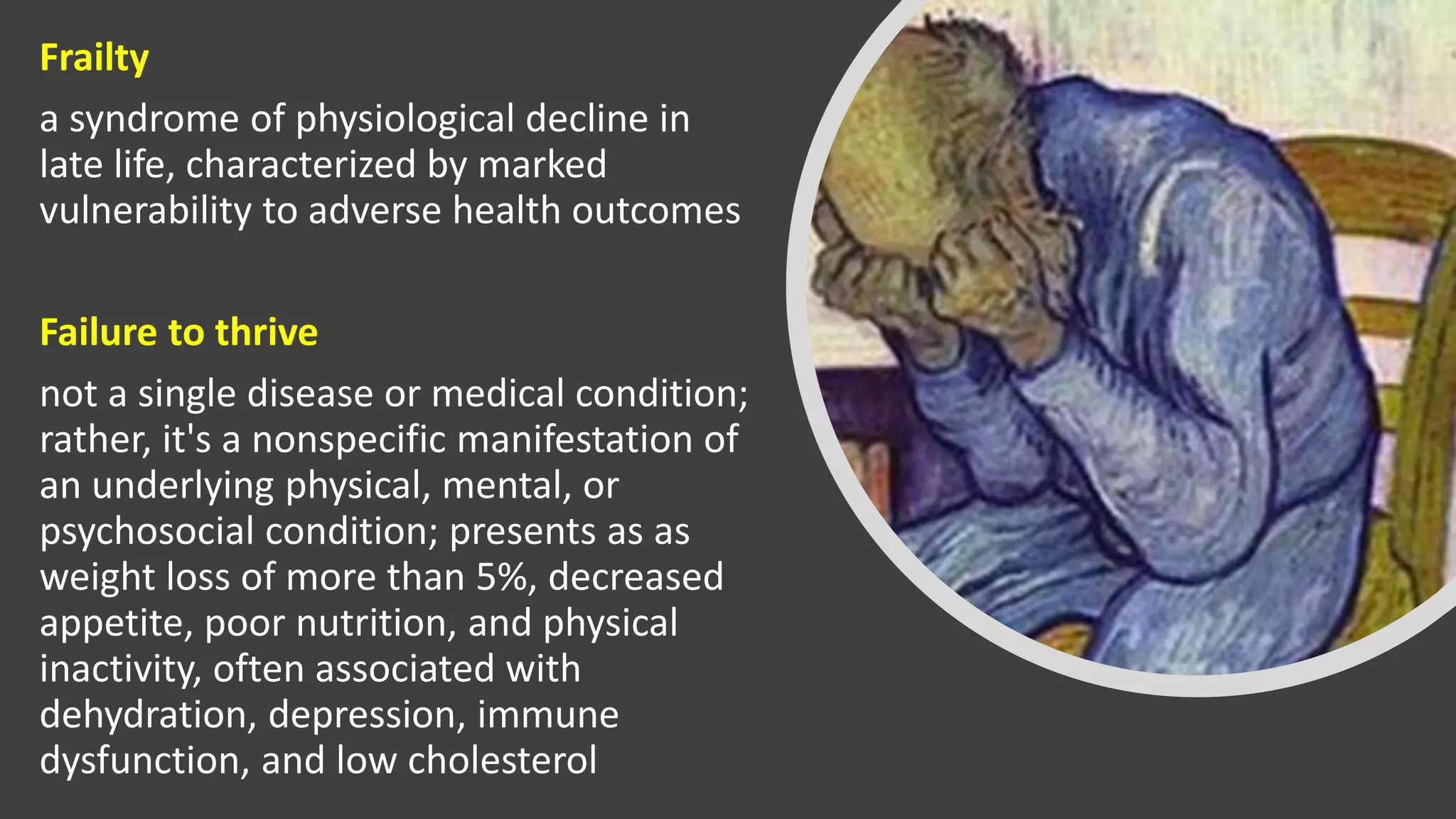
Frailty and failure-to-thrive management
Frailty
a syndrome of physiological decline in
late life, characterized by marked
vulnerability to adverse health outcomes
Failure to thrive
not a single disease or medical condition;
rather, it's a nonspecific manifestation of
an underlying physical, mental, or
psychosocial condition; presents as as
weight loss of more than 5%, decreased
appetite, poor nutrition, and physical
inactivity, often associated with
dehydration, depression, immune
dysfunction, and low cholesterol
Geriatrician’s role
• Multitrack investigation and
management of interacting
causation
• Coordination of care, especially if
with need for more complex care
• Prioritize and stratify
management based on patient-
centered goals
• Cure
• Palliation
• Quality of life
Polypharmacy
management and
medication
rationalization
The use of more than 5
medications, some of
which may be clinically
inappropriate
Geriatrician’s role
Manage
Drug appropriateness
Interactions
Adverse effects
Rationalize medications
vis-a-viz appropriateness
Care goals
Quality of life
Discharge planning
Geriatrician’s
role
Comprehensive needs and provider
assessment
Comprehensive care planning
Accurate and effective hand offs
Procurement of needed tools/equipment
Discharge location preparation
Endorsement of care
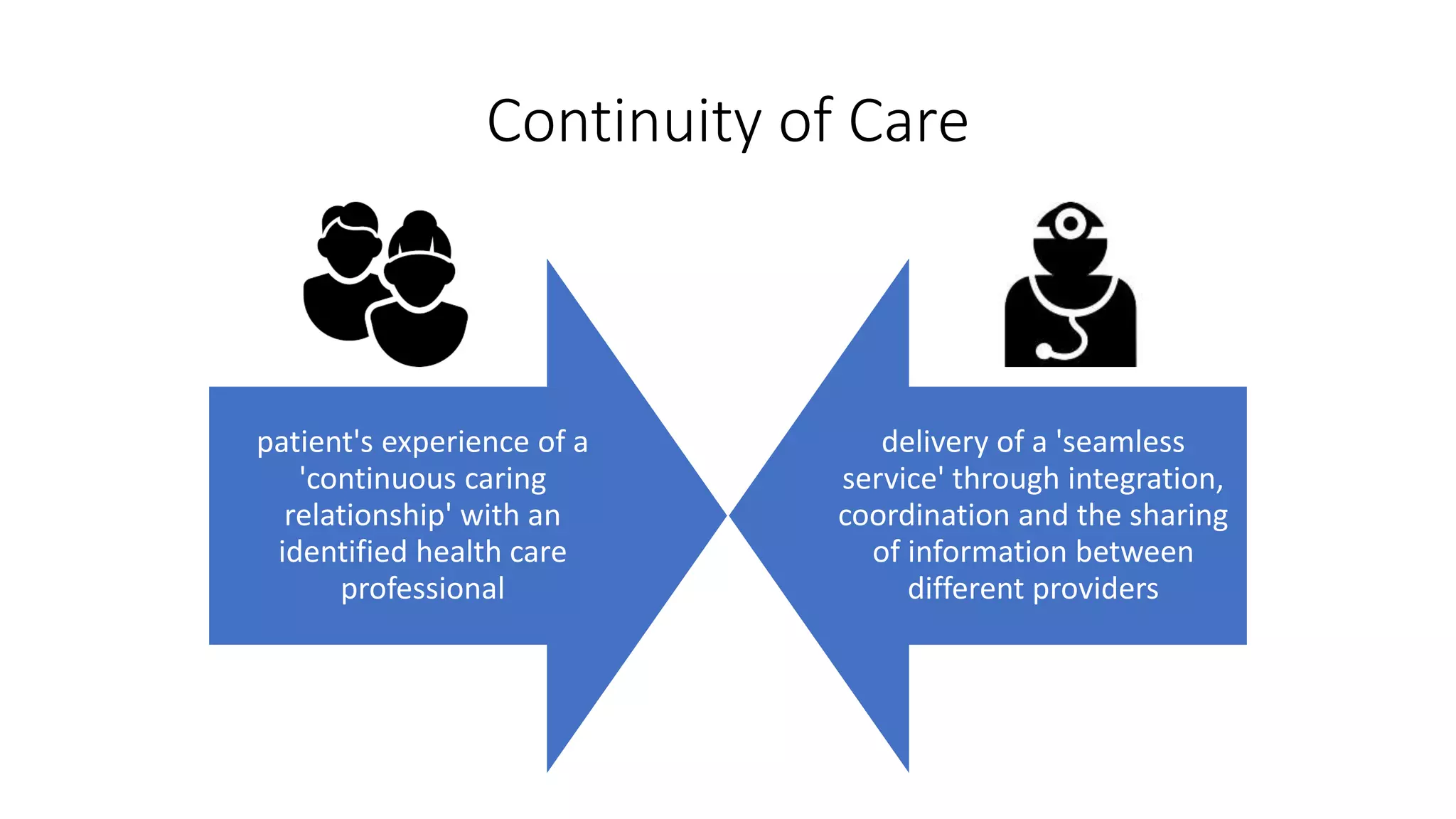
Continuity of Care
patient's experience of a
'continuous caring
relationship' with an
identified health care
professional
delivery of a 'seamless
service' through integration,
coordination and the sharing
of information between
different providers
Continuity of care occurs when separate and discrete
elements of care are connected and when those
elements of care that endure over time are maintained
and supported.
http://www.cfhi-fcass.ca/Migrated/PDF/ResearchReports/CommissionedResearch/cr_contcare_e.pdf
Home Care
wide range of
health care
services that can
be given in your
home for an
illness or injury
usually less
expensive, more
convenient, and just
as effective as care
you get in a hospital
or skilled nursing
facility (SNF)
Home Care Services
• Doctor’s visits
• Nursing visits, chronic nursing
care
• Case management
• Procedural visits (doctor/nurses)
• Intravenous therapy (e.g.
fluids, antibiotics and other
medications)
• Foley catheter, Nasogastric
tube insertion
• PEG, tracheostomy
replacement
• Pain management
• Wound care and Ostomy care
Palliative care
Institutionalized
Care
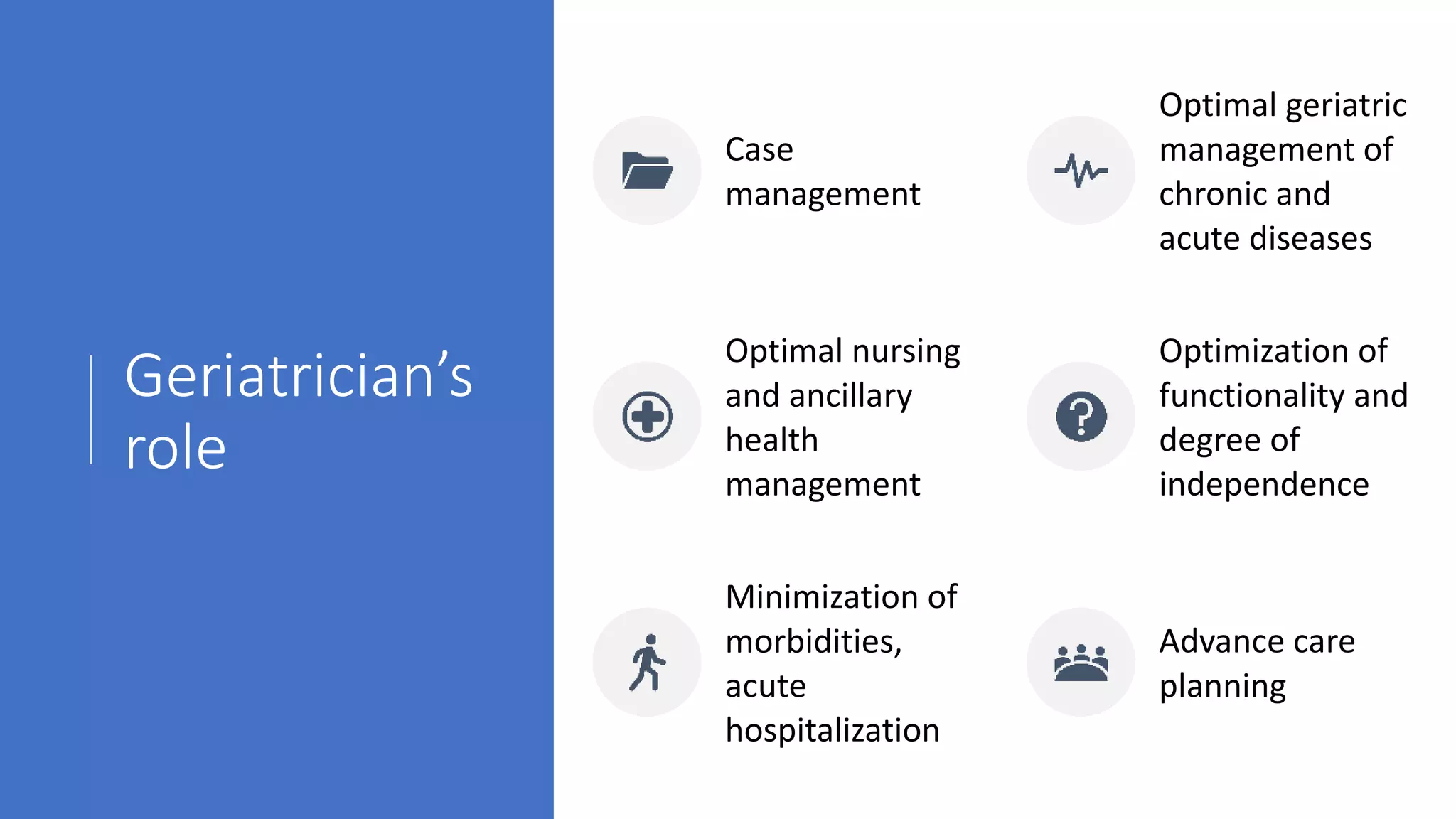
Geriatrician’s
role
Case
management
Optimal geriatric
management of
chronic and
acute diseases
Optimal nursing
and ancillary
health
management
Optimization of
functionality and
degree of
independence
Minimization of
morbidities,
acute
hospitalization
Advance care
planning
In summary
• Referral to a geriatrician is recommended for
• Management of older person with multiple
co-morbidities and complex, interacting
problems
• Management of a peculiar clinical
manifestation in the older person
• Frailty and failure-to-thrive management
• Polypharmacy management and medication
rationalization
• Discharge planning
• Continuity of care including home care
• Palliative care
• Institutional care
Thank you for listening!

When to refer to a geriatrician 2018

  • 1.
    (When to Referto a Geriatrician) MARC EVANS M. ABAT, MD, FPCP, FPCGM Head, Center for Healthy Aging and Section of Geriatric Medicine The Medical City
  • 2.
    Outline • Who isthe geriatrician? • What can a geriatrician bring to patient care?
  • 3.
    Disclosures • Received honorariafor lectures from: Nestle, Getz Pharma, Sanofi Pasteur, The Medical City • Received honoraria for clinical trials from: Novartis, Bayer • Received travel grants and support from: Nestle, Abbott, Bayer, The Medical City
  • 4.
    The Geriatrician primary caredoctors who have additional specialized training in treating older patients coordinate overall care with other physicians and guide the patient in making treatment choices manage all the health issues of an older patient, designing care plans to deal with the whole person https://www.hopkinsmedicine.org/health/healthy_aging/healthy_connections/specialists-in-aging-do-you-need-a-geriatrician https://www.everydayhealth.com/senior-health/going-to-a-geriatric-specialist.aspx https://www.aarp.org/health/conditions-treatments/info-2016/geriatrician-geriatric-doctor-physician.html
  • 5.
    Education Committee WritingGroup (ECWG) of the American Geriatrics Society recommends that undergraduate students should be trained profoundly in the 13 most common geriatric syndromes dementia inappropriate prescribing of medications osteoporosis depression incontinence sensory alterations including hearing and visual impairment delirium iatrogenic problems immobility and gait disturbances falls failure to thrive pressure ulcers sleep disorders
  • 6.
    What can a geriatrician bringto patient care? • Management of older person with multiple co-morbidities and complex, interacting problems • Management of a peculiar clinical manifestation in the older person • Frailty and failure-to-thrive management • Polypharmacy management and medication rationalization • Discharge planning • Continuity of care including home care • Palliative care • Institutional care
  • 7.
  • 8.
    The older personwith multiple co-morbidities and complex, interacting problems
  • 10.
    Geriatrician’s role • Managementof most conditions in the elderly • Coordination of care, especially if with need for more complex care • Prioritize and stratify management based on patient-centered goals • Cure • Palliation • Quality of life • Mobilize appropriate resources
  • 11.
  • 12.
    Case in point…. Theunresponsive patient The agitated patient The patient who consults for “MASAMA LANG PO PAKIRAMDAM KO”
  • 13.
    Geriatrician’s role Acknowledging that diseasescan manifest in many ways in older personsHIGH INDEX OF SUSPICION Multitrack investigation and management of interacting causation
  • 14.
  • 15.
    Frailty a syndrome ofphysiological decline in late life, characterized by marked vulnerability to adverse health outcomes Failure to thrive not a single disease or medical condition; rather, it's a nonspecific manifestation of an underlying physical, mental, or psychosocial condition; presents as as weight loss of more than 5%, decreased appetite, poor nutrition, and physical inactivity, often associated with dehydration, depression, immune dysfunction, and low cholesterol
  • 16.
    Geriatrician’s role • Multitrackinvestigation and management of interacting causation • Coordination of care, especially if with need for more complex care • Prioritize and stratify management based on patient- centered goals • Cure • Palliation • Quality of life
  • 17.
  • 18.
    The use ofmore than 5 medications, some of which may be clinically inappropriate
  • 19.
    Geriatrician’s role Manage Drug appropriateness Interactions Adverseeffects Rationalize medications vis-a-viz appropriateness Care goals Quality of life
  • 20.
  • 21.
    Geriatrician’s role Comprehensive needs andprovider assessment Comprehensive care planning Accurate and effective hand offs Procurement of needed tools/equipment Discharge location preparation Endorsement of care
  • 22.
    Continuity of Care patient'sexperience of a 'continuous caring relationship' with an identified health care professional delivery of a 'seamless service' through integration, coordination and the sharing of information between different providers
  • 23.
    Continuity of careoccurs when separate and discrete elements of care are connected and when those elements of care that endure over time are maintained and supported. http://www.cfhi-fcass.ca/Migrated/PDF/ResearchReports/CommissionedResearch/cr_contcare_e.pdf
  • 24.
    Home Care wide rangeof health care services that can be given in your home for an illness or injury usually less expensive, more convenient, and just as effective as care you get in a hospital or skilled nursing facility (SNF)
  • 25.
    Home Care Services •Doctor’s visits • Nursing visits, chronic nursing care • Case management • Procedural visits (doctor/nurses) • Intravenous therapy (e.g. fluids, antibiotics and other medications) • Foley catheter, Nasogastric tube insertion • PEG, tracheostomy replacement • Pain management • Wound care and Ostomy care
  • 26.
  • 27.
  • 28.
    Geriatrician’s role Case management Optimal geriatric management of chronicand acute diseases Optimal nursing and ancillary health management Optimization of functionality and degree of independence Minimization of morbidities, acute hospitalization Advance care planning
  • 29.
    In summary • Referralto a geriatrician is recommended for • Management of older person with multiple co-morbidities and complex, interacting problems • Management of a peculiar clinical manifestation in the older person • Frailty and failure-to-thrive management • Polypharmacy management and medication rationalization • Discharge planning • Continuity of care including home care • Palliative care • Institutional care
  • 30.
    Thank you forlistening!