




THE COMPREHENSIVE
GERIATRIC ASSESSMENT
MARC EVANS M. ABAT, MD, FPCP, FPCGM
Head, Center for Healthy Aging and Section of Geriatrics,
The Medical City
Consultant, Section of Adult Medicine, Department of Medicine,
Philippine General Hospital
Disclosures
• Honoraria: Sanofi Pasteur, Getz Pharma, Nestle
• Clinical Trials: Novartis, Bayer
• Support: Nestle, Abbott, LRI-Therapharma
Case Example
• 75/M
• Brought to the ER for fall and right hip pain and swelling
• Hip x-ray showed complete, displaced fracture of right femoral neck
IS THIS CASE AS SIMPLE AS IT LOOKS?
Objectives
• To define what is a Comprehensive Geriatric
Assessment (CGA)
• To identify the components or domains of the
CGA
• To identify the target population for doing a CGA
• To recognize the clinical syndromes where a CGA
must be done
• To explain the various models of implementing a
CGA
• To show evidence of benefits of the CGA
What is the CGA?
What is the Comprehensive Geriatric
Assessment?
• multidimensional, interdisciplinary diagnostic process
• develop a coordinated and integrated plan for treatment and long-
term follow-up.
• emphasizes quality of life and functional status, prognosis, and
outcome that entails a workup of more depth and breadth
• employment of interdisciplinary teams and the use of any number of
standardized instruments
• both a diagnostic and therapeutic process
http://journals.sagepub.com/doi/pdf/10.1177/107327480301000603
https://www.uptodate.com/contents/comprehensive-geriatric-assessment
https://www.bmj.com/content/343/bmj.d6553
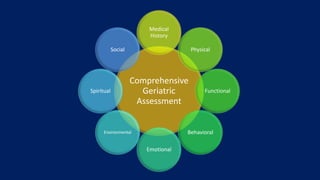
What are the components or
domains of the CGA?
Comprehensive
Geriatric
Assessment
Medical
History
Physical
Functional
Behavioral
Emotional
Environmental
Spiritual
Social
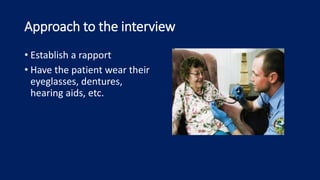
Approach to the interview
• Establish a rapport
• Have the patient wear their
eyeglasses, dentures,
hearing aids, etc.
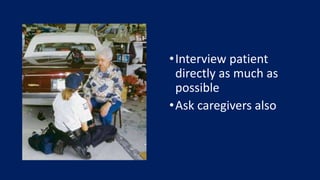
•Interview patient
directly as much as
possible
•Ask caregivers also
Medical history
•Previous diseases including allergies
•Previous surgeries
•Past treatment regimens
•Review of old medical records if available
•Thorough systems review, including fall
history
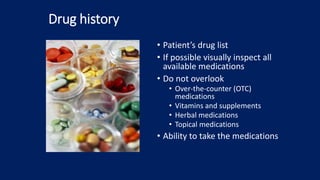
Drug history
• Patient’s drug list
• If possible visually inspect all
available medications
• Do not overlook
• Over-the-counter (OTC)
medications
• Vitamins and supplements
• Herbal medications
• Topical medications
• Ability to take the medications
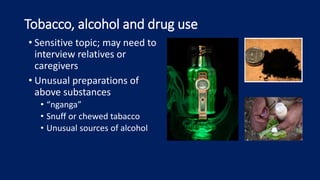
Tobacco, alcohol and drug use
• Sensitive topic; may need to
interview relatives or
caregivers
• Unusual preparations of
above substances
• “nganga”
• Snuff or chewed tabacco
• Unusual sources of alcohol
Nutrition History
• Type, variety, quantity and
frequency of feeding
• Special diets or diet fads
• Use of vitamins and supplements
• Weight changes
• Amount of money spent on food
• Accessibility of kitchen and food
storage
• Problems with chewing, taste and
smell
Mental Health
• Insomnia, changes in sleep patterns,
constipation, cognitive dysfunction,
anorexia, weight loss, fatigue,
preoccupation with bodily functions,
and increased alcohol consumption
• ask about delusions and
hallucinations, past mental health
care, use of psychoactive drugs, and
recent changes in circumstances
• Mood changes or cognitive changes
may indicate depression
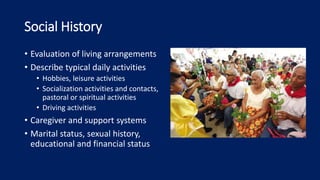
Social History
• Evaluation of living arrangements
• Describe typical daily activities
• Hobbies, leisure activities
• Socialization activities and contacts,
pastoral or spiritual activities
• Driving activities
• Caregiver and support systems
• Marital status, sexual history,
educational and financial status
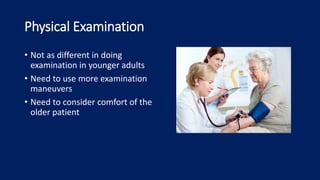
Physical Examination
• Not as different in doing
examination in younger adults
• Need to use more examination
maneuvers
• Need to consider comfort of the
older patient
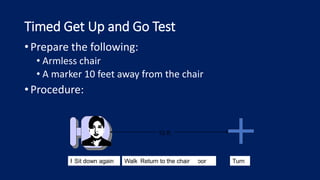
Timed Get Up and Go Test
• Prepare the following:
• Armless chair
• A marker 10 feet away from the chair
• Procedure:
10 ft.
Rise from chair Walk to the marker on the floor Turn
Return to the chair
Sit down again
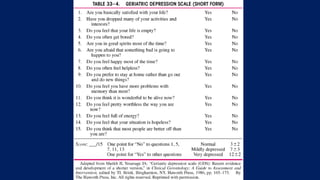
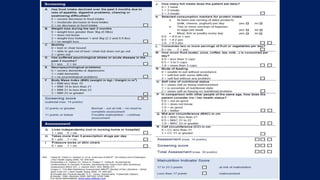
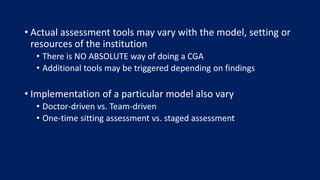
• Actual assessment tools may vary with the model, setting or
resources of the institution
• There is NO ABSOLUTE way of doing a CGA
• Additional tools may be triggered depending on findings
• Implementation of a particular model also vary
• Doctor-driven vs. Team-driven
• One-time sitting assessment vs. staged assessment
What is the target population for
doing a CGA and the clinical
syndromes where a CGA must be
done?
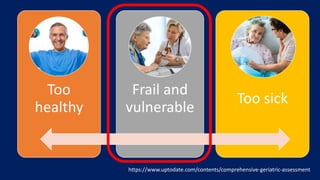
Too
healthy
Frail and
vulnerable
Too sick
https://www.uptodate.com/contents/comprehensive-geriatric-assessment
Geriatric syndromes
• Multifactorial health conditions that occur when the
accumulated effects of impairments in multiple
systems render an older person vulnerable to
situational challenges
• Emphasizes multiple causation of a unified
manifestation
https://www.ncbi.nlm.nih.gov/pmc/articles/PMC2409147/
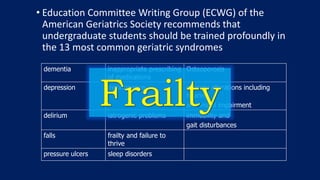
• Education Committee Writing Group (ECWG) of the
American Geriatrics Society recommends that
undergraduate students should be trained profoundly in
the 13 most common geriatric syndromes
dementia inappropriate prescribing
of medications
Osteoporosis
depression incontinence sensory alterations including
hearing
and visual impairment
delirium iatrogenic problems immobility and
gait disturbances
falls frailty and failure to
thrive
pressure ulcers sleep disorders
Frailty
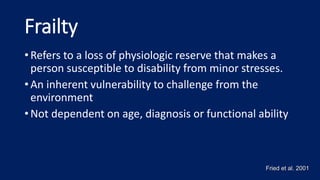
• Refers to a loss of physiologic reserve that makes a
person susceptible to disability from minor stresses.
• An inherent vulnerability to challenge from the
environment
• Not dependent on age, diagnosis or functional ability
Fried et al. 2001
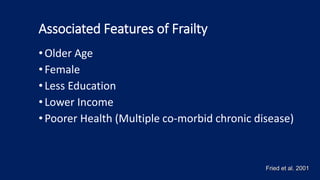
Associated Features of Frailty
• Older Age
•Female
• Less Education
• Lower Income
• Poorer Health (Multiple co-morbid chronic disease)
Fried et al. 2001
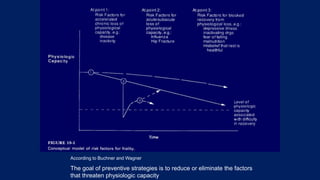
According to Buchner and Wagner
The goal of preventive strategies is to reduce or eliminate the factors
that threaten physiologic capacity
What are the various models of
implementing a CGA?
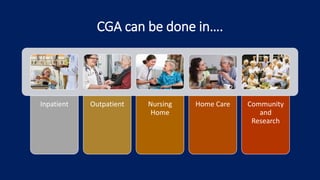
CGA can be done in….
Inpatient Outpatient Nursing
Home
Home Care Community
and
Research
Inpatient models
• Geriatric consultations
• Geriatric Assessment Teams
• Geriatric Evaluation and Management Units (GEMUs)
or Acute Care of Elderly (ACE) Units
https://www.uptodate.com/contents/comprehensive-geriatric-assessment
Outpatient models
• OPD Geriatric Consultations
• Structured Interdisciplinary Teams
• Geriatricians
• Nurse Practitioners
• Social Workers
• Therapists
https://www.uptodate.com/contents/comprehensive-geriatric-assessment
Other models
• Post-discharge and Home care geriatric assessment
• Specialized applications
• Subspecialty areas (e.g. in oncology)
• Preoperative (e.g. for transaortic valve replacement)
• Postoperative assessment
https://www.uptodate.com/contents/comprehensive-geriatric-assessment
How beneficial is doing a CGA?
Meta-analysis on CGA in Admitted Patients
• 22 trials evaluating 10,315 participants in six countries
• Patients in receipt of CGA
• more likely to be alive and in their own homes at up to six months
(OR 1.25, 95% CI 1.11 to 1.42, P = 0.0002) and at the end of
scheduled follow up (median 12 months) (OR 1.16, 95% CI 1.05 to
1.28, P = 0.003)
Cochrane Database Syst Rev. 2011; (7): CD006211.
• less likely to be institutionalised (OR 0.79, 95% CI 0.69 to
0.88, P < 0.0001)
• less likely to suffer death or deterioration (OR 0.76, 95% CI
0.64 to 0.90, P = 0.001)
• more likely to experience improved cognition in the CGA
group (OR 1.11, 95% CI 0.20 to 2.01, P = 0.02)
Cochrane Database Syst Rev. 2011; (7): CD006211.
Elderly patient discharged <72 hours of ER
admission
• 5 trials
• no clear evidence of benefit for CGA interventions in frail older
people being discharged from emergency departments or acute
medical units.
• overall quality of trials was poor
Age and Ageing, Volume 40, Issue 4, 1 July 2011, Pages 436–443,
CGA and Mortality and Adverse Outcomes in
Hospitalized Older Patients
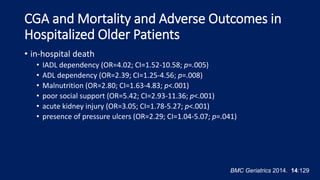
• in-hospital death
• IADL dependency (OR=4.02; CI=1.52-10.58; p=.005)
• ADL dependency (OR=2.39; CI=1.25-4.56; p=.008)
• Malnutrition (OR=2.80; CI=1.63-4.83; p<.001)
• poor social support (OR=5.42; CI=2.93-11.36; p<.001)
• acute kidney injury (OR=3.05; CI=1.78-5.27; p<.001)
• presence of pressure ulcers (OR=2.29; CI=1.04-5.07; p=.041)
BMC Geriatrics 2014. 14:129
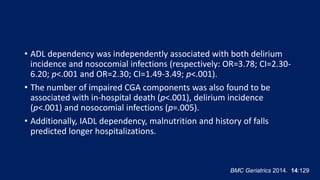
• ADL dependency was independently associated with both delirium
incidence and nosocomial infections (respectively: OR=3.78; CI=2.30-
6.20; p<.001 and OR=2.30; CI=1.49-3.49; p<.001).
• The number of impaired CGA components was also found to be
associated with in-hospital death (p<.001), delirium incidence
(p<.001) and nosocomial infections (p=.005).
• Additionally, IADL dependency, malnutrition and history of falls
predicted longer hospitalizations.
BMC Geriatrics 2014. 14:129
CGA in the OPD setting
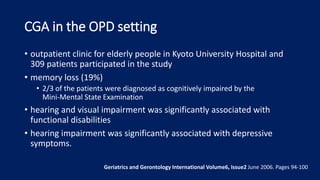
• outpatient clinic for elderly people in Kyoto University Hospital and
309 patients participated in the study
• memory loss (19%)
• 2/3 of the patients were diagnosed as cognitively impaired by the
Mini‐Mental State Examination
• hearing and visual impairment was significantly associated with
functional disabilities
• hearing impairment was significantly associated with depressive
symptoms.
Geriatrics and Gerontology International Volume6, Issue2 June 2006. Pages 94-100
Ambulatory Geriatric Assessment - Frailty
Intervention Trial
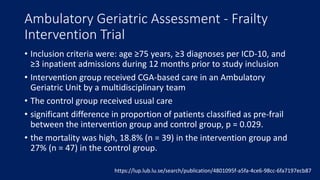
• Inclusion criteria were: age ≥75 years, ≥3 diagnoses per ICD-10, and
≥3 inpatient admissions during 12 months prior to study inclusion
• Intervention group received CGA-based care in an Ambulatory
Geriatric Unit by a multidisciplinary team
• The control group received usual care
• significant difference in proportion of patients classified as pre-frail
between the intervention group and control group, p = 0.029.
• the mortality was high, 18.8% (n = 39) in the intervention group and
27% (n = 47) in the control group.
https://lup.lub.lu.se/search/publication/4801095f-a5fa-4ce6-98cc-6fa7197ecb87
Pre-operative CGA in older patients
undergoing surgery
• Heterogenous studies, meta-analysis precluded
• Randomized trials: positive postoperative outcomes, including
medical complications
• Before-and-after studies reported a positive impact on postoperative
length of stay and other outcomes.
Anaesthesia 2014, 69 (Suppl. 1), 8–16
Proactive care of older people undergoing surgery
('POPS’)
• 2 cohorts of elective orthopaedic patients (pre-POPS vs
POPS, N =54)
• POPS group
• fewer post-operative medical complications including pneumonia
(20% vs 4% [p = 0.008]) and delirium (19% vs 6% [p = 0.036])
• significant pressure sores (19% vs 4% [p = 0.028]), poor pain
control (30% vs 2% [p<0.001]), delayed mobilisation (28% vs 9% [p
= 0.012]) and inappropriate catheter use (20% vs 7% [p = 0.046])
• Length of stay was reduced by 4.5 days
Age Ageing. 2007 Mar;36(2):190-6. Epub 2007 Jan 27.
CGA in cancer patients
• 2 cohorts of older patients (aged 70+ years)
• observational control group (N=70) received standard oncology care
• intervention group (N=65) underwent risk stratification using a
patient-completed screening questionnaire and high-risk patients
received CGA
• more likely to complete cancer treatment as planned (odds ratio (OR) 4.14
(95% CI: 1.50–11.42), P=0.006)
• fewer required treatment modifications (OR 0.34 (95% CI: 0.16–
0.73), P=0.006).
• Overall grade 3+ toxicity rate was 43.8% in the intervention group and
52.9% in the control (P=0.292)
https://www.nature.com/articles/bjc2015120
Challenges in CGA implementation
• Acceptability
• Fiscal support
• Financial viability
• Staffing and capacity building
We have discussed…..
• Comprehensive Geriatric Assessment
• Definition
• Domains
• Patients
• Conditions
• Models
• Benefits
Case Resolution
• After CGA
• Orthostasis from antihypertensives and prostate medications
• Complains of joint pains
• Smoker
• Drinks alcoholic beverages at night to help with sleep induction
• Has always been relatively thin and skinny
• Has poor eyesight and has not had his glasses adjusted for years
• Fair to poor food intake recently due to poor denture fit
• Depressed that his children has not helped him address his problems
The comprehensive geriatric assessment  pcp slides

The comprehensive geriatric assessment pcp slides

  • 1.
    THE COMPREHENSIVE GERIATRIC ASSESSMENT MARCEVANS M. ABAT, MD, FPCP, FPCGM Head, Center for Healthy Aging and Section of Geriatrics, The Medical City Consultant, Section of Adult Medicine, Department of Medicine, Philippine General Hospital
  • 2.
    Disclosures • Honoraria: SanofiPasteur, Getz Pharma, Nestle • Clinical Trials: Novartis, Bayer • Support: Nestle, Abbott, LRI-Therapharma
  • 3.
    Case Example • 75/M •Brought to the ER for fall and right hip pain and swelling • Hip x-ray showed complete, displaced fracture of right femoral neck IS THIS CASE AS SIMPLE AS IT LOOKS?
  • 4.
    Objectives • To definewhat is a Comprehensive Geriatric Assessment (CGA) • To identify the components or domains of the CGA • To identify the target population for doing a CGA • To recognize the clinical syndromes where a CGA must be done • To explain the various models of implementing a CGA • To show evidence of benefits of the CGA
  • 5.
  • 6.
    What is theComprehensive Geriatric Assessment? • multidimensional, interdisciplinary diagnostic process • develop a coordinated and integrated plan for treatment and long- term follow-up. • emphasizes quality of life and functional status, prognosis, and outcome that entails a workup of more depth and breadth • employment of interdisciplinary teams and the use of any number of standardized instruments • both a diagnostic and therapeutic process http://journals.sagepub.com/doi/pdf/10.1177/107327480301000603 https://www.uptodate.com/contents/comprehensive-geriatric-assessment https://www.bmj.com/content/343/bmj.d6553
  • 7.
    What are thecomponents or domains of the CGA?
  • 8.
  • 9.
    Approach to theinterview • Establish a rapport • Have the patient wear their eyeglasses, dentures, hearing aids, etc.
  • 10.
    •Interview patient directly asmuch as possible •Ask caregivers also
  • 11.
    Medical history •Previous diseasesincluding allergies •Previous surgeries •Past treatment regimens •Review of old medical records if available •Thorough systems review, including fall history
  • 12.
    Drug history • Patient’sdrug list • If possible visually inspect all available medications • Do not overlook • Over-the-counter (OTC) medications • Vitamins and supplements • Herbal medications • Topical medications • Ability to take the medications
  • 13.
    Tobacco, alcohol anddrug use • Sensitive topic; may need to interview relatives or caregivers • Unusual preparations of above substances • “nganga” • Snuff or chewed tabacco • Unusual sources of alcohol
  • 14.
    Nutrition History • Type,variety, quantity and frequency of feeding • Special diets or diet fads • Use of vitamins and supplements • Weight changes • Amount of money spent on food • Accessibility of kitchen and food storage • Problems with chewing, taste and smell
  • 15.
    Mental Health • Insomnia,changes in sleep patterns, constipation, cognitive dysfunction, anorexia, weight loss, fatigue, preoccupation with bodily functions, and increased alcohol consumption • ask about delusions and hallucinations, past mental health care, use of psychoactive drugs, and recent changes in circumstances • Mood changes or cognitive changes may indicate depression
  • 16.
    Social History • Evaluationof living arrangements • Describe typical daily activities • Hobbies, leisure activities • Socialization activities and contacts, pastoral or spiritual activities • Driving activities • Caregiver and support systems • Marital status, sexual history, educational and financial status
  • 17.
    Physical Examination • Notas different in doing examination in younger adults • Need to use more examination maneuvers • Need to consider comfort of the older patient
  • 21.
    Timed Get Upand Go Test • Prepare the following: • Armless chair • A marker 10 feet away from the chair • Procedure: 10 ft. Rise from chair Walk to the marker on the floor Turn Return to the chair Sit down again
  • 25.
    • Actual assessmenttools may vary with the model, setting or resources of the institution • There is NO ABSOLUTE way of doing a CGA • Additional tools may be triggered depending on findings • Implementation of a particular model also vary • Doctor-driven vs. Team-driven • One-time sitting assessment vs. staged assessment
  • 26.
    What is thetarget population for doing a CGA and the clinical syndromes where a CGA must be done?
  • 28.
  • 29.
    Geriatric syndromes • Multifactorialhealth conditions that occur when the accumulated effects of impairments in multiple systems render an older person vulnerable to situational challenges • Emphasizes multiple causation of a unified manifestation https://www.ncbi.nlm.nih.gov/pmc/articles/PMC2409147/
  • 30.
    • Education CommitteeWriting Group (ECWG) of the American Geriatrics Society recommends that undergraduate students should be trained profoundly in the 13 most common geriatric syndromes dementia inappropriate prescribing of medications Osteoporosis depression incontinence sensory alterations including hearing and visual impairment delirium iatrogenic problems immobility and gait disturbances falls frailty and failure to thrive pressure ulcers sleep disorders
  • 31.
    Frailty • Refers toa loss of physiologic reserve that makes a person susceptible to disability from minor stresses. • An inherent vulnerability to challenge from the environment • Not dependent on age, diagnosis or functional ability Fried et al. 2001
  • 32.
    Associated Features ofFrailty • Older Age •Female • Less Education • Lower Income • Poorer Health (Multiple co-morbid chronic disease) Fried et al. 2001
  • 33.
    According to Buchnerand Wagner The goal of preventive strategies is to reduce or eliminate the factors that threaten physiologic capacity
  • 34.
    What are thevarious models of implementing a CGA?
  • 35.
    CGA can bedone in…. Inpatient Outpatient Nursing Home Home Care Community and Research
  • 36.
    Inpatient models • Geriatricconsultations • Geriatric Assessment Teams • Geriatric Evaluation and Management Units (GEMUs) or Acute Care of Elderly (ACE) Units https://www.uptodate.com/contents/comprehensive-geriatric-assessment
  • 37.
    Outpatient models • OPDGeriatric Consultations • Structured Interdisciplinary Teams • Geriatricians • Nurse Practitioners • Social Workers • Therapists https://www.uptodate.com/contents/comprehensive-geriatric-assessment
  • 38.
    Other models • Post-dischargeand Home care geriatric assessment • Specialized applications • Subspecialty areas (e.g. in oncology) • Preoperative (e.g. for transaortic valve replacement) • Postoperative assessment https://www.uptodate.com/contents/comprehensive-geriatric-assessment
  • 39.
    How beneficial isdoing a CGA?
  • 40.
    Meta-analysis on CGAin Admitted Patients • 22 trials evaluating 10,315 participants in six countries • Patients in receipt of CGA • more likely to be alive and in their own homes at up to six months (OR 1.25, 95% CI 1.11 to 1.42, P = 0.0002) and at the end of scheduled follow up (median 12 months) (OR 1.16, 95% CI 1.05 to 1.28, P = 0.003) Cochrane Database Syst Rev. 2011; (7): CD006211.
  • 41.
    • less likelyto be institutionalised (OR 0.79, 95% CI 0.69 to 0.88, P < 0.0001) • less likely to suffer death or deterioration (OR 0.76, 95% CI 0.64 to 0.90, P = 0.001) • more likely to experience improved cognition in the CGA group (OR 1.11, 95% CI 0.20 to 2.01, P = 0.02) Cochrane Database Syst Rev. 2011; (7): CD006211.
  • 42.
    Elderly patient discharged<72 hours of ER admission • 5 trials • no clear evidence of benefit for CGA interventions in frail older people being discharged from emergency departments or acute medical units. • overall quality of trials was poor Age and Ageing, Volume 40, Issue 4, 1 July 2011, Pages 436–443,
  • 43.
    CGA and Mortalityand Adverse Outcomes in Hospitalized Older Patients • in-hospital death • IADL dependency (OR=4.02; CI=1.52-10.58; p=.005) • ADL dependency (OR=2.39; CI=1.25-4.56; p=.008) • Malnutrition (OR=2.80; CI=1.63-4.83; p<.001) • poor social support (OR=5.42; CI=2.93-11.36; p<.001) • acute kidney injury (OR=3.05; CI=1.78-5.27; p<.001) • presence of pressure ulcers (OR=2.29; CI=1.04-5.07; p=.041) BMC Geriatrics 2014. 14:129
  • 44.
    • ADL dependencywas independently associated with both delirium incidence and nosocomial infections (respectively: OR=3.78; CI=2.30- 6.20; p<.001 and OR=2.30; CI=1.49-3.49; p<.001). • The number of impaired CGA components was also found to be associated with in-hospital death (p<.001), delirium incidence (p<.001) and nosocomial infections (p=.005). • Additionally, IADL dependency, malnutrition and history of falls predicted longer hospitalizations. BMC Geriatrics 2014. 14:129
  • 45.
    CGA in theOPD setting • outpatient clinic for elderly people in Kyoto University Hospital and 309 patients participated in the study • memory loss (19%) • 2/3 of the patients were diagnosed as cognitively impaired by the Mini‐Mental State Examination • hearing and visual impairment was significantly associated with functional disabilities • hearing impairment was significantly associated with depressive symptoms. Geriatrics and Gerontology International Volume6, Issue2 June 2006. Pages 94-100
  • 46.
    Ambulatory Geriatric Assessment- Frailty Intervention Trial • Inclusion criteria were: age ≥75 years, ≥3 diagnoses per ICD-10, and ≥3 inpatient admissions during 12 months prior to study inclusion • Intervention group received CGA-based care in an Ambulatory Geriatric Unit by a multidisciplinary team • The control group received usual care • significant difference in proportion of patients classified as pre-frail between the intervention group and control group, p = 0.029. • the mortality was high, 18.8% (n = 39) in the intervention group and 27% (n = 47) in the control group. https://lup.lub.lu.se/search/publication/4801095f-a5fa-4ce6-98cc-6fa7197ecb87
  • 47.
    Pre-operative CGA inolder patients undergoing surgery • Heterogenous studies, meta-analysis precluded • Randomized trials: positive postoperative outcomes, including medical complications • Before-and-after studies reported a positive impact on postoperative length of stay and other outcomes. Anaesthesia 2014, 69 (Suppl. 1), 8–16
  • 48.
    Proactive care ofolder people undergoing surgery ('POPS’) • 2 cohorts of elective orthopaedic patients (pre-POPS vs POPS, N =54) • POPS group • fewer post-operative medical complications including pneumonia (20% vs 4% [p = 0.008]) and delirium (19% vs 6% [p = 0.036]) • significant pressure sores (19% vs 4% [p = 0.028]), poor pain control (30% vs 2% [p<0.001]), delayed mobilisation (28% vs 9% [p = 0.012]) and inappropriate catheter use (20% vs 7% [p = 0.046]) • Length of stay was reduced by 4.5 days Age Ageing. 2007 Mar;36(2):190-6. Epub 2007 Jan 27.
  • 49.
    CGA in cancerpatients • 2 cohorts of older patients (aged 70+ years) • observational control group (N=70) received standard oncology care • intervention group (N=65) underwent risk stratification using a patient-completed screening questionnaire and high-risk patients received CGA • more likely to complete cancer treatment as planned (odds ratio (OR) 4.14 (95% CI: 1.50–11.42), P=0.006) • fewer required treatment modifications (OR 0.34 (95% CI: 0.16– 0.73), P=0.006). • Overall grade 3+ toxicity rate was 43.8% in the intervention group and 52.9% in the control (P=0.292) https://www.nature.com/articles/bjc2015120
  • 50.
    Challenges in CGAimplementation • Acceptability • Fiscal support • Financial viability • Staffing and capacity building
  • 51.
    We have discussed….. •Comprehensive Geriatric Assessment • Definition • Domains • Patients • Conditions • Models • Benefits
  • 52.
    Case Resolution • AfterCGA • Orthostasis from antihypertensives and prostate medications • Complains of joint pains • Smoker • Drinks alcoholic beverages at night to help with sleep induction • Has always been relatively thin and skinny • Has poor eyesight and has not had his glasses adjusted for years • Fair to poor food intake recently due to poor denture fit • Depressed that his children has not helped him address his problems