Age Does Matter: Critical Issues in the 
ED Evaluation of Geriatric Patients 
Marc Evans M. Abat, MD, FPCP, FPCGM 
Section of Adult Medicine, Department of Medicine, PGH 
Head, Center for Healthy Aging, The Medical City
Case 
• 92/F 
• CC: increased sleeping 
• (+)hypertension 
• (+)type 2 diabetes on 4 oral hypoglycemic 
agents 
• (+) dyslipidemia
• Came from Samar due to fever and 
headaches 
• Seen at another tertiary hospital in Manila 
– Dx: viral upper respiratory tract infection 
– DM medications adjusted due to high CBGs 
• Increased sleeping started 2 days before 
current consultation
• ROS: (+)memory lapses notable since 2 
months prior to admission 
• Physical examination at the ER 
– BP 100/60 HR 84 RR 20 T 36.7°C 
– Patient drowsy to stuporous, minimal eye 
opening on name calling and tapping, groans 
only with no distinct verbal output 
– E/N findings for other organ systems including 
neuro
What is your initial 
impression? 
A. Hypoglycemia 
B. Infection 
C. Electrolyte Imbalance 
D. Stroke 
E. Dehydration
Outline 
• Critical Role of the Emergency Medicine 
Physician 
• Clinical Vignettes in the Care of the Older 
Patient at the Emergency Department 
• Common Presenting Complaints
Critical Role of the 
Emergency Medicine 
Physician
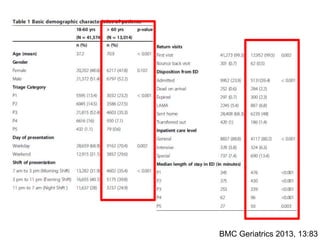
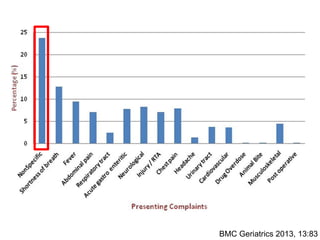
BMC Geriatrics 2013, 13:83
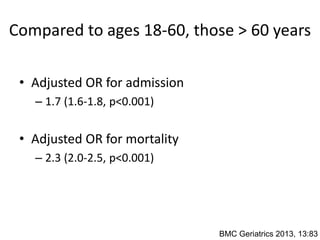
Compared to ages 18-60, those > 60 years 
• Adjusted OR for admission 
– 1.7 (1.6-1.8, p<0.001) 
• Adjusted OR for mortality 
– 2.3 (2.0-2.5, p<0.001) 
BMC Geriatrics 2013, 13:83
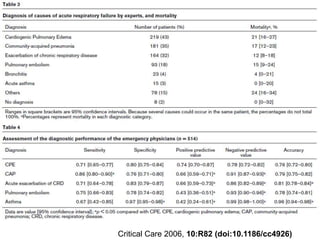
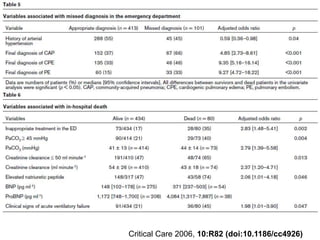
Critical Care 2006, 10:R82 (doi:10.1186/cc4926)
Clinical Vignettes in the 
Care of the Older Patient at 
the Emergency Department
Geriatric syndromes 
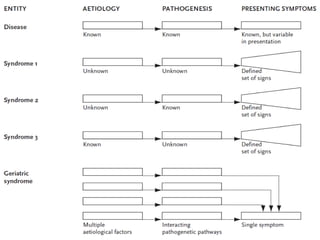
• refer to multifactorial health conditions that 
occur when the accumulated effects of 
impairments in multiple systems render an 
older person vulnerable to situational 
challenges 
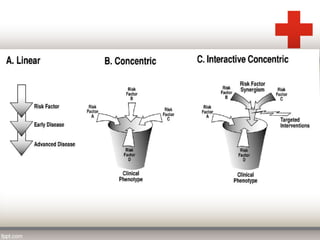
• Emphasizes multiple causation of a unified 
manifestation
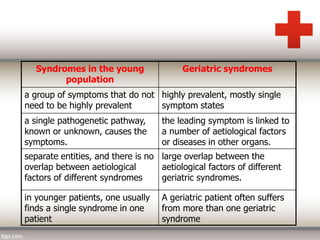
Syndromes in the young 
population 
Geriatric syndromes 
a group of symptoms that do not 
need to be highly prevalent 
highly prevalent, mostly single 
symptom states 
a single pathogenetic pathway, 
known or unknown, causes the 
symptoms. 
the leading symptom is linked to 
a number of aetiological factors 
or diseases in other organs. 
separate entities, and there is no 
overlap between aetiological 
factors of different syndromes 
large overlap between the 
aetiological factors of different 
geriatric syndromes. 
in younger patients, one usually 
finds a single syndrome in one 
patient 
A geriatric patient often suffers 
from more than one geriatric 
syndrome
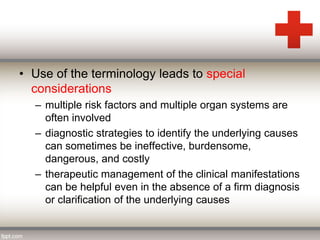
• Use of the terminology leads to special 
considerations 
– multiple risk factors and multiple organ systems are 
often involved 
– diagnostic strategies to identify the underlying causes 
can sometimes be ineffective, burdensome, 
dangerous, and costly 
– therapeutic management of the clinical manifestations 
can be helpful even in the absence of a firm diagnosis 
or clarification of the underlying causes
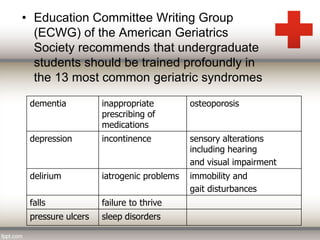
• Education Committee Writing Group 
(ECWG) of the American Geriatrics 
Society recommends that undergraduate 
students should be trained profoundly in 
the 13 most common geriatric syndromes 
dementia inappropriate 
prescribing of 
medications 
osteoporosis 
depression incontinence sensory alterations 
including hearing 
and visual impairment 
delirium iatrogenic problems immobility and 
gait disturbances 
falls failure to thrive 
pressure ulcers sleep disorders
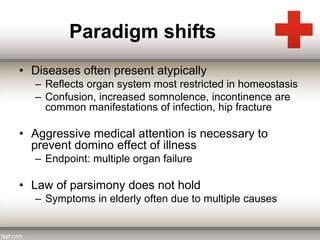
Paradigm shifts 
• Diseases often present atypically 
– Reflects organ system most restricted in homeostasis 
– Confusion, increased somnolence, incontinence are 
common manifestations of infection, hip fracture 
• Aggressive medical attention is necessary to 
prevent domino effect of illness 
– Endpoint: multiple organ failure 
• Law of parsimony does not hold 
– Symptoms in elderly often due to multiple causes
Common Presenting 
Complaints
Acute Myocardial 
Infarction 
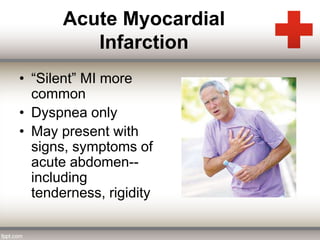
• “Silent” MI more 
common 
• Dyspnea only 
• May present with 
signs, symptoms of 
acute abdomen-- 
including 
tenderness, rigidity
Acute Myocardial 
Infarction 
• Possibly just vague symptoms 
– Weakness 
– Fatigue 
– Syncope 
– Incontinence 
– Confusion 
– TIA/CVA
Congestive Heart Failure 
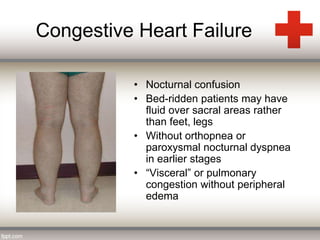
• Nocturnal confusion 
• Bed-ridden patients may have 
fluid over sacral areas rather 
than feet, legs 
• Without orthopnea or 
paroxysmal nocturnal dyspnea 
in earlier stages 
• “Visceral” or pulmonary 
congestion without peripheral 
edema
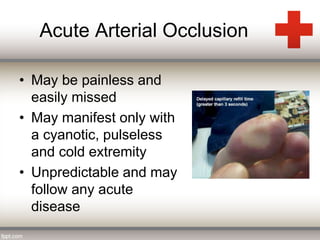
Acute Arterial Occlusion 
• May be painless and 
easily missed 
• May manifest only with 
a cyanotic, pulseless 
and cold extremity 
• Unpredictable and may 
follow any acute 
disease
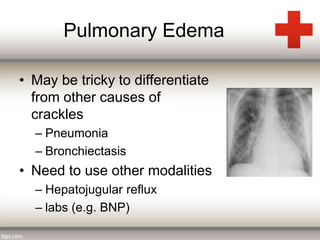
Pulmonary Edema 
• May be tricky to differentiate 
from other causes of 
crackles 
– Pneumonia 
– Bronchiectasis 
• Need to use other modalities 
– Hepatojugular reflux 
– labs (e.g. BNP)
Pulmonary Embolism 
• Suspect in any patient with sudden onset 
of dyspnea when cause cannot be quickly 
identified 
– D-dimer?? 
– DVT screening?? 
– Venous duplex scanning??
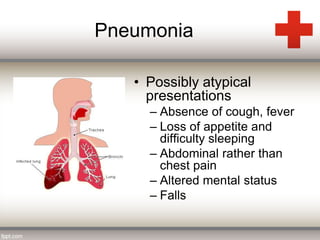
Pneumonia 
• Possibly atypical 
presentations 
– Absence of cough, fever 
– Loss of appetite and 
difficulty sleeping 
– Abdominal rather than 
chest pain 
– Altered mental status 
– Falls
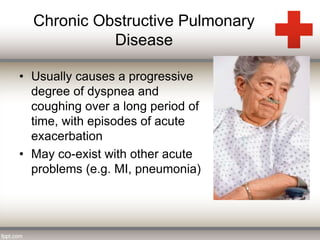
Chronic Obstructive Pulmonary 
Disease 
• Usually causes a progressive 
degree of dyspnea and 
coughing over a long period of 
time, with episodes of acute 
exacerbation 
• May co-exist with other acute 
problems (e.g. MI, pneumonia)
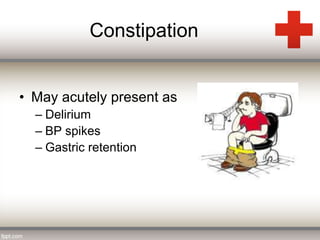
Constipation 
• May acutely present as 
– Delirium 
– BP spikes 
– Gastric retention
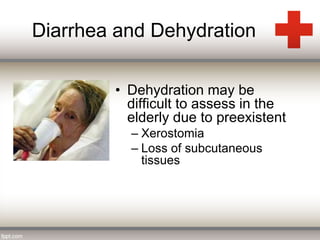
Diarrhea and Dehydration 
• Dehydration may be 
difficult to assess in the 
elderly due to preexistent 
– Xerostomia 
– Loss of subcutaneous 
tissues
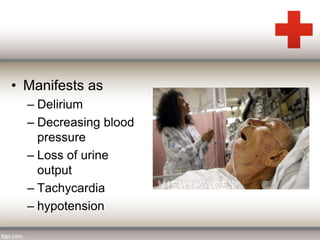
• Manifests as 
– Delirium 
– Decreasing blood 
pressure 
– Loss of urine 
output 
– Tachycardia 
– hypotension
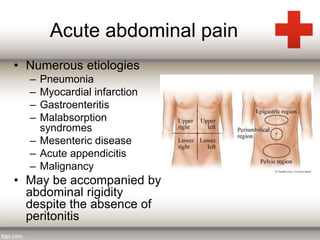
Acute abdominal pain 
• Numerous etiologies 
– Pneumonia 
– Myocardial infarction 
– Gastroenteritis 
– Malabsorption 
syndromes 
– Mesenteric disease 
– Acute appendicitis 
– Malignancy 
• May be accompanied by 
abdominal rigidity 
despite the absence of 
peritonitis
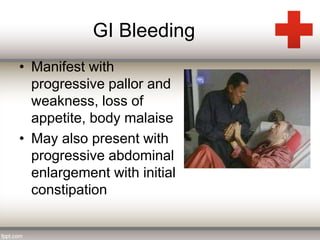
GI Bleeding 
• Manifest with 
progressive pallor and 
weakness, loss of 
appetite, body malaise 
• May also present with 
progressive abdominal 
enlargement with initial 
constipation
Urinary Tract Infection 
• Patient may not complain of painful 
urination or frequency or urgency 
• May manifest with acute incontinence, 
delirium or loss of appetite 
• In cases of pyelonephritis, there may be 
absence of costovertebral tenderness and 
fever
Uremia 
• Symptoms related to the inability of the 
kidney to remove toxins 
• May present with delirium, persistent 
nausea and vomiting, tachypnea 
• May present atypically with body malaise, 
poor appetite, weakness
Hypoglycemia 
• Patient may not 
complain of hunger, 
tremors, sweating 
and other signs seen 
in the young 
• May just present with 
loss of 
consciousness or 
seizures
Hyperglycemia 
• Symptoms are attributable to the 
underlying disorder 
– Diabetic ketoacidosis 
– Hyperosmolar, hyperglycemic state 
• Include delirium, loss of urine output, 
tachypnea, diarrhea, coma
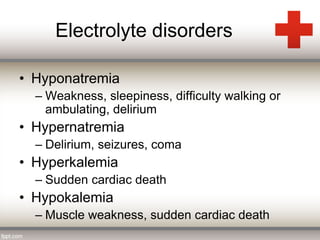
Electrolyte disorders 
• Hyponatremia 
– Weakness, sleepiness, difficulty walking or 
ambulating, delirium 
• Hypernatremia 
– Delirium, seizures, coma 
• Hyperkalemia 
– Sudden cardiac death 
• Hypokalemia 
– Muscle weakness, sudden cardiac death
Dementia vs. Delirium 
• Stable and progressive vs waxing and waning 
• chronic onset vs acute onset 
• The former has more prominent cognitive 
impairment, the latter has sensorium as 
dominant impairment 
• Never assume acute dementia or altered mental 
status is due to “senility” 
• Ask relatives, other caregivers what the patient’s 
baseline mental status is
Possible Causes of Delirium 
• Head injury with 
subdural hematoma 
• Alcohol, drug 
intoxication, withdrawal 
• Tumor 
• CNS Infections 
• Electrolyte imbalances 
• Cardiac failure 
• Hypoglycemia 
• Hypoxia 
• Drug interactions
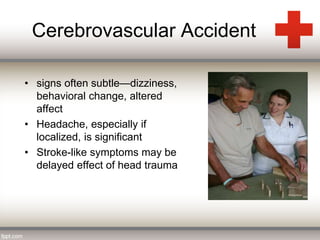
Cerebrovascular Accident 
• signs often subtle—dizziness, 
behavioral change, altered 
affect 
• Headache, especially if 
localized, is significant 
• Stroke-like symptoms may be 
delayed effect of head trauma
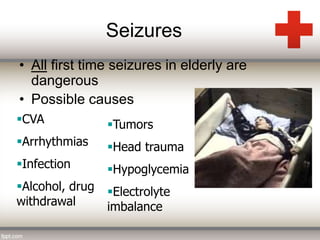
Seizures 
• All first time seizures in elderly are 
dangerous 
• Possible causes 
CVA 
Arrhythmias 
Infection 
Alcohol, drug 
withdrawal 
Tumors 
Head trauma 
Hypoglycemia 
Electrolyte 
imbalance
Syncope 
• Morbidity, mortality higher 
• Consider 
– Cardiogenic causes (MI, arrhythmias) 
– Transient ischemic attack 
– Drug effects (beta blockers, vasodilators) 
– Volume depletion
Depression 
• Common problem 
• May account for symptoms of “senility” 
• Persons >65 account for 25% of all 
suicides 
• Treat as possibly life threatening
Head Injury 
• More likely, even with minor trauma 
• Signs of increased ICP develop slowly 
• Patient may have forgotten injury, delayed 
presentation may be mistaken for CVA
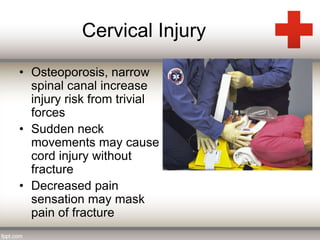
Cervical Injury 
• Osteoporosis, narrow 
spinal canal increase 
injury risk from trivial 
forces 
• Sudden neck 
movements may cause 
cord injury without 
fracture 
• Decreased pain 
sensation may mask 
pain of fracture
Hypovolemia & Shock 
• Decreased ability to compensate 
• Progress to irreversible shock rapidly 
• Tolerate hypoperfusion poorly, even for 
short periods
Hypovolemia & Shock 
• Hypoperfusion may occur at “normal” pressures 
• Medications (beta blockers) may mask signs of 
shock
Geriatric Abuse & Neglect 
• Physical, psychological injury of older 
person by their children or care providers 
• Knows no socioeconomic bounds
Geriatric Abuse & Neglect 
• Contributing factors 
– Advanced age: average mid-80s 
– Multiple chronic diseases 
– Patient lacks total dependence 
– Sleep pattern disturbances leading to 
nocturnal wandering, shouting 
– Family has difficulty upholding commitments
Geriatric Abuse & Neglect 
• Primary findings 
– Trauma inconsistent with history 
– History that changes with multiple tellings
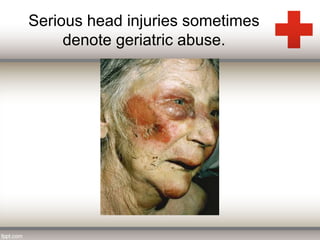
Serious head injuries sometimes 
denote geriatric abuse.
General Management 
Guides 
• No enormous change 
• “Start Low, Go Slow, But Keep on Going” 
• Be wary of Drug Adverse Reactions!
Additional 
• Geriatric Emergency Department 
Guidelines (2014) 
– American College of Emergency Physicians 
– American Geriatrics Society 
– Emergency Nurses Association 
– Society for Academic Emergency Medicine
• Geriatric Emergency Medicine Fellowships
Summary 
• The Emergency Physician plays a vital 
role in the initial management of the 
Geriatric patient 
• Symptoms of the Geriatric ED patient are 
often multiple, overlapping, and atypical, 
complicated by existing diseases, 
medications and age-related changes
Emergencies in Geriatric Patients

Emergencies in Geriatric Patients

  • 1.
    Age Does Matter:Critical Issues in the ED Evaluation of Geriatric Patients Marc Evans M. Abat, MD, FPCP, FPCGM Section of Adult Medicine, Department of Medicine, PGH Head, Center for Healthy Aging, The Medical City
  • 2.
    Case • 92/F • CC: increased sleeping • (+)hypertension • (+)type 2 diabetes on 4 oral hypoglycemic agents • (+) dyslipidemia
  • 3.
    • Came fromSamar due to fever and headaches • Seen at another tertiary hospital in Manila – Dx: viral upper respiratory tract infection – DM medications adjusted due to high CBGs • Increased sleeping started 2 days before current consultation
  • 4.
    • ROS: (+)memorylapses notable since 2 months prior to admission • Physical examination at the ER – BP 100/60 HR 84 RR 20 T 36.7°C – Patient drowsy to stuporous, minimal eye opening on name calling and tapping, groans only with no distinct verbal output – E/N findings for other organ systems including neuro
  • 5.
    What is yourinitial impression? A. Hypoglycemia B. Infection C. Electrolyte Imbalance D. Stroke E. Dehydration
  • 6.
    Outline • CriticalRole of the Emergency Medicine Physician • Clinical Vignettes in the Care of the Older Patient at the Emergency Department • Common Presenting Complaints
  • 7.
    Critical Role ofthe Emergency Medicine Physician
  • 8.
  • 9.
  • 10.
    Compared to ages18-60, those > 60 years • Adjusted OR for admission – 1.7 (1.6-1.8, p<0.001) • Adjusted OR for mortality – 2.3 (2.0-2.5, p<0.001) BMC Geriatrics 2013, 13:83
  • 11.
    Critical Care 2006,10:R82 (doi:10.1186/cc4926)
  • 12.
    Critical Care 2006,10:R82 (doi:10.1186/cc4926)
  • 13.
    Clinical Vignettes inthe Care of the Older Patient at the Emergency Department
  • 14.
    Geriatric syndromes •refer to multifactorial health conditions that occur when the accumulated effects of impairments in multiple systems render an older person vulnerable to situational challenges • Emphasizes multiple causation of a unified manifestation
  • 15.
    Syndromes in theyoung population Geriatric syndromes a group of symptoms that do not need to be highly prevalent highly prevalent, mostly single symptom states a single pathogenetic pathway, known or unknown, causes the symptoms. the leading symptom is linked to a number of aetiological factors or diseases in other organs. separate entities, and there is no overlap between aetiological factors of different syndromes large overlap between the aetiological factors of different geriatric syndromes. in younger patients, one usually finds a single syndrome in one patient A geriatric patient often suffers from more than one geriatric syndrome
  • 17.
    • Use ofthe terminology leads to special considerations – multiple risk factors and multiple organ systems are often involved – diagnostic strategies to identify the underlying causes can sometimes be ineffective, burdensome, dangerous, and costly – therapeutic management of the clinical manifestations can be helpful even in the absence of a firm diagnosis or clarification of the underlying causes
  • 19.
    • Education CommitteeWriting Group (ECWG) of the American Geriatrics Society recommends that undergraduate students should be trained profoundly in the 13 most common geriatric syndromes dementia inappropriate prescribing of medications osteoporosis depression incontinence sensory alterations including hearing and visual impairment delirium iatrogenic problems immobility and gait disturbances falls failure to thrive pressure ulcers sleep disorders
  • 20.
    Paradigm shifts •Diseases often present atypically – Reflects organ system most restricted in homeostasis – Confusion, increased somnolence, incontinence are common manifestations of infection, hip fracture • Aggressive medical attention is necessary to prevent domino effect of illness – Endpoint: multiple organ failure • Law of parsimony does not hold – Symptoms in elderly often due to multiple causes
  • 21.
  • 22.
    Acute Myocardial Infarction • “Silent” MI more common • Dyspnea only • May present with signs, symptoms of acute abdomen-- including tenderness, rigidity
  • 23.
    Acute Myocardial Infarction • Possibly just vague symptoms – Weakness – Fatigue – Syncope – Incontinence – Confusion – TIA/CVA
  • 24.
    Congestive Heart Failure • Nocturnal confusion • Bed-ridden patients may have fluid over sacral areas rather than feet, legs • Without orthopnea or paroxysmal nocturnal dyspnea in earlier stages • “Visceral” or pulmonary congestion without peripheral edema
  • 25.
    Acute Arterial Occlusion • May be painless and easily missed • May manifest only with a cyanotic, pulseless and cold extremity • Unpredictable and may follow any acute disease
  • 26.
    Pulmonary Edema •May be tricky to differentiate from other causes of crackles – Pneumonia – Bronchiectasis • Need to use other modalities – Hepatojugular reflux – labs (e.g. BNP)
  • 27.
    Pulmonary Embolism •Suspect in any patient with sudden onset of dyspnea when cause cannot be quickly identified – D-dimer?? – DVT screening?? – Venous duplex scanning??
  • 28.
    Pneumonia • Possiblyatypical presentations – Absence of cough, fever – Loss of appetite and difficulty sleeping – Abdominal rather than chest pain – Altered mental status – Falls
  • 29.
    Chronic Obstructive Pulmonary Disease • Usually causes a progressive degree of dyspnea and coughing over a long period of time, with episodes of acute exacerbation • May co-exist with other acute problems (e.g. MI, pneumonia)
  • 30.
    Constipation • Mayacutely present as – Delirium – BP spikes – Gastric retention
  • 31.
    Diarrhea and Dehydration • Dehydration may be difficult to assess in the elderly due to preexistent – Xerostomia – Loss of subcutaneous tissues
  • 32.
    • Manifests as – Delirium – Decreasing blood pressure – Loss of urine output – Tachycardia – hypotension
  • 33.
    Acute abdominal pain • Numerous etiologies – Pneumonia – Myocardial infarction – Gastroenteritis – Malabsorption syndromes – Mesenteric disease – Acute appendicitis – Malignancy • May be accompanied by abdominal rigidity despite the absence of peritonitis
  • 34.
    GI Bleeding •Manifest with progressive pallor and weakness, loss of appetite, body malaise • May also present with progressive abdominal enlargement with initial constipation
  • 35.
    Urinary Tract Infection • Patient may not complain of painful urination or frequency or urgency • May manifest with acute incontinence, delirium or loss of appetite • In cases of pyelonephritis, there may be absence of costovertebral tenderness and fever
  • 36.
    Uremia • Symptomsrelated to the inability of the kidney to remove toxins • May present with delirium, persistent nausea and vomiting, tachypnea • May present atypically with body malaise, poor appetite, weakness
  • 37.
    Hypoglycemia • Patientmay not complain of hunger, tremors, sweating and other signs seen in the young • May just present with loss of consciousness or seizures
  • 38.
    Hyperglycemia • Symptomsare attributable to the underlying disorder – Diabetic ketoacidosis – Hyperosmolar, hyperglycemic state • Include delirium, loss of urine output, tachypnea, diarrhea, coma
  • 39.
    Electrolyte disorders •Hyponatremia – Weakness, sleepiness, difficulty walking or ambulating, delirium • Hypernatremia – Delirium, seizures, coma • Hyperkalemia – Sudden cardiac death • Hypokalemia – Muscle weakness, sudden cardiac death
  • 40.
    Dementia vs. Delirium • Stable and progressive vs waxing and waning • chronic onset vs acute onset • The former has more prominent cognitive impairment, the latter has sensorium as dominant impairment • Never assume acute dementia or altered mental status is due to “senility” • Ask relatives, other caregivers what the patient’s baseline mental status is
  • 41.
    Possible Causes ofDelirium • Head injury with subdural hematoma • Alcohol, drug intoxication, withdrawal • Tumor • CNS Infections • Electrolyte imbalances • Cardiac failure • Hypoglycemia • Hypoxia • Drug interactions
  • 42.
    Cerebrovascular Accident •signs often subtle—dizziness, behavioral change, altered affect • Headache, especially if localized, is significant • Stroke-like symptoms may be delayed effect of head trauma
  • 43.
    Seizures • Allfirst time seizures in elderly are dangerous • Possible causes CVA Arrhythmias Infection Alcohol, drug withdrawal Tumors Head trauma Hypoglycemia Electrolyte imbalance
  • 44.
    Syncope • Morbidity,mortality higher • Consider – Cardiogenic causes (MI, arrhythmias) – Transient ischemic attack – Drug effects (beta blockers, vasodilators) – Volume depletion
  • 45.
    Depression • Commonproblem • May account for symptoms of “senility” • Persons >65 account for 25% of all suicides • Treat as possibly life threatening
  • 46.
    Head Injury •More likely, even with minor trauma • Signs of increased ICP develop slowly • Patient may have forgotten injury, delayed presentation may be mistaken for CVA
  • 47.
    Cervical Injury •Osteoporosis, narrow spinal canal increase injury risk from trivial forces • Sudden neck movements may cause cord injury without fracture • Decreased pain sensation may mask pain of fracture
  • 48.
    Hypovolemia & Shock • Decreased ability to compensate • Progress to irreversible shock rapidly • Tolerate hypoperfusion poorly, even for short periods
  • 49.
    Hypovolemia & Shock • Hypoperfusion may occur at “normal” pressures • Medications (beta blockers) may mask signs of shock
  • 50.
    Geriatric Abuse &Neglect • Physical, psychological injury of older person by their children or care providers • Knows no socioeconomic bounds
  • 51.
    Geriatric Abuse &Neglect • Contributing factors – Advanced age: average mid-80s – Multiple chronic diseases – Patient lacks total dependence – Sleep pattern disturbances leading to nocturnal wandering, shouting – Family has difficulty upholding commitments
  • 52.
    Geriatric Abuse &Neglect • Primary findings – Trauma inconsistent with history – History that changes with multiple tellings
  • 53.
    Serious head injuriessometimes denote geriatric abuse.
  • 54.
    General Management Guides • No enormous change • “Start Low, Go Slow, But Keep on Going” • Be wary of Drug Adverse Reactions!
  • 55.
    Additional • GeriatricEmergency Department Guidelines (2014) – American College of Emergency Physicians – American Geriatrics Society – Emergency Nurses Association – Society for Academic Emergency Medicine
  • 56.
    • Geriatric EmergencyMedicine Fellowships
  • 57.
    Summary • TheEmergency Physician plays a vital role in the initial management of the Geriatric patient • Symptoms of the Geriatric ED patient are often multiple, overlapping, and atypical, complicated by existing diseases, medications and age-related changes