
General Care of the Elderly
MARC EVANS M. ABAT, MD, FPCP, FPCGM
Internal Medicine-Geriatric Medicine
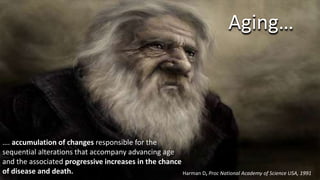
…. accumulation of changes responsible for the
sequential alterations that accompany advancing age
and the associated progressive increases in the chance
of disease and death. Harman D, Proc National Academy of Science USA, 1991
Aging…
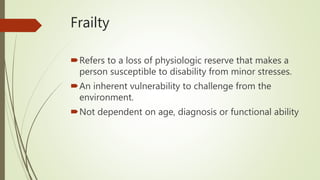
Frailty
Refers to a loss of physiologic reserve that makes a
person susceptible to disability from minor stresses.
An inherent vulnerability to challenge from the
environment.
Not dependent on age, diagnosis or functional ability
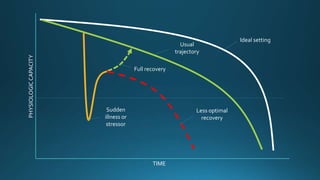
TIME
PHYSIOLOGIC
CAPACITY
Ideal setting
Usual
trajectory
Sudden
illness or
stressor
Full recovery
Less optimal
recovery
https://www.ncbi.nlm.nih.gov/pmc/articles/PMC2409147/
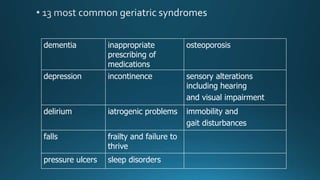
dementia inappropriate
prescribing of
medications
osteoporosis
depression incontinence sensory alterations
including hearing
and visual impairment
delirium iatrogenic problems immobility and
gait disturbances
falls frailty and failure to
thrive
pressure ulcers sleep disorders
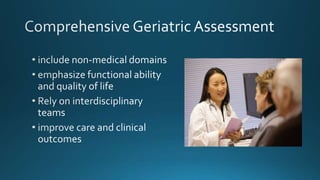
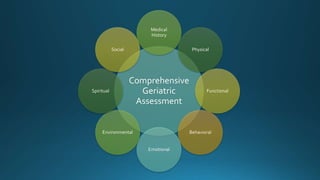
Comprehensive
Geriatric
Assessment
Medical
History
Physical
Functional
Behavioral
Emotional
Environmental
Spiritual
Social
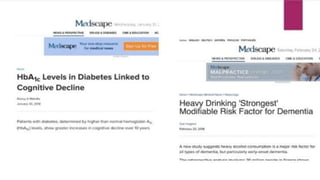
Optimal control of all comorbid conditions
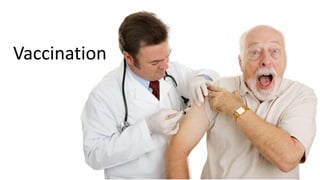
Vaccination
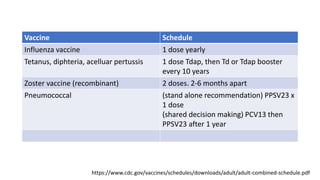
Vaccine Schedule
Influenza vaccine 1 dose yearly
Tetanus, diphteria, acelluar pertussis 1 dose Tdap, then Td or Tdap booster
every 10 years
Zoster vaccine (recombinant) 2 doses. 2-6 months apart
Pneumococcal (stand alone recommendation) PPSV23 x
1 dose
(shared decision making) PCV13 then
PPSV23 after 1 year
https://www.cdc.gov/vaccines/schedules/downloads/adult/adult-combined-schedule.pdf
Be wary of shams
and quackery!
Consider other forms of
medical care access like
doctor’s house calls.
Regular
laboratory
examinations
•Nutritional management
• Caloric intake and macronutrient regulation
• Vitamin and micronutrient supplementation
• Nutraceuticals
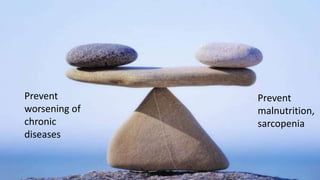
Prevent
worsening of
chronic
diseases
Prevent
malnutrition,
sarcopenia
Mental Health and Stress Management
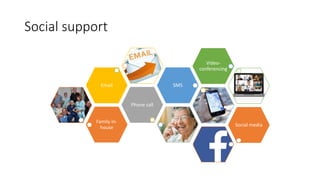
Social support
Family in-
house
Phone call
Email SMS
Video-
conferencing
Social media
General care of the elderly

General care of the elderly

Editor's Notes

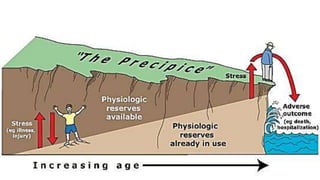
  • #4 Aging is what happens when accumulation of changes (which can happen on multiple levels of complexity  from the genome, epigenetic levels, biochemical processes, macromolecules and tissues, organ systems) responsible for sequential alterations with advancing age Associated with increased chance of disease and death
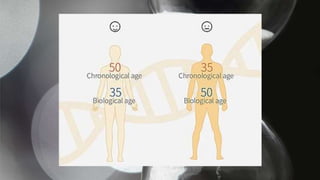
  • #5 Now we obviously see that not all older people are the same. We know of people in their 70s or 80s who are still very active and functional for their age. There are stories of what we call SUPER SENIORS who are master athletes in their respective fields (the Indian marathoner, bodybuilders like Schwarzenegger, etc.) On the other hand there are other persons who are in their 50s or 60s yet are already functionally limited, or even disabled due to the accumulated effects and complications of diseases This is the concept of chronological age vs biological age. The former is the numerical count of time of a person’s existence. The other is the actual manifestations of changes in the function of the entire body that may be phenotypically discordant with time
  • #6 As one ages, and due to numerous factors like baseline health, presence of vices, or disease, the amount of physiologic reserve (the amount of bodily resources that are used to overcome stress) decreases. This is because the body starts to use more of these resources to maintain equilibrium. This is the concept of homeostenosis-the ability to maintain equilibrium becomes narrower. At some point, if the physiologic reserve remaining is overcome, adverse outcomes happen like what we call geriatric syndromes, hospitalization and death As was discussed earlier on biological age, the physiologic reserve may vary from person to person depending on inherent and modifiable factors like genetics, lifestyle, presence of comorbidities, vices, environment, education, etc.