Bariatric Surgery Complications
NUTRITION CASE STUDY
WENDY THOMPSON
WVU DIETETIC INTERN
D E C E M B E R 2 ND, 2 0 1 3
Outline
2

 Overview of the Patient
 Sleeve Gastrectomy Surgery
 Medical Nutrition Therapy for Bariatric Surgery
 Nutrition Care Process of the Patient
 Nutrition Assessment
 Nutrition Diagnosis
 Nutrition Intervention
 Monitoring/Evaluation
 Follow-Ups
Patient Overview
3

 58-year-old female

 Past Medical History:

 Current Medical History:



s/p Gastric Sleeve Surgery
(July 2013)





Persistent Leakage
 Gastric Stenting
 Left Upper Quadrant
Abscess





Nausea and Vomiting
Leukocytosis







Morbid Obesity (BMI 45
pre-surgery)
Hypertension
Hyperlipidemia
GERD
Cholecystectomy
Hysterectomy
What is a Laparoscopic Sleeve
Gastrectomy?
Laparoscopic Sleeve Gastrectomy Overview
5

 Removes 60-80% of the stomach
 Shrinks stomach capacity to ≤300 mL
 Weight loss mechanism = gastric restriction and

possible decreased levels of ghrelin


Ghrelin = appetite stimulating hormone primarily produced in
fundus and with small amounts produced in the pancreas

 Potential nutritional risk factors = nutrient

deficiencies due to:



Decreased intake
Removal of the majority of parietal cells


Decreased hydrochloric acid and intrinsic factor (B12)
Who is a Candidate for Bariatric Surgery?
6

 BMI ≥ 40 or 35-39.9 with comorbidities:
 Type 2 diabetes
 Sleep apnea
 Hypertension
 Cardiovascular disease
 Osteoarthritis
 Age 16-70 (some exceptions possible)
 Failed attempts at diet and exercise
 Have been obese for at least 5 years
 Free of substantial psychological disease, drug or alcohol

dependency
 Candidates must be able to understand surgery and postsurgery lifestyle requirements
 Motivated and well-informed
Outcomes of Sleeve Gastrectomy
7

 Weight Loss Outcomes for

average % of excess body
weight:







1 month: 18-30%
3 months: 37-41%
6 months: 54-61%
1 year: 58-70%
2 years: 61.5%
5 years: no long-term data

 Potential Complications:
 Nausea/Vomiting
 GERD
 Anemia
 Leakage along the staple line
causing peritonitis or abscess
 Sleeve Stricture
 Bowel Obstruction
 Pneumonia
 Deep Venous Thrombosis
(DVT)
 Acute Kidney Injury
 Liver Failure
Post-Bariatric Surgery Behavior
8

 Eat slowly and chew thoroughly – at least 25 times!
 Avoid concentrated sugars, especially in liquid form
 Limit fats and fried foods
 Shrink your portions – do NOT overeat!
 Do not drink liquids with a meal – try not to drink

30 minutes before and after a meal or snack
 If you can no longer tolerate diary – try a lactose-free
diary source
 Exercise – after 2 months more strenuous exercise
can be tolerated
MNT for Sleeve Gastrectomy
9

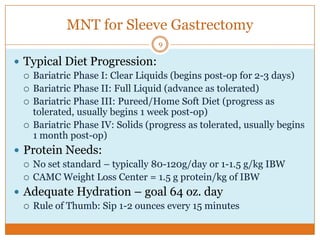
 Typical Diet Progression:
 Bariatric Phase I: Clear Liquids (begins post-op for 2-3 days)
 Bariatric Phase II: Full Liquid (advance as tolerated)
 Bariatric Phase III: Pureed/Home Soft Diet (progress as
tolerated, usually begins 1 week post-op)
 Bariatric Phase IV: Solids (progress as tolerated, usually begins
1 month post-op)
 Protein Needs:
 No set standard – typically 80-120g/day or 1-1.5 g/kg IBW
 CAMC Weight Loss Center = 1.5 g protein/kg of IBW

 Adequate Hydration – goal 64 oz. day
 Rule of Thumb: Sip 1-2 ounces every 15 minutes
Sample Menu for 1 Month Post Op
(Bariatric Home Soft Diet)
10

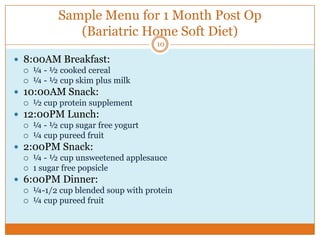
 8:00AM Breakfast:
 ¼ - ½ cooked cereal
 ¼ - ½ cup skim plus milk
 10:00AM Snack:
 ½ cup protein supplement
 12:00PM Lunch:
 ¼ - ½ cup sugar free yogurt
 ¼ cup pureed fruit
 2:00PM Snack:
 ¼ - ½ cup unsweetened applesauce
 1 sugar free popsicle
 6:00PM Dinner:
 ¼-1/2 cup blended soup with protein
 ¼ cup pureed fruit
MNT Life-Long Bariatric Diet
11

 High protein
 Low in refined carbohydrates
 Ideally, choose protein first, then fruits and

vegetables, and then whole grains
 Maintain adequate hydration
Vitamin and Supplement Rx
12

 First 3 Weeks Post-Op:
 Chewable multi-vitamin
 Chewable calcium
 Vitamin D – only if levels are low
 Vitamin B12 – if needed
 Protein supplements


Must be high in protein (15-25g/serving) and low in sugar (less than 10g/serving)

 After 3 Weeks Post-Op:
 Multi-vitamin
 Calcium Citrate (1200 mg)
 Vitamin B12- if needed
 Vitamin D – only if levels are low
 Iron – only if prescribed by MD
 Protein Supplements – if unable to consume 50-70g protein/day
 Ursodiol – “Gall Bladder Pills” only for the first 6 months


Helps prevent gallstones due to rapid weight loss
Nutrition Care Process
Nutrition Assessment (11/12)
14

 Secondary To:

TPN protocol consult
 Current Medical History:
 s/p sleeve gastrectomy, persistent gastric leak, morbid obesity,
HTN, hypokalemia, tachycardia
 Past Medical History:
 HTN, hyperlipidemia, GERD, cholecystectomy, partial
hysterectomy

Bariatric Past Medical History
15

 7/8/2013: Laparoscopic Sleeve Gastrectomy
 N/V started 2 weeks post-op
 8/9/2013: Upper GI Endoscopy – found mild stricture in the










opening of the gastroplasty (between esophagus and stomach),
performed balloon dilation
8/15/2013: Admitted to ER with N/V, HTN, leukocytosis, lactic
acidosis – conducted CT scan to find left upper quadrant abscess
and left pleural effusion
8/16/2013: Transferred to Cleveland Clinic and had abscess drained
8/19/2013: Re-drained abscess
8/23/2013: Re-drained abscess, placed gastric sleeve stent, resealed the leak at the staple line
8/29/2013: Endoscopic exploration found stent partially collapsed
so it was adjusted
9/2/2013: Double stenting placed to correct the collapse stent
11/02/2013: Transferred from Cleveland Clinic to CAMC
Patient Medications and Supplements
16

Medication Name

Reason

Protonix

PPI to decrease stomach acid to treat GERD

Mylanta

Neutralizes existing stomach acid to treat GERD

Reglan

Reduces nausea, vomiting, and GERD

Phenergan

Helps treat existing nausea and vomiting

Zofran

Helps prevent nausea and vomiting

Metoprolol

Beta-blocker to lower blood pressure

Lasix

Loop diuretic to lower blood pressure

Dilaudid

Treats pain

Folic Acid

Individuals post bariatric surgery are at an increased risk for
deficiency – used to prevent deficiency

Vitamin B6
Vitamin B12
Thiamine
Anthropometric Measurements
17

Height

165.1 cm (5’5”)

Weight

112 kg (10/30 – Bed Scale)

IBW

57 kg

% IBW

196%

Adjusted/Feeding Weight

71 kg

BMI

41.1 (Class III Obesity)
Nutrient Needs
18

 Current Diet Order (11/12):


Vivonex RTF @ goal rate of 60ml/hr to provide 1440kcal, 72g
protein, and 1224ml free H2O




NG tube

Bariatric Phase I - Clear Liquids
Estimated Needs Per Kg of IBW

Per Day

Energy (kcal)

18 – 22 kcal

1278 – 1562 kcal

Protein

1 – 1.5 grams

71 – 106 grams

Fluid

Per MD

Per MD
Subjective Information (11/12)
19

 Patient was consuming ~50% of clear liquid diet and

tube feeding was up to 40ml/hour
 Very nauseous
 Vomits multiple times a day and has since 2 weeks
post-surgery in July
 Patient has had nothing but clear liquids and tube
feedings since surgery
Patient Labs
20

11/11

Potential Reasons for Abnormalities

Glucose (74-106)

127 

Stress, insulin resistance

Na (136-145)

135 

K (3.5-5.1)

3.4 

BUN (7-18)

21 

Creatinine (0.6-1.3)

1.4 

eGFR (>60)

47 

Based on creatinine levels – potential decrease in kidney
function

Albumin (3.4-5)

1.6 

Sign of inflammation with potential protein/energy
deficiency

Occurs with prolonged vomiting
Potential decrease in kidney function or dehydration
Nutrition Diagnosis
21

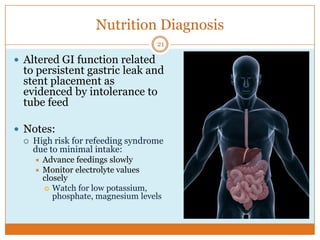
 Altered GI function related

to persistent gastric leak and
stent placement as
evidenced by intolerance to
tube feed

 Notes:


High risk for refeeding syndrome
due to minimal intake:
Advance feedings slowly
 Monitor electrolyte values
closely
 Watch for low potassium,
phosphate, magnesium levels

Nutrition Intervention (11/12)
22

 d/c tube feeding and bariatric clear liquid diet
 Due to persistent N/V
 PICC line placement was ordered by MD and x-ray

was used to verify correct placement
 Initiate TPN @ 8:00PM (11/12) per CAMC protocol




TPN was discussed with Physician, who determined the initial
rate to be 75 ml/hour
Nursing staff was notified

 IPOC
Parenteral Nutrition Invention
23

 PICC Line
 Start: subclavian vein
 End: superior vena cava
Parenteral Nutrition Intervention
24

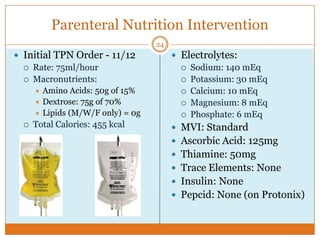
 Initial TPN Order - 11/12
 Rate: 75ml/hour
 Macronutrients:
 Amino Acids: 50g of 15%
 Dextrose: 75g of 70%
 Lipids (M/W/F only) = 0g
 Total Calories: 455 kcal

 Electrolytes:
 Sodium: 140 mEq
 Potassium: 30 mEq
 Calcium: 10 mEq
 Magnesium: 8 mEq
 Phosphate: 6 mEq
 MVI: Standard

 Ascorbic Acid: 125mg
 Thiamine: 50mg
 Trace Elements: None
 Insulin: None

 Pepcid: None (on Protonix)
Monitoring and Evaluation
25

 Goals:

Improve protein status
 Provision of adequate nutrition via nutrition support
 Stabilize blood glucose levels
 Monitoring:
 High Risk – F/U in 5 days
 Will follow daily
 Will monitor weight, labs, and TPN/PPN tolerance

TPN Monitoring and Evaluation
26

Check labs per TPN protocol:
 Every 6 hours:









Glucose

 Daily:


 Weekly (unless abnormal):

Basic Metabolic Panel (BMP)
Sodium
Potassium
Calcium
Chloride









Complete Metabolic Panel
(CMP)
Triglyceride
Magnesium
Phosphorus
Ionized Calcium
Pre-albumin
Liver panel
Follow-Up Assessment (11/14)
27

 Subjective Information:




Patient was tolerating full liquid diet and a Boost Glucose Control
with lunch and dinner
Patient was still nauseated but had only vomited once today
Patient preferences of cream of chicken, tomato, chicken noodle soup
were recorded

 Plan for Patient:


Spoke with social worker and determined that the patient must be on
12-hour cyclic TPN prior to discharge in order to be accepted into a
skilled nursing facility




Plan to start cycling on Monday (11/18)

Patient will require an stent placement – per MD notes, date planned
for 11/20
Follow-Up Assessment (11/19)
28

 Nutrition Orders:
 11/17: TPN d/c due to lost access secondary to multiple blood
clots
 Bariatric Phase II – Full Liquid with Boost Glucose Control w/
lunch and dinner
 Subjective:
 Patient was tolerating full liquid diet and consuming the
majority of the supplement
 Vomiting frequency has decreased but nausea still persist
Follow-Up Assessment (11/19) Cont.
29

 Significant Lab Changes:
 Alkphos (39-117): 306 
 ALT (17-67): 127 
 AST (15-65): 181 
 Suggestive of potential hepatic dysfunction and

common with TPN
Updates
30

 11/20: Gastric stent placed
 11/22: Restarted TPN
 11/24: Started to cycle TPN – due to SNF

requirements
 11/27: Reached cyclic goal of 12 hours
 11/28: Switched TPN back to continuous due to
acute renal failure


TPN providing an average of 1,314 kcal

 12/2: Bariatric Phase III – Pureed/Soft with Boost

Glucose Control and continuous TPN
Questions?
31
References
32

 Snyder-Marlow G, Taylor D, Lenhard MJ. Nutrition

care for patients undergoing laparoscopic sleeve
gastrectomy for weight loss. J Am Diet Assoc.
2010;110(4):600-607. doi: 10.1016/j.jada.
 CAMC Standards of Practice
 http://www.cornellweightlosssurgery.org/pdf/dietar
y_guidelines_sleeve_gastrectomy.pdf
 http://www.camc.org/surgicalweightloss
Appendix: Patient Labs
33
11/11

11/13

11/14

11/15

11/16

11/17

11/18

Glucose (74106)

127 

120 

140 

112 

106

135 

117 

Na (136-145)

135 

137

139

139

143

140

139

K (3.5-5.1)

3.4 

3.3 

3.3 

3.7

3.5

3.4 

3.5

BUN (7-18)

21 

27 

31 

37 

44 

50 

60 

Creat (0.6-1.3)

1.4 

2.0 

2.0 

1.9 

1.6 

1.6 

1.7 

GFR (>60)

47 

31 

31 

33 

40 

40 

37 

2.5

2.3 

3.1

3.6

Phosphorus
(2.5-4.9)
Albumin (3.45)

3.4
1.6 

1.7 

Pre-Alb. (2040)
Triglycerides
(50-200)

1.6 

1.8 
15.5 

224 

Nutrition case study

  • 1.
    Bariatric Surgery Complications NUTRITIONCASE STUDY WENDY THOMPSON WVU DIETETIC INTERN D E C E M B E R 2 ND, 2 0 1 3
  • 2.
    Outline 2  Overview ofthe Patient  Sleeve Gastrectomy Surgery  Medical Nutrition Therapy for Bariatric Surgery  Nutrition Care Process of the Patient  Nutrition Assessment  Nutrition Diagnosis  Nutrition Intervention  Monitoring/Evaluation  Follow-Ups
  • 3.
    Patient Overview 3  58-year-oldfemale  Past Medical History:  Current Medical History:  s/p Gastric Sleeve Surgery (July 2013)   Persistent Leakage  Gastric Stenting  Left Upper Quadrant Abscess    Nausea and Vomiting Leukocytosis     Morbid Obesity (BMI 45 pre-surgery) Hypertension Hyperlipidemia GERD Cholecystectomy Hysterectomy
  • 4.
    What is aLaparoscopic Sleeve Gastrectomy?
  • 5.
    Laparoscopic Sleeve GastrectomyOverview 5  Removes 60-80% of the stomach  Shrinks stomach capacity to ≤300 mL  Weight loss mechanism = gastric restriction and possible decreased levels of ghrelin  Ghrelin = appetite stimulating hormone primarily produced in fundus and with small amounts produced in the pancreas  Potential nutritional risk factors = nutrient deficiencies due to:   Decreased intake Removal of the majority of parietal cells  Decreased hydrochloric acid and intrinsic factor (B12)
  • 6.
    Who is aCandidate for Bariatric Surgery? 6  BMI ≥ 40 or 35-39.9 with comorbidities:  Type 2 diabetes  Sleep apnea  Hypertension  Cardiovascular disease  Osteoarthritis  Age 16-70 (some exceptions possible)  Failed attempts at diet and exercise  Have been obese for at least 5 years  Free of substantial psychological disease, drug or alcohol dependency  Candidates must be able to understand surgery and postsurgery lifestyle requirements  Motivated and well-informed
  • 7.
    Outcomes of SleeveGastrectomy 7  Weight Loss Outcomes for average % of excess body weight:       1 month: 18-30% 3 months: 37-41% 6 months: 54-61% 1 year: 58-70% 2 years: 61.5% 5 years: no long-term data  Potential Complications:  Nausea/Vomiting  GERD  Anemia  Leakage along the staple line causing peritonitis or abscess  Sleeve Stricture  Bowel Obstruction  Pneumonia  Deep Venous Thrombosis (DVT)  Acute Kidney Injury  Liver Failure
  • 8.
    Post-Bariatric Surgery Behavior 8 Eat slowly and chew thoroughly – at least 25 times!  Avoid concentrated sugars, especially in liquid form  Limit fats and fried foods  Shrink your portions – do NOT overeat!  Do not drink liquids with a meal – try not to drink 30 minutes before and after a meal or snack  If you can no longer tolerate diary – try a lactose-free diary source  Exercise – after 2 months more strenuous exercise can be tolerated
  • 9.
    MNT for SleeveGastrectomy 9  Typical Diet Progression:  Bariatric Phase I: Clear Liquids (begins post-op for 2-3 days)  Bariatric Phase II: Full Liquid (advance as tolerated)  Bariatric Phase III: Pureed/Home Soft Diet (progress as tolerated, usually begins 1 week post-op)  Bariatric Phase IV: Solids (progress as tolerated, usually begins 1 month post-op)  Protein Needs:  No set standard – typically 80-120g/day or 1-1.5 g/kg IBW  CAMC Weight Loss Center = 1.5 g protein/kg of IBW  Adequate Hydration – goal 64 oz. day  Rule of Thumb: Sip 1-2 ounces every 15 minutes
  • 10.
    Sample Menu for1 Month Post Op (Bariatric Home Soft Diet) 10  8:00AM Breakfast:  ¼ - ½ cooked cereal  ¼ - ½ cup skim plus milk  10:00AM Snack:  ½ cup protein supplement  12:00PM Lunch:  ¼ - ½ cup sugar free yogurt  ¼ cup pureed fruit  2:00PM Snack:  ¼ - ½ cup unsweetened applesauce  1 sugar free popsicle  6:00PM Dinner:  ¼-1/2 cup blended soup with protein  ¼ cup pureed fruit
  • 11.
    MNT Life-Long BariatricDiet 11  High protein  Low in refined carbohydrates  Ideally, choose protein first, then fruits and vegetables, and then whole grains  Maintain adequate hydration
  • 12.
    Vitamin and SupplementRx 12  First 3 Weeks Post-Op:  Chewable multi-vitamin  Chewable calcium  Vitamin D – only if levels are low  Vitamin B12 – if needed  Protein supplements  Must be high in protein (15-25g/serving) and low in sugar (less than 10g/serving)  After 3 Weeks Post-Op:  Multi-vitamin  Calcium Citrate (1200 mg)  Vitamin B12- if needed  Vitamin D – only if levels are low  Iron – only if prescribed by MD  Protein Supplements – if unable to consume 50-70g protein/day  Ursodiol – “Gall Bladder Pills” only for the first 6 months  Helps prevent gallstones due to rapid weight loss
  • 13.
  • 14.
    Nutrition Assessment (11/12) 14 Secondary To: TPN protocol consult  Current Medical History:  s/p sleeve gastrectomy, persistent gastric leak, morbid obesity, HTN, hypokalemia, tachycardia  Past Medical History:  HTN, hyperlipidemia, GERD, cholecystectomy, partial hysterectomy 
  • 15.
    Bariatric Past MedicalHistory 15  7/8/2013: Laparoscopic Sleeve Gastrectomy  N/V started 2 weeks post-op  8/9/2013: Upper GI Endoscopy – found mild stricture in the        opening of the gastroplasty (between esophagus and stomach), performed balloon dilation 8/15/2013: Admitted to ER with N/V, HTN, leukocytosis, lactic acidosis – conducted CT scan to find left upper quadrant abscess and left pleural effusion 8/16/2013: Transferred to Cleveland Clinic and had abscess drained 8/19/2013: Re-drained abscess 8/23/2013: Re-drained abscess, placed gastric sleeve stent, resealed the leak at the staple line 8/29/2013: Endoscopic exploration found stent partially collapsed so it was adjusted 9/2/2013: Double stenting placed to correct the collapse stent 11/02/2013: Transferred from Cleveland Clinic to CAMC
  • 16.
    Patient Medications andSupplements 16 Medication Name Reason Protonix PPI to decrease stomach acid to treat GERD Mylanta Neutralizes existing stomach acid to treat GERD Reglan Reduces nausea, vomiting, and GERD Phenergan Helps treat existing nausea and vomiting Zofran Helps prevent nausea and vomiting Metoprolol Beta-blocker to lower blood pressure Lasix Loop diuretic to lower blood pressure Dilaudid Treats pain Folic Acid Individuals post bariatric surgery are at an increased risk for deficiency – used to prevent deficiency Vitamin B6 Vitamin B12 Thiamine
  • 17.
    Anthropometric Measurements 17 Height 165.1 cm(5’5”) Weight 112 kg (10/30 – Bed Scale) IBW 57 kg % IBW 196% Adjusted/Feeding Weight 71 kg BMI 41.1 (Class III Obesity)
  • 18.
    Nutrient Needs 18  CurrentDiet Order (11/12):  Vivonex RTF @ goal rate of 60ml/hr to provide 1440kcal, 72g protein, and 1224ml free H2O   NG tube Bariatric Phase I - Clear Liquids Estimated Needs Per Kg of IBW Per Day Energy (kcal) 18 – 22 kcal 1278 – 1562 kcal Protein 1 – 1.5 grams 71 – 106 grams Fluid Per MD Per MD
  • 19.
    Subjective Information (11/12) 19 Patient was consuming ~50% of clear liquid diet and tube feeding was up to 40ml/hour  Very nauseous  Vomits multiple times a day and has since 2 weeks post-surgery in July  Patient has had nothing but clear liquids and tube feedings since surgery
  • 20.
    Patient Labs 20 11/11 Potential Reasonsfor Abnormalities Glucose (74-106) 127  Stress, insulin resistance Na (136-145) 135  K (3.5-5.1) 3.4  BUN (7-18) 21  Creatinine (0.6-1.3) 1.4  eGFR (>60) 47  Based on creatinine levels – potential decrease in kidney function Albumin (3.4-5) 1.6  Sign of inflammation with potential protein/energy deficiency Occurs with prolonged vomiting Potential decrease in kidney function or dehydration
  • 21.
    Nutrition Diagnosis 21  AlteredGI function related to persistent gastric leak and stent placement as evidenced by intolerance to tube feed  Notes:  High risk for refeeding syndrome due to minimal intake: Advance feedings slowly  Monitor electrolyte values closely  Watch for low potassium, phosphate, magnesium levels 
  • 22.
    Nutrition Intervention (11/12) 22 d/c tube feeding and bariatric clear liquid diet  Due to persistent N/V  PICC line placement was ordered by MD and x-ray was used to verify correct placement  Initiate TPN @ 8:00PM (11/12) per CAMC protocol   TPN was discussed with Physician, who determined the initial rate to be 75 ml/hour Nursing staff was notified  IPOC
  • 23.
    Parenteral Nutrition Invention 23 PICC Line  Start: subclavian vein  End: superior vena cava
  • 24.
    Parenteral Nutrition Intervention 24 Initial TPN Order - 11/12  Rate: 75ml/hour  Macronutrients:  Amino Acids: 50g of 15%  Dextrose: 75g of 70%  Lipids (M/W/F only) = 0g  Total Calories: 455 kcal  Electrolytes:  Sodium: 140 mEq  Potassium: 30 mEq  Calcium: 10 mEq  Magnesium: 8 mEq  Phosphate: 6 mEq  MVI: Standard  Ascorbic Acid: 125mg  Thiamine: 50mg  Trace Elements: None  Insulin: None  Pepcid: None (on Protonix)
  • 25.
    Monitoring and Evaluation 25 Goals: Improve protein status  Provision of adequate nutrition via nutrition support  Stabilize blood glucose levels  Monitoring:  High Risk – F/U in 5 days  Will follow daily  Will monitor weight, labs, and TPN/PPN tolerance 
  • 26.
    TPN Monitoring andEvaluation 26 Check labs per TPN protocol:  Every 6 hours:       Glucose  Daily:   Weekly (unless abnormal): Basic Metabolic Panel (BMP) Sodium Potassium Calcium Chloride       Complete Metabolic Panel (CMP) Triglyceride Magnesium Phosphorus Ionized Calcium Pre-albumin Liver panel
  • 27.
    Follow-Up Assessment (11/14) 27 Subjective Information:    Patient was tolerating full liquid diet and a Boost Glucose Control with lunch and dinner Patient was still nauseated but had only vomited once today Patient preferences of cream of chicken, tomato, chicken noodle soup were recorded  Plan for Patient:  Spoke with social worker and determined that the patient must be on 12-hour cyclic TPN prior to discharge in order to be accepted into a skilled nursing facility   Plan to start cycling on Monday (11/18) Patient will require an stent placement – per MD notes, date planned for 11/20
  • 28.
    Follow-Up Assessment (11/19) 28 Nutrition Orders:  11/17: TPN d/c due to lost access secondary to multiple blood clots  Bariatric Phase II – Full Liquid with Boost Glucose Control w/ lunch and dinner  Subjective:  Patient was tolerating full liquid diet and consuming the majority of the supplement  Vomiting frequency has decreased but nausea still persist
  • 29.
    Follow-Up Assessment (11/19)Cont. 29  Significant Lab Changes:  Alkphos (39-117): 306   ALT (17-67): 127   AST (15-65): 181   Suggestive of potential hepatic dysfunction and common with TPN
  • 30.
    Updates 30  11/20: Gastricstent placed  11/22: Restarted TPN  11/24: Started to cycle TPN – due to SNF requirements  11/27: Reached cyclic goal of 12 hours  11/28: Switched TPN back to continuous due to acute renal failure  TPN providing an average of 1,314 kcal  12/2: Bariatric Phase III – Pureed/Soft with Boost Glucose Control and continuous TPN
  • 31.
  • 32.
    References 32  Snyder-Marlow G,Taylor D, Lenhard MJ. Nutrition care for patients undergoing laparoscopic sleeve gastrectomy for weight loss. J Am Diet Assoc. 2010;110(4):600-607. doi: 10.1016/j.jada.  CAMC Standards of Practice  http://www.cornellweightlosssurgery.org/pdf/dietar y_guidelines_sleeve_gastrectomy.pdf  http://www.camc.org/surgicalweightloss
  • 33.
    Appendix: Patient Labs 33 11/11 11/13 11/14 11/15 11/16 11/17 11/18 Glucose(74106) 127  120  140  112  106 135  117  Na (136-145) 135  137 139 139 143 140 139 K (3.5-5.1) 3.4  3.3  3.3  3.7 3.5 3.4  3.5 BUN (7-18) 21  27  31  37  44  50  60  Creat (0.6-1.3) 1.4  2.0  2.0  1.9  1.6  1.6  1.7  GFR (>60) 47  31  31  33  40  40  37  2.5 2.3  3.1 3.6 Phosphorus (2.5-4.9) Albumin (3.45) 3.4 1.6  1.7  Pre-Alb. (2040) Triglycerides (50-200) 1.6  1.8  15.5  224 

Editor's Notes

  • #6 Leaves the stomach shaped like a sleeve or similar to a bananaGhrelin – appetite stimulating hormone, produced in the fundus which is removed during surgeryIntrinsic factor – helps absorb B12Hydrochloric Acid = kills bacteria and helps denature the proteins in our food, making them more vulnerable to attack by pepsinSnyder-Marlow G, Taylor D, Lenhard MJ. Nutrition care for patients undergoing laparoscopic sleeve gastrectomy for weight loss. J Am Diet Assoc. 2010;110(4):600-607. doi: 10.1016/j.jada.
  • #7 Snyder-Marlow G, Taylor D, Lenhard MJ. Nutrition care for patients undergoing laparoscopic sleeve gastrectomy for weight loss. J Am Diet Assoc. 2010;110(4):600-607. doi: 10.1016/j.jada.
  • #8 % of excess body weight lossSnyder-Marlow G, Taylor D, Lenhard MJ. Nutrition care for patients undergoing laparoscopic sleeve gastrectomy for weight loss. J Am Diet Assoc. 2010;110(4):600-607. doi: 10.1016/j.jada.
  • #10 Snyder-Marlow G, Taylor D, Lenhard MJ. Nutrition care for patients undergoing laparoscopic sleeve gastrectomy for weight loss. J Am Diet Assoc. 2010;110(4):600-607. doi: 10.1016/j.jada.
  • #13 Snyder-Marlow G, Taylor D, Lenhard MJ. Nutrition care for patients undergoing laparoscopic sleeve gastrectomy for weight loss. J Am Diet Assoc. 2010;110(4):600-607. doi: 10.1016/j.jada.
  • #15 Vivonex = elemental EN formula
  • #16 Gastroplasty = gastrectomyLeukocytosis = high WBC countLactic acidosis (carbohydrate meals leads to excess short chain fatty acid to colon which lowers colonic pH levels and increase Gram positive anerobes which produce lactate, humans lack lactate dehydrogenase and it is absorbed into the circulation.Pleural effusion = fluid in lung from leakage
  • #21 With TPN: If Triglycerides read 450 then limit lipids– if 600-700 then d/c lipids
  • #25 Worked with RD to calculateEDIT Based on Standards of Care – only show discrepancies!
  • #34 With TPN: If Triglycerides read 450 then limit lipids– if 600-700 then d/c lipids