HERBAL DRUG TECHNOLOGY
Neutraceuticals
Unit-II
PREPARED BY
MS. MANGAL KAMBLE
ASSISTANT PROFESSOR
SANJAY GHODAWAT UNIVERSITY KOLHAPUR.
NUTRACEUTICALS
In 1989, Dr. Stephen De Felice of the USA created the phrase "nutritraceutical"
by combining the terms "pharmaceutical" and "nutrition." A nutraceutical is a
food, food ingredient, or nutrient that, in addition to its nutritional value, offers
health advantages such disease prevention and health promotion. The majority
of diseases, including diabetes, heart disease, obesity, and others, are brought on
by poor dietary and lifestyle choices. Therefore, nutraceuticals are crucial for
both promoting health and preventing disease.
 By 2024, the market for nutraceuticals is expected to generate USD 671.30
billion in revenue.
 Nutraceuticals are predicted to become more popular in developing countries
due to the rising prevalence of non-communicable diseases like diabetes, cancer,
cardiovascular conditions, etc.
 Due to the rising risk of diseases from unhealthy lifestyle choices and people's
conscious adoption of preventative healthcare measures, nutraceuticals are also
becoming more and more important globally and are now a part of everyday
diets.
 Nutraceuticals are becoming more and more popular as a result of steadily rising
healthcare costs.
Overview of the global market and the expansion of
the nutritional sector
 A rapidly growing market for customized goods, particularly functional meals
and beverages, has emerged in developed nations like the US and Europe.
 Nutraceuticals have become an opportunity for economic growth of many
developing countries which have a rich source of medicinal herbs and
traditional knowledge of such plants, especially India, China and South
American countries.
Nutraceuticals should show encouraging results in preventing and
treating a number of illnesses brought on by bad eating and lifestyle
choices.
Plant constituents like as catechins, carotenoids, lycopene, polyphenols,
PUFA, etc., have proven to be highly beneficial in preventing and
treating a variety of illnesses, including cancer, gastrointestinal problems,
cardiovascular disease, and arthritis.
SCOPE OF NUTRACEUTICALS
The nutraceutical market is segmented into functional foods, functional
beverages and dietary supplements which are again subcategorized into different
products which are as follows:
FUNCTIONAL FOODS
• Cereals
• Bakery & Confectionary
• Dairy
• Snacks
• Functional Fats, oils
• Baby Foods
TYPES OF NUTRACEUTICAL PRODUCTS AVAILABLE IN
THE MARKET
FUNCTIONAL BEVERAGES
• Energy Drinks
• Sports Drinks
• Fortified Juices
• Dairy & Dairy Beverages
• Tea, Coffee
DIETARY SUPPLEMENTS
• Vitamins
• Minerals
• Botanicals
• Enzymes
• Fatty Acids
• Proteins
• Probiotics
Constituents Sources
Health Benefits / Disease
Treatment
Antioxidant Vitamins
Vitamin C (ascorbic acid), Vitamin
E (tocopherols), Carotenoids
(fruits, vegetables)
Cancer, Cardiovascular Diseases,
Arthritis, Alzheimer's Disease,
Cataracts
Polyphenols Tea, Coffee
Antimicrobial, Antidiabetic, Anti-
inflammatory, Cardio protective,
Neurodegenerative Disorders
Curcumin Turmeric
Digestive aid, Anti-inflammatory,
Antimutagenic, Lowers bad
cholesterol, Antioxidant, Diabetic
Neuropathy
Capsaicin (Capsicum) Capsicum (chili peppers)
Digestive health, Anti-
inflammatory, Pain relief,
Antioxidant
ROLE OF NUTRACEUTICALS IN VARIOUS DISEASES
Nutraceuticals play an important role in therapeutic areas such as arthritis, cancer, diabetes
digestion, cholesterol, blood pressure, pain killers, depression and various other disorder. The
following table depicts the role of few plants and their constituents in the prevention and
management of diseases.
Gingerol (Ginger) Ginger Anti-inflammatory, Digestive aid,
Antioxidant
iperine Black Pepper
Enhances bioavailability,
Antioxidant, Digestive health
Eugenol Cloves
Antimicrobial, Anti-inflammatory,
Digestive aid
Polyunsaturated Fatty Acids
Omega-3 and Omega-6 (fish oil,
nuts, seeds)
Cardiovascular Disease,
Dysmenorrhea, Diabetes,
Antithrombotic, Asthma,
Hypolipidemic
Probiotics and Prebiotics
Yogurt, Fermented foods
(probiotics), Dietary fiber
(prebiotics)
Gastrointestinal Disorders,
Constipation, Antitumor effects,
Toxin Neutralization
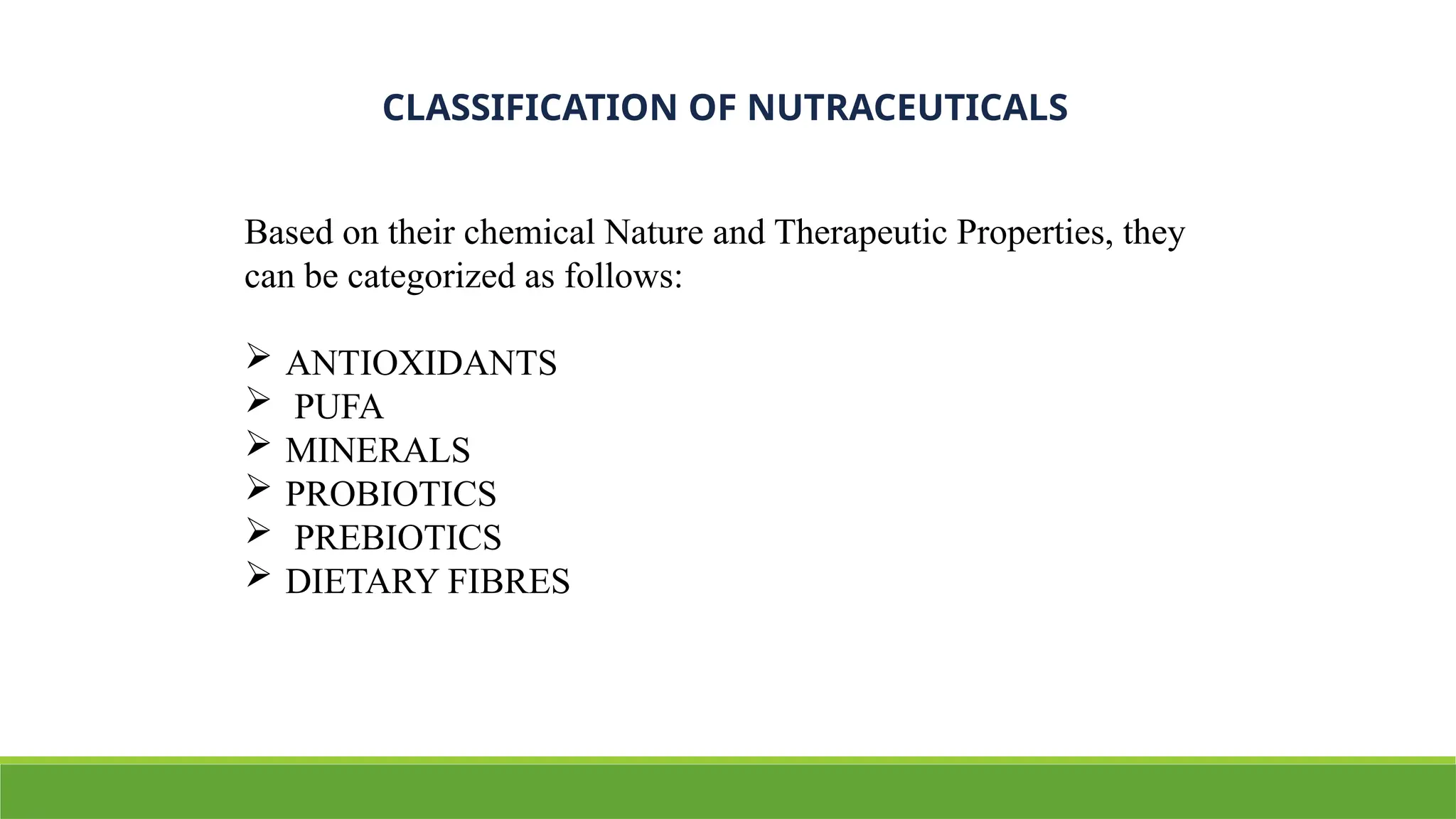
CLASSIFICATION OF NUTRACEUTICALS
Based on their chemical Nature and Therapeutic Properties, they
can be categorized as follows:
 ANTIOXIDANTS
 PUFA
 MINERALS
 PROBIOTICS
 PREBIOTICS
 DIETARY FIBRES
I. Inorganic mineral supplements:
such as calcium, magnesium, manganese, boron, copper, zinc, phosphorous,
etc.
II. Antioxidants:
which are found in fruits, vegetables, and fish and are used to prevent reactive
oxygen species and free scavenging radicals. E.g. Vit A, B, C ,E Beta carotene
III. Polyunsaturated fatty acids (PUFA):
which are fatty acids with multiple double bonds and include essential fatty
acids, such as omega-3-fatty acids, safflower oil, corn oil, soybean oil, and fish
oil.
IV. Probiotics:
which are live microorganisms that, when taken with or without food, improve
intestinal microbial balance and large intestine function. E.g. Lac Chilli,
Saccharomyces cervisiae etc. (YAKULT)
V. Prebiotics:
These are non digestible substances that provide beneficial effects and
protection to the probiotics from gastric acid and digestive enzymes. They
also promote the growth of probiotic bacteria. E.g. Oligo fructose, Inulin,
Galacto-oligosaccharides, Lactulose.
VI. Dietary fibres:
They are two types viz:- water soluble fibres and water insoluble fibres.
They are present rats, vegetables, grains, legumes, etc. They are used to
correct constipation, bowel irregularities.
HERBS AS HEALTH FOOD
a) Alfalfa
Source: It is the entire plant of Medicago sativa belonging to the
Family: Fabacene
Chemical constituents:
Leaves, sprouts and seed contain vitamin-K, vitamin-C, copper,
manganese, folate, thiamine riboflavin, magnesium and iron. One cup
of sprouts contains one gram of protein and one gram of carbohydrates.
It also has a high content of bioactive compounds like saponins
coumarins, flavonoids, phytosterols, phytoestrogens and alkaloids
Uses
It is used as:
 Hypo cholestremic
 Anti hypertensive
 Diuretic.
 Galactogouge
 Anti arthritic.
 To treat kidney stones.
 Anti diabetic.
 To relieve menopausal symptoms.
 Antioxidant
b) Chicory
Source: It is obtained from the plant Cichorium intybus, belonging to the
Family: Asteraceae.
Chemical constituents: Chicory contains a variety of nutrients which include carbohydrates,
protein, vitamins, minerals, soluble fiber, phenolics, Inulin, coumarin, tannins, monomeric
flavonoids, sequiterpene lactones and beta carotene.
Uses: The roots are used as
 A coffee substitute and additive.
 They are mixed in Indian filter coffee
 Used in high blood pressure, heart failure, loss of
appetite stomach upset, constipation, cancer, liver and
gall bladder disorder inflammation and hepatic toxicity.
c) Ginger
Source: It is the dried rhizomes of Zingiber officinale, belonging to the
Family: Zingiberace
Chemical constituents:
It contains volatile oils, minerals, resins. Ginger oil contains zingiberine, bisaboline,
farnesene.
sesquiphellandrene and curcumene. Resins contain phenolic ketones such as
gingerols, shogaols, zingerone and other compounds.
Uses:
 Ginger is used as
• Stomachic
• Aromatic
• Carminative
• Stimulant.
• Flavoring agent.
 In ginger beverages
• Adsorbent of toxins from GIT
• To control parasitic infections
d) Fenugreek
Source: It consists of seeds of the plant Trigonella foenum-graecum, belonging to the
Family: Leguminosae.
Chemical Constituents
It contains alkaloids (Gentiamine, Trigonelline), flavonoids, coumarins, proteins,
amino acids and steroidal saponins
Uses
 Demulcent
 Laxative
 Nutritive
 Expectorant
 Used in the treatment of anorexia, dyspepsia, gastritis, diabetes and high
cholesterol
e) Garlic
Source: It consists of dried bulbs of Allium sativum, belonging to the’
Family: Liliaceae.
Chemical constituents
Garlic contains, carbohydrates, proteins, fats, mucilage, volatile oils and
minerals. The volatile oil contain allin, allicin, allyl propyl disulfide, diallyl
disulfide. Minerals contain phosphorous, iron and copper.
Uses
 Carminative
 Aphrodisiac
 Expectorant
 Stimulant
 Disinfectant.
 Anthelmintic
 Antibacterial.
 Antihypertensive.
 Hypocholestremic.
f) Honey
Source: Honey is a sugar like secretion deposited in honeycomb by the bees Apis
mellifera, A dorsata and other species of Apis, belonging to the
Family: Apidae.
Chemical constituents
Honey is an aqueous solution containing 35% glucose, 45% fructose and 2% sucrose.
Uses
It is used as demulcent sweetening agent, nutrient, antiseptic and expectorant
g) Amla
Source: It consists of fruits of the plant Emblica officinalis
and Phyllanthus emblica, belonging to the
Family: Euphorbiaceae
Chemical constituents:
It contains Vitamin-C (ascorbic acid), calcium, iron and
phosphorous
Uses
 It is used as Diuretic, Laxative.
 Used in the treatment of
• Anemia
• Diarrhea
• Jaundice
 Fruits are used to prepare shampoos and hair oils
h) Ginseng
Source: It consists of roots of the plant Panax ginseng and other
species of Panar, belonging to the
Family: Araliaceae
Chemical constituents:
Ginseng contains saponins, glycosides, volatile oils, sterols,
polysaccharides, minerals, vitamin-B. ,B12, pantothenic acid and
biotin.
Uses
It is used as
 Adaptogenic
 It relieves stress and fatigue.
 Used in hypertension, diabetes, psychogenic impotence and child
psychiatric disorders.
i) Ashwagandha
Source: It consists of dried roots and stem bases of the plant Withania
somnifera belonging to the
Family: Solanaceae
Chemical constituents
It contains alkaloids and steroidal lactones. Alkaloids contain withanine,
somniferine, somnine, tropine, two acyl steryl glucosides sitoindosine-7 and
sitoindosine-8
Uses
Used as
 Sedative
 Hypnotic
 Hypotensive
 Respiratory stimulant
 Immunomodulatory agent
 Anti-stress agent
 Anti-arthritic
j) Spirulina
Source: It is blue green algae obtained from Spirulina maxima or Spirulina
platensis belonging to the
Family: Oscillatoriaceae
Chemical constituents
It contains 50-70% proteins, 5-6% lipids. Lipids contain essential fatty acids like
linoleic acid, oleic acid, palmitic acid.
It also contains glycolipids and sulfolipids, various vitamins like vitamin-B1, B2,
B3. It contains iron and an enzyme superoxide dimutase which has free radical
scavenging effects and helpfull in atherosclerosis, arthritis, diabetes, cataract stress
and aging.
Uses
Used as
 Immune stimulant
 Anticancer, Antiviral
 Hypocholestremic.
 Appetite stimulant

Neutraceuticals.pptx Third year B Pharm Sem VI

  • 1.
    HERBAL DRUG TECHNOLOGY Neutraceuticals Unit-II PREPAREDBY MS. MANGAL KAMBLE ASSISTANT PROFESSOR SANJAY GHODAWAT UNIVERSITY KOLHAPUR.
  • 2.
    NUTRACEUTICALS In 1989, Dr.Stephen De Felice of the USA created the phrase "nutritraceutical" by combining the terms "pharmaceutical" and "nutrition." A nutraceutical is a food, food ingredient, or nutrient that, in addition to its nutritional value, offers health advantages such disease prevention and health promotion. The majority of diseases, including diabetes, heart disease, obesity, and others, are brought on by poor dietary and lifestyle choices. Therefore, nutraceuticals are crucial for both promoting health and preventing disease.
  • 3.
     By 2024,the market for nutraceuticals is expected to generate USD 671.30 billion in revenue.  Nutraceuticals are predicted to become more popular in developing countries due to the rising prevalence of non-communicable diseases like diabetes, cancer, cardiovascular conditions, etc.  Due to the rising risk of diseases from unhealthy lifestyle choices and people's conscious adoption of preventative healthcare measures, nutraceuticals are also becoming more and more important globally and are now a part of everyday diets.  Nutraceuticals are becoming more and more popular as a result of steadily rising healthcare costs. Overview of the global market and the expansion of the nutritional sector
  • 4.
     A rapidlygrowing market for customized goods, particularly functional meals and beverages, has emerged in developed nations like the US and Europe.  Nutraceuticals have become an opportunity for economic growth of many developing countries which have a rich source of medicinal herbs and traditional knowledge of such plants, especially India, China and South American countries.
  • 5.
    Nutraceuticals should showencouraging results in preventing and treating a number of illnesses brought on by bad eating and lifestyle choices. Plant constituents like as catechins, carotenoids, lycopene, polyphenols, PUFA, etc., have proven to be highly beneficial in preventing and treating a variety of illnesses, including cancer, gastrointestinal problems, cardiovascular disease, and arthritis. SCOPE OF NUTRACEUTICALS
  • 6.
    The nutraceutical marketis segmented into functional foods, functional beverages and dietary supplements which are again subcategorized into different products which are as follows: FUNCTIONAL FOODS • Cereals • Bakery & Confectionary • Dairy • Snacks • Functional Fats, oils • Baby Foods TYPES OF NUTRACEUTICAL PRODUCTS AVAILABLE IN THE MARKET
  • 7.
    FUNCTIONAL BEVERAGES • EnergyDrinks • Sports Drinks • Fortified Juices • Dairy & Dairy Beverages • Tea, Coffee DIETARY SUPPLEMENTS • Vitamins • Minerals • Botanicals • Enzymes • Fatty Acids • Proteins • Probiotics
  • 8.
    Constituents Sources Health Benefits/ Disease Treatment Antioxidant Vitamins Vitamin C (ascorbic acid), Vitamin E (tocopherols), Carotenoids (fruits, vegetables) Cancer, Cardiovascular Diseases, Arthritis, Alzheimer's Disease, Cataracts Polyphenols Tea, Coffee Antimicrobial, Antidiabetic, Anti- inflammatory, Cardio protective, Neurodegenerative Disorders Curcumin Turmeric Digestive aid, Anti-inflammatory, Antimutagenic, Lowers bad cholesterol, Antioxidant, Diabetic Neuropathy Capsaicin (Capsicum) Capsicum (chili peppers) Digestive health, Anti- inflammatory, Pain relief, Antioxidant ROLE OF NUTRACEUTICALS IN VARIOUS DISEASES Nutraceuticals play an important role in therapeutic areas such as arthritis, cancer, diabetes digestion, cholesterol, blood pressure, pain killers, depression and various other disorder. The following table depicts the role of few plants and their constituents in the prevention and management of diseases.
  • 9.
    Gingerol (Ginger) GingerAnti-inflammatory, Digestive aid, Antioxidant iperine Black Pepper Enhances bioavailability, Antioxidant, Digestive health Eugenol Cloves Antimicrobial, Anti-inflammatory, Digestive aid Polyunsaturated Fatty Acids Omega-3 and Omega-6 (fish oil, nuts, seeds) Cardiovascular Disease, Dysmenorrhea, Diabetes, Antithrombotic, Asthma, Hypolipidemic Probiotics and Prebiotics Yogurt, Fermented foods (probiotics), Dietary fiber (prebiotics) Gastrointestinal Disorders, Constipation, Antitumor effects, Toxin Neutralization
  • 10.
    CLASSIFICATION OF NUTRACEUTICALS Basedon their chemical Nature and Therapeutic Properties, they can be categorized as follows:  ANTIOXIDANTS  PUFA  MINERALS  PROBIOTICS  PREBIOTICS  DIETARY FIBRES
  • 11.
    I. Inorganic mineralsupplements: such as calcium, magnesium, manganese, boron, copper, zinc, phosphorous, etc. II. Antioxidants: which are found in fruits, vegetables, and fish and are used to prevent reactive oxygen species and free scavenging radicals. E.g. Vit A, B, C ,E Beta carotene III. Polyunsaturated fatty acids (PUFA): which are fatty acids with multiple double bonds and include essential fatty acids, such as omega-3-fatty acids, safflower oil, corn oil, soybean oil, and fish oil. IV. Probiotics: which are live microorganisms that, when taken with or without food, improve intestinal microbial balance and large intestine function. E.g. Lac Chilli, Saccharomyces cervisiae etc. (YAKULT)
  • 12.
    V. Prebiotics: These arenon digestible substances that provide beneficial effects and protection to the probiotics from gastric acid and digestive enzymes. They also promote the growth of probiotic bacteria. E.g. Oligo fructose, Inulin, Galacto-oligosaccharides, Lactulose. VI. Dietary fibres: They are two types viz:- water soluble fibres and water insoluble fibres. They are present rats, vegetables, grains, legumes, etc. They are used to correct constipation, bowel irregularities.
  • 13.
    HERBS AS HEALTHFOOD a) Alfalfa Source: It is the entire plant of Medicago sativa belonging to the Family: Fabacene Chemical constituents: Leaves, sprouts and seed contain vitamin-K, vitamin-C, copper, manganese, folate, thiamine riboflavin, magnesium and iron. One cup of sprouts contains one gram of protein and one gram of carbohydrates. It also has a high content of bioactive compounds like saponins coumarins, flavonoids, phytosterols, phytoestrogens and alkaloids
  • 14.
    Uses It is usedas:  Hypo cholestremic  Anti hypertensive  Diuretic.  Galactogouge  Anti arthritic.  To treat kidney stones.  Anti diabetic.  To relieve menopausal symptoms.  Antioxidant b) Chicory Source: It is obtained from the plant Cichorium intybus, belonging to the Family: Asteraceae. Chemical constituents: Chicory contains a variety of nutrients which include carbohydrates, protein, vitamins, minerals, soluble fiber, phenolics, Inulin, coumarin, tannins, monomeric flavonoids, sequiterpene lactones and beta carotene.
  • 15.
    Uses: The rootsare used as  A coffee substitute and additive.  They are mixed in Indian filter coffee  Used in high blood pressure, heart failure, loss of appetite stomach upset, constipation, cancer, liver and gall bladder disorder inflammation and hepatic toxicity. c) Ginger Source: It is the dried rhizomes of Zingiber officinale, belonging to the Family: Zingiberace Chemical constituents: It contains volatile oils, minerals, resins. Ginger oil contains zingiberine, bisaboline, farnesene. sesquiphellandrene and curcumene. Resins contain phenolic ketones such as gingerols, shogaols, zingerone and other compounds.
  • 16.
    Uses:  Ginger isused as • Stomachic • Aromatic • Carminative • Stimulant. • Flavoring agent.  In ginger beverages • Adsorbent of toxins from GIT • To control parasitic infections d) Fenugreek Source: It consists of seeds of the plant Trigonella foenum-graecum, belonging to the Family: Leguminosae. Chemical Constituents It contains alkaloids (Gentiamine, Trigonelline), flavonoids, coumarins, proteins, amino acids and steroidal saponins
  • 17.
    Uses  Demulcent  Laxative Nutritive  Expectorant  Used in the treatment of anorexia, dyspepsia, gastritis, diabetes and high cholesterol e) Garlic Source: It consists of dried bulbs of Allium sativum, belonging to the’ Family: Liliaceae. Chemical constituents Garlic contains, carbohydrates, proteins, fats, mucilage, volatile oils and minerals. The volatile oil contain allin, allicin, allyl propyl disulfide, diallyl disulfide. Minerals contain phosphorous, iron and copper.
  • 18.
    Uses  Carminative  Aphrodisiac Expectorant  Stimulant  Disinfectant.  Anthelmintic  Antibacterial.  Antihypertensive.  Hypocholestremic. f) Honey Source: Honey is a sugar like secretion deposited in honeycomb by the bees Apis mellifera, A dorsata and other species of Apis, belonging to the Family: Apidae. Chemical constituents Honey is an aqueous solution containing 35% glucose, 45% fructose and 2% sucrose. Uses It is used as demulcent sweetening agent, nutrient, antiseptic and expectorant
  • 19.
    g) Amla Source: Itconsists of fruits of the plant Emblica officinalis and Phyllanthus emblica, belonging to the Family: Euphorbiaceae Chemical constituents: It contains Vitamin-C (ascorbic acid), calcium, iron and phosphorous Uses  It is used as Diuretic, Laxative.  Used in the treatment of • Anemia • Diarrhea • Jaundice  Fruits are used to prepare shampoos and hair oils
  • 20.
    h) Ginseng Source: Itconsists of roots of the plant Panax ginseng and other species of Panar, belonging to the Family: Araliaceae Chemical constituents: Ginseng contains saponins, glycosides, volatile oils, sterols, polysaccharides, minerals, vitamin-B. ,B12, pantothenic acid and biotin. Uses It is used as  Adaptogenic  It relieves stress and fatigue.  Used in hypertension, diabetes, psychogenic impotence and child psychiatric disorders.
  • 21.
    i) Ashwagandha Source: Itconsists of dried roots and stem bases of the plant Withania somnifera belonging to the Family: Solanaceae Chemical constituents It contains alkaloids and steroidal lactones. Alkaloids contain withanine, somniferine, somnine, tropine, two acyl steryl glucosides sitoindosine-7 and sitoindosine-8 Uses Used as  Sedative  Hypnotic  Hypotensive  Respiratory stimulant  Immunomodulatory agent  Anti-stress agent  Anti-arthritic
  • 22.
    j) Spirulina Source: Itis blue green algae obtained from Spirulina maxima or Spirulina platensis belonging to the Family: Oscillatoriaceae Chemical constituents It contains 50-70% proteins, 5-6% lipids. Lipids contain essential fatty acids like linoleic acid, oleic acid, palmitic acid. It also contains glycolipids and sulfolipids, various vitamins like vitamin-B1, B2, B3. It contains iron and an enzyme superoxide dimutase which has free radical scavenging effects and helpfull in atherosclerosis, arthritis, diabetes, cataract stress and aging. Uses Used as  Immune stimulant  Anticancer, Antiviral  Hypocholestremic.  Appetite stimulant