1- 23 year old ,male , with no comorbidities presented
with ho hypoxia , hypotension deviated trachea to
the left with diminished air sound ??
• 2- 60 year old female known DM , HTN , on treatment
, brought un responsive ???
Trauma management in
primary health care
Done by :dr. habiba Mohamed al harthi
R2 family resident
Objectives
Epidemiolgy.
Component of trauma teams .
Goals of trauma management
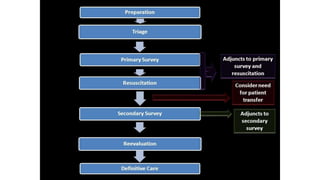
Trauma management phases .
Primary survey.
Secondary survey .
Definitive treatment and management .
•Trauma is the leading cause of
death for people between ages
of 1-44 years ,,exceeded only by
cancer and atherosclerotic
diseases
Epidemiology
• Trauma is a leading cause of mortality globally
• Worldwide, road traffic injuries are the leading cause of death
between the ages of 18 and 29, while in the United States, trauma is
the leading cause of death in young adults and accounts for 10
percent of all deaths among men and women
• Over 45 million people sustain moderate to severe disability each
year due to trauma
• In the United States alone, more than 50 million patients receive
some form of trauma-related medical care for annually, and trauma
accounts for approximately 30 percent of all intensive care unit (ICU)
admissions.(up to date )
• Relatively few patients die after the first 24 hours following injury.
Rather, the majority of deaths occur either at the scene or within the
first four hours after the patient reaches a trauma center
• The objectives of the initial evaluation of the trauma patient are as
follows:
(1) to rapidly identify life-threatening injuries,
(2) to initiate adequate supportive therapy,
(3) to efficiently organize either definitive therapy or transfer to a
facility that provides definitive therapy.
• Teams in primary health care centers including trained physicians and
nursing staff should be available ,in order to optimize patient care.
• Teams should use trauma team approach .each team member should
assigned a specific task or tasks so that each of these can be
performed simulataneously to ensure the most rapid possible
treatment
• Each person should be familiar with basic trauma resuscitation
• 1-BASIC LIFE SUPPORT (BLS)
• 2-ADVANCED TRAUMA LIFE SUPPORT (ATLS)
Role of team leader
• Organizes the group
• Monitors individual performance of team members
• Backs up team members
• Models excellent team behavior
• Facilitates understanding
• Focuses on comprehensive patient care
Effective resuscitation team dynamics
• Effective resuscitation team dynamics
• Closed –loop communications
• Clear massages
• Clear roles and responsibilities
• Knowing ones limitations
• Knowledge sharing
• Constructive intervention
• Re evaluation and summarizing
• Mutual respect
Why ??
• Breakdowns in the care plan and medical mismanagement typically
occur due to one or more of four potential problems
●Communication breakdowns (eg, changes in the patient's physiologic
state or critical test results are not effectively communicated, overall
management plan or priority of tasks is not conveyed clearly by the
team leader)
●Failures in situational awareness (eg, failure to recognize shock, failure
to anticipate blood transfusion needs, failure to modify standard
management for higher risk patients).
●Staffing or workload distribution problems (eg, insufficiently trained
staff conducting a procedure, inadequate staff for patient volume)
●Unresolved conflicts (eg, unresolved hostility about other team
members perceived to be performing inadequately, disagreement
about overall management plan, disagreement among senior clinicians
vying for team leadership)
• Principles of trauma patient management
• Treat the greatest threat to life first.
• Definitive diagnosis is not immediately important.
• Time matters (“golden hour” emphasizes urgency).
• Do no further harm.
• Assess, intervene, reassess
• Did the intervention work?
• Is the patient’s physiology returning to or staying normal
• While the most common causes of mortality from trauma are
hemorrhage, multiple organ dysfunction syndrome, and
cardiopulmonary arrest
• the most common preventable causes of morbidity are unintended
extubation , technical surgical failures, missed injuries, and
intravascular catheter-related complications .
.
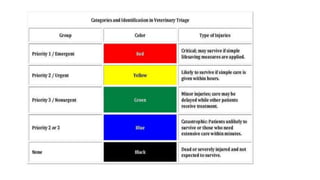
Triage
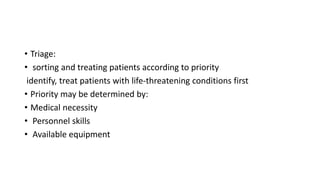
• Triage:
• sorting and treating patients according to priority
identify, treat patients with life-threatening conditions first
• Priority may be determined by:
• Medical necessity
• Personnel skills
• Available equipment
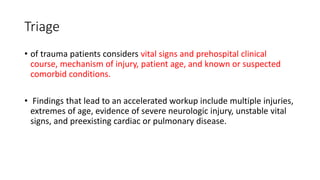
Triage
• of trauma patients considers vital signs and prehospital clinical
course, mechanism of injury, patient age, and known or suspected
comorbid conditions.
• Findings that lead to an accelerated workup include multiple injuries,
extremes of age, evidence of severe neurologic injury, unstable vital
signs, and preexisting cardiac or pulmonary disease.
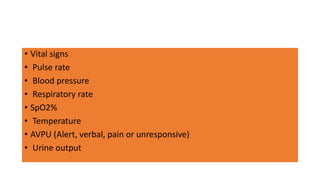
• Vital signs
• Pulse rate
• Blood pressure
• Respiratory rate
• SpO2%
• Temperature
• AVPU (Alert, verbal, pain or unresponsive)
• Urine output
• Traumatic injuries can range from minor isolated wounds to complex
injuries involving multiple organ systems.
• All trauma patients require a systematic approach to management in
order to maximize outcomes and reduce the risk of undiscovered
injuries.
Primary survey
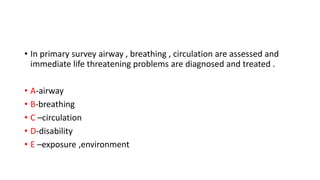
• In primary survey airway , breathing , circulation are assessed and
immediate life threatening problems are diagnosed and treated .
• A-airway
• B-breathing
• C –circulation
• D-disability
• E –exposure ,environment
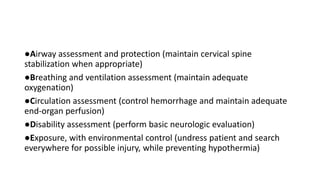
●Airway assessment and protection (maintain cervical spine
stabilization when appropriate)
●Breathing and ventilation assessment (maintain adequate
oxygenation)
●Circulation assessment (control hemorrhage and maintain adequate
end-organ perfusion)
●Disability assessment (perform basic neurologic evaluation)
●Exposure, with environmental control (undress patient and search
everywhere for possible injury, while preventing hypothermia)
• Primary survey usually takes no longer than few minutes , unless
procedures are required ,
• The primary survey must be repeated any time a patients status
changes , including changes in mental status , changes in vital signs
,or administration of new medications or treatment
• AIRWAY
• Always assess the airway
• • Talk to the patient – A patient speaking freely and clearly has an
open airway
• • Look and listen for signs of obstruction
• Snoring or gurgling
• Stridor or noisy breathing
• Foreign body or vomit in mouth
• if airway obstructed, open airway and clear obstruction
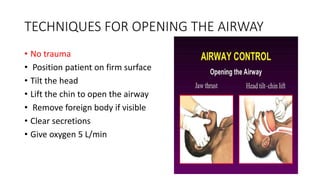
TECHNIQUES FOR OPENING THE AIRWAY
• No trauma
• Position patient on firm surface
• Tilt the head
• Lift the chin to open the airway
• Remove foreign body if visible
• Clear secretions
• Give oxygen 5 L/min
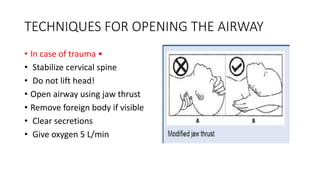
TECHNIQUES FOR OPENING THE AIRWAY
• In case of trauma •
• Stabilize cervical spine
• Do not lift head!
• Open airway using jaw thrust
• Remove foreign body if visible
• Clear secretions
• Give oxygen 5 L/min
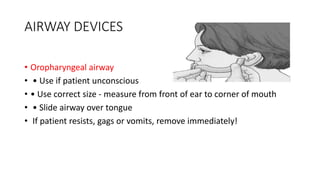
AIRWAY DEVICES
• Oropharyngeal airway
• • Use if patient unconscious
• • Use correct size - measure from front of ear to corner of mouth
• • Slide airway over tongue
• If patient resists, gags or vomits, remove immediately!
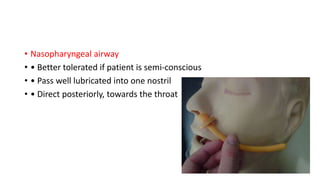
• Nasopharyngeal airway
• • Better tolerated if patient is semi-conscious
• • Pass well lubricated into one nostril
• • Direct posteriorly, towards the throat
•In the unconscious patient, the airway
must be protected immediately once
any obstructions (eg, foreign body,
vomitus, displaced tongue) are removed
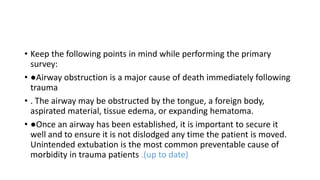
• Keep the following points in mind while performing the primary
survey:
• ●Airway obstruction is a major cause of death immediately following
trauma
• . The airway may be obstructed by the tongue, a foreign body,
aspirated material, tissue edema, or expanding hematoma.
• ●Once an airway has been established, it is important to secure it
well and to ensure it is not dislodged any time the patient is moved.
Unintended extubation is the most common preventable cause of
morbidity in trauma patients .(up to date)
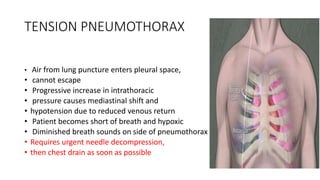
TENSION PNEUMOTHORAX
• Air from lung puncture enters pleural space,
• cannot escape
• Progressive increase in intrathoracic
• pressure causes mediastinal shift and
• hypotension due to reduced venous return
• Patient becomes short of breath and hypoxic
• Diminished breath sounds on side of pneumothorax
• Requires urgent needle decompression,
• then chest drain as soon as possible
INDICATIONS FOR CHEST DECOMPRESSION
• Signs and Symptoms:
• Absent or diminished breath sounds on one side
• Evidence of chest trauma or rib fracture
• Open or "sucking" chest wound
• Diagnoses :
• Pneumothorax
• Tension pneumothorax
• Hemothorax
• Hemo-pnemothorax
Management :
• Give oxygen at 6-10 ml/min ,, via a non –rebreathing face mask , this
is indication for all patient suffering from polytrauma injuries
• Ventilate the patient with rescue breaths , a bag-valve device (bagging
the patient),or a ventilator but put it in mind that if the ventilation
problem is produced by a pneumothorax or tension
pneumothorax,intubation with vigorous bag-valve ventilation could
lead to further detoriartion of patient
• Treat open pneumothorax,tension pneumothorax,flail chest,massive
hemothorax( up to date)
• Insert a large bore needle over rib: – 2nd intercostal space – Over 3rd
rib at mid-clavicular line
• Listen for hissing sound of air escaping
• Insert chest drain
BREATHING
• Assess ventilation - Is the patient in respiratory distress?
• Look – For cyanosis, wounds, deformities, ecchymosis, amplitude,
paradoxical movement
• Feel - Painful areas, abnormal movement
• Percuss - Dullness
• Listen - Reduced breath sounds
• Airway patency alone doesn't assure adequate ventilation , adequate
gas exchange is required to maximize oxygenation and minimize
carbon dioxide accumulation ,
• Ventilation requires adequate function of the lungs ,chest wall ,
diaphragm , each component must be examined and evaluated
rapidly.
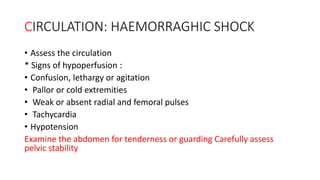
CIRCULATION: HAEMORRAGHIC SHOCK
• Assess the circulation
* Signs of hypoperfusion :
• Confusion, lethargy or agitation
• Pallor or cold extremities
• Weak or absent radial and femoral pulses
• Tachycardia
• Hypotension
Examine the abdomen for tenderness or guarding Carefully assess
pelvic stability
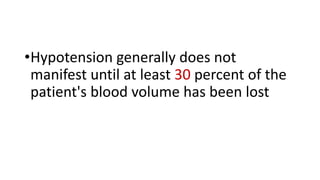
•Hypotension generally does not
manifest until at least 30 percent of the
patient's blood volume has been lost
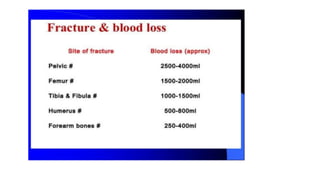
• Large volumes of blood may be hidden in thoracic, abdominal and
pelvic cavities, or from femoral shaft fractures
To decrease bleeding
Apply pressure to external wound
Apply splint to possible femur fracture
Apply pelvic binder to possible pelvic fracture
• Obtain two large bore IV catheters (14-16 gauge) using warmed fluids If
systolic BP <90 mmHg or pulse >110 bpm
• Give 500 ml bolus of Ringer’s Lactate or NS
• Keep patient warm
• Control hemorrhage by direct pressure over the wounds, tourniqutes
should be considered only in very limited conditions (traumatic
amputation).
• Perform CPR if needed
• Reassess vitals
• If still hypotensive after 2L of crystalloids, transfuse blood
INTRAVENOUS ACCESS
• Cannula should be placed in arm vein, not over joint, easy fixation.
Comfortable and convenient for drug administration and care
• Best veins in emergencies:
• Antecubital fossa
• Femoral
• External jugular
• Do not attempt subclavian vein due to high risk of pleural puncture
• Femoral vein
• If right handed, stand on patient’s right, palpate femoral artery
• Prep area carefully; site is contaminated
• Use a 14, 16 or 18 G (20 G in child) cannula mounted on 5 ml syringe
• Avoid injured extremities, if possible
• If patients is pregnant, she should not be on her back, put her on her
left side.
• Send blood for type and crossmatch
FLUIDS AND MEDICINES
• Avoid fluids containing dextrose during resuscitation
• Use Saline or Ringer's lactate
• For shocked patient: give fluids as fast as drip runs until blood
pressure responds
• May need a pressure infusion bag to push fluids
• Monitor response carefully; look at vital signs, urine output
Always give medicines intravenously during resuscitation
• Check the pulse using a pulse oximetre ,however ,remember that
pulse , oximetry can be unreliable in pateints with poor peripheral
perfusion after trauma..
• In trauma patients with significant hemorrhage, a lower score on the
Glasgow Coma Scale (GCS) and older age are both independently
associated with increased mortality, according to multivariable logistic
regression analysis of two large databases
Disability
• Checking for neurological damage: vital part of primary survey
Abbreviated neurological examination:
• – ALERT
• – VERBAL - responsive to verbal stimulus
• – PAIN - responsive to painful stimulus
• – UNRESPONSIVE
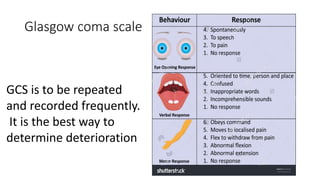
Glasgow coma scale
GCS is to be repeated
and recorded frequently.
It is the best way to
determine deterioration
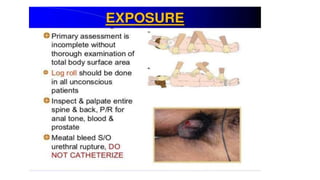
EXPOSURE
• Remove all patient's clothing
• Examine whole patient
• Front and back; log roll carefully
• Do not allow patient to get cold (especially children)
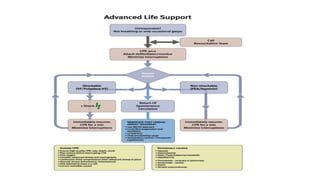
• Cardiopulmonary resuscitation (CPR)
• (American heart association)
• >follow the C-A-B (compression –airway-breathing)
• >compression should be in a rate of 100/min moving the chest inward
at least 2 inches in adult and 13 of the chest diameter in children
• >compression ventilation ratio should be 30/2
• >minimize interruption to the chest compression .
Resuscitation
• Start resuscitation at the same time as performing
primary survey Do not start secondary survey until
completing primary survey Constantly reassess
patient for response to treatment; if condition
deteriorates, reassess ABC.
Adjuncts to the primary survey
• Radiography :
• the “trauma triple”is portable cervical spine ,an anteroposterior
chest, an anteroposterior pelvis radiograph ,,, these provide the
maximum amount of information about potentially dangerous
conditions in a minimum amount of time
IMAGING
• X-Rays
• Chest
• Pelvis
• Cervical spine
• Ultrasound
• -FAST scan
• Laboratory studies :obtain cbc,chemistry , urinalysis , bhcg (female in
childbearing age)
• Blood preparation :order type,screen , .consider cross maching 2-4
units of RBCS
• Urinary and gastric catheterization .
• Temperature monitoring
•Secondary survey
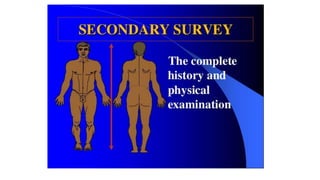
• Secondary survey
• Perform complete, thorough patient examination to ensure no other
injuries are missed
Secondary survey
• The secondary survey is performed only after the primary survey has
been finished and all immediate threats have been treated
• The secondary survey is a head to toe examination
• Dessigned to identify any injuries that might have been missed .
• Do not start definitive treatment until secondary survey is completed
unless required as life-saving measure
• When definitive treatment is not available, have a plan for safe
transfer of patient to another centre
Secondary survey
• Head Exam
• Scalp, eyes, ears
• Soft tissues
• Neck Exam
• Penetrating injuries
• Swelling or crepitus
• Neurological Exam
• Glasgow Coma Score
• Motor examination
• Sensory examination
• Reflexes
• Chest exam
• Clavicles, ribs
• – Breath,
• heart sounds
• Abdominal Exam
• Penetrating injury
• Blunt injury: nasogastric tube
• Rectal exam
• Urinary catheter
• Pelvis and Limbs
• fractures –
• Pulses –
• Lacerations, ecchymosis
Patient history
• SAMPLE
• Symptoms –PAIN,shortness of breath ,other symptoms
• Allergies to medications
• Medications taken
• Past medical /surgical history
• Last meal –important to determine risk of aspiration
• Events Leading up to trauma
REASSESSMENT
• Always perform an ABCDE primary survey if patient deteriorates
• Signs of adequate resuscitation
• Slowing of tachycardia
• Urine output normalizes
• Blood pressure increases
MONITORING
• EKG monitoring if available
• Pulse oximeter
• Most widely used physiological monitoring device for heart rate,
oxygenation
• Especially useful in anaesthesia, ICU
• Simple to use
• Should be minimum standard of monitoring in every surgical theatre
• Blood pressure
• Manually or automated machine
Indication of referral to higher level
• 1- patient needs advanced care that is not available in the clinic
• 2- if there is a lack of skills , instruents , or equipment
• 3-lack of radiology services
Contraindication of referral to higher level
• 1-patients whose vital signs are unstable due to active bleeding ,
multiple fractures or suspicion of internal bleeding
• 2-patient with minor trauma not requiring any advanced medical
support.
• Planning and preparation:
• Mode of transport
Accompanying personnel, including family
• Supplies needed for any possible treatment
• Identifying possible complications
• Communicate with all involved in transfer including receiving hospital
• Be prepared: if anything can go wrong, it will and at the worst
possible time
STABILIZATION AND TRANSFER
Resuscitation completed
Laboratory specimen sent
Controlled airway
Normalized circulation
Immobilized fractures
Appropriate analgesia
Functioning intravenous lines
Documentation completed
Transfer :
– Ward – Operating theatre – Higher level of care centre
• PATIENT SAFETY: Consent
• Informed consent means that patient and patient’s family understand
– What is to take place
• – Potential risks, complications of both proceeding and not
proceeding
• Have given permission for intervention
• Be attentive to legal, religious, cultural, linguistic, family norms and
differences Our job is not to judge, but to provide care to all without
regard to social status or any other considerations
• RECORD KEEPING
• • Essential that patients receive written note describing diagnosis,
procedure performed
• • All records should be clear, accurate, complete, signed
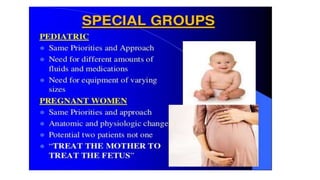
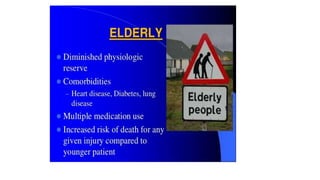
Elderly trauma
• Falls , motor vehicle accidents are the leading cause of trauma in
elderly .
• According to a systematic review of 18 studies, the probability of
falling at least once in any given year for individuals 65 years and
older is approximately 27 percent.(up to date ).
• Falls in the elderly most often occur from a standing position on a
level surface, with orthopedic injury (eg, hip or long bone fracture)
the most common significant complication.
• Elderly patients may be hypotensive relative to their baseline blood
pressure but still have blood pressure measurements in the "normal"
range. A single episode of hypotension substantially increases the
likelihood that a serious injury has occurred (up to date )
• Although there is little prospective data to guide triage decisions
about geriatric trauma patients, given the increased risk for severe
injury and death in this population, we suggest that trauma patients
over the age of 70 be evaluated at a trauma center with trauma team
activation whenever possible, regardless of the mechanism (ie, falls
from standing warrant such evaluation)(up to date )
Reference
• Who health organization (Emergency and Essential Surgical Care
(EESC) programme)
• Up to date
• American heart association (ATLS )

Trauma management in_primary_care_setting

  • 1.
    1- 23 yearold ,male , with no comorbidities presented with ho hypoxia , hypotension deviated trachea to the left with diminished air sound ??
  • 2.
    • 2- 60year old female known DM , HTN , on treatment , brought un responsive ???
  • 3.
    Trauma management in primaryhealth care Done by :dr. habiba Mohamed al harthi R2 family resident
  • 4.
    Objectives Epidemiolgy. Component of traumateams . Goals of trauma management Trauma management phases . Primary survey. Secondary survey . Definitive treatment and management .
  • 5.
    •Trauma is theleading cause of death for people between ages of 1-44 years ,,exceeded only by cancer and atherosclerotic diseases
  • 6.
    Epidemiology • Trauma isa leading cause of mortality globally • Worldwide, road traffic injuries are the leading cause of death between the ages of 18 and 29, while in the United States, trauma is the leading cause of death in young adults and accounts for 10 percent of all deaths among men and women • Over 45 million people sustain moderate to severe disability each year due to trauma • In the United States alone, more than 50 million patients receive some form of trauma-related medical care for annually, and trauma accounts for approximately 30 percent of all intensive care unit (ICU) admissions.(up to date )
  • 7.
    • Relatively fewpatients die after the first 24 hours following injury. Rather, the majority of deaths occur either at the scene or within the first four hours after the patient reaches a trauma center
  • 9.
    • The objectivesof the initial evaluation of the trauma patient are as follows: (1) to rapidly identify life-threatening injuries, (2) to initiate adequate supportive therapy, (3) to efficiently organize either definitive therapy or transfer to a facility that provides definitive therapy.
  • 10.
    • Teams inprimary health care centers including trained physicians and nursing staff should be available ,in order to optimize patient care. • Teams should use trauma team approach .each team member should assigned a specific task or tasks so that each of these can be performed simulataneously to ensure the most rapid possible treatment
  • 11.
    • Each personshould be familiar with basic trauma resuscitation • 1-BASIC LIFE SUPPORT (BLS) • 2-ADVANCED TRAUMA LIFE SUPPORT (ATLS)
  • 13.
    Role of teamleader • Organizes the group • Monitors individual performance of team members • Backs up team members • Models excellent team behavior • Facilitates understanding • Focuses on comprehensive patient care
  • 14.
    Effective resuscitation teamdynamics • Effective resuscitation team dynamics • Effective resuscitation team dynamics • Effective resuscitation team dynamics • Effective resuscitation team dynamics • Effective resuscitation team dynamics • Effective resuscitation team dynamics • Effective resuscitation team dynamics
  • 15.
    • Closed –loopcommunications • Clear massages • Clear roles and responsibilities • Knowing ones limitations • Knowledge sharing • Constructive intervention • Re evaluation and summarizing • Mutual respect
  • 16.
    Why ?? • Breakdownsin the care plan and medical mismanagement typically occur due to one or more of four potential problems ●Communication breakdowns (eg, changes in the patient's physiologic state or critical test results are not effectively communicated, overall management plan or priority of tasks is not conveyed clearly by the team leader) ●Failures in situational awareness (eg, failure to recognize shock, failure to anticipate blood transfusion needs, failure to modify standard management for higher risk patients).
  • 17.
    ●Staffing or workloaddistribution problems (eg, insufficiently trained staff conducting a procedure, inadequate staff for patient volume) ●Unresolved conflicts (eg, unresolved hostility about other team members perceived to be performing inadequately, disagreement about overall management plan, disagreement among senior clinicians vying for team leadership)
  • 18.
    • Principles oftrauma patient management • Treat the greatest threat to life first. • Definitive diagnosis is not immediately important. • Time matters (“golden hour” emphasizes urgency). • Do no further harm. • Assess, intervene, reassess • Did the intervention work? • Is the patient’s physiology returning to or staying normal
  • 19.
    • While themost common causes of mortality from trauma are hemorrhage, multiple organ dysfunction syndrome, and cardiopulmonary arrest • the most common preventable causes of morbidity are unintended extubation , technical surgical failures, missed injuries, and intravascular catheter-related complications .
  • 20.
  • 22.
  • 24.
    • Triage: • sortingand treating patients according to priority identify, treat patients with life-threatening conditions first • Priority may be determined by: • Medical necessity • Personnel skills • Available equipment
  • 25.
    Triage • of traumapatients considers vital signs and prehospital clinical course, mechanism of injury, patient age, and known or suspected comorbid conditions. • Findings that lead to an accelerated workup include multiple injuries, extremes of age, evidence of severe neurologic injury, unstable vital signs, and preexisting cardiac or pulmonary disease.
  • 26.
    • Vital signs •Pulse rate • Blood pressure • Respiratory rate • SpO2% • Temperature • AVPU (Alert, verbal, pain or unresponsive) • Urine output
  • 27.
    • Traumatic injuriescan range from minor isolated wounds to complex injuries involving multiple organ systems. • All trauma patients require a systematic approach to management in order to maximize outcomes and reduce the risk of undiscovered injuries.
  • 28.
  • 29.
    • In primarysurvey airway , breathing , circulation are assessed and immediate life threatening problems are diagnosed and treated . • A-airway • B-breathing • C –circulation • D-disability • E –exposure ,environment
  • 30.
    ●Airway assessment andprotection (maintain cervical spine stabilization when appropriate) ●Breathing and ventilation assessment (maintain adequate oxygenation) ●Circulation assessment (control hemorrhage and maintain adequate end-organ perfusion) ●Disability assessment (perform basic neurologic evaluation) ●Exposure, with environmental control (undress patient and search everywhere for possible injury, while preventing hypothermia)
  • 31.
    • Primary surveyusually takes no longer than few minutes , unless procedures are required , • The primary survey must be repeated any time a patients status changes , including changes in mental status , changes in vital signs ,or administration of new medications or treatment
  • 32.
    • AIRWAY • Alwaysassess the airway • • Talk to the patient – A patient speaking freely and clearly has an open airway • • Look and listen for signs of obstruction • Snoring or gurgling • Stridor or noisy breathing • Foreign body or vomit in mouth • if airway obstructed, open airway and clear obstruction
  • 33.
    TECHNIQUES FOR OPENINGTHE AIRWAY • No trauma • Position patient on firm surface • Tilt the head • Lift the chin to open the airway • Remove foreign body if visible • Clear secretions • Give oxygen 5 L/min
  • 34.
    TECHNIQUES FOR OPENINGTHE AIRWAY • In case of trauma • • Stabilize cervical spine • Do not lift head! • Open airway using jaw thrust • Remove foreign body if visible • Clear secretions • Give oxygen 5 L/min
  • 35.
    AIRWAY DEVICES • Oropharyngealairway • • Use if patient unconscious • • Use correct size - measure from front of ear to corner of mouth • • Slide airway over tongue • If patient resists, gags or vomits, remove immediately!
  • 36.
    • Nasopharyngeal airway •• Better tolerated if patient is semi-conscious • • Pass well lubricated into one nostril • • Direct posteriorly, towards the throat
  • 37.
    •In the unconsciouspatient, the airway must be protected immediately once any obstructions (eg, foreign body, vomitus, displaced tongue) are removed
  • 38.
    • Keep thefollowing points in mind while performing the primary survey: • ●Airway obstruction is a major cause of death immediately following trauma • . The airway may be obstructed by the tongue, a foreign body, aspirated material, tissue edema, or expanding hematoma. • ●Once an airway has been established, it is important to secure it well and to ensure it is not dislodged any time the patient is moved. Unintended extubation is the most common preventable cause of morbidity in trauma patients .(up to date)
  • 39.
    TENSION PNEUMOTHORAX • Airfrom lung puncture enters pleural space, • cannot escape • Progressive increase in intrathoracic • pressure causes mediastinal shift and • hypotension due to reduced venous return • Patient becomes short of breath and hypoxic • Diminished breath sounds on side of pneumothorax • Requires urgent needle decompression, • then chest drain as soon as possible
  • 40.
    INDICATIONS FOR CHESTDECOMPRESSION • Signs and Symptoms: • Absent or diminished breath sounds on one side • Evidence of chest trauma or rib fracture • Open or "sucking" chest wound • Diagnoses : • Pneumothorax • Tension pneumothorax • Hemothorax • Hemo-pnemothorax
  • 41.
    Management : • Giveoxygen at 6-10 ml/min ,, via a non –rebreathing face mask , this is indication for all patient suffering from polytrauma injuries • Ventilate the patient with rescue breaths , a bag-valve device (bagging the patient),or a ventilator but put it in mind that if the ventilation problem is produced by a pneumothorax or tension pneumothorax,intubation with vigorous bag-valve ventilation could lead to further detoriartion of patient • Treat open pneumothorax,tension pneumothorax,flail chest,massive hemothorax( up to date)
  • 42.
    • Insert alarge bore needle over rib: – 2nd intercostal space – Over 3rd rib at mid-clavicular line • Listen for hissing sound of air escaping • Insert chest drain
  • 44.
    BREATHING • Assess ventilation- Is the patient in respiratory distress? • Look – For cyanosis, wounds, deformities, ecchymosis, amplitude, paradoxical movement • Feel - Painful areas, abnormal movement • Percuss - Dullness • Listen - Reduced breath sounds
  • 46.
    • Airway patencyalone doesn't assure adequate ventilation , adequate gas exchange is required to maximize oxygenation and minimize carbon dioxide accumulation , • Ventilation requires adequate function of the lungs ,chest wall , diaphragm , each component must be examined and evaluated rapidly.
  • 47.
    CIRCULATION: HAEMORRAGHIC SHOCK •Assess the circulation * Signs of hypoperfusion : • Confusion, lethargy or agitation • Pallor or cold extremities • Weak or absent radial and femoral pulses • Tachycardia • Hypotension Examine the abdomen for tenderness or guarding Carefully assess pelvic stability
  • 49.
    •Hypotension generally doesnot manifest until at least 30 percent of the patient's blood volume has been lost
  • 50.
    • Large volumesof blood may be hidden in thoracic, abdominal and pelvic cavities, or from femoral shaft fractures To decrease bleeding Apply pressure to external wound Apply splint to possible femur fracture Apply pelvic binder to possible pelvic fracture
  • 51.
    • Obtain twolarge bore IV catheters (14-16 gauge) using warmed fluids If systolic BP <90 mmHg or pulse >110 bpm • Give 500 ml bolus of Ringer’s Lactate or NS • Keep patient warm • Control hemorrhage by direct pressure over the wounds, tourniqutes should be considered only in very limited conditions (traumatic amputation). • Perform CPR if needed • Reassess vitals • If still hypotensive after 2L of crystalloids, transfuse blood
  • 52.
    INTRAVENOUS ACCESS • Cannulashould be placed in arm vein, not over joint, easy fixation. Comfortable and convenient for drug administration and care • Best veins in emergencies: • Antecubital fossa • Femoral • External jugular • Do not attempt subclavian vein due to high risk of pleural puncture
  • 53.
    • Femoral vein •If right handed, stand on patient’s right, palpate femoral artery • Prep area carefully; site is contaminated • Use a 14, 16 or 18 G (20 G in child) cannula mounted on 5 ml syringe • Avoid injured extremities, if possible
  • 54.
    • If patientsis pregnant, she should not be on her back, put her on her left side. • Send blood for type and crossmatch
  • 55.
    FLUIDS AND MEDICINES •Avoid fluids containing dextrose during resuscitation • Use Saline or Ringer's lactate • For shocked patient: give fluids as fast as drip runs until blood pressure responds • May need a pressure infusion bag to push fluids • Monitor response carefully; look at vital signs, urine output Always give medicines intravenously during resuscitation
  • 56.
    • Check thepulse using a pulse oximetre ,however ,remember that pulse , oximetry can be unreliable in pateints with poor peripheral perfusion after trauma..
  • 57.
    • In traumapatients with significant hemorrhage, a lower score on the Glasgow Coma Scale (GCS) and older age are both independently associated with increased mortality, according to multivariable logistic regression analysis of two large databases
  • 58.
    Disability • Checking forneurological damage: vital part of primary survey Abbreviated neurological examination: • – ALERT • – VERBAL - responsive to verbal stimulus • – PAIN - responsive to painful stimulus • – UNRESPONSIVE
  • 59.
    Glasgow coma scale GCSis to be repeated and recorded frequently. It is the best way to determine deterioration
  • 61.
    EXPOSURE • Remove allpatient's clothing • Examine whole patient • Front and back; log roll carefully • Do not allow patient to get cold (especially children)
  • 63.
    • Cardiopulmonary resuscitation(CPR) • (American heart association) • >follow the C-A-B (compression –airway-breathing) • >compression should be in a rate of 100/min moving the chest inward at least 2 inches in adult and 13 of the chest diameter in children • >compression ventilation ratio should be 30/2 • >minimize interruption to the chest compression .
  • 65.
  • 66.
    • Start resuscitationat the same time as performing primary survey Do not start secondary survey until completing primary survey Constantly reassess patient for response to treatment; if condition deteriorates, reassess ABC.
  • 67.
    Adjuncts to theprimary survey • Radiography : • the “trauma triple”is portable cervical spine ,an anteroposterior chest, an anteroposterior pelvis radiograph ,,, these provide the maximum amount of information about potentially dangerous conditions in a minimum amount of time
  • 68.
    IMAGING • X-Rays • Chest •Pelvis • Cervical spine • Ultrasound • -FAST scan
  • 69.
    • Laboratory studies:obtain cbc,chemistry , urinalysis , bhcg (female in childbearing age) • Blood preparation :order type,screen , .consider cross maching 2-4 units of RBCS • Urinary and gastric catheterization . • Temperature monitoring
  • 71.
  • 73.
    • Secondary survey •Perform complete, thorough patient examination to ensure no other injuries are missed
  • 74.
    Secondary survey • Thesecondary survey is performed only after the primary survey has been finished and all immediate threats have been treated • The secondary survey is a head to toe examination • Dessigned to identify any injuries that might have been missed .
  • 75.
    • Do notstart definitive treatment until secondary survey is completed unless required as life-saving measure • When definitive treatment is not available, have a plan for safe transfer of patient to another centre
  • 76.
    Secondary survey • HeadExam • Scalp, eyes, ears • Soft tissues • Neck Exam • Penetrating injuries • Swelling or crepitus • Neurological Exam • Glasgow Coma Score • Motor examination • Sensory examination • Reflexes
  • 77.
    • Chest exam •Clavicles, ribs • – Breath, • heart sounds • Abdominal Exam • Penetrating injury • Blunt injury: nasogastric tube • Rectal exam • Urinary catheter • Pelvis and Limbs • fractures – • Pulses – • Lacerations, ecchymosis
  • 78.
    Patient history • SAMPLE •Symptoms –PAIN,shortness of breath ,other symptoms • Allergies to medications • Medications taken • Past medical /surgical history • Last meal –important to determine risk of aspiration • Events Leading up to trauma
  • 79.
    REASSESSMENT • Always performan ABCDE primary survey if patient deteriorates • Signs of adequate resuscitation • Slowing of tachycardia • Urine output normalizes • Blood pressure increases
  • 80.
    MONITORING • EKG monitoringif available • Pulse oximeter • Most widely used physiological monitoring device for heart rate, oxygenation • Especially useful in anaesthesia, ICU • Simple to use • Should be minimum standard of monitoring in every surgical theatre • Blood pressure • Manually or automated machine
  • 81.
    Indication of referralto higher level • 1- patient needs advanced care that is not available in the clinic • 2- if there is a lack of skills , instruents , or equipment • 3-lack of radiology services
  • 82.
    Contraindication of referralto higher level • 1-patients whose vital signs are unstable due to active bleeding , multiple fractures or suspicion of internal bleeding • 2-patient with minor trauma not requiring any advanced medical support.
  • 84.
    • Planning andpreparation: • Mode of transport Accompanying personnel, including family • Supplies needed for any possible treatment • Identifying possible complications • Communicate with all involved in transfer including receiving hospital • Be prepared: if anything can go wrong, it will and at the worst possible time
  • 85.
    STABILIZATION AND TRANSFER Resuscitationcompleted Laboratory specimen sent Controlled airway Normalized circulation Immobilized fractures Appropriate analgesia Functioning intravenous lines Documentation completed Transfer : – Ward – Operating theatre – Higher level of care centre
  • 86.
    • PATIENT SAFETY:Consent • Informed consent means that patient and patient’s family understand – What is to take place • – Potential risks, complications of both proceeding and not proceeding • Have given permission for intervention • Be attentive to legal, religious, cultural, linguistic, family norms and differences Our job is not to judge, but to provide care to all without regard to social status or any other considerations
  • 87.
    • RECORD KEEPING •• Essential that patients receive written note describing diagnosis, procedure performed • • All records should be clear, accurate, complete, signed
  • 90.
    Elderly trauma • Falls, motor vehicle accidents are the leading cause of trauma in elderly . • According to a systematic review of 18 studies, the probability of falling at least once in any given year for individuals 65 years and older is approximately 27 percent.(up to date ). • Falls in the elderly most often occur from a standing position on a level surface, with orthopedic injury (eg, hip or long bone fracture) the most common significant complication.
  • 91.
    • Elderly patientsmay be hypotensive relative to their baseline blood pressure but still have blood pressure measurements in the "normal" range. A single episode of hypotension substantially increases the likelihood that a serious injury has occurred (up to date )
  • 92.
    • Although thereis little prospective data to guide triage decisions about geriatric trauma patients, given the increased risk for severe injury and death in this population, we suggest that trauma patients over the age of 70 be evaluated at a trauma center with trauma team activation whenever possible, regardless of the mechanism (ie, falls from standing warrant such evaluation)(up to date )
  • 93.
    Reference • Who healthorganization (Emergency and Essential Surgical Care (EESC) programme) • Up to date • American heart association (ATLS )