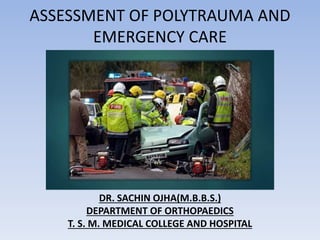
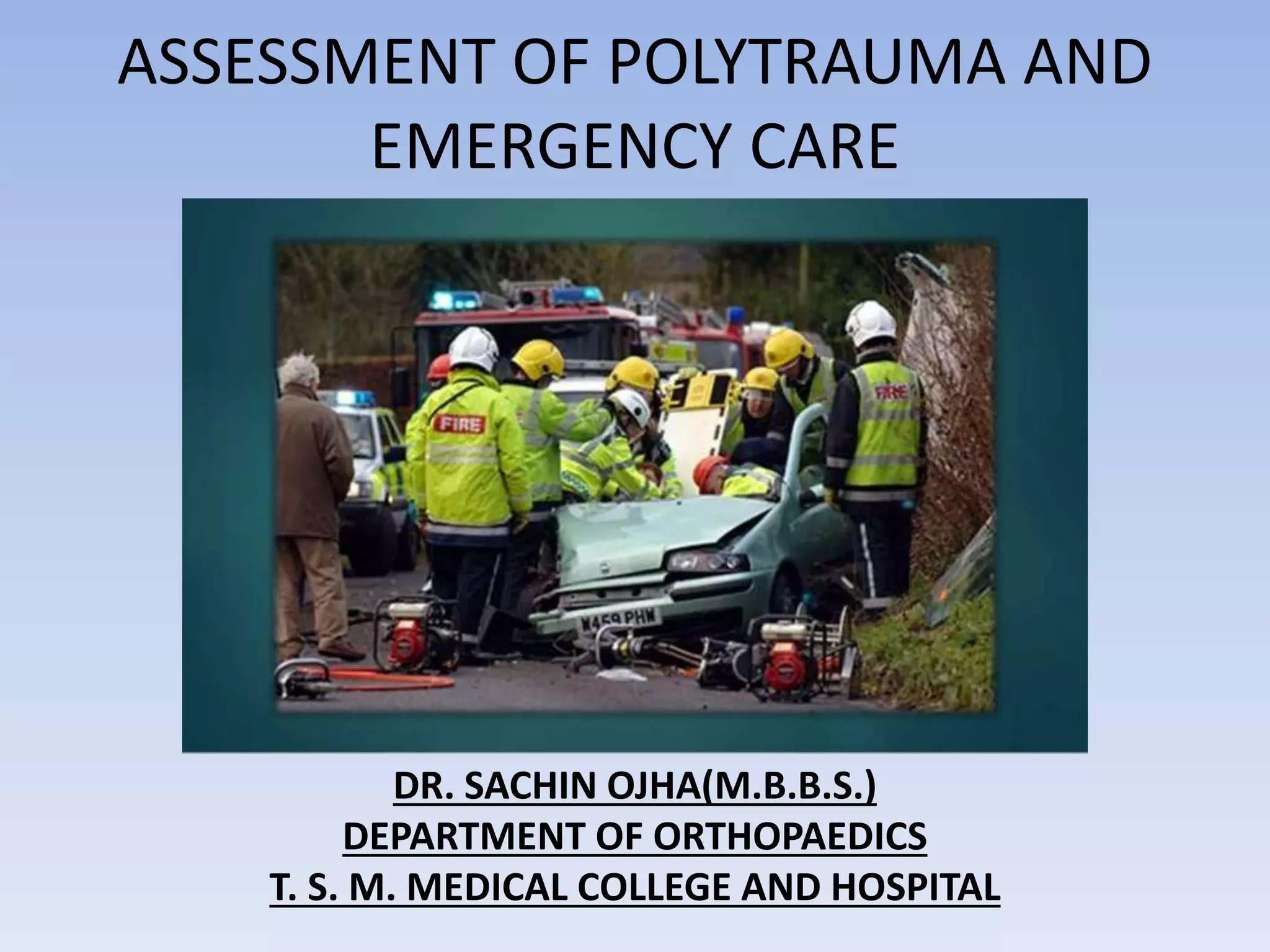
ASSESSMENT OF POLYTRAUMA AND
EMERGENCY CARE
DR. SACHIN OJHA(M.B.B.S.)
DEPARTMENT OF ORTHOPAEDICS
T. S. M. MEDICAL COLLEGE AND HOSPITAL
Polytrauma
• The term polytrauma refers to either multiple
fractures in limbs and spine or multiple system
injuries, involving head, thorax , abdomen and
pelvis in victim of accidents.
• Injury to atleast two organ systems which might
cause a potentially life-threatening condition.
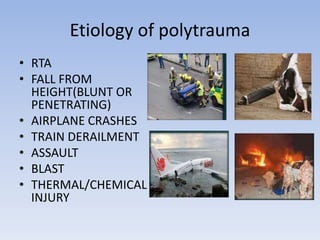
Etiology of polytrauma
• RTA
• FALL FROM
HEIGHT(BLUNT OR
PENETRATING)
• AIRPLANE CRASHES
• TRAIN DERAILMENT
• ASSAULT
• BLAST
• THERMAL/CHEMICAL
INJURY
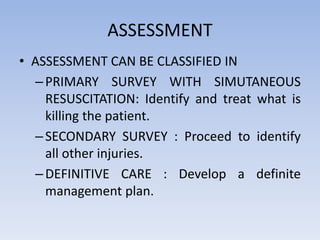
ASSESSMENT
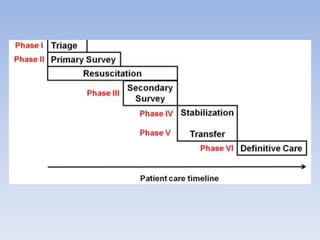
• ASSESSMENT CAN BE CLASSIFIED IN
–PRIMARY SURVEY WITH SIMUTANEOUS
RESUSCITATION: Identify and treat what is
killing the patient.
–SECONDARY SURVEY : Proceed to identify
all other injuries.
–DEFINITIVE CARE : Develop a definite
management plan.
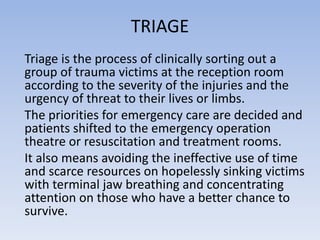
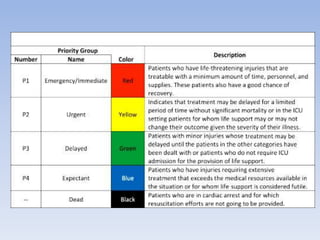
TRIAGE
Triage is the process of clinically sorting out a
group of trauma victims at the reception room
according to the severity of the injuries and the
urgency of threat to their lives or limbs.
The priorities for emergency care are decided and
patients shifted to the emergency operation
theatre or resuscitation and treatment rooms.
It also means avoiding the ineffective use of time
and scarce resources on hopelessly sinking victims
with terminal jaw breathing and concentrating
attention on those who have a better chance to
survive.
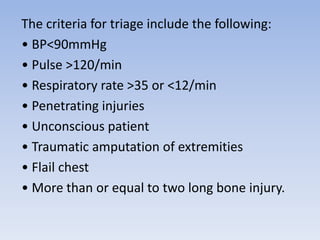
The criteria for triage include the following:
• BP<90mmHg
• Pulse >120/min
• Respiratory rate >35 or <12/min
• Penetrating injuries
• Unconscious patient
• Traumatic amputation of extremities
• Flail chest
• More than or equal to two long bone injury.
PRIMARY SURVEY
• IMMEDIATE SURVEY
• AIRWAY OBSTRUCTION
• BREATHING AND VENTILATION
• CIRCULATION
• NEUROLOGICAL STATUS
IMMEDIATE SURVEY
• Rescue the patient from the site of trauma
and free from the sources
– Thermal ;
– Chemical or;
– Mechanical.
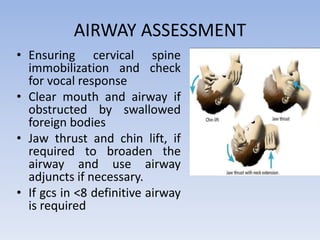
AIRWAY ASSESSMENT
• Ensuring cervical spine
immobilization and check
for vocal response
• Clear mouth and airway if
obstructed by swallowed
foreign bodies
• Jaw thrust and chin lift, if
required to broaden the
airway and use airway
adjuncts if necessary.
• If gcs in <8 definitive airway
is required
Airway management
• Extending the neck (chin up)
• Pulling forward the jaw
• Removing any foreign body
• Pressing the tongue down.
• In cases of obstruction in throat: use mechanical
suction apparatus
• Endotracheal tube intubation if required
• Restoration of ventilation and oxygentaion by stabilizing
the chest wall, by strapping over a pad and letting out
the air or blood from the pleural cavity by a needle.
• The injured extremities are stabilized by putting the
splint.
Breathing and Ventilation assessment
•Oxygen should be administered to all trauma
patients, at a high concentration.
•Ventilation requires an adequately functioning
chest wall, lungs, and diaphragm.
•Any patient with deteriorating oxygen
saturation despite oxygen support, with a patent
airway and a good ventilatory effort, must be
suspected of haemothorax or pneumothorax.
• Give 100% oxygen support at high ßow
• Inspect, palpate, percuss and auscultate chest.
• Anticipate for tension the help of warning signs
and Immediately decompress if suspected
• Insert chest drain for pneumothorax
/hemothorax(thoracocentesis)
• Rule out causes of major thoracic vessel bleeding
A tension pneumothorax should be immediately
decompressed with the insertion of a needle
into the second intercostal space, in the
midclavicular line. This can then be followed by
definitive chest drain insertion at an appropriate
time.
CIRCULATION
One should simultaneously attend to the
circulatory failure due to open haemorrhage
and hypovolaemic shock as evidenced by
pallor, sweat on the forehead, weak pulse and
low BP.
External haemorrhage is arrested by direct
pressure with a clean pad. IV fluids are started
quickly through an open vein if necessary and
arrangements made for blood matching and
transfusion.
Neurological Status
The next step is the quick survey of the neurological status
noting the following:
• Disturbance of consciousness
• Pupillary changes
• Blood or cerebrospinal fluid oozing from nose and ears
• Paralysis/spontaneous or reflex movement of the limbs
One should record the level of consciousness the time Of
first examination using the gow Coma Scale.
In all cases diminished consciousness, one should look
signs of intracranial damage such as dilated pupil.
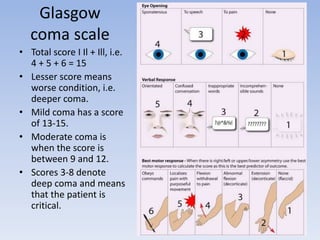
Glasgow
coma scale
• Total score I Il + Ill, i.e.
4 + 5 + 6 = 15
• Lesser score means
worse condition, i.e.
deeper coma.
• Mild coma has a score
of 13-15.
• Moderate coma is
when the score is
between 9 and 12.
• Scores 3-8 denote
deep coma and means
that the patient is
critical.
SECONDARY EVALUATION
Thorough head to toe examination to identify all other injuries.
1. Fractures involving extremities of bones, pelvis and spine are
evaluated with radiographs and proper splinting should be
done.
2. Distal pulses are evaluated manually or by a hand-held
Doppler system.
3. Vascular injuries are dealt with emergency surgery.
4. Broad spectrum antibiotics and tetanus/gas gangrene
prophylaxis are instituted in open wounds.
5. A pelvic external fixator should be applied in
haemodynamically unstable injuries.
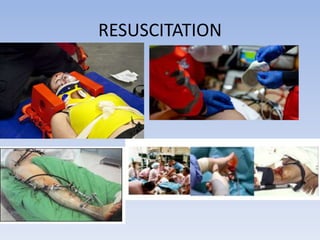
RESUSCITATION
• The aim is to quickly restore oxygenation to the
vital tissues of brain, heart and kidneys by IV
fluid and blood, before irreversible damage
occurs to vital organs
• Head injury is assessed according to the level of
consciousness.
– injury to cervical spine must be looked for
– extra care must be taken in handling and turning the
patient to prevent cord injury as a 'second accident‘
– An emergency intervention is decided by the
neurosurgeon in cases of depressed fracture skull as
well as middle meningeal haemorrhage.
•Faciomaxillary injuries often cause obstruction to
breathing, needing immediate life-saving attention.
•Faciomaxillary dental and ophthalmic surgeons have to
team up for stabilising the jaw fractures and repairing
the wounds of the face, tongue and eyes.
•In chest injuries, flail chest due to multiple fractures in
the ribs is treated by strapping to stabilise the chest
wall.
•Open sucking wounds causing respiratory distress are
covered by sterile pads and strapping. Acute
pneumothorax must be dealt with by aspiration by
needle.
• Closed abdominal injuries with internal
haemorrhage will be given priority for
emergency surgery.
• Open wounds such as stab wound must be
dealt with by immediate exploration and repair.
Major limb fractures should be splinted
immediately. Fractures with vascular
embarrassment should be dealt with, urgently.
Lab diagnosis
• Essential haematological and biochemical tests
for Hb, PCV and blood sugar are carried out
first.
• If facilities are available, arterial blood gas
analysis and serum electrolytes are also
estimated.
• Radiological examinations should include eFAST
(focussed assessment with sonography for
trauma scan) with cervical spine, chest,
abdomen, pelvis, skull and limbs.
Following is the list of procedures that need to be followed in an
emergency room:
• Resuscitation-securing airway, breathing, circulation
• Nasal 02
• Intravenous fluids
• Fracture splinting
• Haemodynamically stable
• Reduce major joint dislocations with neurovascular
compromise
• Emergency vascular repair if present
• Long bone fracture stabilisation
• External/internal fixation
• Open wound debridement
• Neurosurgical evaluation and surgery if needed
• Definitive fixation of fractures of spine, joint articular surface
and early wound cover
Definitive Care
Definitive treatment of the fractures can be done
after the general condition of the patient is
stabilised as early as possible.
The priorities in skeletal trauma are as follows:
• External fixator application for
haemodynamically unstable pelvic fractures
• Reduction of dislocations of joints with
neurovascular compromise
• Repair of vascular injuries
• Open fracture, debridement and stabilisation
• Stabilisation of unstable spine
THANK YOU

POLYTRAUMA.pptx

  • 1.
    ASSESSMENT OF POLYTRAUMAAND EMERGENCY CARE DR. SACHIN OJHA(M.B.B.S.) DEPARTMENT OF ORTHOPAEDICS T. S. M. MEDICAL COLLEGE AND HOSPITAL
  • 2.
    Polytrauma • The termpolytrauma refers to either multiple fractures in limbs and spine or multiple system injuries, involving head, thorax , abdomen and pelvis in victim of accidents. • Injury to atleast two organ systems which might cause a potentially life-threatening condition.
  • 3.
    Etiology of polytrauma •RTA • FALL FROM HEIGHT(BLUNT OR PENETRATING) • AIRPLANE CRASHES • TRAIN DERAILMENT • ASSAULT • BLAST • THERMAL/CHEMICAL INJURY
  • 4.
    ASSESSMENT • ASSESSMENT CANBE CLASSIFIED IN –PRIMARY SURVEY WITH SIMUTANEOUS RESUSCITATION: Identify and treat what is killing the patient. –SECONDARY SURVEY : Proceed to identify all other injuries. –DEFINITIVE CARE : Develop a definite management plan.
  • 6.
    TRIAGE Triage is theprocess of clinically sorting out a group of trauma victims at the reception room according to the severity of the injuries and the urgency of threat to their lives or limbs. The priorities for emergency care are decided and patients shifted to the emergency operation theatre or resuscitation and treatment rooms. It also means avoiding the ineffective use of time and scarce resources on hopelessly sinking victims with terminal jaw breathing and concentrating attention on those who have a better chance to survive.
  • 7.
    The criteria fortriage include the following: • BP<90mmHg • Pulse >120/min • Respiratory rate >35 or <12/min • Penetrating injuries • Unconscious patient • Traumatic amputation of extremities • Flail chest • More than or equal to two long bone injury.
  • 9.
    PRIMARY SURVEY • IMMEDIATESURVEY • AIRWAY OBSTRUCTION • BREATHING AND VENTILATION • CIRCULATION • NEUROLOGICAL STATUS
  • 10.
    IMMEDIATE SURVEY • Rescuethe patient from the site of trauma and free from the sources – Thermal ; – Chemical or; – Mechanical.
  • 11.
    AIRWAY ASSESSMENT • Ensuringcervical spine immobilization and check for vocal response • Clear mouth and airway if obstructed by swallowed foreign bodies • Jaw thrust and chin lift, if required to broaden the airway and use airway adjuncts if necessary. • If gcs in <8 definitive airway is required
  • 12.
    Airway management • Extendingthe neck (chin up) • Pulling forward the jaw • Removing any foreign body • Pressing the tongue down. • In cases of obstruction in throat: use mechanical suction apparatus • Endotracheal tube intubation if required • Restoration of ventilation and oxygentaion by stabilizing the chest wall, by strapping over a pad and letting out the air or blood from the pleural cavity by a needle. • The injured extremities are stabilized by putting the splint.
  • 13.
    Breathing and Ventilationassessment •Oxygen should be administered to all trauma patients, at a high concentration. •Ventilation requires an adequately functioning chest wall, lungs, and diaphragm. •Any patient with deteriorating oxygen saturation despite oxygen support, with a patent airway and a good ventilatory effort, must be suspected of haemothorax or pneumothorax.
  • 14.
    • Give 100%oxygen support at high ßow • Inspect, palpate, percuss and auscultate chest. • Anticipate for tension the help of warning signs and Immediately decompress if suspected • Insert chest drain for pneumothorax /hemothorax(thoracocentesis) • Rule out causes of major thoracic vessel bleeding
  • 15.
    A tension pneumothoraxshould be immediately decompressed with the insertion of a needle into the second intercostal space, in the midclavicular line. This can then be followed by definitive chest drain insertion at an appropriate time.
  • 16.
    CIRCULATION One should simultaneouslyattend to the circulatory failure due to open haemorrhage and hypovolaemic shock as evidenced by pallor, sweat on the forehead, weak pulse and low BP. External haemorrhage is arrested by direct pressure with a clean pad. IV fluids are started quickly through an open vein if necessary and arrangements made for blood matching and transfusion.
  • 17.
    Neurological Status The nextstep is the quick survey of the neurological status noting the following: • Disturbance of consciousness • Pupillary changes • Blood or cerebrospinal fluid oozing from nose and ears • Paralysis/spontaneous or reflex movement of the limbs One should record the level of consciousness the time Of first examination using the gow Coma Scale. In all cases diminished consciousness, one should look signs of intracranial damage such as dilated pupil.
  • 18.
    Glasgow coma scale • Totalscore I Il + Ill, i.e. 4 + 5 + 6 = 15 • Lesser score means worse condition, i.e. deeper coma. • Mild coma has a score of 13-15. • Moderate coma is when the score is between 9 and 12. • Scores 3-8 denote deep coma and means that the patient is critical.
  • 19.
    SECONDARY EVALUATION Thorough headto toe examination to identify all other injuries. 1. Fractures involving extremities of bones, pelvis and spine are evaluated with radiographs and proper splinting should be done. 2. Distal pulses are evaluated manually or by a hand-held Doppler system. 3. Vascular injuries are dealt with emergency surgery. 4. Broad spectrum antibiotics and tetanus/gas gangrene prophylaxis are instituted in open wounds. 5. A pelvic external fixator should be applied in haemodynamically unstable injuries.
  • 21.
  • 22.
    • The aimis to quickly restore oxygenation to the vital tissues of brain, heart and kidneys by IV fluid and blood, before irreversible damage occurs to vital organs • Head injury is assessed according to the level of consciousness. – injury to cervical spine must be looked for – extra care must be taken in handling and turning the patient to prevent cord injury as a 'second accident‘ – An emergency intervention is decided by the neurosurgeon in cases of depressed fracture skull as well as middle meningeal haemorrhage.
  • 23.
    •Faciomaxillary injuries oftencause obstruction to breathing, needing immediate life-saving attention. •Faciomaxillary dental and ophthalmic surgeons have to team up for stabilising the jaw fractures and repairing the wounds of the face, tongue and eyes. •In chest injuries, flail chest due to multiple fractures in the ribs is treated by strapping to stabilise the chest wall. •Open sucking wounds causing respiratory distress are covered by sterile pads and strapping. Acute pneumothorax must be dealt with by aspiration by needle.
  • 24.
    • Closed abdominalinjuries with internal haemorrhage will be given priority for emergency surgery. • Open wounds such as stab wound must be dealt with by immediate exploration and repair. Major limb fractures should be splinted immediately. Fractures with vascular embarrassment should be dealt with, urgently.
  • 25.
    Lab diagnosis • Essentialhaematological and biochemical tests for Hb, PCV and blood sugar are carried out first. • If facilities are available, arterial blood gas analysis and serum electrolytes are also estimated. • Radiological examinations should include eFAST (focussed assessment with sonography for trauma scan) with cervical spine, chest, abdomen, pelvis, skull and limbs.
  • 26.
    Following is thelist of procedures that need to be followed in an emergency room: • Resuscitation-securing airway, breathing, circulation • Nasal 02 • Intravenous fluids • Fracture splinting • Haemodynamically stable • Reduce major joint dislocations with neurovascular compromise • Emergency vascular repair if present • Long bone fracture stabilisation • External/internal fixation • Open wound debridement • Neurosurgical evaluation and surgery if needed • Definitive fixation of fractures of spine, joint articular surface and early wound cover
  • 27.
    Definitive Care Definitive treatmentof the fractures can be done after the general condition of the patient is stabilised as early as possible. The priorities in skeletal trauma are as follows: • External fixator application for haemodynamically unstable pelvic fractures • Reduction of dislocations of joints with neurovascular compromise • Repair of vascular injuries • Open fracture, debridement and stabilisation • Stabilisation of unstable spine
  • 28.