Numeracy and Maths
in the Nursery
• Help them to feel confident with numbers by talking about them and using them during
every day experiences.
• Count as many things as you can: the number of buttons as you fasten them, the
number of fingers as you put on gloves, the number of socks as you put them in the
washing machine or the number of place settings at a table
• Sing number nursery songs and rhymes as you are sitting in a traffic jam, walking to the
shops etc. Many number songs such as Five Little Ducks or Ten Green Bottles, start with a
number and count backwards. Some rhymes count in a forward sequence; a favourite
example is '1,2,3,4,5 Once I caught a fish alive'
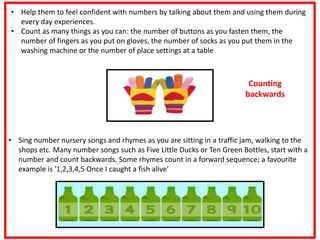
Counting
backwards
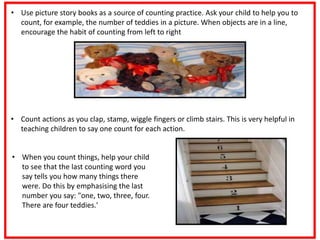
• Use picture story books as a source of counting practice. Ask your child to help you to
count, for example, the number of teddies in a picture. When objects are in a line,
encourage the habit of counting from left to right
• Count actions as you clap, stamp, wiggle fingers or climb stairs. This is very helpful in
teaching children to say one count for each action.
• When you count things, help your child
to see that the last counting word you
say tells you how many things there
were. Do this by emphasising the last
number you say: "one, two, three, four.
There are four teddies.'
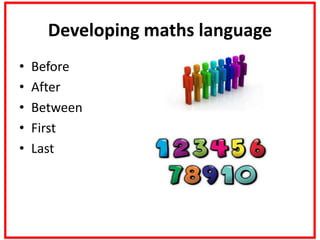
Developing maths language
• Before
• After
• Between
• First
• Last
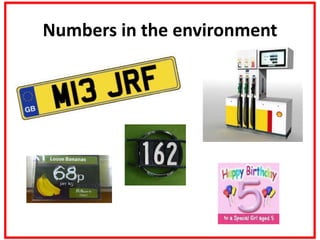
Numbers in the environment
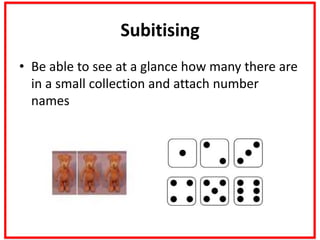
Subitising
• Be able to see at a glance how many there are
in a small collection and attach number
names
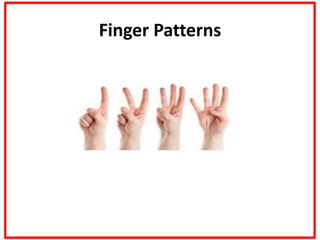
Finger Patterns
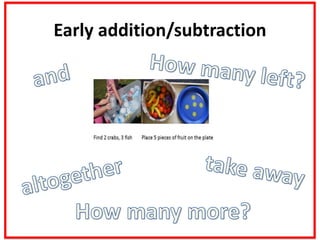
Early addition/subtraction
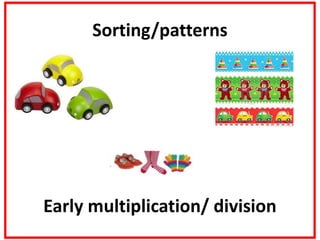
Sorting/patterns
Early multiplication/ division
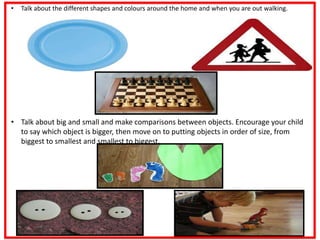
• Talk about the different shapes and colours around the home and when you are out walking.
• Talk about big and small and make comparisons between objects. Encourage your child
to say which object is bigger, then move on to putting objects in order of size, from
biggest to smallest and smallest to biggest.
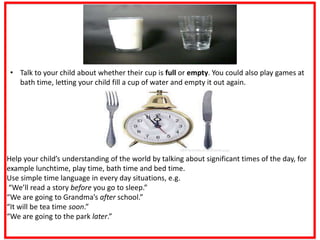
• Talk to your child about whether their cup is full or empty. You could also play games at
bath time, letting your child fill a cup of water and empty it out again.
Help your child’s understanding of the world by talking about significant times of the day, for
example lunchtime, play time, bath time and bed time.
Use simple time language in every day situations, e.g.
“We’ll read a story before you go to sleep.”
“We are going to Grandma’s after school.”
“It will be tea time soon.”
“We are going to the park later.”
Useful Websites
http://www.oxfordowl.co.uk/for-home/maths-owl/fun-activities
http://www.topmarks.co.uk/maths-games/3-5-years/counting
http://www.bbc.co.uk/cbeebies/the-numtums/
http://www.bbc.co.uk/cbeebies/numberjacks/games/numberjacks-
numberjumpinggenerator
http://www.bbc.co.uk/cbeebies/teletubbies/games/teletubbies-morethanone/
http://www.bbc.co.uk/cbeebies/tikkabilla/games/tikkabilla-tambasabacus

Nursery