Maths Information EveningMaths Information Evening
99thth
November 2016November 2016
What is progress in Maths?What is progress in Maths?
At all levels learning maths is about solving problems
using key processes such as:
 Looking for patterns and relationships between
numbers.
 Making sense of and checking information.
 Communicating and presenting maths using words and
diagrams (symbols and pictures).
 Reasoning and developing mathematical arguments.
 Calculating
 Comparing
 Manipulating, organising and interpreting information.
 Reasoning
Maths in Key Stage 1Maths in Key Stage 1
In Year 1 Autumn term I – taught
twice a week with provision activities
available
Year 1 – till Summer term – taught 5
times a week
Year 2 – taught 5 times a week
Taught across the curriculum where
possible
General Number SkillsGeneral Number Skills
1:1 Correspondence
Number formation
Maths vocabulary
Place value
Place ValuePlace Value
Children have to be really comfortable
with their understanding of the value
of number to be able to apply it.
The position (place) of a digit in a
number determines its value. Hence the
term place value.
Maths ResourcesMaths Resources
Bead Strings
Tens and ones
Number squares
Cubes/counters
Exhibition of a NumberExhibition of a Number
Can you make an exhibition of the
number 12 using as much of the
equipment as you can?
Can you show it in different jumps?
As a fraction of a number?
Using measurements or money?
What numbers are being shown here?What numbers are being shown here?
Addition - Year 1Addition - Year 1
Using pictures of objects – cubes,
counters
Using number lines to add one-digit to
a two-digit number to 20
Bead strings.
Number bonds to 10 and 20.
0 1 2 3 4 5 6 7 8 9 10 11 12 13 14 15
Addition - Year 2Addition - Year 2
When children are confident with using
empty number lines, they will use their
knowledge of tens and ones to add
Two digit numbers and ones: 34 + 5
Two digit numbers and tens: 34 + 40
 2 two-digit numbers: 34 + 23
Ones can then be done in one jump or by
bridging to the next ten.
Blank Number LinesBlank Number Lines
Draw yourself a blank number line.
Can you find the answer to this calculation by
adding the tens and ones?
48 + 36 = ?
Can you add the tens in one jump and ones
in one jump?
Remember to show how you’re adding in
each jump and write the numbers
underneath!
Addition – Year 2Addition – Year 2
Count on from the largest number,
irrespective of the order of the calculation.
Estimating calculations:
49 + 52 = ?
What estimation could I make here?
“I know that 49 and 52 are both close to
50 so the answer should be somewhere
near 100.”
Addition – Year 2Addition – Year 2
 Children will begin to use informal pencil and
paper methods (jottings) to support, record and
explain partial mental methods building on
existing mental strategies.
 Partitioning – tens and ones
35 + 52 = ?
(t) 30 + 50 = 80
(o) 5 + 2 = 7
(r) 80 + 7 = 87
Choosing an AppropriateChoosing an Appropriate
StrategyStrategy
Can you choose the most appropriate
strategy to find the answer to these
calculations?
53 + 24 =
37 + 56 =
Subtraction – Year 1Subtraction – Year 1
 Bead strings, counters and cubes
 Using pictorial representations
 Finding the difference
 Subtract a one-digit number from a teen number.
7
6
5
4
3
2
1
3
2
1
Subtraction – Year 1Subtraction – Year 1
Using a number line to ‘count back’ or
subtract e.g. 6-3=3
- Start from the biggest number
- Count backwards as we’re taking away
- Show the value of each jump
Missing numbers
Subtraction – Year 2Subtraction – Year 2
Using understanding of tens and ones
to subtract:
- Two digit number and ones
- Two digit number and tens
- 2 two digit numbers
Subtracting the tens in one jump and
the ones in one jump
Bridging through the ten
Your go!Your go!
Find the answer to this on a blank
number line. Can you subtract the tens
and ones in one jump?
74 – 53 = ?
Find the answer to this subtraction by
bridging to the nearest ten.
73 – 59 = ?
Subtraction – Year 2Subtraction – Year 2
Partitioning:
This is trickier to show children when subtracting as
there will be some situations where the children
need to take away too many ones.
77 – 42 =
(t) 70 – 40 = 30
(o) 7 – 2 = 5
(r) 30 + 5 = 35
If there are more ones in
the second number then
you only partition that
number (or use a number
line!)
77– 49 =
(t) 77 – 40 = 37
(o) 37 – 9 = 28
Because we have separated
the tens and ones we must
recombine them by ADDING!
Multiplication – Year 1Multiplication – Year 1
Using objects and pictures to make
lots of or groups:
Using bead strings to show lots of or
groups of:
3 x 5 = 15
Multiplication – Year 1Multiplication – Year 1
We use lots of different words to show
multiplication – it’s important to not just call
them the ‘Times Tables’.
Multiplication – Year 1Multiplication – Year 1
 Children should be able to model a multiplication
calculation using an array, with support.
3 x 5 = 15
5 x 3 = 15
We often do
this using
edible objects!
Multiplication - Year 2Multiplication - Year 2
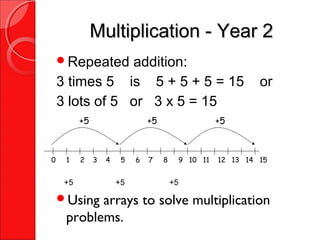
Repeated addition:
3 times 5 is 5 + 5 + 5 = 15 or
3 lots of 5 or 3 x 5 = 15
Using arrays to solve multiplication
problems.
0 1 2 3 4 5 6 7 8 9 10 11 12 13 14 15
+5 +5 +5
+5 +5 +5
Multiplication - Stage 2 -Multiplication - Stage 2 -
CommutativityCommutativity
Children should know that 3 x 5 has
the same answer as 5 x 3. This can
also be shown on the number line.
0 1 2 3 4 5 6 7 8 9 10 11 12 13 14 15
+5 +5 +5
+3 +3 +3 +3 +3
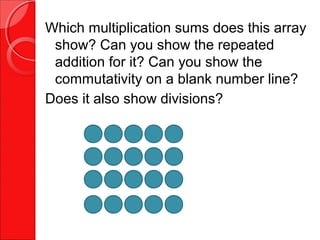
Which multiplication sums does this array
show? Can you show the repeated
addition for it? Can you show the
commutativity on a blank number line?
Does it also show divisions?
Division – Year 1Division – Year 1
Introducing division is practical, using
equipment to demonstrate and letting children
experience sharing through play.
6 sweets shared between 2 people, how many do
they each get?
Division – Year 2Division – Year 2
 Grouping or repeated subtraction:
There are 6 sweets. How many people can get 2
sweets each?
Using arrays to solve division problems.
Repeated subtraction on a number line: 12 ÷ 3 = 4
0 1 2 3 4 5 6 7 8 9 10 11 12
-3 -3 -3 -3
Division - Year 2Division - Year 2
 Repeated subtraction to divide using an empty
number line:
24 ÷ 4 = 6
Using multiplication and counting in ‘lots of’:
30 ÷ 5 = ? How many 5’s are in 30?
0 4 8 12 16 20 24
-4 -4 -4 -4 -4 -4
Using and ApplyingUsing and Applying
After they have learnt a calculation skill,
we give the children opportunities to
use and apply their knowledge.
This is a great chance to get the
children to talk about the strategies they
are using and check that they are
applying the most appropriate strategy
– although as long as it works for them
it can be any strategy!
Word ProblemsWord Problems
A word problem gives the children a
question.
They have to look at the words and
numbers used in the word problem to
decide which calculation they need to
write.
We would also encourage them to use
pictorial representations to find the
answers.
One-Step Problems
There are 5 lily pads in the pond. They each
have 3 frogs on. How many frogs are there
altogether?
5 x 3 = 15
Two Step Problems
Matt has 25 bags of plain crisps and 31
packets of flavoured crisps. There are 52
children in the class and they have one packet
each. How many packets are left?
• What are the steps needed to solve this
problem?
• What calculations will you need to write?
• What methods would you use to solve these
problems?
• Would a pictorial representation be the best
method?
Problem SolvingProblem Solving
Solving a problem is more open-ended.
There’s usually more than one answer.
Problem solving helps children to:
Think
Apply
Communicate
Reason
Problem SolvingProblem Solving
There are a few problems on each
table.
Have a go at finding as many solutions
as you can with your group.
Feel free to move around to the other
tables to look at theirs!
Helping Your Child At Home
Don’t!
• Push a skill, especially if a child is becoming confused or is feeling
pressured. It always pays to talk to the teacher if you feel your child is not
understanding something, rather than confuse them further by teaching
them in a different way.
• Force workbooks on your child. They will do plenty of writing in
their maths books at school. At home, you have the opportunity to help
them memorise their number facts and perform mathematical calculations
in their heads.
• Stress written sums laid out as you used to do them! Nowadays
it is the development of what we call ‘numerical fluency’ that counts.
Children need to be comfortable with numbers, to understand how they
work and to be confident in doing mental calculations.
• Just give them bigger numbers to work with.
Consider the ways that you could challenge them
to deepen their understanding of that concept.
Helping Your Child At Home
Do!
• ‘Little and often’! Counting sultanas as you eat them or stairs when
going up to a first floor flat is a much better way of rehearsing counting
than sitting over a workbook.
• Give LOTS of praise. Resist the temptation to say, ‘but’ or to point
out mistakes every time. Children need encouragement and positive
reinforcement to be confident, and a confident child makes a better
learner.
• Play games! Dice, dominoes, track games and cards all make
excellent
excuses for using and applying our number skills. And at the same time
your child is learning the important skills of losing with grace and
winning with style!
• Remember that your focussed attention is a far more
important and pleasurable commodity for any child than
any amount of TV or video game activity. Every child
wants to be doing things one-on-one with someone they
love and trust.

KS1 Maths evening 2017

  • 1.
    Maths Information EveningMathsInformation Evening 99thth November 2016November 2016
  • 2.
    What is progressin Maths?What is progress in Maths? At all levels learning maths is about solving problems using key processes such as:  Looking for patterns and relationships between numbers.  Making sense of and checking information.  Communicating and presenting maths using words and diagrams (symbols and pictures).  Reasoning and developing mathematical arguments.  Calculating  Comparing  Manipulating, organising and interpreting information.  Reasoning
  • 3.
    Maths in KeyStage 1Maths in Key Stage 1 In Year 1 Autumn term I – taught twice a week with provision activities available Year 1 – till Summer term – taught 5 times a week Year 2 – taught 5 times a week Taught across the curriculum where possible
  • 4.
    General Number SkillsGeneralNumber Skills 1:1 Correspondence Number formation Maths vocabulary Place value
  • 5.
    Place ValuePlace Value Childrenhave to be really comfortable with their understanding of the value of number to be able to apply it. The position (place) of a digit in a number determines its value. Hence the term place value.
  • 6.
    Maths ResourcesMaths Resources BeadStrings Tens and ones Number squares Cubes/counters
  • 7.
    Exhibition of aNumberExhibition of a Number Can you make an exhibition of the number 12 using as much of the equipment as you can? Can you show it in different jumps? As a fraction of a number? Using measurements or money?
  • 8.
    What numbers arebeing shown here?What numbers are being shown here?
  • 9.
    Addition - Year1Addition - Year 1 Using pictures of objects – cubes, counters Using number lines to add one-digit to a two-digit number to 20 Bead strings. Number bonds to 10 and 20. 0 1 2 3 4 5 6 7 8 9 10 11 12 13 14 15
  • 10.
    Addition - Year2Addition - Year 2 When children are confident with using empty number lines, they will use their knowledge of tens and ones to add Two digit numbers and ones: 34 + 5 Two digit numbers and tens: 34 + 40  2 two-digit numbers: 34 + 23 Ones can then be done in one jump or by bridging to the next ten.
  • 11.
    Blank Number LinesBlankNumber Lines Draw yourself a blank number line. Can you find the answer to this calculation by adding the tens and ones? 48 + 36 = ? Can you add the tens in one jump and ones in one jump? Remember to show how you’re adding in each jump and write the numbers underneath!
  • 12.
    Addition – Year2Addition – Year 2 Count on from the largest number, irrespective of the order of the calculation. Estimating calculations: 49 + 52 = ? What estimation could I make here? “I know that 49 and 52 are both close to 50 so the answer should be somewhere near 100.”
  • 13.
    Addition – Year2Addition – Year 2  Children will begin to use informal pencil and paper methods (jottings) to support, record and explain partial mental methods building on existing mental strategies.  Partitioning – tens and ones 35 + 52 = ? (t) 30 + 50 = 80 (o) 5 + 2 = 7 (r) 80 + 7 = 87
  • 14.
    Choosing an AppropriateChoosingan Appropriate StrategyStrategy Can you choose the most appropriate strategy to find the answer to these calculations? 53 + 24 = 37 + 56 =
  • 15.
    Subtraction – Year1Subtraction – Year 1  Bead strings, counters and cubes  Using pictorial representations  Finding the difference  Subtract a one-digit number from a teen number. 7 6 5 4 3 2 1 3 2 1
  • 16.
    Subtraction – Year1Subtraction – Year 1 Using a number line to ‘count back’ or subtract e.g. 6-3=3 - Start from the biggest number - Count backwards as we’re taking away - Show the value of each jump Missing numbers
  • 17.
    Subtraction – Year2Subtraction – Year 2 Using understanding of tens and ones to subtract: - Two digit number and ones - Two digit number and tens - 2 two digit numbers Subtracting the tens in one jump and the ones in one jump Bridging through the ten
  • 18.
    Your go!Your go! Findthe answer to this on a blank number line. Can you subtract the tens and ones in one jump? 74 – 53 = ? Find the answer to this subtraction by bridging to the nearest ten. 73 – 59 = ?
  • 19.
    Subtraction – Year2Subtraction – Year 2 Partitioning: This is trickier to show children when subtracting as there will be some situations where the children need to take away too many ones. 77 – 42 = (t) 70 – 40 = 30 (o) 7 – 2 = 5 (r) 30 + 5 = 35 If there are more ones in the second number then you only partition that number (or use a number line!) 77– 49 = (t) 77 – 40 = 37 (o) 37 – 9 = 28 Because we have separated the tens and ones we must recombine them by ADDING!
  • 20.
    Multiplication – Year1Multiplication – Year 1 Using objects and pictures to make lots of or groups:
  • 21.
    Using bead stringsto show lots of or groups of: 3 x 5 = 15 Multiplication – Year 1Multiplication – Year 1 We use lots of different words to show multiplication – it’s important to not just call them the ‘Times Tables’.
  • 22.
    Multiplication – Year1Multiplication – Year 1  Children should be able to model a multiplication calculation using an array, with support. 3 x 5 = 15 5 x 3 = 15 We often do this using edible objects!
  • 23.
    Multiplication - Year2Multiplication - Year 2 Repeated addition: 3 times 5 is 5 + 5 + 5 = 15 or 3 lots of 5 or 3 x 5 = 15 Using arrays to solve multiplication problems. 0 1 2 3 4 5 6 7 8 9 10 11 12 13 14 15 +5 +5 +5 +5 +5 +5
  • 24.
    Multiplication - Stage2 -Multiplication - Stage 2 - CommutativityCommutativity Children should know that 3 x 5 has the same answer as 5 x 3. This can also be shown on the number line. 0 1 2 3 4 5 6 7 8 9 10 11 12 13 14 15 +5 +5 +5 +3 +3 +3 +3 +3
  • 25.
    Which multiplication sumsdoes this array show? Can you show the repeated addition for it? Can you show the commutativity on a blank number line? Does it also show divisions?
  • 26.
    Division – Year1Division – Year 1 Introducing division is practical, using equipment to demonstrate and letting children experience sharing through play. 6 sweets shared between 2 people, how many do they each get?
  • 27.
    Division – Year2Division – Year 2  Grouping or repeated subtraction: There are 6 sweets. How many people can get 2 sweets each? Using arrays to solve division problems. Repeated subtraction on a number line: 12 ÷ 3 = 4 0 1 2 3 4 5 6 7 8 9 10 11 12 -3 -3 -3 -3
  • 28.
    Division - Year2Division - Year 2  Repeated subtraction to divide using an empty number line: 24 ÷ 4 = 6 Using multiplication and counting in ‘lots of’: 30 ÷ 5 = ? How many 5’s are in 30? 0 4 8 12 16 20 24 -4 -4 -4 -4 -4 -4
  • 29.
    Using and ApplyingUsingand Applying After they have learnt a calculation skill, we give the children opportunities to use and apply their knowledge. This is a great chance to get the children to talk about the strategies they are using and check that they are applying the most appropriate strategy – although as long as it works for them it can be any strategy!
  • 30.
    Word ProblemsWord Problems Aword problem gives the children a question. They have to look at the words and numbers used in the word problem to decide which calculation they need to write. We would also encourage them to use pictorial representations to find the answers.
  • 31.
    One-Step Problems There are5 lily pads in the pond. They each have 3 frogs on. How many frogs are there altogether? 5 x 3 = 15
  • 32.
    Two Step Problems Matthas 25 bags of plain crisps and 31 packets of flavoured crisps. There are 52 children in the class and they have one packet each. How many packets are left? • What are the steps needed to solve this problem? • What calculations will you need to write? • What methods would you use to solve these problems? • Would a pictorial representation be the best method?
  • 33.
    Problem SolvingProblem Solving Solvinga problem is more open-ended. There’s usually more than one answer. Problem solving helps children to: Think Apply Communicate Reason
  • 34.
    Problem SolvingProblem Solving Thereare a few problems on each table. Have a go at finding as many solutions as you can with your group. Feel free to move around to the other tables to look at theirs!
  • 35.
    Helping Your ChildAt Home Don’t! • Push a skill, especially if a child is becoming confused or is feeling pressured. It always pays to talk to the teacher if you feel your child is not understanding something, rather than confuse them further by teaching them in a different way. • Force workbooks on your child. They will do plenty of writing in their maths books at school. At home, you have the opportunity to help them memorise their number facts and perform mathematical calculations in their heads. • Stress written sums laid out as you used to do them! Nowadays it is the development of what we call ‘numerical fluency’ that counts. Children need to be comfortable with numbers, to understand how they work and to be confident in doing mental calculations. • Just give them bigger numbers to work with. Consider the ways that you could challenge them to deepen their understanding of that concept.
  • 36.
    Helping Your ChildAt Home Do! • ‘Little and often’! Counting sultanas as you eat them or stairs when going up to a first floor flat is a much better way of rehearsing counting than sitting over a workbook. • Give LOTS of praise. Resist the temptation to say, ‘but’ or to point out mistakes every time. Children need encouragement and positive reinforcement to be confident, and a confident child makes a better learner. • Play games! Dice, dominoes, track games and cards all make excellent excuses for using and applying our number skills. And at the same time your child is learning the important skills of losing with grace and winning with style! • Remember that your focussed attention is a far more important and pleasurable commodity for any child than any amount of TV or video game activity. Every child wants to be doing things one-on-one with someone they love and trust.