TEACHING MATH TO YOUNG
CHILDREN
TRY TO MEMORIZE THESE
SYMBOLS
Top to bottom, left to right: 1, 7, 12, 3, 6, 4, 5, 10, 8, 9, 11, 2
NOW TEST YOURSELF:
•This is a taste of what a child
has to accomplish when learning
numbers.
MOST IMPORTANTLY –
HAVE A POSITIVE ATTITUDE ABOUT LEARNING MATH!
TEACHING MATH
• MATH CONCEPTS SHOULD BE
CONCRETE & MANIPULATIVE
• CONSIDER PRIOR KNOWLEDGE
• CONSIDER CHILDREN’S INTERESTS
• HELP CHILDREN WITH NEW
VOCABULARY
• SOCIAL INTERACTION IS IMPORTANT
CONCEPT: What are numbers?
• Rote counting
• Identify symbols
• Count objects
• Tell how many
• Telling which one
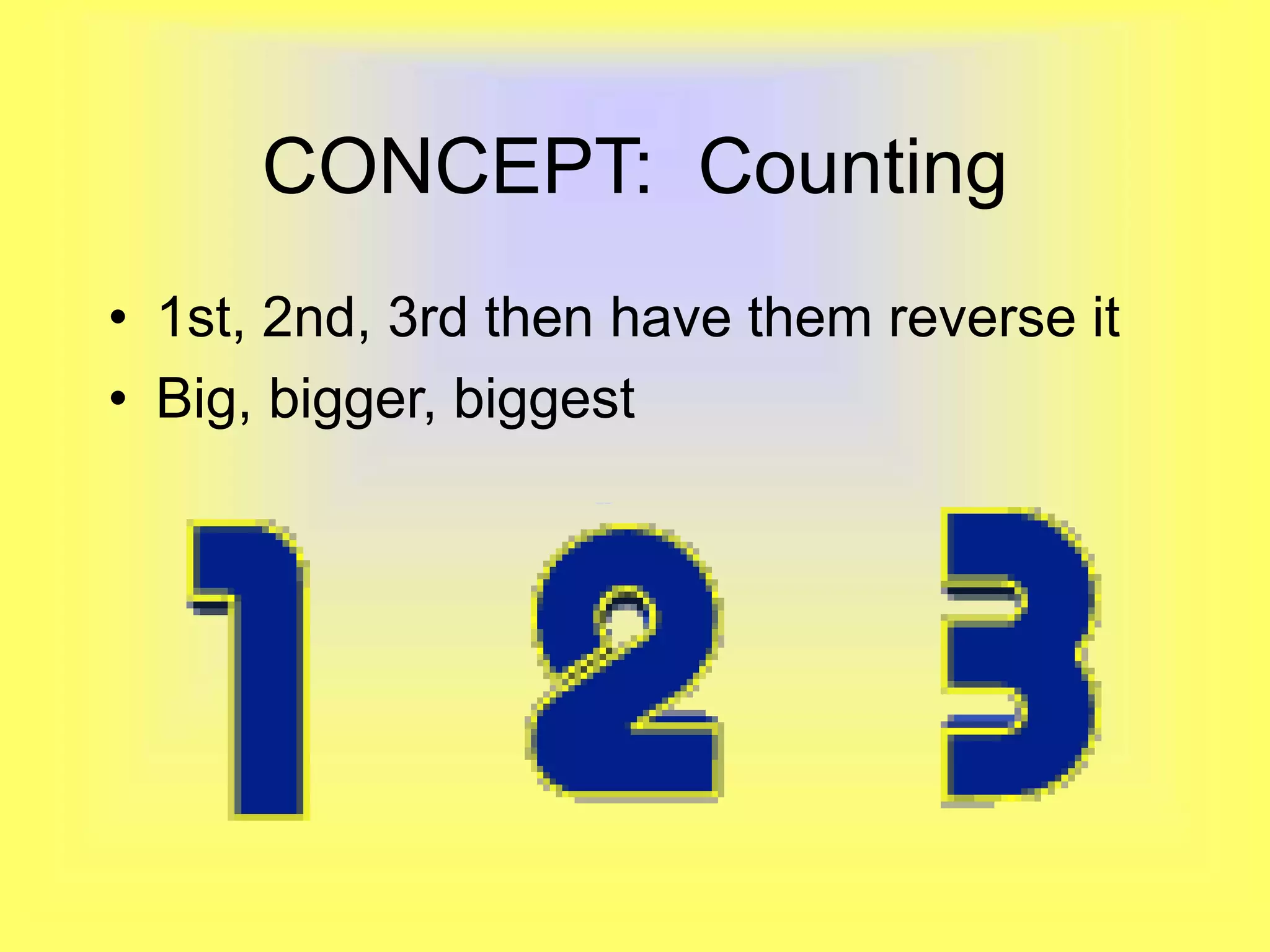
CONCEPT: Counting
• 1st, 2nd, 3rd then have them reverse it
• Big, bigger, biggest
CONCEPT: Measure up
• Measurement comparisons
• Measuring units: inch, pound, quart
CONCEPT: Getting around
• Spatial relations
• Maps
• Follow directions
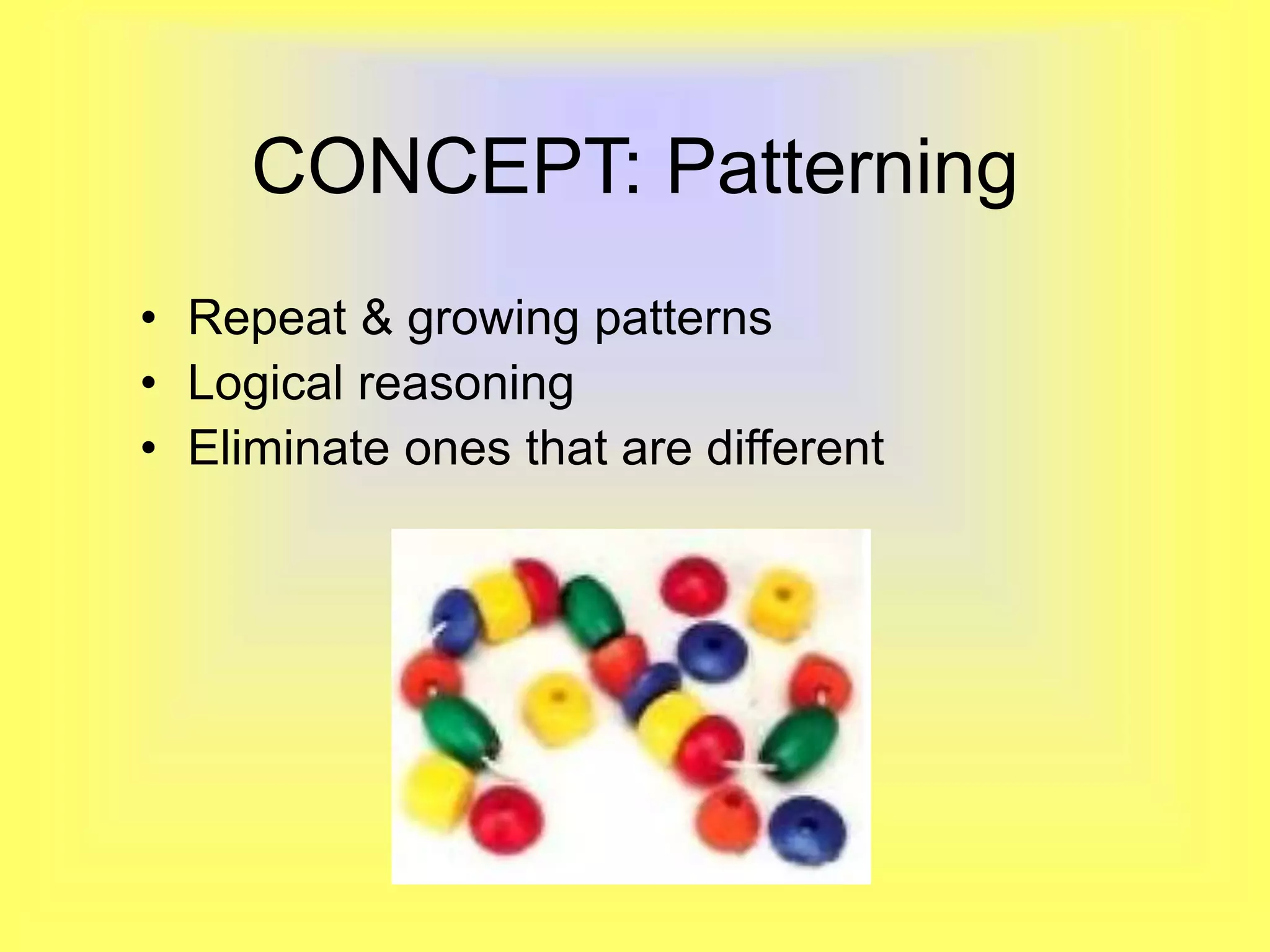
CONCEPT: Patterning
• Repeat & growing patterns
• Logical reasoning
• Eliminate ones that are different
CONCEPT: Seriating
• Size relationships
• From tall to short
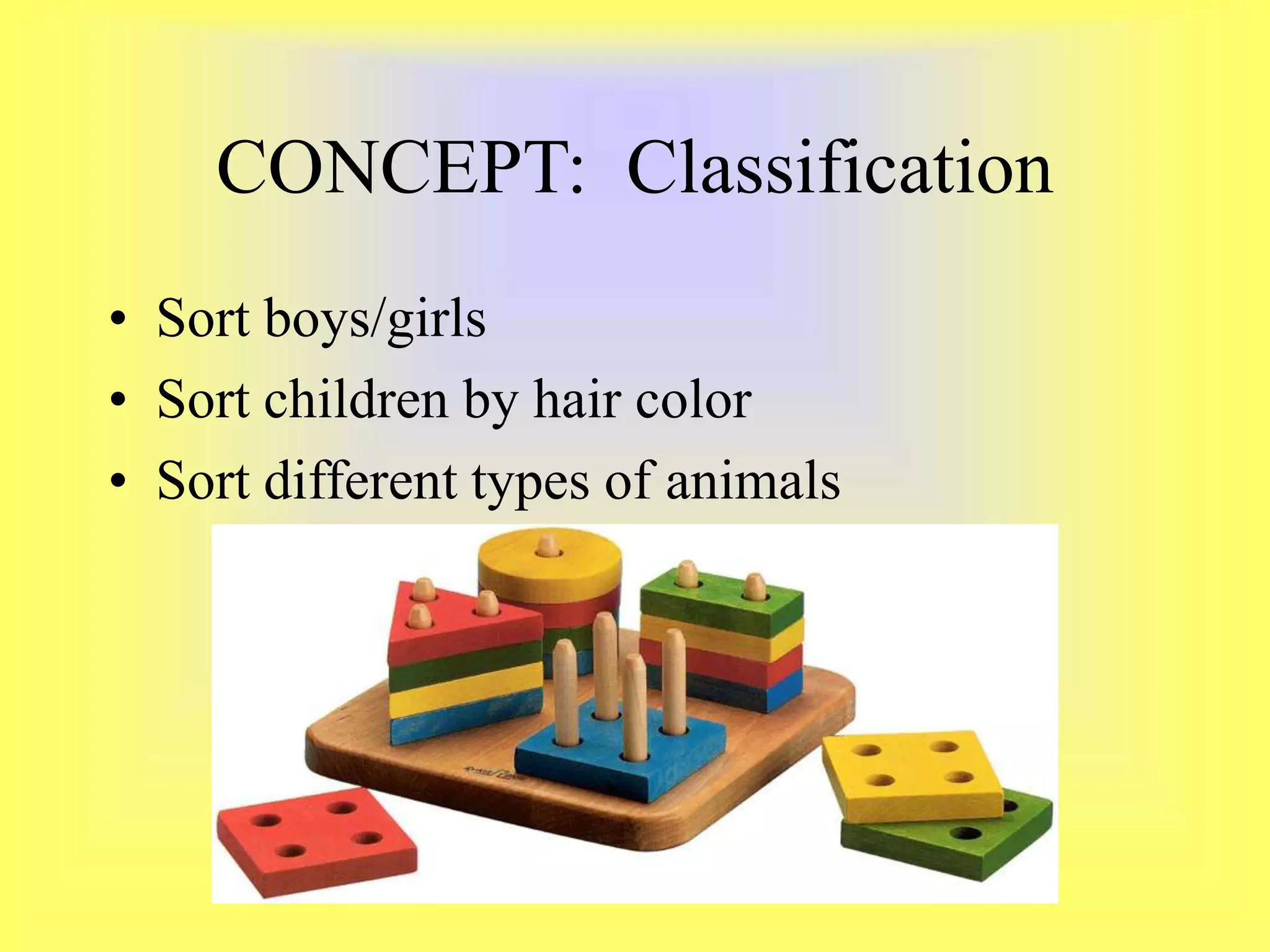
CONCEPT: Classification
• Sort boys/girls
• Sort children by hair color
• Sort different types of animals
CONCEPT: Sequencing
• Sequence the order of pictures in a story
CONCEPT: Symmetry
• Fold and color lines of symmetry
• Use mirror to draw
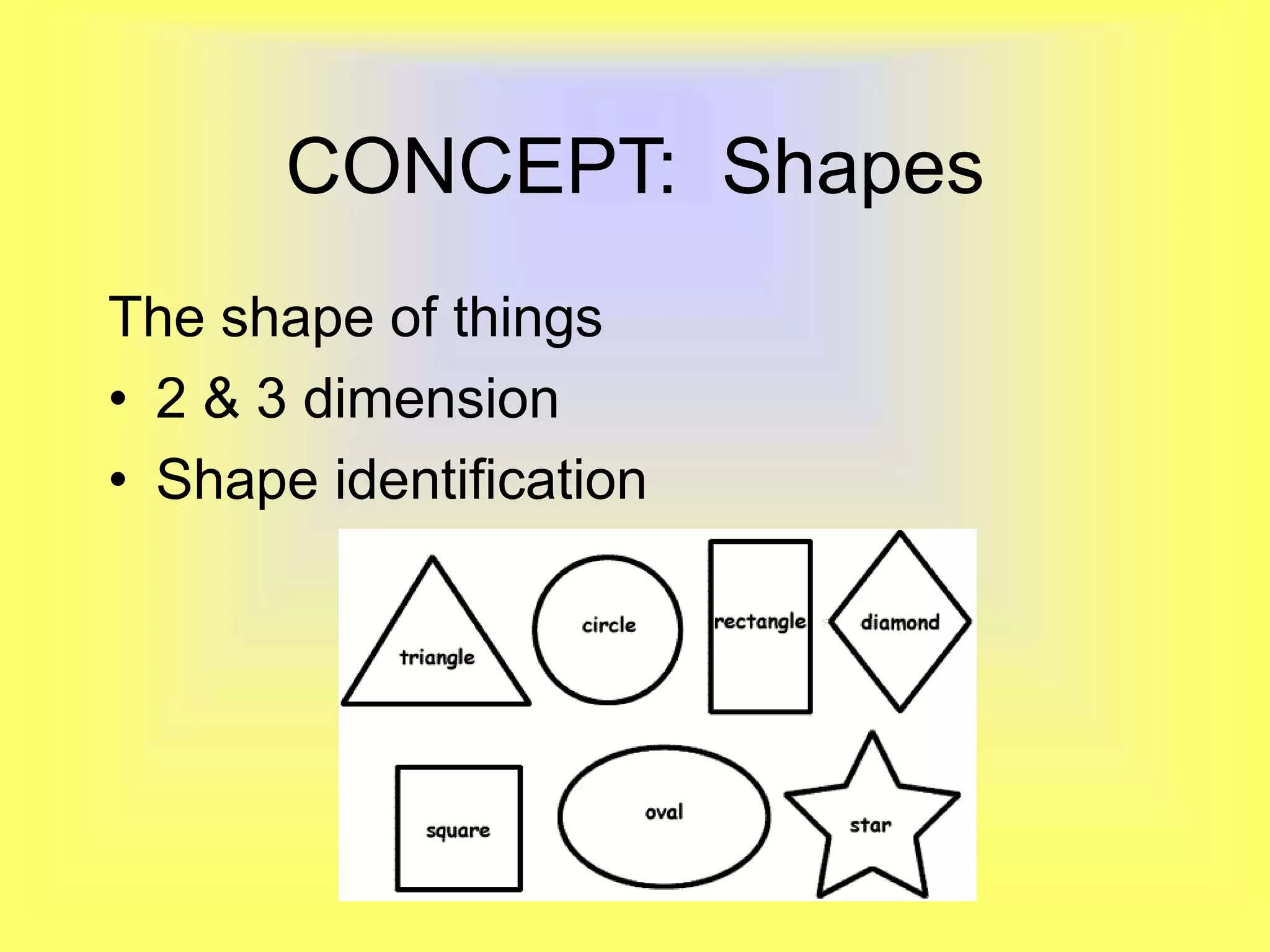
CONCEPT: Shapes
The shape of things
• 2 & 3 dimension
• Shape identification
SHAPES cont’d
• Spheres, cubes, rectangular, prisms,
cylinder (use correct names)
• Pictures of shapes need name written
on it (language development)
• Play game & move # of spaces of the #
of sides (circle=0)
CONCEPT: Money
• Children can start to identify coins
• Playing store helps children gain a
sense of the cost of things
Activity: Read “Smart” by Shel Silverstein
“Just write a check, Mom”
CONCEPT: Time
• Children can start to read a clock
• Time concepts must relate to their world
– The length of their favorite TV show
Have a digital clock next to a face clock
CONCEPT: Statistics &
Probability
• Graph types of bugs found, growth of
plants, etc.
• Predict how many flowers will bloom from
seeds planted.
WHAT ABOUT CALCULATORS &
COMPUTERS
• Children should be allowed to explore
calculators.
• But solving the problem should be the
focus.
• Computers enhance learning if child is
required to interact and think logically.
GUIDELINES
• Oral language is important in
development of math skills.
• Children can have long attention spans.
• Few strong divides between 4 & 5 year
olds.
• Repetition is important.
• Mistakes are good & a natural part of
learning process.
• Simple activities can be complex.
MATHEMATICAL
CLASSROOM MATERIALS:
• Felt & magnetic numbers & shapes
• Peg boards
• Calendars
• Ruler, measuring tapes, measuring cups, scales
• Play money & cash registers
• Timers, clocks, Thermometers
• Counting rods
• Light & heavy objects
• Buttons, keys, spools
• Puzzles
MATH_FOR_YOUNG_CHILDREN.ppt

MATH_FOR_YOUNG_CHILDREN.ppt

  • 1.
    TEACHING MATH TOYOUNG CHILDREN
  • 2.
    TRY TO MEMORIZETHESE SYMBOLS Top to bottom, left to right: 1, 7, 12, 3, 6, 4, 5, 10, 8, 9, 11, 2
  • 3.
  • 4.
    •This is ataste of what a child has to accomplish when learning numbers.
  • 5.
    MOST IMPORTANTLY – HAVEA POSITIVE ATTITUDE ABOUT LEARNING MATH!
  • 6.
    TEACHING MATH • MATHCONCEPTS SHOULD BE CONCRETE & MANIPULATIVE • CONSIDER PRIOR KNOWLEDGE • CONSIDER CHILDREN’S INTERESTS • HELP CHILDREN WITH NEW VOCABULARY • SOCIAL INTERACTION IS IMPORTANT
  • 7.
    CONCEPT: What arenumbers? • Rote counting • Identify symbols • Count objects • Tell how many • Telling which one
  • 8.
    CONCEPT: Counting • 1st,2nd, 3rd then have them reverse it • Big, bigger, biggest
  • 9.
    CONCEPT: Measure up •Measurement comparisons • Measuring units: inch, pound, quart
  • 10.
    CONCEPT: Getting around •Spatial relations • Maps • Follow directions
  • 11.
    CONCEPT: Patterning • Repeat& growing patterns • Logical reasoning • Eliminate ones that are different
  • 12.
    CONCEPT: Seriating • Sizerelationships • From tall to short
  • 13.
    CONCEPT: Classification • Sortboys/girls • Sort children by hair color • Sort different types of animals
  • 14.
    CONCEPT: Sequencing • Sequencethe order of pictures in a story
  • 15.
    CONCEPT: Symmetry • Foldand color lines of symmetry • Use mirror to draw
  • 16.
    CONCEPT: Shapes The shapeof things • 2 & 3 dimension • Shape identification
  • 17.
    SHAPES cont’d • Spheres,cubes, rectangular, prisms, cylinder (use correct names) • Pictures of shapes need name written on it (language development) • Play game & move # of spaces of the # of sides (circle=0)
  • 18.
    CONCEPT: Money • Childrencan start to identify coins • Playing store helps children gain a sense of the cost of things Activity: Read “Smart” by Shel Silverstein “Just write a check, Mom”
  • 19.
    CONCEPT: Time • Childrencan start to read a clock • Time concepts must relate to their world – The length of their favorite TV show Have a digital clock next to a face clock
  • 20.
    CONCEPT: Statistics & Probability •Graph types of bugs found, growth of plants, etc. • Predict how many flowers will bloom from seeds planted.
  • 21.
    WHAT ABOUT CALCULATORS& COMPUTERS • Children should be allowed to explore calculators. • But solving the problem should be the focus. • Computers enhance learning if child is required to interact and think logically.
  • 22.
    GUIDELINES • Oral languageis important in development of math skills. • Children can have long attention spans. • Few strong divides between 4 & 5 year olds. • Repetition is important. • Mistakes are good & a natural part of learning process. • Simple activities can be complex.
  • 23.
    MATHEMATICAL CLASSROOM MATERIALS: • Felt& magnetic numbers & shapes • Peg boards • Calendars • Ruler, measuring tapes, measuring cups, scales • Play money & cash registers • Timers, clocks, Thermometers • Counting rods • Light & heavy objects • Buttons, keys, spools • Puzzles