Introduction to
     Reed-Solomon Code

             Peng Xu
C5000 Software Development Group
      Texas Instruments Inc.
         Stafford, Texas
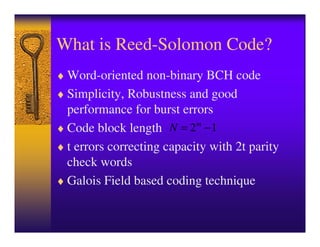
What is Reed-Solomon Code?
♦ Word-oriented non-binary BCH code
♦ Simplicity, Robustness and good
  performance for burst errors
♦ Code block length N = 2 − 1
                            m


♦ t errors correcting capacity with 2t parity
  check words
♦ Galois Field based coding technique
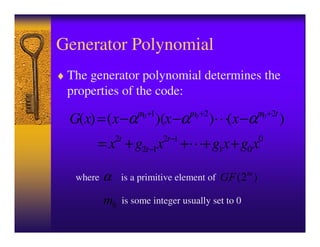
Generator Polynomial
♦ The generator polynomial determines the
 properties of the code:

  G(x) = (x −α          m0 +1
                                )(x −α    m0 +2
                                                  ) (x −α   m0 +2t
                                                                     )
                                 2t −1
       = x + g2t−1x
               2t
                                         + + g1x + g0x      0


   where   α    is a primitive element of GF ( 2 m )

           m0       is some integer usually set to 0
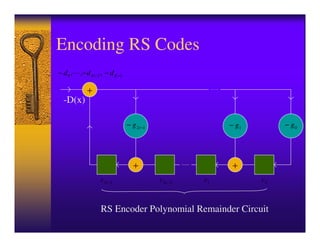
Encoding RS Codes
 C ( x) = D( x) ⋅ x 2t − [ D( x) ⋅ x 2t mod G ( x)]
 where C(x) is the transmitted codeword polynomial, of
       degree N-1
       D(x) is the user data polynomial, of degree K-1
       G(x) is the generator polynomial of the code, of
       degree 2t

 and        N – K = 2t


       d K −1 d K − 2     d1    d0    c2t −1 c2t − 2        c1   c0

                   User Data                       Parity
Encoding RS Codes
− d0 ,   ,− d K − 2 , − d K −1

            +
  -D(x)

                                 − g 2t −1                   − g1        − g0


                                    +                         +
                   c2t −1                    c2 t − 2   c1          c0


                   RS Encoder Polynomial Remainder Circuit
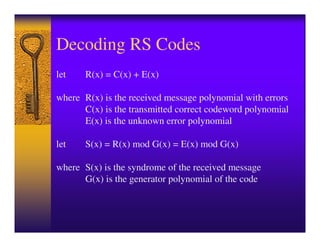
Decoding RS Codes
let    R(x) = C(x) + E(x)

where R(x) is the received message polynomial with errors
      C(x) is the transmitted correct codeword polynomial
      E(x) is the unknown error polynomial

let    S(x) = R(x) mod G(x) = E(x) mod G(x)

where S(x) is the syndrome of the received message
      G(x) is the generator polynomial of the code
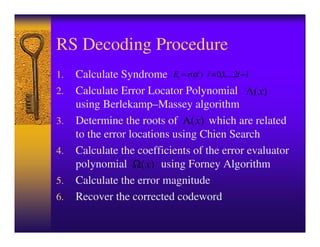
RS Decoding Procedure
1.   Calculate Syndrome Ei = r(αi ) i = 0,1,...,2t −1
2.   Calculate Error Locator Polynomial Λ (x)
     using Berlekamp–Massey algorithm
3.   Determine the roots of Λ (x) which are related
     to the error locations using Chien Search
4.   Calculate the coefficients of the error evaluator
     polynomial Ω(x) using Forney Algorithm
5.   Calculate the error magnitude
6.   Recover the corrected codeword
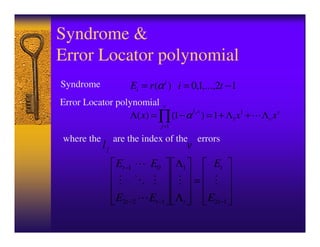
Syndrome &
Error Locator polynomial
Syndrome             Ei = r (α i ) i = 0,1,...,2t − 1
Error Locator polynomial v
                 Λ( x) = ∏ (1 − α ) = 1 + Λ1 x1 +
                                 ljx
                                                             Λv xv
                                j =1

where the        are the index of the           errors
            lj                              v
                 Et −1     E0          Λ1            Et
                                                =
                 E2t −2   Et −1 Λ t                 E2t −1
Berlekamp-Massey Algorithm
This algorithm was developed by Berlekmap
and Massey to solve the problem of
determining the error locator polynomial.

It reduces the complexity from O(t 3 ) of
matrix inversion to O(t 2 ) .
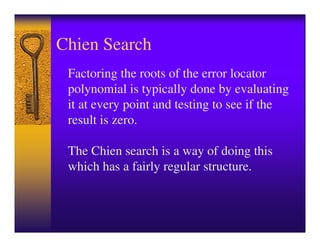
Chien Search
 Factoring the roots of the error locator
 polynomial is typically done by evaluating
 it at every point and testing to see if the
 result is zero.

 The Chien search is a way of doing this
 which has a fairly regular structure.
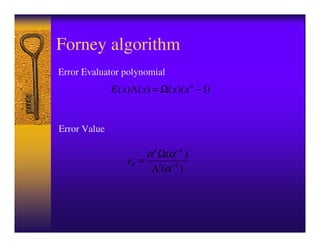
Forney algorithm
Error Evaluator polynomial
              E ( x)Λ( x) = Ω( x)( x n − 1)


Error Value

                       α k Ω(α − k )
                  ek =
                        Λ′(α −k )
Future Tasks
♦ More flexible generator polynomial?
♦ More Logarithm tables of GF?
♦ Convert C54x to C55x codes?
♦ Application Notes?
♦ More…

IntrRSCode

  • 1.
    Introduction to Reed-Solomon Code Peng Xu C5000 Software Development Group Texas Instruments Inc. Stafford, Texas
  • 2.
    What is Reed-SolomonCode? ♦ Word-oriented non-binary BCH code ♦ Simplicity, Robustness and good performance for burst errors ♦ Code block length N = 2 − 1 m ♦ t errors correcting capacity with 2t parity check words ♦ Galois Field based coding technique
  • 3.
    Generator Polynomial ♦ Thegenerator polynomial determines the properties of the code: G(x) = (x −α m0 +1 )(x −α m0 +2 ) (x −α m0 +2t ) 2t −1 = x + g2t−1x 2t + + g1x + g0x 0 where α is a primitive element of GF ( 2 m ) m0 is some integer usually set to 0
  • 4.
    Encoding RS Codes C ( x) = D( x) ⋅ x 2t − [ D( x) ⋅ x 2t mod G ( x)] where C(x) is the transmitted codeword polynomial, of degree N-1 D(x) is the user data polynomial, of degree K-1 G(x) is the generator polynomial of the code, of degree 2t and N – K = 2t d K −1 d K − 2 d1 d0 c2t −1 c2t − 2 c1 c0 User Data Parity
  • 5.
    Encoding RS Codes −d0 , ,− d K − 2 , − d K −1 + -D(x) − g 2t −1 − g1 − g0 + + c2t −1 c2 t − 2 c1 c0 RS Encoder Polynomial Remainder Circuit
  • 6.
    Decoding RS Codes let R(x) = C(x) + E(x) where R(x) is the received message polynomial with errors C(x) is the transmitted correct codeword polynomial E(x) is the unknown error polynomial let S(x) = R(x) mod G(x) = E(x) mod G(x) where S(x) is the syndrome of the received message G(x) is the generator polynomial of the code
  • 7.
    RS Decoding Procedure 1. Calculate Syndrome Ei = r(αi ) i = 0,1,...,2t −1 2. Calculate Error Locator Polynomial Λ (x) using Berlekamp–Massey algorithm 3. Determine the roots of Λ (x) which are related to the error locations using Chien Search 4. Calculate the coefficients of the error evaluator polynomial Ω(x) using Forney Algorithm 5. Calculate the error magnitude 6. Recover the corrected codeword
  • 8.
    Syndrome & Error Locatorpolynomial Syndrome Ei = r (α i ) i = 0,1,...,2t − 1 Error Locator polynomial v Λ( x) = ∏ (1 − α ) = 1 + Λ1 x1 + ljx Λv xv j =1 where the are the index of the errors lj v Et −1 E0 Λ1 Et = E2t −2 Et −1 Λ t E2t −1
  • 9.
    Berlekamp-Massey Algorithm This algorithmwas developed by Berlekmap and Massey to solve the problem of determining the error locator polynomial. It reduces the complexity from O(t 3 ) of matrix inversion to O(t 2 ) .
  • 10.
    Chien Search Factoringthe roots of the error locator polynomial is typically done by evaluating it at every point and testing to see if the result is zero. The Chien search is a way of doing this which has a fairly regular structure.
  • 11.
    Forney algorithm Error Evaluatorpolynomial E ( x)Λ( x) = Ω( x)( x n − 1) Error Value α k Ω(α − k ) ek = Λ′(α −k )
  • 12.
    Future Tasks ♦ Moreflexible generator polynomial? ♦ More Logarithm tables of GF? ♦ Convert C54x to C55x codes? ♦ Application Notes? ♦ More…