The document discusses the foundational concepts in cryptography and network security, specifically focusing on number theory, groups, rings, fields, and modular arithmetic. It explains the properties and types of groups, including cyclic and abelian groups, and details the principles of modular arithmetic and its applications, such as GCD finding and polynomial arithmetic. The document emphasizes the significance of finite fields and polynomials in cryptographic operations.
CS 8792
CRYPTOGRAPHY ANDNETWORK SECURITY
NUMBER THEORY
BY
DHIVYA.K
AP/ECE
RMK COLLEGE OF ENGINEERING AND TECHNOLOGY
2.
INTRODUCTION
We cancombine two elements of the set, perhaps
in several ways, to obtain a third element of the set.
These operations are subject to specific rules,
which define the nature of the set.
3.
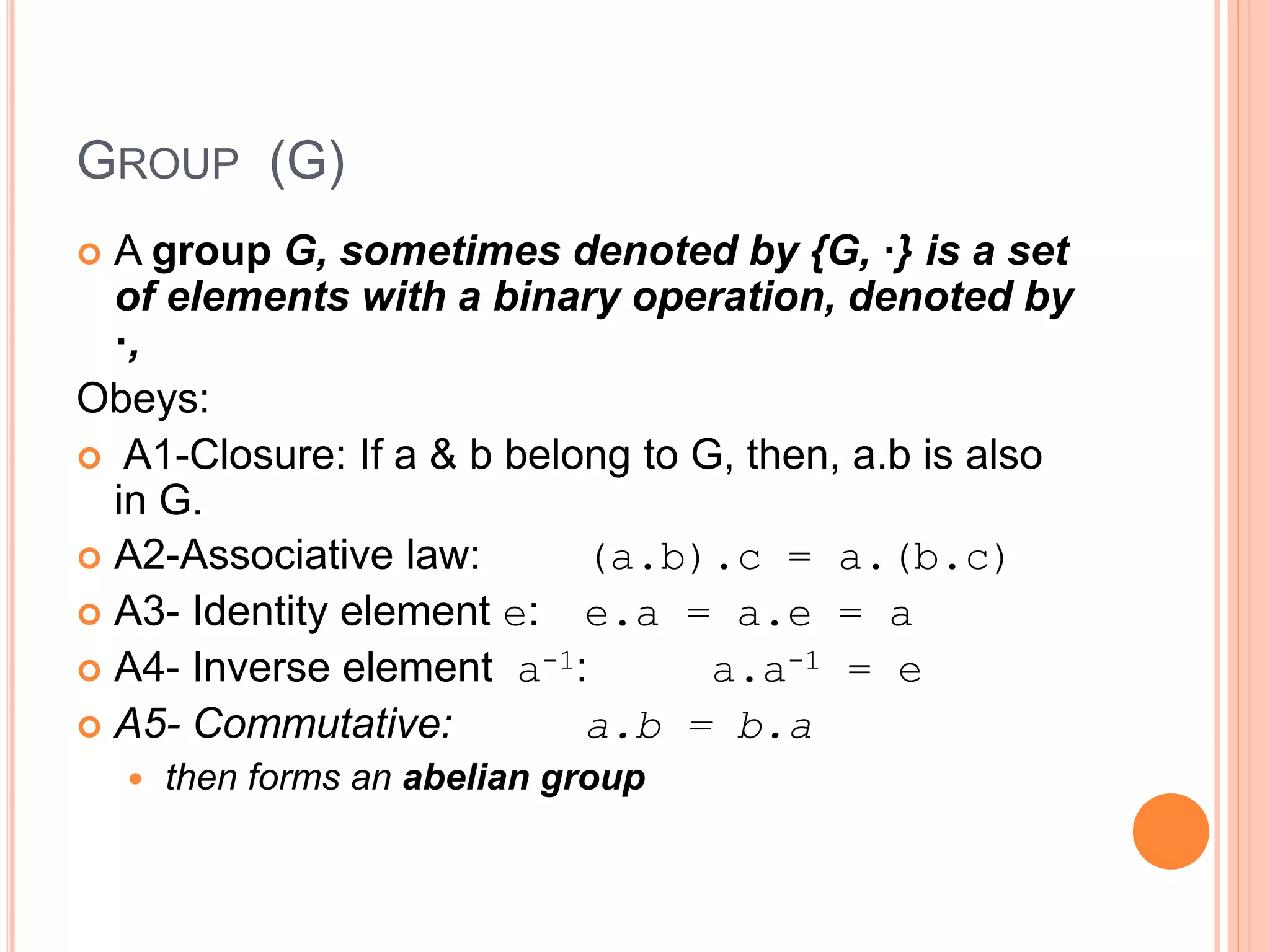
GROUP (G)
Agroup G, sometimes denoted by {G, ·} is a set
of elements with a binary operation, denoted by
·,
Obeys:
A1-Closure: If a & b belong to G, then, a.b is also
in G.
A2-Associative law: (a.b).c = a.(b.c)
A3- Identity element e: e.a = a.e = a
A4- Inverse element a-1: a.a-1 = e
A5- Commutative: a.b = b.a
then forms an abelian group
4.
CYCLIC GROUP
defineexponentiation as repeated application of
operator
example: a3 = a.a.a
and let identity be: e=a0
a group is cyclic if every element is a power of
some fixed element
i.e b = ak for some a and every b in group
a is said to be a generator of the group
Types of Group- Finite and Infinite.
Order of a finite group= no. of elements in the
group.
5.
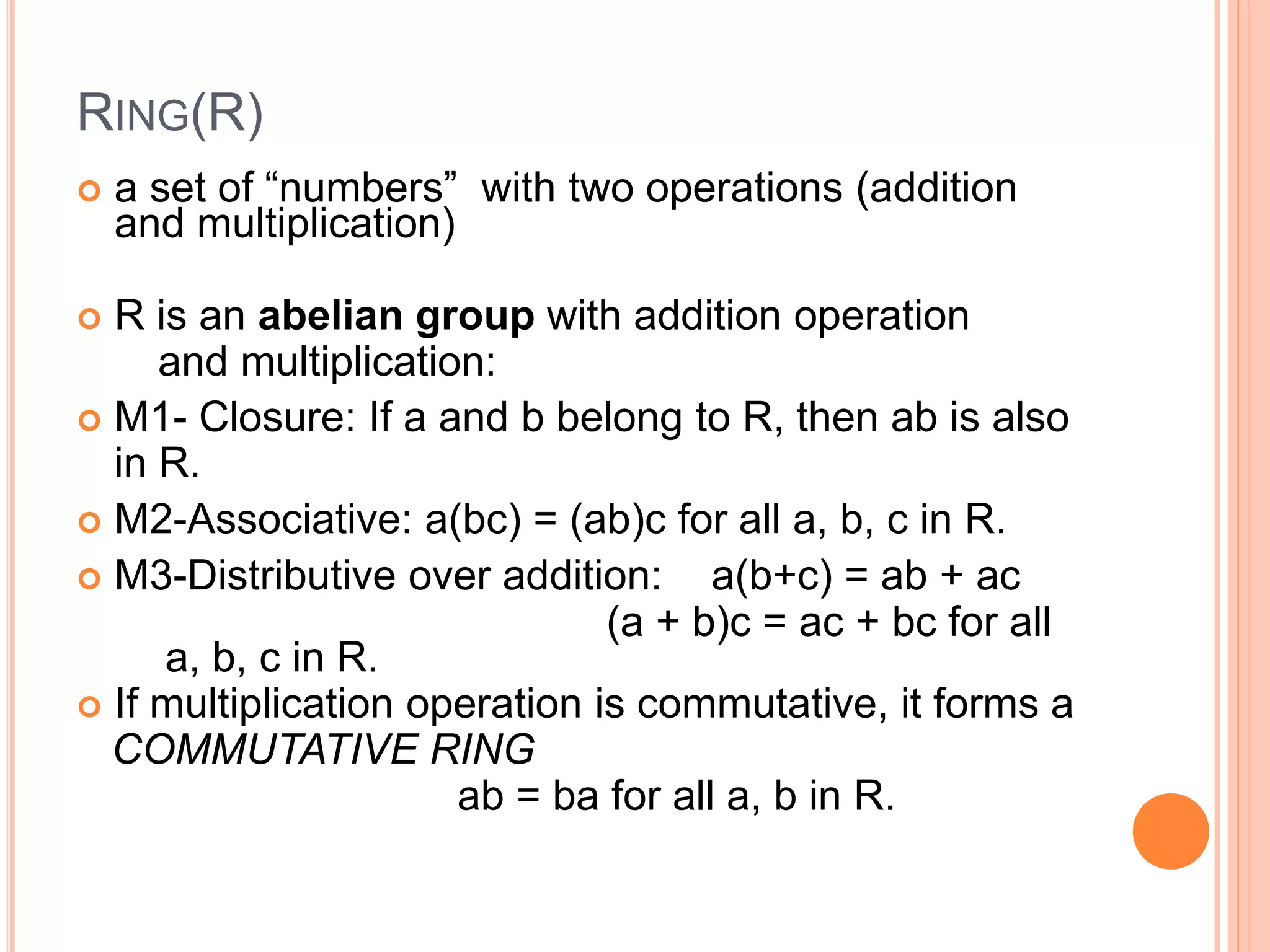
RING(R)
a setof “numbers” with two operations (addition
and multiplication)
R is an abelian group with addition operation
and multiplication:
M1- Closure: If a and b belong to R, then ab is also
in R.
M2-Associative: a(bc) = (ab)c for all a, b, c in R.
M3-Distributive over addition: a(b+c) = ab + ac
(a + b)c = ac + bc for all
a, b, c in R.
If multiplication operation is commutative, it forms a
COMMUTATIVE RING
ab = ba for all a, b in R.
6.
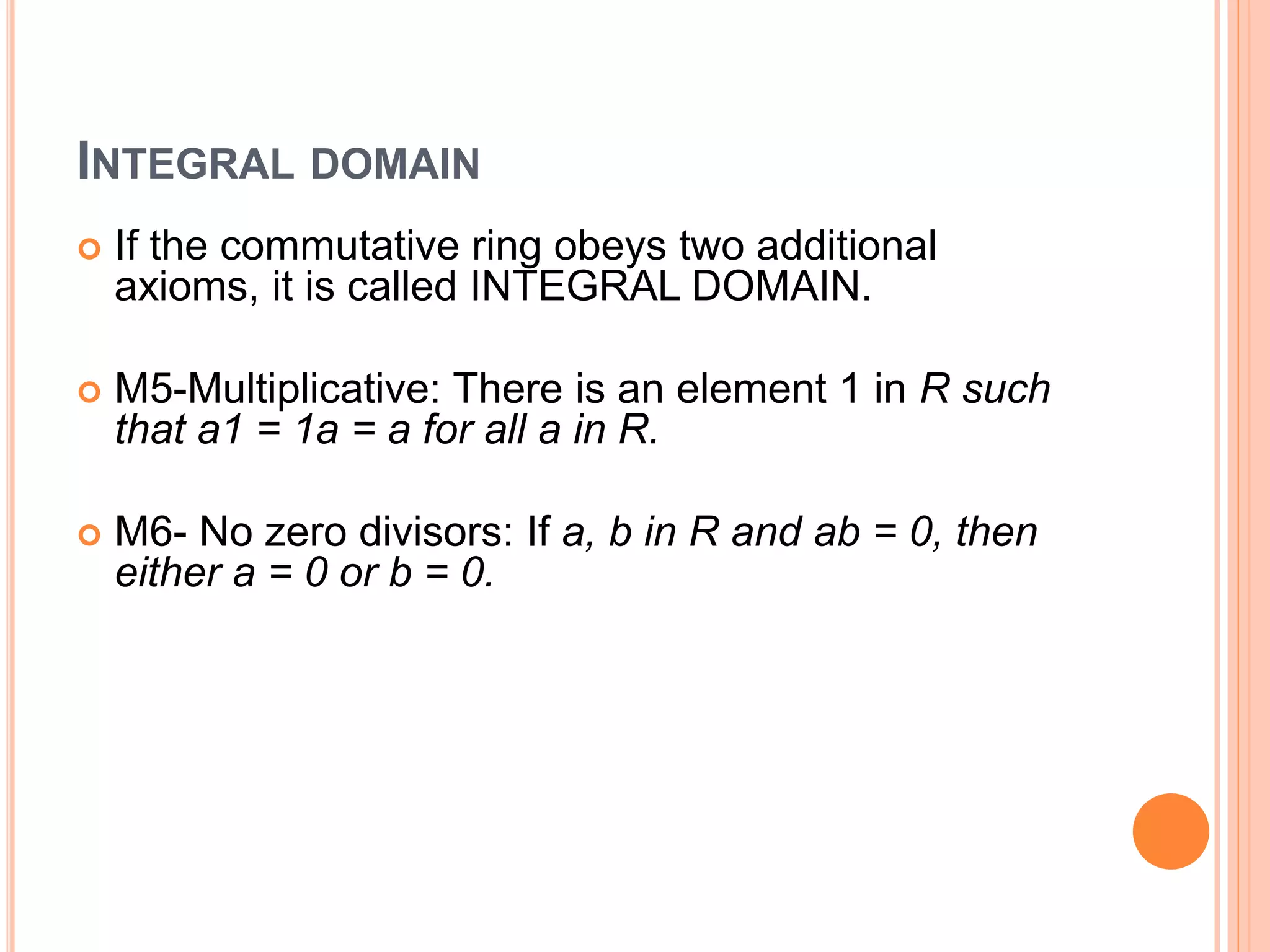
INTEGRAL DOMAIN
Ifthe commutative ring obeys two additional
axioms, it is called INTEGRAL DOMAIN.
M5-Multiplicative: There is an element 1 in R such
that a1 = 1a = a for all a in R.
M6- No zero divisors: If a, b in R and ab = 0, then
either a = 0 or b = 0.
7.
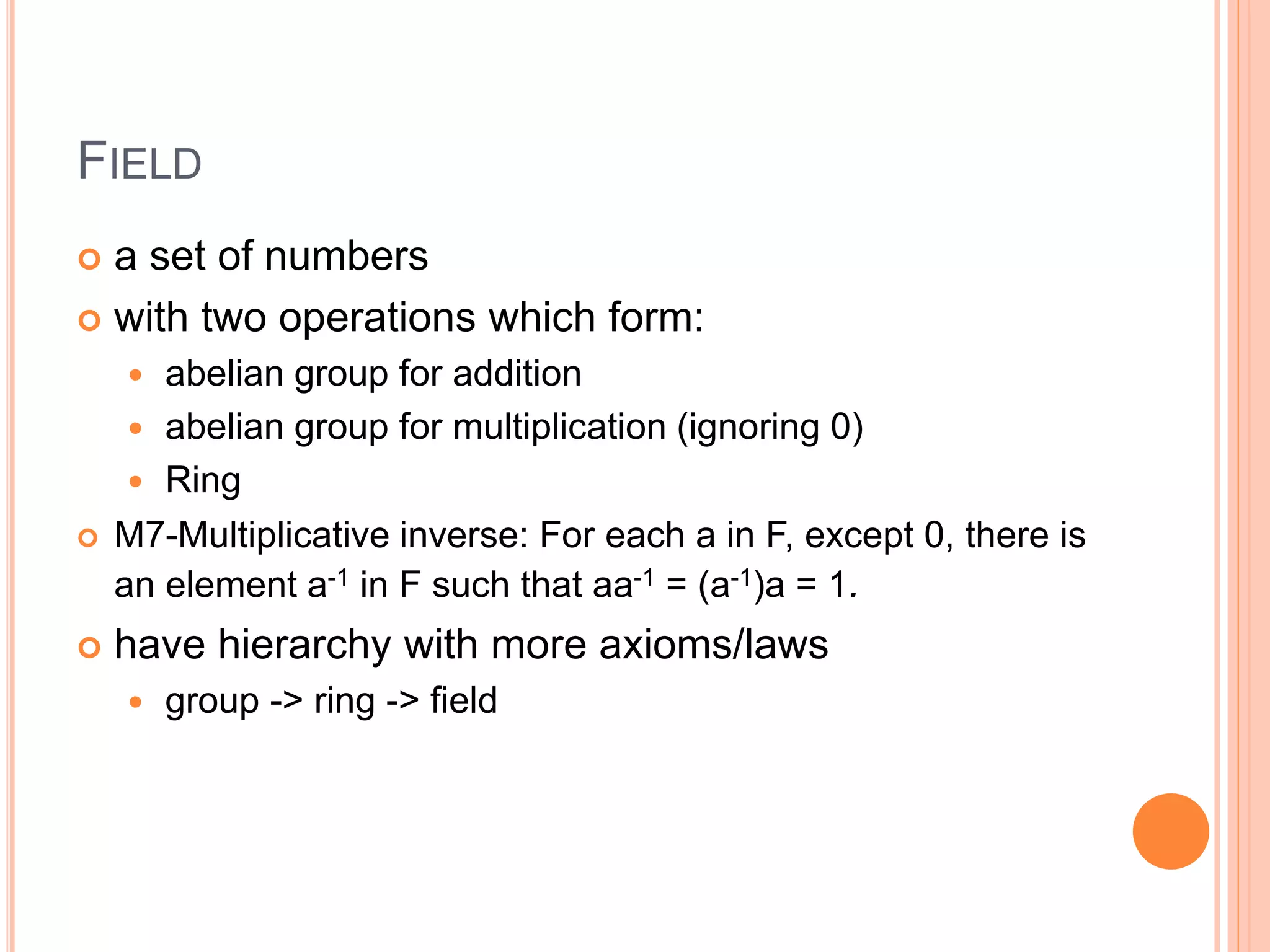
FIELD
a setof numbers
with two operations which form:
abelian group for addition
abelian group for multiplication (ignoring 0)
Ring
M7-Multiplicative inverse: For each a in F, except 0, there is
an element a-1 in F such that aa-1 = (a-1)a = 1.
have hierarchy with more axioms/laws
group -> ring -> field
8.
MODULAR ARITHMETIC
definemodulo operator “a mod n” to be
remainder when a is divided by n
use the term congruence for: a = b mod n
when divided by n, a & b have same remainder
eg. 100 = 34 mod 11
b is called a residue of a mod n
since with integers can always write: a = qn + b
usually chose smallest positive remainder as residue
ie. 0 <= b <= n-1
process is known as modulo reduction
eg. -12 mod 7 = -5 mod 7 = 2 mod 7 = 9 mod 7
9.
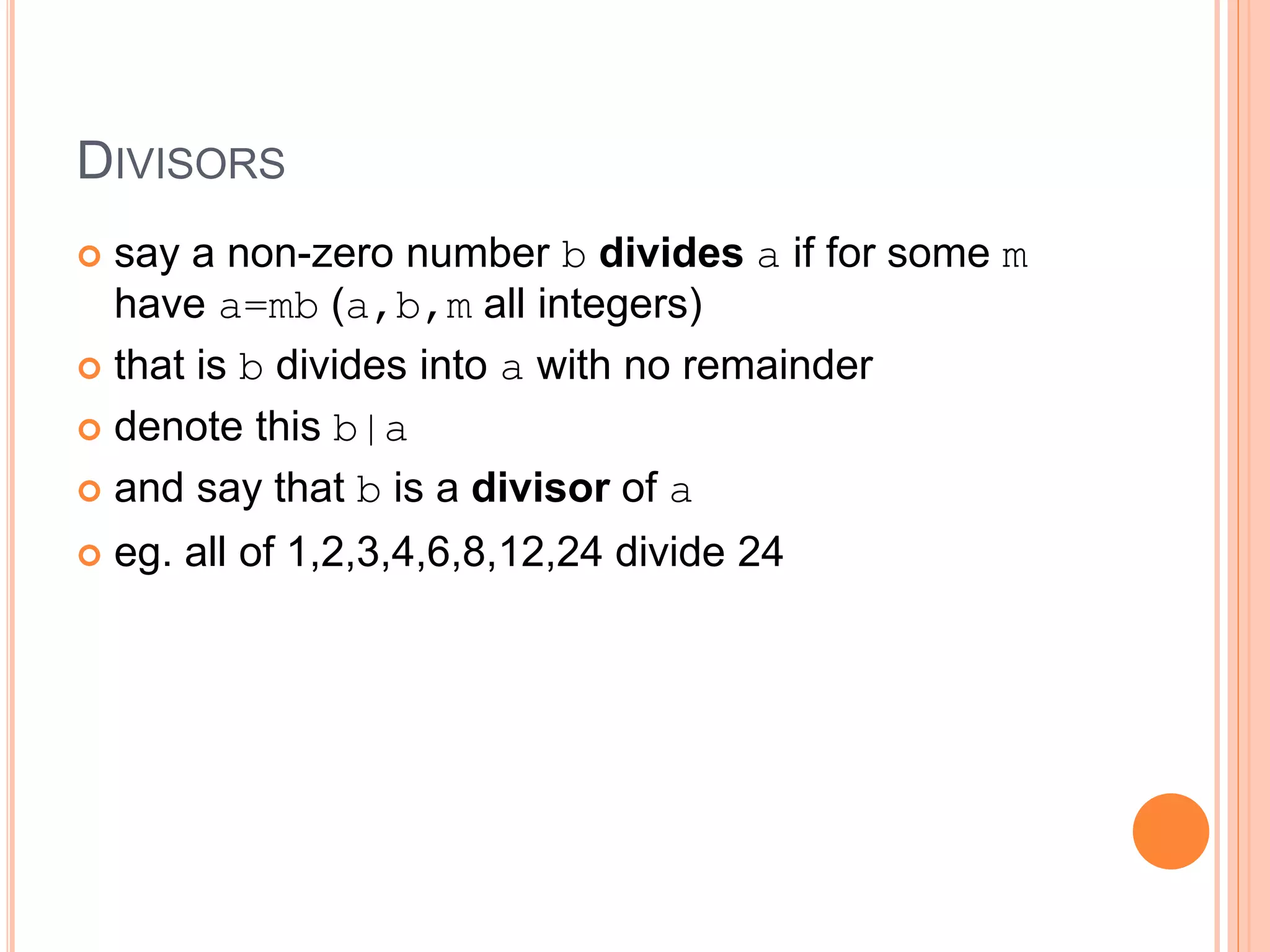
DIVISORS
say anon-zero number b divides a if for some m
have a=mb (a,b,m all integers)
that is b divides into a with no remainder
denote this b|a
and say that b is a divisor of a
eg. all of 1,2,3,4,6,8,12,24 divide 24
10.
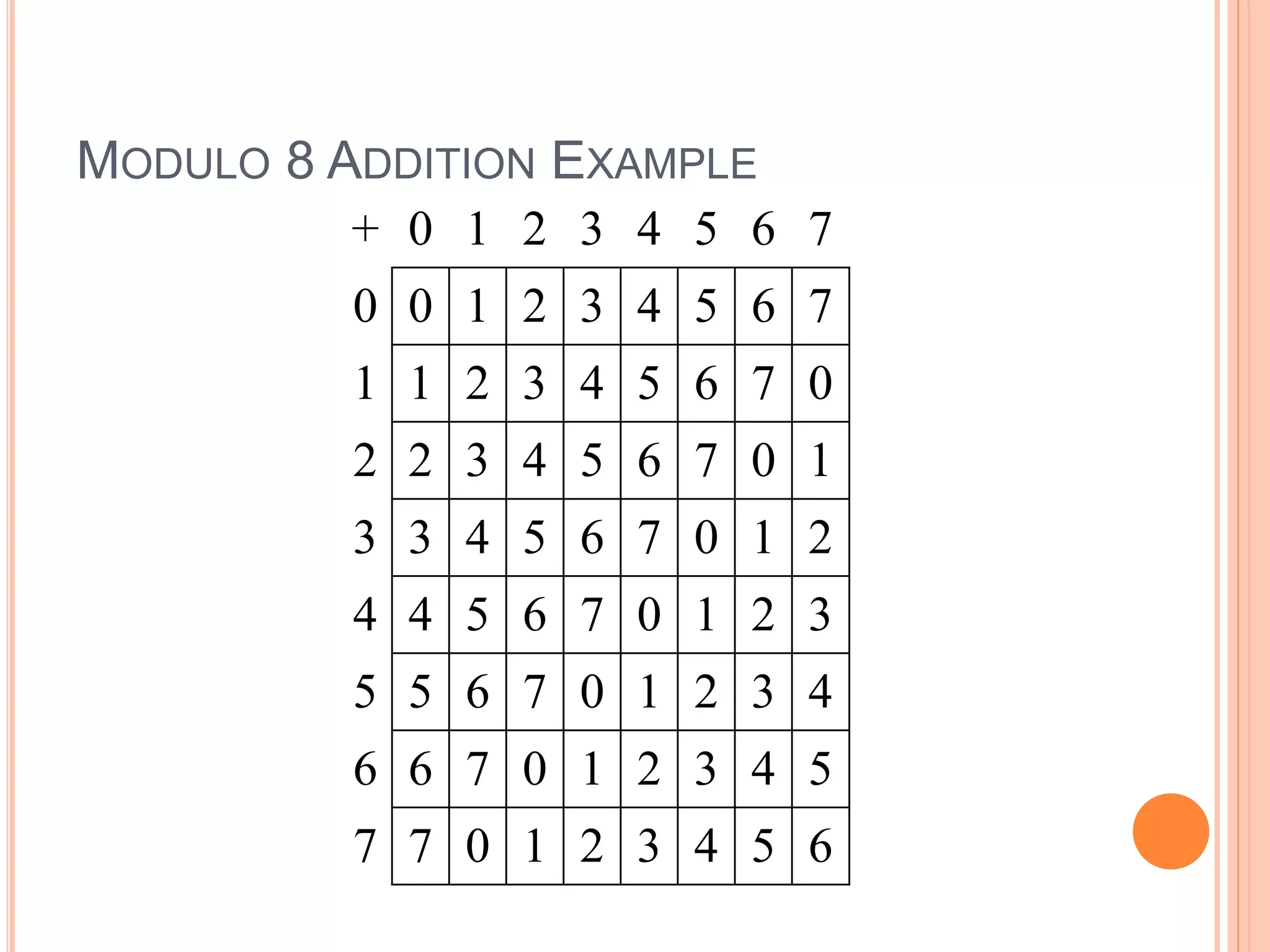
MODULAR ARITHMETIC OPERATIONS
is 'clock arithmetic'
uses a finite number of values, and loops back from
either end
modular arithmetic is when do addition &
multiplication and modulo reduce answer
can do reduction at any point, ie
a+b mod n = [a mod n + b mod n] mod
n
11.
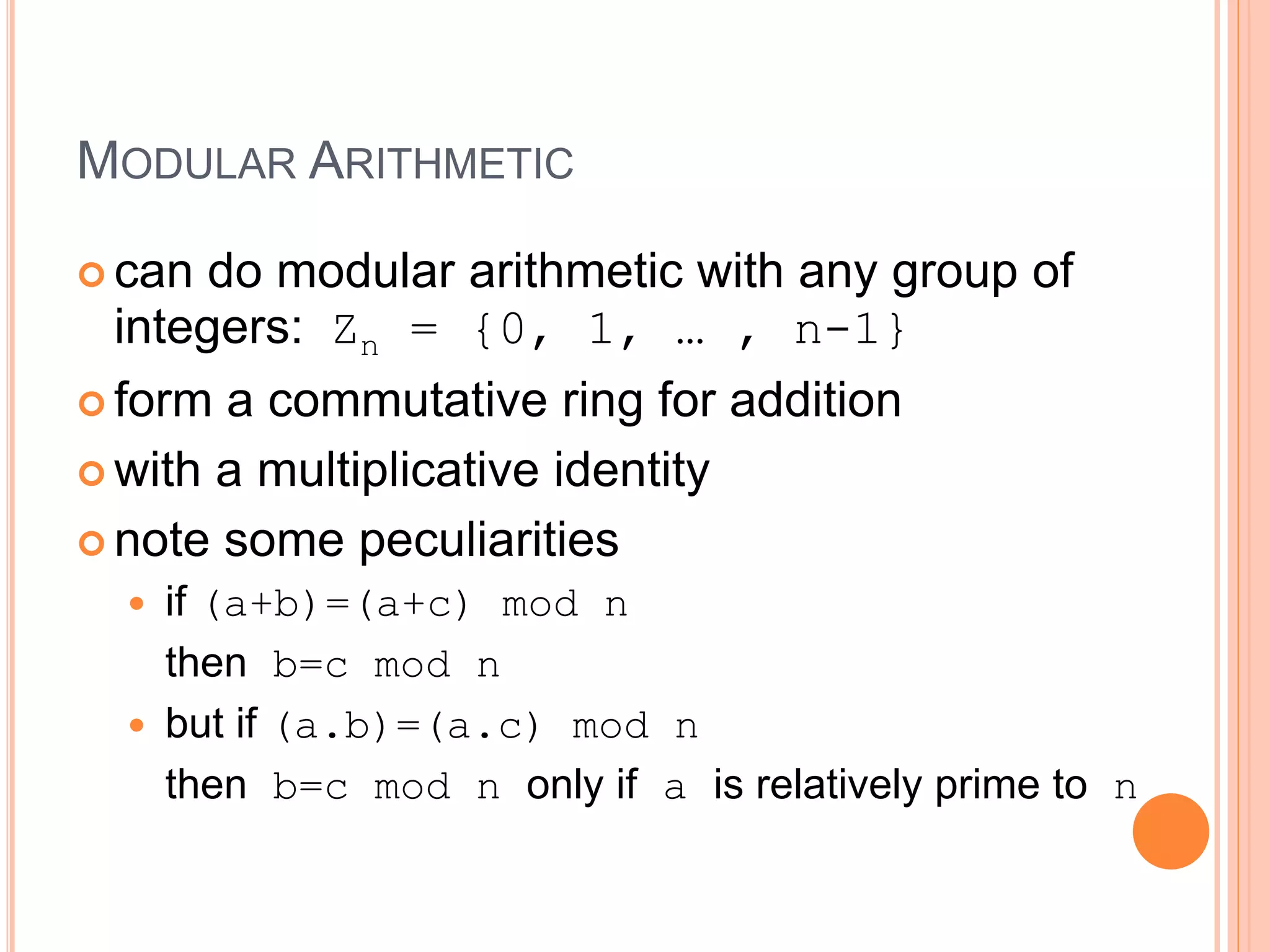
MODULAR ARITHMETIC
cando modular arithmetic with any group of
integers: Zn = {0, 1, … , n-1}
form a commutative ring for addition
with a multiplicative identity
note some peculiarities
if (a+b)=(a+c) mod n
then b=c mod n
but if (a.b)=(a.c) mod n
then b=c mod n only if a is relatively prime to n
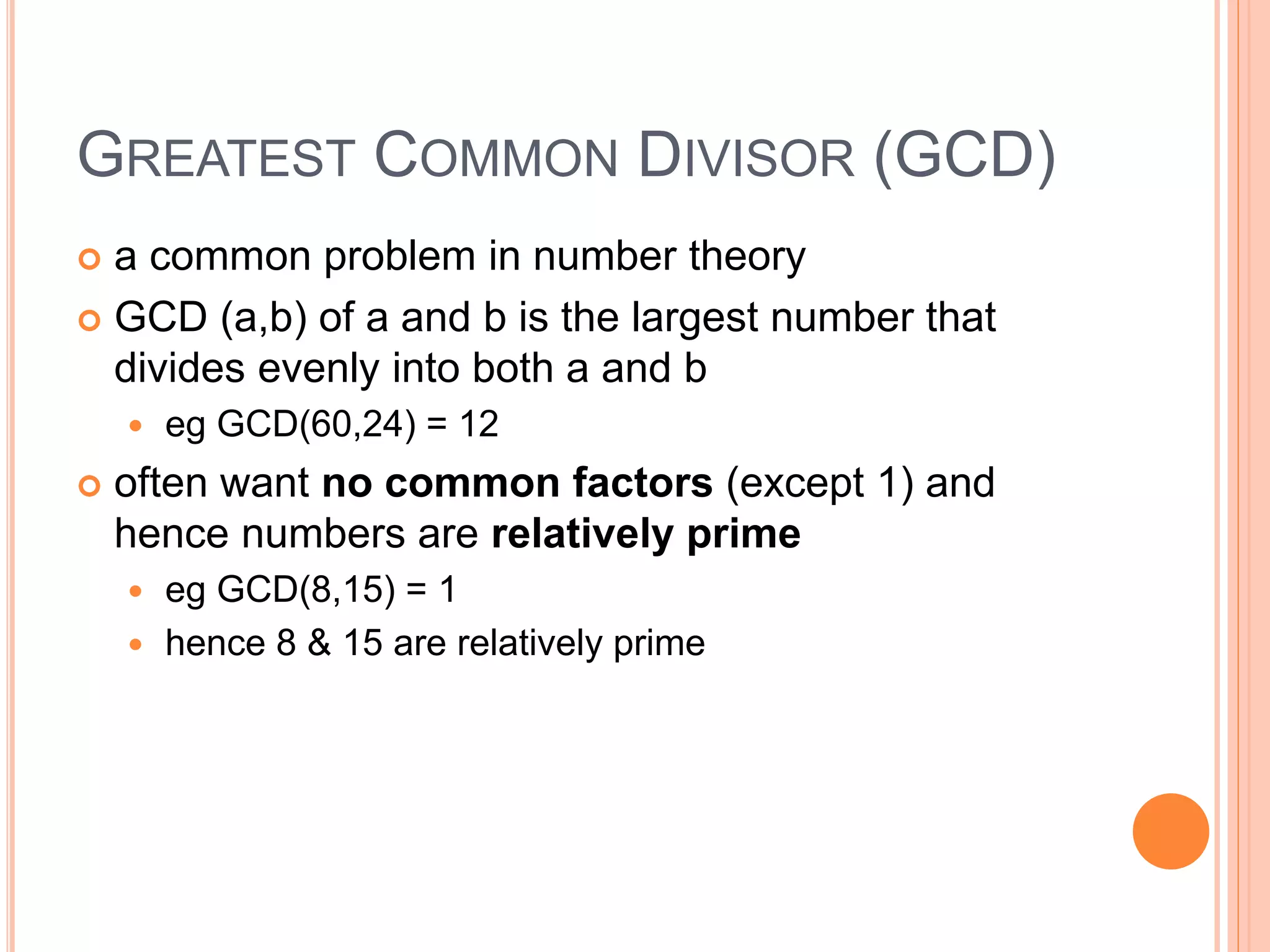
GREATEST COMMON DIVISOR(GCD)
a common problem in number theory
GCD (a,b) of a and b is the largest number that
divides evenly into both a and b
eg GCD(60,24) = 12
often want no common factors (except 1) and
hence numbers are relatively prime
eg GCD(8,15) = 1
hence 8 & 15 are relatively prime
14.
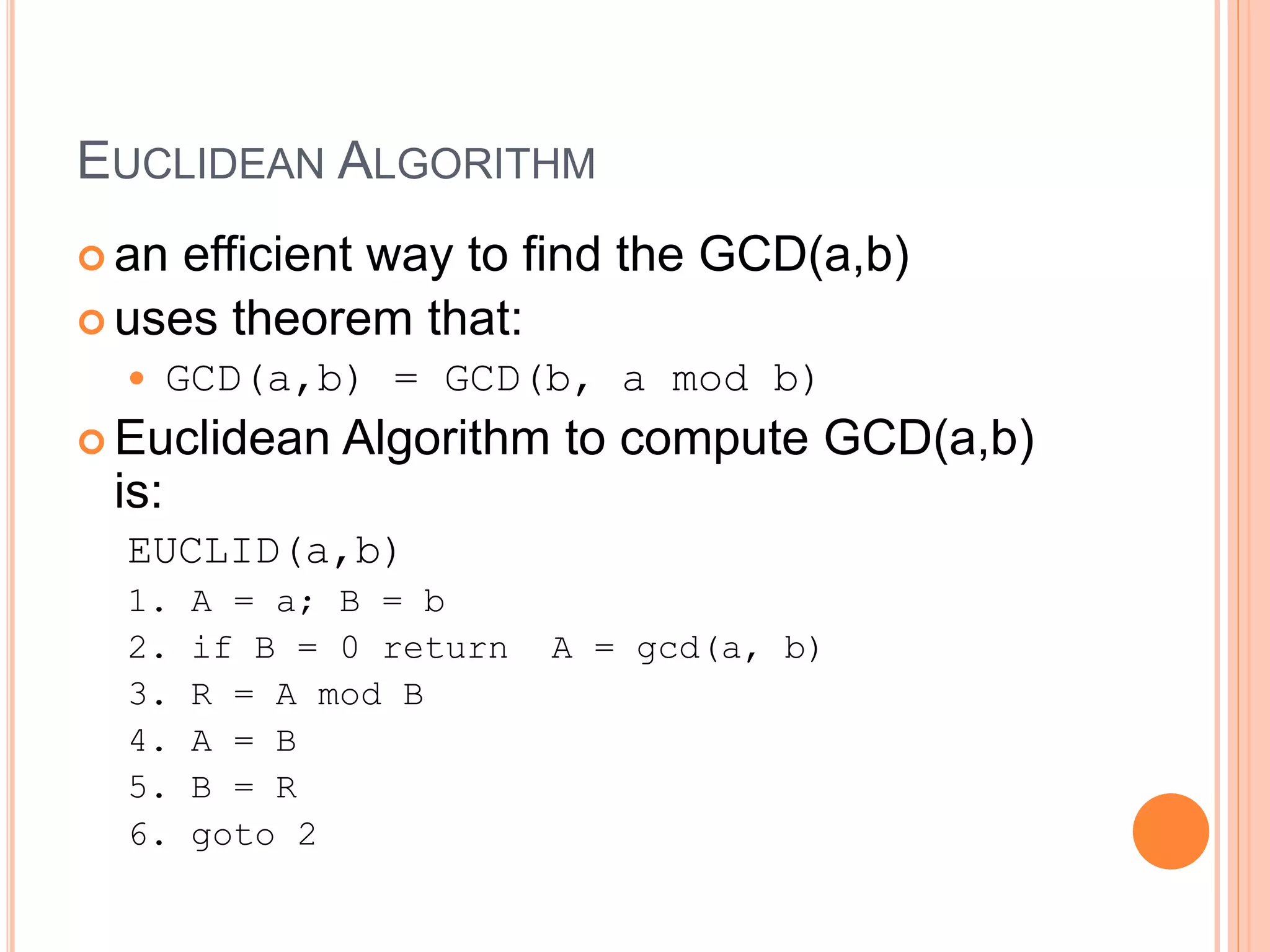
EUCLIDEAN ALGORITHM
anefficient way to find the GCD(a,b)
uses theorem that:
GCD(a,b) = GCD(b, a mod b)
Euclidean Algorithm to compute GCD(a,b)
is:
EUCLID(a,b)
1. A = a; B = b
2. if B = 0 return A = gcd(a, b)
3. R = A mod B
4. A = B
5. B = R
6. goto 2
15.
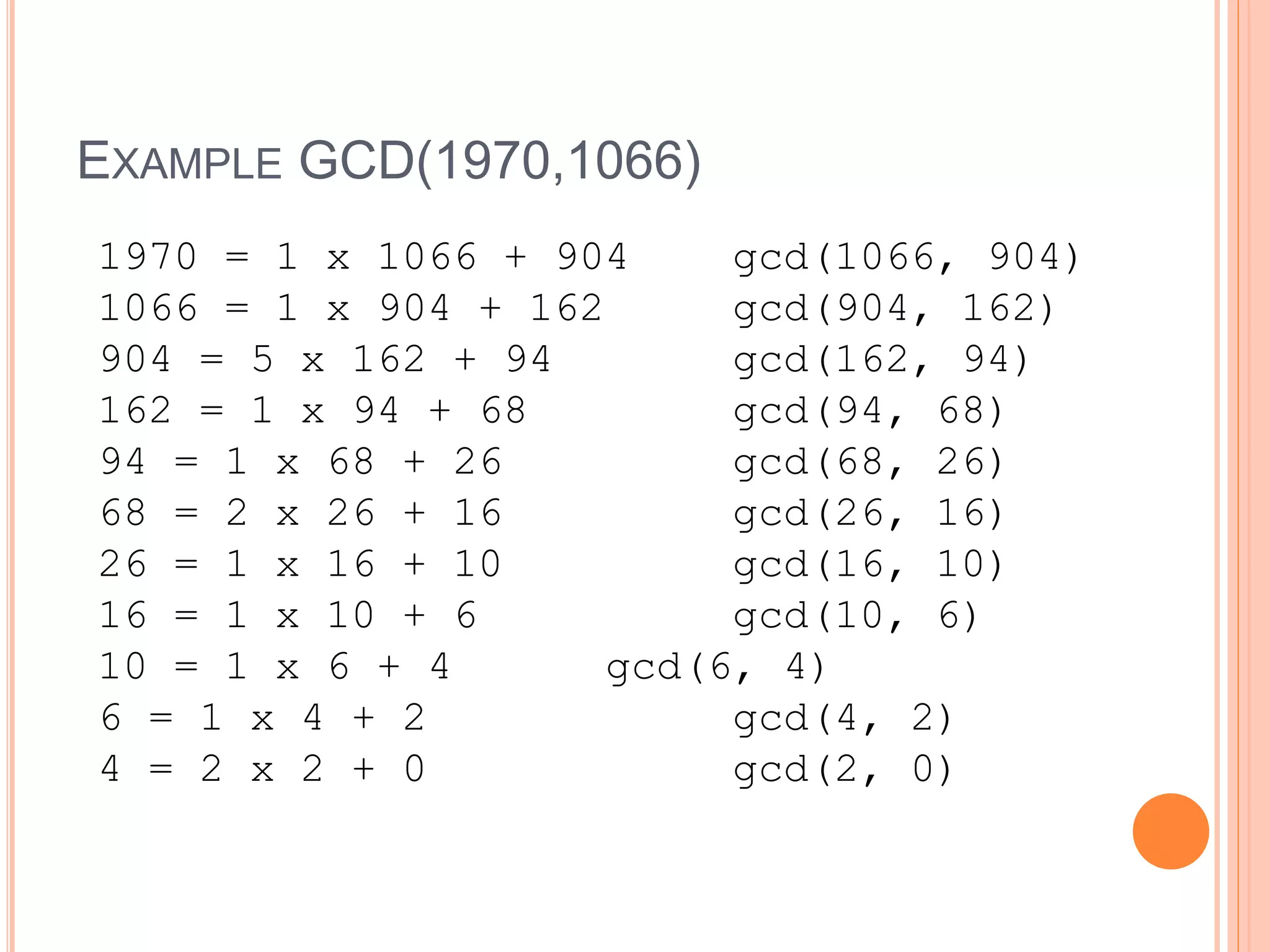
EXAMPLE GCD(1970,1066)
1970 =1 x 1066 + 904 gcd(1066, 904)
1066 = 1 x 904 + 162 gcd(904, 162)
904 = 5 x 162 + 94 gcd(162, 94)
162 = 1 x 94 + 68 gcd(94, 68)
94 = 1 x 68 + 26 gcd(68, 26)
68 = 2 x 26 + 16 gcd(26, 16)
26 = 1 x 16 + 10 gcd(16, 10)
16 = 1 x 10 + 6 gcd(10, 6)
10 = 1 x 6 + 4 gcd(6, 4)
6 = 1 x 4 + 2 gcd(4, 2)
4 = 2 x 2 + 0 gcd(2, 0)
16.
GALOIS FIELDS
finitefields play a key role in cryptography
can show number of elements in a finite field must
be a power of a prime pn
known as Galois fields
denoted GF(pn)
in particular often use the fields:
GF(p)
GF(2n)
17.
GALOIS FIELDS GF(P)
GF(p) is the set of integers {0,1, … , p-1} with
arithmetic operations modulo prime p
these form a finite field
since have multiplicative inverses
hence arithmetic is “well-behaved” and can do
addition, subtraction, multiplication, and division
without leaving the field GF(p)
POLYNOMIAL ARITHMETIC
cancompute using polynomials
f(x) = anxn + an-1xn-1 + … + a1x + a0 = ∑ aixi
nb. not interested in any specific value of x
which is known as the indeterminate
several alternatives available
ordinary polynomial arithmetic
poly arithmetic with coords mod p
poly arithmetic with coords mod p and polynomials mod m(x)
22.
ORDINARY POLYNOMIAL ARITHMETIC
add or subtract corresponding coefficients
multiply all terms by each other
eg
let f(x) = x3 + x2 + 2 and g(x) = x2 – x + 1
f(x) + g(x) = x3 + 2x2 – x + 3
f(x) – g(x) = x3 + x + 1
f(x) x g(x) = x5 + 3x2 – 2x + 2
23.
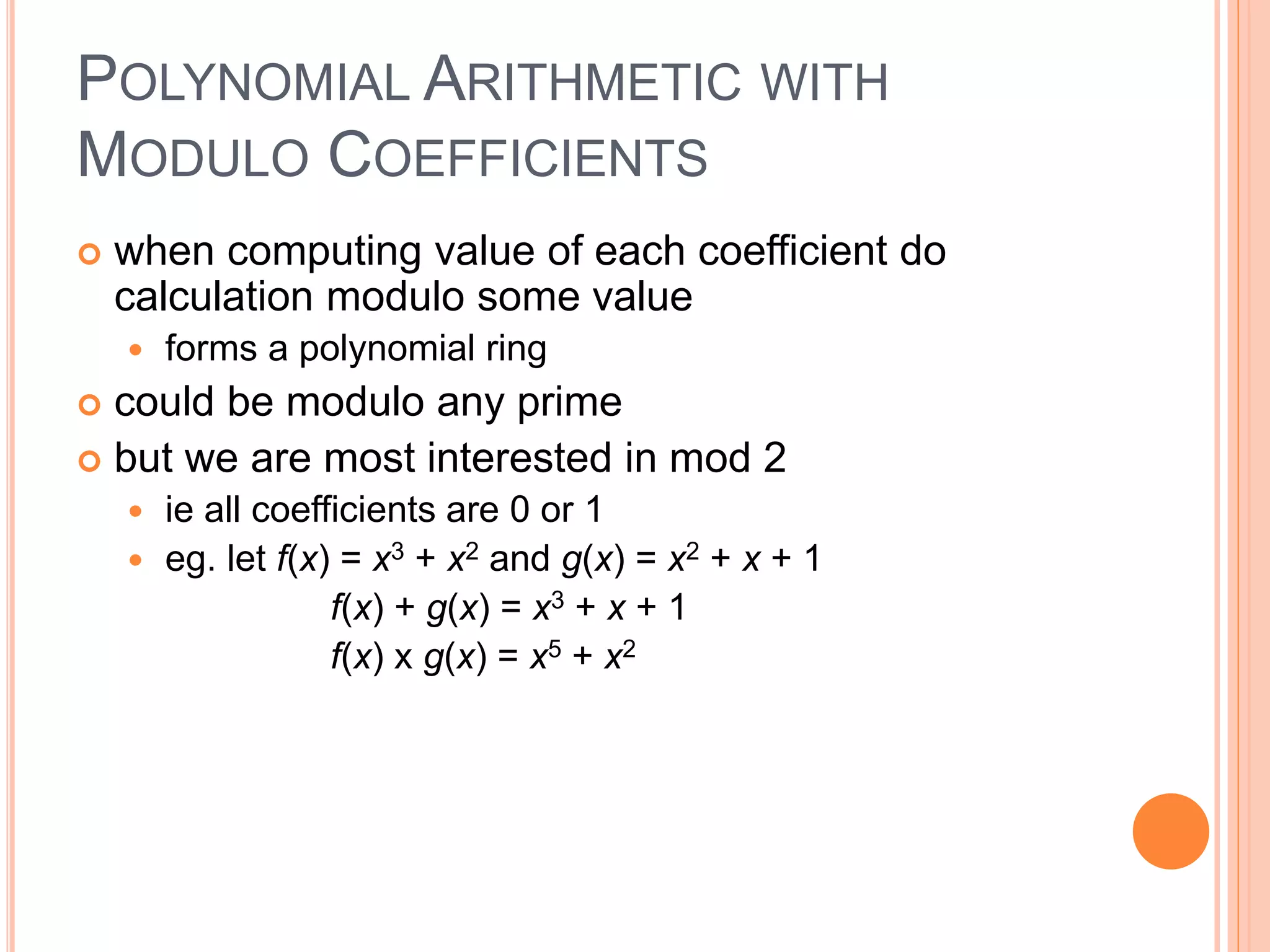
POLYNOMIAL ARITHMETIC WITH
MODULOCOEFFICIENTS
when computing value of each coefficient do
calculation modulo some value
forms a polynomial ring
could be modulo any prime
but we are most interested in mod 2
ie all coefficients are 0 or 1
eg. let f(x) = x3 + x2 and g(x) = x2 + x + 1
f(x) + g(x) = x3 + x + 1
f(x) x g(x) = x5 + x2
24.
POLYNOMIAL DIVISION
canwrite any polynomial in the form:
f(x) = q(x) g(x) + r(x)
can interpret r(x) as being a remainder
r(x) = f(x) mod g(x)
if have no remainder say g(x) divides f(x)
if g(x) has no divisors other than itself & 1 say it is
irreducible (or prime) polynomial
arithmetic modulo an irreducible polynomial forms a
field
25.
POLYNOMIAL GCD
canfind greatest common divisor for polys
c(x) = GCD(a(x), b(x)) if c(x) is the poly of
greatest degree which divides both a(x), b(x)
can adapt Euclid’s Algorithm to find it:
EUCLID[a(x), b(x)]
1. A(x) = a(x); B(x) = b(x)
2. if B(x) = 0 return A(x) = gcd[a(x), b(x)]
3. R(x) = A(x) mod B(x)
4. A(x) ¨ B(x)
5. B(x) ¨ R(x)
6. goto 2
26.
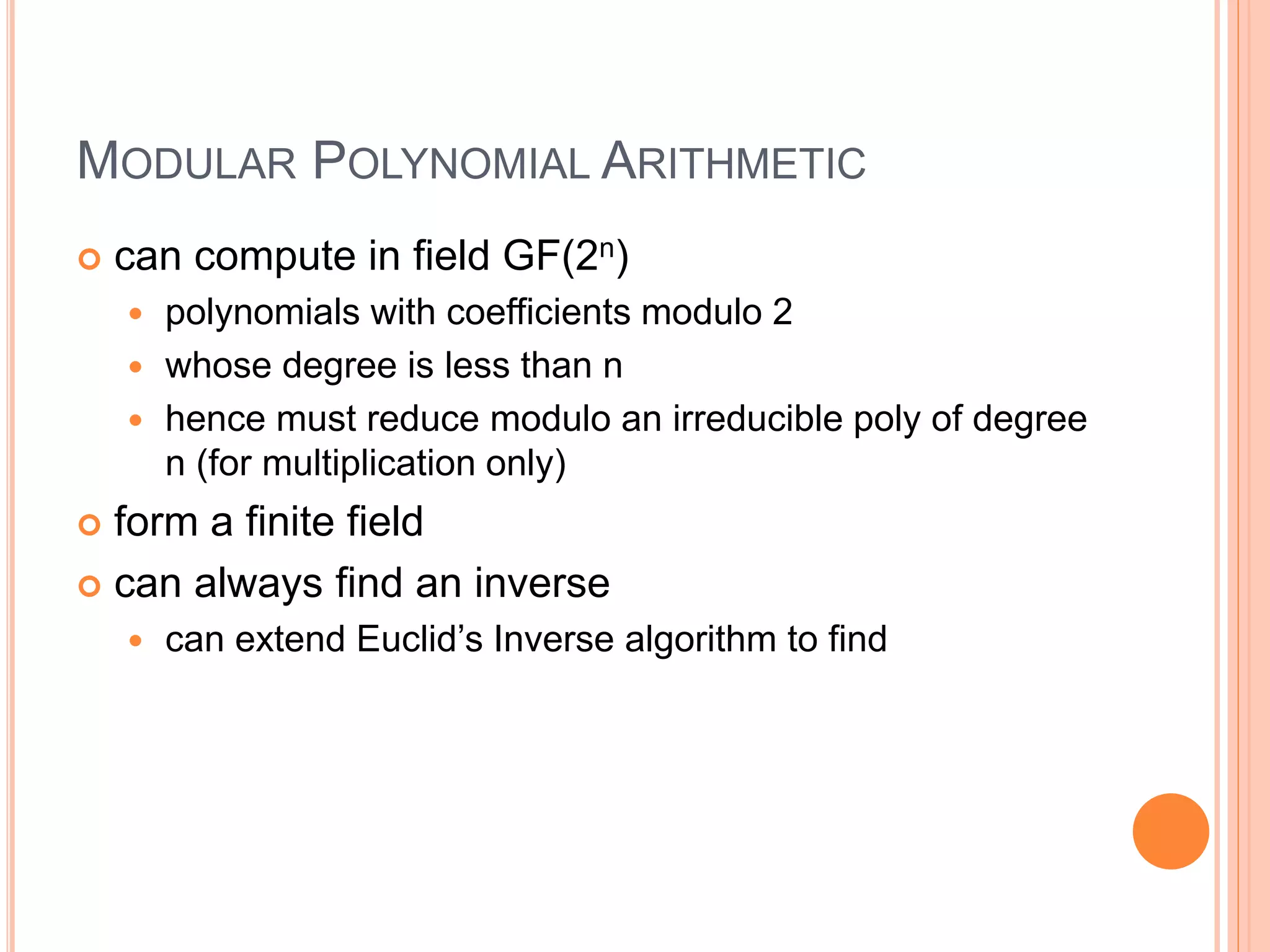
MODULAR POLYNOMIAL ARITHMETIC
can compute in field GF(2n)
polynomials with coefficients modulo 2
whose degree is less than n
hence must reduce modulo an irreducible poly of degree
n (for multiplication only)
form a finite field
can always find an inverse
can extend Euclid’s Inverse algorithm to find
COMPUTATIONAL CONSIDERATIONS
sincecoefficients are 0 or 1, can represent any
such polynomial as a bit string
addition becomes XOR of these bit strings
multiplication is shift & XOR
cf long-hand multiplication
modulo reduction done by repeatedly substituting
highest power with remainder of irreducible poly
(also shift & XOR)
29.
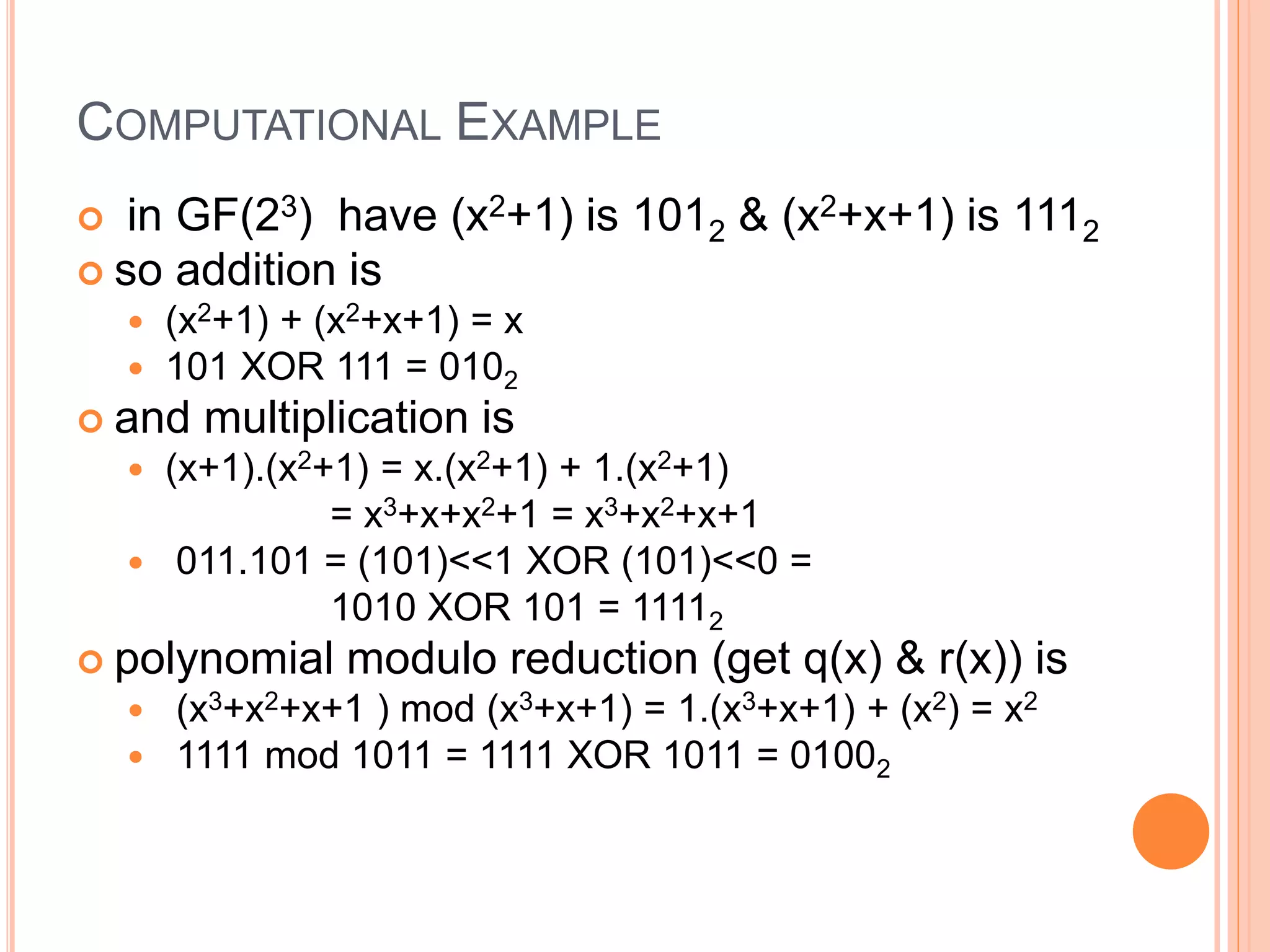
COMPUTATIONAL EXAMPLE
inGF(23) have (x2+1) is 1012 & (x2+x+1) is 1112
so addition is
(x2+1) + (x2+x+1) = x
101 XOR 111 = 0102
and multiplication is
(x+1).(x2+1) = x.(x2+1) + 1.(x2+1)
= x3+x+x2+1 = x3+x2+x+1
011.101 = (101)<<1 XOR (101)<<0 =
1010 XOR 101 = 11112
polynomial modulo reduction (get q(x) & r(x)) is
(x3+x2+x+1 ) mod (x3+x+1) = 1.(x3+x+1) + (x2) = x2
1111 mod 1011 = 1111 XOR 1011 = 01002
30.
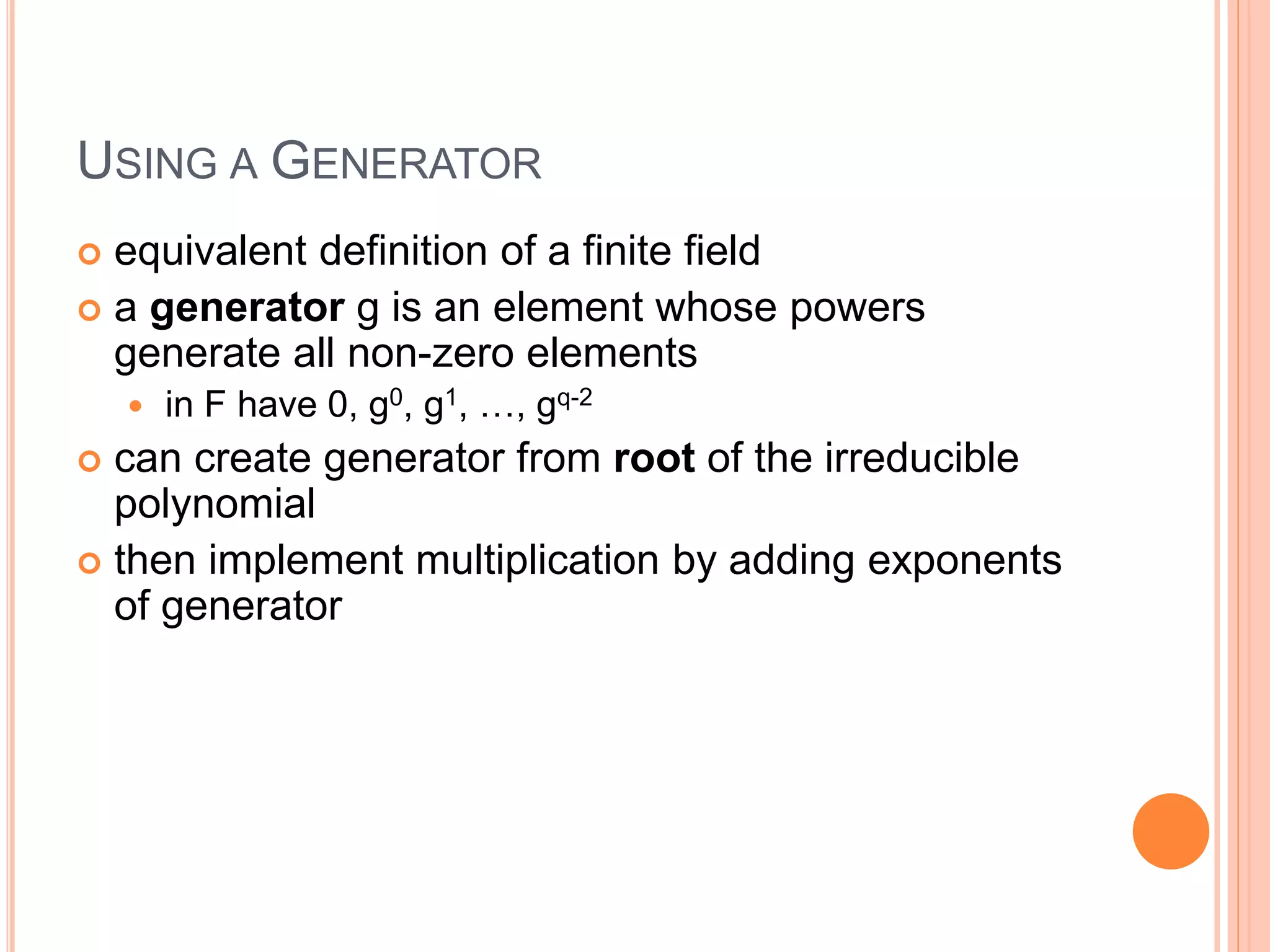
USING A GENERATOR
equivalent definition of a finite field
a generator g is an element whose powers
generate all non-zero elements
in F have 0, g0, g1, …, gq-2
can create generator from root of the irreducible
polynomial
then implement multiplication by adding exponents
of generator
31.
SUMMARY
have considered:
concept of groups, rings, fields
modular arithmetic with integers
Euclid’s algorithm for GCD
finite fields GF(p)
polynomial arithmetic in general and in GF(2n)


![MODULAR ARITHMETIC OPERATIONS
is 'clock arithmetic'
uses a finite number of values, and loops back from
either end
modular arithmetic is when do addition &
multiplication and modulo reduce answer
can do reduction at any point, ie
a+b mod n = [a mod n + b mod n] mod
n](https://image.slidesharecdn.com/numbertheory-200507171820/75/Number-theory-10-2048.jpg)





![POLYNOMIAL GCD
can find greatest common divisor for polys
c(x) = GCD(a(x), b(x)) if c(x) is the poly of
greatest degree which divides both a(x), b(x)
can adapt Euclid’s Algorithm to find it:
EUCLID[a(x), b(x)]
1. A(x) = a(x); B(x) = b(x)
2. if B(x) = 0 return A(x) = gcd[a(x), b(x)]
3. R(x) = A(x) mod B(x)
4. A(x) ¨ B(x)
5. B(x) ¨ R(x)
6. goto 2](https://image.slidesharecdn.com/numbertheory-200507171820/75/Number-theory-25-2048.jpg)