DIGITAL DESIGN
   THIRD EDITION

   M. MORRIS MANO


 CHAPTER 1 : BINARY
 SYSTEMS PROBLEMS
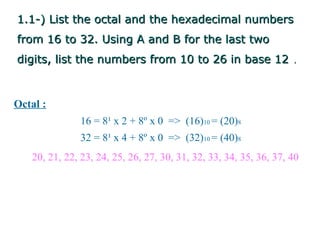
1.1-) List the octal and the hexadecimal numbers
from 16 to 32. Using A and B for the last two
digits, list the numbers from 10 to 26 in base 12 .


Octal :
               16 = 8¹ x 2 + 8º x 0 => (16)10 = (20)8
               32 = 8¹ x 4 + 8º x 0 => (32)10 = (40)8
   20, 21, 22, 23, 24, 25, 26, 27, 30, 31, 32, 33, 34, 35, 36, 37, 40
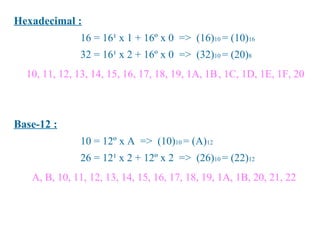
Hexadecimal :
               16 = 16¹ x 1 + 16º x 0 => (16)10 = (10)16
               32 = 16¹ x 2 + 16º x 0 => (32)10 = (20)8
  10, 11, 12, 13, 14, 15, 16, 17, 18, 19, 1A, 1B , 1C, 1D, 1E, 1F, 20


Base-12 :
               10 = 12º x A => (10)10 = (A)12
               26 = 12¹ x 2 + 12º x 2 => (26)10 = (22)12
   A, B, 10, 11, 12, 13, 14, 15, 16, 17, 18, 19, 1A, 1B, 20, 21, 22
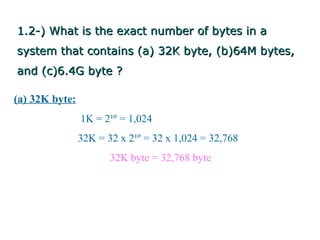
1.2-) What is the exact number of bytes in a
system that contains (a) 32K byte, (b)64M bytes,
and (c)6.4G byte ?

(a) 32K byte:
                1K = 2¹º = 1,024
                32K = 32 x 2¹º = 32 x 1,024 = 32,768
                       32K byte = 32,768 byte
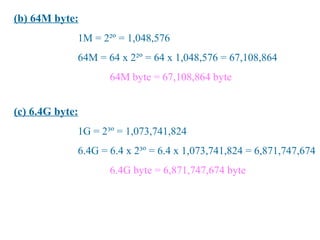
(b) 64M byte:
             1M = 2²º = 1,048,576
             64M = 64 x 2²º = 64 x 1,048,576 = 67,108,864
                    64M byte = 67,108,864 byte


(c) 6.4G byte:
             1G = 2³º = 1,073,741,824
             6.4G = 6.4 x 2³º = 6.4 x 1,073,741,824 = 6,871,747,674
                    6.4G byte = 6,871,747,674 byte
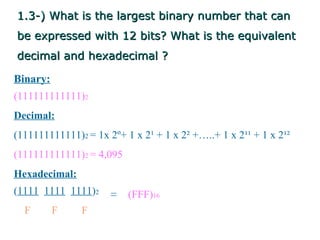
1.3-) What is the largest binary number that can
be expressed with 12 bits? What is the equivalent
decimal and hexadecimal ?

Binary:
(111111111111)2
Decimal:
(111111111111)2 = 1x 2º+ 1 x 2¹ + 1 x 2² +…..+ 1 x 2¹¹ + 1 x 2¹²
(111111111111)2 = 4,095
Hexadecimal:
(1111 1111 1111)2     =   (FFF)16
  F       F    F
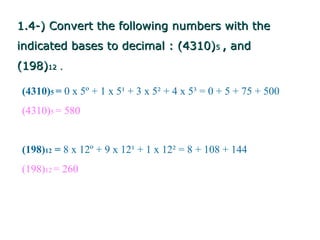
1.4-) Convert the following numbers with the
indicated bases to decimal : (4310)5 , and
(198)12 .

(4310)5 = 0 x 5º + 1 x 5¹ + 3 x 5² + 4 x 5³ = 0 + 5 + 75 + 500
(4310)5 = 580


(198)12 = 8 x 12º + 9 x 12¹ + 1 x 12² = 8 + 108 + 144
(198)12 = 260
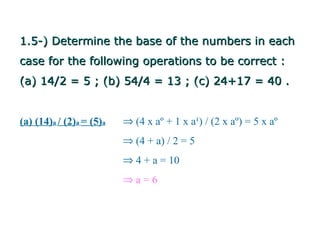
1.5-) Determine the base of the numbers in each
case for the following operations to be correct :
(a) 14/2 = 5 ; (b) 54/4 = 13 ; (c) 24+17 = 40 .


(a) (14)a / (2)a = (5)a   ⇒ (4 x aº + 1 x a¹) / (2 x aº) = 5 x aº
                          ⇒ (4 + a) / 2 = 5
                          ⇒ 4 + a = 10
                          ⇒a=6
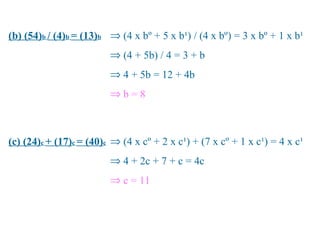
(b) (54)b / (4)b = (13)b ⇒ (4 x bº + 5 x b¹) / (4 x bº) = 3 x bº + 1 x b¹
                         ⇒ (4 + 5b) / 4 = 3 + b
                         ⇒ 4 + 5b = 12 + 4b
                         ⇒b=8


(c) (24)c + (17)c = (40)c ⇒ (4 x cº + 2 x c¹) + (7 x cº + 1 x c¹) = 4 x c¹
                         ⇒ 4 + 2c + 7 + c = 4c
                         ⇒ c = 11
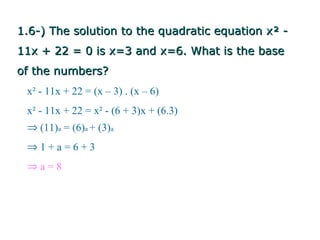
1.6-) The solution to the quadratic equation x² -
11x + 22 = 0 is x=3 and x=6. What is the base
of the numbers?
 x² - 11x + 22 = (x – 3) . (x – 6)
 x² - 11x + 22 = x² - (6 + 3)x + (6.3)
 ⇒ (11)a = (6)a + (3)a
 ⇒1+a=6+3
 ⇒a=8
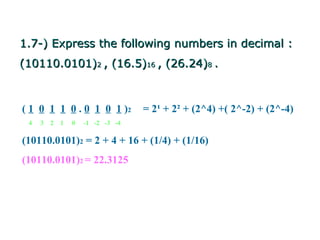
1.7-) Express the following numbers in decimal :
(10110.0101)2 , (16.5)16 , (26.24)8 .


( 1 0 1 1 0 . 0 1 0 1 )2       = 2¹ + 2² + (2^4) +( 2^-2) + (2^-4)
 4   3 2 1   0   -1 -2 -3 -4

(10110.0101)2 = 2 + 4 + 16 + (1/4) + (1/16)
(10110.0101)2 = 22.3125
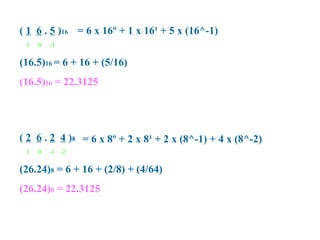
( 1 6 . 5 )16 = 6 x 16º + 1 x 16¹ + 5 x (16^-1)
 1   0   -1

(16.5)16 = 6 + 16 + (5/16)
(16.5)16 = 22.3125


( 2 6 . 2 4 )8 = 6 x 8º + 2 x 8¹ + 2 x (8^-1) + 4 x (8^-2)
 1   0   -1 -2

(26.24)8 = 6 + 16 + (2/8) + (4/64)
(26.24)8 = 22.3125
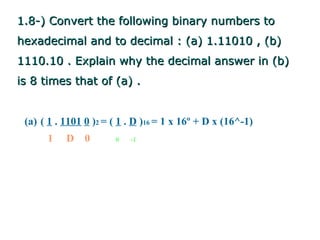
1.8-) Convert the following binary numbers to
hexadecimal and to decimal : (a) 1.11010 , (b)
1110.10 . Explain why the decimal answer in (b)
is 8 times that of (a) .


 (a) ( 1 . 1101 0 )2 = ( 1 . D )16 = 1 x 16º + D x (16^-1)
      1    D 0         0   -1
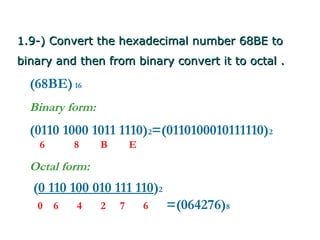
1.9-) Convert the hexadecimal number 68BE to
binary and then from binary convert it to octal .

  (68BE) 16
  Binary form:
  (0110 1000 1011 1110)2=(0110100010111110)2
    6       8    B       E

  Octal form:
  (0 110 100 010 111 110)2
   0    6   4    2   7       6   =(064276)8
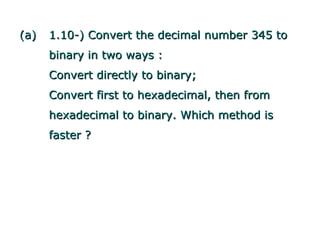
(a)   1.10-) Convert the decimal number 345 to
      binary in two ways :
      Convert directly to binary;
      Convert first to hexadecimal, then from
      hexadecimal to binary. Which method is
      faster ?
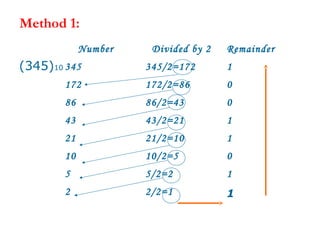
Method 1:
             Number    Divided by 2   Remainder
(345)10 345           345/2=172       1
        172           172/2=86        0
        86            86/2=43         0
        43            43/2=21         1
        21            21/2=10         1
        10            10/2=5          0
        5             5/2=2           1
        2             2/2=1           1
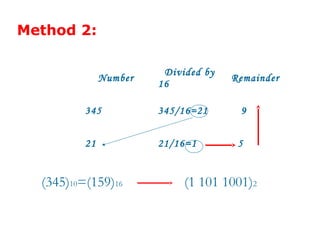
Method 2:

                         Divided by
               Number                 Remainder
                        16

          345           345/16=21      9


          21            21/16=1        5


  (345)10=(159)16            (1 101 1001)2
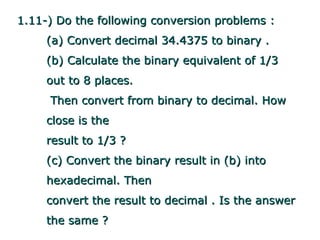
1.11-) Do the following conversion problems :
     (a) Convert decimal 34.4375 to binary .
     (b) Calculate the binary equivalent of 1/3
     out to 8 places.
     Then convert from binary to decimal. How
     close is the
     result to 1/3 ?
     (c) Convert the binary result in (b) into
     hexadecimal. Then
     convert the result to decimal . Is the answer
     the same ?
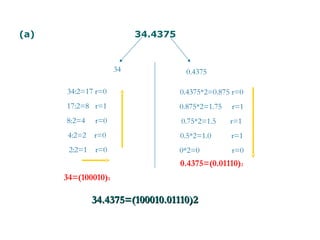
(a)                       34.4375


                     34              0.4375

      34:2=17 r=0                   0.4375*2=0.875 r=0
      17:2=8 r=1                    0.875*2=1.75   r=1
      8:2=4    r=0                  0.75*2=1.5     r=1
       4:2=2   r=0                  0.5*2=1.0      r=1
       2:2=1   r=0                  0*2=0          r=0
                                    0.4375=(0.01110)2
      34=(100010)2

               34.4375=(100010.01110)2
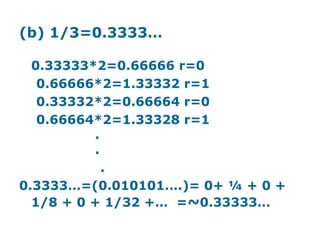
(b) 1/3=0.3333…

  0.33333*2=0.66666 r=0
   0.66666*2=1.33332 r=1
   0.33332*2=0.66664 r=0
   0.66664*2=1.33328 r=1
          .
          .
            .
0.3333…=(0.010101….)= 0+ ¼ + 0 +
  1/8 + 0 + 1/32 +… =~0.33333…
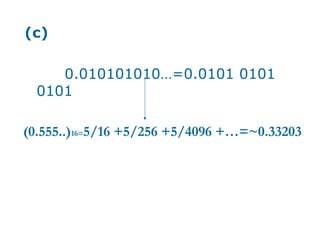
(c)

     0.010101010…=0.0101 0101
  0101

(0.555..)16=5/16 +5/256 +5/4096 +…=~0.33203
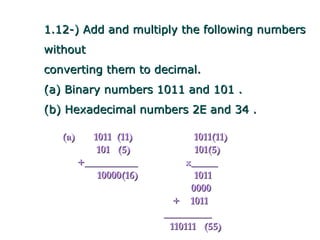
1.12-) Add and multiply the following numbers
without
converting them to decimal.
(a) Binary numbers 1011 and 101 .
(b) Hexadecimal numbers 2E and 34 .

   (a)      1011 (11)           1011(11)
             101 (5)            101(5)
         +__________          x_____
             10000(16)          1011
                               0000
                           + 1011
                         _________
                          110111 (55)
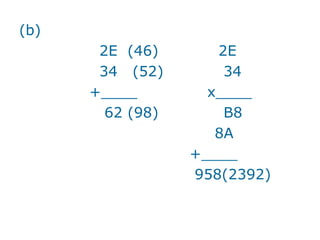
(b)
       2E (46)       2E
       34 (52)        34
      +____         x____
        62 (98)       B8
                     8A
                  +____
                  958(2392)
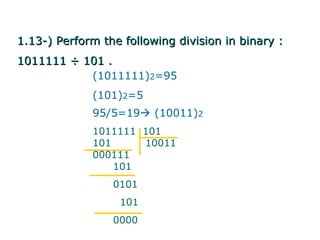
1.13-) Perform the following division in binary :
1011111 ÷ 101 .
           (1011111)2=95
             (101)2=5
             95/5=19 (10011)2
             1011111 101
             101     10011
             000111
                 101
                 0101
                  101
                 0000
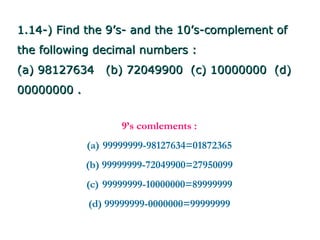
1.14-) Find the 9’s- and the 10’s-complement of
the following decimal numbers :
(a) 98127634 (b) 72049900 (c) 10000000 (d)
00000000 .


                    9’s comlements :
             (a) 99999999-98127634=01872365
             (b) 99999999-72049900=27950099
             (c) 99999999-10000000=89999999
             (d) 99999999-0000000=99999999
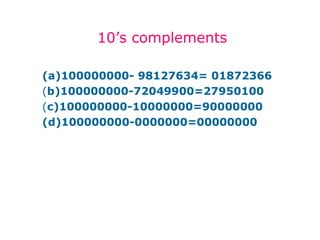
10’s complements

(a)100000000- 98127634= 01872366
(b)100000000-72049900=27950100
(c)100000000-10000000=90000000
(d)100000000-0000000=00000000
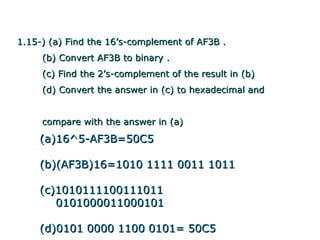
1.15-) (a) Find the 16’s-complement of AF3B .
     (b) Convert AF3B to binary .
     (c) Find the 2’s-complement of the result in (b)
     (d) Convert the answer in (c) to hexadecimal and


     compare with the answer in (a)
    (a)16^5-AF3B=50C5

    (b)(AF3B)16=1010 1111 0011 1011

    (c)1010111100111011
       0101000011000101

    (d)0101 0000 1100 0101= 50C5
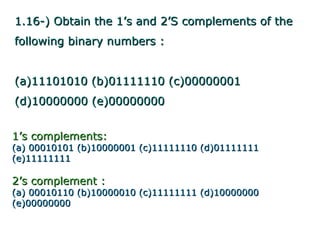
1.16-) Obtain the 1’s and 2’S complements of the
following binary numbers :


(a)11101010 (b)01111110 (c)00000001
(d)10000000 (e)00000000


1’s complements:
(a) 00010101 (b)10000001 (c)11111110 (d)01111111
(e)11111111

2’s complement :
(a) 00010110 (b)10000010 (c)11111111 (d)10000000
(e)00000000
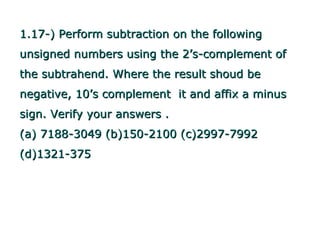
1.17-) Perform subtraction on the following
unsigned numbers using the 2’s-complement of
the subtrahend. Where the result shoud be
negative, 10’s complement it and affix a minus
sign. Verify your answers .
(a) 7188-3049 (b)150-2100 (c)2997-7992
(d)1321-375
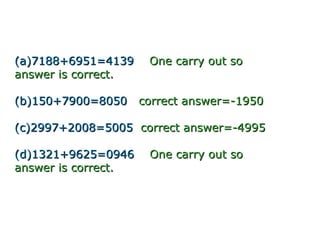
(a)7188+6951=4139     One carry out so
answer is correct.

(b)150+7900=8050     correct answer=-1950

(c)2997+2008=5005 correct answer=-4995

(d)1321+9625=0946     One carry out so
answer is correct.
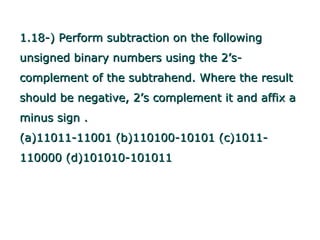
1.18-) Perform subtraction on the following
unsigned binary numbers using the 2’s-
complement of the subtrahend. Where the result
should be negative, 2’s complement it and affix a
minus sign .
(a)11011-11001 (b)110100-10101 (c)1011-
110000 (d)101010-101011
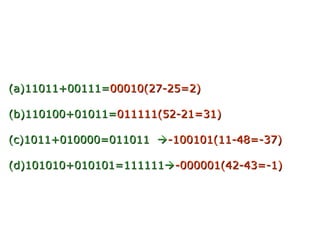
(a)11011+00111=00010(27-25=2)

(b)110100+01011=011111(52-21=31)

(c)1011+010000=011011 -100101(11-48=-37)

(d)101010+010101=111111-000001(42-43=-1)
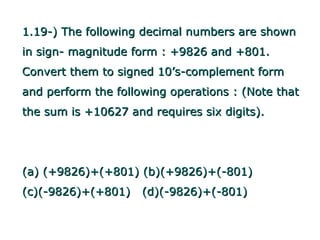
1.19-) The following decimal numbers are shown
in sign- magnitude form : +9826 and +801.
Convert them to signed 10’s-complement form
and perform the following operations : (Note that
the sum is +10627 and requires six digits).


(a) (+9826)+(+801) (b)(+9826)+(-801)
(c)(-9826)+(+801) (d)(-9826)+(-801)
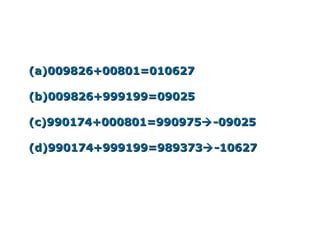
(a)009826+00801=010627

(b)009826+999199=09025

(c)990174+000801=990975 -09025

(d)990174+999199=989373 -10627
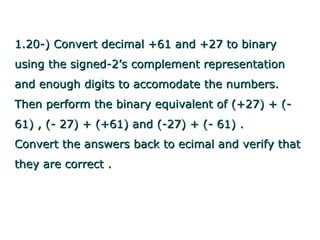
1.20-) Convert decimal +61 and +27 to binary
using the signed-2’s complement representation
and enough digits to accomodate the numbers.
Then perform the binary equivalent of (+27) + (-
61) , (- 27) + (+61) and (-27) + (- 61) .
Convert the answers back to ecimal and verify that
they are correct .
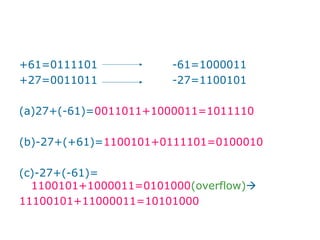
+61=0111101            -61=1000011
+27=0011011            -27=1100101

(a)27+(-61)=0011011+1000011=1011110

(b)-27+(+61)=1100101+0111101=0100010

(c)-27+(-61)=
  1100101+1000011=0101000(overflow)
11100101+11000011=10101000
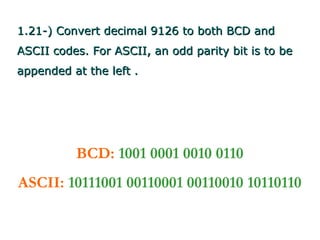
1.21-) Convert decimal 9126 to both BCD and
ASCII codes. For ASCII, an odd parity bit is to be
appended at the left .


          BCD: 1001 0001 0010 0110
ASCII: 10111001 00110001 00110010 10110110
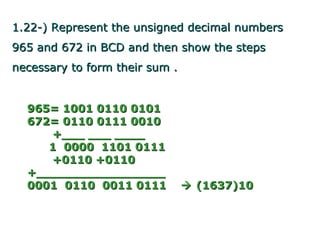
1.22-) Represent the unsigned decimal numbers
965 and 672 in BCD and then show the steps
necessary to form their sum .


  965= 1001 0110 0101
  672= 0110 0111 0010
     +___ ___ ____
     1 0000 1101 0111
     +0110 +0110
  +_________________
  0001 0110 0011 0111            (1637)10
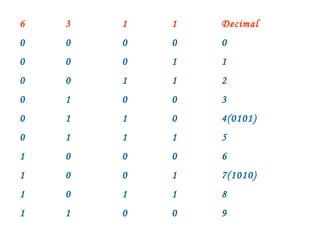
1.23-) Formulate a weighted binary code for the
decimal digits using weights 6, 3, 1, 1 .
6   3   1   1   Decimal
0   0   0   0   0
0   0   0   1   1
0   0   1   1   2
0   1   0   0   3
0   1   1   0   4(0101)
0   1   1   1   5
1   0   0   0   6
1   0   0   1   7(1010)
1   0   1   1   8
1   1   0   0   9
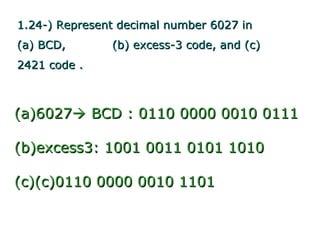
1.24-) Represent decimal number 6027 in
(a) BCD,       (b) excess-3 code, and (c)
2421 code .


(a)6027 BCD : 0110 0000 0010 0111

(b)excess3: 1001 0011 0101 1010

(c)(c)0110 0000 0010 1101
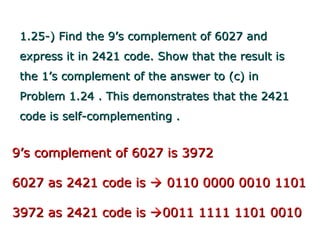
1.25-) Find the 9’s complement of 6027 and
 express it in 2421 code. Show that the result is
 the 1’s complement of the answer to (c) in
 Problem 1.24 . This demonstrates that the 2421
 code is self-complementing .


9’s complement of 6027 is 3972

6027 as 2421 code is  0110 0000 0010 1101

3972 as 2421 code is 0011 1111 1101 0010
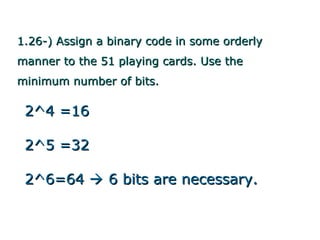
1.26-) Assign a binary code in some orderly
manner to the 51 playing cards. Use the
minimum number of bits.

 2^4 =16

 2^5 =32

 2^6=64  6 bits are necessary.
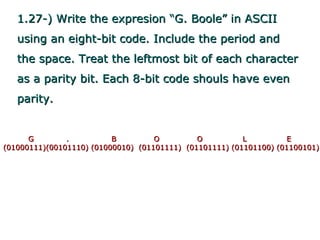
1.27-) Write the expresion “G. Boole” in ASCII
   using an eight-bit code. Include the period and
   the space. Treat the leftmost bit of each character
   as a parity bit. Each 8-bit code shouls have even
   parity.


      G        .          B         O         O          L          E
(01000111)(00101110) (01000010) (01101111) (01101111) (01101100) (01100101)
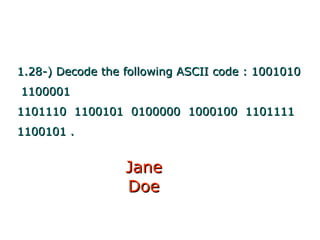
1.28-) Decode the following ASCII code : 1001010
1100001
1101110 1100101 0100000 1000100 1101111
1100101 .


                  Jane
                  Doe
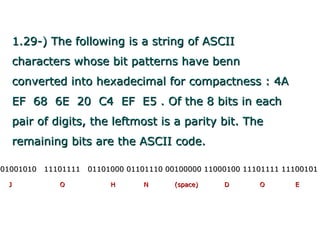
1.29-) The following is a string of ASCII
  characters whose bit patterns have benn
  converted into hexadecimal for compactness : 4A
  EF 68 6E 20 C4 EF E5 . Of the 8 bits in each
  pair of digits, the leftmost is a parity bit. The
  remaining bits are the ASCII code.

01001010   11101111   01101000 01101110 00100000 11000100 11101111 11100101

 J            O            H      N       (space)    D       O       E
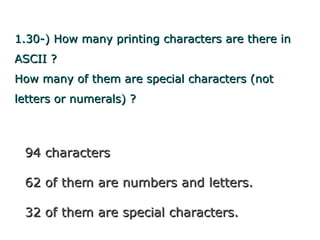
1.30-) How many printing characters are there in
ASCII ?
How many of them are special characters (not
letters or numerals) ?


 94 characters

 62 of them are numbers and letters.

 32 of them are special characters.
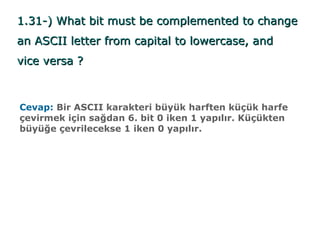
1.31-) What bit must be complemented to change
an ASCII letter from capital to lowercase, and
vice versa ?


Cevap: Bir ASCII karakteri büyük harften küçük harfe
çevirmek için sağdan 6. bit 0 iken 1 yapılır. Küçükten
büyüğe çevrilecekse 1 iken 0 yapılır.
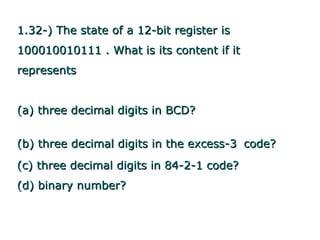
1.32-) The state of a 12-bit register is
100010010111 . What is its content if it
represents


(a) three decimal digits in BCD?


(b) three decimal digits in the excess-3 code?
(c) three decimal digits in 84-2-1 code?
(d) binary number?
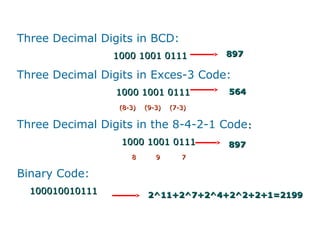
Three Decimal Digits in BCD:
                 1000 1001 0111           897

Three Decimal Digits in Exces-3 Code:
                 1000 1001 0111           564
                  (8-3)   (9-3)   (7-3)

Three Decimal Digits in the 8-4-2-1 Code:
                  1000 1001 0111          897
                     8       9       7

Binary Code:
  100010010111             2^11+2^7+2^4+2^2+2+1=2199
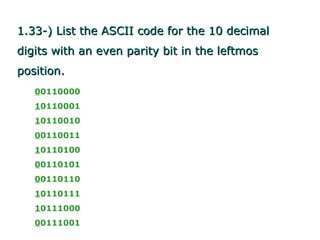
1.33-) List the ASCII code for the 10 decimal
digits with an even parity bit in the leftmos
position.
   00110000
   10110001
   10110010
   00110011
   10110100
   00110101
   00110110
   10110111
   10111000
   00111001
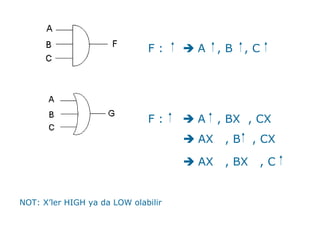
1.34-) Assume a 3-input AND gate with output F
and a 3-input OR gate with output G. Inputs are
A, B, and C . Show the signals (by means of a
timing diagram) of the outputs F and G as
functions of three inputs ABC. Use all possible
combinations of ABC.
F:     A     ,B    ,C


                              F:     A     , BX , CX
                                      AX    ,B     , CX

                                      AX    , BX    ,C


NOT: X’ler HIGH ya da LOW olabilir

Bolum1cozumler

  • 1.
    DIGITAL DESIGN THIRD EDITION M. MORRIS MANO CHAPTER 1 : BINARY SYSTEMS PROBLEMS
  • 2.
    1.1-) List theoctal and the hexadecimal numbers from 16 to 32. Using A and B for the last two digits, list the numbers from 10 to 26 in base 12 . Octal : 16 = 8¹ x 2 + 8º x 0 => (16)10 = (20)8 32 = 8¹ x 4 + 8º x 0 => (32)10 = (40)8 20, 21, 22, 23, 24, 25, 26, 27, 30, 31, 32, 33, 34, 35, 36, 37, 40
  • 3.
    Hexadecimal : 16 = 16¹ x 1 + 16º x 0 => (16)10 = (10)16 32 = 16¹ x 2 + 16º x 0 => (32)10 = (20)8 10, 11, 12, 13, 14, 15, 16, 17, 18, 19, 1A, 1B , 1C, 1D, 1E, 1F, 20 Base-12 : 10 = 12º x A => (10)10 = (A)12 26 = 12¹ x 2 + 12º x 2 => (26)10 = (22)12 A, B, 10, 11, 12, 13, 14, 15, 16, 17, 18, 19, 1A, 1B, 20, 21, 22
  • 4.
    1.2-) What isthe exact number of bytes in a system that contains (a) 32K byte, (b)64M bytes, and (c)6.4G byte ? (a) 32K byte: 1K = 2¹º = 1,024 32K = 32 x 2¹º = 32 x 1,024 = 32,768 32K byte = 32,768 byte
  • 5.
    (b) 64M byte: 1M = 2²º = 1,048,576 64M = 64 x 2²º = 64 x 1,048,576 = 67,108,864 64M byte = 67,108,864 byte (c) 6.4G byte: 1G = 2³º = 1,073,741,824 6.4G = 6.4 x 2³º = 6.4 x 1,073,741,824 = 6,871,747,674 6.4G byte = 6,871,747,674 byte
  • 6.
    1.3-) What isthe largest binary number that can be expressed with 12 bits? What is the equivalent decimal and hexadecimal ? Binary: (111111111111)2 Decimal: (111111111111)2 = 1x 2º+ 1 x 2¹ + 1 x 2² +…..+ 1 x 2¹¹ + 1 x 2¹² (111111111111)2 = 4,095 Hexadecimal: (1111 1111 1111)2 = (FFF)16 F F F
  • 7.
    1.4-) Convert thefollowing numbers with the indicated bases to decimal : (4310)5 , and (198)12 . (4310)5 = 0 x 5º + 1 x 5¹ + 3 x 5² + 4 x 5³ = 0 + 5 + 75 + 500 (4310)5 = 580 (198)12 = 8 x 12º + 9 x 12¹ + 1 x 12² = 8 + 108 + 144 (198)12 = 260
  • 8.
    1.5-) Determine thebase of the numbers in each case for the following operations to be correct : (a) 14/2 = 5 ; (b) 54/4 = 13 ; (c) 24+17 = 40 . (a) (14)a / (2)a = (5)a ⇒ (4 x aº + 1 x a¹) / (2 x aº) = 5 x aº ⇒ (4 + a) / 2 = 5 ⇒ 4 + a = 10 ⇒a=6
  • 9.
    (b) (54)b /(4)b = (13)b ⇒ (4 x bº + 5 x b¹) / (4 x bº) = 3 x bº + 1 x b¹ ⇒ (4 + 5b) / 4 = 3 + b ⇒ 4 + 5b = 12 + 4b ⇒b=8 (c) (24)c + (17)c = (40)c ⇒ (4 x cº + 2 x c¹) + (7 x cº + 1 x c¹) = 4 x c¹ ⇒ 4 + 2c + 7 + c = 4c ⇒ c = 11
  • 10.
    1.6-) The solutionto the quadratic equation x² - 11x + 22 = 0 is x=3 and x=6. What is the base of the numbers? x² - 11x + 22 = (x – 3) . (x – 6) x² - 11x + 22 = x² - (6 + 3)x + (6.3) ⇒ (11)a = (6)a + (3)a ⇒1+a=6+3 ⇒a=8
  • 11.
    1.7-) Express thefollowing numbers in decimal : (10110.0101)2 , (16.5)16 , (26.24)8 . ( 1 0 1 1 0 . 0 1 0 1 )2 = 2¹ + 2² + (2^4) +( 2^-2) + (2^-4) 4 3 2 1 0 -1 -2 -3 -4 (10110.0101)2 = 2 + 4 + 16 + (1/4) + (1/16) (10110.0101)2 = 22.3125
  • 12.
    ( 1 6. 5 )16 = 6 x 16º + 1 x 16¹ + 5 x (16^-1) 1 0 -1 (16.5)16 = 6 + 16 + (5/16) (16.5)16 = 22.3125 ( 2 6 . 2 4 )8 = 6 x 8º + 2 x 8¹ + 2 x (8^-1) + 4 x (8^-2) 1 0 -1 -2 (26.24)8 = 6 + 16 + (2/8) + (4/64) (26.24)8 = 22.3125
  • 13.
    1.8-) Convert thefollowing binary numbers to hexadecimal and to decimal : (a) 1.11010 , (b) 1110.10 . Explain why the decimal answer in (b) is 8 times that of (a) . (a) ( 1 . 1101 0 )2 = ( 1 . D )16 = 1 x 16º + D x (16^-1) 1 D 0 0 -1
  • 14.
    1.9-) Convert thehexadecimal number 68BE to binary and then from binary convert it to octal . (68BE) 16 Binary form: (0110 1000 1011 1110)2=(0110100010111110)2 6 8 B E Octal form: (0 110 100 010 111 110)2 0 6 4 2 7 6 =(064276)8
  • 15.
    (a) 1.10-) Convert the decimal number 345 to binary in two ways : Convert directly to binary; Convert first to hexadecimal, then from hexadecimal to binary. Which method is faster ?
  • 16.
    Method 1: Number Divided by 2 Remainder (345)10 345 345/2=172 1 172 172/2=86 0 86 86/2=43 0 43 43/2=21 1 21 21/2=10 1 10 10/2=5 0 5 5/2=2 1 2 2/2=1 1
  • 17.
    Method 2: Divided by Number Remainder 16 345 345/16=21 9 21 21/16=1 5 (345)10=(159)16 (1 101 1001)2
  • 18.
    1.11-) Do thefollowing conversion problems : (a) Convert decimal 34.4375 to binary . (b) Calculate the binary equivalent of 1/3 out to 8 places. Then convert from binary to decimal. How close is the result to 1/3 ? (c) Convert the binary result in (b) into hexadecimal. Then convert the result to decimal . Is the answer the same ?
  • 19.
    (a) 34.4375 34 0.4375 34:2=17 r=0 0.4375*2=0.875 r=0 17:2=8 r=1 0.875*2=1.75 r=1 8:2=4 r=0 0.75*2=1.5 r=1 4:2=2 r=0 0.5*2=1.0 r=1 2:2=1 r=0 0*2=0 r=0 0.4375=(0.01110)2 34=(100010)2 34.4375=(100010.01110)2
  • 20.
    (b) 1/3=0.3333… 0.33333*2=0.66666 r=0 0.66666*2=1.33332 r=1 0.33332*2=0.66664 r=0 0.66664*2=1.33328 r=1 . . . 0.3333…=(0.010101….)= 0+ ¼ + 0 + 1/8 + 0 + 1/32 +… =~0.33333…
  • 21.
    (c) 0.010101010…=0.0101 0101 0101 (0.555..)16=5/16 +5/256 +5/4096 +…=~0.33203
  • 22.
    1.12-) Add andmultiply the following numbers without converting them to decimal. (a) Binary numbers 1011 and 101 . (b) Hexadecimal numbers 2E and 34 . (a) 1011 (11) 1011(11) 101 (5) 101(5) +__________ x_____ 10000(16) 1011 0000 + 1011 _________ 110111 (55)
  • 23.
    (b) 2E (46) 2E 34 (52) 34 +____ x____ 62 (98) B8 8A +____ 958(2392)
  • 24.
    1.13-) Perform thefollowing division in binary : 1011111 ÷ 101 . (1011111)2=95 (101)2=5 95/5=19 (10011)2 1011111 101 101 10011 000111 101 0101 101 0000
  • 25.
    1.14-) Find the9’s- and the 10’s-complement of the following decimal numbers : (a) 98127634 (b) 72049900 (c) 10000000 (d) 00000000 . 9’s comlements : (a) 99999999-98127634=01872365 (b) 99999999-72049900=27950099 (c) 99999999-10000000=89999999 (d) 99999999-0000000=99999999
  • 26.
    10’s complements (a)100000000- 98127634=01872366 (b)100000000-72049900=27950100 (c)100000000-10000000=90000000 (d)100000000-0000000=00000000
  • 27.
    1.15-) (a) Findthe 16’s-complement of AF3B . (b) Convert AF3B to binary . (c) Find the 2’s-complement of the result in (b) (d) Convert the answer in (c) to hexadecimal and compare with the answer in (a) (a)16^5-AF3B=50C5 (b)(AF3B)16=1010 1111 0011 1011 (c)1010111100111011 0101000011000101 (d)0101 0000 1100 0101= 50C5
  • 28.
    1.16-) Obtain the1’s and 2’S complements of the following binary numbers : (a)11101010 (b)01111110 (c)00000001 (d)10000000 (e)00000000 1’s complements: (a) 00010101 (b)10000001 (c)11111110 (d)01111111 (e)11111111 2’s complement : (a) 00010110 (b)10000010 (c)11111111 (d)10000000 (e)00000000
  • 29.
    1.17-) Perform subtractionon the following unsigned numbers using the 2’s-complement of the subtrahend. Where the result shoud be negative, 10’s complement it and affix a minus sign. Verify your answers . (a) 7188-3049 (b)150-2100 (c)2997-7992 (d)1321-375
  • 30.
    (a)7188+6951=4139 One carry out so answer is correct. (b)150+7900=8050 correct answer=-1950 (c)2997+2008=5005 correct answer=-4995 (d)1321+9625=0946 One carry out so answer is correct.
  • 31.
    1.18-) Perform subtractionon the following unsigned binary numbers using the 2’s- complement of the subtrahend. Where the result should be negative, 2’s complement it and affix a minus sign . (a)11011-11001 (b)110100-10101 (c)1011- 110000 (d)101010-101011
  • 32.
  • 33.
    1.19-) The followingdecimal numbers are shown in sign- magnitude form : +9826 and +801. Convert them to signed 10’s-complement form and perform the following operations : (Note that the sum is +10627 and requires six digits). (a) (+9826)+(+801) (b)(+9826)+(-801) (c)(-9826)+(+801) (d)(-9826)+(-801)
  • 34.
  • 35.
    1.20-) Convert decimal+61 and +27 to binary using the signed-2’s complement representation and enough digits to accomodate the numbers. Then perform the binary equivalent of (+27) + (- 61) , (- 27) + (+61) and (-27) + (- 61) . Convert the answers back to ecimal and verify that they are correct .
  • 36.
    +61=0111101 -61=1000011 +27=0011011 -27=1100101 (a)27+(-61)=0011011+1000011=1011110 (b)-27+(+61)=1100101+0111101=0100010 (c)-27+(-61)= 1100101+1000011=0101000(overflow) 11100101+11000011=10101000
  • 37.
    1.21-) Convert decimal9126 to both BCD and ASCII codes. For ASCII, an odd parity bit is to be appended at the left . BCD: 1001 0001 0010 0110 ASCII: 10111001 00110001 00110010 10110110
  • 38.
    1.22-) Represent theunsigned decimal numbers 965 and 672 in BCD and then show the steps necessary to form their sum . 965= 1001 0110 0101 672= 0110 0111 0010 +___ ___ ____ 1 0000 1101 0111 +0110 +0110 +_________________ 0001 0110 0011 0111  (1637)10
  • 39.
    1.23-) Formulate aweighted binary code for the decimal digits using weights 6, 3, 1, 1 .
  • 40.
    6 3 1 1 Decimal 0 0 0 0 0 0 0 0 1 1 0 0 1 1 2 0 1 0 0 3 0 1 1 0 4(0101) 0 1 1 1 5 1 0 0 0 6 1 0 0 1 7(1010) 1 0 1 1 8 1 1 0 0 9
  • 41.
    1.24-) Represent decimalnumber 6027 in (a) BCD, (b) excess-3 code, and (c) 2421 code . (a)6027 BCD : 0110 0000 0010 0111 (b)excess3: 1001 0011 0101 1010 (c)(c)0110 0000 0010 1101
  • 42.
    1.25-) Find the9’s complement of 6027 and express it in 2421 code. Show that the result is the 1’s complement of the answer to (c) in Problem 1.24 . This demonstrates that the 2421 code is self-complementing . 9’s complement of 6027 is 3972 6027 as 2421 code is  0110 0000 0010 1101 3972 as 2421 code is 0011 1111 1101 0010
  • 43.
    1.26-) Assign abinary code in some orderly manner to the 51 playing cards. Use the minimum number of bits. 2^4 =16 2^5 =32 2^6=64  6 bits are necessary.
  • 44.
    1.27-) Write theexpresion “G. Boole” in ASCII using an eight-bit code. Include the period and the space. Treat the leftmost bit of each character as a parity bit. Each 8-bit code shouls have even parity. G . B O O L E (01000111)(00101110) (01000010) (01101111) (01101111) (01101100) (01100101)
  • 45.
    1.28-) Decode thefollowing ASCII code : 1001010 1100001 1101110 1100101 0100000 1000100 1101111 1100101 . Jane Doe
  • 46.
    1.29-) The followingis a string of ASCII characters whose bit patterns have benn converted into hexadecimal for compactness : 4A EF 68 6E 20 C4 EF E5 . Of the 8 bits in each pair of digits, the leftmost is a parity bit. The remaining bits are the ASCII code. 01001010 11101111 01101000 01101110 00100000 11000100 11101111 11100101 J O H N (space) D O E
  • 47.
    1.30-) How manyprinting characters are there in ASCII ? How many of them are special characters (not letters or numerals) ? 94 characters 62 of them are numbers and letters. 32 of them are special characters.
  • 48.
    1.31-) What bitmust be complemented to change an ASCII letter from capital to lowercase, and vice versa ? Cevap: Bir ASCII karakteri büyük harften küçük harfe çevirmek için sağdan 6. bit 0 iken 1 yapılır. Küçükten büyüğe çevrilecekse 1 iken 0 yapılır.
  • 49.
    1.32-) The stateof a 12-bit register is 100010010111 . What is its content if it represents (a) three decimal digits in BCD? (b) three decimal digits in the excess-3 code? (c) three decimal digits in 84-2-1 code? (d) binary number?
  • 50.
    Three Decimal Digitsin BCD: 1000 1001 0111 897 Three Decimal Digits in Exces-3 Code: 1000 1001 0111 564 (8-3) (9-3) (7-3) Three Decimal Digits in the 8-4-2-1 Code: 1000 1001 0111 897 8 9 7 Binary Code: 100010010111 2^11+2^7+2^4+2^2+2+1=2199
  • 51.
    1.33-) List theASCII code for the 10 decimal digits with an even parity bit in the leftmos position. 00110000 10110001 10110010 00110011 10110100 00110101 00110110 10110111 10111000 00111001
  • 52.
    1.34-) Assume a3-input AND gate with output F and a 3-input OR gate with output G. Inputs are A, B, and C . Show the signals (by means of a timing diagram) of the outputs F and G as functions of three inputs ABC. Use all possible combinations of ABC.
  • 53.
    F: A ,B ,C F: A , BX , CX  AX ,B , CX  AX , BX ,C NOT: X’ler HIGH ya da LOW olabilir

Editor's Notes