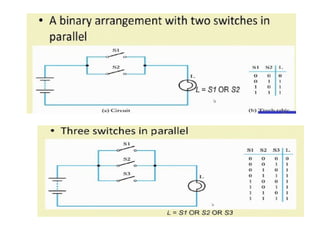
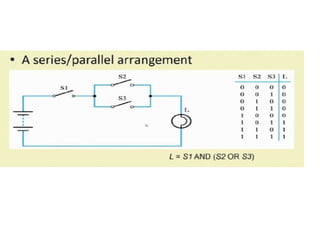
EC3352- DIGITAL SYSTEMS DESIGN
Dr. C.Helen Sulochana
Professor/ECE
SXCCE
UNIT I - BASIC CONCEPTS
• Review of number systems-representation-
conversions, Review of Boolean algebra- theorems,
sum of product and product of sum simplification,
canonical forms min term and max term,
Simplification of Boolean expressions-Karnaugh
map, completely and incompletely specified
functions, Implementation of Boolean expressions
using universal gates ,Tabulation methods.
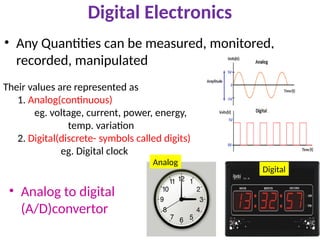
Digital Electronics
• Any Quantities can be measured, monitored,
recorded, manipulated
Their values are represented as
1. Analog(continuous)
eg. voltage, current, power, energy,
temp. variation
2. Digital(discrete- symbols called digits)
eg. Digital clock
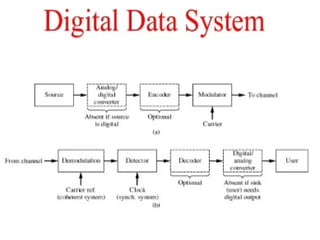
• Analog to digital
(A/D)convertor
Analog
Digital
Communication
Business transactions
traffic control
spacecraft guidance
 medical treatment, weather monitoring,
Internet
Commercial industry- digital telephones, digital televisions,
digital cameras,
Applications
 economical and easy to design.
 very well suited for both numerical and non-numerical
information processing.
 high speed and high noise immunity
 easy to duplicate similar circuits and complex digital ICs are
manufactured
Advantages
UNIT I
• Number Systems
• Boolean Algebra
• Karnaugh map Minimization
• Tabulation Method
BASIC CONCEPTS(DIGITAL FUNDAMENTALS)
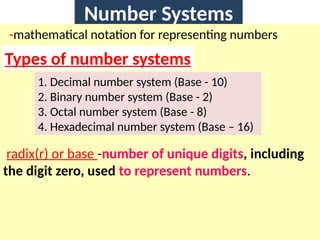
Number Systems
-mathematical notation for representing numbers
radix(r) or base -number of unique digits, including
the digit zero, used to represent numbers.
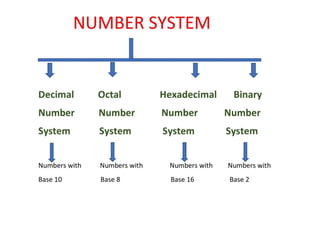
1. Decimal number system (Base - 10)
2. Binary number system (Base - 2)
3. Octal number system (Base - 8)
4. Hexadecimal number system (Base – 16)
Types of number systems
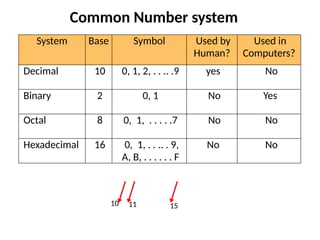
System Base Symbol Used by
Human?
Used in
Computers?
Decimal 10 0, 1, 2, . . .. .9 yes No
Binary 2 0, 1 No Yes
Octal 8 0, 1, . . . . .7 No No
Hexadecimal 16 0, 1, . . .. . 9,
A, B, . . . . . . F
No No
Common Number system
10 11 15
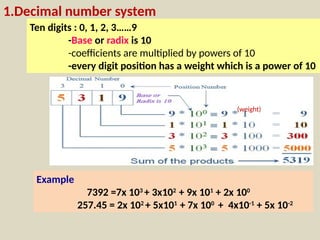
1.Decimal number system
Ten digits : 0, 1, 2, 3……9
-Base or radix is 10
-coefficients are multiplied by powers of 10
-every digit position has a weight which is a power of 10
Example
7392 =7x 10³
+ 3x10²
+ 9x 101
+ 2x 100
257.45 = 2x 10²
+ 5x101
+ 7x 100
+ 4x10⁻¹
+ 5x 10⁻²
(weight)
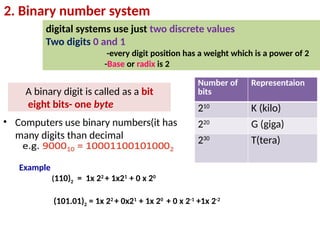
2. Binary number system
Example
(110)2 = 1x 22
+ 1x21
+ 0 x 20
(101.01)2 = 1x 22
+ 0x21
+ 1x 20
+ 0 x 2-1
+1x 2-2
digital systems use just two discrete values
Two digits 0 and 1
-every digit position has a weight which is a power of 2
-Base or radix is 2
A binary digit is called as a bit
eight bits- one byte
Number of
bits
Representaion
210
K (kilo)
220
G (giga)
230
T(tera)
• Computers use binary numbers(it has
many digits than decimal
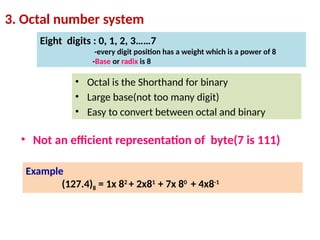
3. Octal number system
Eight digits : 0, 1, 2, 3……7
-every digit position has a weight which is a power of 8
-Base or radix is 8
Example
(127.4)8 = 1x 82
+ 2x81
+ 7x 80
+ 4x8-1
• Octal is the Shorthand for binary
• Large base(not too many digit)
• Easy to convert between octal and binary
• Not an efficient representation of byte(7 is 111)
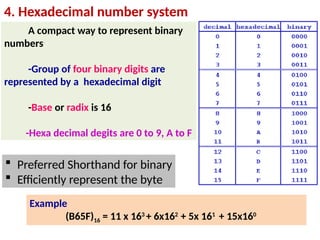
4. Hexadecimal number system
Example
(B65F)16 = 11 x 163
+ 6x162
+ 5x 161
+ 15x160
 Preferred Shorthand for binary
 Efficiently represent the byte
A compact way to represent binary
numbers
-Group of four binary digits are
represented by a hexadecimal digit
-Base or radix is 16
-Hexa decimal degits are 0 to 9, A to F
to
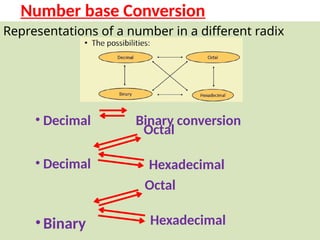
Number base Conversion
Representations of a number in a different radix
• Decimal Binary conversion
• Decimal
•Binary
Octal
Hexadecimal
Octal
Hexadecimal
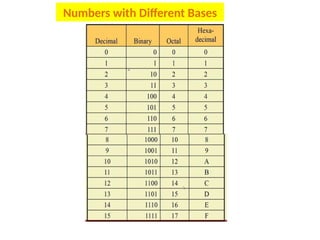
Numbers with Different Bases
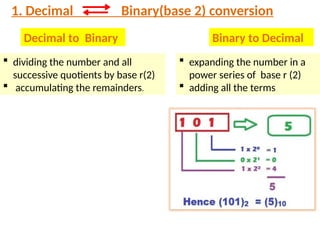
1. Decimal Binary(base 2) conversion
Decimal to Binary Binary to Decimal
 expanding the number in a
power series of base r (2)
 adding all the terms
 dividing the number and all
successive quotients by base r(2)
 accumulating the remainders.
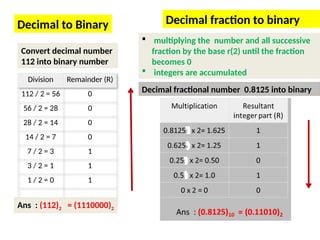
Division Remainder (R)
112 / 2 = 56 0
56 / 2 = 28 0
28 / 2 = 14 0
14 / 2 = 7 0
7 / 2 = 3 1
3 / 2 = 1 1
1 / 2 = 0 1
Decimal to Binary
Ans : (112)2 = (1110000)2
Convert decimal number
112 into binary number
Decimal fractional number 0.8125 into binary
 multiplying the number and all successive
fraction by the base r(2) until the fraction
becomes 0
 integers are accumulated
Decimal fraction to binary
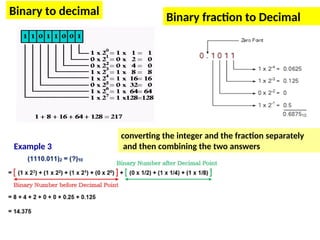
Binary to decimal
Example 3
converting the integer and the fraction separately
and then combining the two answers
Binary fraction to Decimal
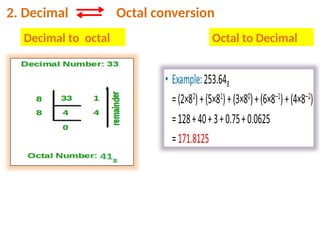
2. Decimal Octal conversion
Decimal to octal Octal to Decimal
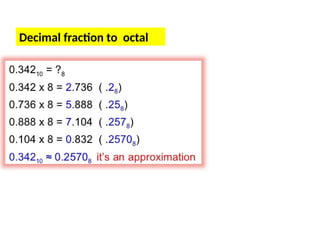
Decimal fraction to octal
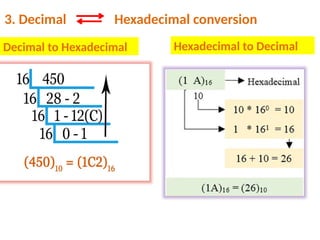
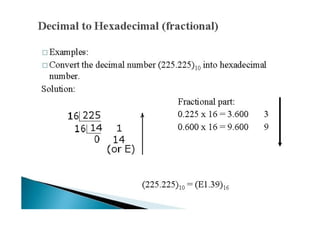
3. Decimal Hexadecimal conversion
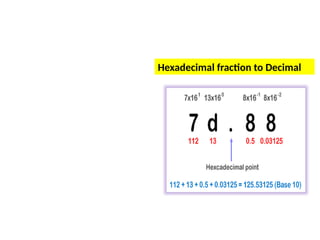
Decimal to Hexadecimal Hexadecimal to Decimal
Hexadecimal fraction to Decimal
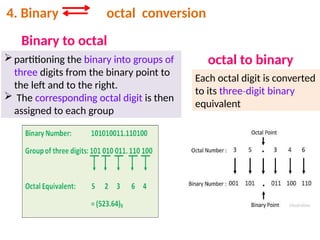
partitioning the binary into groups of
three digits from the binary point to
the left and to the right.
 The corresponding octal digit is then
assigned to each group
Each octal digit is converted
to its three digit binary
‐
equivalent
Binary to octal
octal to binary
4. Binary octal conversion
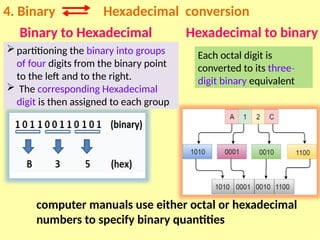
4. Binary Hexadecimal conversion
Binary to Hexadecimal Hexadecimal to binary
computer manuals use either octal or hexadecimal
numbers to specify binary quantities
Each octal digit is
converted to its three‐
digit binary equivalent
partitioning the binary into groups
of four digits from the binary point
to the left and to the right.
 The corresponding Hexadecimal
digit is then assigned to each group
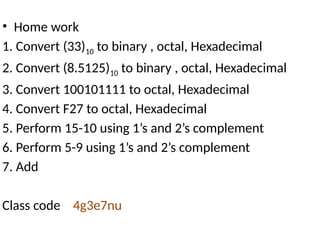
• Home work
1. Convert (33)10 to binary , octal, Hexadecimal
2. Convert (8.5125)10 to binary , octal, Hexadecimal
3. Convert 100101111 to octal, Hexadecimal
4. Convert F27 to octal, Hexadecimal
5. Perform 15-10 using 1’s and 2’s complement
6. Perform 5-9 using 1’s and 2’s complement
7. Add
Class code 4g3e7nu
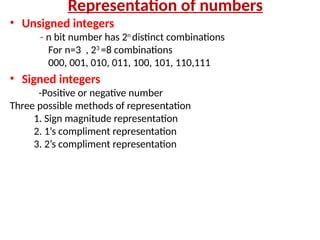
Representation of numbers
• Unsigned integers
- n bit number has 2n
distinct combinations
For n=3 , 23
=8 combinations
000, 001, 010, 011, 100, 101, 110,111
• Signed integers
-Positive or negative number
Three possible methods of representation
1. Sign magnitude representation
2. 1’s compliment representation
3. 2’s compliment representation
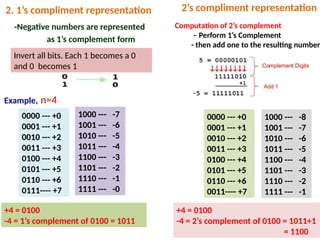
2. 1’s compliment representation
-Negative numbers are represented
as 1’s complement form
1000 --- -7
1001 --- -6
1010 --- -5
1011 --- -4
1100 --- -3
1101 --- -2
1110 --- -1
1111 --- -0
Invert all bits. Each 1 becomes a 0
and 0 becomes 1
0000 --- +0
0001 --- +1
0010 --- +2
0011 --- +3
0100 --- +4
0101 --- +5
0110 --- +6
0111---- +7
Example, n=4
+4 = 0100
-4 = 1’s complement of 0100 = 1011
1000 --- -8
1001 --- -7
1010 --- -6
1011 --- -5
1100 --- -4
1101 --- -3
1110 --- -2
1111 --- -1
+4 = 0100
-4 = 2’s complement of 0100 = 1011+1
= 1100
0000 --- +0
0001 --- +1
0010 --- +2
0011 --- +3
0100 --- +4
0101 --- +5
0110 --- +6
0011---- +7
2’s compliment representation
Computation of 2’s complement
– Perform 1’s Complement
- then add one to the resulting number.
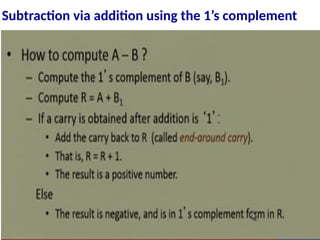
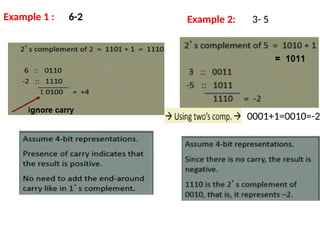
Subtraction via addition using the 1’s complement
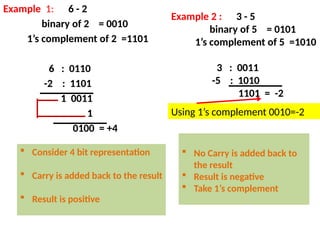
Example 1: 6 - 2
binary of 2 = 0010
1’s complement of 2 =1101
6 : 0110
-2 : 1101
1 0011
1
0100 = +4
 Consider 4 bit representation
 Carry is added back to the result
 Result is positive
Example 2 : 3 - 5
binary of 5 = 0101
1’s complement of 5 =1010
3 : 0011
-5 : 1010
1101 = -2
 No Carry is added back to
the result
 Result is negative
 Take 1’s complement
Using 1’s complement 0010=-2
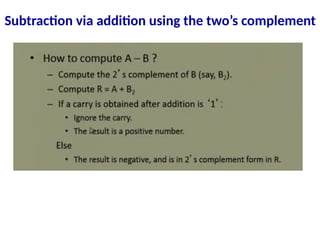
Subtraction via addition using the two’s complement
Example 1 : 6-2 Example 2: 3- 5
0001+1=0010=-2
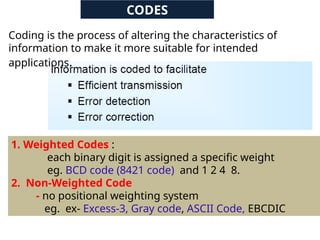
CODES
1. Weighted Codes :
each binary digit is assigned a specific weight
eg. BCD code (8421 code) and 1 2 4 8.
2. Non-Weighted Code
- no positional weighting system
eg. ex- Excess-3, Gray code, ASCII Code, EBCDIC
Coding is the process of altering the characteristics of
information to make it more suitable for intended
applications.
• Digital systems use two distinct values (two stable states-0
& 1)
• Any discrete element is represented with unique binary
code
BINARY CODES
Binary code -combinations of 0’s and 1’s(used in
computer).
n‐bit binary code(minimum) - group of n bits 2n
distinct
combination
• Computer use binary system, people use the decimal system.
1.Binary-Coded Decimal Code(8421 code)
A binary code that distinguishes among 10 elements -
contain at least four bits,(6 unassigned combinations)
Binar
y
code
Arithmeti
c
operation
Decimal Decimal
computer
Decimal to BCD BCD to Decimal
• BCD- replace a decimal digit(number) with an individual binary
code of 4 bits
BCD code has weights of 8, 4, 2, and 1, correspond to
each bit.
 eg. (0110)BCD= 8 * 0 + 4 * 1 + 2 * 1 + 1 * 0 = 6.
for one decimal digit- 4 bit code
k decimal digit- 4k bit code
• Decimal 396 is represented with 12 bits
 Decimal number in BCD = its binary , if the number is
between 0 and 9.
binary combinations 1010 to 1111 are not used in BCD
Decimal BCD
decimal numbers and not
binary numbers,
written with the symbols
0, 1, 2, ……., 9
Represented with binary code
0000, 0001, 0010, …. 1001
decimal value is the same
Used in
seven segment display
Disadvantage
 needs more bits than its
equivalent binary value
Advantage
use of decimal numbers(input and
output data are generated as decimal )
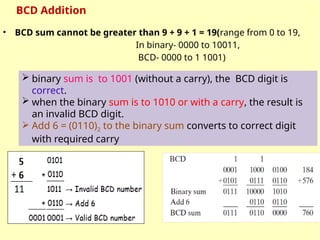
• BCD sum cannot be greater than 9 + 9 + 1 = 19(range from 0 to 19,
In binary- 0000 to 10011,
BCD- 0000 to 1 1001)
 binary sum is to 1001 (without a carry), the BCD digit is
correct.
 when the binary sum is to 1010 or with a carry, the result is
an invalid BCD digit.
 Add 6 = (0110)2 to the binary sum converts to correct digit
with required carry
BCD Addition
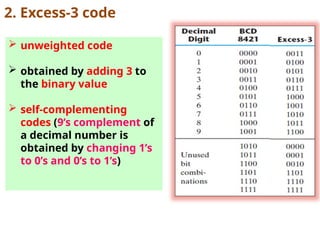
2. Excess‐3 code
 unweighted code
 obtained by adding 3 to
the binary value
 self‐complementing
codes (9’s complement of
a decimal number is
obtained by changing 1’s
to 0’s and 0’s to 1’s)
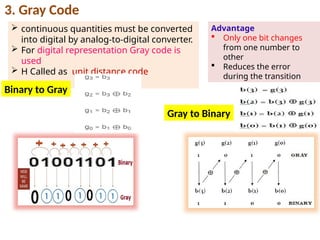
 continuous quantities must be converted
into digital by analog‐to‐digital converter.
 For digital representation Gray code is
used
 H Called as unit distance code
3. Gray Code
Binary to Gray
Gray to Binary
Advantage
 Only one bit changes
from one number to
other
 Reduces the error
during the transition
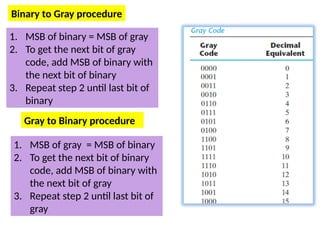
Binary to Gray procedure
1. MSB of binary = MSB of gray
2. To get the next bit of gray
code, add MSB of binary with
the next bit of binary
3. Repeat step 2 until last bit of
binary
Gray to Binary procedure
1. MSB of gray = MSB of binary
2. To get the next bit of binary
code, add MSB of binary with
the next bit of gray
3. Repeat step 2 until last bit of
gray
eg. a. American Standard Code for Information
Interchange (ASCII)
b. Extended binary coded decimal interchange code
(EBCDIC)
4. Alphanumeric codes
 Binary code for alphanumeric characters
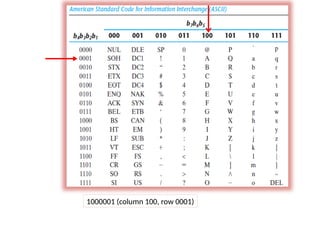
 seven bit code - b1(LSB) to b7(MSB)
a.American Standard Code for Information Interchange (ASC
ASCII code contains
 94 graphic characters(26 uppercase letters (A through Z), the 26
lowercase
letters (a through z), the 10 numerals (0 through 9), and 32 special
printable characters, such as %, *, and $).
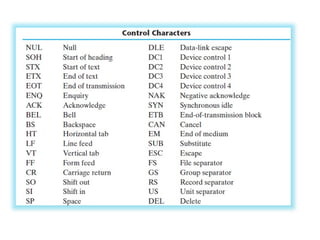
 control characters -control functions for printing and nonprinting
Three types of control characters:
1. Format effectors -control the layout of printing-backspace (BS),
horizontal tabulation (HT), and carriage return (CR).
2. Information separators - to separate the data into divisions such as
paragraphs and pages-record separator (RS) and file separator (FS).
3. Communication‐control characters - useful during the transmission
of text between remote device-STX (start of text) and ETX (end of text),
1000001 (column 100, row 0001)
• 8-bit binary code for numeric and alphanumeric characters.
• 128 characters in ASCII, 256 in EBCDIC
• Binary form in ASCII, BCD form in EBCDIC
b. Extended binary coded decimal interchange code (EBCDIC)
Boolean algebra
• Developed by George Boole
• Algebra of binary logic or algebra of two values i.e
True/False or Yes/ No
Applications of Boolean Algebra
• Used to perform logical operations in computer
• In digital computer True represented by 1(high voltage)
and False represented by 0(low voltage)
• Logical operations are performed by logical operators
• Fundamental logical operators
1. AND (conjuction)
2. OR (disjuction)
3. NOT(negation/complement)
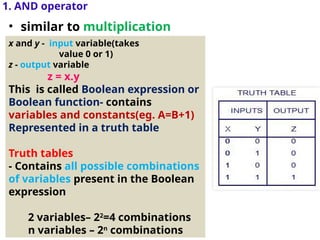
• similar to multiplication
1. AND operator
x and y - input variable(takes
value 0 or 1)
z - output variable
z = x.y
This is called Boolean expression or
Boolean function- contains
variables and constants(eg. A=B+1)
Represented in a truth table
Truth tables
- Contains all possible combinations
of variables present in the Boolean
expression
2 variables– 22
=4 combinations
n variables – 2n
combinations
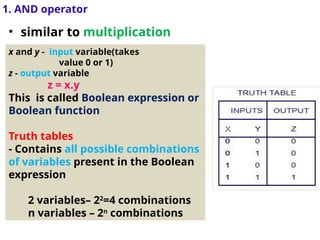
• similar to multiplication
1. AND operator
x and y - input variable(takes
value 0 or 1)
z - output variable
z = x.y
This is called Boolean expression or
Boolean function
Truth tables
- Contains all possible combinations
of variables present in the Boolean
expression
2 variables– 22
=4 combinations
n variables – 2n
combinations
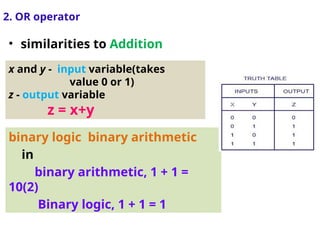
• similarities to Addition
2. OR operator
x and y - input variable(takes
value 0 or 1)
z - output variable
z = x+y
binary logic binary arithmetic
in
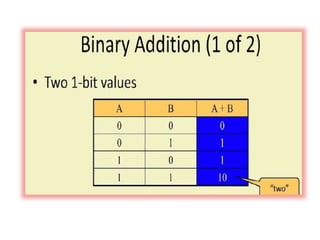
binary arithmetic, 1 + 1 =
10(2)
Binary logic, 1 + 1 = 1
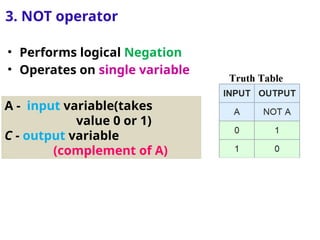
• Performs logical Negation
• Operates on single variable
3. NOT operator
A - input variable(takes
value 0 or 1)
C - output variable
(complement of A)
• Evaluate the following expression uing truth
table x’y’+x
Logic Gates
• Boolean algebra applied in computer’s electronic
circuits
• logic gates(logic circuits)- physical electronic circuit
implementing a Boolean operation(logic operation)
• Operates on one or more signals and produce single
output either 1(high voltage) or 0(low voltage)
Types of logic gates
1. AND gate
2. OR gate
3. NOT gate
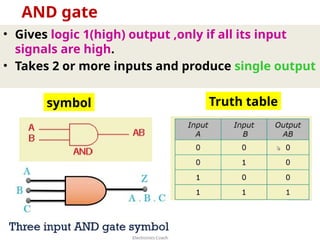
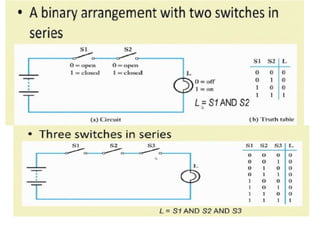
• Gives logic 1(high) output ,only if all its input
signals are high.
• Takes 2 or more inputs and produce single output
AND gate
Truth table
symbol
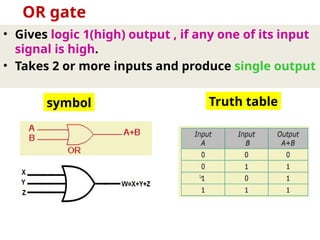
• Gives logic 1(high) output , if any one of its input
signal is high.
• Takes 2 or more inputs and produce single output
OR gate
Truth table
symbol
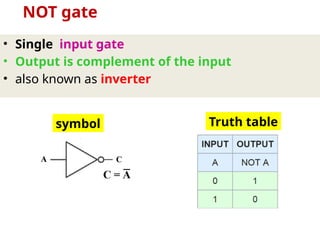
• Single input gate
• Output is complement of the input
• also known as inverter
NOT gate
Truth table
symbol
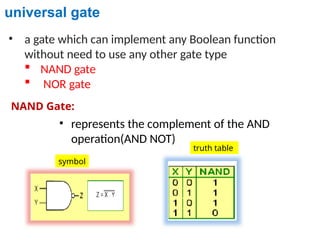
universal gate
• a gate which can implement any Boolean function
without need to use any other gate type
 NAND gate
 NOR gate
NAND Gate:
• represents the complement of the AND
operation(AND NOT)
truth table
symbol
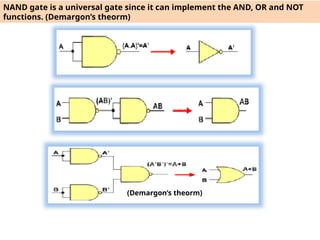
NAND gate is a universal gate since it can implement the AND, OR and NOT
functions. (Demargon’s theorm)
(Demargon’s theorm)
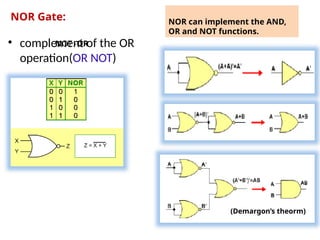
NOR can implement the AND,
OR and NOT functions.
NOR Gate:
NOT -OR
• complement of the OR
operation(OR NOT)
(Demargon’s theorm)
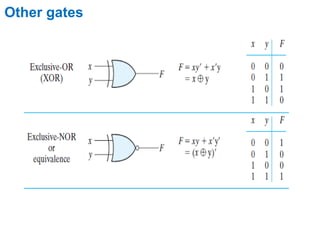
Other gates
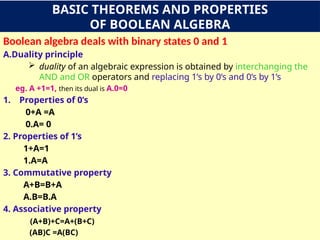
BASIC THEOREMS AND PROPERTIES
OF BOOLEAN ALGEBRA
Boolean algebra deals with binary states 0 and 1
A.Duality principle
 duality of an algebraic expression is obtained by interchanging the
AND and OR operators and replacing 1’s by 0’s and 0’s by 1’s
eg. A +1=1, then its dual is A.0=0
1. Properties of 0’s
0+A =A
0.A= 0
2. Properties of 1’s
1+A=1
1.A=A
3. Commutative property
A+B=B+A
A.B=B.A
4. Associative property
(A+B)+C=A+(B+C)
(AB)C =A(BC)
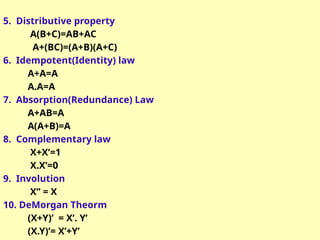
5. Distributive property
A(B+C)=AB+AC
A+(BC)=(A+B)(A+C)
6. Idempotent(Identity) law
A+A=A
A.A=A
7. Absorption(Redundance) Law
A+AB=A
A(A+B)=A
8. Complementary law
X+X’=1
X.X’=0
9. Involution
X’’ = X
10. DeMorgan Theorm
(X+Y)’ = X’. Y’
(X.Y)’= X’+Y’
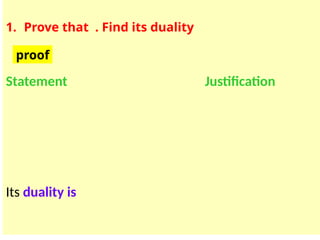
1. Prove that . Find its duality
Statement Justification
Its duality is
proof
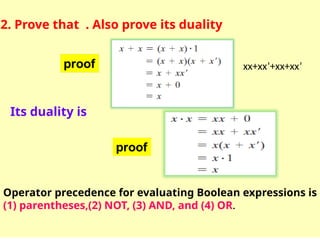
2. Prove that . Also prove its duality
Its duality is
Operator precedence for evaluating Boolean expressions is
(1) parentheses,(2) NOT, (3) AND, and (4) OR.
xx+xx’+xx+xx’
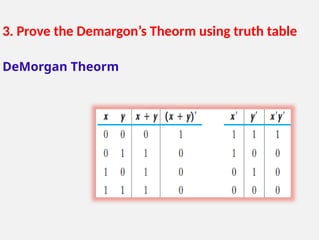
3. Prove the Demargon’s Theorm using truth table
DeMorgan Theorm
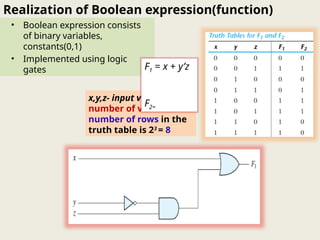
x,y,z- input variables
number of variables =3
number of rows in the
truth table is 23
= 8
Realization of Boolean expression(function)
• Boolean expression consists
of binary variables,
constants(0,1)
• Implemented using logic
gates F1 = x + y’z
F2=
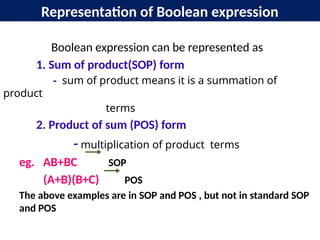
Representation of Boolean expression
Boolean expression can be represented as
1. Sum of product(SOP) form
- sum of product means it is a summation of
product
terms
2. Product of sum (POS) form
- multiplication of product terms
eg. AB+BC SOP
(A+B)(B+C) POS
The above examples are in SOP and POS , but not in standard SOP
and POS
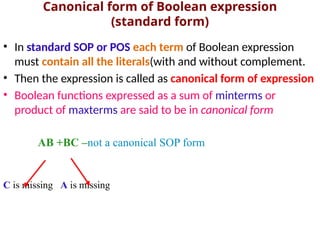
Canonical form of Boolean expression
(standard form)
• In standard SOP or POS each term of Boolean expression
must contain all the literals(with and without complement.
• Then the expression is called as canonical form of expression
• Boolean functions expressed as a sum of minterms or
product of maxterms are said to be in canonical form
AB +BC –not a canonical SOP form
C is missing A is missing
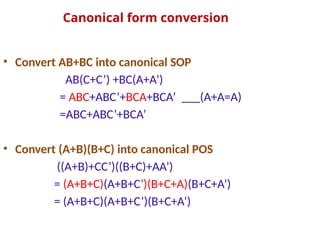
• Convert AB+BC into canonical SOP
AB(C+C’) +BC(A+A’)
= ABC+ABC’+BCA+BCA’ ___(A+A=A)
=ABC+ABC’+BCA’
• Convert (A+B)(B+C) into canonical POS
((A+B)+CC’)((B+C)+AA’)
= (A+B+C)(A+B+C’)(B+C+A)(B+C+A’)
= (A+B+C)(A+B+C’)(B+C+A’)
Canonical form conversion
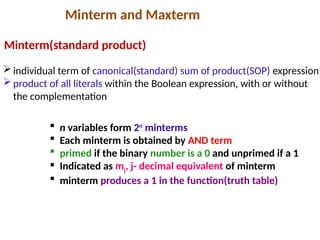
Minterm and Maxterm
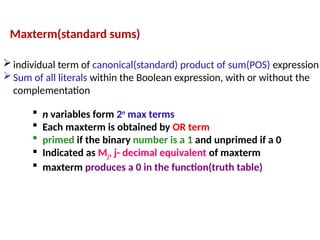
Minterm(standard product)
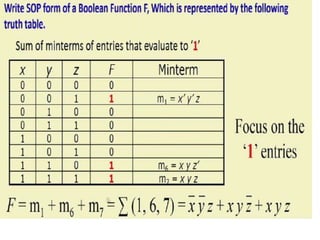
individual term of canonical(standard) sum of product(SOP) expression
product of all literals within the Boolean expression, with or without
the complementation
 n variables form 2n
minterms
 Each minterm is obtained by AND term
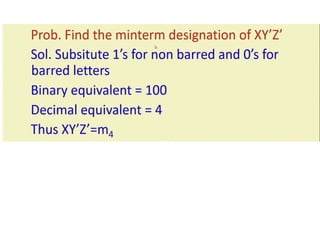
 primed if the binary number is a 0 and unprimed if a 1
 Indicated as mj, j- decimal equivalent of minterm
 minterm produces a 1 in the function(truth table)
 n variables form 2n
max terms
 Each maxterm is obtained by OR term
 primed if the binary number is a 1 and unprimed if a 0
 Indicated as Mj, j- decimal equivalent of maxterm
 maxterm produces a 0 in the function(truth table)
Maxterm(standard sums)
individual term of canonical(standard) product of sum(POS) expression
Sum of all literals within the Boolean expression, with or without the
complementation
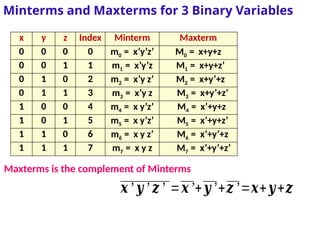
x y z Index Minterm Maxterm
0 0 0 0 m0 = x’y’z’ M0 = x+y+z
0 0 1 1 m1 = x’y’z M1 = x+y+z’
0 1 0 2 m2 = x’y z’ M2 = x+y’+z
0 1 1 3 m3 = x’y z M3 = x+y’+z’
1 0 0 4 m4 = x y’z’ M4 = x’+y+z
1 0 1 5 m5 = x y’z’ M5 = x’+y+z’
1 1 0 6 m6 = x y z’ M6 = x’+y’+z
1 1 1 7 m7 = x y z M7 = x’+y’+z’
Minterms and Maxterms for 3 Binary Variables
Maxterms is the complement of Minterms
𝒙’ 𝒚’ 𝒛’ =𝒙’+𝒚’+𝒛’=𝒙+𝒚+𝒛
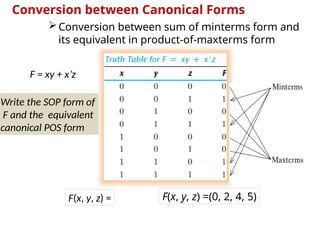
Conversion between Canonical Forms
Conversion between sum of minterms form and
its equivalent in product‐of‐maxterms form
F = xy + x’z
F(x, y, z) = F(x, y, z) =(0, 2, 4, 5)
Write the SOP form of
F and the equivalent
canonical POS form
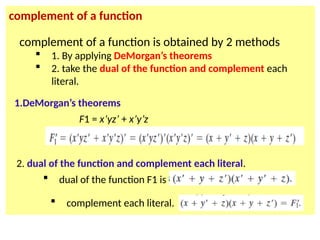
complement of a function
F1 = x’yz’ + x’y’z
complement of a function is obtained by 2 methods
 1. By applying DeMorgan’s theorems
 2. take the dual of the function and complement each
literal.
1.DeMorgan’s theorems
2. dual of the function and complement each literal.
 dual of the function F1 is
 complement each literal.
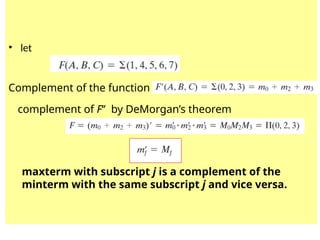
• let
Complement of the function is
complement of F‘’ by DeMorgan’s theorem
maxterm with subscript j is a complement of the
minterm with the same subscript j and vice versa.
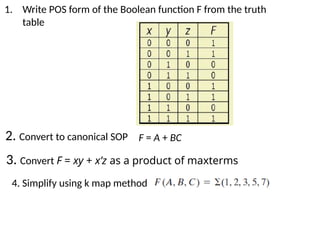
F = A + BC
1. Write POS form of the Boolean function F from the truth
table
2. Convert to canonical SOP
3. Convert F = xy + x’z as a product of maxterms
4. Simplify using k map method
Minimization of canonical expression
 Canonical SOP and POS are expansion of Boolean expression
 Canonical forms are not usually minimal
Minimization of Boolean expression
 reduce the number of gates and number of inputs to the
gate
 reduce the complexity and cost of a circuit
Methods to reduce the Boolean expression
• Algebraic method
• Karnaugh map or K-map
• Quine-McCluskey method
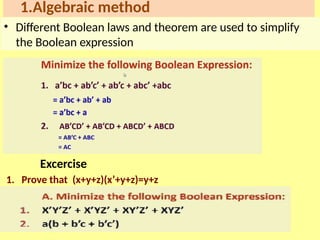
1.Algebraic method
• Different Boolean laws and theorem are used to simplify
the Boolean expression
Excercise
1. Prove that (x+y+z)(x’+y+z)=y+z
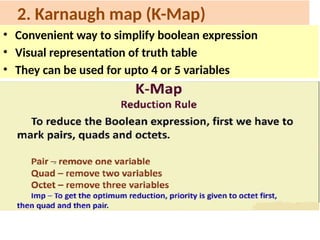
• Convenient way to simplify boolean expression
• Visual representation of truth table
• They can be used for upto 4 or 5 variables
2. Karnaugh map (K-Map)
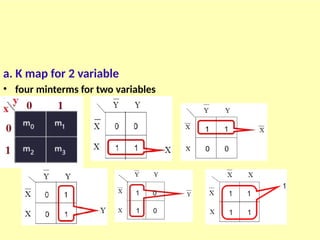
a. K map for 2 variable
• four minterms for two variables
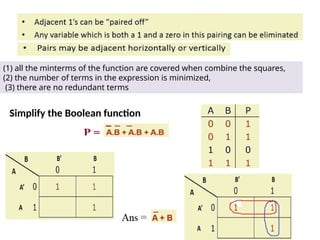
Simplify the Boolean function
(1) all the minterms of the function are covered when combine the squares,
(2) the number of terms in the expression is minimized,
(3) there are no redundant terms
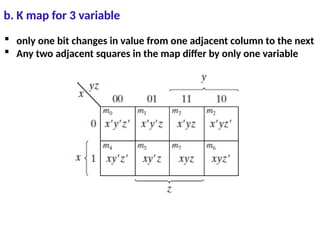
b. K map for 3 variable
 only one bit changes in value from one adjacent column to the next
 Any two adjacent squares in the map differ by only one variable
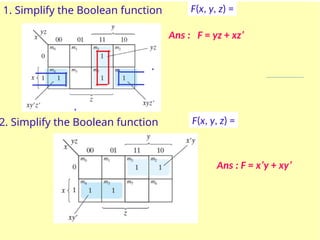
1. Simplify the Boolean function F(x, y, z) =
Ans : F = yz + xz’
2. Simplify the Boolean function F(x, y, z) =
Ans : F = x’y + xy’
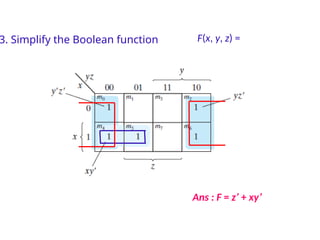
3. Simplify the Boolean function F(x, y, z) =
Ans : F = z’ + xy’
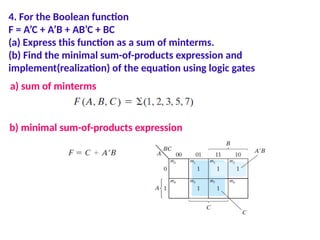
4. For the Boolean function
F = A’C + A’B + AB’C + BC
(a) Express this function as a sum of minterms.
(b) Find the minimal sum-of-products expression and
implement(realization) of the equation using logic gates
a) sum of minterms
b) minimal sum-of-products expression
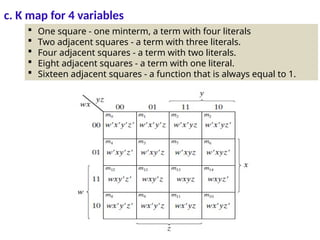
c. K map for 4 variables
 One square - one minterm, a term with four literals
 Two adjacent squares - a term with three literals.
 Four adjacent squares - a term with two literals.
 Eight adjacent squares - a term with one literal.
 Sixteen adjacent squares - a function that is always equal to 1.
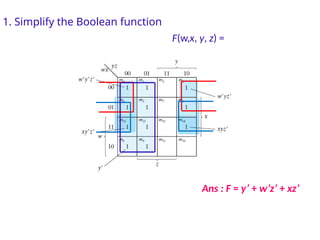
1. Simplify the Boolean function
F(w,x, y, z) =
Ans : F = y’ + w’z’ + xz’
F = ABC + BCD + ABCD + ABC
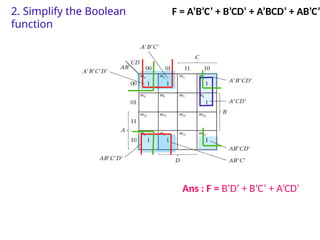
F = A’B’C’ + B’CD’ + A’BCD’ + AB’C’
2. Simplify the Boolean
function
Ans : F = B’D’ + B’C’ + A’CD’
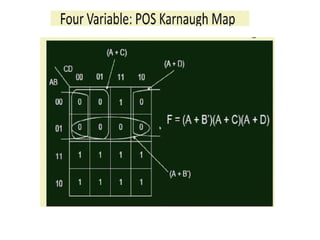
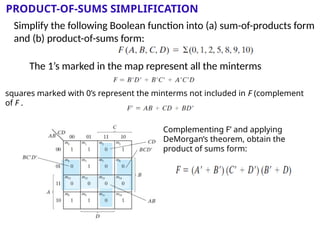
PRODUCT-OF-SUMS SIMPLIFICATION
Simplify the following Boolean function into (a) sum-of-products form
and (b) product-of-sums form:
The 1’s marked in the map represent all the minterms
squares marked with 0’s represent the minterms not included in F (complement
of F .
Complementing F’ and applying
DeMorgan’s theorem, obtain the
product of sums form:
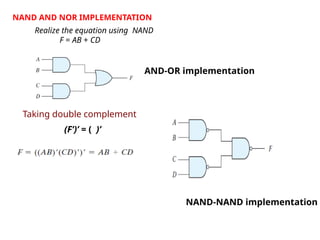
NAND AND NOR IMPLEMENTATION
Realize the equation using NAND
F = AB + CD
(F’)’ = ( )’
AND-OR implementation
Taking double complement
NAND-NAND implementation
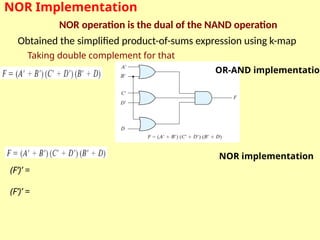
NOR Implementation
NOR operation is the dual of the NAND operation
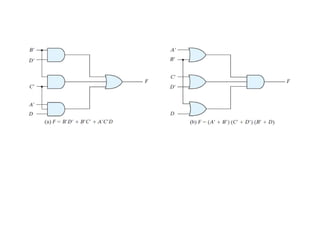
Obtained the simplified product-of-sums expression using k-map
Taking double complement for that
OR-AND implementation
(F’)’ =
(F’)’ =
NOR implementation
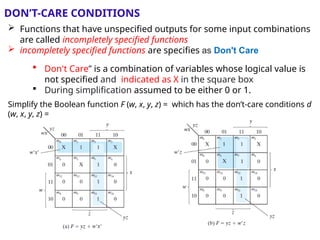
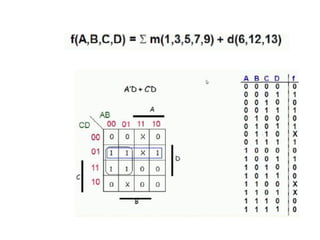
DON’T-CARE CONDITIONS
Simplify the Boolean function F (w, x, y, z) = which has the don’t-care conditions d
(w, x, y, z) =
 Don't Care” is a combination of variables whose logical value is
not specified and indicated as X in the square box
 During simplification assumed to be either 0 or 1.
 Functions that have unspecified outputs for some input combinations
are called incompletely specified functions
 incompletely specified functions are specifies as Don't Care
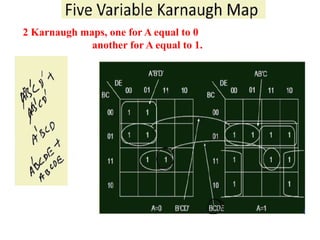
2 Karnaugh maps, one for A equal to 0
another for A equal to 1.
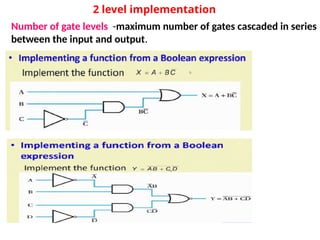
2 level implementation
Number of gate levels -maximum number of gates cascaded in series
between the input and output.
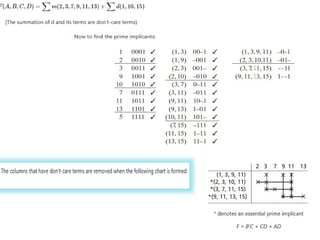
c. Quine-McCluskey method(tabular method)
 Based on the concept of prime implicants
 when a large number of inputs are present k map is tedious
Steps
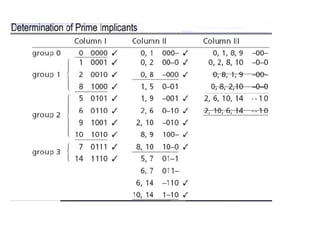
1. Find all prime implicants of the Boolean function
2. Construct prime implicant table
3. Select minimal set of prime implicant
1. Given boolean function is converted in to canonical
SOP(minterms)
2. Arrange binary form of each minterms in group of same
number of ‘1’s
3. Combine terms with Hamming distance 1 from adjacent
groups(tick the terms)
4. Keep doing until no combination possible between
adjacent groups
5. Unticked terms are prime implicant
1. Find prime implicants
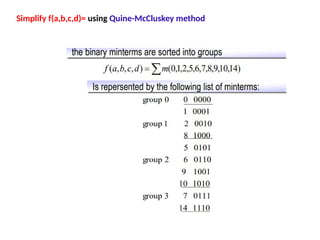
Simplify f(a,b,c,d)= using Quine-McCluskey method
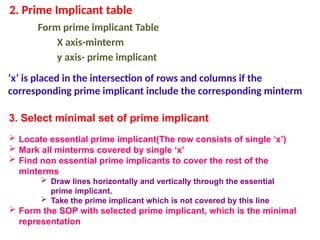
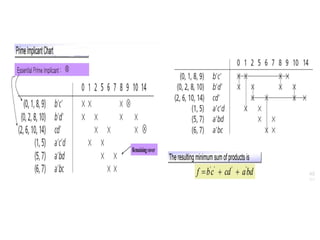
2. Prime Implicant table
Form prime implicant Table
X axis-minterm
y axis- prime implicant
‘x’ is placed in the intersection of rows and columns if the
corresponding prime implicant include the corresponding minterm
3. Select minimal set of prime implicant
 Locate essential prime implicant(The row consists of single ‘x’)
 Mark all minterms covered by single ‘x’
 Find non essential prime implicants to cover the rest of the
minterms
 Draw lines horizontally and vertically through the essential
prime implicant.
 Take the prime implicant which is not covered by this line
 Form the SOP with selected prime implicant, which is the minimal
representation
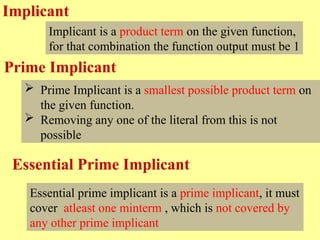
Implicant
Implicant is a product term on the given function,
for that combination the function output must be 1
 Prime Implicant is a smallest possible product term on
the given function.
 Removing any one of the literal from this is not
possible
Essential prime implicant is a prime implicant, it must
cover atleast one minterm , which is not covered by
any other prime implicant
Prime Implicant
Essential Prime Implicant
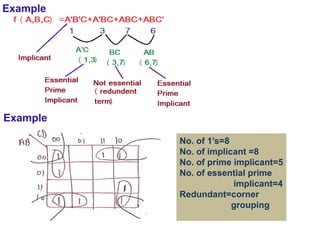
Example
Example
No. of 1’s=8
No. of implicant =8
No. of prime implicant=5
No. of essential prime
implicant=4
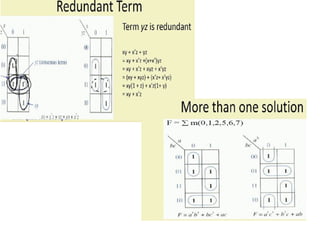
Redundant=corner
grouping
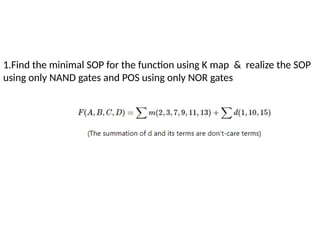
1.Find the minimal SOP for the function using K map & realize the SOP
using only NAND gates and POS using only NOR gates
EC8392 -DIGITAL ELECTRONICS -basics

EC8392 -DIGITAL ELECTRONICS -basics

  • 1.
    EC3352- DIGITAL SYSTEMSDESIGN Dr. C.Helen Sulochana Professor/ECE SXCCE
  • 2.
    UNIT I -BASIC CONCEPTS • Review of number systems-representation- conversions, Review of Boolean algebra- theorems, sum of product and product of sum simplification, canonical forms min term and max term, Simplification of Boolean expressions-Karnaugh map, completely and incompletely specified functions, Implementation of Boolean expressions using universal gates ,Tabulation methods.
  • 3.
    Digital Electronics • AnyQuantities can be measured, monitored, recorded, manipulated Their values are represented as 1. Analog(continuous) eg. voltage, current, power, energy, temp. variation 2. Digital(discrete- symbols called digits) eg. Digital clock • Analog to digital (A/D)convertor Analog Digital
  • 4.
    Communication Business transactions traffic control spacecraftguidance  medical treatment, weather monitoring, Internet Commercial industry- digital telephones, digital televisions, digital cameras, Applications  economical and easy to design.  very well suited for both numerical and non-numerical information processing.  high speed and high noise immunity  easy to duplicate similar circuits and complex digital ICs are manufactured Advantages
  • 5.
  • 6.
    • Number Systems •Boolean Algebra • Karnaugh map Minimization • Tabulation Method BASIC CONCEPTS(DIGITAL FUNDAMENTALS)
  • 7.
    Number Systems -mathematical notationfor representing numbers radix(r) or base -number of unique digits, including the digit zero, used to represent numbers. 1. Decimal number system (Base - 10) 2. Binary number system (Base - 2) 3. Octal number system (Base - 8) 4. Hexadecimal number system (Base – 16) Types of number systems
  • 9.
    System Base SymbolUsed by Human? Used in Computers? Decimal 10 0, 1, 2, . . .. .9 yes No Binary 2 0, 1 No Yes Octal 8 0, 1, . . . . .7 No No Hexadecimal 16 0, 1, . . .. . 9, A, B, . . . . . . F No No Common Number system 10 11 15
  • 10.
    1.Decimal number system Tendigits : 0, 1, 2, 3……9 -Base or radix is 10 -coefficients are multiplied by powers of 10 -every digit position has a weight which is a power of 10 Example 7392 =7x 10³ + 3x10² + 9x 101 + 2x 100 257.45 = 2x 10² + 5x101 + 7x 100 + 4x10⁻¹ + 5x 10⁻² (weight)
  • 11.
    2. Binary numbersystem Example (110)2 = 1x 22 + 1x21 + 0 x 20 (101.01)2 = 1x 22 + 0x21 + 1x 20 + 0 x 2-1 +1x 2-2 digital systems use just two discrete values Two digits 0 and 1 -every digit position has a weight which is a power of 2 -Base or radix is 2 A binary digit is called as a bit eight bits- one byte Number of bits Representaion 210 K (kilo) 220 G (giga) 230 T(tera) • Computers use binary numbers(it has many digits than decimal
  • 12.
    3. Octal numbersystem Eight digits : 0, 1, 2, 3……7 -every digit position has a weight which is a power of 8 -Base or radix is 8 Example (127.4)8 = 1x 82 + 2x81 + 7x 80 + 4x8-1 • Octal is the Shorthand for binary • Large base(not too many digit) • Easy to convert between octal and binary • Not an efficient representation of byte(7 is 111)
  • 13.
    4. Hexadecimal numbersystem Example (B65F)16 = 11 x 163 + 6x162 + 5x 161 + 15x160  Preferred Shorthand for binary  Efficiently represent the byte A compact way to represent binary numbers -Group of four binary digits are represented by a hexadecimal digit -Base or radix is 16 -Hexa decimal degits are 0 to 9, A to F
  • 14.
    to Number base Conversion Representationsof a number in a different radix • Decimal Binary conversion • Decimal •Binary Octal Hexadecimal Octal Hexadecimal
  • 15.
  • 16.
    1. Decimal Binary(base2) conversion Decimal to Binary Binary to Decimal  expanding the number in a power series of base r (2)  adding all the terms  dividing the number and all successive quotients by base r(2)  accumulating the remainders.
  • 17.
    Division Remainder (R) 112/ 2 = 56 0 56 / 2 = 28 0 28 / 2 = 14 0 14 / 2 = 7 0 7 / 2 = 3 1 3 / 2 = 1 1 1 / 2 = 0 1 Decimal to Binary Ans : (112)2 = (1110000)2 Convert decimal number 112 into binary number Decimal fractional number 0.8125 into binary  multiplying the number and all successive fraction by the base r(2) until the fraction becomes 0  integers are accumulated Decimal fraction to binary
  • 18.
    Binary to decimal Example3 converting the integer and the fraction separately and then combining the two answers Binary fraction to Decimal
  • 19.
    2. Decimal Octalconversion Decimal to octal Octal to Decimal
  • 20.
  • 21.
    3. Decimal Hexadecimalconversion Decimal to Hexadecimal Hexadecimal to Decimal
  • 23.
  • 24.
    partitioning the binaryinto groups of three digits from the binary point to the left and to the right.  The corresponding octal digit is then assigned to each group Each octal digit is converted to its three digit binary ‐ equivalent Binary to octal octal to binary 4. Binary octal conversion
  • 25.
    4. Binary Hexadecimalconversion Binary to Hexadecimal Hexadecimal to binary computer manuals use either octal or hexadecimal numbers to specify binary quantities Each octal digit is converted to its three‐ digit binary equivalent partitioning the binary into groups of four digits from the binary point to the left and to the right.  The corresponding Hexadecimal digit is then assigned to each group
  • 28.
    • Home work 1.Convert (33)10 to binary , octal, Hexadecimal 2. Convert (8.5125)10 to binary , octal, Hexadecimal 3. Convert 100101111 to octal, Hexadecimal 4. Convert F27 to octal, Hexadecimal 5. Perform 15-10 using 1’s and 2’s complement 6. Perform 5-9 using 1’s and 2’s complement 7. Add Class code 4g3e7nu
  • 29.
    Representation of numbers •Unsigned integers - n bit number has 2n distinct combinations For n=3 , 23 =8 combinations 000, 001, 010, 011, 100, 101, 110,111 • Signed integers -Positive or negative number Three possible methods of representation 1. Sign magnitude representation 2. 1’s compliment representation 3. 2’s compliment representation
  • 30.
    2. 1’s complimentrepresentation -Negative numbers are represented as 1’s complement form 1000 --- -7 1001 --- -6 1010 --- -5 1011 --- -4 1100 --- -3 1101 --- -2 1110 --- -1 1111 --- -0 Invert all bits. Each 1 becomes a 0 and 0 becomes 1 0000 --- +0 0001 --- +1 0010 --- +2 0011 --- +3 0100 --- +4 0101 --- +5 0110 --- +6 0111---- +7 Example, n=4 +4 = 0100 -4 = 1’s complement of 0100 = 1011 1000 --- -8 1001 --- -7 1010 --- -6 1011 --- -5 1100 --- -4 1101 --- -3 1110 --- -2 1111 --- -1 +4 = 0100 -4 = 2’s complement of 0100 = 1011+1 = 1100 0000 --- +0 0001 --- +1 0010 --- +2 0011 --- +3 0100 --- +4 0101 --- +5 0110 --- +6 0011---- +7 2’s compliment representation Computation of 2’s complement – Perform 1’s Complement - then add one to the resulting number.
  • 31.
    Subtraction via additionusing the 1’s complement
  • 32.
    Example 1: 6- 2 binary of 2 = 0010 1’s complement of 2 =1101 6 : 0110 -2 : 1101 1 0011 1 0100 = +4  Consider 4 bit representation  Carry is added back to the result  Result is positive Example 2 : 3 - 5 binary of 5 = 0101 1’s complement of 5 =1010 3 : 0011 -5 : 1010 1101 = -2  No Carry is added back to the result  Result is negative  Take 1’s complement Using 1’s complement 0010=-2
  • 33.
    Subtraction via additionusing the two’s complement
  • 34.
    Example 1 :6-2 Example 2: 3- 5 0001+1=0010=-2
  • 35.
    CODES 1. Weighted Codes: each binary digit is assigned a specific weight eg. BCD code (8421 code) and 1 2 4 8. 2. Non-Weighted Code - no positional weighting system eg. ex- Excess-3, Gray code, ASCII Code, EBCDIC Coding is the process of altering the characteristics of information to make it more suitable for intended applications.
  • 36.
    • Digital systemsuse two distinct values (two stable states-0 & 1) • Any discrete element is represented with unique binary code BINARY CODES Binary code -combinations of 0’s and 1’s(used in computer). n‐bit binary code(minimum) - group of n bits 2n distinct combination
  • 37.
    • Computer usebinary system, people use the decimal system. 1.Binary-Coded Decimal Code(8421 code) A binary code that distinguishes among 10 elements - contain at least four bits,(6 unassigned combinations) Binar y code Arithmeti c operation Decimal Decimal computer Decimal to BCD BCD to Decimal • BCD- replace a decimal digit(number) with an individual binary code of 4 bits
  • 38.
    BCD code hasweights of 8, 4, 2, and 1, correspond to each bit.  eg. (0110)BCD= 8 * 0 + 4 * 1 + 2 * 1 + 1 * 0 = 6. for one decimal digit- 4 bit code k decimal digit- 4k bit code • Decimal 396 is represented with 12 bits  Decimal number in BCD = its binary , if the number is between 0 and 9. binary combinations 1010 to 1111 are not used in BCD
  • 39.
    Decimal BCD decimal numbersand not binary numbers, written with the symbols 0, 1, 2, ……., 9 Represented with binary code 0000, 0001, 0010, …. 1001 decimal value is the same Used in seven segment display Disadvantage  needs more bits than its equivalent binary value Advantage use of decimal numbers(input and output data are generated as decimal )
  • 40.
    • BCD sumcannot be greater than 9 + 9 + 1 = 19(range from 0 to 19, In binary- 0000 to 10011, BCD- 0000 to 1 1001)  binary sum is to 1001 (without a carry), the BCD digit is correct.  when the binary sum is to 1010 or with a carry, the result is an invalid BCD digit.  Add 6 = (0110)2 to the binary sum converts to correct digit with required carry BCD Addition
  • 41.
    2. Excess‐3 code unweighted code  obtained by adding 3 to the binary value  self‐complementing codes (9’s complement of a decimal number is obtained by changing 1’s to 0’s and 0’s to 1’s)
  • 42.
     continuous quantitiesmust be converted into digital by analog‐to‐digital converter.  For digital representation Gray code is used  H Called as unit distance code 3. Gray Code Binary to Gray Gray to Binary Advantage  Only one bit changes from one number to other  Reduces the error during the transition
  • 43.
    Binary to Grayprocedure 1. MSB of binary = MSB of gray 2. To get the next bit of gray code, add MSB of binary with the next bit of binary 3. Repeat step 2 until last bit of binary Gray to Binary procedure 1. MSB of gray = MSB of binary 2. To get the next bit of binary code, add MSB of binary with the next bit of gray 3. Repeat step 2 until last bit of gray
  • 44.
    eg. a. AmericanStandard Code for Information Interchange (ASCII) b. Extended binary coded decimal interchange code (EBCDIC) 4. Alphanumeric codes  Binary code for alphanumeric characters
  • 45.
     seven bitcode - b1(LSB) to b7(MSB) a.American Standard Code for Information Interchange (ASC ASCII code contains  94 graphic characters(26 uppercase letters (A through Z), the 26 lowercase letters (a through z), the 10 numerals (0 through 9), and 32 special printable characters, such as %, *, and $).  control characters -control functions for printing and nonprinting Three types of control characters: 1. Format effectors -control the layout of printing-backspace (BS), horizontal tabulation (HT), and carriage return (CR). 2. Information separators - to separate the data into divisions such as paragraphs and pages-record separator (RS) and file separator (FS). 3. Communication‐control characters - useful during the transmission of text between remote device-STX (start of text) and ETX (end of text),
  • 46.
  • 48.
    • 8-bit binarycode for numeric and alphanumeric characters. • 128 characters in ASCII, 256 in EBCDIC • Binary form in ASCII, BCD form in EBCDIC b. Extended binary coded decimal interchange code (EBCDIC)
  • 49.
    Boolean algebra • Developedby George Boole • Algebra of binary logic or algebra of two values i.e True/False or Yes/ No Applications of Boolean Algebra • Used to perform logical operations in computer • In digital computer True represented by 1(high voltage) and False represented by 0(low voltage) • Logical operations are performed by logical operators • Fundamental logical operators 1. AND (conjuction) 2. OR (disjuction) 3. NOT(negation/complement)
  • 50.
    • similar tomultiplication 1. AND operator x and y - input variable(takes value 0 or 1) z - output variable z = x.y This is called Boolean expression or Boolean function- contains variables and constants(eg. A=B+1) Represented in a truth table Truth tables - Contains all possible combinations of variables present in the Boolean expression 2 variables– 22 =4 combinations n variables – 2n combinations
  • 51.
    • similar tomultiplication 1. AND operator x and y - input variable(takes value 0 or 1) z - output variable z = x.y This is called Boolean expression or Boolean function Truth tables - Contains all possible combinations of variables present in the Boolean expression 2 variables– 22 =4 combinations n variables – 2n combinations
  • 52.
    • similarities toAddition 2. OR operator x and y - input variable(takes value 0 or 1) z - output variable z = x+y binary logic binary arithmetic in binary arithmetic, 1 + 1 = 10(2) Binary logic, 1 + 1 = 1
  • 53.
    • Performs logicalNegation • Operates on single variable 3. NOT operator A - input variable(takes value 0 or 1) C - output variable (complement of A)
  • 54.
    • Evaluate thefollowing expression uing truth table x’y’+x
  • 55.
    Logic Gates • Booleanalgebra applied in computer’s electronic circuits • logic gates(logic circuits)- physical electronic circuit implementing a Boolean operation(logic operation) • Operates on one or more signals and produce single output either 1(high voltage) or 0(low voltage) Types of logic gates 1. AND gate 2. OR gate 3. NOT gate
  • 56.
    • Gives logic1(high) output ,only if all its input signals are high. • Takes 2 or more inputs and produce single output AND gate Truth table symbol
  • 57.
    • Gives logic1(high) output , if any one of its input signal is high. • Takes 2 or more inputs and produce single output OR gate Truth table symbol
  • 58.
    • Single inputgate • Output is complement of the input • also known as inverter NOT gate Truth table symbol
  • 62.
    universal gate • agate which can implement any Boolean function without need to use any other gate type  NAND gate  NOR gate NAND Gate: • represents the complement of the AND operation(AND NOT) truth table symbol
  • 63.
    NAND gate isa universal gate since it can implement the AND, OR and NOT functions. (Demargon’s theorm) (Demargon’s theorm)
  • 64.
    NOR can implementthe AND, OR and NOT functions. NOR Gate: NOT -OR • complement of the OR operation(OR NOT) (Demargon’s theorm)
  • 65.
  • 66.
    BASIC THEOREMS ANDPROPERTIES OF BOOLEAN ALGEBRA Boolean algebra deals with binary states 0 and 1 A.Duality principle  duality of an algebraic expression is obtained by interchanging the AND and OR operators and replacing 1’s by 0’s and 0’s by 1’s eg. A +1=1, then its dual is A.0=0 1. Properties of 0’s 0+A =A 0.A= 0 2. Properties of 1’s 1+A=1 1.A=A 3. Commutative property A+B=B+A A.B=B.A 4. Associative property (A+B)+C=A+(B+C) (AB)C =A(BC)
  • 67.
    5. Distributive property A(B+C)=AB+AC A+(BC)=(A+B)(A+C) 6.Idempotent(Identity) law A+A=A A.A=A 7. Absorption(Redundance) Law A+AB=A A(A+B)=A 8. Complementary law X+X’=1 X.X’=0 9. Involution X’’ = X 10. DeMorgan Theorm (X+Y)’ = X’. Y’ (X.Y)’= X’+Y’
  • 68.
    1. Prove that. Find its duality Statement Justification Its duality is proof
  • 69.
    2. Prove that. Also prove its duality Its duality is Operator precedence for evaluating Boolean expressions is (1) parentheses,(2) NOT, (3) AND, and (4) OR. xx+xx’+xx+xx’
  • 70.
    3. Prove theDemargon’s Theorm using truth table DeMorgan Theorm
  • 71.
    x,y,z- input variables numberof variables =3 number of rows in the truth table is 23 = 8 Realization of Boolean expression(function) • Boolean expression consists of binary variables, constants(0,1) • Implemented using logic gates F1 = x + y’z F2=
  • 72.
    Representation of Booleanexpression Boolean expression can be represented as 1. Sum of product(SOP) form - sum of product means it is a summation of product terms 2. Product of sum (POS) form - multiplication of product terms eg. AB+BC SOP (A+B)(B+C) POS The above examples are in SOP and POS , but not in standard SOP and POS
  • 73.
    Canonical form ofBoolean expression (standard form) • In standard SOP or POS each term of Boolean expression must contain all the literals(with and without complement. • Then the expression is called as canonical form of expression • Boolean functions expressed as a sum of minterms or product of maxterms are said to be in canonical form AB +BC –not a canonical SOP form C is missing A is missing
  • 74.
    • Convert AB+BCinto canonical SOP AB(C+C’) +BC(A+A’) = ABC+ABC’+BCA+BCA’ ___(A+A=A) =ABC+ABC’+BCA’ • Convert (A+B)(B+C) into canonical POS ((A+B)+CC’)((B+C)+AA’) = (A+B+C)(A+B+C’)(B+C+A)(B+C+A’) = (A+B+C)(A+B+C’)(B+C+A’) Canonical form conversion
  • 75.
    Minterm and Maxterm Minterm(standardproduct) individual term of canonical(standard) sum of product(SOP) expression product of all literals within the Boolean expression, with or without the complementation  n variables form 2n minterms  Each minterm is obtained by AND term  primed if the binary number is a 0 and unprimed if a 1  Indicated as mj, j- decimal equivalent of minterm  minterm produces a 1 in the function(truth table)
  • 76.
     n variablesform 2n max terms  Each maxterm is obtained by OR term  primed if the binary number is a 1 and unprimed if a 0  Indicated as Mj, j- decimal equivalent of maxterm  maxterm produces a 0 in the function(truth table) Maxterm(standard sums) individual term of canonical(standard) product of sum(POS) expression Sum of all literals within the Boolean expression, with or without the complementation
  • 77.
    x y zIndex Minterm Maxterm 0 0 0 0 m0 = x’y’z’ M0 = x+y+z 0 0 1 1 m1 = x’y’z M1 = x+y+z’ 0 1 0 2 m2 = x’y z’ M2 = x+y’+z 0 1 1 3 m3 = x’y z M3 = x+y’+z’ 1 0 0 4 m4 = x y’z’ M4 = x’+y+z 1 0 1 5 m5 = x y’z’ M5 = x’+y+z’ 1 1 0 6 m6 = x y z’ M6 = x’+y’+z 1 1 1 7 m7 = x y z M7 = x’+y’+z’ Minterms and Maxterms for 3 Binary Variables Maxterms is the complement of Minterms 𝒙’ 𝒚’ 𝒛’ =𝒙’+𝒚’+𝒛’=𝒙+𝒚+𝒛
  • 80.
    Conversion between CanonicalForms Conversion between sum of minterms form and its equivalent in product‐of‐maxterms form F = xy + x’z F(x, y, z) = F(x, y, z) =(0, 2, 4, 5) Write the SOP form of F and the equivalent canonical POS form
  • 81.
    complement of afunction F1 = x’yz’ + x’y’z complement of a function is obtained by 2 methods  1. By applying DeMorgan’s theorems  2. take the dual of the function and complement each literal. 1.DeMorgan’s theorems 2. dual of the function and complement each literal.  dual of the function F1 is  complement each literal.
  • 82.
    • let Complement ofthe function is complement of F‘’ by DeMorgan’s theorem maxterm with subscript j is a complement of the minterm with the same subscript j and vice versa.
  • 83.
    F = A+ BC 1. Write POS form of the Boolean function F from the truth table 2. Convert to canonical SOP 3. Convert F = xy + x’z as a product of maxterms 4. Simplify using k map method
  • 84.
    Minimization of canonicalexpression  Canonical SOP and POS are expansion of Boolean expression  Canonical forms are not usually minimal Minimization of Boolean expression  reduce the number of gates and number of inputs to the gate  reduce the complexity and cost of a circuit Methods to reduce the Boolean expression • Algebraic method • Karnaugh map or K-map • Quine-McCluskey method
  • 85.
    1.Algebraic method • DifferentBoolean laws and theorem are used to simplify the Boolean expression Excercise 1. Prove that (x+y+z)(x’+y+z)=y+z
  • 86.
    • Convenient wayto simplify boolean expression • Visual representation of truth table • They can be used for upto 4 or 5 variables 2. Karnaugh map (K-Map)
  • 87.
    a. K mapfor 2 variable • four minterms for two variables
  • 88.
    Simplify the Booleanfunction (1) all the minterms of the function are covered when combine the squares, (2) the number of terms in the expression is minimized, (3) there are no redundant terms
  • 89.
    b. K mapfor 3 variable  only one bit changes in value from one adjacent column to the next  Any two adjacent squares in the map differ by only one variable
  • 90.
    1. Simplify theBoolean function F(x, y, z) = Ans : F = yz + xz’ 2. Simplify the Boolean function F(x, y, z) = Ans : F = x’y + xy’
  • 91.
    3. Simplify theBoolean function F(x, y, z) = Ans : F = z’ + xy’
  • 92.
    4. For theBoolean function F = A’C + A’B + AB’C + BC (a) Express this function as a sum of minterms. (b) Find the minimal sum-of-products expression and implement(realization) of the equation using logic gates a) sum of minterms b) minimal sum-of-products expression
  • 93.
    c. K mapfor 4 variables  One square - one minterm, a term with four literals  Two adjacent squares - a term with three literals.  Four adjacent squares - a term with two literals.  Eight adjacent squares - a term with one literal.  Sixteen adjacent squares - a function that is always equal to 1.
  • 94.
    1. Simplify theBoolean function F(w,x, y, z) = Ans : F = y’ + w’z’ + xz’
  • 95.
    F = ABC+ BCD + ABCD + ABC F = A’B’C’ + B’CD’ + A’BCD’ + AB’C’ 2. Simplify the Boolean function Ans : F = B’D’ + B’C’ + A’CD’
  • 96.
    PRODUCT-OF-SUMS SIMPLIFICATION Simplify thefollowing Boolean function into (a) sum-of-products form and (b) product-of-sums form: The 1’s marked in the map represent all the minterms squares marked with 0’s represent the minterms not included in F (complement of F . Complementing F’ and applying DeMorgan’s theorem, obtain the product of sums form:
  • 98.
    NAND AND NORIMPLEMENTATION Realize the equation using NAND F = AB + CD (F’)’ = ( )’ AND-OR implementation Taking double complement NAND-NAND implementation
  • 99.
    NOR Implementation NOR operationis the dual of the NAND operation Obtained the simplified product-of-sums expression using k-map Taking double complement for that OR-AND implementation (F’)’ = (F’)’ = NOR implementation
  • 101.
    DON’T-CARE CONDITIONS Simplify theBoolean function F (w, x, y, z) = which has the don’t-care conditions d (w, x, y, z) =  Don't Care” is a combination of variables whose logical value is not specified and indicated as X in the square box  During simplification assumed to be either 0 or 1.  Functions that have unspecified outputs for some input combinations are called incompletely specified functions  incompletely specified functions are specifies as Don't Care
  • 103.
    2 Karnaugh maps,one for A equal to 0 another for A equal to 1.
  • 107.
    2 level implementation Numberof gate levels -maximum number of gates cascaded in series between the input and output.
  • 109.
    c. Quine-McCluskey method(tabularmethod)  Based on the concept of prime implicants  when a large number of inputs are present k map is tedious Steps 1. Find all prime implicants of the Boolean function 2. Construct prime implicant table 3. Select minimal set of prime implicant
  • 110.
    1. Given booleanfunction is converted in to canonical SOP(minterms) 2. Arrange binary form of each minterms in group of same number of ‘1’s 3. Combine terms with Hamming distance 1 from adjacent groups(tick the terms) 4. Keep doing until no combination possible between adjacent groups 5. Unticked terms are prime implicant 1. Find prime implicants
  • 111.
    Simplify f(a,b,c,d)= usingQuine-McCluskey method
  • 113.
    2. Prime Implicanttable Form prime implicant Table X axis-minterm y axis- prime implicant ‘x’ is placed in the intersection of rows and columns if the corresponding prime implicant include the corresponding minterm 3. Select minimal set of prime implicant  Locate essential prime implicant(The row consists of single ‘x’)  Mark all minterms covered by single ‘x’  Find non essential prime implicants to cover the rest of the minterms  Draw lines horizontally and vertically through the essential prime implicant.  Take the prime implicant which is not covered by this line  Form the SOP with selected prime implicant, which is the minimal representation
  • 116.
    Implicant Implicant is aproduct term on the given function, for that combination the function output must be 1  Prime Implicant is a smallest possible product term on the given function.  Removing any one of the literal from this is not possible Essential prime implicant is a prime implicant, it must cover atleast one minterm , which is not covered by any other prime implicant Prime Implicant Essential Prime Implicant
  • 117.
    Example Example No. of 1’s=8 No.of implicant =8 No. of prime implicant=5 No. of essential prime implicant=4 Redundant=corner grouping
  • 118.
    1.Find the minimalSOP for the function using K map & realize the SOP using only NAND gates and POS using only NOR gates