NUMBER SYSTEM
• CONVENTIONAL NUMBER SYSTEM
• REDUNDANT NUMBER SYSTEM
• RESIDUE NUMBER SYSTEM
CONVENTIONAL NUMBER SYSTEM
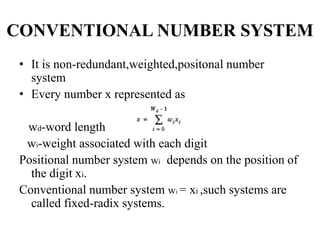
• It is non-redundant,weighted,positonal number
system
• Every number x represented as
wd-word length
wi-weight associated with each digit
Positional number system wi depends on the position of
the digit xi.
Conventional number system wi = xi ,such systems are
called fixed-radix systems.
Number
Integer Fractional part.
• A fixed –point number is written from L to R with
MSB at L and LSB at R.
• 2 distinct forms of
fixed-point arithmetic
Integer arithmetic
( RH imprtant) (RH kept RH
arithmetic dropped)

Fractional fixed point
(LH imprtnt)
(LH kept RH dropped)
• Fractional fixed point arithmetic- signed mantissa and
exponent.
• Advantage-suppress parasitic oscillation , less chip
area & faster.
Fixed point represented by:
•
•
•
•
•

SIGNED –MAGNITUDE REPRESENTATION
COMPLENENT REPRESENTATION
ONE’S COMPLENENT REPRESENTATION
TWO’S COMPLENENT REPRESENTATION
BINARY OFFSET REPRENSATION
SIGNED-MAGNITUDE REPRESENTATION
• Magnitude & sign represented separately
• 1st digit-sign,remaining digit-Magnitude
• Representation:

• Zero +0 or -0 , not in the case of 1.
• Adv : Mul , div easy
• Disadv : add,sub – sign-operands
COMPLENENT REPRESENTATION
• Pos no. – 1’s ,2’s,binary offset = signed mag rep
• Neg no. -x=R-x
• For y>x
x+(R-y)=R-(y-x)
• For x>y
R-(y-x)=R-(x-y)
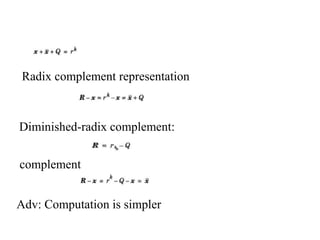
Radix complement representation

Diminished-radix complement:
complement
Adv: Computation is simpler
ONE’S COMPLENENTREPRESENTATION
• Dimnished rep: R=

; r=2 & k=0

• ReP:

• X>0 1’s complement=binary word
• X<0 bit values complement of positive value.
• Arithmetic operations -complicated
TWO’S COMPLENENT REPRESENTATION
•
•
•
•
•

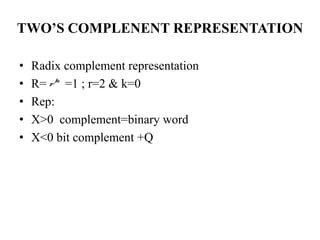
Radix complement representation
R= =1 ; r=2 & k=0
Rep:
X>0 complement=binary word
X<0 bit complement +Q
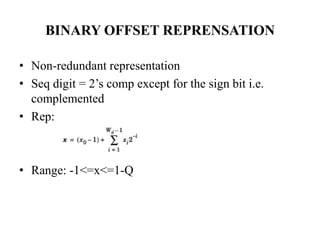
BINARY OFFSET REPRENSATION
• Non-redundant representation
• Seq digit = 2’s comp except for the sign bit i.e.
complemented
• Rep:

• Range: -1<=x<=1-Q
REDUNDANT NUMBER SYSTEM
• Time consuming , add , sub-without long carry paths.
• Simplify-speed-suitable application-specific
arithmetic units
• 3 such representation are:
• SIGNED-DIGIT CODE
• CANONIC SIGNED DIGIT CODE
• ON-LINE ARITMETIC
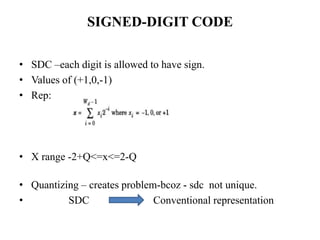
SIGNED-DIGIT CODE
• SDC –each digit is allowed to have sign.
• Values of (+1,0,-1)
• Rep:

• X range -2+Q<=x<=2-Q
• Quantizing – creates problem-bcoz - sdc not unique.
•
SDC
Conventional representation
CANONIC SIGNED DIGIT CODE
• CSDC –Unique representation
• Rep:

• X range (-4/3)+Q<=x<=(4/3)-Q
• Average no. of non-zero digit
Wd/3 + (1+2-wd)/9
ON-LINE ARITMETIC
•
•
•
•
•

Compute ith digit.
Uses only ( i + small positive constant)
Favorable - Recursive algorithm
Mul , div -SDC
SDC
2’s complement allows online operation.
RESIDUE NUMBER SYSTEM
• RNS-avoids carry propagation
• Rep by a set of residues after an integer division by
mutal prime factor(moduli)
• Relation (m1, m2…mp (moduli) and x ): x=qi mi+ri
• qi, mi,ri are integers x=(r1,r2…rn)
• The Chinese remainder theorem:
A=(a1,a2....ap) & B=(b1,b2…bp)
then,
A B=[(a1 b1)m1,(a2 b2)m2….(ap
bp)mp]
• ARITHMETIC OPERATIONS USING RNS:
• Addition and subtraction

• Multiplication

• Division
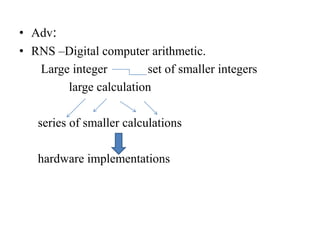
• Adv:
• RNS –Digital computer arithmetic.
Large integer
set of smaller integers
large calculation
series of smaller calculations
hardware implementations
• Diadv:
• Restricted to fixed pioint arithmetic
• Comparision of overflow,quantization operation is
difficult in order to round off
RNS
normal no. Rep.
• Not suitable – Recursieve loops.

Number system

  • 1.
    NUMBER SYSTEM • CONVENTIONALNUMBER SYSTEM • REDUNDANT NUMBER SYSTEM • RESIDUE NUMBER SYSTEM
  • 2.
    CONVENTIONAL NUMBER SYSTEM •It is non-redundant,weighted,positonal number system • Every number x represented as wd-word length wi-weight associated with each digit Positional number system wi depends on the position of the digit xi. Conventional number system wi = xi ,such systems are called fixed-radix systems.
  • 3.
    Number Integer Fractional part. •A fixed –point number is written from L to R with MSB at L and LSB at R. • 2 distinct forms of fixed-point arithmetic Integer arithmetic ( RH imprtant) (RH kept RH arithmetic dropped) Fractional fixed point (LH imprtnt) (LH kept RH dropped)
  • 4.
    • Fractional fixedpoint arithmetic- signed mantissa and exponent. • Advantage-suppress parasitic oscillation , less chip area & faster. Fixed point represented by: • • • • • SIGNED –MAGNITUDE REPRESENTATION COMPLENENT REPRESENTATION ONE’S COMPLENENT REPRESENTATION TWO’S COMPLENENT REPRESENTATION BINARY OFFSET REPRENSATION
  • 5.
    SIGNED-MAGNITUDE REPRESENTATION • Magnitude& sign represented separately • 1st digit-sign,remaining digit-Magnitude • Representation: • Zero +0 or -0 , not in the case of 1. • Adv : Mul , div easy • Disadv : add,sub – sign-operands
  • 6.
    COMPLENENT REPRESENTATION • Posno. – 1’s ,2’s,binary offset = signed mag rep • Neg no. -x=R-x • For y>x x+(R-y)=R-(y-x) • For x>y R-(y-x)=R-(x-y)
  • 7.
    Radix complement representation Diminished-radixcomplement: complement Adv: Computation is simpler
  • 8.
    ONE’S COMPLENENTREPRESENTATION • Dimnishedrep: R= ; r=2 & k=0 • ReP: • X>0 1’s complement=binary word • X<0 bit values complement of positive value. • Arithmetic operations -complicated
  • 9.
    TWO’S COMPLENENT REPRESENTATION • • • • • Radixcomplement representation R= =1 ; r=2 & k=0 Rep: X>0 complement=binary word X<0 bit complement +Q
  • 10.
    BINARY OFFSET REPRENSATION •Non-redundant representation • Seq digit = 2’s comp except for the sign bit i.e. complemented • Rep: • Range: -1<=x<=1-Q
  • 11.
    REDUNDANT NUMBER SYSTEM •Time consuming , add , sub-without long carry paths. • Simplify-speed-suitable application-specific arithmetic units • 3 such representation are: • SIGNED-DIGIT CODE • CANONIC SIGNED DIGIT CODE • ON-LINE ARITMETIC
  • 12.
    SIGNED-DIGIT CODE • SDC–each digit is allowed to have sign. • Values of (+1,0,-1) • Rep: • X range -2+Q<=x<=2-Q • Quantizing – creates problem-bcoz - sdc not unique. • SDC Conventional representation
  • 13.
    CANONIC SIGNED DIGITCODE • CSDC –Unique representation • Rep: • X range (-4/3)+Q<=x<=(4/3)-Q • Average no. of non-zero digit Wd/3 + (1+2-wd)/9
  • 14.
    ON-LINE ARITMETIC • • • • • Compute ithdigit. Uses only ( i + small positive constant) Favorable - Recursive algorithm Mul , div -SDC SDC 2’s complement allows online operation.
  • 15.
    RESIDUE NUMBER SYSTEM •RNS-avoids carry propagation • Rep by a set of residues after an integer division by mutal prime factor(moduli) • Relation (m1, m2…mp (moduli) and x ): x=qi mi+ri • qi, mi,ri are integers x=(r1,r2…rn) • The Chinese remainder theorem: A=(a1,a2....ap) & B=(b1,b2…bp) then, A B=[(a1 b1)m1,(a2 b2)m2….(ap bp)mp]
  • 16.
    • ARITHMETIC OPERATIONSUSING RNS: • Addition and subtraction • Multiplication • Division
  • 17.
    • Adv: • RNS–Digital computer arithmetic. Large integer set of smaller integers large calculation series of smaller calculations hardware implementations
  • 18.
    • Diadv: • Restrictedto fixed pioint arithmetic • Comparision of overflow,quantization operation is difficult in order to round off RNS normal no. Rep. • Not suitable – Recursieve loops.