Contents
•SN2 & SN1 Reactions.
Definition
Mechanism
Kinetics
Stereochemistry
Reactivity
• Comparison head.
• References.
Definition
SN2
• It is a bimolecular nucleophilic substitution
reaction between alkyl halide and strong
nucleophile wherein nucleophile displaces
halide group and forms the product.
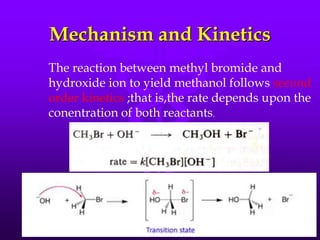
Mechanism and Kinetics
The reaction between methyl bromide and
hydroxide ion to yield methanol follows second
order kinetics ;that is,the rate depends upon the
conentration of both reactants.
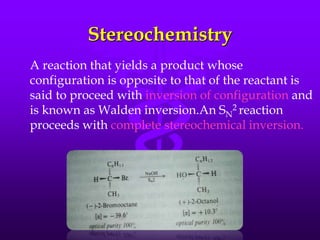
Stereochemistry
A reaction that yields a product whose
configuration is opposite to that of the reactant is
said to proceed with inversion of configuration and
is known as Walden inversion.An SN
2 reaction
proceeds with complete stereochemical inversion.
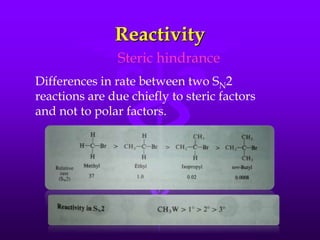
Reactivity
Steric hindrance
Differences in rate between two SN2
reactions are due chiefly to steric factors
and not to polar factors.
Definition
SN1
• It is a unimolecular nucleophilic
substitution reaction between alkyl
halide and Weak nucleophile wherein
nucleophile displaces halide group and
forms the product.
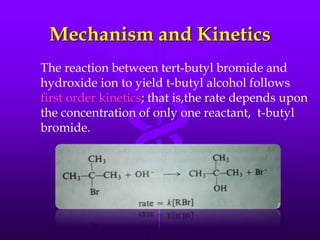
Mechanism and Kinetics
The reaction between tert-butyl bromide and
hydroxide ion to yield t-butyl alcohol follows
first order kinetics; that is,the rate depends upon
the concentration of only one reactant, t-butyl
bromide.
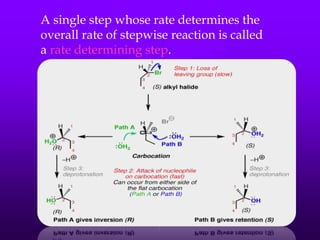
A single step whose rate determines the
overall rate of stepwise reaction is called
a rate determining step.
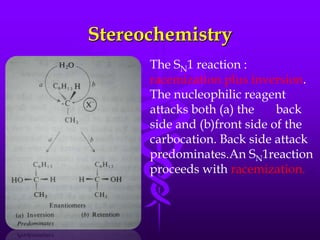
Stereochemistry
The SN1 reaction :
racemization plus inversion.
The nucleophilic reagent
attacks both (a) the back
side and (b)front side of the
carbocation. Back side attack
predominates.An SN1reaction
proceeds with racemization.
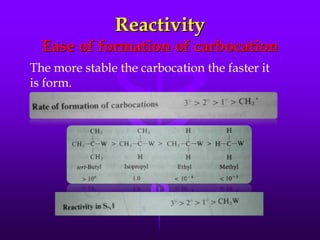
Reactivity
Ease of formation of carbocation
The more stable the carbocation the faster it
is form.
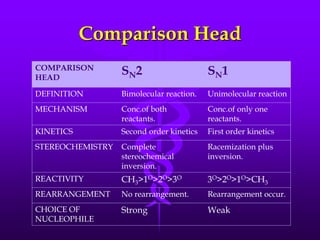
Comparison Head
COMPARISON
HEAD
SN2 SN1
DEFINITION Bimolecular reaction. Unimolecular reaction
MECHANISM Conc.of both
reactants.
Conc.of only one
reactants.
KINETICS Second order kinetics First order kinetics
STEREOCHEMISTRY Complete
stereochemical
inversion.
Racemization plus
inversion.
REACTIVITY CH3>1O>2O>3O 3O>2O>1O>CH3
REARRANGEMENT No rearrangement. Rearrangement occur.
CHOICE OF
NUCLEOPHILE
Strong Weak
References
• Morrison and Boyd,Textbook of organic
chemistry,Sixth edition, Pearson
education 2004.
• Master Organic Chemistry Llc, 1831 12th
Avenue South, #171, Nashville Tn, USA
37203.
Nucleophilic substitution reaction

Nucleophilic substitution reaction

  • 2.
    Contents •SN2 & SN1Reactions. Definition Mechanism Kinetics Stereochemistry Reactivity • Comparison head. • References.
  • 3.
    Definition SN2 • It isa bimolecular nucleophilic substitution reaction between alkyl halide and strong nucleophile wherein nucleophile displaces halide group and forms the product.
  • 4.
    Mechanism and Kinetics Thereaction between methyl bromide and hydroxide ion to yield methanol follows second order kinetics ;that is,the rate depends upon the conentration of both reactants.
  • 5.
    Stereochemistry A reaction thatyields a product whose configuration is opposite to that of the reactant is said to proceed with inversion of configuration and is known as Walden inversion.An SN 2 reaction proceeds with complete stereochemical inversion.
  • 6.
    Reactivity Steric hindrance Differences inrate between two SN2 reactions are due chiefly to steric factors and not to polar factors.
  • 7.
    Definition SN1 • It isa unimolecular nucleophilic substitution reaction between alkyl halide and Weak nucleophile wherein nucleophile displaces halide group and forms the product.
  • 8.
    Mechanism and Kinetics Thereaction between tert-butyl bromide and hydroxide ion to yield t-butyl alcohol follows first order kinetics; that is,the rate depends upon the concentration of only one reactant, t-butyl bromide.
  • 9.
    A single stepwhose rate determines the overall rate of stepwise reaction is called a rate determining step.
  • 10.
    Stereochemistry The SN1 reaction: racemization plus inversion. The nucleophilic reagent attacks both (a) the back side and (b)front side of the carbocation. Back side attack predominates.An SN1reaction proceeds with racemization.
  • 11.
    Reactivity Ease of formationof carbocation The more stable the carbocation the faster it is form.
  • 12.
    Comparison Head COMPARISON HEAD SN2 SN1 DEFINITIONBimolecular reaction. Unimolecular reaction MECHANISM Conc.of both reactants. Conc.of only one reactants. KINETICS Second order kinetics First order kinetics STEREOCHEMISTRY Complete stereochemical inversion. Racemization plus inversion. REACTIVITY CH3>1O>2O>3O 3O>2O>1O>CH3 REARRANGEMENT No rearrangement. Rearrangement occur. CHOICE OF NUCLEOPHILE Strong Weak
  • 13.
    References • Morrison andBoyd,Textbook of organic chemistry,Sixth edition, Pearson education 2004. • Master Organic Chemistry Llc, 1831 12th Avenue South, #171, Nashville Tn, USA 37203.