Nucleophilic substitution reactions at
saturated carbon atom
Dr. Sakshi Kabra Malpani
7/17/2021 1
Nucleophilic Substitution
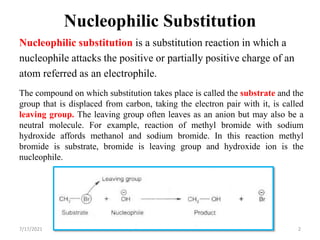
Nucleophilic substitution is a substitution reaction in which a
nucleophile attacks the positive or partially positive charge of an
atom referred as an electrophile.
The compound on which substitution takes place is called the substrate and the
group that is displaced from carbon, taking the electron pair with it, is called
leaving group. The leaving group often leaves as an anion but may also be a
neutral molecule. For example, reaction of methyl bromide with sodium
hydroxide affords methanol and sodium bromide. In this reaction methyl
bromide is substrate, bromide is leaving group and hydroxide ion is the
nucleophile.
7/17/2021 2
Combinations for Nucleophilic
Substitution Reactions
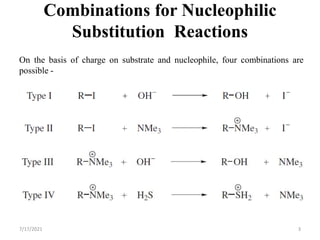
On the basis of charge on substrate and nucleophile, four combinations are
possible -
7/17/2021 3
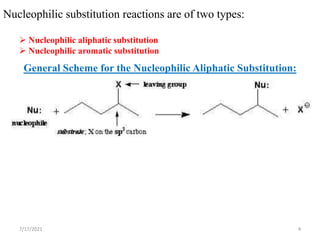
Nucleophilic substitution reactions are of two types:
 Nucleophilic aliphatic substitution
 Nucleophilic aromatic substitution
General Scheme for the Nucleophilic Aliphatic Substitution:
7/17/2021 4
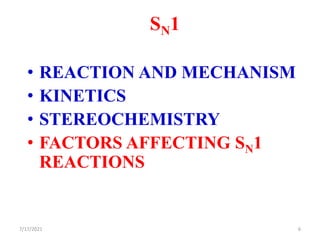
Types of Nucleophilic Substitution
SN1 SN2
S: Substitution
N: Nucleophilic
1: Unimolecular
S: Substitution
N: Nucleophilic
2: Bimolecular
Y C X C Y X
+
+ C+
leaving group goes first and nucleophile comes later
Y C X C Y X
+
+
nucleophile attacks and leaving group goes simultaneously
7/17/2021 5
SN1
• REACTION AND MECHANISM
• KINETICS
• STEREOCHEMISTRY
• FACTORS AFFECTING SN1
REACTIONS
7/17/2021 6
SN1: Reaction and mechanism
7/17/2021 7
8
SN1 (Substitution Nucleophilic
Unimolecular)
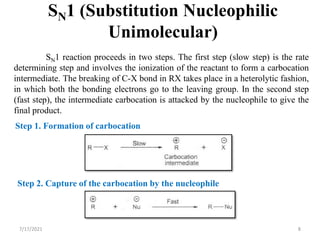
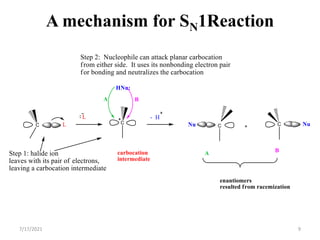
SN1 reaction proceeds in two steps. The first step (slow step) is the rate
determining step and involves the ionization of the reactant to form a carbocation
intermediate. The breaking of C-X bond in RX takes place in a heterolytic fashion,
in which both the bonding electrons go to the leaving group. In the second step
(fast step), the intermediate carbocation is attacked by the nucleophile to give the
final product.
Step 1. Formation of carbocation
Step 2. Capture of the carbocation by the nucleophile
7/17/2021
A mechanism for SN1Reaction
7/17/2021 9
10
SN1 Energy Diagram
• Rate-determining step is formation of carbocation
• rate = k[RX] or substrate
7/17/2021
7/17/2021 11
SN1 reaction : Kinetics
7/17/2021 12
Kinetics of a Nucleophilic
substitution: an SN1 reaction
• 2 step reaction
• The reactions follows first order(unimolecular)
kinetics
• Rate of reaction depends the slowest step
– Hetero-cleavage of halide
• Rate of reaction = k [alkyl halide/substrate]
7/17/2021 13
SN1 reaction : Stereochemistry
7/17/2021 14
15
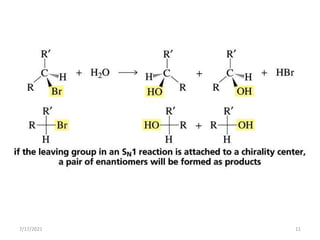
Stereochemistry of SN1 Reaction
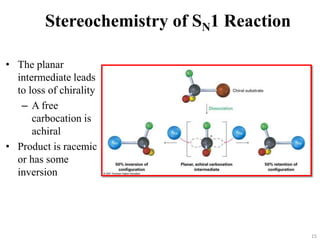
• The planar
intermediate leads
to loss of chirality
– A free
carbocation is
achiral
• Product is racemic
or has some
inversion
16
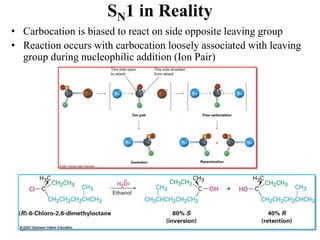
SN1 in Reality
• Carbocation is biased to react on side opposite leaving group
• Reaction occurs with carbocation loosely associated with leaving
group during nucleophilic addition (Ion Pair)
7/17/2021
Effects of Ion Pair Formation
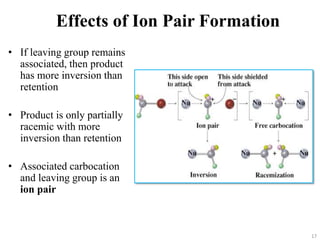
• If leaving group remains
associated, then product
has more inversion than
retention
• Product is only partially
racemic with more
inversion than retention
• Associated carbocation
and leaving group is an
ion pair
17
Generalization
7/17/2021 18
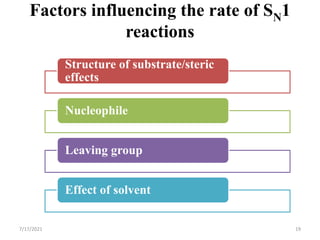
Factors influencing the rate of SN1
reactions
Structure of substrate/steric
effects
Nucleophile
Leaving group
Effect of solvent
7/17/2021 19
SN1 reaction : Substrate structure
7/17/2021 20
21
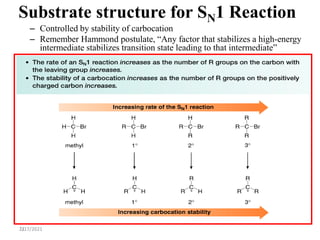
Substrate structure for SN1 Reaction
– Controlled by stability of carbocation
– Remember Hammond postulate, “Any factor that stabilizes a high-energy
intermediate stabilizes transition state leading to that intermediate”
7/17/2021
SN1 reaction : Effect of
Nucleophile
7/17/2021 22
23
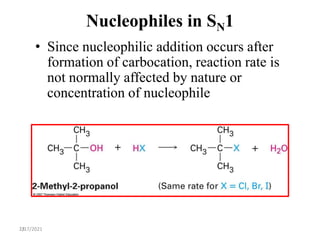
Nucleophiles in SN1
• Since nucleophilic addition occurs after
formation of carbocation, reaction rate is
not normally affected by nature or
concentration of nucleophile
7/17/2021
Effect of the Nucleophile
Weak nucleophiles fail to promote the SN2
reaction; therefore, reactions with weak
nucleophiles often go by the SN1 mechanism if
the substrate is secondary or tertiary
7/17/2021 24
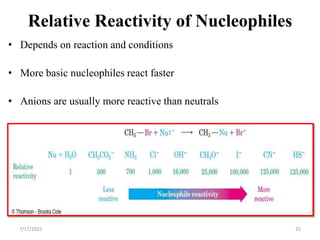
Relative Reactivity of Nucleophiles
• Depends on reaction and conditions
• More basic nucleophiles react faster
• Anions are usually more reactive than neutrals
7/17/2021 25
SN1 reaction : Effect of leaving
group
7/17/2021 26
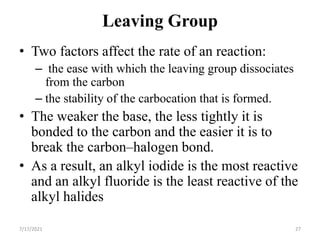
Leaving Group
• Two factors affect the rate of an reaction:
– the ease with which the leaving group dissociates
from the carbon
– the stability of the carbocation that is formed.
• The weaker the base, the less tightly it is
bonded to the carbon and the easier it is to
break the carbon–halogen bond.
• As a result, an alkyl iodide is the most reactive
and an alkyl fluoride is the least reactive of the
alkyl halides
7/17/2021 27
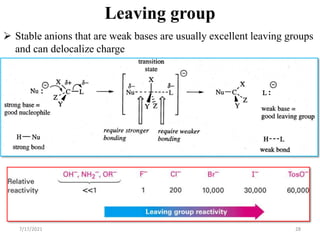
Leaving group
 Stable anions that are weak bases are usually excellent leaving groups
and can delocalize charge
7/17/2021 28
SN1 reaction : Effect of Solvent
7/17/2021 29
30
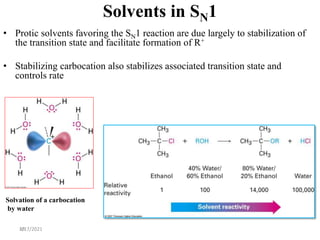
Solvents in SN1
• Protic solvents favoring the SN1 reaction are due largely to stabilization of
the transition state and facilitate formation of R+
• Stabilizing carbocation also stabilizes associated transition state and
controls rate
Solvation of a carbocation
by water
7/17/2021
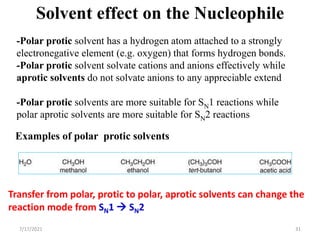
-Polar protic solvent has a hydrogen atom attached to a strongly
electronegative element (e.g. oxygen) that forms hydrogen bonds.
-Polar protic solvent solvate cations and anions effectively while
aprotic solvents do not solvate anions to any appreciable extend
-Polar protic solvents are more suitable for SN1 reactions while
polar aprotic solvents are more suitable for SN2 reactions
Solvent effect on the Nucleophile
Examples of polar protic solvents
Transfer from polar, protic to polar, aprotic solvents can change the
reaction mode from SN1  SN2
7/17/2021 31
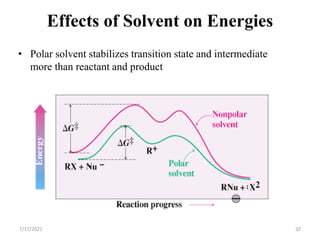
Effects of Solvent on Energies
• Polar solvent stabilizes transition state and intermediate
more than reactant and product
7/17/2021 32
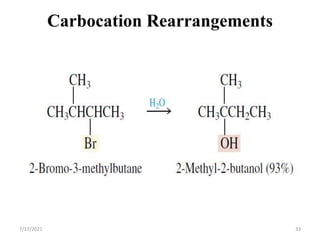
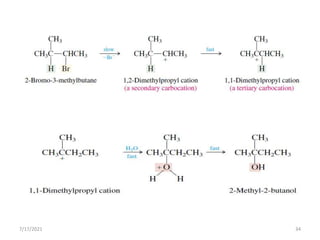
Carbocation Rearrangements
7/17/2021 33
7/17/2021 34
• First order kinetics: rate = k [RX]
–unimolecular rate-determining step
• Carbocation intermediate
–rate follows carbocation stability
–rearrangements are observed
• Reaction is not stereospecific:
–racemization in reactions of optically active
substrates
Characteristics of the SN1 mechanism
SN2
• REACTION AND MECHANISM
• KINETICS
• STEREOCHEMISTRY
• FACTORS AFFECTING SN2
REACTIONS
7/17/2021 36
SN2 : Reaction and mechanism
7/17/2021 37
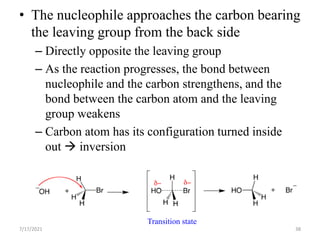
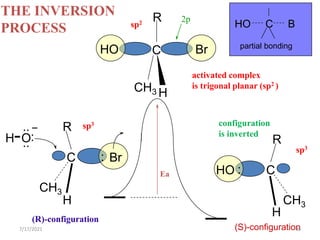
• The nucleophile approaches the carbon bearing
the leaving group from the back side
– Directly opposite the leaving group
– As the reaction progresses, the bond between
nucleophile and the carbon strengthens, and the
bond between the carbon atom and the leaving
group weakens
– Carbon atom has its configuration turned inside
out  inversion
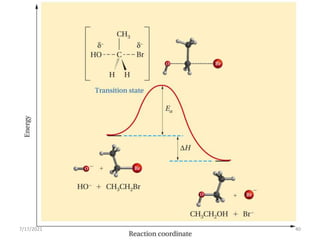
Transition state
7/17/2021 38
Transition State
• Arrangement of the atoms in which
nucleophile and the leaving group are both
partially bonded to the carbon atom
undergoing substitution
– Bond breaking and forming and occurred
simultaneously
• Concerted reaction
7/17/2021 39
7/17/2021 40
SN2 reaction : Kinetics
7/17/2021 41
42
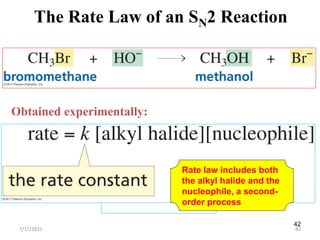
The Rate Law of an SN2 Reaction
Obtained experimentally:
Rate law includes both
the alkyl halide and the
nucleophile, a second-
order process
7/17/2021 42
SN2 reaction : Stereochemistry
7/17/2021 43
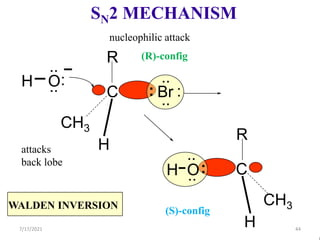
SN2 MECHANISM
O
C
R
H
CH3
H O:
..
..
attacks
back lobe
nucleophilic attack
(R)-config
(S)-config
C
R
H
CH3
Br
: :
..
..
H :
..
..
WALDEN INVERSION
7/17/2021 44
C
R
H
CH3
Br
:
C
R
H
CH3
HO :
C
H
CH3
R
Br
HO
H O:
..
..
activated complex
is trigonal planar (sp2 )
(R)-configuration
(S)-configuration
configuration
is inverted
Ea
HO C B
partial bonding
2p
THE INVERSION
PROCESS
sp3
sp3
sp2
7/17/2021 45
Factors influencing the rate of SN2
reactions
Structure of substrate/steric
effects
Nucleophile
Leaving group
Effect of solvent
7/17/2021 46
SN2 reaction : substrate
structure
7/17/2021 47
• Less bulky
• Should stabilize the
transition state
7/17/2021 48
49
Steric Effects on SN2 Reactions
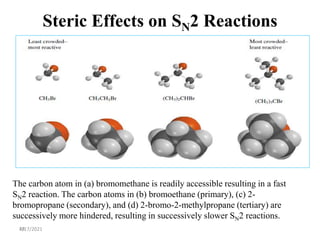
The carbon atom in (a) bromomethane is readily accessible resulting in a fast
SN2 reaction. The carbon atoms in (b) bromoethane (primary), (c) 2-
bromopropane (secondary), and (d) 2-bromo-2-methylpropane (tertiary) are
successively more hindered, resulting in successively slower SN2 reactions.
7/17/2021
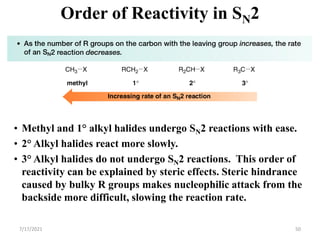
• Methyl and 1° alkyl halides undergo SN2 reactions with ease.
• 2° Alkyl halides react more slowly.
• 3° Alkyl halides do not undergo SN2 reactions. This order of
reactivity can be explained by steric effects. Steric hindrance
caused by bulky R groups makes nucleophilic attack from the
backside more difficult, slowing the reaction rate.
Order of Reactivity in SN2
7/17/2021 50
SN2 reaction : Effect of
Nucleophile
7/17/2021 51
Effect of Nucleophile
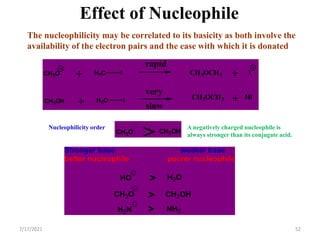
The nucleophilicity may be correlated to its basicity as both involve the
availability of the electron pairs and the ease with which it is donated
CH3O H3C I
CH3OH H3C I
CH3OCH3
CH3OCH3 HI
I
+ +
rapid
very
slow
+
+
Nucleophilicity order
CH3O CH3OH
> A negatively charged nucleophile is
always stronger than its conjugate acid.
Stronger base weaker base
better nucleophile poorer nucleophile
HO > H2O
CH3O > CH3OH
H2N > NH3
7/17/2021 52
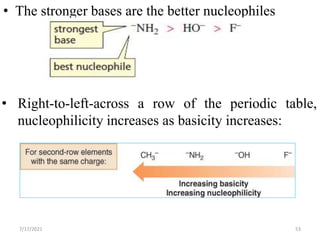
• The stronger bases are the better nucleophiles
7/17/2021 53
• Right-to-left-across a row of the periodic table,
nucleophilicity increases as basicity increases:
SN2 reaction : Effect of leaving
group
7/17/2021 54
55
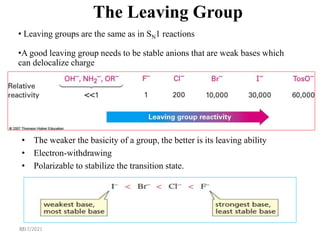
The Leaving Group
• The weaker the basicity of a group, the better is its leaving ability
• Electron-withdrawing
• Polarizable to stabilize the transition state.
7/17/2021
• Leaving groups are the same as in SN1 reactions
•A good leaving group needs to be stable anions that are weak bases which
can delocalize charge
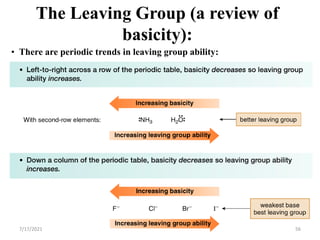
• There are periodic trends in leaving group ability:
The Leaving Group (a review of
basicity):
7/17/2021 56
SN2 reaction : Effect of Solvent
7/17/2021 57
Solvent Effects on SN2 Reactions:
Polar Protic and Aprotic solvent
• Aprotic solvents are those solvents whose molecules do
not have a hydrogen that is attached to an atom of an
electronegative element
• They do the same way as protic solvents solvate cations;
by orienting their negative ends around cation and by
donating unshared electron pairs to vacant orbitals of the
cation
• Rate of SN2 reaction generally increased when they are
carried out in a polar aprotic solvent
7/17/2021 58
59
Solvent Effects (1/2)
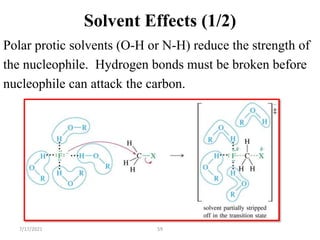
Polar protic solvents (O-H or N-H) reduce the strength of
the nucleophile. Hydrogen bonds must be broken before
nucleophile can attack the carbon.
7/17/2021
60
Solvent Effects (2/2)
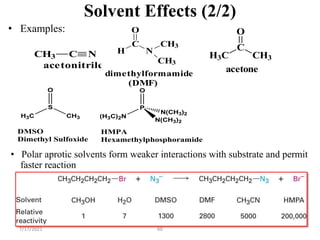
• Examples:
CH3 C N
acetonitrile
C
O
H3C CH3
acetone
dimethylformamide
(DMF)
C
H
O
N
CH3
CH3
S
O
CH3
H3C
DMSO
Dimethyl Sulfoxide
P
O
(H3C)2N
N(CH3)2
N(CH3)2
HMPA
Hexamethylphosphoramide
7/17/2021
• Polar aprotic solvents form weaker interactions with substrate and permit
faster reaction
61
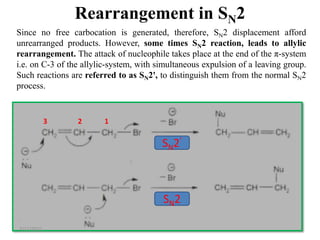
Since no free carbocation is generated, therefore, SN2 displacement afford
unrearranged products. However, some times SN2 reaction, leads to allylic
rearrangement. The attack of nucleophile takes place at the end of the π-system
i.e. on C-3 of the allylic-system, with simultaneous expulsion of a leaving group.
Such reactions are referred to as SN2', to distinguish them from the normal SN2
process.
3 2 1
SN2’
SN2
7/17/2021
Rearrangement in SN2
• Kinetics: Rate = k [RX] [Nu:-]. Both RX and Nu:- are
involved in the rate-determining step.
• Nucleophile: Negatively-charged (strong nucleophile)
work best; occasionally neutral nucleophiles can be used.
• Reactivity of alkyl halides: Sensitive to steric effects
CH3 > 1° > 2° due to steric effects that hinder backside attack.
3° halides do not react.
7/17/2021 62
Characteristics of SN2 Reaction
The SN2 Reaction
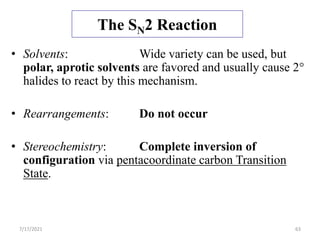
• Solvents: Wide variety can be used, but
polar, aprotic solvents are favored and usually cause 2°
halides to react by this mechanism.
• Rearrangements: Do not occur
• Stereochemistry: Complete inversion of
configuration via pentacoordinate carbon Transition
State.
7/17/2021 63
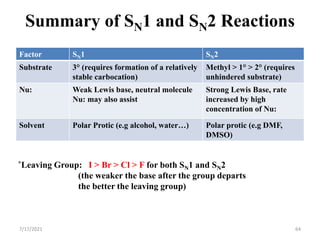
Summary of SN1 and SN2 Reactions
Factor SN1 SN2
Substrate 3° (requires formation of a relatively
stable carbocation)
Methyl > 1° > 2° (requires
unhindered substrate)
Nu: Weak Lewis base, neutral molecule
Nu: may also assist
Strong Lewis Base, rate
increased by high
concentration of Nu:
Solvent Polar Protic (e.g alcohol, water…) Polar protic (e.g DMF,
DMSO)
*Leaving Group: I > Br > Cl > F for both SN1 and SN2
(the weaker the base after the group departs
the better the leaving group)
7/17/2021 64
7/17/2021 65
7/17/2021 66
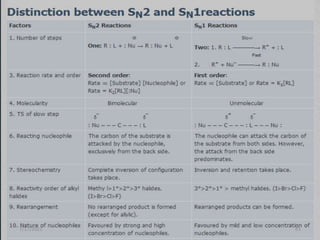
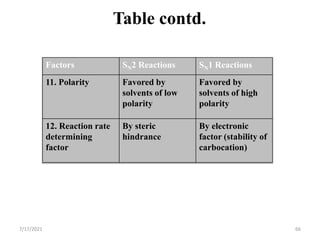
Factors SN2 Reactions SN1 Reactions
11. Polarity Favored by
solvents of low
polarity
Favored by
solvents of high
polarity
12. Reaction rate
determining
factor
By steric
hindrance
By electronic
factor (stability of
carbocation)
Table contd.
67
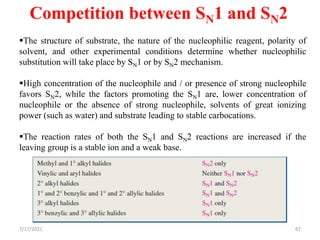
The structure of substrate, the nature of the nucleophilic reagent, polarity of
solvent, and other experimental conditions determine whether nucleophilic
substitution will take place by SN1 or by SN2 mechanism.
High concentration of the nucleophile and / or presence of strong nucleophile
favors SN2, while the factors promoting the SN1 are, lower concentration of
nucleophile or the absence of strong nucleophile, solvents of great ionizing
power (such as water) and substrate leading to stable carbocations.
The reaction rates of both the SN1 and SN2 reactions are increased if the
leaving group is a stable ion and a weak base.
Competition between SN1 and SN2
7/17/2021
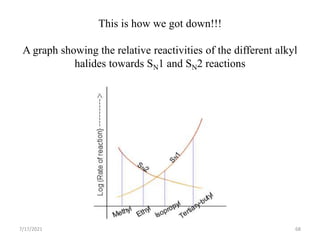
This is how we got down!!!
A graph showing the relative reactivities of the different alkyl
halides towards SN1 and SN2 reactions
7/17/2021 68
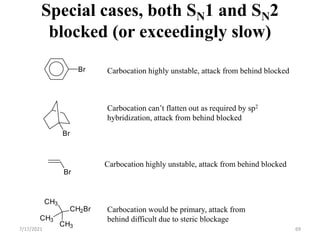
Special cases, both SN1 and SN2
blocked (or exceedingly slow)
Br
Br
Br
CH3
CH3
CH3
CH2Br
Carbocation highly unstable, attack from behind blocked
Carbocation would be primary, attack from
behind difficult due to steric blockage
Carbocation can’t flatten out as required by sp2
hybridization, attack from behind blocked
7/17/2021 69
SN
i (Substitution
Nucleophilic Internal)
7/17/2021 70
71
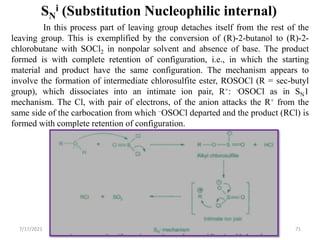
In this process part of leaving group detaches itself from the rest of the
leaving group. This is exemplified by the conversion of (R)-2-butanol to (R)-2-
chlorobutane with SOCl2 in nonpolar solvent and absence of base. The product
formed is with complete retention of configuration, i.e., in which the starting
material and product have the same configuration. The mechanism appears to
involve the formation of intermediate chlorosulfite ester, ROSOCl (R = sec-butyl
group), which dissociates into an intimate ion pair, R+: -OSOCl as in SN1
mechanism. The Cl, with pair of electrons, of the anion attacks the R+ from the
same side of the carbocation from which –OSOCl departed and the product (RCl) is
formed with complete retention of configuration.
SN
i (Substitution Nucleophilic internal)
7/17/2021
SN
i (Substitution Nucleophilic internal) :
Summary
• Retention of configuration
• Enhanced rate of reaction
7/17/2021 72
Neighboring group
participation (NGP)
7/17/2021 73
Introduction
Nucleophilic substitution reaction
Unusual behaviour
Substrate and reagent are both parts
of the same molecule
Enhanced rate with an unexpected
stereochemistry
7/17/2021 74
What is NGP?
Definition:-
The interaction of a reaction centre
with a lone pair of electrons in an atom or the
electrons present in a sigma bond or pi bond.
Anchimeric assistance.
7/17/2021 75
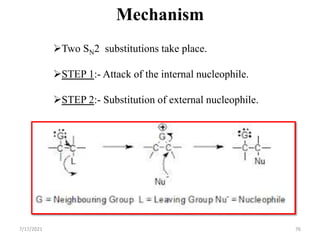
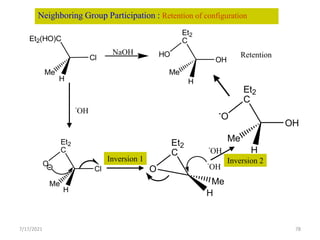
Mechanism
Two SN2 substitutions take place.
STEP 1:- Attack of the internal nucleophile.
STEP 2:- Substitution of external nucleophile.
7/17/2021 76
Stereochemistry
7/17/2021 77
Cl
Et2(HO)C
H
Me
Et2
C
H
Me
HO
OH
Cl
Et2
C
H
Me
O
Et2
C
H
Me
O
Et2
C
H
Me
-
O
OH
NaOH Retention
-
OH
-
OH
-
OH
Inversion 1 Inversion 2
Neighboring Group Participation : Retention of configuration
7/17/2021 78
Different types of NG
7/17/2021 79
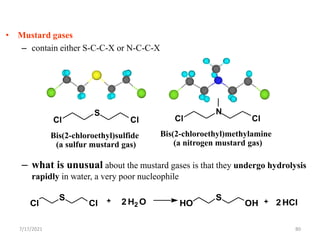
• Mustard gases
– contain either S-C-C-X or N-C-C-X
– what is unusual about the mustard gases is that they undergo hydrolysis
rapidly in water, a very poor nucleophile
Cl
S
Cl 2 H2 O HO
S
OH 2 HCl
+ +
Bis(2-chloroethyl)sulfide
(a sulfur mustard gas)
Bis(2-chloroethyl)methylamine
(a nitrogen mustard gas)
Cl
S
Cl Cl
N
Cl
7/17/2021 80
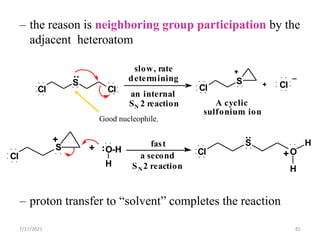
– the reason is neighboring group participation by the
adjacent heteroatom
– proton transfer to “solvent” completes the reaction
Cl
S
Cl
Cl
S O-H
H
Cl
S
Cl
S
O
H
H
Cl
+
+
A cyclic
sulfonium ion
an internal
SN 2 reaction
slow, rate
determining
+
+
a second
SN2 reaction
fast
+
:
:
:
Good nucleophile.
7/17/2021 81
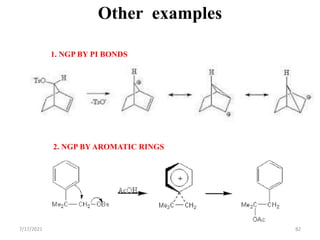
Other examples
1. NGP BY PI BONDS
2. NGP BY AROMATIC RINGS
7/17/2021 82
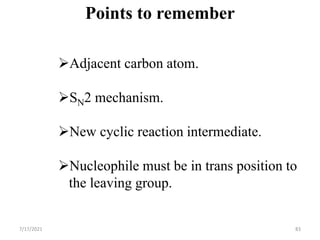
Points to remember
Adjacent carbon atom.
SN2 mechanism.
New cyclic reaction intermediate.
Nucleophile must be in trans position to
the leaving group.
7/17/2021 83
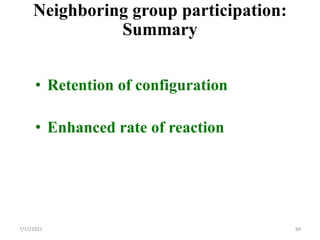
Neighboring group participation:
Summary
• Retention of configuration
• Enhanced rate of reaction
7/17/2021 84
Thank you for your attention
7/17/2021 85

Nucleophilic substitution reactions

  • 1.
    Nucleophilic substitution reactionsat saturated carbon atom Dr. Sakshi Kabra Malpani 7/17/2021 1
  • 2.
    Nucleophilic Substitution Nucleophilic substitutionis a substitution reaction in which a nucleophile attacks the positive or partially positive charge of an atom referred as an electrophile. The compound on which substitution takes place is called the substrate and the group that is displaced from carbon, taking the electron pair with it, is called leaving group. The leaving group often leaves as an anion but may also be a neutral molecule. For example, reaction of methyl bromide with sodium hydroxide affords methanol and sodium bromide. In this reaction methyl bromide is substrate, bromide is leaving group and hydroxide ion is the nucleophile. 7/17/2021 2
  • 3.
    Combinations for Nucleophilic SubstitutionReactions On the basis of charge on substrate and nucleophile, four combinations are possible - 7/17/2021 3
  • 4.
    Nucleophilic substitution reactionsare of two types:  Nucleophilic aliphatic substitution  Nucleophilic aromatic substitution General Scheme for the Nucleophilic Aliphatic Substitution: 7/17/2021 4
  • 5.
    Types of NucleophilicSubstitution SN1 SN2 S: Substitution N: Nucleophilic 1: Unimolecular S: Substitution N: Nucleophilic 2: Bimolecular Y C X C Y X + + C+ leaving group goes first and nucleophile comes later Y C X C Y X + + nucleophile attacks and leaving group goes simultaneously 7/17/2021 5
  • 6.
    SN1 • REACTION ANDMECHANISM • KINETICS • STEREOCHEMISTRY • FACTORS AFFECTING SN1 REACTIONS 7/17/2021 6
  • 7.
    SN1: Reaction andmechanism 7/17/2021 7
  • 8.
    8 SN1 (Substitution Nucleophilic Unimolecular) SN1reaction proceeds in two steps. The first step (slow step) is the rate determining step and involves the ionization of the reactant to form a carbocation intermediate. The breaking of C-X bond in RX takes place in a heterolytic fashion, in which both the bonding electrons go to the leaving group. In the second step (fast step), the intermediate carbocation is attacked by the nucleophile to give the final product. Step 1. Formation of carbocation Step 2. Capture of the carbocation by the nucleophile 7/17/2021
  • 9.
    A mechanism forSN1Reaction 7/17/2021 9
  • 10.
    10 SN1 Energy Diagram •Rate-determining step is formation of carbocation • rate = k[RX] or substrate 7/17/2021
  • 11.
  • 12.
    SN1 reaction :Kinetics 7/17/2021 12
  • 13.
    Kinetics of aNucleophilic substitution: an SN1 reaction • 2 step reaction • The reactions follows first order(unimolecular) kinetics • Rate of reaction depends the slowest step – Hetero-cleavage of halide • Rate of reaction = k [alkyl halide/substrate] 7/17/2021 13
  • 14.
    SN1 reaction :Stereochemistry 7/17/2021 14
  • 15.
    15 Stereochemistry of SN1Reaction • The planar intermediate leads to loss of chirality – A free carbocation is achiral • Product is racemic or has some inversion
  • 16.
    16 SN1 in Reality •Carbocation is biased to react on side opposite leaving group • Reaction occurs with carbocation loosely associated with leaving group during nucleophilic addition (Ion Pair) 7/17/2021
  • 17.
    Effects of IonPair Formation • If leaving group remains associated, then product has more inversion than retention • Product is only partially racemic with more inversion than retention • Associated carbocation and leaving group is an ion pair 17
  • 18.
  • 19.
    Factors influencing therate of SN1 reactions Structure of substrate/steric effects Nucleophile Leaving group Effect of solvent 7/17/2021 19
  • 20.
    SN1 reaction :Substrate structure 7/17/2021 20
  • 21.
    21 Substrate structure forSN1 Reaction – Controlled by stability of carbocation – Remember Hammond postulate, “Any factor that stabilizes a high-energy intermediate stabilizes transition state leading to that intermediate” 7/17/2021
  • 22.
    SN1 reaction :Effect of Nucleophile 7/17/2021 22
  • 23.
    23 Nucleophiles in SN1 •Since nucleophilic addition occurs after formation of carbocation, reaction rate is not normally affected by nature or concentration of nucleophile 7/17/2021
  • 24.
    Effect of theNucleophile Weak nucleophiles fail to promote the SN2 reaction; therefore, reactions with weak nucleophiles often go by the SN1 mechanism if the substrate is secondary or tertiary 7/17/2021 24
  • 25.
    Relative Reactivity ofNucleophiles • Depends on reaction and conditions • More basic nucleophiles react faster • Anions are usually more reactive than neutrals 7/17/2021 25
  • 26.
    SN1 reaction :Effect of leaving group 7/17/2021 26
  • 27.
    Leaving Group • Twofactors affect the rate of an reaction: – the ease with which the leaving group dissociates from the carbon – the stability of the carbocation that is formed. • The weaker the base, the less tightly it is bonded to the carbon and the easier it is to break the carbon–halogen bond. • As a result, an alkyl iodide is the most reactive and an alkyl fluoride is the least reactive of the alkyl halides 7/17/2021 27
  • 28.
    Leaving group  Stableanions that are weak bases are usually excellent leaving groups and can delocalize charge 7/17/2021 28
  • 29.
    SN1 reaction :Effect of Solvent 7/17/2021 29
  • 30.
    30 Solvents in SN1 •Protic solvents favoring the SN1 reaction are due largely to stabilization of the transition state and facilitate formation of R+ • Stabilizing carbocation also stabilizes associated transition state and controls rate Solvation of a carbocation by water 7/17/2021
  • 31.
    -Polar protic solventhas a hydrogen atom attached to a strongly electronegative element (e.g. oxygen) that forms hydrogen bonds. -Polar protic solvent solvate cations and anions effectively while aprotic solvents do not solvate anions to any appreciable extend -Polar protic solvents are more suitable for SN1 reactions while polar aprotic solvents are more suitable for SN2 reactions Solvent effect on the Nucleophile Examples of polar protic solvents Transfer from polar, protic to polar, aprotic solvents can change the reaction mode from SN1  SN2 7/17/2021 31
  • 32.
    Effects of Solventon Energies • Polar solvent stabilizes transition state and intermediate more than reactant and product 7/17/2021 32
  • 33.
  • 34.
  • 35.
    • First orderkinetics: rate = k [RX] –unimolecular rate-determining step • Carbocation intermediate –rate follows carbocation stability –rearrangements are observed • Reaction is not stereospecific: –racemization in reactions of optically active substrates Characteristics of the SN1 mechanism
  • 36.
    SN2 • REACTION ANDMECHANISM • KINETICS • STEREOCHEMISTRY • FACTORS AFFECTING SN2 REACTIONS 7/17/2021 36
  • 37.
    SN2 : Reactionand mechanism 7/17/2021 37
  • 38.
    • The nucleophileapproaches the carbon bearing the leaving group from the back side – Directly opposite the leaving group – As the reaction progresses, the bond between nucleophile and the carbon strengthens, and the bond between the carbon atom and the leaving group weakens – Carbon atom has its configuration turned inside out  inversion Transition state 7/17/2021 38
  • 39.
    Transition State • Arrangementof the atoms in which nucleophile and the leaving group are both partially bonded to the carbon atom undergoing substitution – Bond breaking and forming and occurred simultaneously • Concerted reaction 7/17/2021 39
  • 40.
  • 41.
    SN2 reaction :Kinetics 7/17/2021 41
  • 42.
    42 The Rate Lawof an SN2 Reaction Obtained experimentally: Rate law includes both the alkyl halide and the nucleophile, a second- order process 7/17/2021 42
  • 43.
    SN2 reaction :Stereochemistry 7/17/2021 43
  • 44.
    SN2 MECHANISM O C R H CH3 H O: .. .. attacks backlobe nucleophilic attack (R)-config (S)-config C R H CH3 Br : : .. .. H : .. .. WALDEN INVERSION 7/17/2021 44
  • 45.
    C R H CH3 Br : C R H CH3 HO : C H CH3 R Br HO H O: .. .. activatedcomplex is trigonal planar (sp2 ) (R)-configuration (S)-configuration configuration is inverted Ea HO C B partial bonding 2p THE INVERSION PROCESS sp3 sp3 sp2 7/17/2021 45
  • 46.
    Factors influencing therate of SN2 reactions Structure of substrate/steric effects Nucleophile Leaving group Effect of solvent 7/17/2021 46
  • 47.
    SN2 reaction :substrate structure 7/17/2021 47
  • 48.
    • Less bulky •Should stabilize the transition state 7/17/2021 48
  • 49.
    49 Steric Effects onSN2 Reactions The carbon atom in (a) bromomethane is readily accessible resulting in a fast SN2 reaction. The carbon atoms in (b) bromoethane (primary), (c) 2- bromopropane (secondary), and (d) 2-bromo-2-methylpropane (tertiary) are successively more hindered, resulting in successively slower SN2 reactions. 7/17/2021
  • 50.
    • Methyl and1° alkyl halides undergo SN2 reactions with ease. • 2° Alkyl halides react more slowly. • 3° Alkyl halides do not undergo SN2 reactions. This order of reactivity can be explained by steric effects. Steric hindrance caused by bulky R groups makes nucleophilic attack from the backside more difficult, slowing the reaction rate. Order of Reactivity in SN2 7/17/2021 50
  • 51.
    SN2 reaction :Effect of Nucleophile 7/17/2021 51
  • 52.
    Effect of Nucleophile Thenucleophilicity may be correlated to its basicity as both involve the availability of the electron pairs and the ease with which it is donated CH3O H3C I CH3OH H3C I CH3OCH3 CH3OCH3 HI I + + rapid very slow + + Nucleophilicity order CH3O CH3OH > A negatively charged nucleophile is always stronger than its conjugate acid. Stronger base weaker base better nucleophile poorer nucleophile HO > H2O CH3O > CH3OH H2N > NH3 7/17/2021 52
  • 53.
    • The strongerbases are the better nucleophiles 7/17/2021 53 • Right-to-left-across a row of the periodic table, nucleophilicity increases as basicity increases:
  • 54.
    SN2 reaction :Effect of leaving group 7/17/2021 54
  • 55.
    55 The Leaving Group •The weaker the basicity of a group, the better is its leaving ability • Electron-withdrawing • Polarizable to stabilize the transition state. 7/17/2021 • Leaving groups are the same as in SN1 reactions •A good leaving group needs to be stable anions that are weak bases which can delocalize charge
  • 56.
    • There areperiodic trends in leaving group ability: The Leaving Group (a review of basicity): 7/17/2021 56
  • 57.
    SN2 reaction :Effect of Solvent 7/17/2021 57
  • 58.
    Solvent Effects onSN2 Reactions: Polar Protic and Aprotic solvent • Aprotic solvents are those solvents whose molecules do not have a hydrogen that is attached to an atom of an electronegative element • They do the same way as protic solvents solvate cations; by orienting their negative ends around cation and by donating unshared electron pairs to vacant orbitals of the cation • Rate of SN2 reaction generally increased when they are carried out in a polar aprotic solvent 7/17/2021 58
  • 59.
    59 Solvent Effects (1/2) Polarprotic solvents (O-H or N-H) reduce the strength of the nucleophile. Hydrogen bonds must be broken before nucleophile can attack the carbon. 7/17/2021
  • 60.
    60 Solvent Effects (2/2) •Examples: CH3 C N acetonitrile C O H3C CH3 acetone dimethylformamide (DMF) C H O N CH3 CH3 S O CH3 H3C DMSO Dimethyl Sulfoxide P O (H3C)2N N(CH3)2 N(CH3)2 HMPA Hexamethylphosphoramide 7/17/2021 • Polar aprotic solvents form weaker interactions with substrate and permit faster reaction
  • 61.
    61 Since no freecarbocation is generated, therefore, SN2 displacement afford unrearranged products. However, some times SN2 reaction, leads to allylic rearrangement. The attack of nucleophile takes place at the end of the π-system i.e. on C-3 of the allylic-system, with simultaneous expulsion of a leaving group. Such reactions are referred to as SN2', to distinguish them from the normal SN2 process. 3 2 1 SN2’ SN2 7/17/2021 Rearrangement in SN2
  • 62.
    • Kinetics: Rate= k [RX] [Nu:-]. Both RX and Nu:- are involved in the rate-determining step. • Nucleophile: Negatively-charged (strong nucleophile) work best; occasionally neutral nucleophiles can be used. • Reactivity of alkyl halides: Sensitive to steric effects CH3 > 1° > 2° due to steric effects that hinder backside attack. 3° halides do not react. 7/17/2021 62 Characteristics of SN2 Reaction
  • 63.
    The SN2 Reaction •Solvents: Wide variety can be used, but polar, aprotic solvents are favored and usually cause 2° halides to react by this mechanism. • Rearrangements: Do not occur • Stereochemistry: Complete inversion of configuration via pentacoordinate carbon Transition State. 7/17/2021 63
  • 64.
    Summary of SN1and SN2 Reactions Factor SN1 SN2 Substrate 3° (requires formation of a relatively stable carbocation) Methyl > 1° > 2° (requires unhindered substrate) Nu: Weak Lewis base, neutral molecule Nu: may also assist Strong Lewis Base, rate increased by high concentration of Nu: Solvent Polar Protic (e.g alcohol, water…) Polar protic (e.g DMF, DMSO) *Leaving Group: I > Br > Cl > F for both SN1 and SN2 (the weaker the base after the group departs the better the leaving group) 7/17/2021 64
  • 65.
  • 66.
    7/17/2021 66 Factors SN2Reactions SN1 Reactions 11. Polarity Favored by solvents of low polarity Favored by solvents of high polarity 12. Reaction rate determining factor By steric hindrance By electronic factor (stability of carbocation) Table contd.
  • 67.
    67 The structure ofsubstrate, the nature of the nucleophilic reagent, polarity of solvent, and other experimental conditions determine whether nucleophilic substitution will take place by SN1 or by SN2 mechanism. High concentration of the nucleophile and / or presence of strong nucleophile favors SN2, while the factors promoting the SN1 are, lower concentration of nucleophile or the absence of strong nucleophile, solvents of great ionizing power (such as water) and substrate leading to stable carbocations. The reaction rates of both the SN1 and SN2 reactions are increased if the leaving group is a stable ion and a weak base. Competition between SN1 and SN2 7/17/2021
  • 68.
    This is howwe got down!!! A graph showing the relative reactivities of the different alkyl halides towards SN1 and SN2 reactions 7/17/2021 68
  • 69.
    Special cases, bothSN1 and SN2 blocked (or exceedingly slow) Br Br Br CH3 CH3 CH3 CH2Br Carbocation highly unstable, attack from behind blocked Carbocation highly unstable, attack from behind blocked Carbocation would be primary, attack from behind difficult due to steric blockage Carbocation can’t flatten out as required by sp2 hybridization, attack from behind blocked 7/17/2021 69
  • 70.
  • 71.
    71 In this processpart of leaving group detaches itself from the rest of the leaving group. This is exemplified by the conversion of (R)-2-butanol to (R)-2- chlorobutane with SOCl2 in nonpolar solvent and absence of base. The product formed is with complete retention of configuration, i.e., in which the starting material and product have the same configuration. The mechanism appears to involve the formation of intermediate chlorosulfite ester, ROSOCl (R = sec-butyl group), which dissociates into an intimate ion pair, R+: -OSOCl as in SN1 mechanism. The Cl, with pair of electrons, of the anion attacks the R+ from the same side of the carbocation from which –OSOCl departed and the product (RCl) is formed with complete retention of configuration. SN i (Substitution Nucleophilic internal) 7/17/2021
  • 72.
    SN i (Substitution Nucleophilicinternal) : Summary • Retention of configuration • Enhanced rate of reaction 7/17/2021 72
  • 73.
  • 74.
    Introduction Nucleophilic substitution reaction Unusualbehaviour Substrate and reagent are both parts of the same molecule Enhanced rate with an unexpected stereochemistry 7/17/2021 74
  • 75.
    What is NGP? Definition:- Theinteraction of a reaction centre with a lone pair of electrons in an atom or the electrons present in a sigma bond or pi bond. Anchimeric assistance. 7/17/2021 75
  • 76.
    Mechanism Two SN2 substitutionstake place. STEP 1:- Attack of the internal nucleophile. STEP 2:- Substitution of external nucleophile. 7/17/2021 76
  • 77.
  • 78.
    Cl Et2(HO)C H Me Et2 C H Me HO OH Cl Et2 C H Me O Et2 C H Me O Et2 C H Me - O OH NaOH Retention - OH - OH - OH Inversion 1Inversion 2 Neighboring Group Participation : Retention of configuration 7/17/2021 78
  • 79.
    Different types ofNG 7/17/2021 79
  • 80.
    • Mustard gases –contain either S-C-C-X or N-C-C-X – what is unusual about the mustard gases is that they undergo hydrolysis rapidly in water, a very poor nucleophile Cl S Cl 2 H2 O HO S OH 2 HCl + + Bis(2-chloroethyl)sulfide (a sulfur mustard gas) Bis(2-chloroethyl)methylamine (a nitrogen mustard gas) Cl S Cl Cl N Cl 7/17/2021 80
  • 81.
    – the reasonis neighboring group participation by the adjacent heteroatom – proton transfer to “solvent” completes the reaction Cl S Cl Cl S O-H H Cl S Cl S O H H Cl + + A cyclic sulfonium ion an internal SN 2 reaction slow, rate determining + + a second SN2 reaction fast + : : : Good nucleophile. 7/17/2021 81
  • 82.
    Other examples 1. NGPBY PI BONDS 2. NGP BY AROMATIC RINGS 7/17/2021 82
  • 83.
    Points to remember Adjacentcarbon atom. SN2 mechanism. New cyclic reaction intermediate. Nucleophile must be in trans position to the leaving group. 7/17/2021 83
  • 84.
    Neighboring group participation: Summary •Retention of configuration • Enhanced rate of reaction 7/17/2021 84
  • 85.
    Thank you foryour attention 7/17/2021 85