METHODS OF NUCLEIC ACID
DETECTION
NAME : KALPANA LAMANI
USN : 2BA18BT005
DEPARTMENT OF BIOTECHNOLOGY
1. UV SPECTROSCOPY
• This property of UV absorbance can be used quickly to estimate
the concentration and purity of DNA and RNA in analytical
sample.
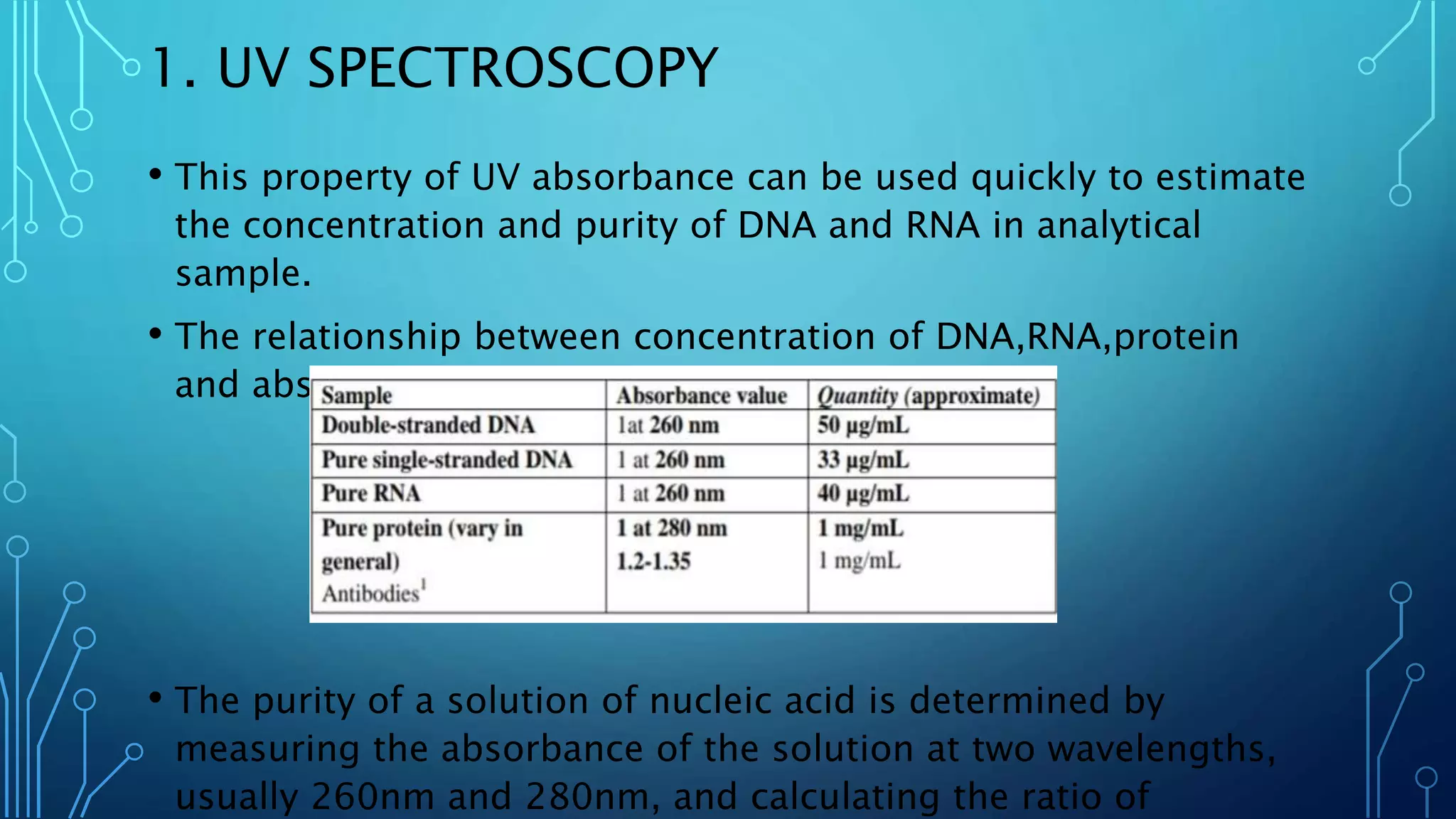
• The relationship between concentration of DNA,RNA,protein
and absorptivity are as below :
• The purity of a solution of nucleic acid is determined by
measuring the absorbance of the solution at two wavelengths,
usually 260nm and 280nm, and calculating the ratio of
• Value of this ratio is 2.0,1.8 and 0.6 for pure RNA,DNA and protein
respectively. A ratio of less than 1.8 signifies that the sample is
contaminated with protein or phenol and the preparation is not proper.
Fig : UV detection of nucleic acid
Fig : Nucleic acid melting
curve
showing hyperchromicity
2. ETHIDIUM BROMIDE STAINING
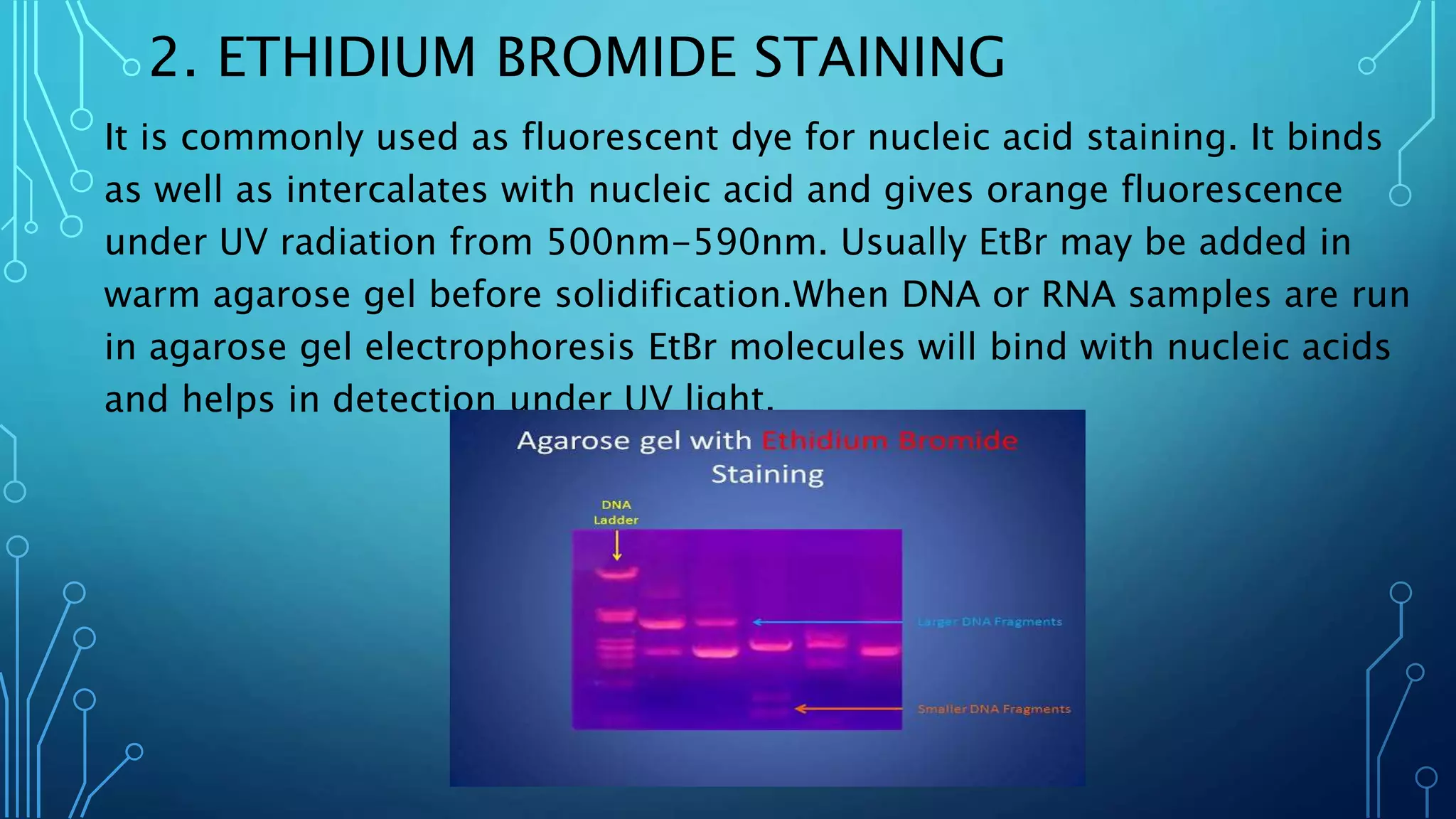
It is commonly used as fluorescent dye for nucleic acid staining. It binds
as well as intercalates with nucleic acid and gives orange fluorescence
under UV radiation from 500nm-590nm. Usually EtBr may be added in
warm agarose gel before solidification.When DNA or RNA samples are run
in agarose gel electrophoresis EtBr molecules will bind with nucleic acids
and helps in detection under UV light.
3. FLUOROMETRIC QUANTIFICATION
An assay using Hoechst 33258 dye is specific for DNA because it
is less sensitive to detect RNA. Hoechst 33258 is non intercalating
reagent and binds to the minor groove of the DNA with preference
for AT sequences. This dye is positively charged and thus form
electrostatic interaction with the negative potential of stretch of
AT base pairs. Upon binding to the minor groove of the double
helix DNA,the fluorescence characteristics of Hoechst 33258
change dramatically, showing a large increase in emission at
458nm
DAPI (4’,6-diamidino-2-phenylindole) has the similar
characteristics to H33258 is also appropriate for DNA or RNA
quantitaion,although it is not as commonly used as Hoechst
33258 DAPI is excited with a peak at 344nm. Emission is detected

Nucleic acid detection_methods

  • 1.
    METHODS OF NUCLEICACID DETECTION NAME : KALPANA LAMANI USN : 2BA18BT005 DEPARTMENT OF BIOTECHNOLOGY
  • 2.
    1. UV SPECTROSCOPY •This property of UV absorbance can be used quickly to estimate the concentration and purity of DNA and RNA in analytical sample. • The relationship between concentration of DNA,RNA,protein and absorptivity are as below : • The purity of a solution of nucleic acid is determined by measuring the absorbance of the solution at two wavelengths, usually 260nm and 280nm, and calculating the ratio of
  • 3.
    • Value ofthis ratio is 2.0,1.8 and 0.6 for pure RNA,DNA and protein respectively. A ratio of less than 1.8 signifies that the sample is contaminated with protein or phenol and the preparation is not proper. Fig : UV detection of nucleic acid Fig : Nucleic acid melting curve showing hyperchromicity
  • 4.
    2. ETHIDIUM BROMIDESTAINING It is commonly used as fluorescent dye for nucleic acid staining. It binds as well as intercalates with nucleic acid and gives orange fluorescence under UV radiation from 500nm-590nm. Usually EtBr may be added in warm agarose gel before solidification.When DNA or RNA samples are run in agarose gel electrophoresis EtBr molecules will bind with nucleic acids and helps in detection under UV light.
  • 5.
    3. FLUOROMETRIC QUANTIFICATION Anassay using Hoechst 33258 dye is specific for DNA because it is less sensitive to detect RNA. Hoechst 33258 is non intercalating reagent and binds to the minor groove of the DNA with preference for AT sequences. This dye is positively charged and thus form electrostatic interaction with the negative potential of stretch of AT base pairs. Upon binding to the minor groove of the double helix DNA,the fluorescence characteristics of Hoechst 33258 change dramatically, showing a large increase in emission at 458nm DAPI (4’,6-diamidino-2-phenylindole) has the similar characteristics to H33258 is also appropriate for DNA or RNA quantitaion,although it is not as commonly used as Hoechst 33258 DAPI is excited with a peak at 344nm. Emission is detected