Nuclear Reactor
By
Ashvani Shukla
C&I
Reliance
INDEX
• INTRODUCTION TO NUCLEAR POWER PLANT
• NUCLEAR REACTOR
• TYPE OF REACTOR
• APPLICATION
• ADVANTAGE
• DISADVANTAGE
INTRODUCTION
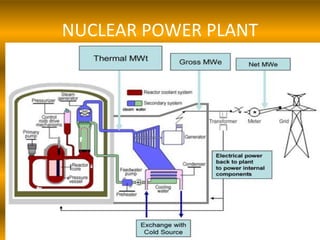
• A nuclear reactor produces and controls the release of
energy from splitting the atoms of certain elements. In a
nuclear power reactor, the energy released is used as heat
to make steam to generate electricity. (In a research reactor
the main purpose is to utilize the actual neutrons produced
in the core. In most naval reactors, steam drives a turbine
directly for propulsion.)
• The principles for using nuclear power to produce
electricity are the same for most types of reactor. The
energy released from continuous fission of the atoms of the
fuel is harnessed as heat in either a gas or water, and is
used to produce steam. The steam is used to drive the
turbines which produce electricity (as in most fossil fuel
plants).
• The world's first nuclear reactors operated naturally in a
uranium deposit about two billion years ago. These were in
rich uranium ore bodies and moderated by percolating
rainwater. The 17 known at Oklo in west Africa, each less than
100 kW thermal, together consumed about six tones of that
uranium. It is assumed that these were not unique worldwide.
• Today, reactors derived from designs originally developed for
propelling submarines and large naval ships generate about
85% of the world's nuclear electricity. The main design is the
pressurized water reactor (PWR) which has water at over 300°C
under pressure in its primary cooling/heat transfer circuit, and
generates steam in a secondary circuit. The less numerous
boiling water reactor (BWR) makes steam in the primary circuit
above the reactor core, at similar temperatures and pressure.
Both types use water as both coolant and moderator, to slow
neutrons. Since water normally boils at 100°C, they have
robust steel pressure vessels or tubes to enable the higher
operating temperature. (Another type uses heavy water, with
deuterium atoms, as moderator. Hence the term ‘light water’ is
used to differentiate.)
Components of a nuclear reactor
• There are several components common to most types of
reactors:
• Fuel. Uranium is the basic fuel. Usually pellets of uranium
oxide (UO2) are arranged in tubes to form fuel rods. The rods
are arranged into fuel assemblies in the reactor core
• Moderator. Material in the core which slows down the
neutrons released from fission so that they cause more fission.
It is usually water, but may be heavy water or graphite.
• Control rods. These are made with neutron-absorbing material
such as cadmium, hafnium or boron, and are inserted or
withdrawn from the core to control the rate of reaction, or to
halt it.* In some PWR reactors, special control rods are used to
enable the core to sustain a low level of power
efficiently. (Secondary control systems involve other neutron
absorbers, usually boron in the coolant – its concentration can
be adjusted over time as the fuel burns up.)
• Coolant. A fluid circulating through the core so as to transfer
the heat from it. In light water reactors the water moderator
functions also as primary coolant. Except in BWRs, there is
secondary coolant circuit where the water becomes steam.
(See also later section on primary coolant characteristics)
• Pressure vessel or pressure tubes. Usually a robust steel vessel
containing the reactor core and moderator/coolant, but it may
be a series of tubes holding the fuel and conveying the coolant
through the surrounding moderator.
• Steam generator. Part of the cooling system of pressurized
water reactors (PWR & PHWR) where the high-pressure
primary coolant bringing heat from the reactor is used to make
steam for the turbine, in a secondary circuit. Essentially a heat
exchanger like a motor car radiator*. Reactors have up to six
'loops', each with a steam generator. Since 1980 over 110 PWR
reactors have had their steam generators replaced after 20-30
years service, 57 of these in USA.
• Containment. The structure around the
reactor and associated steam generators
which is designed to protect it from outside
intrusion and to protect those outside from
the effects of radiation in case of any serious
malfunction inside. It is typically a meter-thick
concrete and steel structure.
• There are several different types of reactors as
indicated in the following table.
• Nuclear power plants in commercial
operation
• Fuelling a nuclear power reactor
• Most reactors need to be shut down for refueling, so
that the pressure vessel can be opened up. In this case
refueling is at intervals of 1-2 years, when a quarter to
a third of the fuel assemblies are replaced with fresh
ones. The CANDU and RBMK types have pressure tubes
(rather than a pressure vessel enclosing the reactor
core) and can be refueled under load by disconnecting
individual pressure tubes.
• If graphite or heavy water is used as moderator, it is
possible to run a power reactor on natural instead of
enriched uranium. Natural uranium has the same
elemental composition as when it was mined (0.7% U-
235, over 99.2% U-238), enriched uranium has had the
proportion of the fissile isotope (U-235) increased by a
process called enrichment, commonly to 3.5 - 5.0%. In
this case the moderator can be ordinary water,
• and such reactors are collectively called light water
reactors. Because the light water absorbs neutrons as well
as slowing them, it is less efficient as a moderator than
heavy water or graphite.
• During operation, some of the U-238 is changed
to plutonium, and Pu-239 ends up providing about one
third of the energy from the fuel.
• In most reactors the fuel is ceramic uranium oxide
(UO2 with a melting point of 2800°C) and most is enriched.
The fuel pellets (usually about 1 cm diameter and 1.5 cm
long) are typically arranged in a long zirconium alloy
(zircaloy) tube to form a fuel rod, the zirconium being hard,
corrosion-resistant and transparent to neutrons.*
Numerous rods form a fuel assembly, which is an open
lattice and can be lifted into and out of the reactor core. In
the most common reactors these are about 3.5 to 4 metres
long.
• Burnable poisons are often used in fuel or coolant to even
out the performance of the reactor over time from fresh
fuel being loaded to refueling. These are neutron absorbers
which decay under neutron exposure, compensating for the
progressive buildup of neutron absorbers in the fuel as it is
burned. The best known is gadolinium, which is a vital
ingredient of fuel in naval reactors where installing fresh
fuel is very inconvenient, so reactors are designed to run
more than a decade between refueling. Gadolinium is
incorporated in the ceramic fuel pellets. An alternative is
zirconium diboride integral fuel burnable absorber (IFBA) as
a thin coating on normal pellets.
• Gadolinium, mostly at up to 3g oxide per kilogram of fuel,
requires slightly higher fuel enrichment to compensate for
it, and also after burn-up of about 17 GWd/t it retains
about 4% of its absorptive effect and does not decrease
further. The ZrB2 IFBA burns away more steadily and
completely, and has no impact on fuel pellet properties. It
is now used in most US reactors and a few in Asia. China
has the technology for AP1000 reactors.
NUCLEAR POWER PLANT
TYPE OF REACTOR
• 1 – PRESSURISED WATER REACTOR
• This is the most common type, with over 230 in
use for power generation and several hundred
more employed for naval propulsion. The design
of PWRs originated as a submarine power plant.
PWRs use ordinary water as both coolant and
moderator. The design is distinguished by having
a primary cooling circuit which flows through the
core of the reactor under very high pressure, and
a secondary circuit in which steam is generated to
drive the turbine. In Russia these are known as
VVER types – water-moderated and -cooled.
• A PWR has fuel assemblies of 200-300 rods each,
arranged vertically in the core, and a large reactor
would have about 150-250 fuel assemblies with 80-100
tones of uranium.
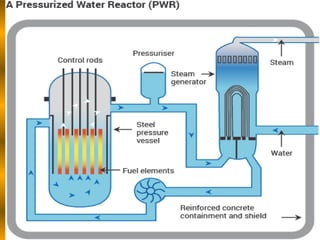
• Water in the reactor core reaches about 325°C, hence
it must be kept under about 150 times atmospheric
pressure to prevent it boiling. Pressure is maintained
by steam in a pressurizes (see diagram). In the primary
cooling circuit the water is also the moderator, and if
any of it turned to steam the fission reaction would
slow down. This negative feedback effect is one of the
safety features of the type. The secondary shutdown
system involves adding boron to the primary circuit.
• The secondary circuit is under less pressure and the
water here boils in the heat exchangers which are thus
steam generators. The steam drives the turbine to
produce electricity, and is then condensed and
returned to the heat exchangers in contact with the
primary circuit.
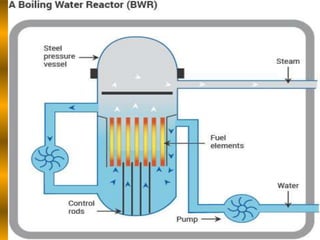
2-Boiling water reactor (BWR)
• This design has many similarities to the PWR,
except that there is only a single circuit in
which the water is at lower pressure (about 75
times atmospheric pressure) so that it boils in
the core at about 285°C. The reactor is
designed to operate with 12-15% of the water
in the top part of the core as steam, and
hence with less moderating effect and thus
efficiency there. BWR units can operate in
load-following mode more readily then PWRs.
• The steam passes through drier plates (steam separators)
above the core and then directly to the turbines, which are
thus part of the reactor circuit. Since the water around the
core of a reactor is always contaminated with traces of
radionuclide's, it means that the turbine must be shielded
and radiological protection provided during maintenance.
The cost of this tends to balance the savings due to the
simpler design. Most of the radioactivity in the water is
very short-lived*, so the turbine hall can be entered soon
after the reactor is shut down.
• The steam passes through drier plates (steam separators)
above the core and then directly to the turbines, which are
thus part of the reactor circuit. Since the water around the
core of a reactor is always contaminated with traces of
radionuclide's, it means that the turbine must be shielded
and radiological protection provided during maintenance.
The cost of this tends to balance the savings due to the
simpler design. Most of the radioactivity in the water is
very short-lived*, so the turbine hall can be entered soon
after the reactor is shut down.
• A BWR fuel assembly comprises 90-100 fuel
rods, and there are up to 750 assemblies in a
reactor core, holding up to 140 tones of
uranium. The secondary control system
involves restricting water flow through the
core so that more steam in the top part
reduces moderation.
3-Pressurised heavy water reactor
(PHWR)
• The PHWR reactor design has been developed
since the 1950s in Canada as the CANDU, and
from 1980s also in India. PHWRs generally use
natural uranium (0.7% U-235) oxide as fuel,
hence needs a more efficient moderator, in
this case heavy water (D2O).** The PHWR
produces more energy per kilogram of mined
uranium than other designs, but also produces
a much larger amount of used fuel per unit
output
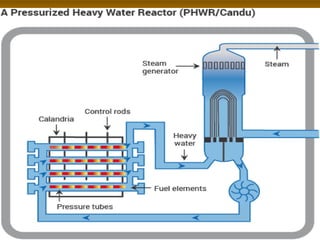
• The moderator is in a large tank called a
calandria, penetrated by several hundred
horizontal pressure tubes which form channels
for the fuel, cooled by a flow of heavy water
under high pressure in the primary cooling circuit,
reaching 290°C. As in the PWR, the primary
coolant generates steam in a secondary circuit to
drive the turbines. The pressure tube design
means that the reactor can be refueled
progressively without shutting down, by isolating
individual pressure tubes from the cooling
circuit. It is also less costly to build than designs
with a large pressure vessel, but the tubes have
not proved as durable.
• A CANDU fuel assembly consists of a bundle of 37 half
meter long fuel rods (ceramic fuel pellets in zircaloy
tubes) plus a support structure, with 12 bundles lying
end to end in a fuel channel. Control rods penetrate
the calandria vertically, and a secondary shutdown
system involves adding gadolinium to the moderator.
The heavy water moderator circulating through the
body of the calandria vessel also yields some heat
(though this circuit is not shown on the diagram
above).
• Newer PHWR designs such as the Advanced Candu
Reactor (ACR) have light water cooling and slightly-
enriched fuel.
• CANDU reactors can accept a variety of fuels. They may
be run on recycled uranium from reprocessing LWR
used fuel, or a blend of this and depleted uranium left
over from enrichment plants. About 4000 MWe of
PWR might then fuel 1000 MWe of CANDU capacity,
with addition of depleted uranium. Thorium may also
be used in fuel.
4-Advanced gas-cooled reactor (AGR)
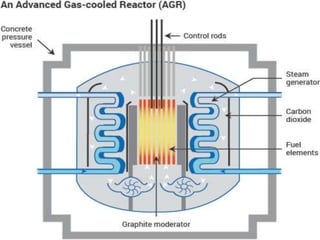
• These are the second generation of British gas-
cooled reactors, using graphite moderator and
carbon dioxide as primary coolant. The fuel is
uranium oxide pellets, enriched to 2.5-3.5%, in
stainless steel tubes. The carbon dioxide
circulates through the core, reaching 650°C and
then past steam generator tubes outside it, but
still inside the concrete and steel pressure vessel
(hence 'integral' design). Control rods penetrate
the moderator and a secondary shutdown system
involves injecting nitrogen to the coolant.
5-Light water graphite-moderated
reactor (RBMK)
• This is a Soviet design, developed from plutonium
production reactors. It employs long (7 meter)
vertical pressure tubes running through graphite
moderator, and is cooled by water, which is
allowed to boil in the core at 290°C, much as in a
BWR. Fuel is low-enriched uranium oxide made
up into fuel assemblies 3.5 meters long. With
moderation largely due to the fixed graphite,
excess boiling simply reduces the cooling and
neutron absorption without inhibiting the fission
reaction and a positive feedback problem can
arise, which is why they have never been built
outside the Soviet Union.
6-Fast neutron reactors (FNR)
• Some reactors (only one in commercial service) do not
have a moderator and utilize fast neutrons, generating
power from plutonium while making more of it from
the U-238 isotope in or around the fuel. While they get
more than 60 times as much energy from the original
uranium compared with the normal reactors, they are
expensive to build. Further development of them is
likely in the next decade, and the main designs
expected to be built in two decades are FNRs. If they
are configured to produce more fissile material
(plutonium) than they consume they are called Fast
Breeder Reactors (FBR).
7-Lifetime of nuclear reactors
• Most of today's nuclear plants which were originally designed
for 30 or 40-year operating lives. However, with major
investments in systems, structures and components lives can
be extended, and in several countries there are active
programs to extend operating lives. In the USA most of the
more than one hundred reactors are expected to be granted
license extensions from 40 to 60 years. This justifies significant
capital expenditure in upgrading systems and components,
including building in extra performance margins.
• Some components simply wear out, corrode or degrade to a
low level of efficiency. These need to be replaced. Steam
generators are the most prominent and expensive of these,
and many have been replaced after about 30 years where the
reactor otherwise has the prospect of running for 60 years.
This is essentially an economic decision. Lesser components
are more straightforward to replace as they age. In Candu
reactors, pressure tube replacement has been undertaken on
some plants after about 30 years operation.
• A second issue is that of obsolescence. For
instance, older reactors have analogue
instrument and control systems. Thirdly, the
properties of materials may degrade with age,
particularly with heat and neutron irradiation. In
respect to all these aspects, investment is needed
to maintain reliability and safety. Also, periodic
safety reviews are undertaken on older plants in
line with international safety conventions and
principles to ensure that safety margins are
maintained.
THANK YOU

Admens Effect 2655.pdf

  • 1.
  • 2.
    INDEX • INTRODUCTION TONUCLEAR POWER PLANT • NUCLEAR REACTOR • TYPE OF REACTOR • APPLICATION • ADVANTAGE • DISADVANTAGE
  • 3.
    INTRODUCTION • A nuclearreactor produces and controls the release of energy from splitting the atoms of certain elements. In a nuclear power reactor, the energy released is used as heat to make steam to generate electricity. (In a research reactor the main purpose is to utilize the actual neutrons produced in the core. In most naval reactors, steam drives a turbine directly for propulsion.) • The principles for using nuclear power to produce electricity are the same for most types of reactor. The energy released from continuous fission of the atoms of the fuel is harnessed as heat in either a gas or water, and is used to produce steam. The steam is used to drive the turbines which produce electricity (as in most fossil fuel plants).
  • 4.
    • The world'sfirst nuclear reactors operated naturally in a uranium deposit about two billion years ago. These were in rich uranium ore bodies and moderated by percolating rainwater. The 17 known at Oklo in west Africa, each less than 100 kW thermal, together consumed about six tones of that uranium. It is assumed that these were not unique worldwide. • Today, reactors derived from designs originally developed for propelling submarines and large naval ships generate about 85% of the world's nuclear electricity. The main design is the pressurized water reactor (PWR) which has water at over 300°C under pressure in its primary cooling/heat transfer circuit, and generates steam in a secondary circuit. The less numerous boiling water reactor (BWR) makes steam in the primary circuit above the reactor core, at similar temperatures and pressure. Both types use water as both coolant and moderator, to slow neutrons. Since water normally boils at 100°C, they have robust steel pressure vessels or tubes to enable the higher operating temperature. (Another type uses heavy water, with deuterium atoms, as moderator. Hence the term ‘light water’ is used to differentiate.)
  • 5.
    Components of anuclear reactor • There are several components common to most types of reactors: • Fuel. Uranium is the basic fuel. Usually pellets of uranium oxide (UO2) are arranged in tubes to form fuel rods. The rods are arranged into fuel assemblies in the reactor core • Moderator. Material in the core which slows down the neutrons released from fission so that they cause more fission. It is usually water, but may be heavy water or graphite. • Control rods. These are made with neutron-absorbing material such as cadmium, hafnium or boron, and are inserted or withdrawn from the core to control the rate of reaction, or to halt it.* In some PWR reactors, special control rods are used to enable the core to sustain a low level of power efficiently. (Secondary control systems involve other neutron absorbers, usually boron in the coolant – its concentration can be adjusted over time as the fuel burns up.)
  • 6.
    • Coolant. Afluid circulating through the core so as to transfer the heat from it. In light water reactors the water moderator functions also as primary coolant. Except in BWRs, there is secondary coolant circuit where the water becomes steam. (See also later section on primary coolant characteristics) • Pressure vessel or pressure tubes. Usually a robust steel vessel containing the reactor core and moderator/coolant, but it may be a series of tubes holding the fuel and conveying the coolant through the surrounding moderator. • Steam generator. Part of the cooling system of pressurized water reactors (PWR & PHWR) where the high-pressure primary coolant bringing heat from the reactor is used to make steam for the turbine, in a secondary circuit. Essentially a heat exchanger like a motor car radiator*. Reactors have up to six 'loops', each with a steam generator. Since 1980 over 110 PWR reactors have had their steam generators replaced after 20-30 years service, 57 of these in USA.
  • 7.
    • Containment. Thestructure around the reactor and associated steam generators which is designed to protect it from outside intrusion and to protect those outside from the effects of radiation in case of any serious malfunction inside. It is typically a meter-thick concrete and steel structure. • There are several different types of reactors as indicated in the following table. • Nuclear power plants in commercial operation
  • 8.
    • Fuelling anuclear power reactor • Most reactors need to be shut down for refueling, so that the pressure vessel can be opened up. In this case refueling is at intervals of 1-2 years, when a quarter to a third of the fuel assemblies are replaced with fresh ones. The CANDU and RBMK types have pressure tubes (rather than a pressure vessel enclosing the reactor core) and can be refueled under load by disconnecting individual pressure tubes. • If graphite or heavy water is used as moderator, it is possible to run a power reactor on natural instead of enriched uranium. Natural uranium has the same elemental composition as when it was mined (0.7% U- 235, over 99.2% U-238), enriched uranium has had the proportion of the fissile isotope (U-235) increased by a process called enrichment, commonly to 3.5 - 5.0%. In this case the moderator can be ordinary water,
  • 9.
    • and suchreactors are collectively called light water reactors. Because the light water absorbs neutrons as well as slowing them, it is less efficient as a moderator than heavy water or graphite. • During operation, some of the U-238 is changed to plutonium, and Pu-239 ends up providing about one third of the energy from the fuel. • In most reactors the fuel is ceramic uranium oxide (UO2 with a melting point of 2800°C) and most is enriched. The fuel pellets (usually about 1 cm diameter and 1.5 cm long) are typically arranged in a long zirconium alloy (zircaloy) tube to form a fuel rod, the zirconium being hard, corrosion-resistant and transparent to neutrons.* Numerous rods form a fuel assembly, which is an open lattice and can be lifted into and out of the reactor core. In the most common reactors these are about 3.5 to 4 metres long.
  • 10.
    • Burnable poisonsare often used in fuel or coolant to even out the performance of the reactor over time from fresh fuel being loaded to refueling. These are neutron absorbers which decay under neutron exposure, compensating for the progressive buildup of neutron absorbers in the fuel as it is burned. The best known is gadolinium, which is a vital ingredient of fuel in naval reactors where installing fresh fuel is very inconvenient, so reactors are designed to run more than a decade between refueling. Gadolinium is incorporated in the ceramic fuel pellets. An alternative is zirconium diboride integral fuel burnable absorber (IFBA) as a thin coating on normal pellets. • Gadolinium, mostly at up to 3g oxide per kilogram of fuel, requires slightly higher fuel enrichment to compensate for it, and also after burn-up of about 17 GWd/t it retains about 4% of its absorptive effect and does not decrease further. The ZrB2 IFBA burns away more steadily and completely, and has no impact on fuel pellet properties. It is now used in most US reactors and a few in Asia. China has the technology for AP1000 reactors.
  • 11.
  • 12.
    TYPE OF REACTOR •1 – PRESSURISED WATER REACTOR • This is the most common type, with over 230 in use for power generation and several hundred more employed for naval propulsion. The design of PWRs originated as a submarine power plant. PWRs use ordinary water as both coolant and moderator. The design is distinguished by having a primary cooling circuit which flows through the core of the reactor under very high pressure, and a secondary circuit in which steam is generated to drive the turbine. In Russia these are known as VVER types – water-moderated and -cooled.
  • 14.
    • A PWRhas fuel assemblies of 200-300 rods each, arranged vertically in the core, and a large reactor would have about 150-250 fuel assemblies with 80-100 tones of uranium. • Water in the reactor core reaches about 325°C, hence it must be kept under about 150 times atmospheric pressure to prevent it boiling. Pressure is maintained by steam in a pressurizes (see diagram). In the primary cooling circuit the water is also the moderator, and if any of it turned to steam the fission reaction would slow down. This negative feedback effect is one of the safety features of the type. The secondary shutdown system involves adding boron to the primary circuit. • The secondary circuit is under less pressure and the water here boils in the heat exchangers which are thus steam generators. The steam drives the turbine to produce electricity, and is then condensed and returned to the heat exchangers in contact with the primary circuit.
  • 15.
    2-Boiling water reactor(BWR) • This design has many similarities to the PWR, except that there is only a single circuit in which the water is at lower pressure (about 75 times atmospheric pressure) so that it boils in the core at about 285°C. The reactor is designed to operate with 12-15% of the water in the top part of the core as steam, and hence with less moderating effect and thus efficiency there. BWR units can operate in load-following mode more readily then PWRs.
  • 16.
    • The steampasses through drier plates (steam separators) above the core and then directly to the turbines, which are thus part of the reactor circuit. Since the water around the core of a reactor is always contaminated with traces of radionuclide's, it means that the turbine must be shielded and radiological protection provided during maintenance. The cost of this tends to balance the savings due to the simpler design. Most of the radioactivity in the water is very short-lived*, so the turbine hall can be entered soon after the reactor is shut down. • The steam passes through drier plates (steam separators) above the core and then directly to the turbines, which are thus part of the reactor circuit. Since the water around the core of a reactor is always contaminated with traces of radionuclide's, it means that the turbine must be shielded and radiological protection provided during maintenance. The cost of this tends to balance the savings due to the simpler design. Most of the radioactivity in the water is very short-lived*, so the turbine hall can be entered soon after the reactor is shut down.
  • 17.
    • A BWRfuel assembly comprises 90-100 fuel rods, and there are up to 750 assemblies in a reactor core, holding up to 140 tones of uranium. The secondary control system involves restricting water flow through the core so that more steam in the top part reduces moderation.
  • 19.
    3-Pressurised heavy waterreactor (PHWR) • The PHWR reactor design has been developed since the 1950s in Canada as the CANDU, and from 1980s also in India. PHWRs generally use natural uranium (0.7% U-235) oxide as fuel, hence needs a more efficient moderator, in this case heavy water (D2O).** The PHWR produces more energy per kilogram of mined uranium than other designs, but also produces a much larger amount of used fuel per unit output
  • 20.
    • The moderatoris in a large tank called a calandria, penetrated by several hundred horizontal pressure tubes which form channels for the fuel, cooled by a flow of heavy water under high pressure in the primary cooling circuit, reaching 290°C. As in the PWR, the primary coolant generates steam in a secondary circuit to drive the turbines. The pressure tube design means that the reactor can be refueled progressively without shutting down, by isolating individual pressure tubes from the cooling circuit. It is also less costly to build than designs with a large pressure vessel, but the tubes have not proved as durable.
  • 22.
    • A CANDUfuel assembly consists of a bundle of 37 half meter long fuel rods (ceramic fuel pellets in zircaloy tubes) plus a support structure, with 12 bundles lying end to end in a fuel channel. Control rods penetrate the calandria vertically, and a secondary shutdown system involves adding gadolinium to the moderator. The heavy water moderator circulating through the body of the calandria vessel also yields some heat (though this circuit is not shown on the diagram above). • Newer PHWR designs such as the Advanced Candu Reactor (ACR) have light water cooling and slightly- enriched fuel. • CANDU reactors can accept a variety of fuels. They may be run on recycled uranium from reprocessing LWR used fuel, or a blend of this and depleted uranium left over from enrichment plants. About 4000 MWe of PWR might then fuel 1000 MWe of CANDU capacity, with addition of depleted uranium. Thorium may also be used in fuel.
  • 23.
    4-Advanced gas-cooled reactor(AGR) • These are the second generation of British gas- cooled reactors, using graphite moderator and carbon dioxide as primary coolant. The fuel is uranium oxide pellets, enriched to 2.5-3.5%, in stainless steel tubes. The carbon dioxide circulates through the core, reaching 650°C and then past steam generator tubes outside it, but still inside the concrete and steel pressure vessel (hence 'integral' design). Control rods penetrate the moderator and a secondary shutdown system involves injecting nitrogen to the coolant.
  • 25.
    5-Light water graphite-moderated reactor(RBMK) • This is a Soviet design, developed from plutonium production reactors. It employs long (7 meter) vertical pressure tubes running through graphite moderator, and is cooled by water, which is allowed to boil in the core at 290°C, much as in a BWR. Fuel is low-enriched uranium oxide made up into fuel assemblies 3.5 meters long. With moderation largely due to the fixed graphite, excess boiling simply reduces the cooling and neutron absorption without inhibiting the fission reaction and a positive feedback problem can arise, which is why they have never been built outside the Soviet Union.
  • 26.
    6-Fast neutron reactors(FNR) • Some reactors (only one in commercial service) do not have a moderator and utilize fast neutrons, generating power from plutonium while making more of it from the U-238 isotope in or around the fuel. While they get more than 60 times as much energy from the original uranium compared with the normal reactors, they are expensive to build. Further development of them is likely in the next decade, and the main designs expected to be built in two decades are FNRs. If they are configured to produce more fissile material (plutonium) than they consume they are called Fast Breeder Reactors (FBR).
  • 27.
    7-Lifetime of nuclearreactors • Most of today's nuclear plants which were originally designed for 30 or 40-year operating lives. However, with major investments in systems, structures and components lives can be extended, and in several countries there are active programs to extend operating lives. In the USA most of the more than one hundred reactors are expected to be granted license extensions from 40 to 60 years. This justifies significant capital expenditure in upgrading systems and components, including building in extra performance margins. • Some components simply wear out, corrode or degrade to a low level of efficiency. These need to be replaced. Steam generators are the most prominent and expensive of these, and many have been replaced after about 30 years where the reactor otherwise has the prospect of running for 60 years. This is essentially an economic decision. Lesser components are more straightforward to replace as they age. In Candu reactors, pressure tube replacement has been undertaken on some plants after about 30 years operation.
  • 28.
    • A secondissue is that of obsolescence. For instance, older reactors have analogue instrument and control systems. Thirdly, the properties of materials may degrade with age, particularly with heat and neutron irradiation. In respect to all these aspects, investment is needed to maintain reliability and safety. Also, periodic safety reviews are undertaken on older plants in line with international safety conventions and principles to ensure that safety margins are maintained.
  • 29.