NUCLEAR MODELS
CHAPTER 2
2.1 The Liquid Drop Model
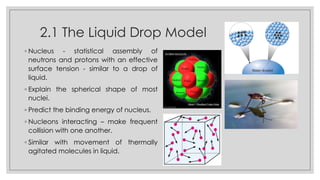
◦ Nucleus - statistical assembly of
neutrons and protons with an effective
surface tension - similar to a drop of
liquid.
◦ Explain the spherical shape of most
nuclei.
◦ Predict the binding energy of nucleus.
◦ Nucleons interacting – make frequent
collision with one another.
◦ Similar with movement of thermally
agitated molecules in liquid.
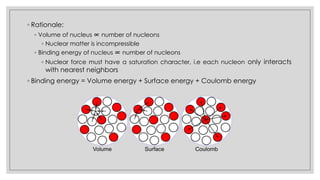
◦ Rationale;
◦ Volume of nucleus ∝ number of nucleons
◦ Nuclear matter is incompressible
◦ Binding energy of nucleus ∝ number of nucleons
◦ Nuclear force must have a saturation character, i.e each nucleon only interacts
with nearest neighbors
◦ Binding energy = Volume energy + Surface energy + Coulomb energy
◦ Semi-empirical mass formula – apply to atomic masses.
◦ Atomic mass M(Z,A) – sum of 6 terms.
1. Mass of the constituent nucleons and electrons;
2. Volume term;
3. Surface term;
Strong nuclear force – short range
Independent of nucleus’s size
 
Overestimate the nuclear force
Correct the volume term
Proportional to surface area
Decrease the binding energy
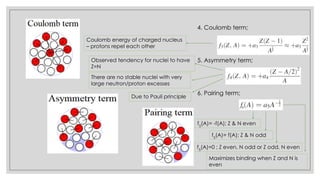
4. Coulomb term;
5. Asymmetry term;
6. Pairing term;
Coulomb energy of charged nucleus
– protons repel each other
Due to Pauli principle
There are no stable nuclei with very
large neutron/proton excesses
Observed tendency for nuclei to have
Z=N
Maximizes binding when Z and N is
even
f5
(A)= -f(A); Z & N even
f5
(A)=0 ; Z even, N odd or Z odd, N even
f5
(A)= f(A); Z & N odd
◦ To remember the term - notation VSCAP;
Binding energy
◦ a1
= av
= 15.56 MeV/c2
◦ a2
= as
= 17.23 MeV/c2
◦ a3
= ac
= 0.697 MeV/c2
◦ a4
= aa
= 93.14 MeV/c2
◦ a5
= ap
= 12.0 MeV/c2
One commonly used value
 
The data fitting remarkably
good, but not exact
Gives accurate values for some
200 stable and many more
unstable nuclei.
◦ Contribution of each term to binding energy per nucleon;
Volume term increases
the ΔEbe
, the other term
reduce ΔEbe
Curve total SEMF – Binding
energy after all terms
have been considered
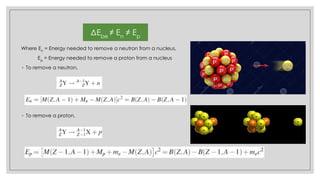
Where En
= Energy needed to remove a neutron from a nucleus,
Ep
= Energy needed to remove a proton from a nucleus
◦ To remove a neutron,
◦ To remove a proton,
ΔEbe
≠ En
≠ Ep
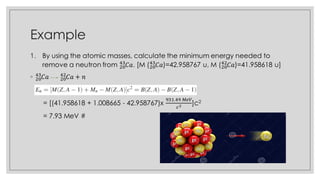
Example
◦  
◦  
 
Solution
◦  
 
Exercises
◦  
DEC 2019 (Q1.c)
Ans : 519.83 MeV
DEC 2019 (Q1.d)
 
JUN 2019
 
JUN 2018 (Q2.b)
 
DEC 2016 (Q1.d)
 
JUN 2016 (Q1.c)
JUN 2015 (Q1.b)
JUN 2015 (Q1)

Nuclear Models

  • 1.
  • 2.
    2.1 The LiquidDrop Model ◦ Nucleus - statistical assembly of neutrons and protons with an effective surface tension - similar to a drop of liquid. ◦ Explain the spherical shape of most nuclei. ◦ Predict the binding energy of nucleus. ◦ Nucleons interacting – make frequent collision with one another. ◦ Similar with movement of thermally agitated molecules in liquid.
  • 3.
    ◦ Rationale; ◦ Volumeof nucleus ∝ number of nucleons ◦ Nuclear matter is incompressible ◦ Binding energy of nucleus ∝ number of nucleons ◦ Nuclear force must have a saturation character, i.e each nucleon only interacts with nearest neighbors ◦ Binding energy = Volume energy + Surface energy + Coulomb energy
  • 4.
    ◦ Semi-empirical massformula – apply to atomic masses. ◦ Atomic mass M(Z,A) – sum of 6 terms. 1. Mass of the constituent nucleons and electrons; 2. Volume term; 3. Surface term; Strong nuclear force – short range Strong nuclear force – short range Independent of nucleus’s size   Overestimate the nuclear force Correct the volume term Proportional to surface area Decrease the binding energy
  • 5.
    4. Coulomb term; 5.Asymmetry term; 6. Pairing term; Coulomb energy of charged nucleus – protons repel each other Due to Pauli principle There are no stable nuclei with very large neutron/proton excesses Observed tendency for nuclei to have Z=N Maximizes binding when Z and N is even f5 (A)= -f(A); Z & N even f5 (A)=0 ; Z even, N odd or Z odd, N even f5 (A)= f(A); Z & N odd
  • 6.
    ◦ To rememberthe term - notation VSCAP; Binding energy ◦ a1 = av = 15.56 MeV/c2 ◦ a2 = as = 17.23 MeV/c2 ◦ a3 = ac = 0.697 MeV/c2 ◦ a4 = aa = 93.14 MeV/c2 ◦ a5 = ap = 12.0 MeV/c2 One commonly used value  
  • 7.
    The data fittingremarkably good, but not exact Gives accurate values for some 200 stable and many more unstable nuclei.
  • 8.
    ◦ Contribution ofeach term to binding energy per nucleon; Volume term increases the ΔEbe , the other term reduce ΔEbe Curve total SEMF – Binding energy after all terms have been considered
  • 9.
    Where En = Energyneeded to remove a neutron from a nucleus, Ep = Energy needed to remove a proton from a nucleus ◦ To remove a neutron, ◦ To remove a proton, ΔEbe ≠ En ≠ Ep
  • 10.
  • 11.
  • 12.
  • 13.
  • 14.
    DEC 2019 (Q1.c) Ans: 519.83 MeV
  • 15.
  • 16.
    JUN 2018 (Q2.b)   DEC2016 (Q1.d)  
  • 17.
  • 18.