NUCLEAR & PARTICLE PHYSICS
NUCLEAR PHYSICS
Prof. Anjali A. dahikar
PRESENTED BY
Nuclear Models
Here we will discuss various models of proposed for nuclear structure
Following models we have to discuss here -
Liquid drop model
1.
2. Nuclear shell model
3. Collective model
03
@rajput_physics_accademy
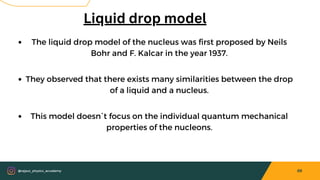
Liquid drop model
The liquid drop model of the nucleus was first proposed by Neils
Bohr and F. Kalcar in the year 1937.
They observed that there exists many similarities between the drop
of a liquid and a nucleus.
This model doesn`t focus on the individual quantum mechanical
properties of the nucleons.
04
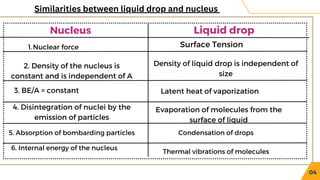
Similarities between liquid drop and nucleus
Nucleus Liquid drop
Nuclear force
1. Surface Tension
2. Density of the nucleus is
constant and is independent of A
Density of liquid drop is independent of
size
3. BE/A = constant Latent heat of vaporization
4. Disintegration of nuclei by the
emission of particles
Evaporation of molecules from the
surface of liquid
5. Absorption of bombarding particles Condensation of drops
6. Internal energy of the nucleus
Thermal vibrations of molecules
@ rajput_physics_accademy 05
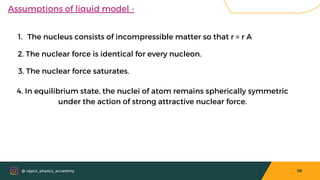
Assumptions of liquid model -
The nucleus consists of incompressible matter so that r = r A
1.
2. The nuclear force is identical for every nucleon.
3. The nuclear force saturates.
4. In equilibrium state, the nuclei of atom remains spherically symmetric
under the action of strong attractive nuclear force.
08
@ rajput_physics_accademy
Semi-Empirical Mass formula-
Binding energy (B) = Zm +Nm -M
n
P
M = Zm +Nm -B
P n
Binding energy = B + B + B + B + B
2 3 4 5
1
Volume energy (B ) -
1
A molecule interacts only with its neighbours and number of
neighbours is independent of size of the drop
B = a A
v
1
08
@ rajput_physics_accademy
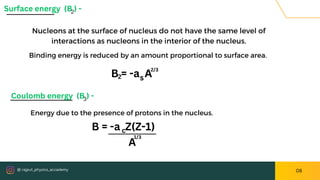
Surface energy (B ) -
2
Nucleons at the surface of nucleus do not have the same level of
interactions as nucleons in the interior of the nucleus.
Binding energy is reduced by an amount proportional to surface area.
B = -a A
2 s
2/3
Coulomb energy (B ) -
3
Energy due to the presence of protons in the nucleus.
B = -a Z(Z-1)
c
A
1/3
08
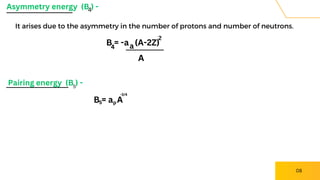
Asymmetry energy (B ) -
4
It arises due to the asymmetry in the number of protons and number of neutrons.
B = -a (A-2Z)
4 a
2
Pairing energy (B ) -
5
B = a A
p
A
-3/4
5
09
@ rajput_physics_accademy
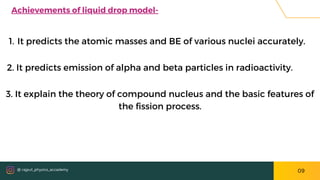
Achievements of liquid drop model-
It predicts the atomic masses and BE of various nuclei accurately.
1.
2. It predicts emission of alpha and beta particles in radioactivity.
3. It explain the theory of compound nucleus and the basic features of
the fission process.
@ rajput_physics_accademy
10
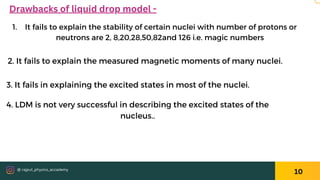
Drawbacks of liquid drop model -
It fails to explain the stability of certain nuclei with number of protons or
neutrons are 2, 8,20,28,50,82and 126 i.e. magic numbers
1.
2. It fails to explain the measured magnetic moments of many nuclei.
3. It fails in explaining the excited states in most of the nuclei.
4. LDM is not very successful in describing the excited states of the
nucleus..

Liquid drop model

  • 1.
    NUCLEAR & PARTICLEPHYSICS NUCLEAR PHYSICS Prof. Anjali A. dahikar PRESENTED BY
  • 2.
    Nuclear Models Here wewill discuss various models of proposed for nuclear structure Following models we have to discuss here - Liquid drop model 1. 2. Nuclear shell model 3. Collective model
  • 3.
    03 @rajput_physics_accademy Liquid drop model Theliquid drop model of the nucleus was first proposed by Neils Bohr and F. Kalcar in the year 1937. They observed that there exists many similarities between the drop of a liquid and a nucleus. This model doesn`t focus on the individual quantum mechanical properties of the nucleons.
  • 4.
    04 Similarities between liquiddrop and nucleus Nucleus Liquid drop Nuclear force 1. Surface Tension 2. Density of the nucleus is constant and is independent of A Density of liquid drop is independent of size 3. BE/A = constant Latent heat of vaporization 4. Disintegration of nuclei by the emission of particles Evaporation of molecules from the surface of liquid 5. Absorption of bombarding particles Condensation of drops 6. Internal energy of the nucleus Thermal vibrations of molecules
  • 5.
    @ rajput_physics_accademy 05 Assumptionsof liquid model - The nucleus consists of incompressible matter so that r = r A 1. 2. The nuclear force is identical for every nucleon. 3. The nuclear force saturates. 4. In equilibrium state, the nuclei of atom remains spherically symmetric under the action of strong attractive nuclear force.
  • 6.
    08 @ rajput_physics_accademy Semi-Empirical Massformula- Binding energy (B) = Zm +Nm -M n P M = Zm +Nm -B P n Binding energy = B + B + B + B + B 2 3 4 5 1 Volume energy (B ) - 1 A molecule interacts only with its neighbours and number of neighbours is independent of size of the drop B = a A v 1
  • 7.
    08 @ rajput_physics_accademy Surface energy(B ) - 2 Nucleons at the surface of nucleus do not have the same level of interactions as nucleons in the interior of the nucleus. Binding energy is reduced by an amount proportional to surface area. B = -a A 2 s 2/3 Coulomb energy (B ) - 3 Energy due to the presence of protons in the nucleus. B = -a Z(Z-1) c A 1/3
  • 8.
    08 Asymmetry energy (B) - 4 It arises due to the asymmetry in the number of protons and number of neutrons. B = -a (A-2Z) 4 a 2 Pairing energy (B ) - 5 B = a A p A -3/4 5
  • 9.
    09 @ rajput_physics_accademy Achievements ofliquid drop model- It predicts the atomic masses and BE of various nuclei accurately. 1. 2. It predicts emission of alpha and beta particles in radioactivity. 3. It explain the theory of compound nucleus and the basic features of the fission process.
  • 10.
    @ rajput_physics_accademy 10 Drawbacks ofliquid drop model - It fails to explain the stability of certain nuclei with number of protons or neutrons are 2, 8,20,28,50,82and 126 i.e. magic numbers 1. 2. It fails to explain the measured magnetic moments of many nuclei. 3. It fails in explaining the excited states in most of the nuclei. 4. LDM is not very successful in describing the excited states of the nucleus..