Nuclear energy
Mit ME Dept. Page 1
A
Seminar report
On-
Introduction of Nuclear Energy
Submitted in partial fulfillment of the requirement for the award of degree of
BACHELOR OF TECHNOLOGY
in
MECHANICAL ENGG.
by
Seminar Guide: Seminar Coordinator:
(Assistant professor)
DEPARTMENT OF MECHANICAL ENGINEERING
MORADABAD INSTITUTE OF TEHCNOLOGY
RAMGANGA VIHAR, PHASE-2, MORADABAD- 244001 (U.P.)
Session: 2017-201
Moradabad Institute of Technology
DEPARTMENT OF MECHANICAL ENGINEERING
Nuclear energy
Mit ME Dept. Page 2
MORADABAD-244001
Session 2017–2018
CERTIFICATE
This is to certify that student name Student of B.Tech. Third year, Mechanical
branch, college name, Moradabad have successfully completed his project
entitled “Nuclear energy”under our guidance and supervision.
While Gleaming the required information and styling the report he was found
pretty sincere and devoted. The report produced him is completely authentic
proof of his dedicated efforts. The assistance and help taken during the course
of the work has been duly acknowledged and the source of literature amply
recorded.
SeminarGuide
(Assistant professor)
Acknowledgement
I would like to thank respected Mr. Rakesh Kumar Gangwar and Mr. Arvind Kumar Singh
for giving me such a wonderful opportunity to expand my knowledge for my own branch and
giving me guidelines to present a seminar report. It helped me a lot to realize of what we
study for. Secondly, I would like to thank my parents who patiently helped me as i went
Nuclear energy
Mit ME Dept. Page 3
through my work and helped to modify and eliminate some of the irrelevant or un-necessary
stuffs. Thirdly, I would like to thank my friends who helped me to make my work more
organized and well-stacked till the end. Next, I would thank Microsoft for developing such a
wonderful tool like MS Word. It helped my work a lot to remain error-free. Last but clearly
not the least, I would thank The Almighty for giving me strength to complete my report on
time.
Signature……………….
Name ………………..
Roll no ………………..
Date ………………..
Content Page No.
INTRODUCTION 5
a) By nuclear fission 7
b) By nuclear fusion 8
Nuclear energy
Mit ME Dept. Page 4
Binding energy 9
Binding energy curve 10
Types of fission reaction 11
a) Un-controled chain reaction 12
b) Controled chain reaction 13
Fission product 14
Advantage of nuclear energy 15
Disadvantages of nuclear energy 15
INTRODUCTION
Energy emitted during detoration of heavy radioactive element or during combining of two
lighter radioactive element is called nuclear energy.
Nuclear reaction takes place in two ways
a) By nuclear fission
Nuclear energy
Mit ME Dept. Page 5
b) by nuclear fusion
Energy from disintegrating atomic nuclei has a tremendous potential to do good for the
people of the world. We routinely use X-rays to examine for fractures, treat cancer with
radiation and diagnose disease with the use or radioactive isotopes. About 17% of the
energy in the world comes from nuclear power plants.
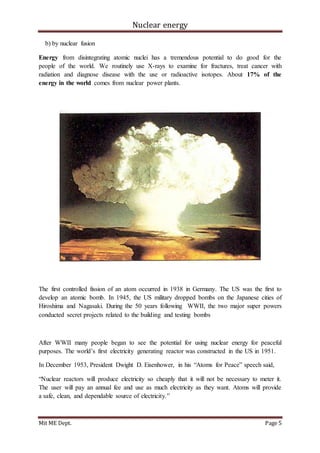
The first controlled fission of an atom occurred in 1938 in Germany. The US was the first to
develop an atomic bomb. In 1945, the US military dropped bombs on the Japanese cities of
Hiroshima and Nagasaki. During the 50 years following WWII, the two major super powers
conducted secret projects related to the building and testing bombs
After WWII many people began to see the potential for using nuclear energy for peaceful
purposes. The world’s first electricity generating reactor was constructed in the US in 1951.
In December 1953, President Dwight D. Eisenhower, in his “Atoms for Peace” speech said,
“Nuclear reactors will produce electricity so cheaply that it will not be necessary to meter it.
The user will pay an annual fee and use as much electricity as they want. Atoms will provide
a safe, clean, and dependable source of electricity.”
Nuclear energy
Mit ME Dept. Page 6
The Russians built their first plant in 1954. Nuclear reactor construction in the US has been
on hold for a long time now as concerns over the safety of the reactors and the problem of
nuclear waste storage have not been solved. Nuclear power industry experts believe that the
American public will begin to favor nuclear reactors as a source of electricity because they do
not produce carbon dioxide during the production of electricity. The Bush energy plan has
provisions for constructing nuclear reactors.
Energy Policy Act – 1.45 billion plus for the cogeneration part – Subtitle D – Nuclear Energy
4.6 billionAtomic structure – Atoms are fundamental subunits of matter. Matter is anything
that takes up space and has mass. Air, water, trees, cement, and gold are examples of matter.
All atoms have a central region know as the nucleus, which is composed of two kinds of
relatively heavy particles: positively charged particles called protons and uncharged particles
called neutrons. Surrounding the nucleus is a cloud of relatively light weight, fast moving,
negatively charged particles called electrons. The atoms of each element differ in the number
of protons, neutrons, and electrons present.
All atoms have a central region know as the nucleus, which is composed of two kinds of
relatively heavy particles: positively charged particles called protons and uncharged particles
called neutrons. Surrounding the nucleus is a cloud of relatively light weight, fast moving,
negatively charged particles called electrons. The atoms of each element differ in the number
of protons, neutrons, and electrons present.
One of the chief aim of the Department of Atomic Energy is the development of Nuclear
Energy for economic generation as an alternative source of electric power when in due
course the conventional sources will be exhausted in the country.
If we review the situation today, the petroleum prices are escalating and the other sources
of energy such as Coal, Gas are exhausting fast and Hydro has limited potential. The
amount of coal required for 400 MWe power generations is of the order of 5 x 10⁶ kgs
per day. Whereas a nuclear power station of the same capacity need only 200 kg of
atomic Fuel per day. Transportation of coal of such magnitude over long distance is not
economical.
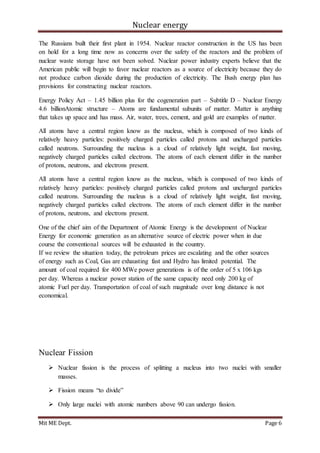
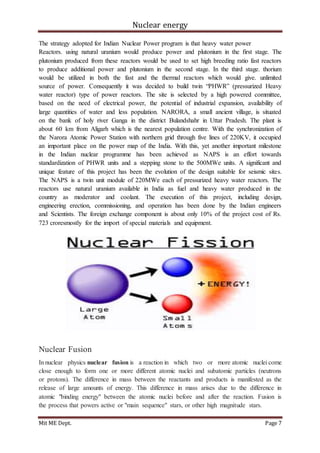
Nuclear Fission
 Nuclear fission is the process of splitting a nucleus into two nuclei with smaller
masses.
 Fission means “to divide”
 Only large nuclei with atomic numbers above 90 can undergo fission.
Nuclear energy
Mit ME Dept. Page 7
The strategy adopted for Indian Nuclear Power program is that heavy water power
Reactors. using natural uranium would produce power and plutonium in the first stage. The
plutonium produced from these reactors would be used to set high breeding ratio fast reactors
to produce additional power and plutonium in the second stage. In the third stage. thorium
would be utilized in both the fast and the thermal reactors which would give. unlimited
source of power. Consequently it was decided to build twin “PHWR” (pressurized Heavy
water reactor) type of power reactors. The site is selected by a high powered committee,
based on the need of electrical power, the potential of industrial expansion, availability of
large quantities of water and less population. NARORA, a small ancient village, is situated
on the bank of holy river Ganga in the district Bulandshahr in Uttar Pradesh. The plant is
about 60 km from Aligarh which is the nearest population centre. With the synchronization of
the Narora Atomic Power Station with northern grid through five lines of 220KV, it occupied
an important place on the power map of the India. With this, yet another important milestone
in the Indian nuclear programme has been achieved as NAPS is an effort towards
standardization of PHWR units and a stepping stone to the 500MWe units. A significant and
unique feature of this project has been the evolution of the design suitable for seismic sites.
The NAPS is a twin unit module of 220MWe each of pressurized heavy water reactors. The
reactors use natural uranium available in India as fuel and heavy water produced in the
country as moderator and coolant. The execution of this project, including design,
engineering erection, commissioning, and operation has been done by the Indian engineers
and Scientists. The foreign exchange component is about only 10% of the project cost of Rs.
723 croresmostly for the import of special materials and equipment.
Nuclear Fusion
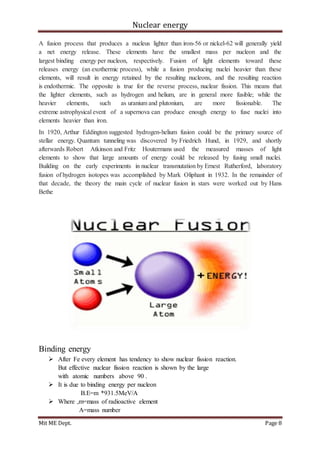
In nuclear physics nuclear fusion is a reaction in which two or more atomic nuclei come
close enough to form one or more different atomic nuclei and subatomic particles (neutrons
or protons). The difference in mass between the reactants and products is manifested as the
release of large amounts of energy. This difference in mass arises due to the difference in
atomic "binding energy" between the atomic nuclei before and after the reaction. Fusion is
the process that powers active or "main sequence" stars, or other high magnitude stars.
Nuclear energy
Mit ME Dept. Page 8
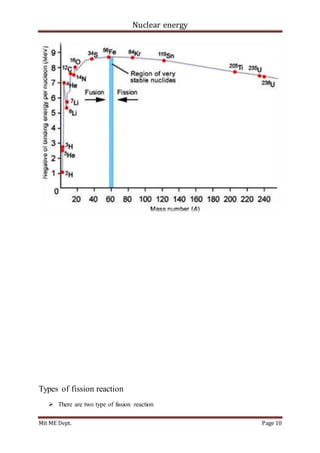
A fusion process that produces a nucleus lighter than iron-56 or nickel-62 will generally yield
a net energy release. These elements have the smallest mass per nucleon and the
largest binding energy per nucleon, respectively. Fusion of light elements toward these
releases energy (an exothermic process), while a fusion producing nuclei heavier than these
elements, will result in energy retained by the resulting nucleons, and the resulting reaction
is endothermic. The opposite is true for the reverse process, nuclear fission. This means that
the lighter elements, such as hydrogen and helium, are in general more fusible; while the
heavier elements, such as uranium and plutonium, are more fissionable. The
extreme astrophysical event of a supernova can produce enough energy to fuse nuclei into
elements heavier than iron.
In 1920, Arthur Eddington suggested hydrogen-helium fusion could be the primary source of
stellar energy. Quantum tunneling was discovered by Friedrich Hund, in 1929, and shortly
afterwards Robert Atkinson and Fritz Houtermans used the measured masses of light
elements to show that large amounts of energy could be released by fusing small nuclei.
Building on the early experiments in nuclear transmutation by Ernest Rutherford, laboratory
fusion of hydrogen isotopes was accomplished by Mark Oliphant in 1932. In the remainder of
that decade, the theory the main cycle of nuclear fusion in stars were worked out by Hans
Bethe
Binding energy
 After Fe every element has tendency to show nuclear fission reaction.
But effective nuclear fission reaction is shown by the large
with atomic numbers above 90 .
 It is due to binding energy per nucleon
B.E=m *931.5MeV/A
 Where ,m=mass of radioactive element
A=mass number
Nuclear energy
Mit ME Dept. Page 9
In general, binding energy represents the mechanical work that must be done against the
forces which hold an object together, disassembling the object into component parts
separated by sufficient distance that further separation requires negligible additional work.
In bound systems, if the binding energy is removed from the system, it must be subtracted
from the mass of the unbound system, simply because this energy has mass. Thus, if energy
is removed (or emitted) from the system at the time it is bound, the loss of energy from the
system will also result in the loss of the mass of the energy from the system.[1] System mass
is not conserved in this process because the system is "open" (i.e., is not an isolated system to
mass or energy input or loss) during the binding process.
There are several types of binding energy, each operating over a different distance and energy
scale. The smaller the scale of a bound system, the higher its associated binding energy.
Nuclear binding energy is the energy that would be required to disassemble the nucleus of
an atom into its component parts. These component parts are neutrons and protons which are
collectively called nucleons. The binding energy of nuclei is due to the attractive forces that
hold these nucleons together, and it is always a positive number, since all nuclei would
require the expenditure of energy to separate them into individual protons and neutrons.
The mass of an atomic nucleus is less than the sum of the individual masses of the
free constituent protons and neutrons (according to Einstein's equation E=mc2) and this
'missing mass' is known as the mass defect and represents the energy that was released when
the nucleus was formed.
The term "nuclear binding energy" may also refer to the energy balance in processes in which
the nucleus splits into fragments composed of more than one nucleon. If new binding
energy is available when light nuclei fuse, or when heavy nuclei split, either process can
result in release of this binding energy. This energy may be made available as nuclear
energy and can be used to produce electricity as in (nuclear power or in a nuclear weapon
When a large nucleus splits into pieces, excess energy is emitted as photons (gamma rays)
and as the kinetic energy of a number of different ejected particles (nuclear fission products).
The nuclear binding energies and forces are on the order of a million times greater than
the electron binding energies of light atoms like hydrogen.
The mass defect of a nucleus represents the mass of the energy of binding of the nucleus, and
is the difference between the mass of a nucleus and the sum of the masses of the nucleons of
which it is composed
Binding energy curve;
Nuclear energy
Mit ME Dept. Page 10
Types of fission reaction
 There are two type of fission reaction
Nuclear energy
Mit ME Dept. Page 11
1).uncontroled chain reaction
2). controled chain reaction
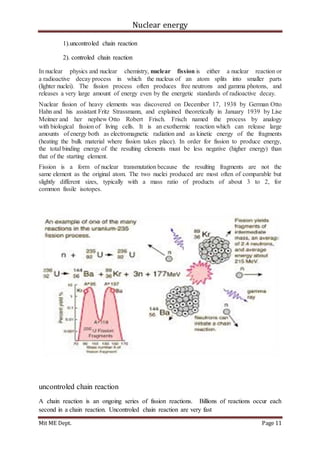
In nuclear physics and nuclear chemistry, nuclear fission is either a nuclear reaction or
a radioactive decay process in which the nucleus of an atom splits into smaller parts
(lighter nuclei). The fission process often produces free neutrons and gamma photons, and
releases a very large amount of energy even by the energetic standards of radioactive decay.
Nuclear fission of heavy elements was discovered on December 17, 1938 by German Otto
Hahn and his assistant Fritz Strassmann, and explained theoretically in January 1939 by Lise
Meitner and her nephew Otto Robert Frisch. Frisch named the process by analogy
with biological fission of living cells. It is an exothermic reaction which can release large
amounts of energy both as electromagnetic radiation and as kinetic energy of the fragments
(heating the bulk material where fission takes place). In order for fission to produce energy,
the total binding energy of the resulting elements must be less negative (higher energy) than
that of the starting element.
Fission is a form of nuclear transmutation because the resulting fragments are not the
same element as the original atom. The two nuclei produced are most often of comparable but
slightly different sizes, typically with a mass ratio of products of about 3 to 2, for
common fissile isotopes.
uncontroled chain reaction
A chain reaction is an ongoing series of fission reactions. Billions of reactions occur each
second in a chain reaction. Uncontroled chain reaction are very fast
Nuclear energy
Mit ME Dept. Page 12
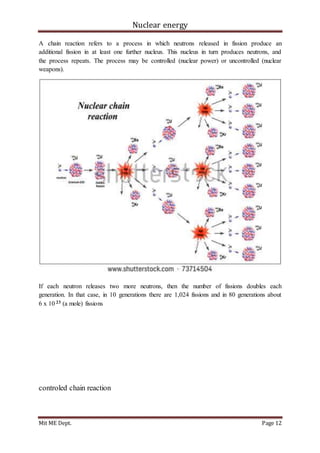
A chain reaction refers to a process in which neutrons released in fission produce an
additional fission in at least one further nucleus. This nucleus in turn produces neutrons, and
the process repeats. The process may be controlled (nuclear power) or uncontrolled (nuclear
weapons).
If each neutron releases two more neutrons, then the number of fissions doubles each
generation. In that case, in 10 generations there are 1,024 fissions and in 80 generations about
6 x 10 23 (a mole) fissions
controled chain reaction
Nuclear energy
Mit ME Dept. Page 13
During detoration of nuclear bomb.When nuclear bomb detorate then it undergoes
uncontrolled fission reaction.
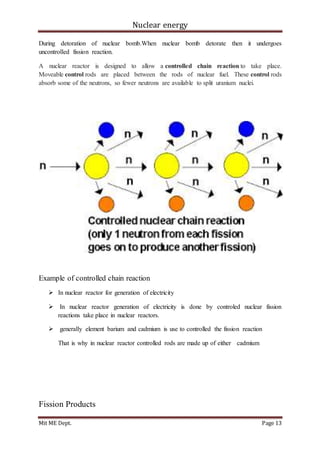
A nuclear reactor is designed to allow a controlled chain reaction to take place.
Moveable control rods are placed between the rods of nuclear fuel. These control rods
absorb some of the neutrons, so fewer neutrons are available to split uranium nuclei.
Example of controlled chain reaction
 In nuclear reactor for generation of electricity
 In nuclear reactor generation of electricity is done by controled nuclear fission
reactions take place in nuclear reactors.
 generally element barium and cadmium is use to controlled the fission reaction
That is why in nuclear reactor controlled rods are made up of either cadmium
Fission Products
Nuclear energy
Mit ME Dept. Page 14
The products of nuclear fission reactions are radioactive, but the energy released from these
reactions is less harmful to the environment than the use of fossil fuels. The products are
intensely radioactive and must be treated or stored.
Nuclear fission products are the atomic fragments left after a large atomic nucleus
undergoes nuclear fission. Typically, a large nucleus like that of uranium fissions by splitting
into two smaller nuclei, along with a few neutron, the release of heat energy (kinetic energy
of the nuclei), and gamma rays. The two smaller nuclei are the fission products. (See
also Fission products (by element)).
About 0.2% to 0.4% of fissions are ternary fissions, producing a third light nucleus such
as helium-4 (90%) or tritium (7%).
The fission products themselves are usually unstable and therefore radioactive; due to being
relatively neutron-rich for their atomic number, many of them quickly undergo beta decay.
This releases additional energy in the form of beta particles, antineutrinos, and gamma rays.
Thus, fission events normally result in beta and gamma radiation, even though this radiation
is not produced directly by the fission event itself.
The produced radionuclides have varying half-lives, and therefore vary in radioactivity. For
instance, strontium-89 and strontium-90 are produced in similar quantities in fission, and
each nucleus decays by beta emission. But 90Sr has a 30-year half-life, and 89Sr a 50.5-day
half-life. Thus in the 50.5 days it takes half the 89Sr atoms to decay, emitting the same
number of beta particles as there were decays, less than 0.4% of the 90Sr atoms have decayed,
emitting only 0.4% of the betas. The radioactive emission rate is highest for the shortest lived
radionuclides, although they also decay the fastest. Additionally, less stable fission products
are less likely to decay to stable nuclides, instead decaying to other radionuclides, which
undergo further decay and radiation emission, adding to the radiation output. It is these short
lived fission products that are the immediate hazard of spent fuel, and the energy output of
the radiation also generates significant heat which must be considered when storing spent
fuel. As there are hundreds of different radionuclides created, the initial radioactivity level
fades quickly as short lived radionuclides decay.
Advantages of Nuclear energy
Nuclear energy
Mit ME Dept. Page 15
• Clean
• Plentiful Supply
• High energy content in uranium
– Small fuel pellet
– Can provide base load power
– Energy savings in transportation
• Operating cost is low after construction
Disadvantage of using Nuclear energy
• Clean
• Plentiful Supply
• High energy content in uranium
– Small fuel pellet
– Can provide base load power
– Energy savings in transportation
• Operating cost is low after construction
Nuclear energy
Mit ME Dept. Page 16
j

Nuclear Energy

  • 1.
    Nuclear energy Mit MEDept. Page 1 A Seminar report On- Introduction of Nuclear Energy Submitted in partial fulfillment of the requirement for the award of degree of BACHELOR OF TECHNOLOGY in MECHANICAL ENGG. by Seminar Guide: Seminar Coordinator: (Assistant professor) DEPARTMENT OF MECHANICAL ENGINEERING MORADABAD INSTITUTE OF TEHCNOLOGY RAMGANGA VIHAR, PHASE-2, MORADABAD- 244001 (U.P.) Session: 2017-201 Moradabad Institute of Technology DEPARTMENT OF MECHANICAL ENGINEERING
  • 2.
    Nuclear energy Mit MEDept. Page 2 MORADABAD-244001 Session 2017–2018 CERTIFICATE This is to certify that student name Student of B.Tech. Third year, Mechanical branch, college name, Moradabad have successfully completed his project entitled “Nuclear energy”under our guidance and supervision. While Gleaming the required information and styling the report he was found pretty sincere and devoted. The report produced him is completely authentic proof of his dedicated efforts. The assistance and help taken during the course of the work has been duly acknowledged and the source of literature amply recorded. SeminarGuide (Assistant professor) Acknowledgement I would like to thank respected Mr. Rakesh Kumar Gangwar and Mr. Arvind Kumar Singh for giving me such a wonderful opportunity to expand my knowledge for my own branch and giving me guidelines to present a seminar report. It helped me a lot to realize of what we study for. Secondly, I would like to thank my parents who patiently helped me as i went
  • 3.
    Nuclear energy Mit MEDept. Page 3 through my work and helped to modify and eliminate some of the irrelevant or un-necessary stuffs. Thirdly, I would like to thank my friends who helped me to make my work more organized and well-stacked till the end. Next, I would thank Microsoft for developing such a wonderful tool like MS Word. It helped my work a lot to remain error-free. Last but clearly not the least, I would thank The Almighty for giving me strength to complete my report on time. Signature………………. Name ……………….. Roll no ……………….. Date ……………….. Content Page No. INTRODUCTION 5 a) By nuclear fission 7 b) By nuclear fusion 8
  • 4.
    Nuclear energy Mit MEDept. Page 4 Binding energy 9 Binding energy curve 10 Types of fission reaction 11 a) Un-controled chain reaction 12 b) Controled chain reaction 13 Fission product 14 Advantage of nuclear energy 15 Disadvantages of nuclear energy 15 INTRODUCTION Energy emitted during detoration of heavy radioactive element or during combining of two lighter radioactive element is called nuclear energy. Nuclear reaction takes place in two ways a) By nuclear fission
  • 5.
    Nuclear energy Mit MEDept. Page 5 b) by nuclear fusion Energy from disintegrating atomic nuclei has a tremendous potential to do good for the people of the world. We routinely use X-rays to examine for fractures, treat cancer with radiation and diagnose disease with the use or radioactive isotopes. About 17% of the energy in the world comes from nuclear power plants. The first controlled fission of an atom occurred in 1938 in Germany. The US was the first to develop an atomic bomb. In 1945, the US military dropped bombs on the Japanese cities of Hiroshima and Nagasaki. During the 50 years following WWII, the two major super powers conducted secret projects related to the building and testing bombs After WWII many people began to see the potential for using nuclear energy for peaceful purposes. The world’s first electricity generating reactor was constructed in the US in 1951. In December 1953, President Dwight D. Eisenhower, in his “Atoms for Peace” speech said, “Nuclear reactors will produce electricity so cheaply that it will not be necessary to meter it. The user will pay an annual fee and use as much electricity as they want. Atoms will provide a safe, clean, and dependable source of electricity.”
  • 6.
    Nuclear energy Mit MEDept. Page 6 The Russians built their first plant in 1954. Nuclear reactor construction in the US has been on hold for a long time now as concerns over the safety of the reactors and the problem of nuclear waste storage have not been solved. Nuclear power industry experts believe that the American public will begin to favor nuclear reactors as a source of electricity because they do not produce carbon dioxide during the production of electricity. The Bush energy plan has provisions for constructing nuclear reactors. Energy Policy Act – 1.45 billion plus for the cogeneration part – Subtitle D – Nuclear Energy 4.6 billionAtomic structure – Atoms are fundamental subunits of matter. Matter is anything that takes up space and has mass. Air, water, trees, cement, and gold are examples of matter. All atoms have a central region know as the nucleus, which is composed of two kinds of relatively heavy particles: positively charged particles called protons and uncharged particles called neutrons. Surrounding the nucleus is a cloud of relatively light weight, fast moving, negatively charged particles called electrons. The atoms of each element differ in the number of protons, neutrons, and electrons present. All atoms have a central region know as the nucleus, which is composed of two kinds of relatively heavy particles: positively charged particles called protons and uncharged particles called neutrons. Surrounding the nucleus is a cloud of relatively light weight, fast moving, negatively charged particles called electrons. The atoms of each element differ in the number of protons, neutrons, and electrons present. One of the chief aim of the Department of Atomic Energy is the development of Nuclear Energy for economic generation as an alternative source of electric power when in due course the conventional sources will be exhausted in the country. If we review the situation today, the petroleum prices are escalating and the other sources of energy such as Coal, Gas are exhausting fast and Hydro has limited potential. The amount of coal required for 400 MWe power generations is of the order of 5 x 10⁶ kgs per day. Whereas a nuclear power station of the same capacity need only 200 kg of atomic Fuel per day. Transportation of coal of such magnitude over long distance is not economical. Nuclear Fission  Nuclear fission is the process of splitting a nucleus into two nuclei with smaller masses.  Fission means “to divide”  Only large nuclei with atomic numbers above 90 can undergo fission.
  • 7.
    Nuclear energy Mit MEDept. Page 7 The strategy adopted for Indian Nuclear Power program is that heavy water power Reactors. using natural uranium would produce power and plutonium in the first stage. The plutonium produced from these reactors would be used to set high breeding ratio fast reactors to produce additional power and plutonium in the second stage. In the third stage. thorium would be utilized in both the fast and the thermal reactors which would give. unlimited source of power. Consequently it was decided to build twin “PHWR” (pressurized Heavy water reactor) type of power reactors. The site is selected by a high powered committee, based on the need of electrical power, the potential of industrial expansion, availability of large quantities of water and less population. NARORA, a small ancient village, is situated on the bank of holy river Ganga in the district Bulandshahr in Uttar Pradesh. The plant is about 60 km from Aligarh which is the nearest population centre. With the synchronization of the Narora Atomic Power Station with northern grid through five lines of 220KV, it occupied an important place on the power map of the India. With this, yet another important milestone in the Indian nuclear programme has been achieved as NAPS is an effort towards standardization of PHWR units and a stepping stone to the 500MWe units. A significant and unique feature of this project has been the evolution of the design suitable for seismic sites. The NAPS is a twin unit module of 220MWe each of pressurized heavy water reactors. The reactors use natural uranium available in India as fuel and heavy water produced in the country as moderator and coolant. The execution of this project, including design, engineering erection, commissioning, and operation has been done by the Indian engineers and Scientists. The foreign exchange component is about only 10% of the project cost of Rs. 723 croresmostly for the import of special materials and equipment. Nuclear Fusion In nuclear physics nuclear fusion is a reaction in which two or more atomic nuclei come close enough to form one or more different atomic nuclei and subatomic particles (neutrons or protons). The difference in mass between the reactants and products is manifested as the release of large amounts of energy. This difference in mass arises due to the difference in atomic "binding energy" between the atomic nuclei before and after the reaction. Fusion is the process that powers active or "main sequence" stars, or other high magnitude stars.
  • 8.
    Nuclear energy Mit MEDept. Page 8 A fusion process that produces a nucleus lighter than iron-56 or nickel-62 will generally yield a net energy release. These elements have the smallest mass per nucleon and the largest binding energy per nucleon, respectively. Fusion of light elements toward these releases energy (an exothermic process), while a fusion producing nuclei heavier than these elements, will result in energy retained by the resulting nucleons, and the resulting reaction is endothermic. The opposite is true for the reverse process, nuclear fission. This means that the lighter elements, such as hydrogen and helium, are in general more fusible; while the heavier elements, such as uranium and plutonium, are more fissionable. The extreme astrophysical event of a supernova can produce enough energy to fuse nuclei into elements heavier than iron. In 1920, Arthur Eddington suggested hydrogen-helium fusion could be the primary source of stellar energy. Quantum tunneling was discovered by Friedrich Hund, in 1929, and shortly afterwards Robert Atkinson and Fritz Houtermans used the measured masses of light elements to show that large amounts of energy could be released by fusing small nuclei. Building on the early experiments in nuclear transmutation by Ernest Rutherford, laboratory fusion of hydrogen isotopes was accomplished by Mark Oliphant in 1932. In the remainder of that decade, the theory the main cycle of nuclear fusion in stars were worked out by Hans Bethe Binding energy  After Fe every element has tendency to show nuclear fission reaction. But effective nuclear fission reaction is shown by the large with atomic numbers above 90 .  It is due to binding energy per nucleon B.E=m *931.5MeV/A  Where ,m=mass of radioactive element A=mass number
  • 9.
    Nuclear energy Mit MEDept. Page 9 In general, binding energy represents the mechanical work that must be done against the forces which hold an object together, disassembling the object into component parts separated by sufficient distance that further separation requires negligible additional work. In bound systems, if the binding energy is removed from the system, it must be subtracted from the mass of the unbound system, simply because this energy has mass. Thus, if energy is removed (or emitted) from the system at the time it is bound, the loss of energy from the system will also result in the loss of the mass of the energy from the system.[1] System mass is not conserved in this process because the system is "open" (i.e., is not an isolated system to mass or energy input or loss) during the binding process. There are several types of binding energy, each operating over a different distance and energy scale. The smaller the scale of a bound system, the higher its associated binding energy. Nuclear binding energy is the energy that would be required to disassemble the nucleus of an atom into its component parts. These component parts are neutrons and protons which are collectively called nucleons. The binding energy of nuclei is due to the attractive forces that hold these nucleons together, and it is always a positive number, since all nuclei would require the expenditure of energy to separate them into individual protons and neutrons. The mass of an atomic nucleus is less than the sum of the individual masses of the free constituent protons and neutrons (according to Einstein's equation E=mc2) and this 'missing mass' is known as the mass defect and represents the energy that was released when the nucleus was formed. The term "nuclear binding energy" may also refer to the energy balance in processes in which the nucleus splits into fragments composed of more than one nucleon. If new binding energy is available when light nuclei fuse, or when heavy nuclei split, either process can result in release of this binding energy. This energy may be made available as nuclear energy and can be used to produce electricity as in (nuclear power or in a nuclear weapon When a large nucleus splits into pieces, excess energy is emitted as photons (gamma rays) and as the kinetic energy of a number of different ejected particles (nuclear fission products). The nuclear binding energies and forces are on the order of a million times greater than the electron binding energies of light atoms like hydrogen. The mass defect of a nucleus represents the mass of the energy of binding of the nucleus, and is the difference between the mass of a nucleus and the sum of the masses of the nucleons of which it is composed Binding energy curve;
  • 10.
    Nuclear energy Mit MEDept. Page 10 Types of fission reaction  There are two type of fission reaction
  • 11.
    Nuclear energy Mit MEDept. Page 11 1).uncontroled chain reaction 2). controled chain reaction In nuclear physics and nuclear chemistry, nuclear fission is either a nuclear reaction or a radioactive decay process in which the nucleus of an atom splits into smaller parts (lighter nuclei). The fission process often produces free neutrons and gamma photons, and releases a very large amount of energy even by the energetic standards of radioactive decay. Nuclear fission of heavy elements was discovered on December 17, 1938 by German Otto Hahn and his assistant Fritz Strassmann, and explained theoretically in January 1939 by Lise Meitner and her nephew Otto Robert Frisch. Frisch named the process by analogy with biological fission of living cells. It is an exothermic reaction which can release large amounts of energy both as electromagnetic radiation and as kinetic energy of the fragments (heating the bulk material where fission takes place). In order for fission to produce energy, the total binding energy of the resulting elements must be less negative (higher energy) than that of the starting element. Fission is a form of nuclear transmutation because the resulting fragments are not the same element as the original atom. The two nuclei produced are most often of comparable but slightly different sizes, typically with a mass ratio of products of about 3 to 2, for common fissile isotopes. uncontroled chain reaction A chain reaction is an ongoing series of fission reactions. Billions of reactions occur each second in a chain reaction. Uncontroled chain reaction are very fast
  • 12.
    Nuclear energy Mit MEDept. Page 12 A chain reaction refers to a process in which neutrons released in fission produce an additional fission in at least one further nucleus. This nucleus in turn produces neutrons, and the process repeats. The process may be controlled (nuclear power) or uncontrolled (nuclear weapons). If each neutron releases two more neutrons, then the number of fissions doubles each generation. In that case, in 10 generations there are 1,024 fissions and in 80 generations about 6 x 10 23 (a mole) fissions controled chain reaction
  • 13.
    Nuclear energy Mit MEDept. Page 13 During detoration of nuclear bomb.When nuclear bomb detorate then it undergoes uncontrolled fission reaction. A nuclear reactor is designed to allow a controlled chain reaction to take place. Moveable control rods are placed between the rods of nuclear fuel. These control rods absorb some of the neutrons, so fewer neutrons are available to split uranium nuclei. Example of controlled chain reaction  In nuclear reactor for generation of electricity  In nuclear reactor generation of electricity is done by controled nuclear fission reactions take place in nuclear reactors.  generally element barium and cadmium is use to controlled the fission reaction That is why in nuclear reactor controlled rods are made up of either cadmium Fission Products
  • 14.
    Nuclear energy Mit MEDept. Page 14 The products of nuclear fission reactions are radioactive, but the energy released from these reactions is less harmful to the environment than the use of fossil fuels. The products are intensely radioactive and must be treated or stored. Nuclear fission products are the atomic fragments left after a large atomic nucleus undergoes nuclear fission. Typically, a large nucleus like that of uranium fissions by splitting into two smaller nuclei, along with a few neutron, the release of heat energy (kinetic energy of the nuclei), and gamma rays. The two smaller nuclei are the fission products. (See also Fission products (by element)). About 0.2% to 0.4% of fissions are ternary fissions, producing a third light nucleus such as helium-4 (90%) or tritium (7%). The fission products themselves are usually unstable and therefore radioactive; due to being relatively neutron-rich for their atomic number, many of them quickly undergo beta decay. This releases additional energy in the form of beta particles, antineutrinos, and gamma rays. Thus, fission events normally result in beta and gamma radiation, even though this radiation is not produced directly by the fission event itself. The produced radionuclides have varying half-lives, and therefore vary in radioactivity. For instance, strontium-89 and strontium-90 are produced in similar quantities in fission, and each nucleus decays by beta emission. But 90Sr has a 30-year half-life, and 89Sr a 50.5-day half-life. Thus in the 50.5 days it takes half the 89Sr atoms to decay, emitting the same number of beta particles as there were decays, less than 0.4% of the 90Sr atoms have decayed, emitting only 0.4% of the betas. The radioactive emission rate is highest for the shortest lived radionuclides, although they also decay the fastest. Additionally, less stable fission products are less likely to decay to stable nuclides, instead decaying to other radionuclides, which undergo further decay and radiation emission, adding to the radiation output. It is these short lived fission products that are the immediate hazard of spent fuel, and the energy output of the radiation also generates significant heat which must be considered when storing spent fuel. As there are hundreds of different radionuclides created, the initial radioactivity level fades quickly as short lived radionuclides decay. Advantages of Nuclear energy
  • 15.
    Nuclear energy Mit MEDept. Page 15 • Clean • Plentiful Supply • High energy content in uranium – Small fuel pellet – Can provide base load power – Energy savings in transportation • Operating cost is low after construction Disadvantage of using Nuclear energy • Clean • Plentiful Supply • High energy content in uranium – Small fuel pellet – Can provide base load power – Energy savings in transportation • Operating cost is low after construction
  • 16.
    Nuclear energy Mit MEDept. Page 16 j