Program: Diploma (Mechanical)
Class: TY (ME) Semester: V
Course: Power Plant Engineering
Code: 22566
LECTURE 15:
Unit: 5. Nuclear Power Plants
02
wwwwwwwwwwww....ssssaaaannnnddddiiiippppffffoooouuuunnnnddddaaaattttiiiioooonnnn....oooorrrrggggMechanical Engineering Department, Sandip Polytechnic, NashikMechanical Engineering Department, Sandip Polytechnic, NashikMechanical Engineering Department, Sandip Polytechnic, NashikMechanical Engineering Department, Sandip Polytechnic, Nashik
Name of theName of theName of theName of the Trainer : Prof. Rushikesh Deoram SonarTrainer : Prof. Rushikesh Deoram SonarTrainer : Prof. Rushikesh Deoram SonarTrainer : Prof. Rushikesh Deoram Sonar
Years ofYears ofYears ofYears of Experience : 10Experience : 10Experience : 10Experience : 10
DomainDomainDomainDomain Expertise : Mechanical EngineeringExpertise : Mechanical EngineeringExpertise : Mechanical EngineeringExpertise : Mechanical Engineering
Qualification: M.E. (Design Engineering)Qualification: M.E. (Design Engineering)Qualification: M.E. (Design Engineering)Qualification: M.E. (Design Engineering)
Contact Details:Contact Details:Contact Details:Contact Details:
+91 9890481959+91 9890481959+91 9890481959+91 9890481959
rushikesh.sonar@sandippolytechnic.orgrushikesh.sonar@sandippolytechnic.orgrushikesh.sonar@sandippolytechnic.orgrushikesh.sonar@sandippolytechnic.org
03Unit V: Nuclear Power Plants
TOPICS COVERED IN PREVIOUS LECTURE
5.1 Nuclear Power Plants :5.1 Nuclear Power Plants :5.1 Nuclear Power Plants :5.1 Nuclear Power Plants :----
* Classification* Classification* Classification* Classification
* General arrangement* General arrangement* General arrangement* General arrangement
* Operating Principles* Operating Principles* Operating Principles* Operating Principles
wwwwwwwwwwww....ssssaaaannnnddddiiiippppffffoooouuuunnnnddddaaaattttiiiioooonnnn....oooorrrrggggMechanical Engineering Department, Sandip Polytechnic, NashikMechanical Engineering Department, Sandip Polytechnic, NashikMechanical Engineering Department, Sandip Polytechnic, NashikMechanical Engineering Department, Sandip Polytechnic, Nashik
TOPICS TO BE COVERED IN THIS LECTURE
5.2 Nuclear Fuels & Nuclear Reactors5.2 Nuclear Fuels & Nuclear Reactors5.2 Nuclear Fuels & Nuclear Reactors5.2 Nuclear Fuels & Nuclear Reactors
5.3 Adv. & Disadv. Of Nuclear Power Plants5.3 Adv. & Disadv. Of Nuclear Power Plants5.3 Adv. & Disadv. Of Nuclear Power Plants5.3 Adv. & Disadv. Of Nuclear Power Plants
5.4 Introduction to AERB and IAEA5.4 Introduction to AERB and IAEA5.4 Introduction to AERB and IAEA5.4 Introduction to AERB and IAEA
04Unit V: Nuclear Power Plants
5.2.1: NUCLEAR FUELS: INTRODUCTION
Fuel of a nuclear reactor should be fissionable material which can be defined as an element or isotope whose nuclei can be caused
to undergo nuclear fission by nuclear bombardment and to produce a fission chain reaction. It can be one or all of the following :
U233, U235 and Pu239
Natural uranium found in earth crust contains three isotopes namely U234, U235 and U238 and their average percentage is as
follows :
U238 – 99.3% U235 – 0.7 % U234 – Trace
wwwwwwwwwwww....ssssaaaannnnddddiiiippppffffoooouuuunnnnddddaaaattttiiiioooonnnn....oooorrrrggggMechanical Engineering Department, Sandip Polytechnic, NashikMechanical Engineering Department, Sandip Polytechnic, NashikMechanical Engineering Department, Sandip Polytechnic, NashikMechanical Engineering Department, Sandip Polytechnic, Nashik
U238 – 99.3% U235 – 0.7 % U234 – Trace
Out of these U233 is most unstable and is capable of sustaining chain reaction and has been given the name as primary fuel.
U233 and Pu239 are artificially produced from Th232 and U238 respectively and are called secondary fuel.
Pu239 and U233 so produced can be fissioned by thermal neutrons. Nuclear fuel should not be expensive to fabricate.
It should be able to operate at high temperatures and should be resistant to radiation damage.
05Unit V: Nuclear Power Plants
5.2.1: NUCLEAR FUELS: URANIUM OXIDE (UO2) OVER NATURAL URANIUM :
ADVANTAGES
1. It is more stable than natural uranium.
2. There is no problem of phase change in case of uranium oxide and therefore it can be used for higher
temperatures.
3. It does not corrode as easily as natural uranium.
4. It is more compatible with most of the coolants and is not attacked by H2, N2.
5. There is greater dimensional stability during use.
wwwwwwwwwwww....ssssaaaannnnddddiiiippppffffoooouuuunnnnddddaaaattttiiiioooonnnn....oooorrrrggggMechanical Engineering Department, Sandip Polytechnic, NashikMechanical Engineering Department, Sandip Polytechnic, NashikMechanical Engineering Department, Sandip Polytechnic, NashikMechanical Engineering Department, Sandip Polytechnic, Nashik
DISADVANTAGES
1. It has low thermal conductivity.
2. It is more brittle than natural uranium and therefore it can break due to thermal stresses.
3. Its enrichment is essential.
06Unit V: Nuclear Power Plants
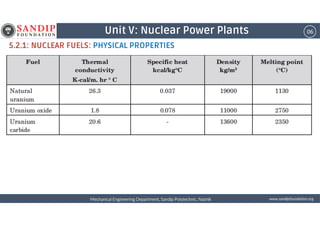
5.2.1: NUCLEAR FUELS: PHYSICAL PROPERTIES
wwwwwwwwwwww....ssssaaaannnnddddiiiippppffffoooouuuunnnnddddaaaattttiiiioooonnnn....oooorrrrggggMechanical Engineering Department, Sandip Polytechnic, NashikMechanical Engineering Department, Sandip Polytechnic, NashikMechanical Engineering Department, Sandip Polytechnic, NashikMechanical Engineering Department, Sandip Polytechnic, Nashik
07Unit V: Nuclear Power Plants
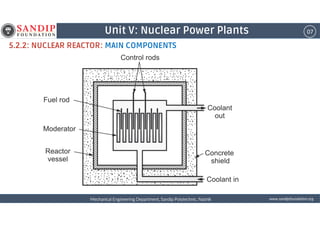
5.2.2: NUCLEAR REACTOR: MAIN COMPONENTS
wwwwwwwwwwww....ssssaaaannnnddddiiiippppffffoooouuuunnnnddddaaaattttiiiioooonnnn....oooorrrrggggMechanical Engineering Department, Sandip Polytechnic, NashikMechanical Engineering Department, Sandip Polytechnic, NashikMechanical Engineering Department, Sandip Polytechnic, NashikMechanical Engineering Department, Sandip Polytechnic, Nashik
08Unit V: Nuclear Power Plants
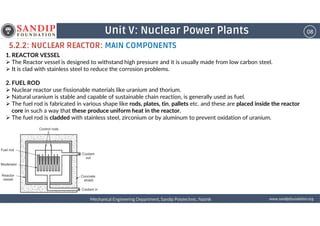
5.2.2: NUCLEAR REACTOR: MAIN COMPONENTS
1. REACTOR VESSEL
The Reactor vessel is designed to withstand high pressure and it is usually made from low carbon steel.
It is clad with stainless steel to reduce the corrosion problems.
2. FUEL ROD
Nuclear reactor use fissionable materials like uranium and thorium.
Natural uranium is stable and capable of sustainable chain reaction, is generally used as fuel.
The fuel rod is fabricated in various shape like rods, plates, tin, pallets etc. and these are placed inside the reactor
core in such a way that these produce uniform heat in the reactor.
wwwwwwwwwwww....ssssaaaannnnddddiiiippppffffoooouuuunnnnddddaaaattttiiiioooonnnn....oooorrrrggggMechanical Engineering Department, Sandip Polytechnic, NashikMechanical Engineering Department, Sandip Polytechnic, NashikMechanical Engineering Department, Sandip Polytechnic, NashikMechanical Engineering Department, Sandip Polytechnic, Nashik
core in such a way that these produce uniform heat in the reactor.
The fuel rod is cladded with stainless steel, zirconium or by aluminum to prevent oxidation of uranium.
09Unit V: Nuclear Power Plants
5.2.2: NUCLEAR REACTOR: MAIN COMPONENTS
3. MODERATOR
The moderator are the substances which help in reducing the speed of neutrons and make them to lose
their kinetic energy by collisions but at the same time do not absorb them but scatters them.
Reduce velocity of neutrons up to thermal speed help in maintaining the fission chain reaction in the
reactor, when the ordinary uranium is used.
The moderators are lighter than fuel. Various materials used for moderators are Light Water (H2O),
Deuterium or Heavy Water (D2O), Graphite and Beryllium.
wwwwwwwwwwww....ssssaaaannnnddddiiiippppffffoooouuuunnnnddddaaaattttiiiioooonnnn....oooorrrrggggMechanical Engineering Department, Sandip Polytechnic, NashikMechanical Engineering Department, Sandip Polytechnic, NashikMechanical Engineering Department, Sandip Polytechnic, NashikMechanical Engineering Department, Sandip Polytechnic, Nashik
10Unit V: Nuclear Power Plants
5.2.2: NUCLEAR REACTOR: MAIN COMPONENTS
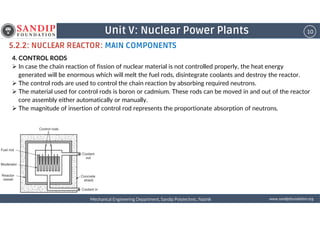
4. CONTROL RODS
In case the chain reaction of fission of nuclear material is not controlled properly, the heat energy
generated will be enormous which will melt the fuel rods, disintegrate coolants and destroy the reactor.
The control rods are used to control the chain reaction by absorbing required neutrons.
The material used for control rods is boron or cadmium. These rods can be moved in and out of the reactor
core assembly either automatically or manually.
The magnitude of insertion of control rod represents the proportionate absorption of neutrons.
wwwwwwwwwwww....ssssaaaannnnddddiiiippppffffoooouuuunnnnddddaaaattttiiiioooonnnn....oooorrrrggggMechanical Engineering Department, Sandip Polytechnic, NashikMechanical Engineering Department, Sandip Polytechnic, NashikMechanical Engineering Department, Sandip Polytechnic, NashikMechanical Engineering Department, Sandip Polytechnic, Nashik
11Unit V: Nuclear Power Plants
5.2.2: NUCLEAR REACTOR: MAIN COMPONENTS
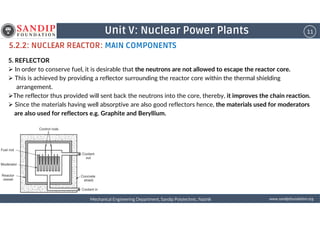
5. REFLECTOR
In order to conserve fuel, it is desirable that the neutrons are not allowed to escape the reactor core.
This is achieved by providing a reflector surrounding the reactor core within the thermal shielding
arrangement.
The reflector thus provided will sent back the neutrons into the core, thereby, it improves the chain reaction.
Since the materials having well absorptive are also good reflectors hence, the materials used for moderators
are also used for reflectors e.g. Graphite and Beryllium.
wwwwwwwwwwww....ssssaaaannnnddddiiiippppffffoooouuuunnnnddddaaaattttiiiioooonnnn....oooorrrrggggMechanical Engineering Department, Sandip Polytechnic, NashikMechanical Engineering Department, Sandip Polytechnic, NashikMechanical Engineering Department, Sandip Polytechnic, NashikMechanical Engineering Department, Sandip Polytechnic, Nashik
are also used for reflectors e.g. Graphite and Beryllium.
12Unit V: Nuclear Power Plants
5.2.2: NUCLEAR REACTOR: MAIN COMPONENTS
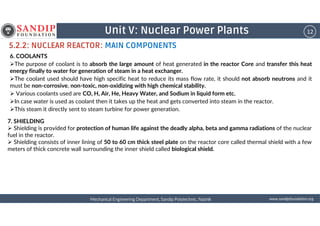
6. COOLANTS
The purpose of coolant is to absorb the large amount of heat generated in the reactor Core and transfer this heat
energy finally to water for generation of steam in a heat exchanger.
The coolant used should have high specific heat to reduce its mass flow rate, it should not absorb neutrons and it
must be non-corrosive, non-toxic, non-oxidizing with high chemical stability.
Various coolants used are CO, H, Air, He, Heavy Water, and Sodium in liquid form etc.
In case water is used as coolant then it takes up the heat and gets converted into steam in the reactor.
This steam it directly sent to steam turbine for power generation.
wwwwwwwwwwww....ssssaaaannnnddddiiiippppffffoooouuuunnnnddddaaaattttiiiioooonnnn....oooorrrrggggMechanical Engineering Department, Sandip Polytechnic, NashikMechanical Engineering Department, Sandip Polytechnic, NashikMechanical Engineering Department, Sandip Polytechnic, NashikMechanical Engineering Department, Sandip Polytechnic, Nashik
7. SHIELDING
Shielding is provided for protection of human life against the deadly alpha, beta and gamma radiations of the nuclear
fuel in the reactor.
Shielding consists of inner lining of 50 to 60 cm thick steel plate on the reactor core called thermal shield with a few
meters of thick concrete wall surrounding the inner shield called biological shield.
13Unit V: Nuclear Power Plants
5.2.3: NUCLEAR REACTOR: CLASSIFICATION
1. BASED ON NEUTRON ENERGY
a) Fast reactors
b) Slow or thermal
c) Intermediate reactors
2. BASED ON TYPE OF FUEL USED
a) Natural Uranium Fuel Reactors : In this reactors the natural fuel is used as fuel
b) Enriched Uranium Fuel Reactors : In this reactor the enriched uranium of 5 to 10% of U235 is used as fuel.
wwwwwwwwwwww....ssssaaaannnnddddiiiippppffffoooouuuunnnnddddaaaattttiiiioooonnnn....oooorrrrggggMechanical Engineering Department, Sandip Polytechnic, NashikMechanical Engineering Department, Sandip Polytechnic, NashikMechanical Engineering Department, Sandip Polytechnic, NashikMechanical Engineering Department, Sandip Polytechnic, Nashik
3. BASED ON COOLANT USED
a) Water Cooled Reactors
b) Heavy Water Cooled Reactors
c) Liquid Metal (Sodium Or Bismuth) Cooled Reactors
d) Gas Cooled Reactors
4. BASED ON MODERATORS USED 5. BASED ON TYPE OF CORE USED
a) Water & Heavy Water Reactors a) Homogeneous reactors
b) Graphite Reactors b) Heterogeneous Reactors
c) Beryllium Reactors
14Unit V: Nuclear Power Plants
5.3: NUCLEAR REACTOR POWER PLANTS: TYPES
1. Thermal Reactor
1. Pressurized Water Reactor (PWR) Power Plant
2. Boiling Water Reactor (BWR) Power Plant
3. Gas Cooled Reactor (GCR) Power Plant
2. Fast Breeder Reactors
1. Liquid Metal Fast Breeder Reactor (LMFBR)
wwwwwwwwwwww....ssssaaaannnnddddiiiippppffffoooouuuunnnnddddaaaattttiiiioooonnnn....oooorrrrggggMechanical Engineering Department, Sandip Polytechnic, NashikMechanical Engineering Department, Sandip Polytechnic, NashikMechanical Engineering Department, Sandip Polytechnic, NashikMechanical Engineering Department, Sandip Polytechnic, Nashik
1. Liquid Metal Fast Breeder Reactor (LMFBR)
15Unit V: Nuclear Power Plants
5.3.1 : NUCLEAR REACTOR: Pressurized Water Reactor (PWR) Power Plant
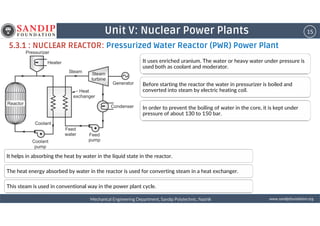
It uses enriched uranium. The water or heavy water under pressure is
used both as coolant and moderator.
Before starting the reactor the water in pressurizer is boiled and
converted into steam by electric heating coil.
In order to prevent the boiling of water in the core, it is kept under
pressure of about 130 to 150 bar.
wwwwwwwwwwww....ssssaaaannnnddddiiiippppffffoooouuuunnnnddddaaaattttiiiioooonnnn....oooorrrrggggMechanical Engineering Department, Sandip Polytechnic, NashikMechanical Engineering Department, Sandip Polytechnic, NashikMechanical Engineering Department, Sandip Polytechnic, NashikMechanical Engineering Department, Sandip Polytechnic, Nashik
pressure of about 130 to 150 bar.
It helps in absorbing the heat by water in the liquid state in the reactor.
The heat energy absorbed by water in the reactor is used for converting steam in a heat exchanger.
This steam is used in conventional way in the power plant cycle.
16Unit V: Nuclear Power Plants
5.3.1 : NUCLEAR REACTOR: Pressurized Water Reactor (PWR) Power Plant
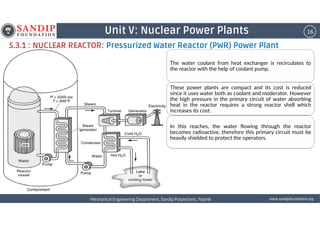
The water coolant from heat exchanger is recirculates to
the reactor with the help of coolant pump.
These power plants are compact and its cost is reduced
since it uses water both as coolant and moderator. However
the high pressure in the primary circuit of water absorbing
heat in the reactor requires a strong reactor shell which
increases its cost.
wwwwwwwwwwww....ssssaaaannnnddddiiiippppffffoooouuuunnnnddddaaaattttiiiioooonnnn....oooorrrrggggMechanical Engineering Department, Sandip Polytechnic, NashikMechanical Engineering Department, Sandip Polytechnic, NashikMechanical Engineering Department, Sandip Polytechnic, NashikMechanical Engineering Department, Sandip Polytechnic, Nashik
increases its cost.
In this reaches, the water flowing through the reactor
becomes radioactive, therefore this primary circuit must be
heavily shielded to protect the operators.
17Unit V: Nuclear Power Plants
5.3.1 : NUCLEAR REACTOR: Pressurized Water Reactor (PWR) Power Plant
ADVANTAGES :
1. Water is used both as coolant and moderator which is cheap and easily available.
2. Reactor is compact
3. Small number of control rods is required.
4. Fission products remain contained in the reactor.
DISADVANTAGES :
1. Capital cost is high since the reactor and primary circuit works under pressure.
2. Only saturated steam can be generated in secondary circuit, therefore the efficiency of plant is low.
wwwwwwwwwwww....ssssaaaannnnddddiiiippppffffoooouuuunnnnddddaaaattttiiiioooonnnn....oooorrrrggggMechanical Engineering Department, Sandip Polytechnic, NashikMechanical Engineering Department, Sandip Polytechnic, NashikMechanical Engineering Department, Sandip Polytechnic, NashikMechanical Engineering Department, Sandip Polytechnic, Nashik
2. Only saturated steam can be generated in secondary circuit, therefore the efficiency of plant is low.
3. Costly shielding is required to shield the operators in primary circuit since the coolant becomes radioactive
4. Severe corrosion problems
5. Fuel suffers from radiations. Therefore, it's reprocessing is difficult
6. Plants needs to be shut down for fuel charging
18Unit V: Nuclear Power Plants
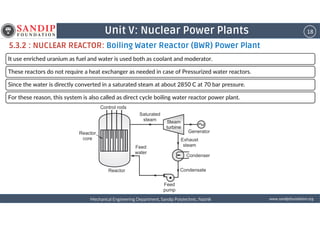
5.3.2 : NUCLEAR REACTOR: Boiling Water Reactor (BWR) Power Plant
It use enriched uranium as fuel and water is used both as coolant and moderator.
These reactors do not require a heat exchanger as needed in case of Pressurized water reactors.
Since the water is directly converted in a saturated steam at about 2850 C at 70 bar pressure.
For these reason, this system is also called as direct cycle boiling water reactor power plant.
wwwwwwwwwwww....ssssaaaannnnddddiiiippppffffoooouuuunnnnddddaaaattttiiiioooonnnn....oooorrrrggggMechanical Engineering Department, Sandip Polytechnic, NashikMechanical Engineering Department, Sandip Polytechnic, NashikMechanical Engineering Department, Sandip Polytechnic, NashikMechanical Engineering Department, Sandip Polytechnic, Nashik
19Unit V: Nuclear Power Plants
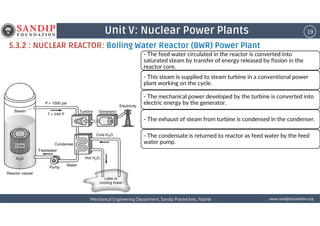
5.3.2 : NUCLEAR REACTOR: Boiling Water Reactor (BWR) Power Plant
- The feed water circulated in the reactor is converted into
saturated steam by transfer of energy released by fission in the
reactor core.
- This steam is supplied to steam turbine in a conventional power
plant working on the cycle.
- The mechanical power developed by the turbine is converted into
electric energy by the generator.
wwwwwwwwwwww....ssssaaaannnnddddiiiippppffffoooouuuunnnnddddaaaattttiiiioooonnnn....oooorrrrggggMechanical Engineering Department, Sandip Polytechnic, NashikMechanical Engineering Department, Sandip Polytechnic, NashikMechanical Engineering Department, Sandip Polytechnic, NashikMechanical Engineering Department, Sandip Polytechnic, Nashik
- The exhaust of steam from turbine is condensed in the condenser.
- The condensate is returned to reactor as feed water by the feed
water pump.
20Unit V: Nuclear Power Plants
5.3.2 : NUCLEAR REACTOR: Boiling Water Reactor (BWR) Power Plant
ADVANTAGES :
1. It eliminates the use of heat exchanger, pressurizer. circulating pump and piping.
2. Therefore system is simple, cheap and efficiency is high.
3. Use of low pressure reactor further reduces the cost of plant.
DISADVANTAGES :
wwwwwwwwwwww....ssssaaaannnnddddiiiippppffffoooouuuunnnnddddaaaattttiiiioooonnnn....oooorrrrggggMechanical Engineering Department, Sandip Polytechnic, NashikMechanical Engineering Department, Sandip Polytechnic, NashikMechanical Engineering Department, Sandip Polytechnic, NashikMechanical Engineering Department, Sandip Polytechnic, Nashik
DISADVANTAGES :
1. It has the possibility of radioactive contamination of steam turbine.
2. It cannot meet the sudden changes in load on the plant.
3. System requires extensive safety devices against radioactive radiations which are costly.
21Unit V: Nuclear Power Plants
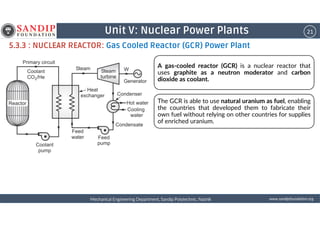
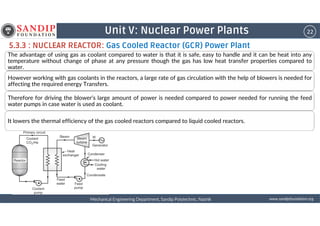
5.3.3 : NUCLEAR REACTOR: Gas Cooled Reactor (GCR) Power Plant
A gas-cooled reactor (GCR) is a nuclear reactor that
uses graphite as a neutron moderator and carbon
dioxide as coolant.
The GCR is able to use natural uranium as fuel, enabling
the countries that developed them to fabricate their
own fuel without relying on other countries for supplies
wwwwwwwwwwww....ssssaaaannnnddddiiiippppffffoooouuuunnnnddddaaaattttiiiioooonnnn....oooorrrrggggMechanical Engineering Department, Sandip Polytechnic, NashikMechanical Engineering Department, Sandip Polytechnic, NashikMechanical Engineering Department, Sandip Polytechnic, NashikMechanical Engineering Department, Sandip Polytechnic, Nashik
own fuel without relying on other countries for supplies
of enriched uranium.
22Unit V: Nuclear Power Plants
5.3.3 : NUCLEAR REACTOR: Gas Cooled Reactor (GCR) Power Plant
The advantage of using gas as coolant compared to water is that it is safe, easy to handle and it can be heat into any
temperature without change of phase at any pressure though the gas has low heat transfer properties compared to
water.
However working with gas coolants in the reactors, a large rate of gas circulation with the help of blowers is needed for
affecting the required energy Transfers.
Therefore for driving the blower’s large amount of power is needed compared to power needed for running the feed
water pumps in case water is used as coolant.
wwwwwwwwwwww....ssssaaaannnnddddiiiippppffffoooouuuunnnnddddaaaattttiiiioooonnnn....oooorrrrggggMechanical Engineering Department, Sandip Polytechnic, NashikMechanical Engineering Department, Sandip Polytechnic, NashikMechanical Engineering Department, Sandip Polytechnic, NashikMechanical Engineering Department, Sandip Polytechnic, Nashik
It lowers the thermal efficiency of the gas cooled reactors compared to liquid cooled reactors.
23Unit V: Nuclear Power Plants
ADVANTAGES :
1. It has no corrosion problem.
2. Gases are safe and easy to handle.
3. Graphite remains stable at high temperatures and radiation problems are minimum.
4. These can be operated at high temperatures.
5. Gases can be pressurized easily.
DISADVANTAGES :
5.3.3 : NUCLEAR REACTOR: Gas Cooled Reactor (GCR) Power Plant
wwwwwwwwwwww....ssssaaaannnnddddiiiippppffffoooouuuunnnnddddaaaattttiiiioooonnnn....oooorrrrggggMechanical Engineering Department, Sandip Polytechnic, NashikMechanical Engineering Department, Sandip Polytechnic, NashikMechanical Engineering Department, Sandip Polytechnic, NashikMechanical Engineering Department, Sandip Polytechnic, Nashik
DISADVANTAGES :
1. Gases have lower heat transfer coefficient thus it requires large heat exchangers.
2. Fuels have to be operated at high temperatures.
3. Large amount of fuel loading is required.
4. If helium is used as in case of HTGC, leakage is a major problem.
24Unit V: Nuclear Power Plants
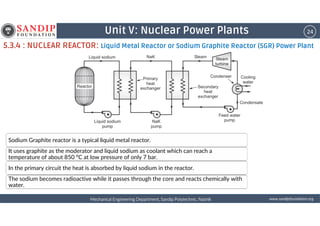
5.3.4 : NUCLEAR REACTOR: Liquid Metal Reactor or Sodium Graphite Reactor (SGR) Power Plant
wwwwwwwwwwww....ssssaaaannnnddddiiiippppffffoooouuuunnnnddddaaaattttiiiioooonnnn....oooorrrrggggMechanical Engineering Department, Sandip Polytechnic, NashikMechanical Engineering Department, Sandip Polytechnic, NashikMechanical Engineering Department, Sandip Polytechnic, NashikMechanical Engineering Department, Sandip Polytechnic, Nashik
Sodium Graphite reactor is a typical liquid metal reactor.
It uses graphite as the moderator and liquid sodium as coolant which can reach a
temperature of about 850 °C at low pressure of only 7 bar.
In the primary circuit the heat is absorbed by liquid sodium in the reactor.
The sodium becomes radioactive while it passes through the core and reacts chemically with
water.
25Unit V: Nuclear Power Plants
5.3.4 : NUCLEAR REACTOR: Liquid Metal Reactor or Sodium Graphite Reactor (SGR) Power Plant
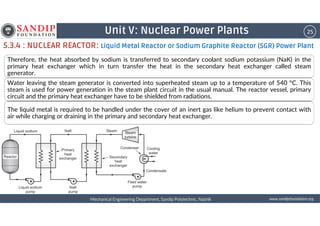
Therefore, the heat absorbed by sodium is transferred to secondary coolant sodium potassium (NaK) in the
primary heat exchanger which in turn transfer the heat in the secondary heat exchanger called steam
generator.
Water leaving the steam generator is converted into superheated steam up to a temperature of 540 °C. This
steam is used for power generation in the steam plant circuit in the usual manual. The reactor vessel, primary
circuit and the primary heat exchanger have to be shielded from radiations.
The liquid metal is required to be handled under the cover of an inert gas like helium to prevent contact with
air while charging or draining in the primary and secondary heat exchanger.
wwwwwwwwwwww....ssssaaaannnnddddiiiippppffffoooouuuunnnnddddaaaattttiiiioooonnnn....oooorrrrggggMechanical Engineering Department, Sandip Polytechnic, NashikMechanical Engineering Department, Sandip Polytechnic, NashikMechanical Engineering Department, Sandip Polytechnic, NashikMechanical Engineering Department, Sandip Polytechnic, Nashik
air while charging or draining in the primary and secondary heat exchanger.
26Unit V: Nuclear Power Plants
5.3.4 : NUCLEAR REACTOR: Liquid Metal Reactor or Sodium Graphite Reactor (SGR) Power Plant
ADVANTAGES :
1. High temperatures of steam can be obtained due to use of liquid sodium as coolant.
2. System need not be pressurized thermal efficiency is high.
3. Cost of pressure vessel and piping system is reduced due to use or low pressures sodium in primary circuit.
DISADVANTAGES :
wwwwwwwwwwww....ssssaaaannnnddddiiiippppffffoooouuuunnnnddddaaaattttiiiioooonnnn....oooorrrrggggMechanical Engineering Department, Sandip Polytechnic, NashikMechanical Engineering Department, Sandip Polytechnic, NashikMechanical Engineering Department, Sandip Polytechnic, NashikMechanical Engineering Department, Sandip Polytechnic, Nashik
DISADVANTAGES :
1. Sodium reacts violently with air and water.
2. Intermediate heat exchanger is required to separate radioactive sodium with water and steam.
3. Primary and secondary heat exchanger are needed to be shielded with concrete blocks against radiations.
4. Any leakage of sodium coolant is highly dangerous.
27Unit V: Nuclear Power Plants
5.4.1 : NUCLEAR POWER PLANT: ADVANTAGES
ADVANTAGES :
1. A nuclear power station occupies much smaller space compared to other conventional plant.
2. No need of plenty of water; hence it is not essential to construct plant near natural source of water.
3. Needs less fuel; for e.g. 1 kg of uranium produces a heat, which is equivalent to 4300 tonnes of coal.
4. It is possible to locate the plant near to load center
5. Clean operation, no ash is produced.
wwwwwwwwwwww....ssssaaaannnnddddiiiippppffffoooouuuunnnnddddaaaattttiiiioooonnnn....oooorrrrggggMechanical Engineering Department, Sandip Polytechnic, NashikMechanical Engineering Department, Sandip Polytechnic, NashikMechanical Engineering Department, Sandip Polytechnic, NashikMechanical Engineering Department, Sandip Polytechnic, Nashik
5. Clean operation, no ash is produced.
6. If bulk power is produced it is economical.
7. Independent of geographical conditions.
8. Saving of natural resources such as coal, oil, gas etc.
28Unit V: Nuclear Power Plants
5.4.1 : NUCLEAR POWER PLANT: DISADVANTAGES
DISADVANTAGES :
1. The fuel is not easily available and it is very costly.
2. Initial cost for constructing nuclear power station is quite high.
3. Erection and commissioning of this plant is much complicated.
4. The fission by products is radioactive in nature, and it may cause high radioactive pollution.
5. The maintenance cost is higher and the skilled man power required to run a nuclear power plant.
wwwwwwwwwwww....ssssaaaannnnddddiiiippppffffoooouuuunnnnddddaaaattttiiiioooonnnn....oooorrrrggggMechanical Engineering Department, Sandip Polytechnic, NashikMechanical Engineering Department, Sandip Polytechnic, NashikMechanical Engineering Department, Sandip Polytechnic, NashikMechanical Engineering Department, Sandip Polytechnic, Nashik
5. The maintenance cost is higher and the skilled man power required to run a nuclear power plant.
6. Sudden fluctuation of load cannot be met up efficiently by nuclear plant.
7. Maintenance cost is very high.
8. Waste disposal is problematic.
29Unit V: Nuclear Power Plants
5.5 : INTRODUCTION TO REGULATING AGENCIES AND REGULATION
5.5.1 : ATOMIC ENERGY REGULATORY BOARD (AERB)
The Atomic Energy Regulatory Board (AERB) was constituted on 15 November
1983 by the President of India by exercising the powers conferred by Section 27
of the Atomic Energy Act, 1962 (33 of 1962) to carry out certain regulatory
and safety functions under the Act.
“The mission of the Board is to ensure that the use of ionizing
radiation and nuclear energy in India does not cause undue risk to health and
the environment.”
wwwwwwwwwwww....ssssaaaannnnddddiiiippppffffoooouuuunnnnddddaaaattttiiiioooonnnn....oooorrrrggggMechanical Engineering Department, Sandip Polytechnic, NashikMechanical Engineering Department, Sandip Polytechnic, NashikMechanical Engineering Department, Sandip Polytechnic, NashikMechanical Engineering Department, Sandip Polytechnic, Nashik
the environment.”
AERB also receives advice from the Advisory Committee on Nuclear Safety (ACNS). ACNS
is composed of experts from AERB, Department of Atomic Energy (DAE) and institutions
outside the DAE.
ACNS provides recommendations on the safety codes, Guides and manuals prepared for
siting, design, construction, operation, quality assurance and decommissioning/life
extension of nuclear power plants which have been prepared by the respective advisory
committees for each of these areas.
30Unit V: Nuclear Power Plants
5.5 : INTRODUCTION TO REGULATING AGENCIES AND REGULATION
5.5.1 : INTERNATIONAL ATOMIC ENERGY AGENCY (IAEA)
The International Atomic Energy Agency (IAEA) is an international organization that seeks to
promote the peaceful use of nuclear energy, and to inhibit its use for any military purpose,
including nuclear weapons. The IAEA was established as an autonomous organization on 29
July 1957.
The IAEA has its headquarters in Vienna, Austria. The IAEA has two "Regional Safeguards
Offices" which are located in Toronto, Canada, and in Tokyo, Japan. The IAEA also has two
liaison offices which are located in New York City, United States, and in Geneva,
wwwwwwwwwwww....ssssaaaannnnddddiiiippppffffoooouuuunnnnddddaaaattttiiiioooonnnn....oooorrrrggggMechanical Engineering Department, Sandip Polytechnic, NashikMechanical Engineering Department, Sandip Polytechnic, NashikMechanical Engineering Department, Sandip Polytechnic, NashikMechanical Engineering Department, Sandip Polytechnic, Nashik
liaison offices which are located in New York City, United States, and in Geneva,
Switzerland.
The IAEA serves as an intergovernmental forum for scientific and technical co-operation in
the peaceful use of nuclear technology and nuclear power worldwide.
The programs of the IAEA encourage the development of the peaceful applications of
nuclear energy, science and technology, provide international safeguards against misuse of
nuclear technology and nuclear materials, and promote nuclear safety (including radiation
protection) and nuclear security standards and their implementation.
31Unit V: Nuclear Power Plants
5.5 : INTRODUCTION TO REGULATING AGENCIES AND REGULATION
5.5.1 : INTERNATIONAL ATOMIC ENERGY AGENCY (IAEA)
Three main pillars – or areas of work – underpin the IAEA's mission:
Safety and Security; Science and Technology; and Safeguards and Verification.
Missions
wwwwwwwwwwww....ssssaaaannnnddddiiiippppffffoooouuuunnnnddddaaaattttiiiioooonnnn....oooorrrrggggMechanical Engineering Department, Sandip Polytechnic, NashikMechanical Engineering Department, Sandip Polytechnic, NashikMechanical Engineering Department, Sandip Polytechnic, NashikMechanical Engineering Department, Sandip Polytechnic, Nashik
The IAEA is generally described as having three main missions:
1. Peaceful uses: Promoting the peaceful uses of nuclear energy by its member states,
2. Safeguards: Implementing safeguards to verify that nuclear energy is not used for military
purposes
3. Nuclear safety: Promoting high standards for nuclear safety
32Unit II: High Pressure Boilers
In this lesson, We have learnedIn this lesson, We have learnedIn this lesson, We have learnedIn this lesson, We have learned
5.2 Nuclear Fuels and Nuclear Reactors
5.3 Advantages and Disadvantages
SUMMARY
wwwwwwwwwwww....ssssaaaannnnddddiiiippppffffoooouuuunnnnddddaaaattttiiiioooonnnn....oooorrrrggggMechanical Engineering Department, Sandip Polytechnic, NashikMechanical Engineering Department, Sandip Polytechnic, NashikMechanical Engineering Department, Sandip Polytechnic, NashikMechanical Engineering Department, Sandip Polytechnic, Nashik
5.3 Advantages and Disadvantages
5.4 Introduction to Regulating Agencies (AERB and IAEA)
33Unit II: High Pressure Boilers
Our Next Video Lecture Topic
6.1 Estimation of Production Cost of Electrical Energy
6.2 Estimation of Various Performance Parameters
wwwwwwwwwwww....ssssaaaannnnddddiiiippppffffoooouuuunnnnddddaaaattttiiiioooonnnn....oooorrrrggggMechanical Engineering Department, Sandip Polytechnic, NashikMechanical Engineering Department, Sandip Polytechnic, NashikMechanical Engineering Department, Sandip Polytechnic, NashikMechanical Engineering Department, Sandip Polytechnic, Nashik
Till Then Stay Connected,
THANK YOU
6.3 Factors affecting Choice of Power Plants

Lecture 15_PPE_Unit 5: Nuclear Power Plants

  • 1.
    Program: Diploma (Mechanical) Class:TY (ME) Semester: V Course: Power Plant Engineering Code: 22566 LECTURE 15: Unit: 5. Nuclear Power Plants
  • 2.
    02 wwwwwwwwwwww....ssssaaaannnnddddiiiippppffffoooouuuunnnnddddaaaattttiiiioooonnnn....oooorrrrggggMechanical Engineering Department,Sandip Polytechnic, NashikMechanical Engineering Department, Sandip Polytechnic, NashikMechanical Engineering Department, Sandip Polytechnic, NashikMechanical Engineering Department, Sandip Polytechnic, Nashik Name of theName of theName of theName of the Trainer : Prof. Rushikesh Deoram SonarTrainer : Prof. Rushikesh Deoram SonarTrainer : Prof. Rushikesh Deoram SonarTrainer : Prof. Rushikesh Deoram Sonar Years ofYears ofYears ofYears of Experience : 10Experience : 10Experience : 10Experience : 10 DomainDomainDomainDomain Expertise : Mechanical EngineeringExpertise : Mechanical EngineeringExpertise : Mechanical EngineeringExpertise : Mechanical Engineering Qualification: M.E. (Design Engineering)Qualification: M.E. (Design Engineering)Qualification: M.E. (Design Engineering)Qualification: M.E. (Design Engineering) Contact Details:Contact Details:Contact Details:Contact Details: +91 9890481959+91 9890481959+91 9890481959+91 9890481959 rushikesh.sonar@sandippolytechnic.orgrushikesh.sonar@sandippolytechnic.orgrushikesh.sonar@sandippolytechnic.orgrushikesh.sonar@sandippolytechnic.org
  • 3.
    03Unit V: NuclearPower Plants TOPICS COVERED IN PREVIOUS LECTURE 5.1 Nuclear Power Plants :5.1 Nuclear Power Plants :5.1 Nuclear Power Plants :5.1 Nuclear Power Plants :---- * Classification* Classification* Classification* Classification * General arrangement* General arrangement* General arrangement* General arrangement * Operating Principles* Operating Principles* Operating Principles* Operating Principles wwwwwwwwwwww....ssssaaaannnnddddiiiippppffffoooouuuunnnnddddaaaattttiiiioooonnnn....oooorrrrggggMechanical Engineering Department, Sandip Polytechnic, NashikMechanical Engineering Department, Sandip Polytechnic, NashikMechanical Engineering Department, Sandip Polytechnic, NashikMechanical Engineering Department, Sandip Polytechnic, Nashik TOPICS TO BE COVERED IN THIS LECTURE 5.2 Nuclear Fuels & Nuclear Reactors5.2 Nuclear Fuels & Nuclear Reactors5.2 Nuclear Fuels & Nuclear Reactors5.2 Nuclear Fuels & Nuclear Reactors 5.3 Adv. & Disadv. Of Nuclear Power Plants5.3 Adv. & Disadv. Of Nuclear Power Plants5.3 Adv. & Disadv. Of Nuclear Power Plants5.3 Adv. & Disadv. Of Nuclear Power Plants 5.4 Introduction to AERB and IAEA5.4 Introduction to AERB and IAEA5.4 Introduction to AERB and IAEA5.4 Introduction to AERB and IAEA
  • 4.
    04Unit V: NuclearPower Plants 5.2.1: NUCLEAR FUELS: INTRODUCTION Fuel of a nuclear reactor should be fissionable material which can be defined as an element or isotope whose nuclei can be caused to undergo nuclear fission by nuclear bombardment and to produce a fission chain reaction. It can be one or all of the following : U233, U235 and Pu239 Natural uranium found in earth crust contains three isotopes namely U234, U235 and U238 and their average percentage is as follows : U238 – 99.3% U235 – 0.7 % U234 – Trace wwwwwwwwwwww....ssssaaaannnnddddiiiippppffffoooouuuunnnnddddaaaattttiiiioooonnnn....oooorrrrggggMechanical Engineering Department, Sandip Polytechnic, NashikMechanical Engineering Department, Sandip Polytechnic, NashikMechanical Engineering Department, Sandip Polytechnic, NashikMechanical Engineering Department, Sandip Polytechnic, Nashik U238 – 99.3% U235 – 0.7 % U234 – Trace Out of these U233 is most unstable and is capable of sustaining chain reaction and has been given the name as primary fuel. U233 and Pu239 are artificially produced from Th232 and U238 respectively and are called secondary fuel. Pu239 and U233 so produced can be fissioned by thermal neutrons. Nuclear fuel should not be expensive to fabricate. It should be able to operate at high temperatures and should be resistant to radiation damage.
  • 5.
    05Unit V: NuclearPower Plants 5.2.1: NUCLEAR FUELS: URANIUM OXIDE (UO2) OVER NATURAL URANIUM : ADVANTAGES 1. It is more stable than natural uranium. 2. There is no problem of phase change in case of uranium oxide and therefore it can be used for higher temperatures. 3. It does not corrode as easily as natural uranium. 4. It is more compatible with most of the coolants and is not attacked by H2, N2. 5. There is greater dimensional stability during use. wwwwwwwwwwww....ssssaaaannnnddddiiiippppffffoooouuuunnnnddddaaaattttiiiioooonnnn....oooorrrrggggMechanical Engineering Department, Sandip Polytechnic, NashikMechanical Engineering Department, Sandip Polytechnic, NashikMechanical Engineering Department, Sandip Polytechnic, NashikMechanical Engineering Department, Sandip Polytechnic, Nashik DISADVANTAGES 1. It has low thermal conductivity. 2. It is more brittle than natural uranium and therefore it can break due to thermal stresses. 3. Its enrichment is essential.
  • 6.
    06Unit V: NuclearPower Plants 5.2.1: NUCLEAR FUELS: PHYSICAL PROPERTIES wwwwwwwwwwww....ssssaaaannnnddddiiiippppffffoooouuuunnnnddddaaaattttiiiioooonnnn....oooorrrrggggMechanical Engineering Department, Sandip Polytechnic, NashikMechanical Engineering Department, Sandip Polytechnic, NashikMechanical Engineering Department, Sandip Polytechnic, NashikMechanical Engineering Department, Sandip Polytechnic, Nashik
  • 7.
    07Unit V: NuclearPower Plants 5.2.2: NUCLEAR REACTOR: MAIN COMPONENTS wwwwwwwwwwww....ssssaaaannnnddddiiiippppffffoooouuuunnnnddddaaaattttiiiioooonnnn....oooorrrrggggMechanical Engineering Department, Sandip Polytechnic, NashikMechanical Engineering Department, Sandip Polytechnic, NashikMechanical Engineering Department, Sandip Polytechnic, NashikMechanical Engineering Department, Sandip Polytechnic, Nashik
  • 8.
    08Unit V: NuclearPower Plants 5.2.2: NUCLEAR REACTOR: MAIN COMPONENTS 1. REACTOR VESSEL The Reactor vessel is designed to withstand high pressure and it is usually made from low carbon steel. It is clad with stainless steel to reduce the corrosion problems. 2. FUEL ROD Nuclear reactor use fissionable materials like uranium and thorium. Natural uranium is stable and capable of sustainable chain reaction, is generally used as fuel. The fuel rod is fabricated in various shape like rods, plates, tin, pallets etc. and these are placed inside the reactor core in such a way that these produce uniform heat in the reactor. wwwwwwwwwwww....ssssaaaannnnddddiiiippppffffoooouuuunnnnddddaaaattttiiiioooonnnn....oooorrrrggggMechanical Engineering Department, Sandip Polytechnic, NashikMechanical Engineering Department, Sandip Polytechnic, NashikMechanical Engineering Department, Sandip Polytechnic, NashikMechanical Engineering Department, Sandip Polytechnic, Nashik core in such a way that these produce uniform heat in the reactor. The fuel rod is cladded with stainless steel, zirconium or by aluminum to prevent oxidation of uranium.
  • 9.
    09Unit V: NuclearPower Plants 5.2.2: NUCLEAR REACTOR: MAIN COMPONENTS 3. MODERATOR The moderator are the substances which help in reducing the speed of neutrons and make them to lose their kinetic energy by collisions but at the same time do not absorb them but scatters them. Reduce velocity of neutrons up to thermal speed help in maintaining the fission chain reaction in the reactor, when the ordinary uranium is used. The moderators are lighter than fuel. Various materials used for moderators are Light Water (H2O), Deuterium or Heavy Water (D2O), Graphite and Beryllium. wwwwwwwwwwww....ssssaaaannnnddddiiiippppffffoooouuuunnnnddddaaaattttiiiioooonnnn....oooorrrrggggMechanical Engineering Department, Sandip Polytechnic, NashikMechanical Engineering Department, Sandip Polytechnic, NashikMechanical Engineering Department, Sandip Polytechnic, NashikMechanical Engineering Department, Sandip Polytechnic, Nashik
  • 10.
    10Unit V: NuclearPower Plants 5.2.2: NUCLEAR REACTOR: MAIN COMPONENTS 4. CONTROL RODS In case the chain reaction of fission of nuclear material is not controlled properly, the heat energy generated will be enormous which will melt the fuel rods, disintegrate coolants and destroy the reactor. The control rods are used to control the chain reaction by absorbing required neutrons. The material used for control rods is boron or cadmium. These rods can be moved in and out of the reactor core assembly either automatically or manually. The magnitude of insertion of control rod represents the proportionate absorption of neutrons. wwwwwwwwwwww....ssssaaaannnnddddiiiippppffffoooouuuunnnnddddaaaattttiiiioooonnnn....oooorrrrggggMechanical Engineering Department, Sandip Polytechnic, NashikMechanical Engineering Department, Sandip Polytechnic, NashikMechanical Engineering Department, Sandip Polytechnic, NashikMechanical Engineering Department, Sandip Polytechnic, Nashik
  • 11.
    11Unit V: NuclearPower Plants 5.2.2: NUCLEAR REACTOR: MAIN COMPONENTS 5. REFLECTOR In order to conserve fuel, it is desirable that the neutrons are not allowed to escape the reactor core. This is achieved by providing a reflector surrounding the reactor core within the thermal shielding arrangement. The reflector thus provided will sent back the neutrons into the core, thereby, it improves the chain reaction. Since the materials having well absorptive are also good reflectors hence, the materials used for moderators are also used for reflectors e.g. Graphite and Beryllium. wwwwwwwwwwww....ssssaaaannnnddddiiiippppffffoooouuuunnnnddddaaaattttiiiioooonnnn....oooorrrrggggMechanical Engineering Department, Sandip Polytechnic, NashikMechanical Engineering Department, Sandip Polytechnic, NashikMechanical Engineering Department, Sandip Polytechnic, NashikMechanical Engineering Department, Sandip Polytechnic, Nashik are also used for reflectors e.g. Graphite and Beryllium.
  • 12.
    12Unit V: NuclearPower Plants 5.2.2: NUCLEAR REACTOR: MAIN COMPONENTS 6. COOLANTS The purpose of coolant is to absorb the large amount of heat generated in the reactor Core and transfer this heat energy finally to water for generation of steam in a heat exchanger. The coolant used should have high specific heat to reduce its mass flow rate, it should not absorb neutrons and it must be non-corrosive, non-toxic, non-oxidizing with high chemical stability. Various coolants used are CO, H, Air, He, Heavy Water, and Sodium in liquid form etc. In case water is used as coolant then it takes up the heat and gets converted into steam in the reactor. This steam it directly sent to steam turbine for power generation. wwwwwwwwwwww....ssssaaaannnnddddiiiippppffffoooouuuunnnnddddaaaattttiiiioooonnnn....oooorrrrggggMechanical Engineering Department, Sandip Polytechnic, NashikMechanical Engineering Department, Sandip Polytechnic, NashikMechanical Engineering Department, Sandip Polytechnic, NashikMechanical Engineering Department, Sandip Polytechnic, Nashik 7. SHIELDING Shielding is provided for protection of human life against the deadly alpha, beta and gamma radiations of the nuclear fuel in the reactor. Shielding consists of inner lining of 50 to 60 cm thick steel plate on the reactor core called thermal shield with a few meters of thick concrete wall surrounding the inner shield called biological shield.
  • 13.
    13Unit V: NuclearPower Plants 5.2.3: NUCLEAR REACTOR: CLASSIFICATION 1. BASED ON NEUTRON ENERGY a) Fast reactors b) Slow or thermal c) Intermediate reactors 2. BASED ON TYPE OF FUEL USED a) Natural Uranium Fuel Reactors : In this reactors the natural fuel is used as fuel b) Enriched Uranium Fuel Reactors : In this reactor the enriched uranium of 5 to 10% of U235 is used as fuel. wwwwwwwwwwww....ssssaaaannnnddddiiiippppffffoooouuuunnnnddddaaaattttiiiioooonnnn....oooorrrrggggMechanical Engineering Department, Sandip Polytechnic, NashikMechanical Engineering Department, Sandip Polytechnic, NashikMechanical Engineering Department, Sandip Polytechnic, NashikMechanical Engineering Department, Sandip Polytechnic, Nashik 3. BASED ON COOLANT USED a) Water Cooled Reactors b) Heavy Water Cooled Reactors c) Liquid Metal (Sodium Or Bismuth) Cooled Reactors d) Gas Cooled Reactors 4. BASED ON MODERATORS USED 5. BASED ON TYPE OF CORE USED a) Water & Heavy Water Reactors a) Homogeneous reactors b) Graphite Reactors b) Heterogeneous Reactors c) Beryllium Reactors
  • 14.
    14Unit V: NuclearPower Plants 5.3: NUCLEAR REACTOR POWER PLANTS: TYPES 1. Thermal Reactor 1. Pressurized Water Reactor (PWR) Power Plant 2. Boiling Water Reactor (BWR) Power Plant 3. Gas Cooled Reactor (GCR) Power Plant 2. Fast Breeder Reactors 1. Liquid Metal Fast Breeder Reactor (LMFBR) wwwwwwwwwwww....ssssaaaannnnddddiiiippppffffoooouuuunnnnddddaaaattttiiiioooonnnn....oooorrrrggggMechanical Engineering Department, Sandip Polytechnic, NashikMechanical Engineering Department, Sandip Polytechnic, NashikMechanical Engineering Department, Sandip Polytechnic, NashikMechanical Engineering Department, Sandip Polytechnic, Nashik 1. Liquid Metal Fast Breeder Reactor (LMFBR)
  • 15.
    15Unit V: NuclearPower Plants 5.3.1 : NUCLEAR REACTOR: Pressurized Water Reactor (PWR) Power Plant It uses enriched uranium. The water or heavy water under pressure is used both as coolant and moderator. Before starting the reactor the water in pressurizer is boiled and converted into steam by electric heating coil. In order to prevent the boiling of water in the core, it is kept under pressure of about 130 to 150 bar. wwwwwwwwwwww....ssssaaaannnnddddiiiippppffffoooouuuunnnnddddaaaattttiiiioooonnnn....oooorrrrggggMechanical Engineering Department, Sandip Polytechnic, NashikMechanical Engineering Department, Sandip Polytechnic, NashikMechanical Engineering Department, Sandip Polytechnic, NashikMechanical Engineering Department, Sandip Polytechnic, Nashik pressure of about 130 to 150 bar. It helps in absorbing the heat by water in the liquid state in the reactor. The heat energy absorbed by water in the reactor is used for converting steam in a heat exchanger. This steam is used in conventional way in the power plant cycle.
  • 16.
    16Unit V: NuclearPower Plants 5.3.1 : NUCLEAR REACTOR: Pressurized Water Reactor (PWR) Power Plant The water coolant from heat exchanger is recirculates to the reactor with the help of coolant pump. These power plants are compact and its cost is reduced since it uses water both as coolant and moderator. However the high pressure in the primary circuit of water absorbing heat in the reactor requires a strong reactor shell which increases its cost. wwwwwwwwwwww....ssssaaaannnnddddiiiippppffffoooouuuunnnnddddaaaattttiiiioooonnnn....oooorrrrggggMechanical Engineering Department, Sandip Polytechnic, NashikMechanical Engineering Department, Sandip Polytechnic, NashikMechanical Engineering Department, Sandip Polytechnic, NashikMechanical Engineering Department, Sandip Polytechnic, Nashik increases its cost. In this reaches, the water flowing through the reactor becomes radioactive, therefore this primary circuit must be heavily shielded to protect the operators.
  • 17.
    17Unit V: NuclearPower Plants 5.3.1 : NUCLEAR REACTOR: Pressurized Water Reactor (PWR) Power Plant ADVANTAGES : 1. Water is used both as coolant and moderator which is cheap and easily available. 2. Reactor is compact 3. Small number of control rods is required. 4. Fission products remain contained in the reactor. DISADVANTAGES : 1. Capital cost is high since the reactor and primary circuit works under pressure. 2. Only saturated steam can be generated in secondary circuit, therefore the efficiency of plant is low. wwwwwwwwwwww....ssssaaaannnnddddiiiippppffffoooouuuunnnnddddaaaattttiiiioooonnnn....oooorrrrggggMechanical Engineering Department, Sandip Polytechnic, NashikMechanical Engineering Department, Sandip Polytechnic, NashikMechanical Engineering Department, Sandip Polytechnic, NashikMechanical Engineering Department, Sandip Polytechnic, Nashik 2. Only saturated steam can be generated in secondary circuit, therefore the efficiency of plant is low. 3. Costly shielding is required to shield the operators in primary circuit since the coolant becomes radioactive 4. Severe corrosion problems 5. Fuel suffers from radiations. Therefore, it's reprocessing is difficult 6. Plants needs to be shut down for fuel charging
  • 18.
    18Unit V: NuclearPower Plants 5.3.2 : NUCLEAR REACTOR: Boiling Water Reactor (BWR) Power Plant It use enriched uranium as fuel and water is used both as coolant and moderator. These reactors do not require a heat exchanger as needed in case of Pressurized water reactors. Since the water is directly converted in a saturated steam at about 2850 C at 70 bar pressure. For these reason, this system is also called as direct cycle boiling water reactor power plant. wwwwwwwwwwww....ssssaaaannnnddddiiiippppffffoooouuuunnnnddddaaaattttiiiioooonnnn....oooorrrrggggMechanical Engineering Department, Sandip Polytechnic, NashikMechanical Engineering Department, Sandip Polytechnic, NashikMechanical Engineering Department, Sandip Polytechnic, NashikMechanical Engineering Department, Sandip Polytechnic, Nashik
  • 19.
    19Unit V: NuclearPower Plants 5.3.2 : NUCLEAR REACTOR: Boiling Water Reactor (BWR) Power Plant - The feed water circulated in the reactor is converted into saturated steam by transfer of energy released by fission in the reactor core. - This steam is supplied to steam turbine in a conventional power plant working on the cycle. - The mechanical power developed by the turbine is converted into electric energy by the generator. wwwwwwwwwwww....ssssaaaannnnddddiiiippppffffoooouuuunnnnddddaaaattttiiiioooonnnn....oooorrrrggggMechanical Engineering Department, Sandip Polytechnic, NashikMechanical Engineering Department, Sandip Polytechnic, NashikMechanical Engineering Department, Sandip Polytechnic, NashikMechanical Engineering Department, Sandip Polytechnic, Nashik - The exhaust of steam from turbine is condensed in the condenser. - The condensate is returned to reactor as feed water by the feed water pump.
  • 20.
    20Unit V: NuclearPower Plants 5.3.2 : NUCLEAR REACTOR: Boiling Water Reactor (BWR) Power Plant ADVANTAGES : 1. It eliminates the use of heat exchanger, pressurizer. circulating pump and piping. 2. Therefore system is simple, cheap and efficiency is high. 3. Use of low pressure reactor further reduces the cost of plant. DISADVANTAGES : wwwwwwwwwwww....ssssaaaannnnddddiiiippppffffoooouuuunnnnddddaaaattttiiiioooonnnn....oooorrrrggggMechanical Engineering Department, Sandip Polytechnic, NashikMechanical Engineering Department, Sandip Polytechnic, NashikMechanical Engineering Department, Sandip Polytechnic, NashikMechanical Engineering Department, Sandip Polytechnic, Nashik DISADVANTAGES : 1. It has the possibility of radioactive contamination of steam turbine. 2. It cannot meet the sudden changes in load on the plant. 3. System requires extensive safety devices against radioactive radiations which are costly.
  • 21.
    21Unit V: NuclearPower Plants 5.3.3 : NUCLEAR REACTOR: Gas Cooled Reactor (GCR) Power Plant A gas-cooled reactor (GCR) is a nuclear reactor that uses graphite as a neutron moderator and carbon dioxide as coolant. The GCR is able to use natural uranium as fuel, enabling the countries that developed them to fabricate their own fuel without relying on other countries for supplies wwwwwwwwwwww....ssssaaaannnnddddiiiippppffffoooouuuunnnnddddaaaattttiiiioooonnnn....oooorrrrggggMechanical Engineering Department, Sandip Polytechnic, NashikMechanical Engineering Department, Sandip Polytechnic, NashikMechanical Engineering Department, Sandip Polytechnic, NashikMechanical Engineering Department, Sandip Polytechnic, Nashik own fuel without relying on other countries for supplies of enriched uranium.
  • 22.
    22Unit V: NuclearPower Plants 5.3.3 : NUCLEAR REACTOR: Gas Cooled Reactor (GCR) Power Plant The advantage of using gas as coolant compared to water is that it is safe, easy to handle and it can be heat into any temperature without change of phase at any pressure though the gas has low heat transfer properties compared to water. However working with gas coolants in the reactors, a large rate of gas circulation with the help of blowers is needed for affecting the required energy Transfers. Therefore for driving the blower’s large amount of power is needed compared to power needed for running the feed water pumps in case water is used as coolant. wwwwwwwwwwww....ssssaaaannnnddddiiiippppffffoooouuuunnnnddddaaaattttiiiioooonnnn....oooorrrrggggMechanical Engineering Department, Sandip Polytechnic, NashikMechanical Engineering Department, Sandip Polytechnic, NashikMechanical Engineering Department, Sandip Polytechnic, NashikMechanical Engineering Department, Sandip Polytechnic, Nashik It lowers the thermal efficiency of the gas cooled reactors compared to liquid cooled reactors.
  • 23.
    23Unit V: NuclearPower Plants ADVANTAGES : 1. It has no corrosion problem. 2. Gases are safe and easy to handle. 3. Graphite remains stable at high temperatures and radiation problems are minimum. 4. These can be operated at high temperatures. 5. Gases can be pressurized easily. DISADVANTAGES : 5.3.3 : NUCLEAR REACTOR: Gas Cooled Reactor (GCR) Power Plant wwwwwwwwwwww....ssssaaaannnnddddiiiippppffffoooouuuunnnnddddaaaattttiiiioooonnnn....oooorrrrggggMechanical Engineering Department, Sandip Polytechnic, NashikMechanical Engineering Department, Sandip Polytechnic, NashikMechanical Engineering Department, Sandip Polytechnic, NashikMechanical Engineering Department, Sandip Polytechnic, Nashik DISADVANTAGES : 1. Gases have lower heat transfer coefficient thus it requires large heat exchangers. 2. Fuels have to be operated at high temperatures. 3. Large amount of fuel loading is required. 4. If helium is used as in case of HTGC, leakage is a major problem.
  • 24.
    24Unit V: NuclearPower Plants 5.3.4 : NUCLEAR REACTOR: Liquid Metal Reactor or Sodium Graphite Reactor (SGR) Power Plant wwwwwwwwwwww....ssssaaaannnnddddiiiippppffffoooouuuunnnnddddaaaattttiiiioooonnnn....oooorrrrggggMechanical Engineering Department, Sandip Polytechnic, NashikMechanical Engineering Department, Sandip Polytechnic, NashikMechanical Engineering Department, Sandip Polytechnic, NashikMechanical Engineering Department, Sandip Polytechnic, Nashik Sodium Graphite reactor is a typical liquid metal reactor. It uses graphite as the moderator and liquid sodium as coolant which can reach a temperature of about 850 °C at low pressure of only 7 bar. In the primary circuit the heat is absorbed by liquid sodium in the reactor. The sodium becomes radioactive while it passes through the core and reacts chemically with water.
  • 25.
    25Unit V: NuclearPower Plants 5.3.4 : NUCLEAR REACTOR: Liquid Metal Reactor or Sodium Graphite Reactor (SGR) Power Plant Therefore, the heat absorbed by sodium is transferred to secondary coolant sodium potassium (NaK) in the primary heat exchanger which in turn transfer the heat in the secondary heat exchanger called steam generator. Water leaving the steam generator is converted into superheated steam up to a temperature of 540 °C. This steam is used for power generation in the steam plant circuit in the usual manual. The reactor vessel, primary circuit and the primary heat exchanger have to be shielded from radiations. The liquid metal is required to be handled under the cover of an inert gas like helium to prevent contact with air while charging or draining in the primary and secondary heat exchanger. wwwwwwwwwwww....ssssaaaannnnddddiiiippppffffoooouuuunnnnddddaaaattttiiiioooonnnn....oooorrrrggggMechanical Engineering Department, Sandip Polytechnic, NashikMechanical Engineering Department, Sandip Polytechnic, NashikMechanical Engineering Department, Sandip Polytechnic, NashikMechanical Engineering Department, Sandip Polytechnic, Nashik air while charging or draining in the primary and secondary heat exchanger.
  • 26.
    26Unit V: NuclearPower Plants 5.3.4 : NUCLEAR REACTOR: Liquid Metal Reactor or Sodium Graphite Reactor (SGR) Power Plant ADVANTAGES : 1. High temperatures of steam can be obtained due to use of liquid sodium as coolant. 2. System need not be pressurized thermal efficiency is high. 3. Cost of pressure vessel and piping system is reduced due to use or low pressures sodium in primary circuit. DISADVANTAGES : wwwwwwwwwwww....ssssaaaannnnddddiiiippppffffoooouuuunnnnddddaaaattttiiiioooonnnn....oooorrrrggggMechanical Engineering Department, Sandip Polytechnic, NashikMechanical Engineering Department, Sandip Polytechnic, NashikMechanical Engineering Department, Sandip Polytechnic, NashikMechanical Engineering Department, Sandip Polytechnic, Nashik DISADVANTAGES : 1. Sodium reacts violently with air and water. 2. Intermediate heat exchanger is required to separate radioactive sodium with water and steam. 3. Primary and secondary heat exchanger are needed to be shielded with concrete blocks against radiations. 4. Any leakage of sodium coolant is highly dangerous.
  • 27.
    27Unit V: NuclearPower Plants 5.4.1 : NUCLEAR POWER PLANT: ADVANTAGES ADVANTAGES : 1. A nuclear power station occupies much smaller space compared to other conventional plant. 2. No need of plenty of water; hence it is not essential to construct plant near natural source of water. 3. Needs less fuel; for e.g. 1 kg of uranium produces a heat, which is equivalent to 4300 tonnes of coal. 4. It is possible to locate the plant near to load center 5. Clean operation, no ash is produced. wwwwwwwwwwww....ssssaaaannnnddddiiiippppffffoooouuuunnnnddddaaaattttiiiioooonnnn....oooorrrrggggMechanical Engineering Department, Sandip Polytechnic, NashikMechanical Engineering Department, Sandip Polytechnic, NashikMechanical Engineering Department, Sandip Polytechnic, NashikMechanical Engineering Department, Sandip Polytechnic, Nashik 5. Clean operation, no ash is produced. 6. If bulk power is produced it is economical. 7. Independent of geographical conditions. 8. Saving of natural resources such as coal, oil, gas etc.
  • 28.
    28Unit V: NuclearPower Plants 5.4.1 : NUCLEAR POWER PLANT: DISADVANTAGES DISADVANTAGES : 1. The fuel is not easily available and it is very costly. 2. Initial cost for constructing nuclear power station is quite high. 3. Erection and commissioning of this plant is much complicated. 4. The fission by products is radioactive in nature, and it may cause high radioactive pollution. 5. The maintenance cost is higher and the skilled man power required to run a nuclear power plant. wwwwwwwwwwww....ssssaaaannnnddddiiiippppffffoooouuuunnnnddddaaaattttiiiioooonnnn....oooorrrrggggMechanical Engineering Department, Sandip Polytechnic, NashikMechanical Engineering Department, Sandip Polytechnic, NashikMechanical Engineering Department, Sandip Polytechnic, NashikMechanical Engineering Department, Sandip Polytechnic, Nashik 5. The maintenance cost is higher and the skilled man power required to run a nuclear power plant. 6. Sudden fluctuation of load cannot be met up efficiently by nuclear plant. 7. Maintenance cost is very high. 8. Waste disposal is problematic.
  • 29.
    29Unit V: NuclearPower Plants 5.5 : INTRODUCTION TO REGULATING AGENCIES AND REGULATION 5.5.1 : ATOMIC ENERGY REGULATORY BOARD (AERB) The Atomic Energy Regulatory Board (AERB) was constituted on 15 November 1983 by the President of India by exercising the powers conferred by Section 27 of the Atomic Energy Act, 1962 (33 of 1962) to carry out certain regulatory and safety functions under the Act. “The mission of the Board is to ensure that the use of ionizing radiation and nuclear energy in India does not cause undue risk to health and the environment.” wwwwwwwwwwww....ssssaaaannnnddddiiiippppffffoooouuuunnnnddddaaaattttiiiioooonnnn....oooorrrrggggMechanical Engineering Department, Sandip Polytechnic, NashikMechanical Engineering Department, Sandip Polytechnic, NashikMechanical Engineering Department, Sandip Polytechnic, NashikMechanical Engineering Department, Sandip Polytechnic, Nashik the environment.” AERB also receives advice from the Advisory Committee on Nuclear Safety (ACNS). ACNS is composed of experts from AERB, Department of Atomic Energy (DAE) and institutions outside the DAE. ACNS provides recommendations on the safety codes, Guides and manuals prepared for siting, design, construction, operation, quality assurance and decommissioning/life extension of nuclear power plants which have been prepared by the respective advisory committees for each of these areas.
  • 30.
    30Unit V: NuclearPower Plants 5.5 : INTRODUCTION TO REGULATING AGENCIES AND REGULATION 5.5.1 : INTERNATIONAL ATOMIC ENERGY AGENCY (IAEA) The International Atomic Energy Agency (IAEA) is an international organization that seeks to promote the peaceful use of nuclear energy, and to inhibit its use for any military purpose, including nuclear weapons. The IAEA was established as an autonomous organization on 29 July 1957. The IAEA has its headquarters in Vienna, Austria. The IAEA has two "Regional Safeguards Offices" which are located in Toronto, Canada, and in Tokyo, Japan. The IAEA also has two liaison offices which are located in New York City, United States, and in Geneva, wwwwwwwwwwww....ssssaaaannnnddddiiiippppffffoooouuuunnnnddddaaaattttiiiioooonnnn....oooorrrrggggMechanical Engineering Department, Sandip Polytechnic, NashikMechanical Engineering Department, Sandip Polytechnic, NashikMechanical Engineering Department, Sandip Polytechnic, NashikMechanical Engineering Department, Sandip Polytechnic, Nashik liaison offices which are located in New York City, United States, and in Geneva, Switzerland. The IAEA serves as an intergovernmental forum for scientific and technical co-operation in the peaceful use of nuclear technology and nuclear power worldwide. The programs of the IAEA encourage the development of the peaceful applications of nuclear energy, science and technology, provide international safeguards against misuse of nuclear technology and nuclear materials, and promote nuclear safety (including radiation protection) and nuclear security standards and their implementation.
  • 31.
    31Unit V: NuclearPower Plants 5.5 : INTRODUCTION TO REGULATING AGENCIES AND REGULATION 5.5.1 : INTERNATIONAL ATOMIC ENERGY AGENCY (IAEA) Three main pillars – or areas of work – underpin the IAEA's mission: Safety and Security; Science and Technology; and Safeguards and Verification. Missions wwwwwwwwwwww....ssssaaaannnnddddiiiippppffffoooouuuunnnnddddaaaattttiiiioooonnnn....oooorrrrggggMechanical Engineering Department, Sandip Polytechnic, NashikMechanical Engineering Department, Sandip Polytechnic, NashikMechanical Engineering Department, Sandip Polytechnic, NashikMechanical Engineering Department, Sandip Polytechnic, Nashik The IAEA is generally described as having three main missions: 1. Peaceful uses: Promoting the peaceful uses of nuclear energy by its member states, 2. Safeguards: Implementing safeguards to verify that nuclear energy is not used for military purposes 3. Nuclear safety: Promoting high standards for nuclear safety
  • 32.
    32Unit II: HighPressure Boilers In this lesson, We have learnedIn this lesson, We have learnedIn this lesson, We have learnedIn this lesson, We have learned 5.2 Nuclear Fuels and Nuclear Reactors 5.3 Advantages and Disadvantages SUMMARY wwwwwwwwwwww....ssssaaaannnnddddiiiippppffffoooouuuunnnnddddaaaattttiiiioooonnnn....oooorrrrggggMechanical Engineering Department, Sandip Polytechnic, NashikMechanical Engineering Department, Sandip Polytechnic, NashikMechanical Engineering Department, Sandip Polytechnic, NashikMechanical Engineering Department, Sandip Polytechnic, Nashik 5.3 Advantages and Disadvantages 5.4 Introduction to Regulating Agencies (AERB and IAEA)
  • 33.
    33Unit II: HighPressure Boilers Our Next Video Lecture Topic 6.1 Estimation of Production Cost of Electrical Energy 6.2 Estimation of Various Performance Parameters wwwwwwwwwwww....ssssaaaannnnddddiiiippppffffoooouuuunnnnddddaaaattttiiiioooonnnn....oooorrrrggggMechanical Engineering Department, Sandip Polytechnic, NashikMechanical Engineering Department, Sandip Polytechnic, NashikMechanical Engineering Department, Sandip Polytechnic, NashikMechanical Engineering Department, Sandip Polytechnic, Nashik Till Then Stay Connected, THANK YOU 6.3 Factors affecting Choice of Power Plants