VAAGDEVI ENGINEERING COLLEGE
DEPARTMENT OF ELECTRONICS & COMMUNICATION ENGINEERING
A Technical Seminar
Presentation
On
NUCLEAR BATTERY
Guide :
Mr.Ch.PRASHANTH
Assistant professor
Presented by :
A.ROHAN SAI NAIK
20UK1A0443
Introduction
How Nuclear battery work
Types of Radioisotopes
Advantages of Nuclear battery
Challenges and Concerns
Applications
Future prospects
Safety measures
Ethical considerations
Conclusion
CONTENTS
INTRODUCTION
• Nuclear Batteries: Harnessing Atomic Energy
• Nuclear batteries are compact devices that convert the energy released
by the radioactive decay of certain isotopes into electrical power.
• These batteries have unique properties that make them suitable for
specific applications, ranging from space exploration to medical
devices.
HOW NUCLEAR BATTERY WORK
• Radioactive Decay: Unstable atomic nuclei release energy
in the form of radiation as they transform into more stable
configurations.
• Conversion of Decay Heat: Radioactive decay generates
heat. This heat is converted into electricity using a
thermoelectric converter.
• Components: Nuclear batteries consist of a radioisotope, a
thermoelectric converter, and shielding materials to
contain radiation
TYPES OF RADIOISOTOPES
• Polonium-210: Emits alpha particles, used in space probes due to
its high energy density.
• Tritium: Emits low-energy beta particles, used in self-powered
lighting and medical devices.
• Strontium-90: Emits beta particles, used in pacemakers and
remote sensors.
• Isotope selection depends on decay properties and safety
considerations
ADVANTAGES OF NUCLEAR BATTERY
• High Energy Density: Nuclear battery outperform traditional
chemical battery in terms of energy output over time.
• Long Lifespan: Some radioisotopes have half-lives of decades,
ensuring a stable power source for extended periods.
• Environmental Friendliness: Emit minimal greenhouse gases
and pollutants during operation.
• Remote and Harsh Environments: Nuclear battery excel
where recharging or replacing batteries is impractical.
CHALLENGES AND CONCERNS
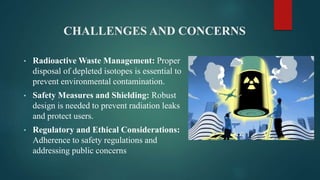
• Radioactive Waste Management: Proper
disposal of depleted isotopes is essential to
prevent environmental contamination.
• Safety Measures and Shielding: Robust
design is needed to prevent radiation leaks
and protect users.
• Regulatory and Ethical Considerations:
Adherence to safety regulations and
addressing public concerns
APPLICATIONS
• Space Exploration: Powering deep space probes like Voyager 1,
which have exceeded their expected operational lifespan.
• Medical Implants: Long-lasting batteries for pacemakers,
artificial hearts, and other implantable devices.
• Remote Sensors: Monitoring environmental parameters in remote
locations, such as deep-sea sensors
FUTURE PROSPECTS
• Advances in Radioisotope Selection: Developing isotopes with
optimal decay properties and minimal waste.
• Integration with Renewable Energy: Combining nuclear battery
with solar panels for extended missions.
• Miniaturization and Efficiency: Smaller, more efficient designs for
a wider range of applications
SAFETY MEASURES
• Design for Containment: Double-layered containers to
prevent the escape of radioactive materials.
• Shielding: Layers of materials like lead or depleted
uranium to absorb radiation.
• Emergency Protocols: Procedures to handle any potential
accidents or malfunctions.
ETHICAL CONSIDERATIONS
• Responsible Handling: Strict protocols for manufacturing,
use, and disposal of nuclear battery.
• Public Perception and Education: Addressing
misconceptions and educating the public about benefits and
risks.
• Balancing Benefits and Risks: Weighing the advantages of
nuclear battery against potential hazards
CONCLUSION
• Nuclear battery offer a unique solution for long-lasting, compact
power sources.
• Their applications range from space exploration to improving
medical technology.
• Continued research and responsible use are essential to harness
their potential
nuclear battery.pptx

nuclear battery.pptx

  • 1.
    VAAGDEVI ENGINEERING COLLEGE DEPARTMENTOF ELECTRONICS & COMMUNICATION ENGINEERING A Technical Seminar Presentation On NUCLEAR BATTERY Guide : Mr.Ch.PRASHANTH Assistant professor Presented by : A.ROHAN SAI NAIK 20UK1A0443
  • 2.
    Introduction How Nuclear batterywork Types of Radioisotopes Advantages of Nuclear battery Challenges and Concerns Applications Future prospects Safety measures Ethical considerations Conclusion CONTENTS
  • 3.
    INTRODUCTION • Nuclear Batteries:Harnessing Atomic Energy • Nuclear batteries are compact devices that convert the energy released by the radioactive decay of certain isotopes into electrical power. • These batteries have unique properties that make them suitable for specific applications, ranging from space exploration to medical devices.
  • 4.
    HOW NUCLEAR BATTERYWORK • Radioactive Decay: Unstable atomic nuclei release energy in the form of radiation as they transform into more stable configurations. • Conversion of Decay Heat: Radioactive decay generates heat. This heat is converted into electricity using a thermoelectric converter. • Components: Nuclear batteries consist of a radioisotope, a thermoelectric converter, and shielding materials to contain radiation
  • 5.
    TYPES OF RADIOISOTOPES •Polonium-210: Emits alpha particles, used in space probes due to its high energy density. • Tritium: Emits low-energy beta particles, used in self-powered lighting and medical devices. • Strontium-90: Emits beta particles, used in pacemakers and remote sensors. • Isotope selection depends on decay properties and safety considerations
  • 6.
    ADVANTAGES OF NUCLEARBATTERY • High Energy Density: Nuclear battery outperform traditional chemical battery in terms of energy output over time. • Long Lifespan: Some radioisotopes have half-lives of decades, ensuring a stable power source for extended periods. • Environmental Friendliness: Emit minimal greenhouse gases and pollutants during operation. • Remote and Harsh Environments: Nuclear battery excel where recharging or replacing batteries is impractical.
  • 7.
    CHALLENGES AND CONCERNS •Radioactive Waste Management: Proper disposal of depleted isotopes is essential to prevent environmental contamination. • Safety Measures and Shielding: Robust design is needed to prevent radiation leaks and protect users. • Regulatory and Ethical Considerations: Adherence to safety regulations and addressing public concerns
  • 8.
    APPLICATIONS • Space Exploration:Powering deep space probes like Voyager 1, which have exceeded their expected operational lifespan. • Medical Implants: Long-lasting batteries for pacemakers, artificial hearts, and other implantable devices. • Remote Sensors: Monitoring environmental parameters in remote locations, such as deep-sea sensors
  • 9.
    FUTURE PROSPECTS • Advancesin Radioisotope Selection: Developing isotopes with optimal decay properties and minimal waste. • Integration with Renewable Energy: Combining nuclear battery with solar panels for extended missions. • Miniaturization and Efficiency: Smaller, more efficient designs for a wider range of applications
  • 10.
    SAFETY MEASURES • Designfor Containment: Double-layered containers to prevent the escape of radioactive materials. • Shielding: Layers of materials like lead or depleted uranium to absorb radiation. • Emergency Protocols: Procedures to handle any potential accidents or malfunctions.
  • 11.
    ETHICAL CONSIDERATIONS • ResponsibleHandling: Strict protocols for manufacturing, use, and disposal of nuclear battery. • Public Perception and Education: Addressing misconceptions and educating the public about benefits and risks. • Balancing Benefits and Risks: Weighing the advantages of nuclear battery against potential hazards
  • 12.
    CONCLUSION • Nuclear batteryoffer a unique solution for long-lasting, compact power sources. • Their applications range from space exploration to improving medical technology. • Continued research and responsible use are essential to harness their potential