SMT KAMALA & SRI VENKAPPA M AGADI COLLEGE
OF ENGINEERING & TECHNOLOGY LAXMESHWAR.
DEPARTMENT OF ELECTRICAL & ELECTRONICS
A Seminar On
NUCLEAR BATTERIES
UNDER THE GUIDENCE OF
Prof. SANGEETA T
PRESENTED BY,
KIRANKUMAR M K
IntroductionIntroduction
MethodologyMethodology
Merits and DemeritsMerits and Demerits
ApplicationsApplications
ReferencesReferences
CONTENTS
∗ Idea was introduced in 1950 and patented to Tracer
Lab.
∗ Radioisotope electric power system developed by Paul
Brown.
∗ Chemical batteries require frequent replacements and
are bulky.
∗ Fuel and Solar cells are expensive and requires sunlight
respectively.
INTRODUCTION
∗ Uses emissions from radioactive isotope to generate
electricity.
∗ Nuclear batteries have lifespan upto decades.
∗ Do not rely on nuclear reaction , so no radioactive
wastes.
∗ Can be used in inaccessible and extreme conditions.
CONT…
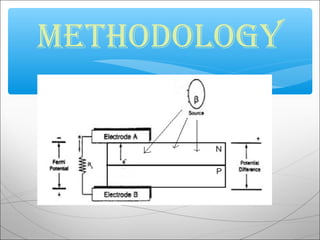
METHODOLOGY
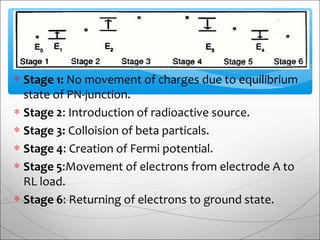
∗ Stage 1: No movement of charges due to equilibrium
state of PN-junction.
∗ Stage 2: Introduction of radioactive source.
∗ Stage 3: Colloision of beta particals.
∗ Stage 4: Creation of Fermi potential.
∗ Stage 5:Movement of electrons from electrode A to
RL load.
∗ Stage 6: Returning of electrons to ground state.
∗ Life span- minimum of 10 years.
∗ Reliable electricity.
∗ Lighter with high energy density.
∗ It is efficient.
∗ Fuel used is the nuclear waste from nuclear fission.
MERITS
∗ High initial cost of production.
∗ Energy conversion methodologies are not much
advanced.
∗ Regional and country-specific laws regarding use
and disposal of radioactive fuels.
∗ To gain social acceptance.
demerits
∗ Space application
∗ Medical application
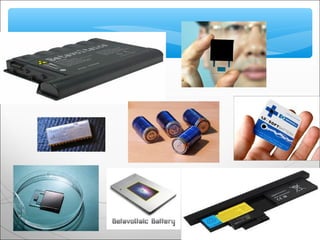
∗ In Mobile devices.
∗ It can be used in Automobiles
APPLiCAtiONs
∗ Small compact devices of future, requires small
batteries.
∗ Nuclear batteries increase functionality, reliability and
longevity.
∗ Until final disposal all Radiation Protection Standards
must be met.
∗ Batteries of the near future.
CONCLusiON
∗ J. P. Blanchard "Stretching the boundaries of nuclear
technology", The Bridge, vol. 32
∗ H. Guo and A. Lal "Nano power beta voltaic micro
batteries", IEEE Proc. 12th Int. Conf. Solid State Sens.,
Actuators Microsyst,
∗ H. Loferski, J.J Elleman, "Construction of a
promethium-147 atomic battery,". IEEE Trans., on
Electron Devices, vol. 3,
reFereNCes
THANKTHANK YOUYOU

Nuclear Batteries.

  • 1.
    SMT KAMALA &SRI VENKAPPA M AGADI COLLEGE OF ENGINEERING & TECHNOLOGY LAXMESHWAR. DEPARTMENT OF ELECTRICAL & ELECTRONICS A Seminar On NUCLEAR BATTERIES UNDER THE GUIDENCE OF Prof. SANGEETA T PRESENTED BY, KIRANKUMAR M K
  • 2.
    IntroductionIntroduction MethodologyMethodology Merits and DemeritsMeritsand Demerits ApplicationsApplications ReferencesReferences CONTENTS
  • 3.
    ∗ Idea wasintroduced in 1950 and patented to Tracer Lab. ∗ Radioisotope electric power system developed by Paul Brown. ∗ Chemical batteries require frequent replacements and are bulky. ∗ Fuel and Solar cells are expensive and requires sunlight respectively. INTRODUCTION
  • 4.
    ∗ Uses emissionsfrom radioactive isotope to generate electricity. ∗ Nuclear batteries have lifespan upto decades. ∗ Do not rely on nuclear reaction , so no radioactive wastes. ∗ Can be used in inaccessible and extreme conditions. CONT…
  • 5.
  • 6.
    ∗ Stage 1:No movement of charges due to equilibrium state of PN-junction. ∗ Stage 2: Introduction of radioactive source. ∗ Stage 3: Colloision of beta particals. ∗ Stage 4: Creation of Fermi potential. ∗ Stage 5:Movement of electrons from electrode A to RL load. ∗ Stage 6: Returning of electrons to ground state.
  • 8.
    ∗ Life span-minimum of 10 years. ∗ Reliable electricity. ∗ Lighter with high energy density. ∗ It is efficient. ∗ Fuel used is the nuclear waste from nuclear fission. MERITS
  • 9.
    ∗ High initialcost of production. ∗ Energy conversion methodologies are not much advanced. ∗ Regional and country-specific laws regarding use and disposal of radioactive fuels. ∗ To gain social acceptance. demerits
  • 10.
    ∗ Space application ∗Medical application ∗ In Mobile devices. ∗ It can be used in Automobiles APPLiCAtiONs
  • 11.
    ∗ Small compactdevices of future, requires small batteries. ∗ Nuclear batteries increase functionality, reliability and longevity. ∗ Until final disposal all Radiation Protection Standards must be met. ∗ Batteries of the near future. CONCLusiON
  • 12.
    ∗ J. P.Blanchard "Stretching the boundaries of nuclear technology", The Bridge, vol. 32 ∗ H. Guo and A. Lal "Nano power beta voltaic micro batteries", IEEE Proc. 12th Int. Conf. Solid State Sens., Actuators Microsyst, ∗ H. Loferski, J.J Elleman, "Construction of a promethium-147 atomic battery,". IEEE Trans., on Electron Devices, vol. 3, reFereNCes
  • 13.