 Define Intramuscular injection
 Enlist the indications& contraindications of IM
injection
 Enumerate the sites of IM injection
 Discuss the technique in IM injection
 Explain the procedure in administering IM injection
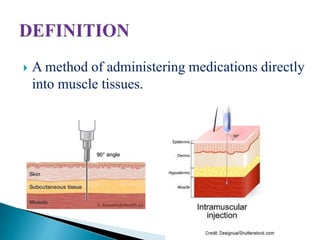
 A method of administering medications directly
into muscle tissues.
INDICATIONS CONTRAINDICATIONS
 Administration and absorption
of large doses (up to 5 ml) in
appropriate sites
 Medications that irritate
subcutaneous tissues
 Cannot locate an appropriate
vein
 Drugs that are altered by
digestive juices
 Un cooperative /cannot take
medications orally
 Active infection near the
injection site
 A known allergy or
hypersensitivity to the material
or to the lidocaine
 Acute myocardial infarction
 Shock
 Coagulation disorders
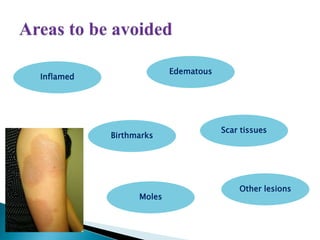
Inflamed
Edematous
Moles
Birthmarks
Scar tissues
Other lesions
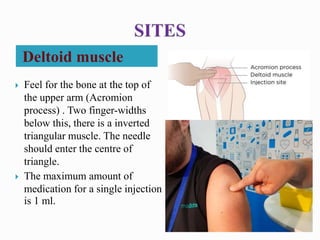
Deltoid muscle
 Feel for the bone at the top of
the upper arm (Acromion
process) . Two finger-widths
below this, there is a inverted
triangular muscle. The needle
should enter the centre of
triangle.
 The maximum amount of
medication for a single injection
is 1 ml.
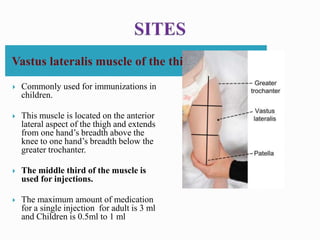
Vastus lateralis muscle of the thigh
 Commonly used for immunizations in
children.
 This muscle is located on the anterior
lateral aspect of the thigh and extends
from one hand’s breadth above the
knee to one hand’s breadth below the
greater trochanter.
 The middle third of the muscle is
used for injections.
 The maximum amount of medication
for a single injection for adult is 3 ml
and Children is 0.5ml to 1 ml
Ventrogluteal muscle of the hip
 Locate the greater trochanter of
the femur with the palm of the
hand.
 Spread index and middle fingers
posteriorly from the anterior
superior iliac spine to the furthest
area possible
 Position the index and middle
fingers into a ‘V’ then administer
in the middle of the V.
 The maximum amount of
medication for a single injection
for adult is 2.5 to 5 ml
 The ventrogluteal site is free from blood vessels
and nerves, and has the greatest thickness of
muscle when compared to other sites
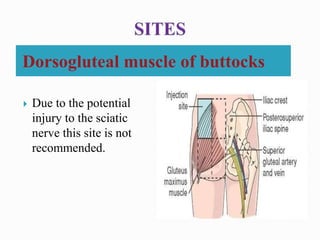
Dorsogluteal muscle of buttocks
 Due to the potential
injury to the sciatic
nerve this site is not
recommended.
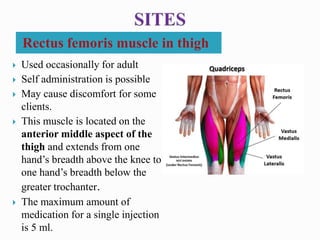
Rectus femoris muscle in thigh
 Used occasionally for adult
 Self administration is possible
 May cause discomfort for some
clients.
 This muscle is located on the
anterior middle aspect of the
thigh and extends from one
hand’s breadth above the knee to
one hand’s breadth below the
greater trochanter.
 The maximum amount of
medication for a single injection
is 5 ml.
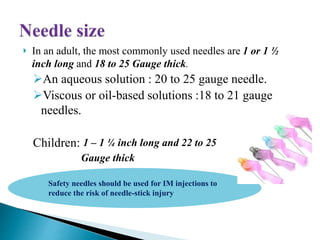
 In an adult, the most commonly used needles are 1 or 1 ½
inch long and 18 to 25 Gauge thick.
An aqueous solution : 20 to 25 gauge needle.
Viscous or oil-based solutions :18 to 21 gauge
needles.
Children: 1 – 1 ¼ inch long and 22 to 25
Gauge thick
Safety needles should be used for IM injections to
reduce the risk of needle-stick injury
The Z-track method is a type of IM injection technique
used to prevent tracking (leakage) of the medication
into the subcutaneous tissue.
Z-Track Injection Sites
 Thigh (vastus lateralis muscle)
 Hip (ventrogluteal)
Purpose of Z-Track Injection
 It helps to prevent medication from seeping into the
subcutaneous tissue and ensures a full dosage.
 Some medications are dark colored (iron preparation)
and can cause staining on the skin. This technique is to
prevent injection site discoloration or lesions.
Procedure
 Skin and tissue are pulled and held firmly while a
long needle is inserted into the muscle.
 Pulling the skin and tissue before the injection
causes the needle track to take the shape of the letter
“Z,” This zigzag track line prevents medication from
leaking from the muscle into surrounding tissue.
 Create Z-track. Keep the needle in place for about
10 seconds before taking it out. After removing the
needle, release the hold on the skin and tissue.
 Apply pressure to the site. Use gauze to apply gentle
pressure to the site for a moment.
 Never massage the site .This may cause the
medication to leak and irritate the skin.
 Prescription sheet
 Tray containing:
 Prescribed medication
 Sterile syringe and needle
 Alcohol swabs
 Gauze /cotton balls
 Container for waste
 Sharp disposal box
 Small tray (to keep the prepared medication).
1.Confirm doctor’s prescription
2.Hand hygiene
3.Assemble equipments
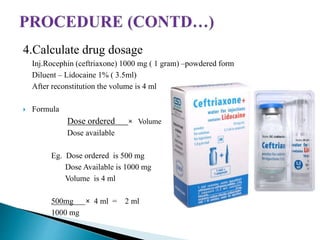
4.Calculate drug dosage
Inj.Rocephin (ceftriaxone) 1000 mg ( 1 gram) –powdered form
Diluent – Lidocaine 1% ( 3.5ml)
After reconstitution the volume is 4 ml
 Formula
Dose ordered × Volume
Dose available
Eg. Dose ordered is 500 mg
Dose Available is 1000 mg
Volume is 4 ml
500mg × 4 ml = 2 ml
1000 mg
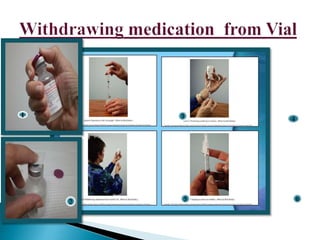
5.Withdraw the drug
From a vial:
 Expose and clean the rubber stopper of the vial with the alcohol swab
 Prepare the appropriate syringe and needle
 Dissolve and mix the drug ,if required
 Inject air equal to the amount of medication needed into the vial and
withdraw the correct dosage of the drug.
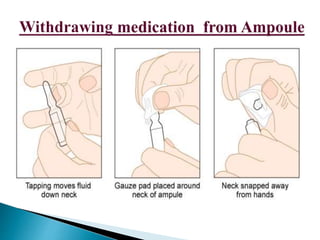
From ampoule:
 Ensure that the medicine in the lower part of an ampoule
 Prepare the appropriate syringe and needle
 File the ampoule, if necessary
 Break the neck of the ampoule protecting the fingers with gauze and
withdraw the correct dosage.
1
2
3 4
5 6
6.Expel air and change the needle.
7.Place the loaded syringe in the small tray with alcohol
swab and cotton balls along with the prescription sheet
and take to the patient.
8.Identify the patient and explain the procedure
9.Provide privacy
10.Position the patient comfortably on bed
11.Select and clean the site
12. Taut (stretch) the skin as required
13. Insert the needle at 90 degree angle
into the muscle
14. Withdraw the plunger. if no blood is aspirated, inject
the medicine slowly (if blood is aspirated, remove
and change the needle then select another site)
15.Withdraw the needle quickly and apply pressure over
the injected site using dry cotton ball.
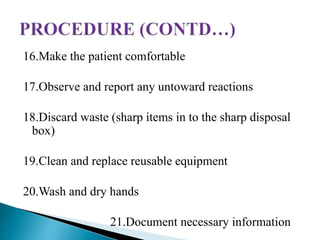
16.Make the patient comfortable
17.Observe and report any untoward reactions
18.Discard waste (sharp items in to the sharp disposal
box)
19.Clean and replace reusable equipment
20.Wash and dry hands
21.Document necessary information
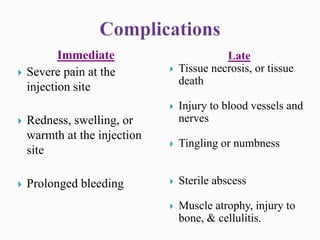
Immediate
 Severe pain at the
injection site
 Redness, swelling, or
warmth at the injection
site
 Prolonged bleeding
Late
 Tissue necrosis, or tissue
death
 Injury to blood vessels and
nerves
 Tingling or numbness
 Sterile abscess
 Muscle atrophy, injury to
bone, & cellulitis.
ntramuscular injectionpresentation......

ntramuscular injectionpresentation......

  • 3.
     Define Intramuscularinjection  Enlist the indications& contraindications of IM injection  Enumerate the sites of IM injection  Discuss the technique in IM injection  Explain the procedure in administering IM injection
  • 4.
     A methodof administering medications directly into muscle tissues.
  • 5.
    INDICATIONS CONTRAINDICATIONS  Administrationand absorption of large doses (up to 5 ml) in appropriate sites  Medications that irritate subcutaneous tissues  Cannot locate an appropriate vein  Drugs that are altered by digestive juices  Un cooperative /cannot take medications orally  Active infection near the injection site  A known allergy or hypersensitivity to the material or to the lidocaine  Acute myocardial infarction  Shock  Coagulation disorders
  • 6.
  • 7.
    Deltoid muscle  Feelfor the bone at the top of the upper arm (Acromion process) . Two finger-widths below this, there is a inverted triangular muscle. The needle should enter the centre of triangle.  The maximum amount of medication for a single injection is 1 ml.
  • 8.
    Vastus lateralis muscleof the thigh  Commonly used for immunizations in children.  This muscle is located on the anterior lateral aspect of the thigh and extends from one hand’s breadth above the knee to one hand’s breadth below the greater trochanter.  The middle third of the muscle is used for injections.  The maximum amount of medication for a single injection for adult is 3 ml and Children is 0.5ml to 1 ml
  • 9.
    Ventrogluteal muscle ofthe hip  Locate the greater trochanter of the femur with the palm of the hand.  Spread index and middle fingers posteriorly from the anterior superior iliac spine to the furthest area possible  Position the index and middle fingers into a ‘V’ then administer in the middle of the V.  The maximum amount of medication for a single injection for adult is 2.5 to 5 ml
  • 10.
     The ventroglutealsite is free from blood vessels and nerves, and has the greatest thickness of muscle when compared to other sites
  • 11.
    Dorsogluteal muscle ofbuttocks  Due to the potential injury to the sciatic nerve this site is not recommended.
  • 12.
    Rectus femoris musclein thigh  Used occasionally for adult  Self administration is possible  May cause discomfort for some clients.  This muscle is located on the anterior middle aspect of the thigh and extends from one hand’s breadth above the knee to one hand’s breadth below the greater trochanter.  The maximum amount of medication for a single injection is 5 ml.
  • 13.
     In anadult, the most commonly used needles are 1 or 1 ½ inch long and 18 to 25 Gauge thick. An aqueous solution : 20 to 25 gauge needle. Viscous or oil-based solutions :18 to 21 gauge needles. Children: 1 – 1 ¼ inch long and 22 to 25 Gauge thick Safety needles should be used for IM injections to reduce the risk of needle-stick injury
  • 14.
    The Z-track methodis a type of IM injection technique used to prevent tracking (leakage) of the medication into the subcutaneous tissue. Z-Track Injection Sites  Thigh (vastus lateralis muscle)  Hip (ventrogluteal)
  • 15.
    Purpose of Z-TrackInjection  It helps to prevent medication from seeping into the subcutaneous tissue and ensures a full dosage.  Some medications are dark colored (iron preparation) and can cause staining on the skin. This technique is to prevent injection site discoloration or lesions.
  • 16.
    Procedure  Skin andtissue are pulled and held firmly while a long needle is inserted into the muscle.  Pulling the skin and tissue before the injection causes the needle track to take the shape of the letter “Z,” This zigzag track line prevents medication from leaking from the muscle into surrounding tissue.
  • 18.
     Create Z-track.Keep the needle in place for about 10 seconds before taking it out. After removing the needle, release the hold on the skin and tissue.  Apply pressure to the site. Use gauze to apply gentle pressure to the site for a moment.  Never massage the site .This may cause the medication to leak and irritate the skin.
  • 19.
     Prescription sheet Tray containing:  Prescribed medication  Sterile syringe and needle  Alcohol swabs  Gauze /cotton balls  Container for waste  Sharp disposal box  Small tray (to keep the prepared medication).
  • 20.
    1.Confirm doctor’s prescription 2.Handhygiene 3.Assemble equipments
  • 21.
    4.Calculate drug dosage Inj.Rocephin(ceftriaxone) 1000 mg ( 1 gram) –powdered form Diluent – Lidocaine 1% ( 3.5ml) After reconstitution the volume is 4 ml  Formula Dose ordered × Volume Dose available Eg. Dose ordered is 500 mg Dose Available is 1000 mg Volume is 4 ml 500mg × 4 ml = 2 ml 1000 mg
  • 22.
    5.Withdraw the drug Froma vial:  Expose and clean the rubber stopper of the vial with the alcohol swab  Prepare the appropriate syringe and needle  Dissolve and mix the drug ,if required  Inject air equal to the amount of medication needed into the vial and withdraw the correct dosage of the drug. From ampoule:  Ensure that the medicine in the lower part of an ampoule  Prepare the appropriate syringe and needle  File the ampoule, if necessary  Break the neck of the ampoule protecting the fingers with gauze and withdraw the correct dosage.
  • 23.
  • 25.
    6.Expel air andchange the needle. 7.Place the loaded syringe in the small tray with alcohol swab and cotton balls along with the prescription sheet and take to the patient. 8.Identify the patient and explain the procedure 9.Provide privacy 10.Position the patient comfortably on bed 11.Select and clean the site
  • 26.
    12. Taut (stretch)the skin as required 13. Insert the needle at 90 degree angle into the muscle 14. Withdraw the plunger. if no blood is aspirated, inject the medicine slowly (if blood is aspirated, remove and change the needle then select another site) 15.Withdraw the needle quickly and apply pressure over the injected site using dry cotton ball.
  • 27.
    16.Make the patientcomfortable 17.Observe and report any untoward reactions 18.Discard waste (sharp items in to the sharp disposal box) 19.Clean and replace reusable equipment 20.Wash and dry hands 21.Document necessary information
  • 28.
    Immediate  Severe painat the injection site  Redness, swelling, or warmth at the injection site  Prolonged bleeding Late  Tissue necrosis, or tissue death  Injury to blood vessels and nerves  Tingling or numbness  Sterile abscess  Muscle atrophy, injury to bone, & cellulitis.