OPEN WOUND
&
BLEEDING
Prepared by
Staff development unit
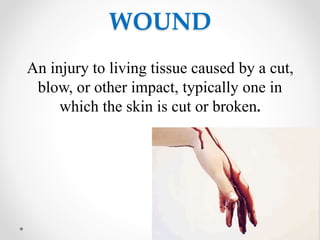
WOUND
An injury to living tissue caused by a cut,
blow, or other impact, typically one in
which the skin is cut or broken.
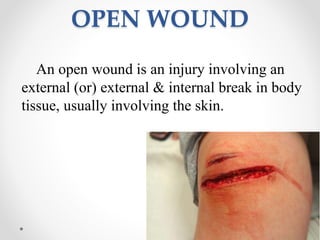
OPEN WOUND
An open wound is an injury involving an
external (or) external & internal break in body
tissue, usually involving the skin.
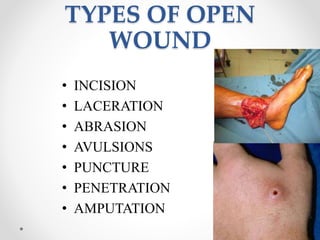
TYPES OF OPEN
WOUND
• INCISION
• LACERATION
• ABRASION
• AVULSIONS
• PUNCTURE
• PENETRATION
• AMPUTATION
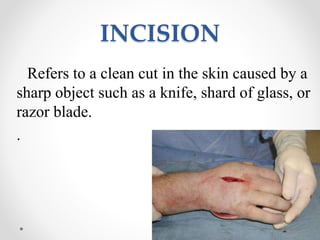
INCISION
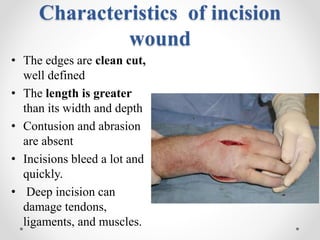
Refers to a clean cut in the skin caused by a
sharp object such as a knife, shard of glass, or
razor blade.
.
Characteristics of incision
wound
• The edges are clean cut,
well defined
• The length is greater
than its width and depth
• Contusion and abrasion
are absent
• Incisions bleed a lot and
quickly.
• Deep incision can
damage tendons,
ligaments, and muscles.
LACERATION
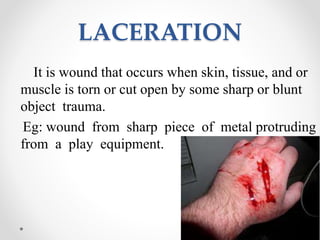
It is wound that occurs when skin, tissue, and or
muscle is torn or cut open by some sharp or blunt
object trauma.
Eg: wound from sharp piece of metal protruding
from a play equipment.
Characteristics of
Laceration wound
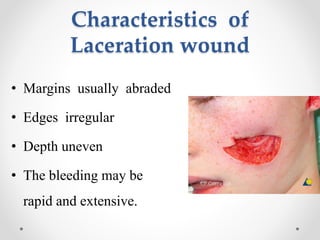
• Margins usually abraded
• Edges irregular
• Depth uneven
• The bleeding may be
rapid and extensive.
ABRASION
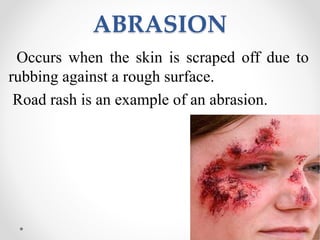
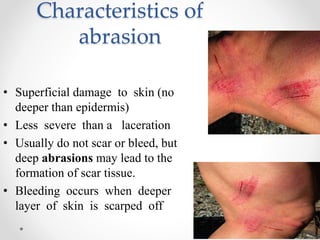
Occurs when the skin is scraped off due to
rubbing against a rough surface.
Road rash is an example of an abrasion.
Characteristics of
abrasion
• Superficial damage to skin (no
deeper than epidermis)
• Less severe than a laceration
• Usually do not scar or bleed, but
deep abrasions may lead to the
formation of scar tissue.
• Bleeding occurs when deeper
layer of skin is scarped off
DEPT
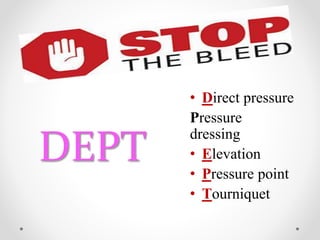
• Direct pressure
Pressure
dressing
• Elevation
• Pressure point
• Tourniquet
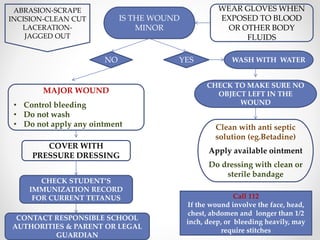
ABRASION-SCRAPE
INCISION-CLEAN CUT
LACERATION-
JAGGED OUT
WEAR GLOVES WHEN
EXPOSED TO BLOOD
OR OTHER BODY
FLUIDS
IS THE WOUND
MINOR
NO YES
MAJOR WOUND
• Control bleeding
• Do not wash
• Do not apply any ointment
WASH WITH WATER
CHECK TO MAKE SURE NO
OBJECT LEFT IN THE
WOUND
Clean with anti septic
solution (eg.Betadine)
Apply available ointment
Do dressing with clean or
sterile bandage
COVER WITH
PRESSURE DRESSING
CHECK STUDENT’S
IMMUNIZATION RECORD
FOR CURRENT TETANUS
CONTACT RESPONSIBLE SCHOOL
AUTHORITIES & PARENT OR LEGAL
GUARDIAN
Call 112
If the wound involve the face, head,
chest, abdomen and longer than 1/2
inch, deep, or bleeding heavily, may
require stitches
PUNCTURE WOUND,
PENETRATING WOUND &
AVULSION
Prepared by
Staff development unit
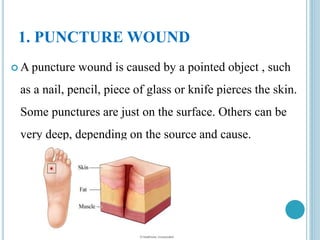
1. PUNCTURE WOUND
 A puncture wound is caused by a pointed object , such
as a nail, pencil, piece of glass or knife pierces the skin.
Some punctures are just on the surface. Others can be
very deep, depending on the source and cause.
PUNCTURE WOUND CONTD…
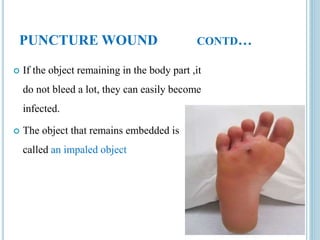
 If the object remaining in the body part ,it
do not bleed a lot, they can easily become
infected.
 The object that remains embedded is
called an impaled object
FIRST AID MANAGEMENT
( IMPALED OBJECT)
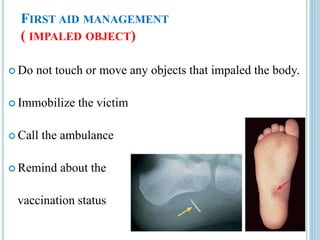
 Do not touch or move any objects that impaled the body.
 Immobilize the victim
 Call the ambulance
 Remind about the
vaccination status
FIRST AID MANAGEMENT
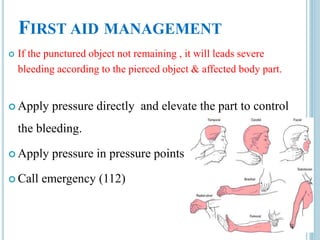
 If the punctured object not remaining , it will leads severe
bleeding according to the pierced object & affected body part.
 Apply pressure directly and elevate the part to control
the bleeding.
 Apply pressure in pressure points
 Call emergency (112)
FIRST AID MANAGEMENT CONTD…
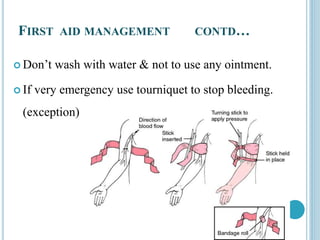
 Don’t wash with water & not to use any ointment.
 If very emergency use tourniquet to stop bleeding.

(exception)
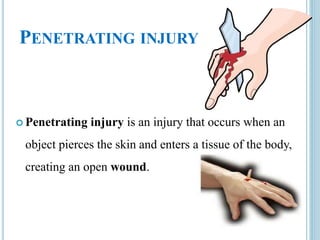
PENETRATING INJURY
 Penetrating injury is an injury that occurs when an
object pierces the skin and enters a tissue of the body,
creating an open wound.
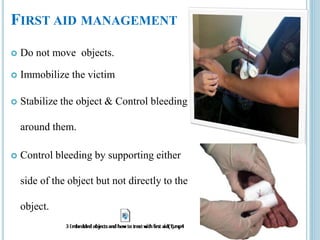
FIRST AID MANAGEMENT
 Do not move objects.
 Immobilize the victim
 Stabilize the object & Control bleeding
around them.
 Control bleeding by supporting either
side of the object but not directly to the
object.
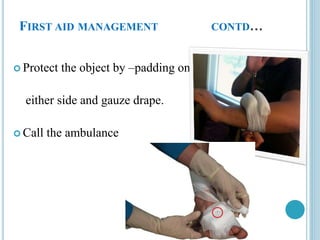
FIRST AID MANAGEMENT CONTD…
 Protect the object by –padding on
either side and gauze drape.
 Call the ambulance
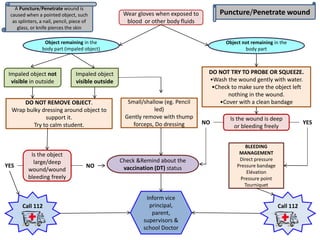
Wear gloves when exposed to
blood or other body fluids
Object remaining in the
body part (impaled object)
Object not remaining in the
body part
Impaled object not
visible in outside
Impaled object
visible outside
DO NOT REMOVE OBJECT.
Wrap bulky dressing around object to
support it.
Try to calm student.
Is the object
large/deep
wound/wound
bleeding freely
Inform vice
principal,
parent,
supervisors &
school Doctor
YES NO
Check &Remind about the
vaccination (DT) status
Call 112
DO NOT TRY TO PROBE OR SQUEEZE.
•Wash the wound gently with water.
•Check to make sure the object left
nothing in the wound.
•Cover with a clean bandage
Is the wound is deep
or bleeding freely
YES
NO
Call 112
BLEEDING
MANAGEMENT
Direct pressure
Pressure bandage
Elévation
Pressure point
Tourniquet
Puncture/Penetrate wound
A Puncture/Penetrate wound is
caused when a pointed object, such
as splinters, a nail, pencil, piece of
glass, or knife pierces the skin
Small/shallow (eg. Pencil
led)
Gently remove with thump
forceps, Do dressing
AVULSION
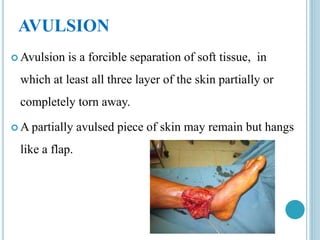
 Avulsion is a forcible separation of soft tissue, in
which at least all three layer of the skin partially or
completely torn away.
 A partially avulsed piece of skin may remain but hangs
like a flap.
FIRST AID FOR AVULSION
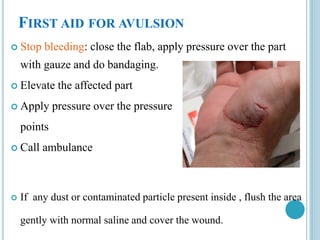
 Stop bleeding: close the flab, apply pressure over the part
with gauze and do bandaging.
 Elevate the affected part
 Apply pressure over the pressure
points
 Call ambulance
 If any dust or contaminated particle present inside , flush the area
gently with normal saline and cover the wound.
AMPUTATION
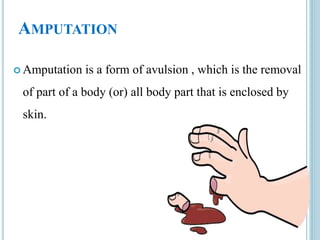
 Amputation is a form of avulsion , which is the removal
of part of a body (or) all body part that is enclosed by
skin.
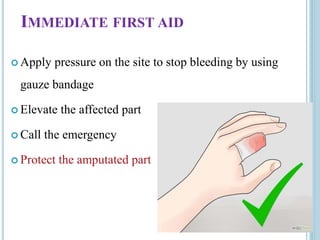
IMMEDIATE FIRST AID
 Apply pressure on the site to stop bleeding by using
gauze bandage
 Elevate the affected part
 Call the emergency
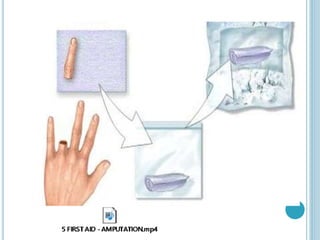
 Protect the amputated part
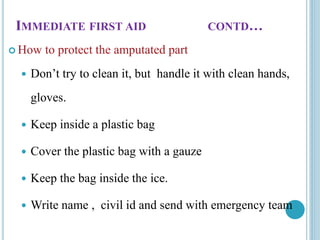
IMMEDIATE FIRST AID CONTD…
 How to protect the amputated part
 Don’t try to clean it, but handle it with clean hands,
gloves.
 Keep inside a plastic bag
 Cover the plastic bag with a gauze
 Keep the bag inside the ice.
 Write name , civil id and send with emergency team
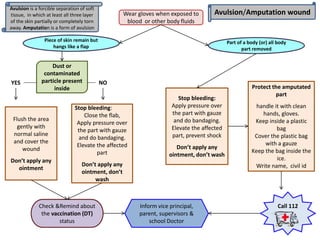
Wear gloves when exposed to
blood or other body fluids
Piece of skin remain but
hangs like a flap
Part of a body (or) all body
part removed
Dust or
contaminated
particle present
inside
Flush the area
gently with
normal saline
and cover the
wound
Don’t apply any
ointment
Inform vice principal,
parent, supervisors &
school Doctor
Check &Remind about
the vaccination (DT)
status
Stop bleeding:
Apply pressure over
the part with gauze
and do bandaging.
Elevate the affected
part, prevent shock
Don’t apply any
ointment, don’t wash
Call 112
Avulsion/Amputation wound
Avulsion is a forcible separation of soft
tissue, in which at least all three layer
of the skin partially or completely torn
away. Amputation is a form of avulsion
Stop bleeding:
Close the flab,
Apply pressure over
the part with gauze
and do bandaging.
Elevate the affected
part
Don’t apply any
ointment, don’t
wash
YES NO
Protect the amputated
part
handle it with clean
hands, gloves.
Keep inside a plastic
bag
Cover the plastic bag
with a gauze
Keep the bag inside the
ice.
Write name, civil id
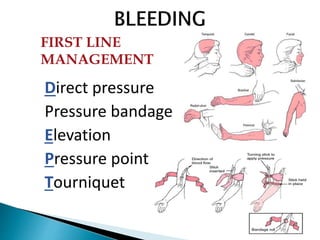
FIRST LINE
MANAGEMENT
Direct pressure
Pressure bandage
Elevation
Pressure point
Tourniquet
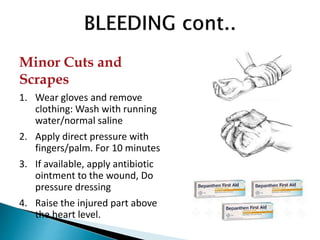
Minor Cuts and
Scrapes
1. Wear gloves and remove
clothing: Wash with running
water/normal saline
2. Apply direct pressure with
fingers/palm. For 10 minutes
3. If available, apply antibiotic
ointment to the wound, Do
pressure dressing
4. Raise the injured part above
the heart level.
Minor Cuts and Scrapes
Call the emergency if:
 You can’t stop the bleeding.
 If wound is gaping, student may need stitches
 You see signs of fracture.
 You suspect an injury to the head, neck or
spine.
Major Cuts and Scrapes
 Control bleeding (DPEPT)
 Prevent the minimize the effect of shock (head
low, elevate the foot)
 Don’t allow the student to eat or drink because
an anesthetic may be needed
 Antibiotic ointment is NOT advised.
 Don’t clean with water and soap.
 Call 112
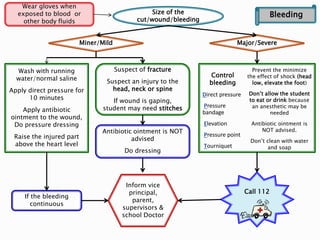
Bleeding
Wear gloves when
exposed to blood or
other body fluids
Size of the
cut/wound/bleeding
Miner/Mild Major/Severe
Wash with running
water/normal saline
Apply direct pressure for
10 minutes
Apply antibiotic
ointment to the wound,
Do pressure dressing
Raise the injured part
above the heart level
Suspect of fracture
Suspect an injury to the
head, neck or spine
If wound is gaping,
student may need stitches
Inform vice
principal,
parent,
supervisors &
school Doctor
Control
bleeding
Direct pressure
Pressure
bandage
Elevation
Pressure point
Tourniquet
Prevent the minimize
the effect of shock (head
low, elevate the foot)
Don’t allow the student
to eat or drink because
an anesthetic may be
needed
Antibiotic ointment is
NOT advised.
Don’t clean with water
and soap
Call 112
If the bleeding
continuous
Antibiotic ointment is NOT
advised
Do dressing
wound ppt.pptx, wound dressing , indication, types, procedure,

wound ppt.pptx, wound dressing , indication, types, procedure,

  • 1.
  • 2.
    WOUND An injury toliving tissue caused by a cut, blow, or other impact, typically one in which the skin is cut or broken.
  • 3.
    OPEN WOUND An openwound is an injury involving an external (or) external & internal break in body tissue, usually involving the skin.
  • 4.
    TYPES OF OPEN WOUND •INCISION • LACERATION • ABRASION • AVULSIONS • PUNCTURE • PENETRATION • AMPUTATION
  • 5.
    INCISION Refers to aclean cut in the skin caused by a sharp object such as a knife, shard of glass, or razor blade. .
  • 6.
    Characteristics of incision wound •The edges are clean cut, well defined • The length is greater than its width and depth • Contusion and abrasion are absent • Incisions bleed a lot and quickly. • Deep incision can damage tendons, ligaments, and muscles.
  • 7.
    LACERATION It is woundthat occurs when skin, tissue, and or muscle is torn or cut open by some sharp or blunt object trauma. Eg: wound from sharp piece of metal protruding from a play equipment.
  • 8.
    Characteristics of Laceration wound •Margins usually abraded • Edges irregular • Depth uneven • The bleeding may be rapid and extensive.
  • 9.
    ABRASION Occurs when theskin is scraped off due to rubbing against a rough surface. Road rash is an example of an abrasion.
  • 10.
    Characteristics of abrasion • Superficialdamage to skin (no deeper than epidermis) • Less severe than a laceration • Usually do not scar or bleed, but deep abrasions may lead to the formation of scar tissue. • Bleeding occurs when deeper layer of skin is scarped off
  • 11.
    DEPT • Direct pressure Pressure dressing •Elevation • Pressure point • Tourniquet
  • 12.
    ABRASION-SCRAPE INCISION-CLEAN CUT LACERATION- JAGGED OUT WEARGLOVES WHEN EXPOSED TO BLOOD OR OTHER BODY FLUIDS IS THE WOUND MINOR NO YES MAJOR WOUND • Control bleeding • Do not wash • Do not apply any ointment WASH WITH WATER CHECK TO MAKE SURE NO OBJECT LEFT IN THE WOUND Clean with anti septic solution (eg.Betadine) Apply available ointment Do dressing with clean or sterile bandage COVER WITH PRESSURE DRESSING CHECK STUDENT’S IMMUNIZATION RECORD FOR CURRENT TETANUS CONTACT RESPONSIBLE SCHOOL AUTHORITIES & PARENT OR LEGAL GUARDIAN Call 112 If the wound involve the face, head, chest, abdomen and longer than 1/2 inch, deep, or bleeding heavily, may require stitches
  • 13.
    PUNCTURE WOUND, PENETRATING WOUND& AVULSION Prepared by Staff development unit
  • 14.
    1. PUNCTURE WOUND A puncture wound is caused by a pointed object , such as a nail, pencil, piece of glass or knife pierces the skin. Some punctures are just on the surface. Others can be very deep, depending on the source and cause.
  • 15.
    PUNCTURE WOUND CONTD… If the object remaining in the body part ,it do not bleed a lot, they can easily become infected.  The object that remains embedded is called an impaled object
  • 16.
    FIRST AID MANAGEMENT (IMPALED OBJECT)  Do not touch or move any objects that impaled the body.  Immobilize the victim  Call the ambulance  Remind about the vaccination status
  • 17.
    FIRST AID MANAGEMENT If the punctured object not remaining , it will leads severe bleeding according to the pierced object & affected body part.  Apply pressure directly and elevate the part to control the bleeding.  Apply pressure in pressure points  Call emergency (112)
  • 18.
    FIRST AID MANAGEMENTCONTD…  Don’t wash with water & not to use any ointment.  If very emergency use tourniquet to stop bleeding. (exception)
  • 19.
    PENETRATING INJURY  Penetratinginjury is an injury that occurs when an object pierces the skin and enters a tissue of the body, creating an open wound.
  • 20.
    FIRST AID MANAGEMENT Do not move objects.  Immobilize the victim  Stabilize the object & Control bleeding around them.  Control bleeding by supporting either side of the object but not directly to the object.
  • 21.
    FIRST AID MANAGEMENTCONTD…  Protect the object by –padding on either side and gauze drape.  Call the ambulance
  • 22.
    Wear gloves whenexposed to blood or other body fluids Object remaining in the body part (impaled object) Object not remaining in the body part Impaled object not visible in outside Impaled object visible outside DO NOT REMOVE OBJECT. Wrap bulky dressing around object to support it. Try to calm student. Is the object large/deep wound/wound bleeding freely Inform vice principal, parent, supervisors & school Doctor YES NO Check &Remind about the vaccination (DT) status Call 112 DO NOT TRY TO PROBE OR SQUEEZE. •Wash the wound gently with water. •Check to make sure the object left nothing in the wound. •Cover with a clean bandage Is the wound is deep or bleeding freely YES NO Call 112 BLEEDING MANAGEMENT Direct pressure Pressure bandage Elévation Pressure point Tourniquet Puncture/Penetrate wound A Puncture/Penetrate wound is caused when a pointed object, such as splinters, a nail, pencil, piece of glass, or knife pierces the skin Small/shallow (eg. Pencil led) Gently remove with thump forceps, Do dressing
  • 23.
    AVULSION  Avulsion isa forcible separation of soft tissue, in which at least all three layer of the skin partially or completely torn away.  A partially avulsed piece of skin may remain but hangs like a flap.
  • 24.
    FIRST AID FORAVULSION  Stop bleeding: close the flab, apply pressure over the part with gauze and do bandaging.  Elevate the affected part  Apply pressure over the pressure points  Call ambulance  If any dust or contaminated particle present inside , flush the area gently with normal saline and cover the wound.
  • 25.
    AMPUTATION  Amputation isa form of avulsion , which is the removal of part of a body (or) all body part that is enclosed by skin.
  • 26.
    IMMEDIATE FIRST AID Apply pressure on the site to stop bleeding by using gauze bandage  Elevate the affected part  Call the emergency  Protect the amputated part
  • 27.
    IMMEDIATE FIRST AIDCONTD…  How to protect the amputated part  Don’t try to clean it, but handle it with clean hands, gloves.  Keep inside a plastic bag  Cover the plastic bag with a gauze  Keep the bag inside the ice.  Write name , civil id and send with emergency team
  • 28.
    Wear gloves whenexposed to blood or other body fluids Piece of skin remain but hangs like a flap Part of a body (or) all body part removed Dust or contaminated particle present inside Flush the area gently with normal saline and cover the wound Don’t apply any ointment Inform vice principal, parent, supervisors & school Doctor Check &Remind about the vaccination (DT) status Stop bleeding: Apply pressure over the part with gauze and do bandaging. Elevate the affected part, prevent shock Don’t apply any ointment, don’t wash Call 112 Avulsion/Amputation wound Avulsion is a forcible separation of soft tissue, in which at least all three layer of the skin partially or completely torn away. Amputation is a form of avulsion Stop bleeding: Close the flab, Apply pressure over the part with gauze and do bandaging. Elevate the affected part Don’t apply any ointment, don’t wash YES NO Protect the amputated part handle it with clean hands, gloves. Keep inside a plastic bag Cover the plastic bag with a gauze Keep the bag inside the ice. Write name, civil id
  • 31.
    FIRST LINE MANAGEMENT Direct pressure Pressurebandage Elevation Pressure point Tourniquet
  • 32.
    Minor Cuts and Scrapes 1.Wear gloves and remove clothing: Wash with running water/normal saline 2. Apply direct pressure with fingers/palm. For 10 minutes 3. If available, apply antibiotic ointment to the wound, Do pressure dressing 4. Raise the injured part above the heart level.
  • 33.
    Minor Cuts andScrapes Call the emergency if:  You can’t stop the bleeding.  If wound is gaping, student may need stitches  You see signs of fracture.  You suspect an injury to the head, neck or spine.
  • 34.
    Major Cuts andScrapes  Control bleeding (DPEPT)  Prevent the minimize the effect of shock (head low, elevate the foot)  Don’t allow the student to eat or drink because an anesthetic may be needed  Antibiotic ointment is NOT advised.  Don’t clean with water and soap.  Call 112
  • 35.
    Bleeding Wear gloves when exposedto blood or other body fluids Size of the cut/wound/bleeding Miner/Mild Major/Severe Wash with running water/normal saline Apply direct pressure for 10 minutes Apply antibiotic ointment to the wound, Do pressure dressing Raise the injured part above the heart level Suspect of fracture Suspect an injury to the head, neck or spine If wound is gaping, student may need stitches Inform vice principal, parent, supervisors & school Doctor Control bleeding Direct pressure Pressure bandage Elevation Pressure point Tourniquet Prevent the minimize the effect of shock (head low, elevate the foot) Don’t allow the student to eat or drink because an anesthetic may be needed Antibiotic ointment is NOT advised. Don’t clean with water and soap Call 112 If the bleeding continuous Antibiotic ointment is NOT advised Do dressing