INTRA
MUSCULAR
INJECTION
PRESENTED BY.
LALITA SHARMA
M.SC NURSING 1ST
YEAR
DEFINITION:
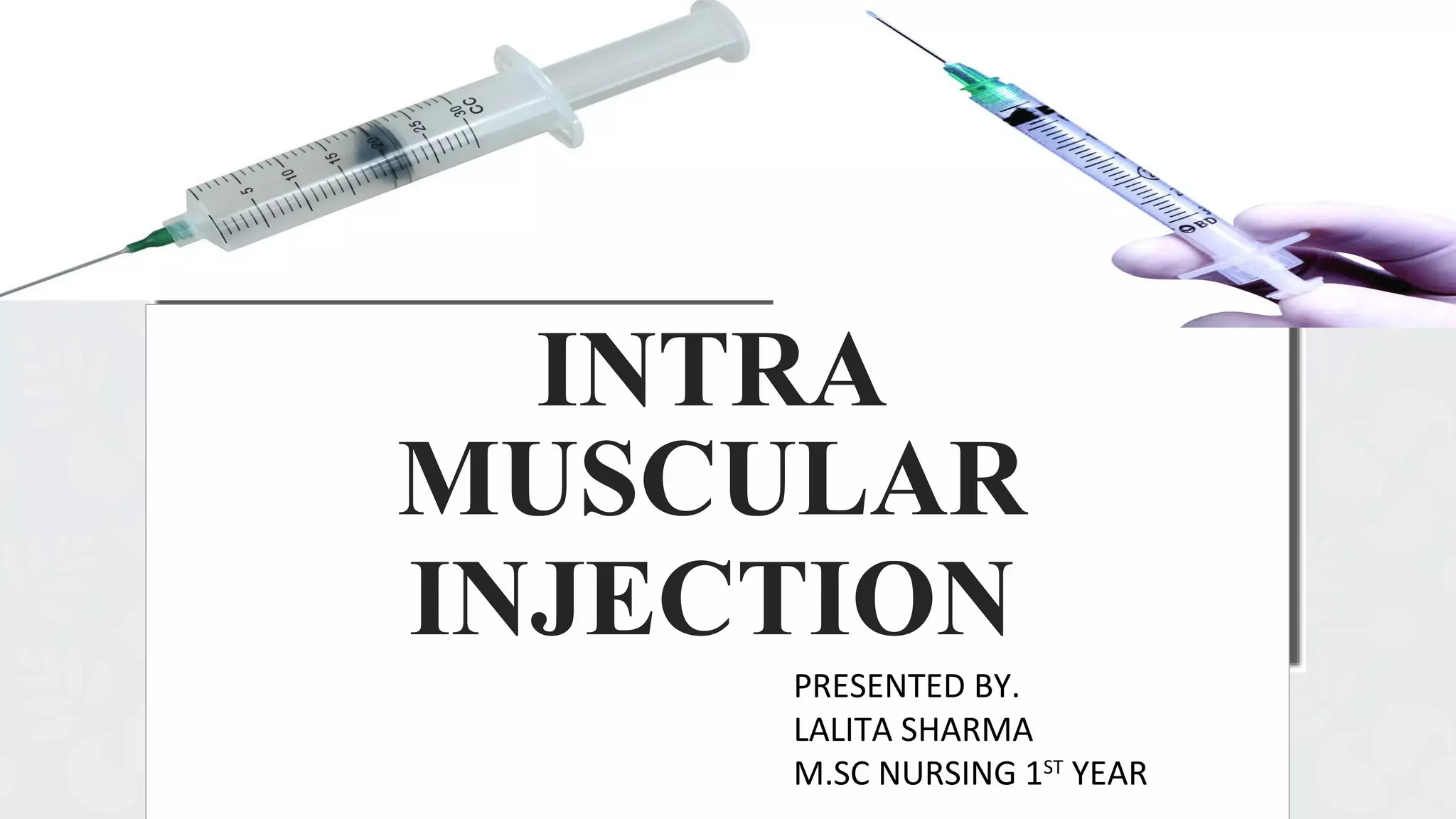
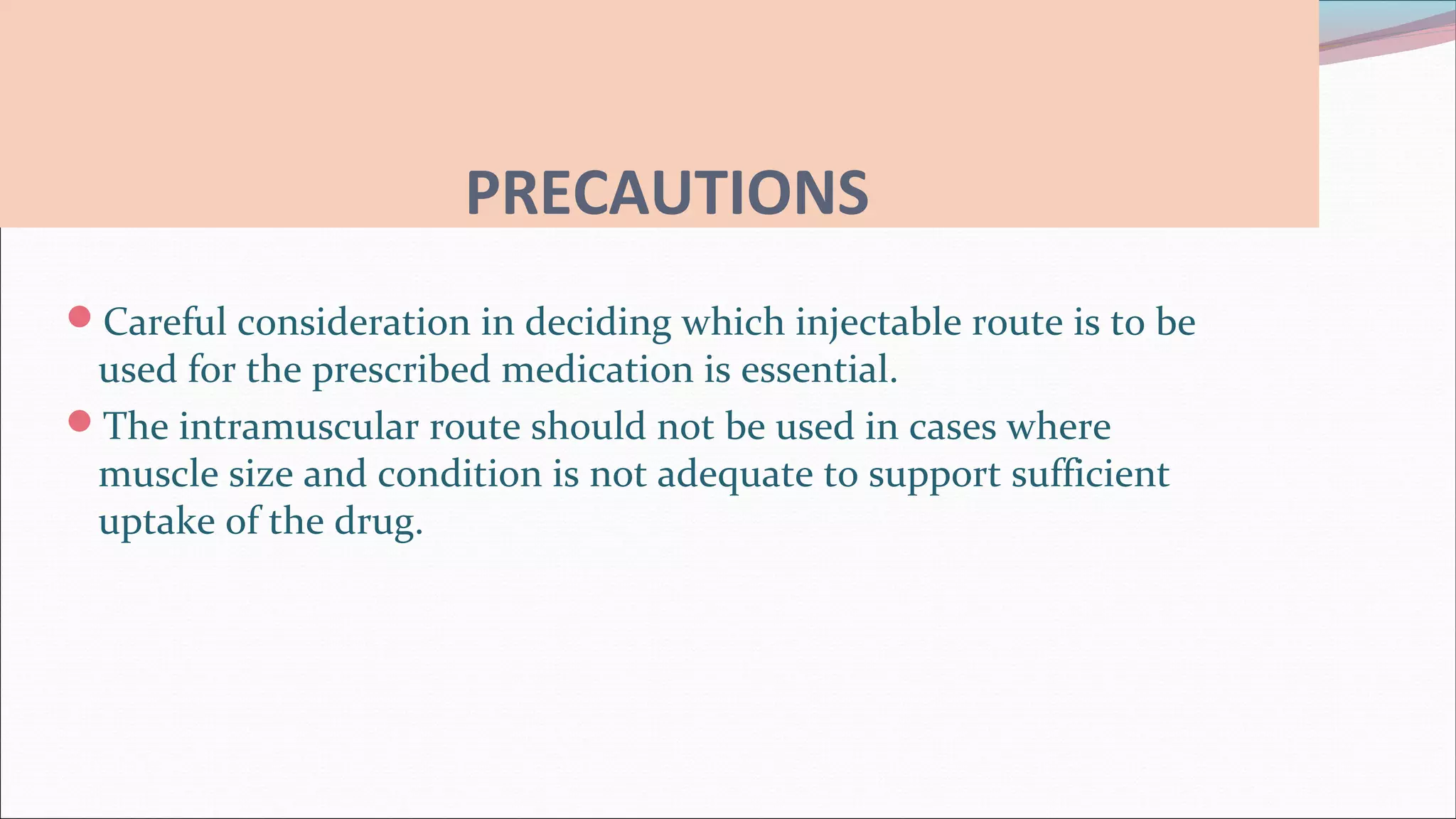
Intramuscular injections
are a common yet
complex technique used
to deliver medication
deep into the large
muscles of the body. It
may be for curative,
diagnostic or
recreational
purpose.
Intramuscular
injection is
define as
introduction of
medicine into
the muscle in
form of solution
PURPOSE
To obtain good effect of medicine than is obtained by oral
medications.
Assures that the total dosage will be administered and the same
will be absorbed for the systemic action of the drug.
The medicines that is not suitable for intravenous
administration.
PRINCIPLES:
LOOK AT THE
CHART PAPER
PRECAUTIONS
Careful consideration in deciding which injectable route is to be
used for the prescribed medication is essential.
The intramuscular route should not be used in cases where
muscle size and condition is not adequate to support sufficient
uptake of the drug.
CONTI..
Intramuscular injection should be avoided if other routes of
administration, especially oral, can be used to provide a
comparable level of absorption and effect in any given
individual's situation and condition.
Intramuscular injections should not be given at a site where there
is any indication of pain .
General Instructions
Give injections only on the doctor’s written orders .
Follow strict aseptic techniques.
Syringes and needles used for injections should be kept
separate from those used for other purpose.
Always have the syringe and needles in good order.
Change the needle after withdrawing the drug from the
rubber stopped container before giving injection to the
patient.
Observe the five rights of the administration of medicines.
Never use a drug whose expiry date is over.
Always have a patient relaxed and placed in a comfortable position.
Never allow the patient to walk soon after the injection
Always give a test dose in case of penicillin and all types of sera.
Expel the air from the syringe before the injection .
Rotate the site for patients getting insulin to prevent lip dystrophy.
Use correct technique of injection – The needle inserted gently and
quickly and the drug injected slowly.
CONTI.
After inserting the needle always withdraw the piston to make sure that it is
not in a blood vessel in case of intramuscular and subcutaneous injections.
Solution for injection should be clear , sterile , nearly neutral in reaction.
Massage the area at the site of injection except in case of intradermal
injections
Injection should be charted immediately
CONTI..
SITES OF INTRAMUSCULAR INJECTIONS:
LOOK AT THE
FLIP CHART
ARTICLES
S.No. Name of the article Rationale
1. A tray containing
Sterile syringes and needles of various sizes
To deliver a certain volume `of
drugs depending on the route of
administration.
2. Transferring forceps to an antiseptic lotion To handle sterile swabs
3. Sterile cotton swabs/gauze pieces in a sterile container. To clean the site before giving
injection
4. A bowl with water and an antiseptic solution To rinse the glass syringes ,
needles and to put the disposable
syringes.
5. Sterile water for injection To dissolve powder form of drugs.
6. Drug ordered. To administer drug to the patient .
7. Ampule file To cut open the ampule and open
the vial.
8. Knife dish (sterile,small covered tray) To carry the prepared medicine to
the patient.
9. A puncture proof container To dispose off the needles.
10. A kidney tray and a paper bag. To dispose off the swabs, ampoules
and vials
PREPARATION OF PATIENT
Perform hand hygiene
Use two patient identifiers to confirm patient.
Assess the patient’s symptoms, knowledge of the medication to be
received, history of allergies, drug allergies, and types of allergic
reactions. Assess for any factors that may contraindicate an IM
injection
Close curtains or door.
Explain the procedure and the medication, and give the patient time to
ask questions.
Wear non-sterile gloves and prepare the patient in the correct position.
Ensure a sharps disposal container is close by for disposal of needle
after administration.
STEPS OF PROCEDURE:
S.
No.
Steps of procedure Rationale Scientific
principles
Nursing
principles
1 Wash hands To reduce transmission
of injection
Microbiology Safety
2 Check medication with
the drug ordered
To ensure that a right
drug dosage is
prepared.
Safety
3 Explanation to the patient To allay anxiety Psychology Comfort
individuality
4 Wear gloves To prevent cross
infection
Microbiology Safety
therapeutic
effectiveness
5. Identify the client again by
asking the name and
checking records
To ensure accuracy,
Double check is necessary
before drug
administration
Psychology
Safety
6. Lie flat onside, prone or sitting position To make the patient
comfortable
Anatomy and
physiology
Safety and
comfort
Therapeutic
effectiveness
.
7. Clean the site with an antiseptic swab
at the centre of the site and rotate
onwards in a circular motion .
Mechanical action of swab
removes dirt and
microorganisms
Physics and
microbiology
chemistry
Safety
8. Hold the swab between the third and
4th
finger of non dominant hand.
Swab can be used after the
injection for massaging
Physics Economy of
material
9. Remove needle cover straight To prevent the contamination
of the needle, bevel, shaft
Microbiology Safety
10
.
Hold the syringe correctly between the
thumb and fingers of the dominant
hand
Quicker and smooth insertion
of the needle proper
manipulation of the syringe.
Anatomy and
physiology
Safety and
comfort of
the patient.
CONTI...
13
.
Move the dominant hand to the piston.
Pull back the syringe to see if there is
any blood. If blood appears, remove the
needle ,discard medicine and prepare
gain If no blood appears push the
medicine slowly
It shows that the needle has
punctured a vein and IM is
not given through vein.
Anatomy and
physiology
Comfort,
Safety, and
therapeutic
effectiveness
14
.
Remove the needle quickly and
smoothly, massage the site
To prevent injury, helps in
easy absorption, stimulates
circulation and improves drug
distribution
Anatomy and
physiology
Comfort,
Safety, and
therapeutic
effectiveness
11
.
Insert the needle quickly at 90 degree
angle.
Ensures needle reaches
muscle
Anatomy and
physiology
Comfort and
safety.
12
.
After needle insertion, in case of
intramuscular grab the lower end of the
syringe barrel with the non-dominant
hand(in the hub of the needle)
Proper manipulation of the
syringe and needle prevents
injury.
Anatomy and
physiology
Comfort and
safety
CONTI...
Conti.
15. Assist the client to assume a
comfortable position.
To give a sense of
well-being
Psychology Comfort
16. Discard the needle and syringe in
an appropriate container.
To prevent reuse of
of the needle and
syringe
Microbiology Safety
17. Remove gloves and wash hands To reduce
transmission of
microorganisms
Microbiology Safety
18. Record in the medicine chart and
the nurse’s record by the writing
the name of the patient, medicine,
dose, route, site and time with
signature
To prevent error and
ensure accuracy
Microbiology Safety
1.VENTROGLUTEAL SITE
It is the site where the gluteus medius muscle lies over the gluteus minimus
PROCEDURE-VENTRO GLUTEAL
1.Place patient on side-lying position, bent the knees and
raise it slightlyto chest.(use alternate hands for hips).
2.Place the nurses heel of hand over the greater
trochanter of patient with fingers pointing towards head
of patient.
3.Index finger should rest on anterior superior iliac
spine, middle finger stretched dorsally.
4.Midpoint of triangle formed between index finger
,middle finger and iliac crest is the site.
ADVANTAGES OF VENTROGLUTEAL
SITE
1.No large nerves or blood vessels in this area.
2.Provides greatest thickness of gluteal muscles.
3.It is sealed off by bone.
4.Contains less consistency fat than buttock
area.
5.Most suitable for adults and children over 1 yr
VENTRO - GLUTEAL
VENTROGLUTEAL
SITE
DORSO GLUTEAL SITE
◦It is composed of the thick gluteal muscles of the
buttocks.
CONTRA-INDICATION
◦Not used for children below 3 years ,because these
muscles are developed by walking.
PROCEDURE FOR DORSOGLUTEAL
1.Patient is positioned in prone position with toes facing
inwards or side-lying position with upper knee flexed
and in front of the lower leg.
2.Palpate the posterior superior iliac spine and draw an
imaginary line to the greater trochanter.(This line is parallel
and lateral to the sciatic nerve ).
3.Injection site is parallel and superior to this site.
DORSOGLUTEAL SITE
VASTUS LATERALIS
◦It is thick and well developed in both adults and children.
◦The area is divide into 3 parts from the greater trochanter of femur and
lateral femoral condyle.
◦The middle third is injection site.
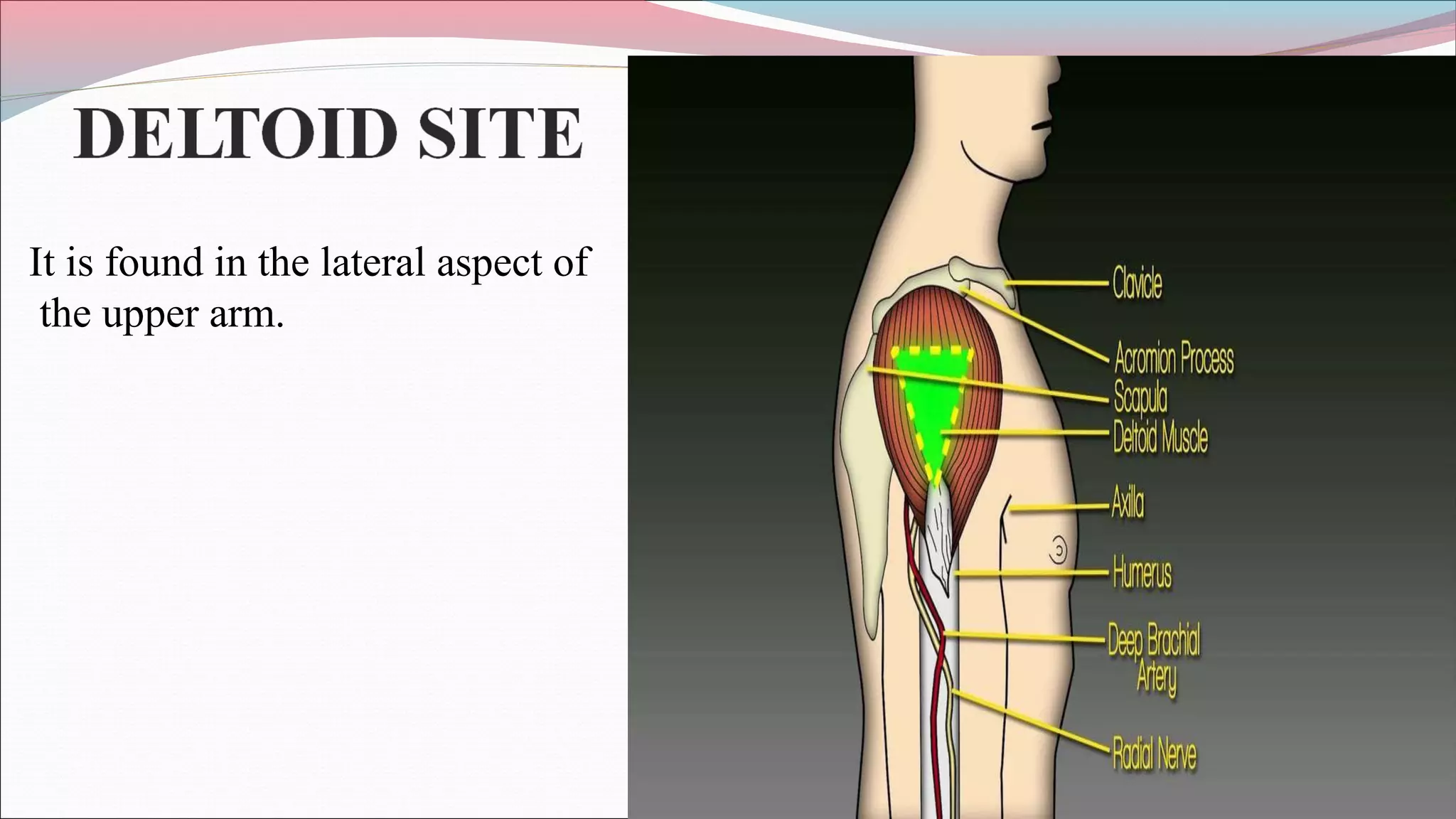
It is found in the lateral aspect of
the upper arm.
PROCEDURE FOR DELTOID SITE
1.Place 4 fingers over the deltoid muscle,first
finger over the acromion process.
2.Top of axilla is the line that marks the lower
border.
3.Triangle formed between these boundaries
is
the site for injection.
RECTUS FEMORIS
◦IT BELONGS TO THE QUADRICEPS
GROUP OF MUSCLES.IT IS SITUATED
IN THE ANTERIOR ASPECT OF THE
THIGH
RECTUS FEMORIS
AFTER CARE OF ARTICLES:
Dismantle all the articles in an appropriate manner.
Wash the kidney tray and place it in the cupboard
Knife dish is washed and sent for autoclaving.
AFTER CARE OF PATIENT:
Monitor for signs of localized redness, swelling, bleeding, or
inflammation at injection site.
Observe the patient for at least 15 minutes following the injection
for signs of reaction to the drug.
INDICATIONS
•Muscles have more blood supply ,so
quicker action of drugs.
•More amount of drug can be administered
than the intradermal and subcutaneous
tissue.
CONTRA-INDICATIONS
•Avoid sites of lesions, lumps, tissue
injury,presence of nodules other pathology.
•Avoid sites near to large blood vessels,
nerves and bones.
Pathological contraindications
Acute MI
Shock
Coagulation disorders
COMPLICATIONS:-
Look at the fannel.
INTRAMUSCULAR INJECTION

INTRAMUSCULAR INJECTION

  • 1.
  • 2.
    DEFINITION: Intramuscular injections are acommon yet complex technique used to deliver medication deep into the large muscles of the body. It may be for curative, diagnostic or recreational purpose. Intramuscular injection is define as introduction of medicine into the muscle in form of solution
  • 3.
    PURPOSE To obtain goodeffect of medicine than is obtained by oral medications. Assures that the total dosage will be administered and the same will be absorbed for the systemic action of the drug. The medicines that is not suitable for intravenous administration.
  • 4.
  • 5.
    PRECAUTIONS Careful consideration indeciding which injectable route is to be used for the prescribed medication is essential. The intramuscular route should not be used in cases where muscle size and condition is not adequate to support sufficient uptake of the drug.
  • 6.
    CONTI.. Intramuscular injection shouldbe avoided if other routes of administration, especially oral, can be used to provide a comparable level of absorption and effect in any given individual's situation and condition. Intramuscular injections should not be given at a site where there is any indication of pain .
  • 7.
    General Instructions Give injectionsonly on the doctor’s written orders . Follow strict aseptic techniques. Syringes and needles used for injections should be kept separate from those used for other purpose. Always have the syringe and needles in good order. Change the needle after withdrawing the drug from the rubber stopped container before giving injection to the patient. Observe the five rights of the administration of medicines.
  • 8.
    Never use adrug whose expiry date is over. Always have a patient relaxed and placed in a comfortable position. Never allow the patient to walk soon after the injection Always give a test dose in case of penicillin and all types of sera. Expel the air from the syringe before the injection . Rotate the site for patients getting insulin to prevent lip dystrophy. Use correct technique of injection – The needle inserted gently and quickly and the drug injected slowly. CONTI.
  • 9.
    After inserting theneedle always withdraw the piston to make sure that it is not in a blood vessel in case of intramuscular and subcutaneous injections. Solution for injection should be clear , sterile , nearly neutral in reaction. Massage the area at the site of injection except in case of intradermal injections Injection should be charted immediately CONTI..
  • 10.
    SITES OF INTRAMUSCULARINJECTIONS: LOOK AT THE FLIP CHART
  • 11.
    ARTICLES S.No. Name ofthe article Rationale 1. A tray containing Sterile syringes and needles of various sizes To deliver a certain volume `of drugs depending on the route of administration. 2. Transferring forceps to an antiseptic lotion To handle sterile swabs 3. Sterile cotton swabs/gauze pieces in a sterile container. To clean the site before giving injection 4. A bowl with water and an antiseptic solution To rinse the glass syringes , needles and to put the disposable syringes. 5. Sterile water for injection To dissolve powder form of drugs. 6. Drug ordered. To administer drug to the patient . 7. Ampule file To cut open the ampule and open the vial. 8. Knife dish (sterile,small covered tray) To carry the prepared medicine to the patient. 9. A puncture proof container To dispose off the needles. 10. A kidney tray and a paper bag. To dispose off the swabs, ampoules and vials
  • 12.
    PREPARATION OF PATIENT Performhand hygiene Use two patient identifiers to confirm patient. Assess the patient’s symptoms, knowledge of the medication to be received, history of allergies, drug allergies, and types of allergic reactions. Assess for any factors that may contraindicate an IM injection Close curtains or door. Explain the procedure and the medication, and give the patient time to ask questions. Wear non-sterile gloves and prepare the patient in the correct position. Ensure a sharps disposal container is close by for disposal of needle after administration.
  • 13.
    STEPS OF PROCEDURE: S. No. Stepsof procedure Rationale Scientific principles Nursing principles 1 Wash hands To reduce transmission of injection Microbiology Safety 2 Check medication with the drug ordered To ensure that a right drug dosage is prepared. Safety 3 Explanation to the patient To allay anxiety Psychology Comfort individuality 4 Wear gloves To prevent cross infection Microbiology Safety therapeutic effectiveness 5. Identify the client again by asking the name and checking records To ensure accuracy, Double check is necessary before drug administration Psychology Safety
  • 14.
    6. Lie flatonside, prone or sitting position To make the patient comfortable Anatomy and physiology Safety and comfort Therapeutic effectiveness . 7. Clean the site with an antiseptic swab at the centre of the site and rotate onwards in a circular motion . Mechanical action of swab removes dirt and microorganisms Physics and microbiology chemistry Safety 8. Hold the swab between the third and 4th finger of non dominant hand. Swab can be used after the injection for massaging Physics Economy of material 9. Remove needle cover straight To prevent the contamination of the needle, bevel, shaft Microbiology Safety 10 . Hold the syringe correctly between the thumb and fingers of the dominant hand Quicker and smooth insertion of the needle proper manipulation of the syringe. Anatomy and physiology Safety and comfort of the patient. CONTI...
  • 15.
    13 . Move the dominanthand to the piston. Pull back the syringe to see if there is any blood. If blood appears, remove the needle ,discard medicine and prepare gain If no blood appears push the medicine slowly It shows that the needle has punctured a vein and IM is not given through vein. Anatomy and physiology Comfort, Safety, and therapeutic effectiveness 14 . Remove the needle quickly and smoothly, massage the site To prevent injury, helps in easy absorption, stimulates circulation and improves drug distribution Anatomy and physiology Comfort, Safety, and therapeutic effectiveness 11 . Insert the needle quickly at 90 degree angle. Ensures needle reaches muscle Anatomy and physiology Comfort and safety. 12 . After needle insertion, in case of intramuscular grab the lower end of the syringe barrel with the non-dominant hand(in the hub of the needle) Proper manipulation of the syringe and needle prevents injury. Anatomy and physiology Comfort and safety CONTI...
  • 16.
    Conti. 15. Assist theclient to assume a comfortable position. To give a sense of well-being Psychology Comfort 16. Discard the needle and syringe in an appropriate container. To prevent reuse of of the needle and syringe Microbiology Safety 17. Remove gloves and wash hands To reduce transmission of microorganisms Microbiology Safety 18. Record in the medicine chart and the nurse’s record by the writing the name of the patient, medicine, dose, route, site and time with signature To prevent error and ensure accuracy Microbiology Safety
  • 17.
    1.VENTROGLUTEAL SITE It isthe site where the gluteus medius muscle lies over the gluteus minimus
  • 18.
    PROCEDURE-VENTRO GLUTEAL 1.Place patienton side-lying position, bent the knees and raise it slightlyto chest.(use alternate hands for hips). 2.Place the nurses heel of hand over the greater trochanter of patient with fingers pointing towards head of patient. 3.Index finger should rest on anterior superior iliac spine, middle finger stretched dorsally. 4.Midpoint of triangle formed between index finger ,middle finger and iliac crest is the site.
  • 19.
    ADVANTAGES OF VENTROGLUTEAL SITE 1.Nolarge nerves or blood vessels in this area. 2.Provides greatest thickness of gluteal muscles. 3.It is sealed off by bone. 4.Contains less consistency fat than buttock area. 5.Most suitable for adults and children over 1 yr
  • 20.
  • 21.
  • 22.
    DORSO GLUTEAL SITE ◦Itis composed of the thick gluteal muscles of the buttocks. CONTRA-INDICATION ◦Not used for children below 3 years ,because these muscles are developed by walking.
  • 23.
    PROCEDURE FOR DORSOGLUTEAL 1.Patientis positioned in prone position with toes facing inwards or side-lying position with upper knee flexed and in front of the lower leg. 2.Palpate the posterior superior iliac spine and draw an imaginary line to the greater trochanter.(This line is parallel and lateral to the sciatic nerve ). 3.Injection site is parallel and superior to this site.
  • 24.
  • 25.
    VASTUS LATERALIS ◦It isthick and well developed in both adults and children. ◦The area is divide into 3 parts from the greater trochanter of femur and lateral femoral condyle. ◦The middle third is injection site.
  • 27.
    It is foundin the lateral aspect of the upper arm.
  • 28.
    PROCEDURE FOR DELTOIDSITE 1.Place 4 fingers over the deltoid muscle,first finger over the acromion process. 2.Top of axilla is the line that marks the lower border. 3.Triangle formed between these boundaries is the site for injection.
  • 29.
    RECTUS FEMORIS ◦IT BELONGSTO THE QUADRICEPS GROUP OF MUSCLES.IT IS SITUATED IN THE ANTERIOR ASPECT OF THE THIGH
  • 30.
  • 31.
    AFTER CARE OFARTICLES: Dismantle all the articles in an appropriate manner. Wash the kidney tray and place it in the cupboard Knife dish is washed and sent for autoclaving.
  • 32.
    AFTER CARE OFPATIENT: Monitor for signs of localized redness, swelling, bleeding, or inflammation at injection site. Observe the patient for at least 15 minutes following the injection for signs of reaction to the drug.
  • 33.
    INDICATIONS •Muscles have moreblood supply ,so quicker action of drugs. •More amount of drug can be administered than the intradermal and subcutaneous tissue.
  • 34.
    CONTRA-INDICATIONS •Avoid sites oflesions, lumps, tissue injury,presence of nodules other pathology. •Avoid sites near to large blood vessels, nerves and bones.
  • 35.
  • 36.