SUTURE
Presented by
kalyan kumar Msc(N)
INTRODUCTION
In surgery suture is a act of bringing tissue
together and holding them in apposition until
healing has taken place.
DEFINITION
A suture is a strand of material used to ligate
blood vessels and tissues together .
CLASSIFICATION
1.According to source
❑ Natural
❑ Synthetic
❑ Matalic
2. According to structure
❖ Monofilament
❖ Multifilament
3. According to fate
➢ Absorbable
➢ Non absorbable
1. ACCORDING TO SOURCE
Natural
❑ Absorbable
❑ Non absorbable
Absorbable:
 Catgut
 Chromium catgut
 Collagen
Non absorbable
 Silk
 Linen
ABSORBABLE
Catgut: Oldest known absorbable suture. Derived from
sheep intestinal mucosa. It is available pre-sterilized in
aluminium coated sterile pack.
Absorption: 5-19 days
Colour: Yellow
Chromium catgut: Coated with thin layer of salt solution
to minimize tissue reaction. Slow the absorption rate,
better knot security. This is packed in isopropyl alcohol.
Absorption: 15-20 days or 90 days
Uses: Ophthalmic surgery
Oral surgery.
Collagen: Obtained by homogenous dispersion of pure
collagen fibrils from the flexor tendons of beef.
 It produces minimal tissue reaction, have uniformity of
absorption and good knot holding ability.
Advantages:
It is easy to handle and knot.
Disadvantages:
Variability of absorption, especially in an
infected field.
NON ABSORBABLE
 Silk : It is made from the filament spun by silk warm
larva. It is cream or orange coloured. The fibres are
braided or twisted. The sizes available are 8-0 and 6-0 to
3-0. These are useful in vascular and nerve anestamosis.
Advantages:
 Easy of handing
 Good knot security
 Cost effective
Disadvantages:
 Should not be used in presence of infection.
Uses: Plastic surgery, ophthalmic surgery and general
surgery.
 Linen: It is natural, non absorbable and
multifilament. Made from staple flax fibres. Size
varies from 20-80. The diameter of the linen strand
cannot be accurately controlled.
Uses:
 Ligation of superficial vessels
 Mucosal suturing.
2. ACCORDING TO STRUCTURE
o Monofilament
o Multifilament
Monofilament: It consists of single strand of material.
Passes through tissues easily-less traumatic. It requires
more knots to prevent slippage. It is preferred for skin
closure because they provide better cosmetic result.
Examples: Nylon, Prolene.
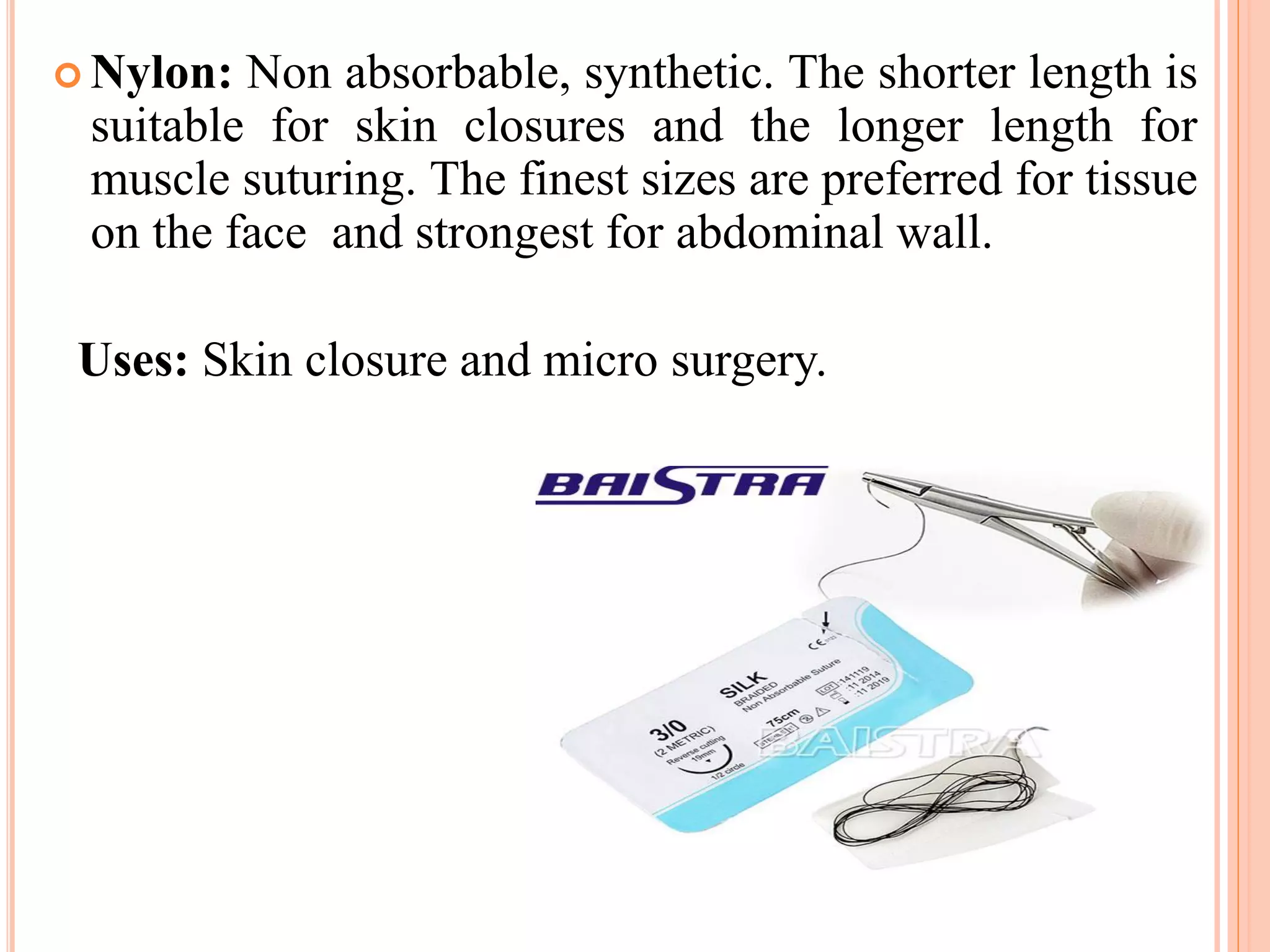
 Nylon: Non absorbable, synthetic. The shorter length is
suitable for skin closures and the longer length for
muscle suturing. The finest sizes are preferred for tissue
on the face and strongest for abdominal wall.
Uses: Skin closure and micro surgery.
 Prolene: Polymer of propylene. Non capillary suture
material. It holds knots better than other synthetic
sutures. It is unaffected by tissue fluids and can be used
in the presence of infection. It can be re sterilized , but
not more than twice.
Advantages:
 Smooth surface
 Less tissue trauma
Disadvantage:
 Handling and knotting.
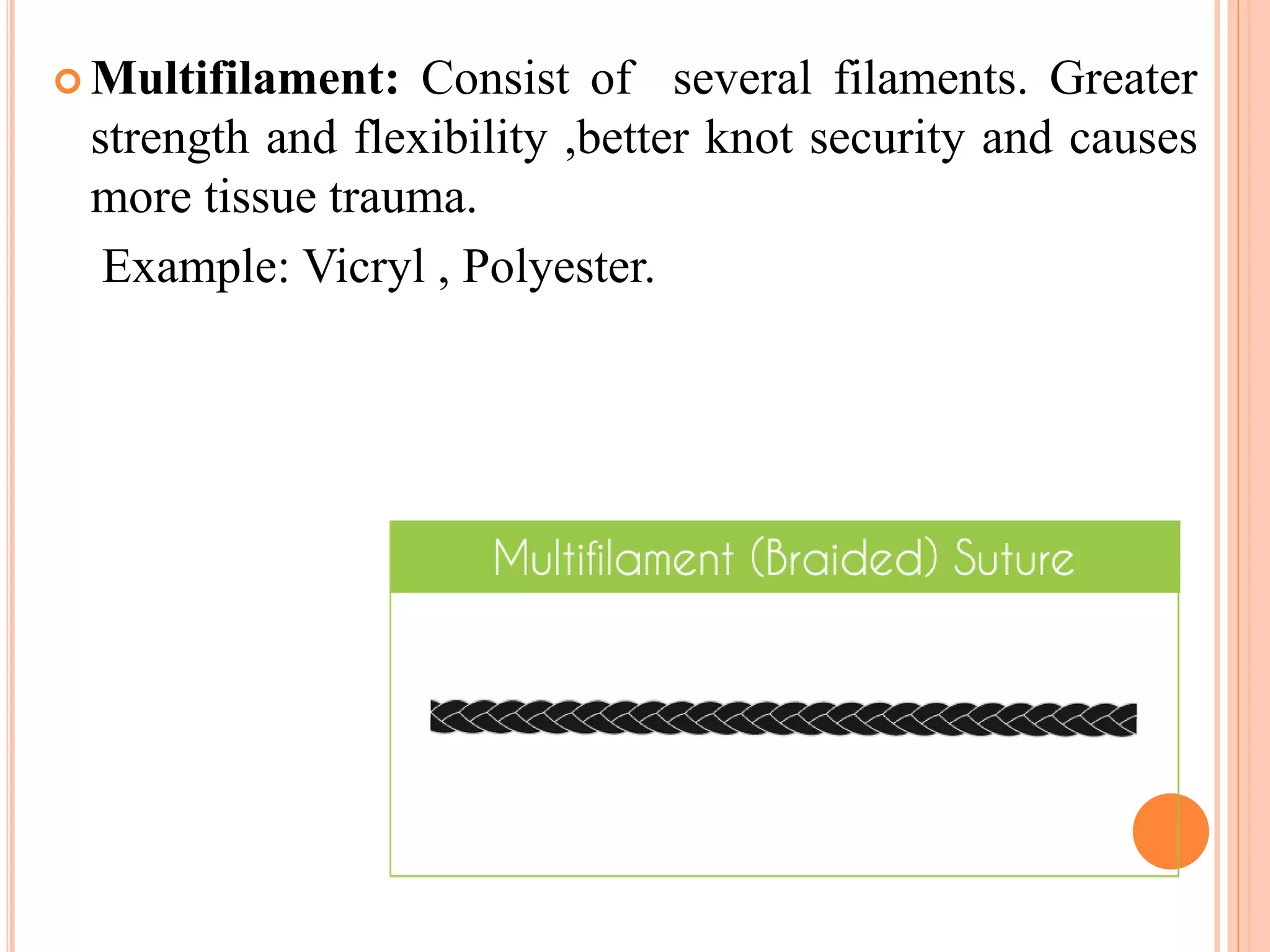
 Multifilament: Consist of several filaments. Greater
strength and flexibility ,better knot security and causes
more tissue trauma.
Example: Vicryl , Polyester.
 Polyester: It is multifilament fibres of polyester. It is
available in the form of coated and uncoated. Uncoated
is rougher and stiffer than coated from. Sizes 5-0 to 2-0
are used for plastic, intestinal sutures and ligation of
small blood vessels. Sizes 0-2 are used for muscle
sutures.
 Coated provides:
✓ Low infection rate
✓ Secure knotting
✓ Smooth removal
✓ Easy passage through tissues.
Advantages:
 Good handling
 Good knotting
Disadvantages:
 Tissue trauma
Summary
Conclusion
Suture  ( Stitches )

Suture ( Stitches )

  • 1.
  • 2.
    INTRODUCTION In surgery sutureis a act of bringing tissue together and holding them in apposition until healing has taken place.
  • 3.
    DEFINITION A suture isa strand of material used to ligate blood vessels and tissues together .
  • 4.
    CLASSIFICATION 1.According to source ❑Natural ❑ Synthetic ❑ Matalic 2. According to structure ❖ Monofilament ❖ Multifilament 3. According to fate ➢ Absorbable ➢ Non absorbable
  • 5.
    1. ACCORDING TOSOURCE Natural ❑ Absorbable ❑ Non absorbable Absorbable:  Catgut  Chromium catgut  Collagen Non absorbable  Silk  Linen
  • 6.
    ABSORBABLE Catgut: Oldest knownabsorbable suture. Derived from sheep intestinal mucosa. It is available pre-sterilized in aluminium coated sterile pack. Absorption: 5-19 days Colour: Yellow Chromium catgut: Coated with thin layer of salt solution to minimize tissue reaction. Slow the absorption rate, better knot security. This is packed in isopropyl alcohol. Absorption: 15-20 days or 90 days Uses: Ophthalmic surgery Oral surgery.
  • 7.
    Collagen: Obtained byhomogenous dispersion of pure collagen fibrils from the flexor tendons of beef.  It produces minimal tissue reaction, have uniformity of absorption and good knot holding ability.
  • 8.
    Advantages: It is easyto handle and knot. Disadvantages: Variability of absorption, especially in an infected field.
  • 9.
    NON ABSORBABLE  Silk: It is made from the filament spun by silk warm larva. It is cream or orange coloured. The fibres are braided or twisted. The sizes available are 8-0 and 6-0 to 3-0. These are useful in vascular and nerve anestamosis. Advantages:  Easy of handing  Good knot security  Cost effective Disadvantages:  Should not be used in presence of infection. Uses: Plastic surgery, ophthalmic surgery and general surgery.
  • 10.
     Linen: Itis natural, non absorbable and multifilament. Made from staple flax fibres. Size varies from 20-80. The diameter of the linen strand cannot be accurately controlled. Uses:  Ligation of superficial vessels  Mucosal suturing.
  • 11.
    2. ACCORDING TOSTRUCTURE o Monofilament o Multifilament Monofilament: It consists of single strand of material. Passes through tissues easily-less traumatic. It requires more knots to prevent slippage. It is preferred for skin closure because they provide better cosmetic result. Examples: Nylon, Prolene.
  • 12.
     Nylon: Nonabsorbable, synthetic. The shorter length is suitable for skin closures and the longer length for muscle suturing. The finest sizes are preferred for tissue on the face and strongest for abdominal wall. Uses: Skin closure and micro surgery.
  • 13.
     Prolene: Polymerof propylene. Non capillary suture material. It holds knots better than other synthetic sutures. It is unaffected by tissue fluids and can be used in the presence of infection. It can be re sterilized , but not more than twice. Advantages:  Smooth surface  Less tissue trauma Disadvantage:  Handling and knotting.
  • 15.
     Multifilament: Consistof several filaments. Greater strength and flexibility ,better knot security and causes more tissue trauma. Example: Vicryl , Polyester.
  • 16.
     Polyester: Itis multifilament fibres of polyester. It is available in the form of coated and uncoated. Uncoated is rougher and stiffer than coated from. Sizes 5-0 to 2-0 are used for plastic, intestinal sutures and ligation of small blood vessels. Sizes 0-2 are used for muscle sutures.  Coated provides: ✓ Low infection rate ✓ Secure knotting ✓ Smooth removal ✓ Easy passage through tissues.
  • 17.
    Advantages:  Good handling Good knotting Disadvantages:  Tissue trauma
  • 18.