NJECTION TECHNIQUE
PAOLO M. ZABAT, RN
INJECTION TECHNIQUE
Giving an injection safely is considered to be a

routine activity. However, it requires knowledge
of anatomy and physiology, pharmacology,
psychology, communication skills and practical
expertise.
A safe injection is one that does not harm the
recipient, does not expose the provider to any
avoidable risks and does not result in waste
that is dangerous for the community.
INJECTION
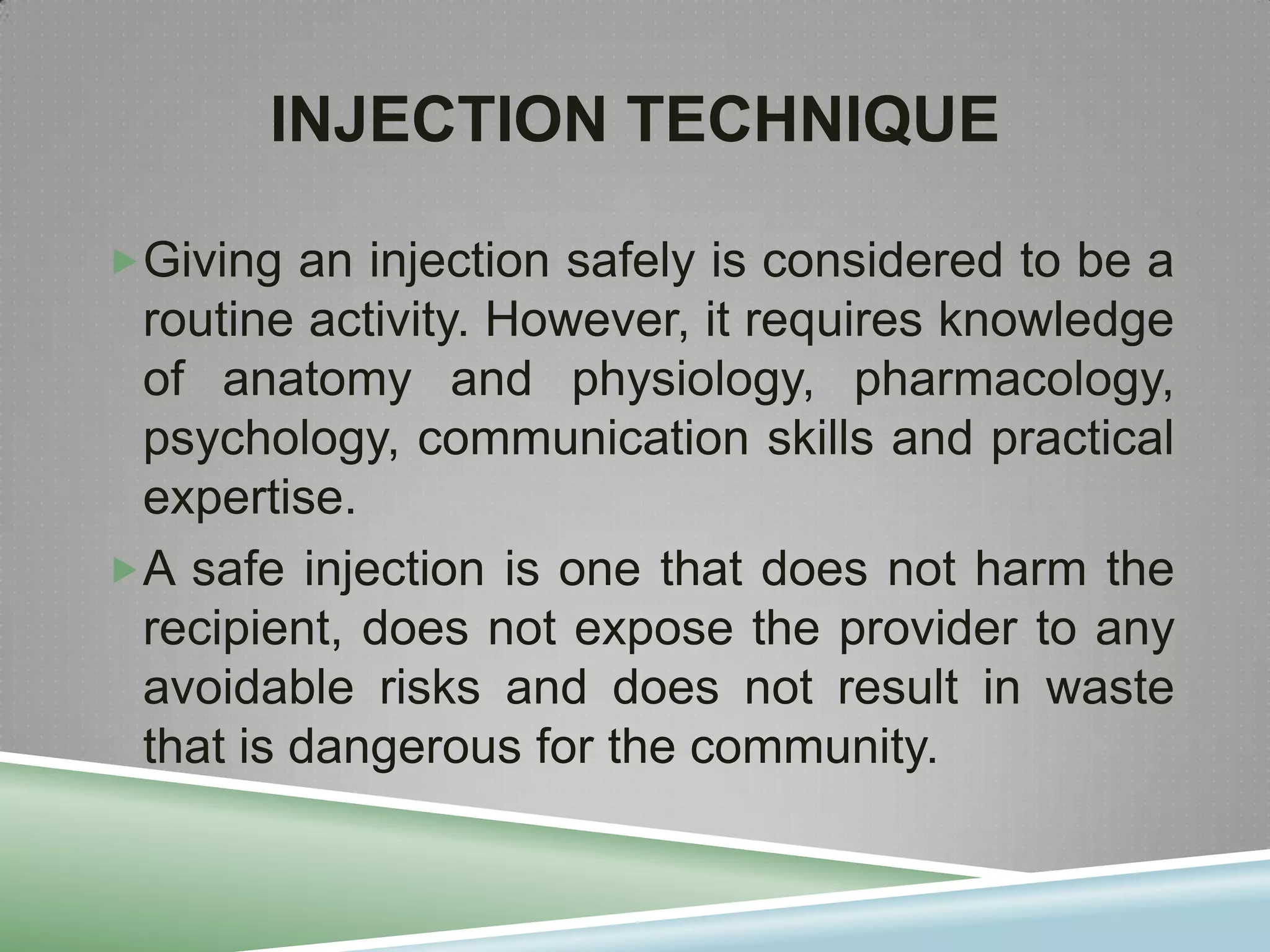
It is an infusion method of putting fluid into

the body, usually with a syringe and a
hollow needle which is pierced through the
skin to a sufficient depth for the material to be
administered into the body.
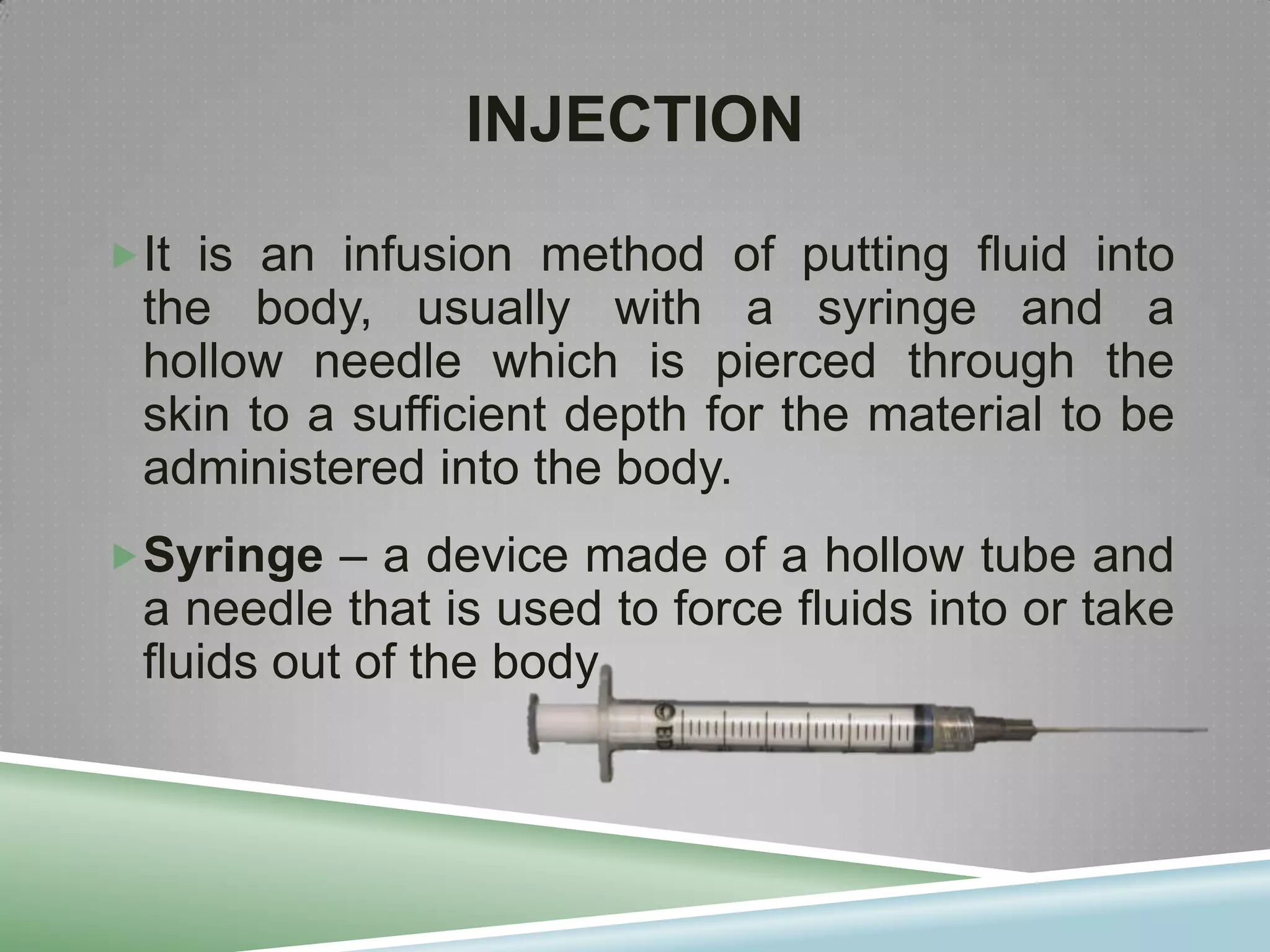
Syringe – a device made of a hollow tube and

a needle that is used to force fluids into or take
fluids out of the body
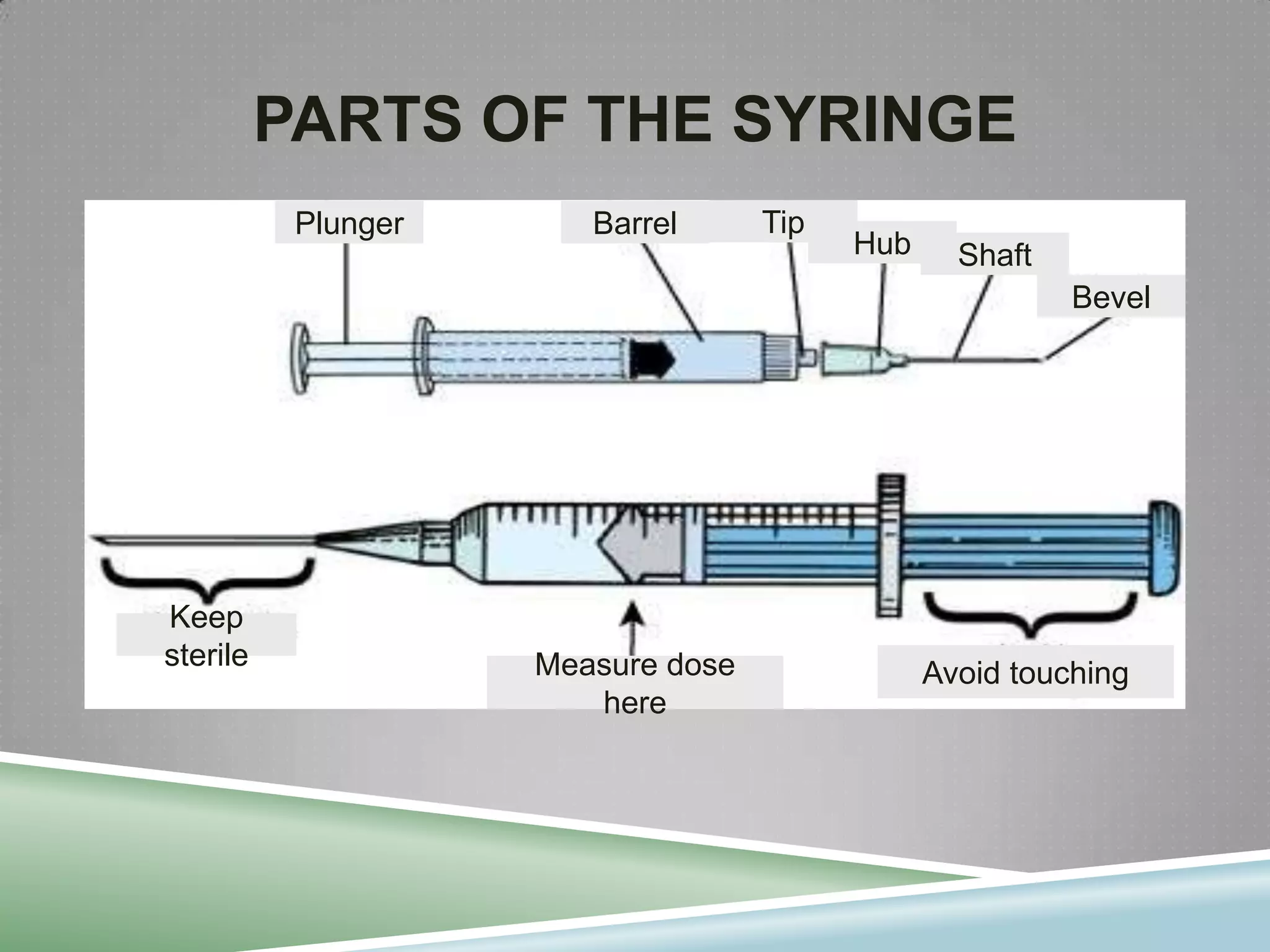
PARTS OF THE SYRINGE
Plunger

Barrel

Tip

Hub

Shaft
Bevel

Keep
sterile

Measure dose
here

Avoid touching
SKIN
RULES IN NEEDLE SYRINGE
SELECTION
 When looking at a needle package, the first number is the gauge

or diameter of the needle (ex: 18, 20) and the second number is
the length (ex: 1, 11/2)
 As the gauge number becomes larger, the size of the needle

becomes smaller.
 The length of the needle is directed by the size of the patient,
the selected insertion site and the tissue you are trying to reach.
(Ex: An IM injection in an emaciated person would require a
shorter needle than the same injection in an obese patient.)
 The size of the syringe is directed by the amount of medication
to be given. If the amount is less than 1ml, use a 1ml syringe. If
the amount of the medication is equal to the size of the syringe,
you may go up to the next size to prevent awkward movements
when deploying the plunger.
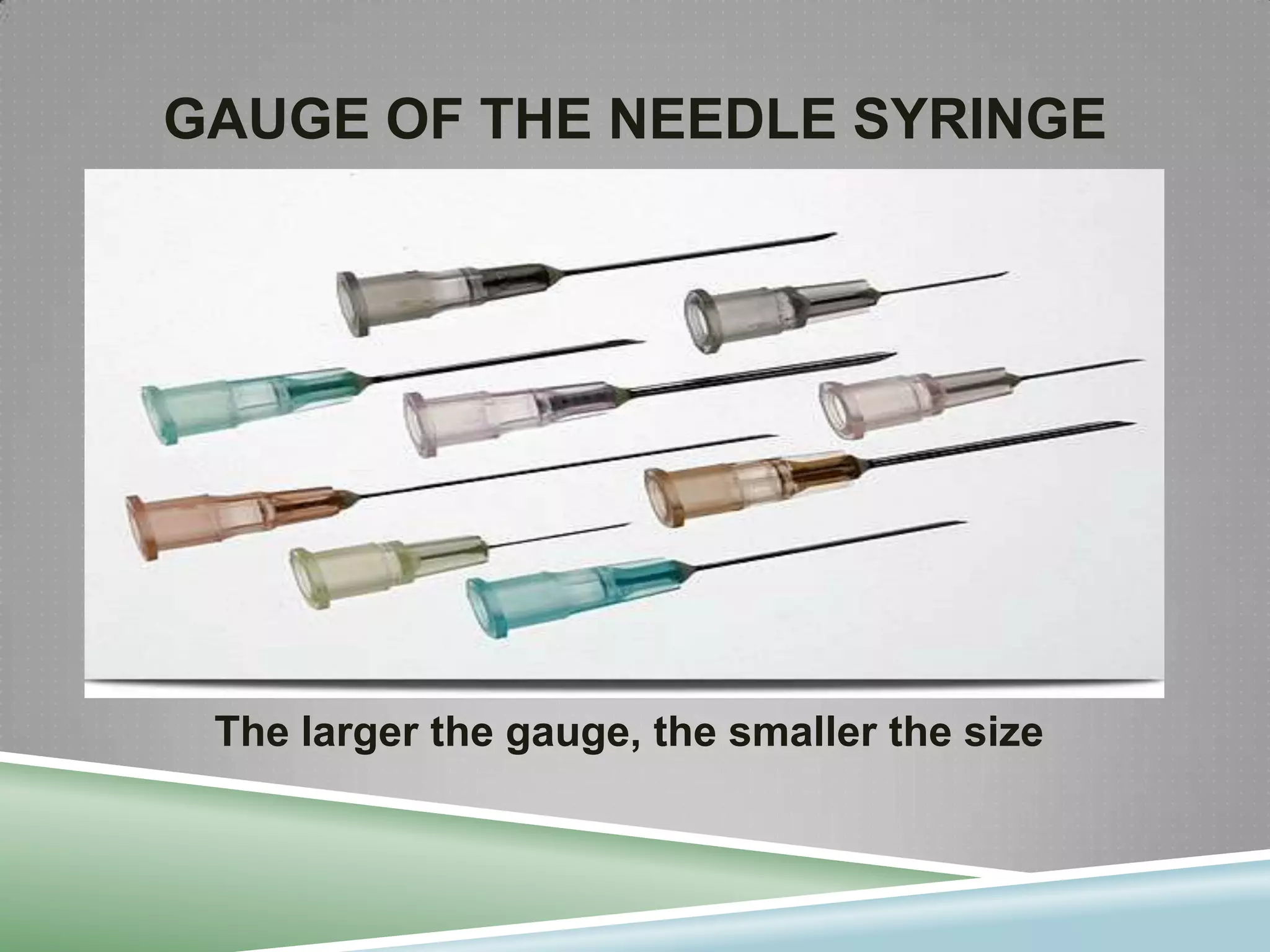
GAUGE OF THE NEEDLE SYRINGE

The larger the gauge, the smaller the size
INJECTION TECHNIQUE

INTRADERMAL INJECTION

SUBCUTANEOUS INJECTION
INTRAMUSCULAR INJECTION
INJECTION TECHNIQUE
INTRADERMAL INJECTION
 It is the introduction via needle of tiny amounts of fluid

into layers of skin.
 It provides a local, rather than systemic effect.
 Syringe used is 1ml tuberculin syringe because of a
very small amount of drug needed.
 Needle used is a short (1/4 to 5/8 inch), fine gauge
(g25-27).
Indications:
 For diagnostic purposes (allergies and sensitivities to
drugs)
 For administering tuberculin testing
INTRADERMAL INJECTION
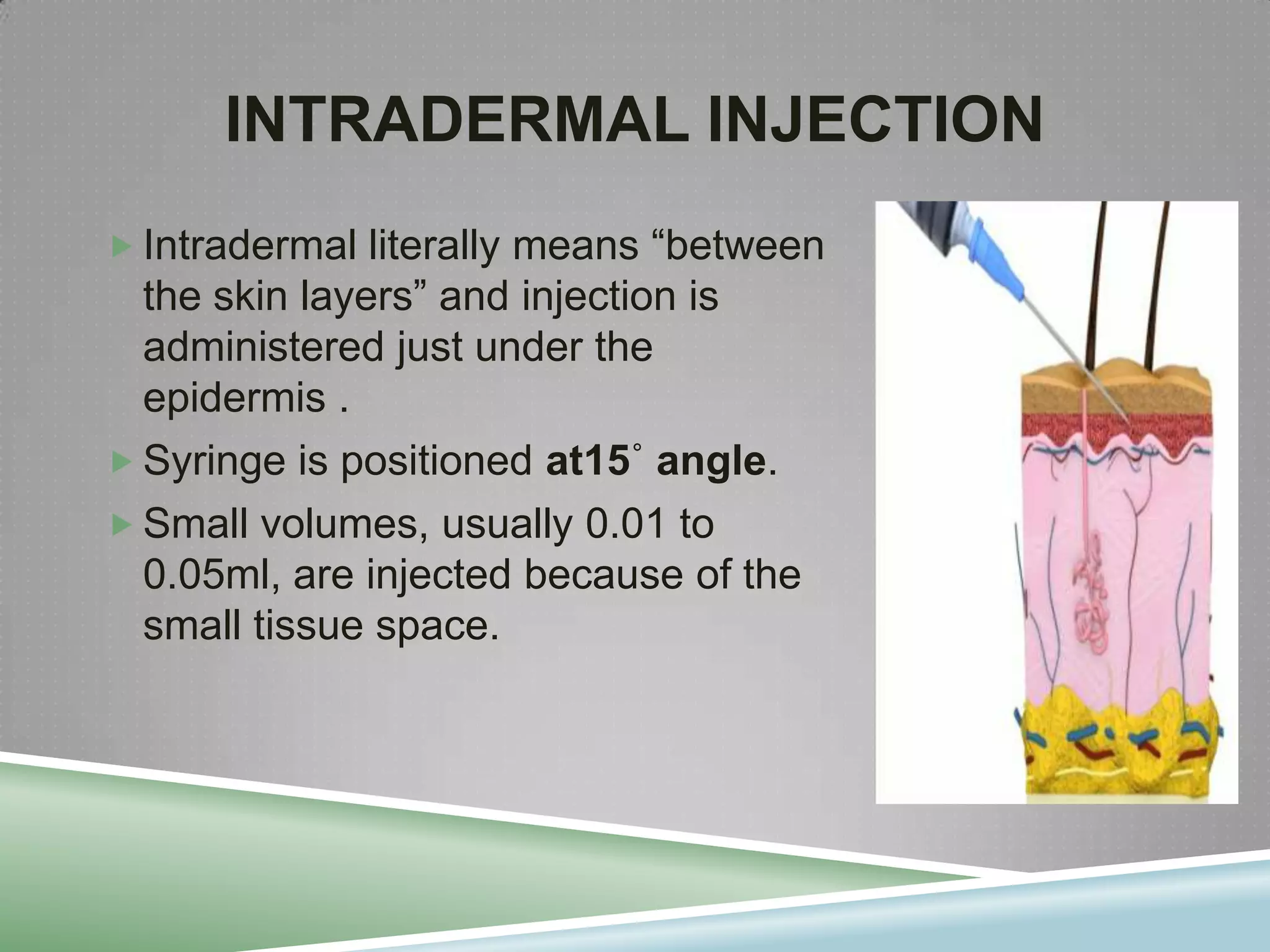
 Intradermal literally means “between

the skin layers” and injection is
administered just under the
epidermis .
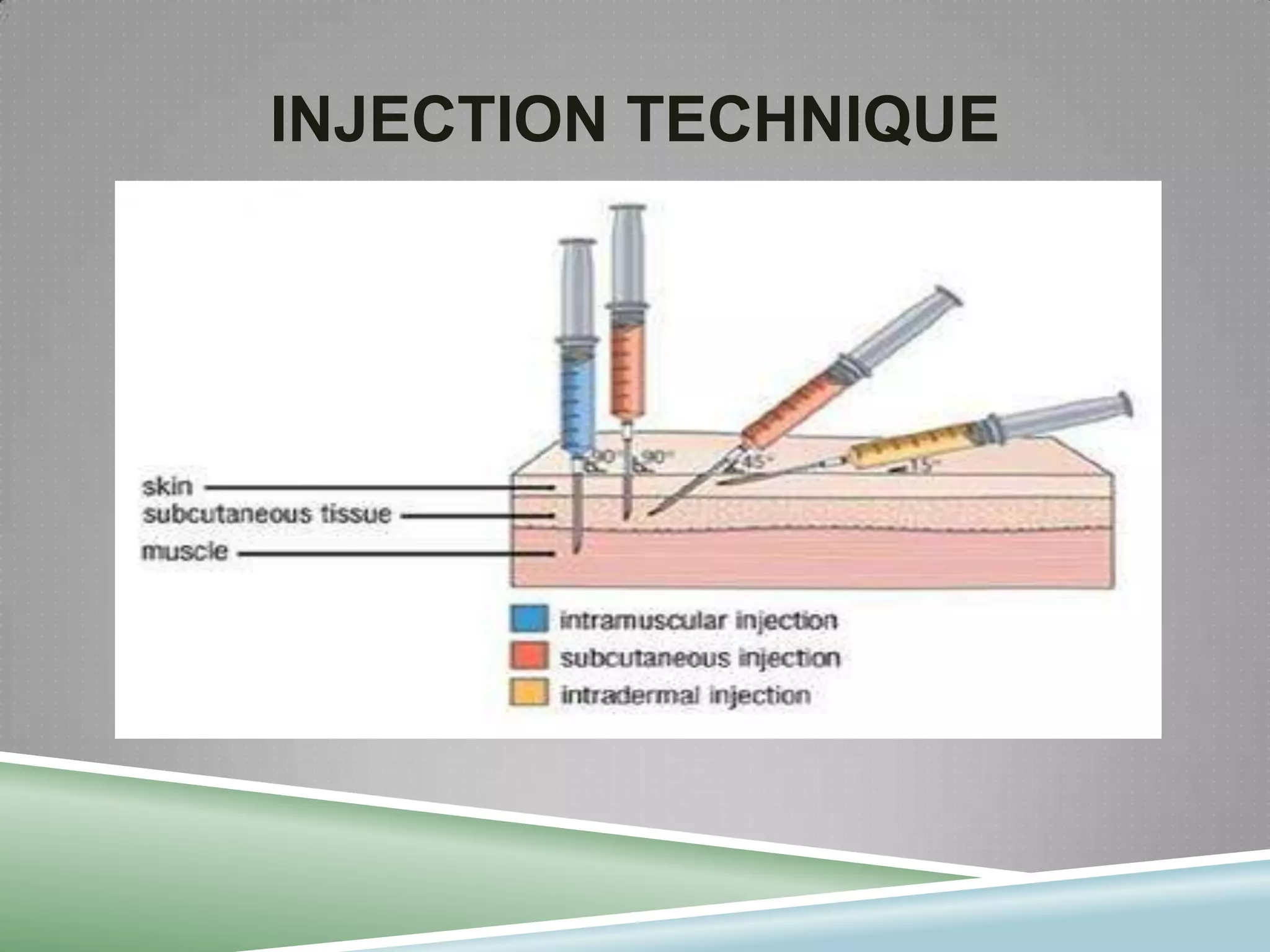
 Syringe is positioned at15˚ angle.
 Small volumes, usually 0.01 to
0.05ml, are injected because of the
small tissue space.
INTRADERMAL INJECTION
 Most commonly used site: Inner surface of the

forearm
 Subscapular region of the back can be used as well
as the deltoid region.
INTRADERMAL INJECTION
REMEMBER:
 Mixture of drug and water for skin testing: 0.9cc of
distilled water/sterile water and 0.1cc of the drug.
 Inject the solution intradermally and just enough to
form a wheal.
 Encircle the site correctly and write the time when to
check the injection site to determine reaction to the
drug.
 Check the site after 30 minutes for signs of reaction.
 If negative, document it as ANST (-); if positive,
ANST (+)
INTRADERMAL INJECTION
REMEMBER:
 A positive result may be manifested by any of the
following:
 Reddening of the site accompanied with marked
elevation
 Increase in circumference of the wheal
 Presence of itchiness on the site
PROCEDURE: ID
 Prepare all the equipment needed: 1cc syringe,

disposable needle (aspirating needle), sterile water,
drug to be tested, wet and dry cotton balls and
ballpen.
 Wash hands and observe appropriate infection
control measures.
 Introduce yourself and verify the client’s identity.
 Explain to the client what you are going to do, why it
is necessary and how the client can cooperate.
 Prepare needed materials aseptically.
 Check the label of the drug three times.
PROCEDURE: ID
 Prepare the medication to be used for skin testing

(e.g ampule or vial)
 Aspirate 0.9cc of distilled water/sterile water and
0.1cc of the drug using the tuberculin syringe with the
aspirating needle.
 Mix the drug and the distilled water in the syringe.
 Replace the aspirating needle with g25 needle.
 Expel excess air.
 Place the syringe on the tray together with the wet
and dry cotton balls.
PROCEDURE: ID
 Confirm again patient’s identity.
 Locate the appropriate site for skin testing.

 Cleanse the medial surface of the forearm by using

firm, circular motion from inner to outer portion.
 Allow the skin to dry before injecting the drug.
 Place hand in non-dominant hand of the patient.
 Remove needle cap and holds syringe at 15 degrees
angle from skin with bevel up.
 Stretch the skin and tell the patient that he/she will
feel a prick as needle is inserted.
PROCEDURE: ID
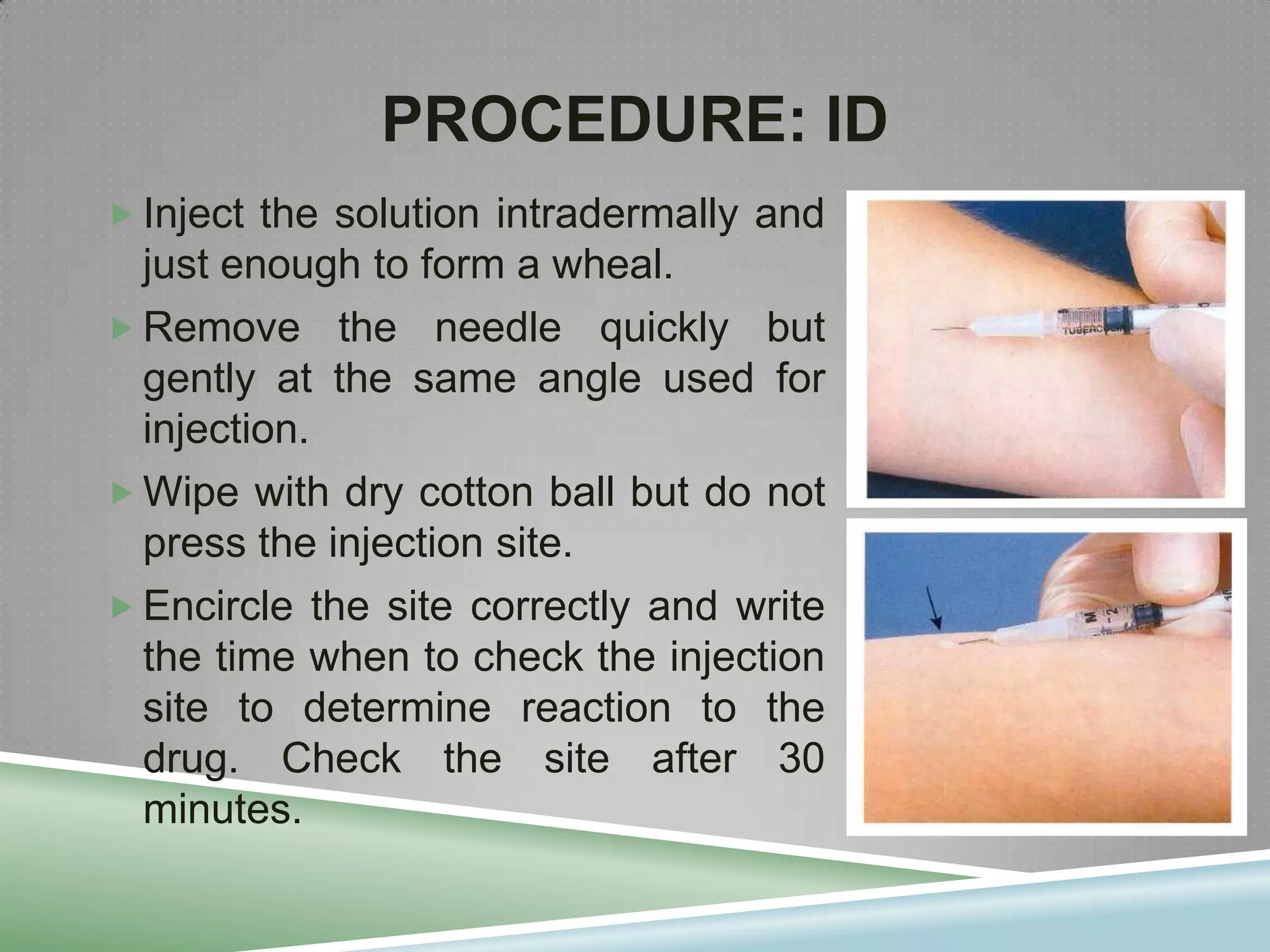
 Inject the solution intradermally and

just enough to form a wheal.
 Remove the needle quickly but
gently at the same angle used for
injection.
 Wipe with dry cotton ball but do not
press the injection site.
 Encircle the site correctly and write
the time when to check the injection
site to determine reaction to the
drug. Check the site after 30
minutes.
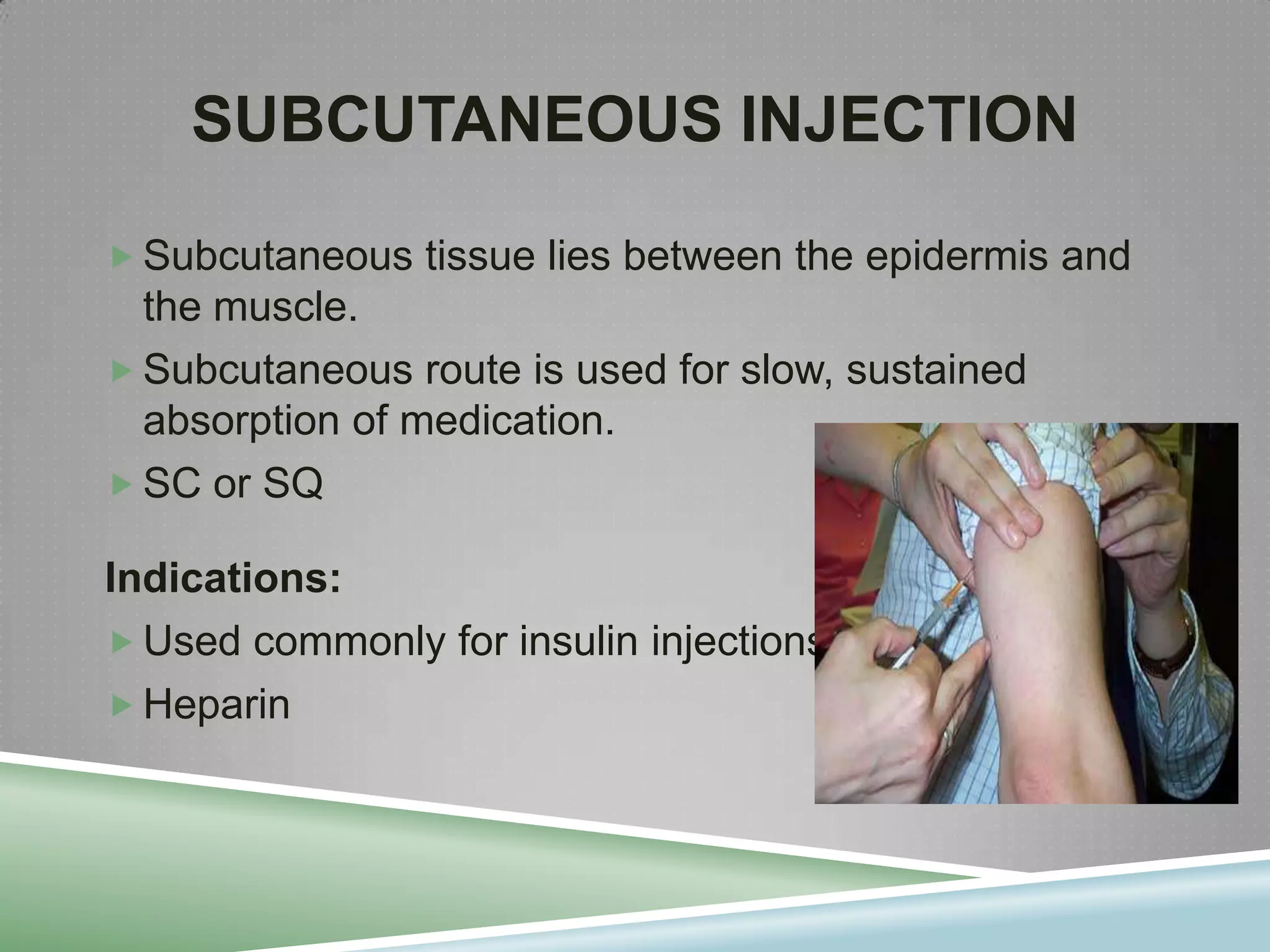
SUBCUTANEOUS INJECTION
 Subcutaneous tissue lies between the epidermis and

the muscle.
 Subcutaneous route is used for slow, sustained
absorption of medication.
 SC or SQ
Indications:
 Used commonly for insulin injections
 Heparin
SUBCUTANEOUS INJECTION
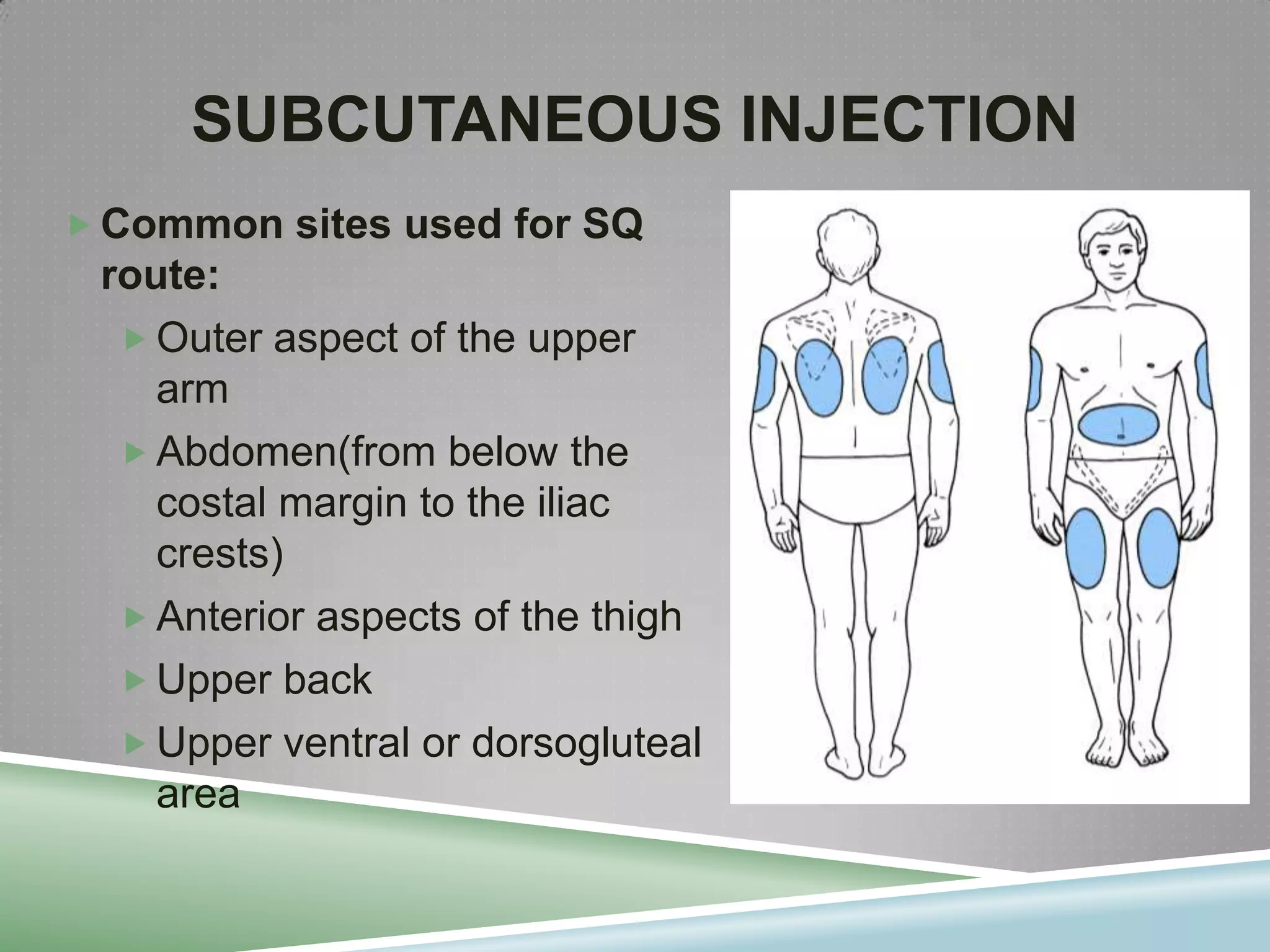
 Common sites used for SQ

route:
 Outer aspect of the upper
arm
 Abdomen(from below the
costal margin to the iliac
crests)
 Anterior aspects of the thigh
 Upper back
 Upper ventral or dorsogluteal
area
SUBCUTANEOUS INJECTION
REMEMBER:
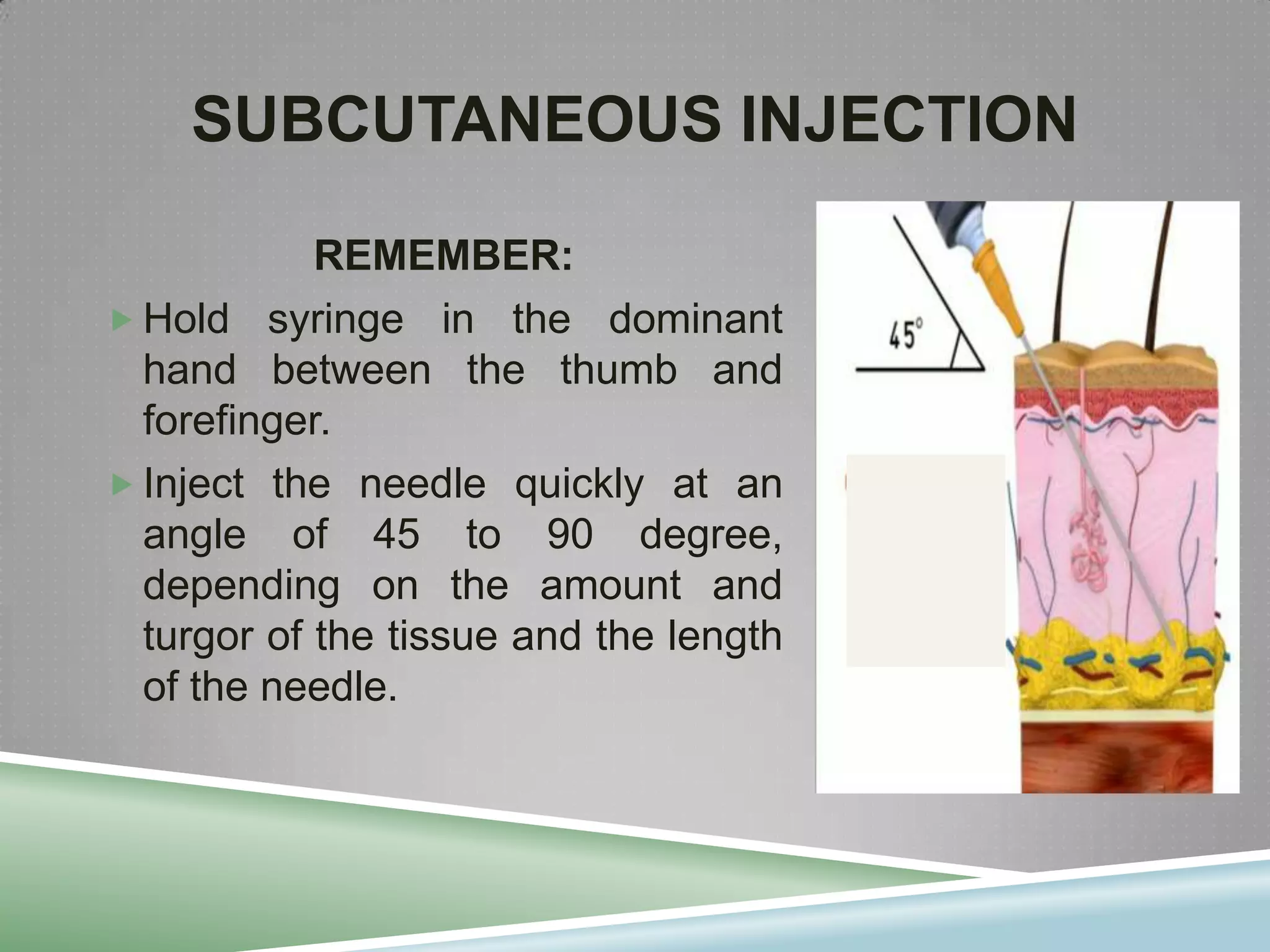
 Hold syringe in the dominant
hand between the thumb and
forefinger.
 Inject the needle quickly at an
angle of 45 to 90 degree,
depending on the amount and
turgor of the tissue and the length
of the needle.
INTRAMUSCULAR INJECTION
 The intramuscular (IM) route injection delivers

medication into well perfused muscle, providing rapid
systemic action and absorbing relatively large doses.
 Gastric disturbances do not affect the medication.
 Clients does not need to be conscious to receive the
medication.
 Absorption occurs even more rapidly than with SQ
route because of greater vascularity of muscle tissue.
 Irritating drugs are commonly given IM because very
few nerve endings are in deep muscle tissues.
5 SITES ACCEPTABLE FOR IM
INJECTION
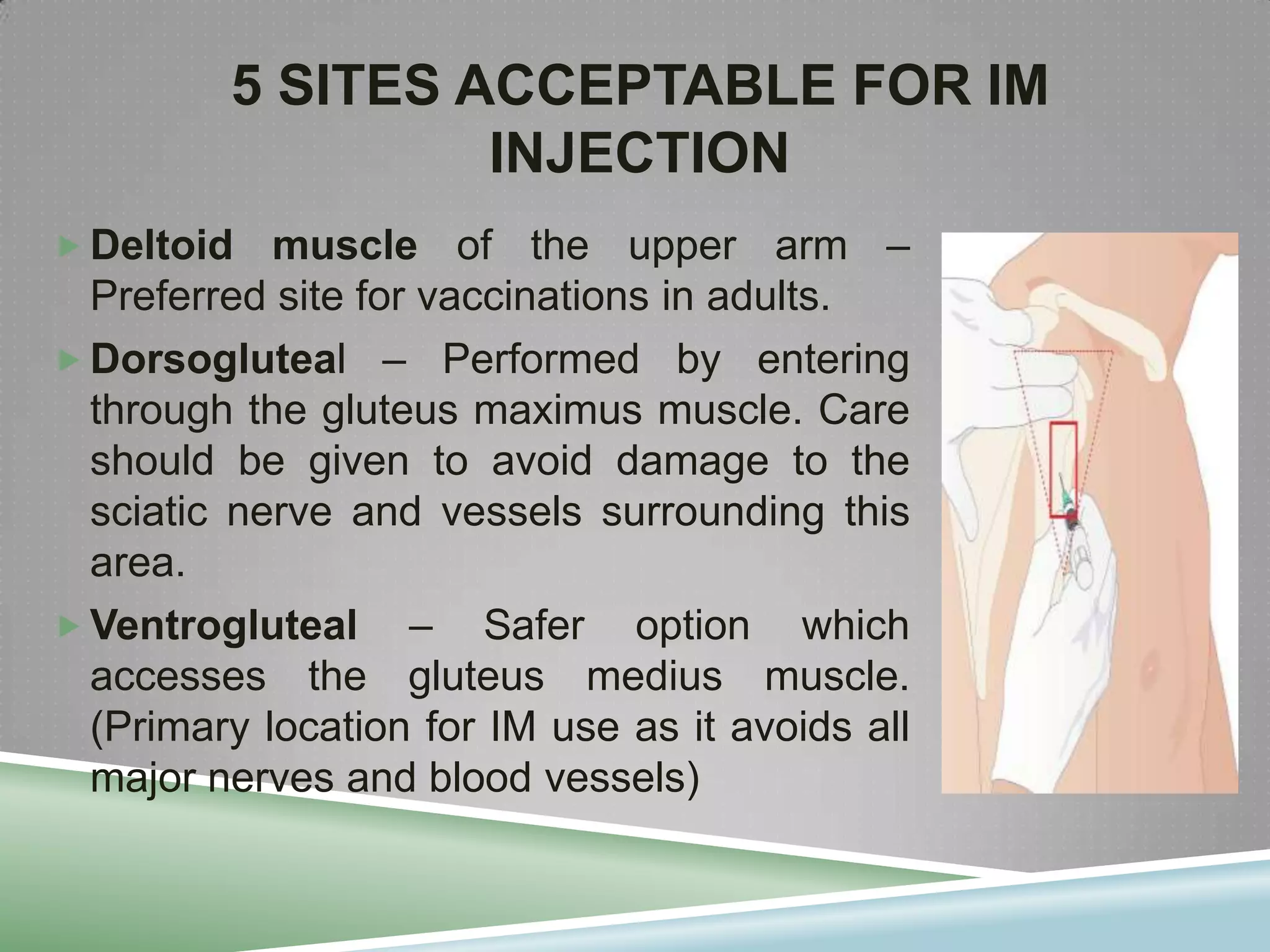
muscle of the upper arm –
Preferred site for vaccinations in adults.
 Dorsogluteal – Performed by entering
through the gluteus maximus muscle. Care
should be given to avoid damage to the
sciatic nerve and vessels surrounding this
area.
 Ventrogluteal – Safer option which
accesses the gluteus medius muscle.
(Primary location for IM use as it avoids all
major nerves and blood vessels)
 Deltoid
5 SITES ACCEPTABLE FOR IM
INJECTION
 Vastus Lateralis – A quadriceps muscle situated on

the outer side of the femur and is used as a primary
site for children. It does have risks associated to it due
to overuse but has been suggested safe for children
up to seven months old.
 Rectus Femoris – Anterior quadriceps muscle which
is rarely used by physicians/nurses but is easily
accessed for self- administration, or for infants.
SITES ACCEPTABLE FOR IM
INJECTION
INTRAMUSCULAR INJECTION
REMEMBER:
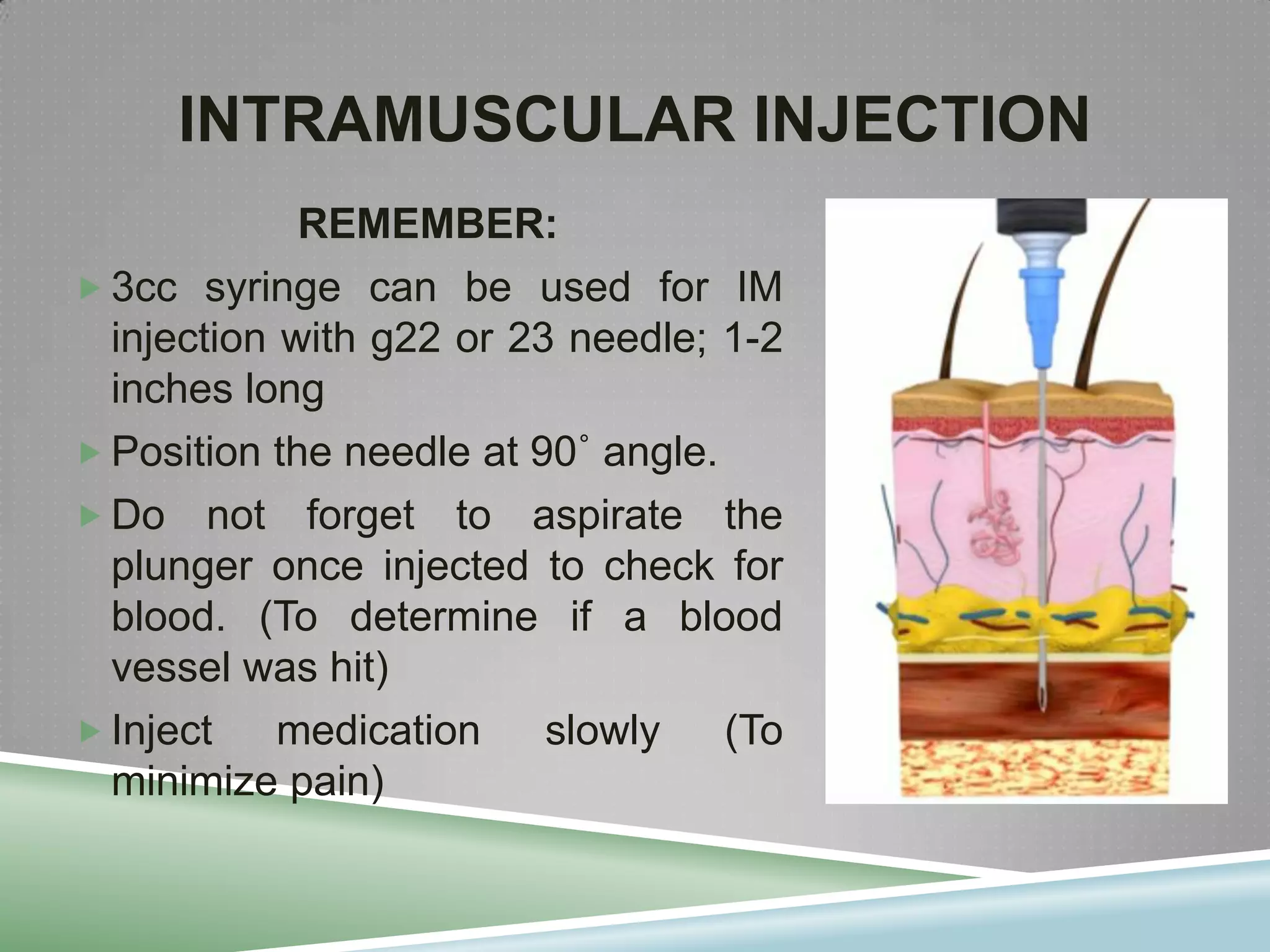
 3cc syringe can be used for IM
injection with g22 or 23 needle; 1-2
inches long
 Position the needle at 90˚ angle.
 Do not forget to aspirate the
plunger once injected to check for
blood. (To determine if a blood
vessel was hit)
 Inject
medication
slowly
(To
minimize pain)
INTRAMUSCULAR INJECTION
REMEMBER:
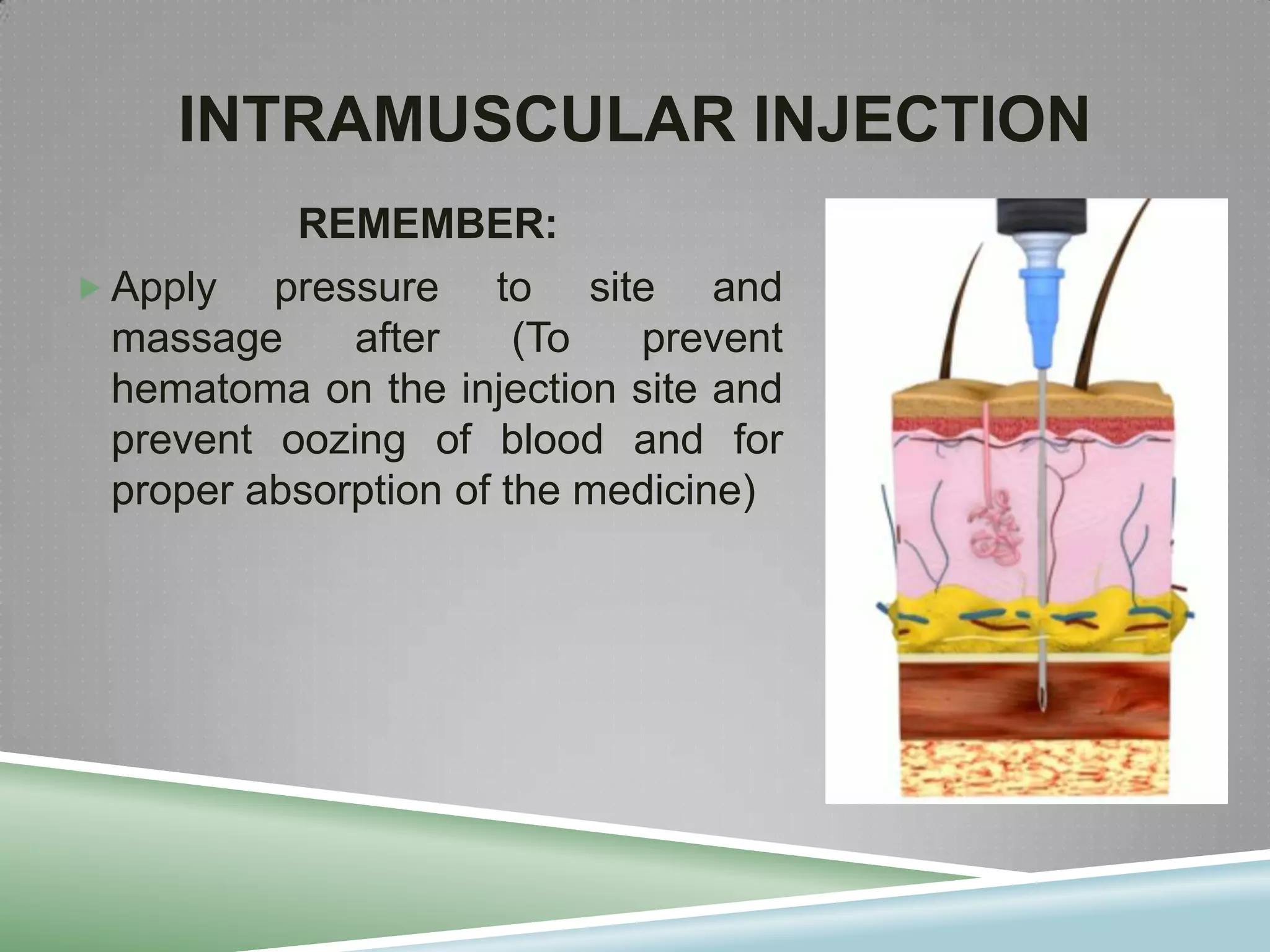
 Apply
pressure to site and
massage
after
(To
prevent
hematoma on the injection site and
prevent oozing of blood and for
proper absorption of the medicine)
PROCEDURE: IM
 Prepare needed materials aseptically.
 Check the label of the drug three times.

 Prepare the medication.
 Position the patient and locate the site correctly.
 Cleanse the site using circular motion from inner to

outer portion and allow it to dry.
 Place a swab between fingers of non-dominant hand.
 Pinch or spread tissue and insert needle quickly at 90
degrees angle in a dartlike position.
PROCEDURE: IM
 Pull back the plunger to check for blood.
 Inject the medication slowly if no blood appears.

 Withdraw needle quickly.
 Apply pressure and dry cotton ball to the site and

massage.
 Leave the client in a comfortable position.
 Dispose the syringe and other materials used
properly, wash hands and document the procedure.
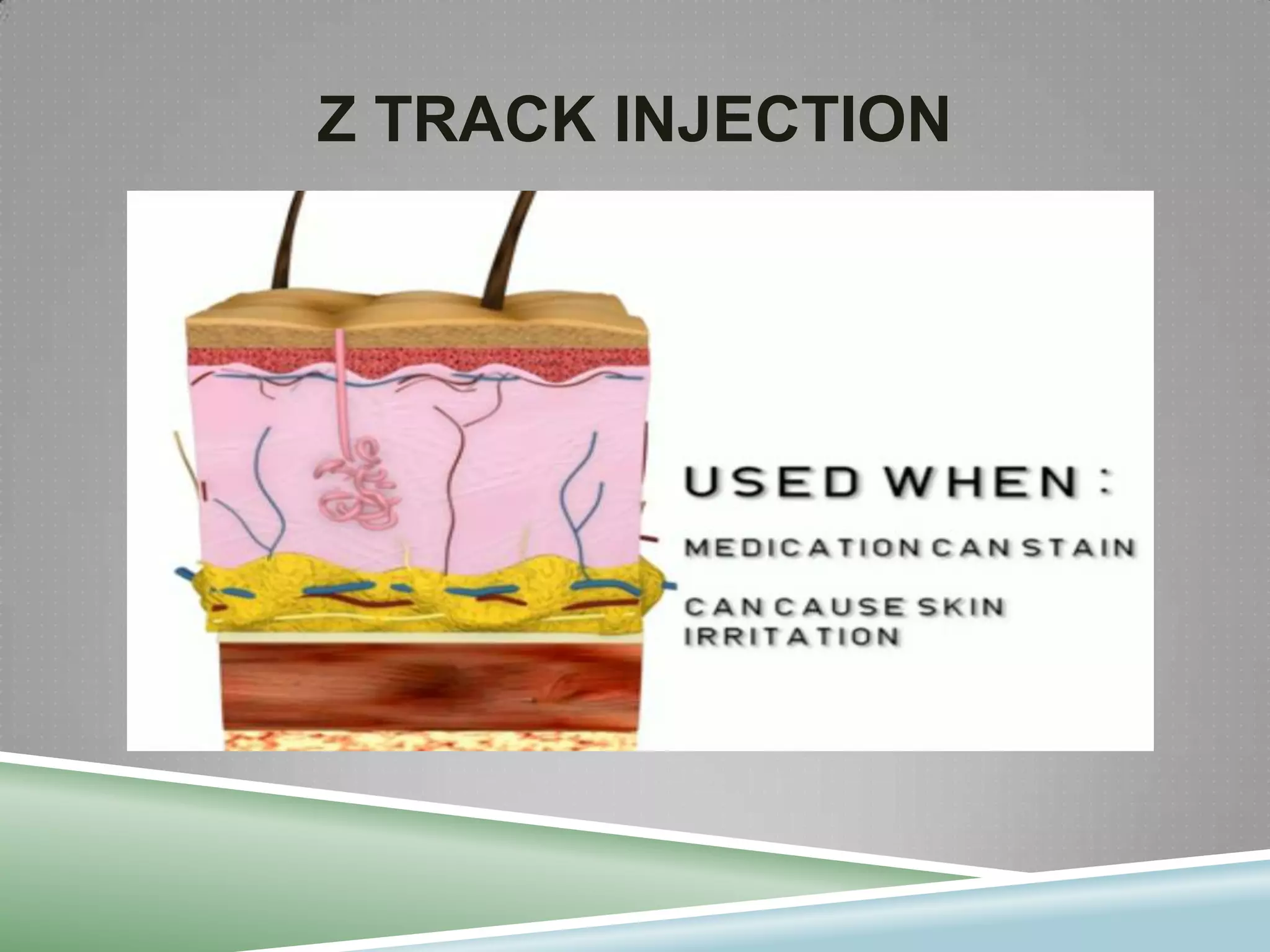
Z TRACK INJECTION
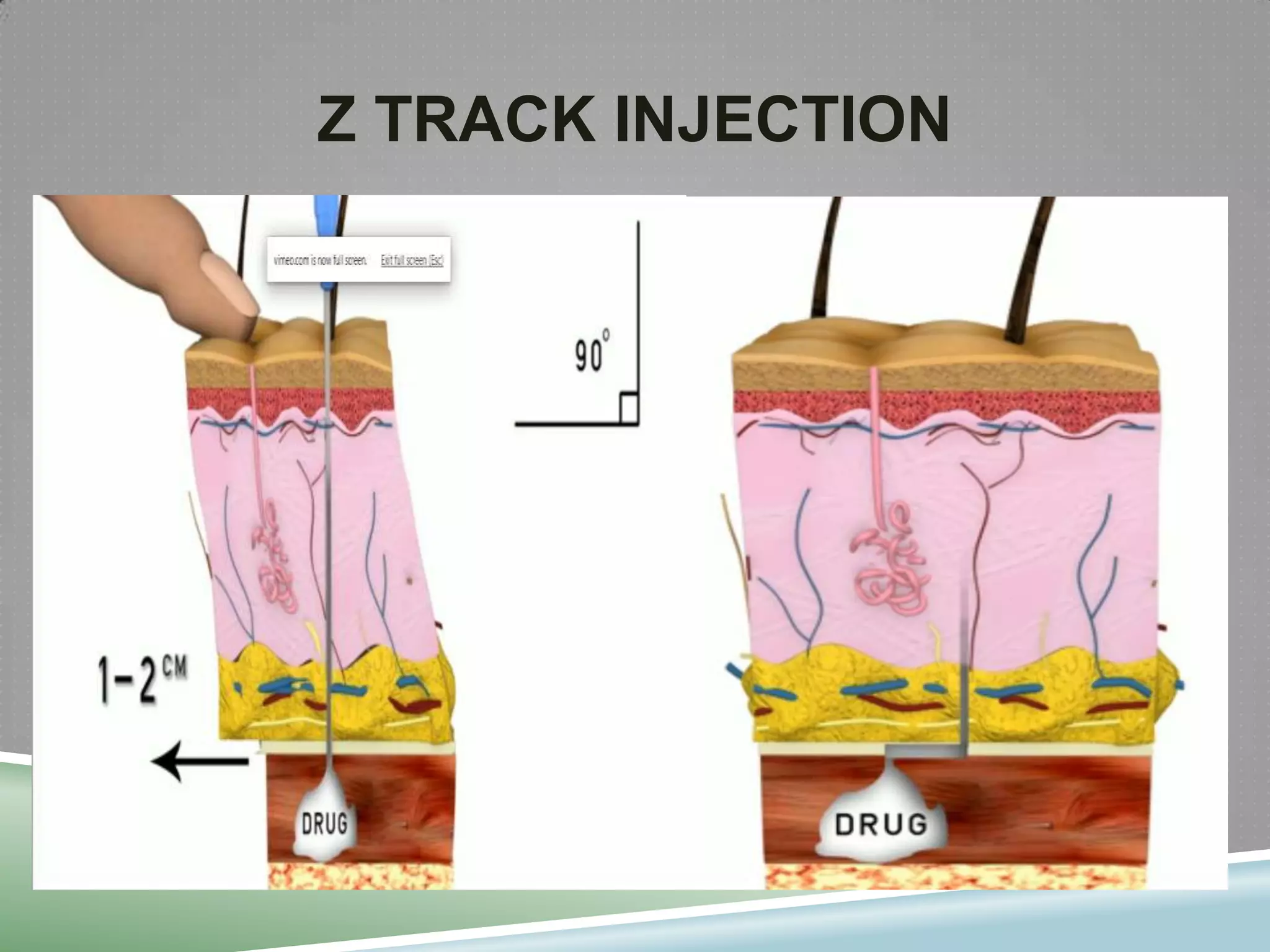
Z TRACK INJECTION
Injection Technique

Injection Technique

  • 1.
  • 2.
    INJECTION TECHNIQUE Giving aninjection safely is considered to be a routine activity. However, it requires knowledge of anatomy and physiology, pharmacology, psychology, communication skills and practical expertise. A safe injection is one that does not harm the recipient, does not expose the provider to any avoidable risks and does not result in waste that is dangerous for the community.
  • 3.
    INJECTION It is aninfusion method of putting fluid into the body, usually with a syringe and a hollow needle which is pierced through the skin to a sufficient depth for the material to be administered into the body. Syringe – a device made of a hollow tube and a needle that is used to force fluids into or take fluids out of the body
  • 4.
    PARTS OF THESYRINGE Plunger Barrel Tip Hub Shaft Bevel Keep sterile Measure dose here Avoid touching
  • 5.
  • 6.
    RULES IN NEEDLESYRINGE SELECTION  When looking at a needle package, the first number is the gauge or diameter of the needle (ex: 18, 20) and the second number is the length (ex: 1, 11/2)  As the gauge number becomes larger, the size of the needle becomes smaller.  The length of the needle is directed by the size of the patient, the selected insertion site and the tissue you are trying to reach. (Ex: An IM injection in an emaciated person would require a shorter needle than the same injection in an obese patient.)  The size of the syringe is directed by the amount of medication to be given. If the amount is less than 1ml, use a 1ml syringe. If the amount of the medication is equal to the size of the syringe, you may go up to the next size to prevent awkward movements when deploying the plunger.
  • 7.
    GAUGE OF THENEEDLE SYRINGE The larger the gauge, the smaller the size
  • 8.
  • 9.
  • 10.
    INTRADERMAL INJECTION  Itis the introduction via needle of tiny amounts of fluid into layers of skin.  It provides a local, rather than systemic effect.  Syringe used is 1ml tuberculin syringe because of a very small amount of drug needed.  Needle used is a short (1/4 to 5/8 inch), fine gauge (g25-27). Indications:  For diagnostic purposes (allergies and sensitivities to drugs)  For administering tuberculin testing
  • 11.
    INTRADERMAL INJECTION  Intradermalliterally means “between the skin layers” and injection is administered just under the epidermis .  Syringe is positioned at15˚ angle.  Small volumes, usually 0.01 to 0.05ml, are injected because of the small tissue space.
  • 12.
    INTRADERMAL INJECTION  Mostcommonly used site: Inner surface of the forearm  Subscapular region of the back can be used as well as the deltoid region.
  • 13.
    INTRADERMAL INJECTION REMEMBER:  Mixtureof drug and water for skin testing: 0.9cc of distilled water/sterile water and 0.1cc of the drug.  Inject the solution intradermally and just enough to form a wheal.  Encircle the site correctly and write the time when to check the injection site to determine reaction to the drug.  Check the site after 30 minutes for signs of reaction.  If negative, document it as ANST (-); if positive, ANST (+)
  • 14.
    INTRADERMAL INJECTION REMEMBER:  Apositive result may be manifested by any of the following:  Reddening of the site accompanied with marked elevation  Increase in circumference of the wheal  Presence of itchiness on the site
  • 15.
    PROCEDURE: ID  Prepareall the equipment needed: 1cc syringe, disposable needle (aspirating needle), sterile water, drug to be tested, wet and dry cotton balls and ballpen.  Wash hands and observe appropriate infection control measures.  Introduce yourself and verify the client’s identity.  Explain to the client what you are going to do, why it is necessary and how the client can cooperate.  Prepare needed materials aseptically.  Check the label of the drug three times.
  • 16.
    PROCEDURE: ID  Preparethe medication to be used for skin testing (e.g ampule or vial)  Aspirate 0.9cc of distilled water/sterile water and 0.1cc of the drug using the tuberculin syringe with the aspirating needle.  Mix the drug and the distilled water in the syringe.  Replace the aspirating needle with g25 needle.  Expel excess air.  Place the syringe on the tray together with the wet and dry cotton balls.
  • 17.
    PROCEDURE: ID  Confirmagain patient’s identity.  Locate the appropriate site for skin testing.  Cleanse the medial surface of the forearm by using firm, circular motion from inner to outer portion.  Allow the skin to dry before injecting the drug.  Place hand in non-dominant hand of the patient.  Remove needle cap and holds syringe at 15 degrees angle from skin with bevel up.  Stretch the skin and tell the patient that he/she will feel a prick as needle is inserted.
  • 18.
    PROCEDURE: ID  Injectthe solution intradermally and just enough to form a wheal.  Remove the needle quickly but gently at the same angle used for injection.  Wipe with dry cotton ball but do not press the injection site.  Encircle the site correctly and write the time when to check the injection site to determine reaction to the drug. Check the site after 30 minutes.
  • 19.
    SUBCUTANEOUS INJECTION  Subcutaneoustissue lies between the epidermis and the muscle.  Subcutaneous route is used for slow, sustained absorption of medication.  SC or SQ Indications:  Used commonly for insulin injections  Heparin
  • 20.
    SUBCUTANEOUS INJECTION  Commonsites used for SQ route:  Outer aspect of the upper arm  Abdomen(from below the costal margin to the iliac crests)  Anterior aspects of the thigh  Upper back  Upper ventral or dorsogluteal area
  • 21.
    SUBCUTANEOUS INJECTION REMEMBER:  Holdsyringe in the dominant hand between the thumb and forefinger.  Inject the needle quickly at an angle of 45 to 90 degree, depending on the amount and turgor of the tissue and the length of the needle.
  • 22.
    INTRAMUSCULAR INJECTION  Theintramuscular (IM) route injection delivers medication into well perfused muscle, providing rapid systemic action and absorbing relatively large doses.  Gastric disturbances do not affect the medication.  Clients does not need to be conscious to receive the medication.  Absorption occurs even more rapidly than with SQ route because of greater vascularity of muscle tissue.  Irritating drugs are commonly given IM because very few nerve endings are in deep muscle tissues.
  • 23.
    5 SITES ACCEPTABLEFOR IM INJECTION muscle of the upper arm – Preferred site for vaccinations in adults.  Dorsogluteal – Performed by entering through the gluteus maximus muscle. Care should be given to avoid damage to the sciatic nerve and vessels surrounding this area.  Ventrogluteal – Safer option which accesses the gluteus medius muscle. (Primary location for IM use as it avoids all major nerves and blood vessels)  Deltoid
  • 24.
    5 SITES ACCEPTABLEFOR IM INJECTION  Vastus Lateralis – A quadriceps muscle situated on the outer side of the femur and is used as a primary site for children. It does have risks associated to it due to overuse but has been suggested safe for children up to seven months old.  Rectus Femoris – Anterior quadriceps muscle which is rarely used by physicians/nurses but is easily accessed for self- administration, or for infants.
  • 25.
  • 27.
    INTRAMUSCULAR INJECTION REMEMBER:  3ccsyringe can be used for IM injection with g22 or 23 needle; 1-2 inches long  Position the needle at 90˚ angle.  Do not forget to aspirate the plunger once injected to check for blood. (To determine if a blood vessel was hit)  Inject medication slowly (To minimize pain)
  • 28.
    INTRAMUSCULAR INJECTION REMEMBER:  Apply pressureto site and massage after (To prevent hematoma on the injection site and prevent oozing of blood and for proper absorption of the medicine)
  • 29.
    PROCEDURE: IM  Prepareneeded materials aseptically.  Check the label of the drug three times.  Prepare the medication.  Position the patient and locate the site correctly.  Cleanse the site using circular motion from inner to outer portion and allow it to dry.  Place a swab between fingers of non-dominant hand.  Pinch or spread tissue and insert needle quickly at 90 degrees angle in a dartlike position.
  • 30.
    PROCEDURE: IM  Pullback the plunger to check for blood.  Inject the medication slowly if no blood appears.  Withdraw needle quickly.  Apply pressure and dry cotton ball to the site and massage.  Leave the client in a comfortable position.  Dispose the syringe and other materials used properly, wash hands and document the procedure.
  • 31.
  • 32.