1 | P a g e
A Project Report on
NOVEL DRUG DELIVERY SYSTEM
Project Report Submitted in partial fulfilment for the award of the degree of Bachelor in
Pharmacy (B. Pharm)
By
SIRAJUDDIN MOLLA
Roll. NO: 27701918043
Regd.No: 182770210070
Under the supervision of
Dr. DEBALINA DAS
NSHM College of Pharmaceutical Technology
NSHM Knowledge Campus, Kolkata-Group of Institutions
2022
2 | P a g e
NSHM Knowledge Campus, Kolkata-Group of Institutions
CERTIFICATE OF APPROVAL
This is to certify that SIRAJUDDIN MOLLA (Roll No 27701918043) student of NSHM
Knowledge Campus, Kolkata-Group of Institutions has carried out the Project Work entitled
“NOVEL DRUG DELIVERY SYSTEM “under my guidance and supervision for the
partial fulfilment of the requirement for the award of Bachelors of Pharmaceutical Technology.
Degree of Maulana Abul Kalam Azad University of Technology. The results presented in this
report have not been included in any other paper submitted for the award of any other degree
to any other Institute or University.
………………………………. ……………………………
(Signature of Director) (Signature of Guide)
Name: Name:
Date: Date:
3 | P a g e
NSHM Knowledge Campus, Kolkata-Group of Institutions
DECLARATION OF ORIGINALITY
I hereby declare that this report contains literature survey and /or survey reports done by the
undersigned candidate, as a partial fulfilment of the degree of Bachelor of Pharmaceutical
Technology. All information in this report have been obtained and presented in accordance
with academic rules and ethical conduct. I also declare that as required by the rules and
conduct, I have fully cited and referenced all materials and results and data that are not
original to my work.
….……………………………….
(Signature of the student)
Name: SIRAJUDDIN MOLLA
Regd. No: 182770210070
Roll No: 27701918043
4 | P a g e
ACKNOWLEDGEMENT
I take this opportunity to express my profound gratitude and deep regards to my guides for her
exemplary guidance, monitoring and constant encouragement throughout the course of this
project. The blessing, help and guidance given by her time to time have been a constant source
of inspiration.
Firstly, I would like to express a deep sense of gratitude to Dr. DEBALINA DAS,
Professor of NSHM KNOWLEDGE CAMPUS, KOLKATA. I am also very thankful for her
cordial support, valuable information and guidance, which helped me in completion of the
study of the seminar through various stages and thankful to mam for her unwaving faith and
total confidence reposed in me.
My sincere and warm acknowledgements are due to our beloved and esteemed Director, Dr.
Subhasis Maity, for his invaluable advice, creative inputs and organizational support in
molding his support.
I would also like to acknowledgement SEKHAR KUMAR BOSE our respected Batch
Coordinator for his enthusiasm and relevant suggestions which led to the proper culmination
of this report.
I am also deeply indebted to all my faculty member for their valuable time and extended co-
operation. I would also like to take this opportunity to wholeheartedly thank all the technicians
of our Laboratory and Librarians for their in valuable support.
Lastly, I thank Almighty, my family and friends for their constant encouragement and their
valuable support, without which this project would not have been possible. I am grateful for
their cooperation during the period of my project.
Name: SIRAJUDDIN MOLLA
Roll no: 27701918043
5 | P a g e
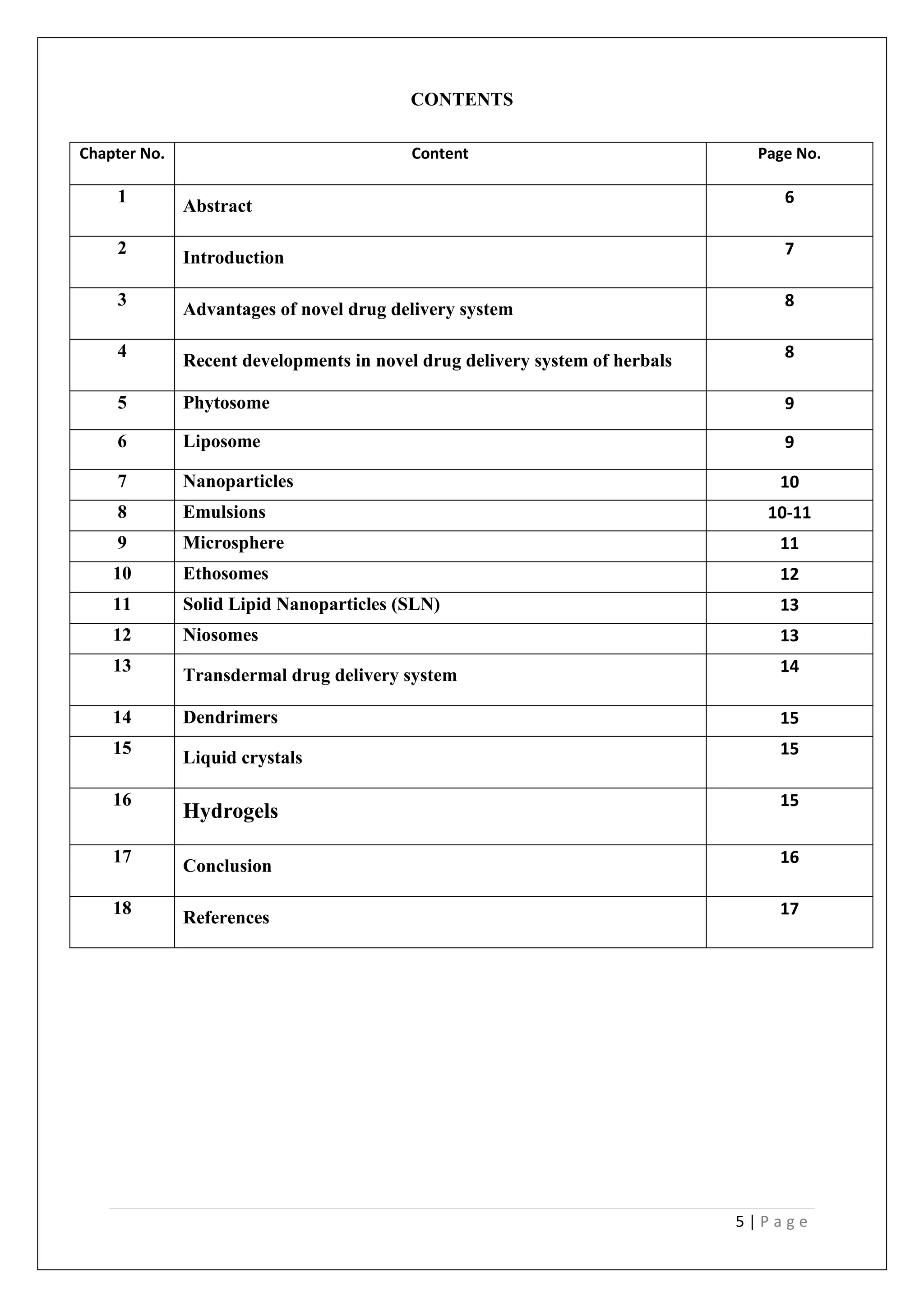
CONTENTS
Chapter No. Content Page No.
1
Abstract 6
2
Introduction 7
3
Advantages of novel drug delivery system 8
4
Recent developments in novel drug delivery system of herbals 8
5 Phytosome 9
6 Liposome 9
7 Nanoparticles 10
8 Emulsions 10-11
9 Microsphere 11
10 Ethosomes 12
11 Solid Lipid Nanoparticles (SLN) 13
12 Niosomes 13
13
Transdermal drug delivery system 14
14 Dendrimers 15
15
Liquid crystals 15
16
Hydrogels
15
17
Conclusion 16
18
References 17
6 | P a g e
NOVEL DRUG DELIVERY SYSTEM
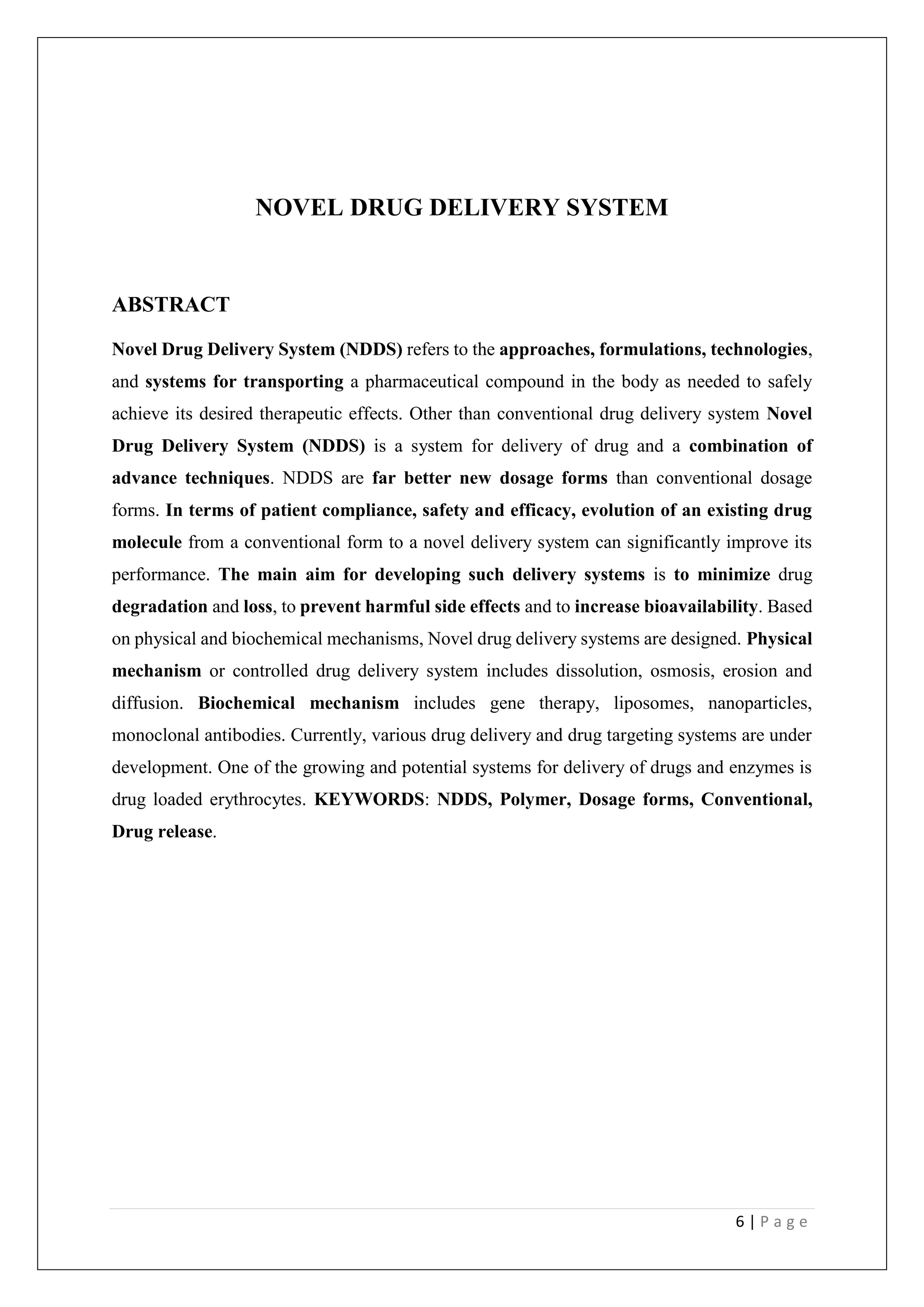
ABSTRACT
Novel Drug Delivery System (NDDS) refers to the approaches, formulations, technologies,
and systems for transporting a pharmaceutical compound in the body as needed to safely
achieve its desired therapeutic effects. Other than conventional drug delivery system Novel
Drug Delivery System (NDDS) is a system for delivery of drug and a combination of
advance techniques. NDDS are far better new dosage forms than conventional dosage
forms. In terms of patient compliance, safety and efficacy, evolution of an existing drug
molecule from a conventional form to a novel delivery system can significantly improve its
performance. The main aim for developing such delivery systems is to minimize drug
degradation and loss, to prevent harmful side effects and to increase bioavailability. Based
on physical and biochemical mechanisms, Novel drug delivery systems are designed. Physical
mechanism or controlled drug delivery system includes dissolution, osmosis, erosion and
diffusion. Biochemical mechanism includes gene therapy, liposomes, nanoparticles,
monoclonal antibodies. Currently, various drug delivery and drug targeting systems are under
development. One of the growing and potential systems for delivery of drugs and enzymes is
drug loaded erythrocytes. KEYWORDS: NDDS, Polymer, Dosage forms, Conventional,
Drug release.
7 | P a g e
INTRODUCTION
Drug delivery is the process of administering the drug or pharmaceutical product, in order to
achieve desired therapeutic effect. The method by which drug delivered is important, as it
has significant effect on its efficacy. Novel drug delivery system involves various approaches
like medical devices or drug-device combination products. Novel drug delivery system
(NDDS) involves combining polymer science, pharmaceutics and molecular biology.The
method by which a drug is delivered can have a significant effect on its efficacy. Some drugs
have an optimum concentration range within which maximum benefit is derived, and
concentrations above or below this range can be toxic or produce no therapeutic benefit at
all. On the other hand, the very slow progress in the efficacy of the treatment of severe diseases,
has suggested a growing need for a multidisciplinary approach to the delivery of therapeutics
to targets in tissues. From this, new ideas on controlling the pharmacokinetics,
pharmacodynamics, non-specific toxicity, immunogenicity, bio-recognition, and efficacy
of drugs were generated. These new strategies, often called drug delivery systems (DDS),
which are based on interdisciplinary approaches that combine polymer science,
pharmaceutics, bio-conjugate chemistry, and molecular biology. To minimize drug degradation
and loss, to prevent harmful side-effects and to increase drug bioavailability and the fraction
of the drug accumulated in the required zone, various drug delivery and drug targeting systems
are currently under development. Novel drug delivery systems can include those based on
physical mechanisms and those based on biochemical mechanisms. Physical mechanisms
also referred as controlled drug delivery systems include osmosis, diffusion, erosion,
dissolution and electro transport. Biochemical mechanisms include monoclonal antibodies,
gene therapy, and vector systems, polymer drug adducts and liposomes. Therapeutic benefits
of some new drug delivery systems include optimization of duration of action of drug,
decreasing dosage frequency, controlling the site of release and maintaining constant drug
levels. Among drug carriers one can name soluble polymers, microparticles made of
insoluble or biodegradable natural and synthetic polymers, microcapsules, cells, cell
ghosts, lipoproteins, liposomes. The carriers can be made slowly degradable, stimuli-
reactive (e.g., pH- or temperature sensitive), and even targeted (e.g., by conjugating them
with specific antibodies against certain characteristic components of the area of interest).
Targeting is the ability to direct the drug-loaded system to the site of interest [2].
8 | P a g e
Advantages of novel drug delivery system [1]
1. Protection from physical and chemical degradation.
2. Sustained delivery.
3. Improved tissue macrophages distribution.
4. Enhancement of stability.
5. Enhancement of pharmacological activity.
6. Protection from toxicity.
7. Increased bioavailability.
8. Enhancement of solubility.
Recent developments in novel drug delivery system of herbals [2]
1. Phytosome
2. Liposome
3. Nanoparticles
4. Emulsions
5. Microsphere
6. Ethosome
7. Solid lipid nanoparticle
8. Niosomes
9. Proniosomes
10. Transdermal Drug Delivery System
11. Dendrimers
12. Liquid Crystals
13. Hydrogels
9 | P a g e
Phytosome
Phytosomes are lipid compatible molecular complex which
are composed of “phyto” which means plant and “some”
meaning cell-like. Complexing the polyphenolic phyto-
constituents in the molar ratio with phosphatidyl choline
results in a new herbal drug delivery system, known as
“Phytosome”. Phytosomes are advanced forms of herbal
products that are better absorbed, utilized to produce better
results than those produced by conventional herbal extracts. Phytosomes show better
pharmacokinetic and therapeutic profiles than conventional herbal extracts [3].
Advantages of phytosome
Phytosome increases the absorption of active constituents, so its dose size required is small.
There is appreciable drug entrapment and improvement in the solubility of bile to herbal
constituents, and it can target the liver. In Phytosome, chemical bonds are formed between
phosphatidylcholine molecules, so it shows good stability. Phytosome improves the
percutaneous absorption of herbal phytoconstituents.
Liposome
Liposomes are concentric bi-layered vesicles in which
aqueous volume is entirely enclosed by a membranous lipid
bi-layer mainly composed of natural or synthetic
phospholipids. The liposomes are spherical particles that
encapsulate the solvents which are freely floating in the
interior [4].
Advantages of liposomes
The high biocompatibility. The easiness of preparation. The
chemical versatility that allows the loading of hydrophilic,
amphiphilic, and lipophilic compounds. The simple
modulation of their pharmacokinetic properties by changing
the chemical composition of the bilayer components.
Fig 1: Phytosome [7]
Fig 2: Structure of a liposome. A liposome
consists of a phospholipid bilayer with an
aqueous core. [8]
10 | P a g e
Nanoparticles
Nanotechnology is science of matter and material that deal with
the particle size in nanometres. The word “Nano” is derived
from Latin word, which means dwarf (1nm=10-9m).
Nanoparticles are defined as particulate dispersions or solid
particles with a size in the range of 10- 1000nm. The drug is
dissolved, entrapped, encapsulated or attached to a nanoparticle
matrix. Nanoparticles offer some specific advantages such as
they help to increase the stability of drugs/proteins and possess useful controlled release
properties. It can be modified to achieve both active and passive targeting; drug loading is very
high and can be administered by various routes such as parenteral, nasal, intra ocular and oral
routes.
Advantages of herbal nanoparticle delivery system
Nano-particulate system delivers the herbal formulation directly to the site of action. Increased
efficacy and therapeutic index. Increased stability via encapsulation. Improved
pharmacokinetic effect. Producible with various sizes, compound surface properties [14].
Emulsions
Emulsion is a biphasic system in which one phase is intimately disperse
in the other phase in the form of minute droplets in ranging in diameter
from 0.1µm to 100 µm. In emulsion, one phase is always water or
aqueous phase, and the other phase
is oily liquid, i.e. non aqueous.
Among them, the microemulsion is also called
nanoemulsion, and the sub-micro-emulsion is called
liquid emulsion. Microemulsion is a clear,
thermodynamically stable, frequently in combination
with a co-surfactant.
Fig 3: Structure of a Nanoparticle. [9]
Fig 4.1: Emulsion. [10.1]
Fig 4: Emulsion. [10]
11 | P a g e
Advantages of emulsion-based formulations
It can release the drug for a long time because it is packed in the inner phase and makes
direct.contact with the body and other tissues. As a result of the lipophilic drugs being made
into o/w/o emulsion, the droplets of oil are phagocytosised by macrophages and increase its
concentration in liver, spleen and kidney. As the emulsion contains herbal formulation, it will
increase the stability of hydrolysed formulated material and improve the penetrability of drug
into skin and mucous [6]. The new type, viz., Elemenum emulsion, is used as an anti-cancer
drug and causes no harm to the heart and liver [7].
Microsphere
Microsphere comprises of small spherical
particles, with diameters in the micrometre
range, typically 1 μm to 1000 μm (1 mm).
Microspheres are sometimes referred to as
micro-particles. Microspheres can be
manufactured from various natural and
synthetic materials. Glass microspheres, polymer microspheres and ceramic microspheres are
commercially available. Microspheres are classified as biodegradable or non-biodegradable.
Biodegradable microspheres include albumin microspheres, modified starch microspheres,
gelatine microspheres, polypropylene dextran microspheres, polylactic acid microspheres, etc.
According to the current literature reports on non-biodegradable microspheres, polylactic acid
is the only polymer approved to be used by people, and it is used as a controlled-release agent.
Solid and hollow microspheres vary widely in density and therefore are used for different
applications.
Advantage of microsphere formulation
Administration of medication via micro-particulate system is advantageous because
microspheres can be ingested or injected, and they can be tailored for desired release profiles
and used for site-specific delivery of drugs and in some cases can even provide organtargeted
release. Drug can be easily released from the formulation. It can protect the specific function
of drugs, and can release the drugs into an outer phase for a long period.
Fig 5: Emulsion.
[https://www.slideshare.net/ArshadKhan63/microspheres-140150384
12 | P a g e
Ethosomes
Ethosomes are developed by mixture of phospholipids
and high concentration of ethanol. This carrier can
penetrate through the skin deeply lead to improve drug
delivery into deeper layer of skin and in blood circulation.
These formulations are useful for topical delivery of
alkaloids in form of gel and cream for patient’s comfort.
They show increase in their permeability through the skin
by fluidizing the lipid domain of the skin. Unstable nature
and poor skin penetration are limits for Ethanosomes
tropical delivery. The Ethosomes was developed and
examined for their ability the topical absorption of Tetrandine through dermal delivery, and
the relation of formulations to the pharmacological activity of Tetrandrine loaded in the
formulation was also accessed. Result of the drug levels in rat plasma showed that when
Tetrandrine is loaded. Ethosomes were topically administered in rats the drug level was low to
be detected in rat plasma. By providing fewer delivery of Tetrandrine into bloodstream, topical
administration might offer favorable efficacy with reduced side effects, thus leading to improve
patient's compliances. In conclusion, Ethosomes were demonstrated to be promising carrier
for improving topical delivery of Tentrandrine via skin.
Advantages of ethosomal drug delivery
Ethosomes enhance transdermal permeation of drug through skin. Ethosomes are a platform
for the delivery of large amounts of diverse groups of drugs. Ethosomal drug is administered
in semisolid form resulting in improvement in patient’s compliance.
Fig 6: Ethosomes [11]
13 | P a g e
Solid Lipid Nanoparticles (SLN)
It is a technique developed in the 1990s. It is a colloidal carrier used especially for the delivery
of lipophilic compounds. The average mean size
of solid lipid nanoparticles ranges from 50 nm to
1000 nm. Solid lipid nanoparticles are composed
of lipid matrix, which becomes solid at room
temperature and also at the body temperature.
The main features of solid lipid nanoparticles
(SLNs) with regard to parenteral application are
the excellent physical stability, protection of incorporated labile drugs from degradation. To
cross blood brain barrier, it should be made for selection of lipids and surfactants. The SLNs
are prepared by different methods such as homogenization and the warm micro-emulsion high-
speed stirring ultra-sonication and solvent-diffusion method. Lipids show compatibility with
lipophilic drugs and increase the entrapment efficiency and drug-loading into the SLN.
Advantages of SLN herbal formulation
It provides controlled release and site-specific drug targeting. Large-scale production can be
done. In this formulation, both lipophilic and hydrophilic drugs can be loaded. Another
advantage is that it is made of lipid matrix (physiological lipids), which decreases danger of
chronic and acute toxicity.
Niosomes
Niosomes are multilamellar vesicles formed from non-
ionic surfactants of the alkyl or dialkyl polyglycerol ether
class and cholesterol. Earlier studies, in association with
L’Oréal have shown that, in general, niosomes have
properties as potential drug carriers similar to liposomes.
Niosomes are different from liposomes in that they offer
certain advantages over liposomes.
Fig 6: Ethosomes [9]
Fig 6: Niosomes [12]
14 | P a g e
Proniosomes
Proniosomes gel system is step forward to noisome, which can be utilized for various
applications in delivery of actives at desire
site. Proniosomal gels are the formulations,
which on in situ hydration with water from
the skin are converted into niosomes.
Advantages of Proniosomes
More stable during storage and sterilization.
Easy to transfer and distribution
Transdermal Drug Delivery System
Transdermal drug delivery system has been an increased interest in the drug
administration via the skin for both local therapeutic effects on diseased skin
(top ical delivery) a s well as for
systemic delivery of drugs. But
immense potential lies in transdermal
drug as future smart drug delivery
devices. These are the devices in
which drug present in the formulation
permeates into the systemic circulation by diffusion to stratum corneum and further to the
effected organ. These devices use polymer matrix, adhesive bandage and permeation
enhancers.
Advantages of Transdermal Drug Delivery System
Controlled drug delivery, enhanced bioavailability, reduction in side effects and easy
application. Transdermal delivery of herbal drugs are to increase the penetration and sustained
action.e.g.transdermal films containing boswellic acid ( Boswellia serrate) and curcumin
(Curcuma longa) were formulated for the treatment of inflammation (synergistic effect).
Limitations are hepatic first pass metabolism, increased herapeutic effect, and maintenance of
steady state concentration in the serum.
Fig 7: Niosomes [13]
Fig 8: Transdermal Drug Delivery system [14]
15 | P a g e
Dendrimers
Dendrimers are nanometer-sized, highly
branched and monodisperse
macromolecules with symmetrical
architecture while their stability and
protection from the Mononuclear Phagocyte
System (MPS) is being achieved by
functionalization of the dendrimers with
polyethylene glycol chains (PEG) [28].
Liquid Crystals
Liquid Crystals combine the properties of both liquid and solid
states. They can be made to from different geometries, with
alternative polar and non-polar layers (i.e., a lamellar phase)
where aqueous drug solutions can be included [29].
Hydrogels
Hydrogels are three-dimensional, hydrophilic,
polymeric networks capable of imbibing large amounts
of water or biological fluids. They are used to regulate
drug release in reservoir-based, controlled release
systems or as carriers in swellable and swelling-
controlled release devices.
Fig 8: Dendrimers [15]
Fig 9: Liquid Crystals [5]
Fig 10: Hydrogel [5]
16 | P a g e
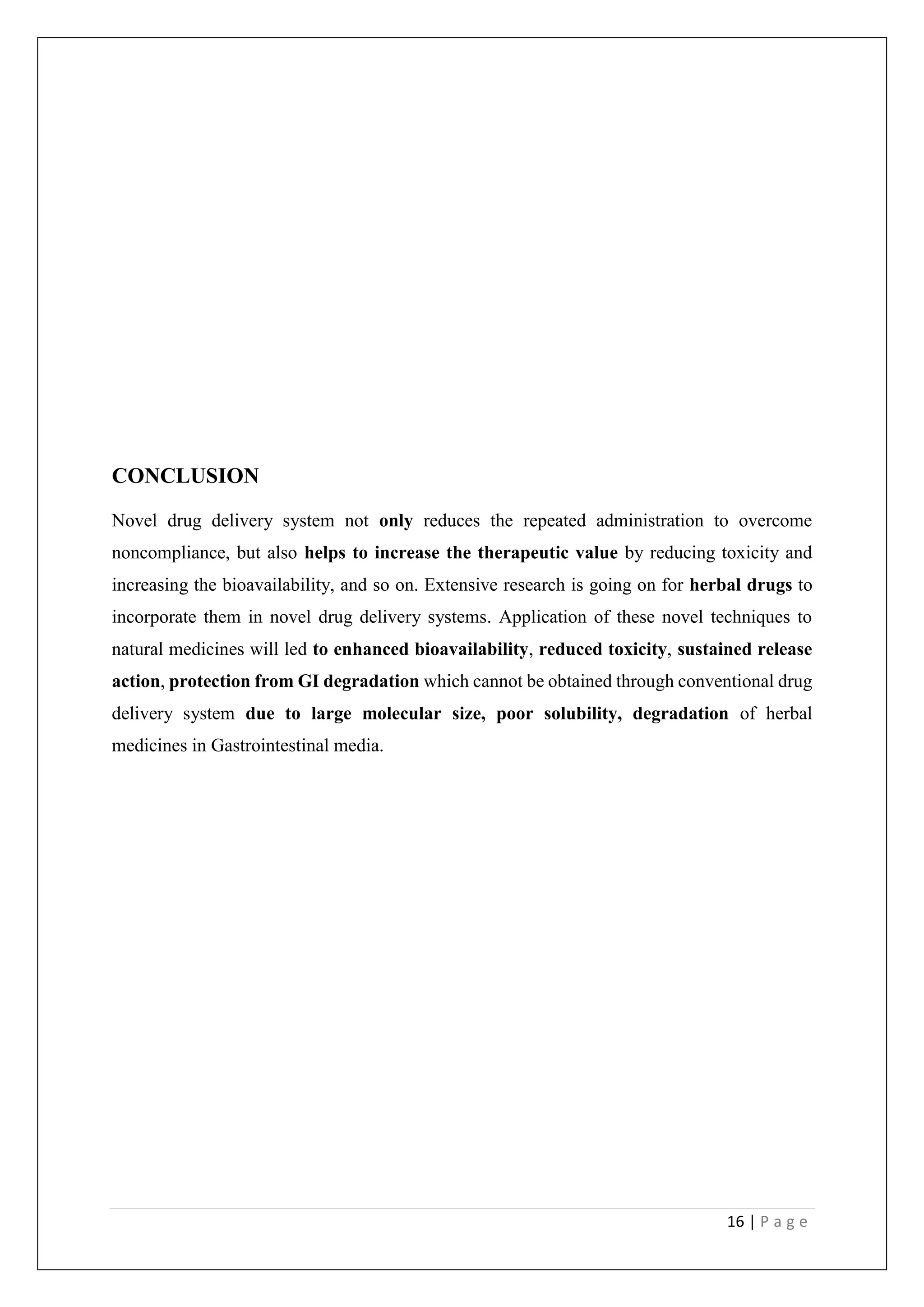
CONCLUSION
Novel drug delivery system not only reduces the repeated administration to overcome
noncompliance, but also helps to increase the therapeutic value by reducing toxicity and
increasing the bioavailability, and so on. Extensive research is going on for herbal drugs to
incorporate them in novel drug delivery systems. Application of these novel techniques to
natural medicines will led to enhanced bioavailability, reduced toxicity, sustained release
action, protection from GI degradation which cannot be obtained through conventional drug
delivery system due to large molecular size, poor solubility, degradation of herbal
medicines in Gastrointestinal media.
17 | P a g e
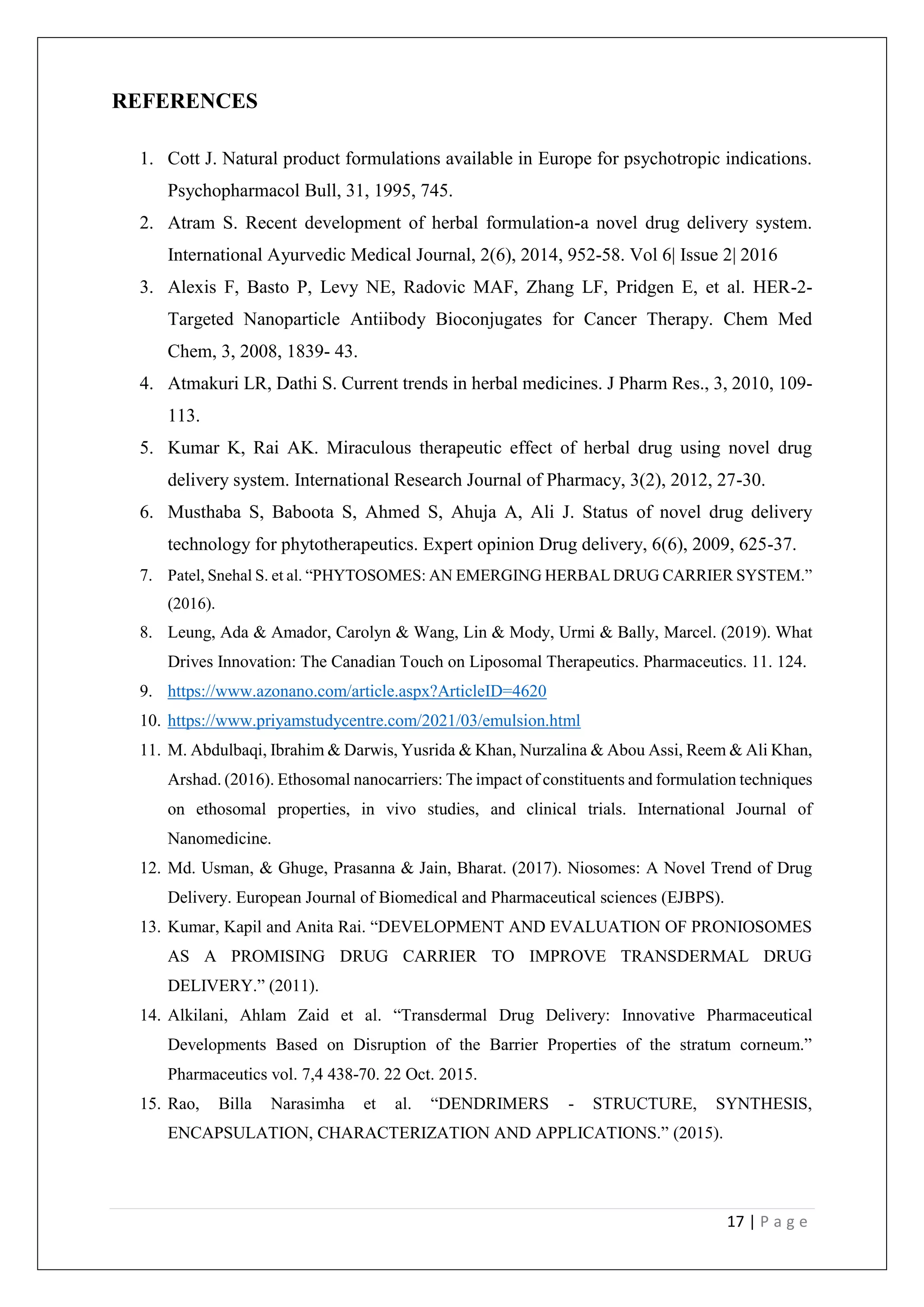
REFERENCES
1. Cott J. Natural product formulations available in Europe for psychotropic indications.
Psychopharmacol Bull, 31, 1995, 745.
2. Atram S. Recent development of herbal formulation-a novel drug delivery system.
International Ayurvedic Medical Journal, 2(6), 2014, 952-58. Vol 6| Issue 2| 2016
3. Alexis F, Basto P, Levy NE, Radovic MAF, Zhang LF, Pridgen E, et al. HER-2-
Targeted Nanoparticle Antiibody Bioconjugates for Cancer Therapy. Chem Med
Chem, 3, 2008, 1839- 43.
4. Atmakuri LR, Dathi S. Current trends in herbal medicines. J Pharm Res., 3, 2010, 109-
113.
5. Kumar K, Rai AK. Miraculous therapeutic effect of herbal drug using novel drug
delivery system. International Research Journal of Pharmacy, 3(2), 2012, 27-30.
6. Musthaba S, Baboota S, Ahmed S, Ahuja A, Ali J. Status of novel drug delivery
technology for phytotherapeutics. Expert opinion Drug delivery, 6(6), 2009, 625-37.
7. Patel, Snehal S. et al. “PHYTOSOMES: AN EMERGING HERBAL DRUG CARRIER SYSTEM.”
(2016).
8. Leung, Ada & Amador, Carolyn & Wang, Lin & Mody, Urmi & Bally, Marcel. (2019). What
Drives Innovation: The Canadian Touch on Liposomal Therapeutics. Pharmaceutics. 11. 124.
9. https://www.azonano.com/article.aspx?ArticleID=4620
10. https://www.priyamstudycentre.com/2021/03/emulsion.html
11. M. Abdulbaqi, Ibrahim & Darwis, Yusrida & Khan, Nurzalina & Abou Assi, Reem & Ali Khan,
Arshad. (2016). Ethosomal nanocarriers: The impact of constituents and formulation techniques
on ethosomal properties, in vivo studies, and clinical trials. International Journal of
Nanomedicine.
12. Md. Usman, & Ghuge, Prasanna & Jain, Bharat. (2017). Niosomes: A Novel Trend of Drug
Delivery. European Journal of Biomedical and Pharmaceutical sciences (EJBPS).
13. Kumar, Kapil and Anita Rai. “DEVELOPMENT AND EVALUATION OF PRONIOSOMES
AS A PROMISING DRUG CARRIER TO IMPROVE TRANSDERMAL DRUG
DELIVERY.” (2011).
14. Alkilani, Ahlam Zaid et al. “Transdermal Drug Delivery: Innovative Pharmaceutical
Developments Based on Disruption of the Barrier Properties of the stratum corneum.”
Pharmaceutics vol. 7,4 438-70. 22 Oct. 2015.
15. Rao, Billa Narasimha et al. “DENDRIMERS - STRUCTURE, SYNTHESIS,
ENCAPSULATION, CHARACTERIZATION AND APPLICATIONS.” (2015).

NOVEL DRUG DELIVERY SYSTEM.pdf

  • 1.
    1 | Pa g e A Project Report on NOVEL DRUG DELIVERY SYSTEM Project Report Submitted in partial fulfilment for the award of the degree of Bachelor in Pharmacy (B. Pharm) By SIRAJUDDIN MOLLA Roll. NO: 27701918043 Regd.No: 182770210070 Under the supervision of Dr. DEBALINA DAS NSHM College of Pharmaceutical Technology NSHM Knowledge Campus, Kolkata-Group of Institutions 2022
  • 2.
    2 | Pa g e NSHM Knowledge Campus, Kolkata-Group of Institutions CERTIFICATE OF APPROVAL This is to certify that SIRAJUDDIN MOLLA (Roll No 27701918043) student of NSHM Knowledge Campus, Kolkata-Group of Institutions has carried out the Project Work entitled “NOVEL DRUG DELIVERY SYSTEM “under my guidance and supervision for the partial fulfilment of the requirement for the award of Bachelors of Pharmaceutical Technology. Degree of Maulana Abul Kalam Azad University of Technology. The results presented in this report have not been included in any other paper submitted for the award of any other degree to any other Institute or University. ………………………………. …………………………… (Signature of Director) (Signature of Guide) Name: Name: Date: Date:
  • 3.
    3 | Pa g e NSHM Knowledge Campus, Kolkata-Group of Institutions DECLARATION OF ORIGINALITY I hereby declare that this report contains literature survey and /or survey reports done by the undersigned candidate, as a partial fulfilment of the degree of Bachelor of Pharmaceutical Technology. All information in this report have been obtained and presented in accordance with academic rules and ethical conduct. I also declare that as required by the rules and conduct, I have fully cited and referenced all materials and results and data that are not original to my work. ….………………………………. (Signature of the student) Name: SIRAJUDDIN MOLLA Regd. No: 182770210070 Roll No: 27701918043
  • 4.
    4 | Pa g e ACKNOWLEDGEMENT I take this opportunity to express my profound gratitude and deep regards to my guides for her exemplary guidance, monitoring and constant encouragement throughout the course of this project. The blessing, help and guidance given by her time to time have been a constant source of inspiration. Firstly, I would like to express a deep sense of gratitude to Dr. DEBALINA DAS, Professor of NSHM KNOWLEDGE CAMPUS, KOLKATA. I am also very thankful for her cordial support, valuable information and guidance, which helped me in completion of the study of the seminar through various stages and thankful to mam for her unwaving faith and total confidence reposed in me. My sincere and warm acknowledgements are due to our beloved and esteemed Director, Dr. Subhasis Maity, for his invaluable advice, creative inputs and organizational support in molding his support. I would also like to acknowledgement SEKHAR KUMAR BOSE our respected Batch Coordinator for his enthusiasm and relevant suggestions which led to the proper culmination of this report. I am also deeply indebted to all my faculty member for their valuable time and extended co- operation. I would also like to take this opportunity to wholeheartedly thank all the technicians of our Laboratory and Librarians for their in valuable support. Lastly, I thank Almighty, my family and friends for their constant encouragement and their valuable support, without which this project would not have been possible. I am grateful for their cooperation during the period of my project. Name: SIRAJUDDIN MOLLA Roll no: 27701918043
  • 5.
    5 | Pa g e CONTENTS Chapter No. Content Page No. 1 Abstract 6 2 Introduction 7 3 Advantages of novel drug delivery system 8 4 Recent developments in novel drug delivery system of herbals 8 5 Phytosome 9 6 Liposome 9 7 Nanoparticles 10 8 Emulsions 10-11 9 Microsphere 11 10 Ethosomes 12 11 Solid Lipid Nanoparticles (SLN) 13 12 Niosomes 13 13 Transdermal drug delivery system 14 14 Dendrimers 15 15 Liquid crystals 15 16 Hydrogels 15 17 Conclusion 16 18 References 17
  • 6.
    6 | Pa g e NOVEL DRUG DELIVERY SYSTEM ABSTRACT Novel Drug Delivery System (NDDS) refers to the approaches, formulations, technologies, and systems for transporting a pharmaceutical compound in the body as needed to safely achieve its desired therapeutic effects. Other than conventional drug delivery system Novel Drug Delivery System (NDDS) is a system for delivery of drug and a combination of advance techniques. NDDS are far better new dosage forms than conventional dosage forms. In terms of patient compliance, safety and efficacy, evolution of an existing drug molecule from a conventional form to a novel delivery system can significantly improve its performance. The main aim for developing such delivery systems is to minimize drug degradation and loss, to prevent harmful side effects and to increase bioavailability. Based on physical and biochemical mechanisms, Novel drug delivery systems are designed. Physical mechanism or controlled drug delivery system includes dissolution, osmosis, erosion and diffusion. Biochemical mechanism includes gene therapy, liposomes, nanoparticles, monoclonal antibodies. Currently, various drug delivery and drug targeting systems are under development. One of the growing and potential systems for delivery of drugs and enzymes is drug loaded erythrocytes. KEYWORDS: NDDS, Polymer, Dosage forms, Conventional, Drug release.
  • 7.
    7 | Pa g e INTRODUCTION Drug delivery is the process of administering the drug or pharmaceutical product, in order to achieve desired therapeutic effect. The method by which drug delivered is important, as it has significant effect on its efficacy. Novel drug delivery system involves various approaches like medical devices or drug-device combination products. Novel drug delivery system (NDDS) involves combining polymer science, pharmaceutics and molecular biology.The method by which a drug is delivered can have a significant effect on its efficacy. Some drugs have an optimum concentration range within which maximum benefit is derived, and concentrations above or below this range can be toxic or produce no therapeutic benefit at all. On the other hand, the very slow progress in the efficacy of the treatment of severe diseases, has suggested a growing need for a multidisciplinary approach to the delivery of therapeutics to targets in tissues. From this, new ideas on controlling the pharmacokinetics, pharmacodynamics, non-specific toxicity, immunogenicity, bio-recognition, and efficacy of drugs were generated. These new strategies, often called drug delivery systems (DDS), which are based on interdisciplinary approaches that combine polymer science, pharmaceutics, bio-conjugate chemistry, and molecular biology. To minimize drug degradation and loss, to prevent harmful side-effects and to increase drug bioavailability and the fraction of the drug accumulated in the required zone, various drug delivery and drug targeting systems are currently under development. Novel drug delivery systems can include those based on physical mechanisms and those based on biochemical mechanisms. Physical mechanisms also referred as controlled drug delivery systems include osmosis, diffusion, erosion, dissolution and electro transport. Biochemical mechanisms include monoclonal antibodies, gene therapy, and vector systems, polymer drug adducts and liposomes. Therapeutic benefits of some new drug delivery systems include optimization of duration of action of drug, decreasing dosage frequency, controlling the site of release and maintaining constant drug levels. Among drug carriers one can name soluble polymers, microparticles made of insoluble or biodegradable natural and synthetic polymers, microcapsules, cells, cell ghosts, lipoproteins, liposomes. The carriers can be made slowly degradable, stimuli- reactive (e.g., pH- or temperature sensitive), and even targeted (e.g., by conjugating them with specific antibodies against certain characteristic components of the area of interest). Targeting is the ability to direct the drug-loaded system to the site of interest [2].
  • 8.
    8 | Pa g e Advantages of novel drug delivery system [1] 1. Protection from physical and chemical degradation. 2. Sustained delivery. 3. Improved tissue macrophages distribution. 4. Enhancement of stability. 5. Enhancement of pharmacological activity. 6. Protection from toxicity. 7. Increased bioavailability. 8. Enhancement of solubility. Recent developments in novel drug delivery system of herbals [2] 1. Phytosome 2. Liposome 3. Nanoparticles 4. Emulsions 5. Microsphere 6. Ethosome 7. Solid lipid nanoparticle 8. Niosomes 9. Proniosomes 10. Transdermal Drug Delivery System 11. Dendrimers 12. Liquid Crystals 13. Hydrogels
  • 9.
    9 | Pa g e Phytosome Phytosomes are lipid compatible molecular complex which are composed of “phyto” which means plant and “some” meaning cell-like. Complexing the polyphenolic phyto- constituents in the molar ratio with phosphatidyl choline results in a new herbal drug delivery system, known as “Phytosome”. Phytosomes are advanced forms of herbal products that are better absorbed, utilized to produce better results than those produced by conventional herbal extracts. Phytosomes show better pharmacokinetic and therapeutic profiles than conventional herbal extracts [3]. Advantages of phytosome Phytosome increases the absorption of active constituents, so its dose size required is small. There is appreciable drug entrapment and improvement in the solubility of bile to herbal constituents, and it can target the liver. In Phytosome, chemical bonds are formed between phosphatidylcholine molecules, so it shows good stability. Phytosome improves the percutaneous absorption of herbal phytoconstituents. Liposome Liposomes are concentric bi-layered vesicles in which aqueous volume is entirely enclosed by a membranous lipid bi-layer mainly composed of natural or synthetic phospholipids. The liposomes are spherical particles that encapsulate the solvents which are freely floating in the interior [4]. Advantages of liposomes The high biocompatibility. The easiness of preparation. The chemical versatility that allows the loading of hydrophilic, amphiphilic, and lipophilic compounds. The simple modulation of their pharmacokinetic properties by changing the chemical composition of the bilayer components. Fig 1: Phytosome [7] Fig 2: Structure of a liposome. A liposome consists of a phospholipid bilayer with an aqueous core. [8]
  • 10.
    10 | Pa g e Nanoparticles Nanotechnology is science of matter and material that deal with the particle size in nanometres. The word “Nano” is derived from Latin word, which means dwarf (1nm=10-9m). Nanoparticles are defined as particulate dispersions or solid particles with a size in the range of 10- 1000nm. The drug is dissolved, entrapped, encapsulated or attached to a nanoparticle matrix. Nanoparticles offer some specific advantages such as they help to increase the stability of drugs/proteins and possess useful controlled release properties. It can be modified to achieve both active and passive targeting; drug loading is very high and can be administered by various routes such as parenteral, nasal, intra ocular and oral routes. Advantages of herbal nanoparticle delivery system Nano-particulate system delivers the herbal formulation directly to the site of action. Increased efficacy and therapeutic index. Increased stability via encapsulation. Improved pharmacokinetic effect. Producible with various sizes, compound surface properties [14]. Emulsions Emulsion is a biphasic system in which one phase is intimately disperse in the other phase in the form of minute droplets in ranging in diameter from 0.1µm to 100 µm. In emulsion, one phase is always water or aqueous phase, and the other phase is oily liquid, i.e. non aqueous. Among them, the microemulsion is also called nanoemulsion, and the sub-micro-emulsion is called liquid emulsion. Microemulsion is a clear, thermodynamically stable, frequently in combination with a co-surfactant. Fig 3: Structure of a Nanoparticle. [9] Fig 4.1: Emulsion. [10.1] Fig 4: Emulsion. [10]
  • 11.
    11 | Pa g e Advantages of emulsion-based formulations It can release the drug for a long time because it is packed in the inner phase and makes direct.contact with the body and other tissues. As a result of the lipophilic drugs being made into o/w/o emulsion, the droplets of oil are phagocytosised by macrophages and increase its concentration in liver, spleen and kidney. As the emulsion contains herbal formulation, it will increase the stability of hydrolysed formulated material and improve the penetrability of drug into skin and mucous [6]. The new type, viz., Elemenum emulsion, is used as an anti-cancer drug and causes no harm to the heart and liver [7]. Microsphere Microsphere comprises of small spherical particles, with diameters in the micrometre range, typically 1 μm to 1000 μm (1 mm). Microspheres are sometimes referred to as micro-particles. Microspheres can be manufactured from various natural and synthetic materials. Glass microspheres, polymer microspheres and ceramic microspheres are commercially available. Microspheres are classified as biodegradable or non-biodegradable. Biodegradable microspheres include albumin microspheres, modified starch microspheres, gelatine microspheres, polypropylene dextran microspheres, polylactic acid microspheres, etc. According to the current literature reports on non-biodegradable microspheres, polylactic acid is the only polymer approved to be used by people, and it is used as a controlled-release agent. Solid and hollow microspheres vary widely in density and therefore are used for different applications. Advantage of microsphere formulation Administration of medication via micro-particulate system is advantageous because microspheres can be ingested or injected, and they can be tailored for desired release profiles and used for site-specific delivery of drugs and in some cases can even provide organtargeted release. Drug can be easily released from the formulation. It can protect the specific function of drugs, and can release the drugs into an outer phase for a long period. Fig 5: Emulsion. [https://www.slideshare.net/ArshadKhan63/microspheres-140150384
  • 12.
    12 | Pa g e Ethosomes Ethosomes are developed by mixture of phospholipids and high concentration of ethanol. This carrier can penetrate through the skin deeply lead to improve drug delivery into deeper layer of skin and in blood circulation. These formulations are useful for topical delivery of alkaloids in form of gel and cream for patient’s comfort. They show increase in their permeability through the skin by fluidizing the lipid domain of the skin. Unstable nature and poor skin penetration are limits for Ethanosomes tropical delivery. The Ethosomes was developed and examined for their ability the topical absorption of Tetrandine through dermal delivery, and the relation of formulations to the pharmacological activity of Tetrandrine loaded in the formulation was also accessed. Result of the drug levels in rat plasma showed that when Tetrandrine is loaded. Ethosomes were topically administered in rats the drug level was low to be detected in rat plasma. By providing fewer delivery of Tetrandrine into bloodstream, topical administration might offer favorable efficacy with reduced side effects, thus leading to improve patient's compliances. In conclusion, Ethosomes were demonstrated to be promising carrier for improving topical delivery of Tentrandrine via skin. Advantages of ethosomal drug delivery Ethosomes enhance transdermal permeation of drug through skin. Ethosomes are a platform for the delivery of large amounts of diverse groups of drugs. Ethosomal drug is administered in semisolid form resulting in improvement in patient’s compliance. Fig 6: Ethosomes [11]
  • 13.
    13 | Pa g e Solid Lipid Nanoparticles (SLN) It is a technique developed in the 1990s. It is a colloidal carrier used especially for the delivery of lipophilic compounds. The average mean size of solid lipid nanoparticles ranges from 50 nm to 1000 nm. Solid lipid nanoparticles are composed of lipid matrix, which becomes solid at room temperature and also at the body temperature. The main features of solid lipid nanoparticles (SLNs) with regard to parenteral application are the excellent physical stability, protection of incorporated labile drugs from degradation. To cross blood brain barrier, it should be made for selection of lipids and surfactants. The SLNs are prepared by different methods such as homogenization and the warm micro-emulsion high- speed stirring ultra-sonication and solvent-diffusion method. Lipids show compatibility with lipophilic drugs and increase the entrapment efficiency and drug-loading into the SLN. Advantages of SLN herbal formulation It provides controlled release and site-specific drug targeting. Large-scale production can be done. In this formulation, both lipophilic and hydrophilic drugs can be loaded. Another advantage is that it is made of lipid matrix (physiological lipids), which decreases danger of chronic and acute toxicity. Niosomes Niosomes are multilamellar vesicles formed from non- ionic surfactants of the alkyl or dialkyl polyglycerol ether class and cholesterol. Earlier studies, in association with L’Oréal have shown that, in general, niosomes have properties as potential drug carriers similar to liposomes. Niosomes are different from liposomes in that they offer certain advantages over liposomes. Fig 6: Ethosomes [9] Fig 6: Niosomes [12]
  • 14.
    14 | Pa g e Proniosomes Proniosomes gel system is step forward to noisome, which can be utilized for various applications in delivery of actives at desire site. Proniosomal gels are the formulations, which on in situ hydration with water from the skin are converted into niosomes. Advantages of Proniosomes More stable during storage and sterilization. Easy to transfer and distribution Transdermal Drug Delivery System Transdermal drug delivery system has been an increased interest in the drug administration via the skin for both local therapeutic effects on diseased skin (top ical delivery) a s well as for systemic delivery of drugs. But immense potential lies in transdermal drug as future smart drug delivery devices. These are the devices in which drug present in the formulation permeates into the systemic circulation by diffusion to stratum corneum and further to the effected organ. These devices use polymer matrix, adhesive bandage and permeation enhancers. Advantages of Transdermal Drug Delivery System Controlled drug delivery, enhanced bioavailability, reduction in side effects and easy application. Transdermal delivery of herbal drugs are to increase the penetration and sustained action.e.g.transdermal films containing boswellic acid ( Boswellia serrate) and curcumin (Curcuma longa) were formulated for the treatment of inflammation (synergistic effect). Limitations are hepatic first pass metabolism, increased herapeutic effect, and maintenance of steady state concentration in the serum. Fig 7: Niosomes [13] Fig 8: Transdermal Drug Delivery system [14]
  • 15.
    15 | Pa g e Dendrimers Dendrimers are nanometer-sized, highly branched and monodisperse macromolecules with symmetrical architecture while their stability and protection from the Mononuclear Phagocyte System (MPS) is being achieved by functionalization of the dendrimers with polyethylene glycol chains (PEG) [28]. Liquid Crystals Liquid Crystals combine the properties of both liquid and solid states. They can be made to from different geometries, with alternative polar and non-polar layers (i.e., a lamellar phase) where aqueous drug solutions can be included [29]. Hydrogels Hydrogels are three-dimensional, hydrophilic, polymeric networks capable of imbibing large amounts of water or biological fluids. They are used to regulate drug release in reservoir-based, controlled release systems or as carriers in swellable and swelling- controlled release devices. Fig 8: Dendrimers [15] Fig 9: Liquid Crystals [5] Fig 10: Hydrogel [5]
  • 16.
    16 | Pa g e CONCLUSION Novel drug delivery system not only reduces the repeated administration to overcome noncompliance, but also helps to increase the therapeutic value by reducing toxicity and increasing the bioavailability, and so on. Extensive research is going on for herbal drugs to incorporate them in novel drug delivery systems. Application of these novel techniques to natural medicines will led to enhanced bioavailability, reduced toxicity, sustained release action, protection from GI degradation which cannot be obtained through conventional drug delivery system due to large molecular size, poor solubility, degradation of herbal medicines in Gastrointestinal media.
  • 17.
    17 | Pa g e REFERENCES 1. Cott J. Natural product formulations available in Europe for psychotropic indications. Psychopharmacol Bull, 31, 1995, 745. 2. Atram S. Recent development of herbal formulation-a novel drug delivery system. International Ayurvedic Medical Journal, 2(6), 2014, 952-58. Vol 6| Issue 2| 2016 3. Alexis F, Basto P, Levy NE, Radovic MAF, Zhang LF, Pridgen E, et al. HER-2- Targeted Nanoparticle Antiibody Bioconjugates for Cancer Therapy. Chem Med Chem, 3, 2008, 1839- 43. 4. Atmakuri LR, Dathi S. Current trends in herbal medicines. J Pharm Res., 3, 2010, 109- 113. 5. Kumar K, Rai AK. Miraculous therapeutic effect of herbal drug using novel drug delivery system. International Research Journal of Pharmacy, 3(2), 2012, 27-30. 6. Musthaba S, Baboota S, Ahmed S, Ahuja A, Ali J. Status of novel drug delivery technology for phytotherapeutics. Expert opinion Drug delivery, 6(6), 2009, 625-37. 7. Patel, Snehal S. et al. “PHYTOSOMES: AN EMERGING HERBAL DRUG CARRIER SYSTEM.” (2016). 8. Leung, Ada & Amador, Carolyn & Wang, Lin & Mody, Urmi & Bally, Marcel. (2019). What Drives Innovation: The Canadian Touch on Liposomal Therapeutics. Pharmaceutics. 11. 124. 9. https://www.azonano.com/article.aspx?ArticleID=4620 10. https://www.priyamstudycentre.com/2021/03/emulsion.html 11. M. Abdulbaqi, Ibrahim & Darwis, Yusrida & Khan, Nurzalina & Abou Assi, Reem & Ali Khan, Arshad. (2016). Ethosomal nanocarriers: The impact of constituents and formulation techniques on ethosomal properties, in vivo studies, and clinical trials. International Journal of Nanomedicine. 12. Md. Usman, & Ghuge, Prasanna & Jain, Bharat. (2017). Niosomes: A Novel Trend of Drug Delivery. European Journal of Biomedical and Pharmaceutical sciences (EJBPS). 13. Kumar, Kapil and Anita Rai. “DEVELOPMENT AND EVALUATION OF PRONIOSOMES AS A PROMISING DRUG CARRIER TO IMPROVE TRANSDERMAL DRUG DELIVERY.” (2011). 14. Alkilani, Ahlam Zaid et al. “Transdermal Drug Delivery: Innovative Pharmaceutical Developments Based on Disruption of the Barrier Properties of the stratum corneum.” Pharmaceutics vol. 7,4 438-70. 22 Oct. 2015. 15. Rao, Billa Narasimha et al. “DENDRIMERS - STRUCTURE, SYNTHESIS, ENCAPSULATION, CHARACTERIZATION AND APPLICATIONS.” (2015).