Presented by:
     1. Wahyono Hadi (105)
2.   Lya Wahyuningsih (106)
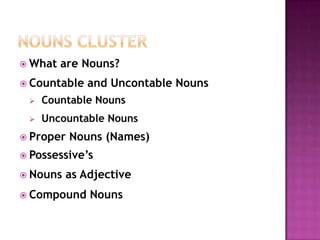
 What   are Nouns?
 Countable   and Uncontable Nouns
    Countable Nouns
    Uncountable Nouns
 Proper   Nouns (Names)
 Possessive’s

 Nouns   as Adjective
 Compound    Nouns
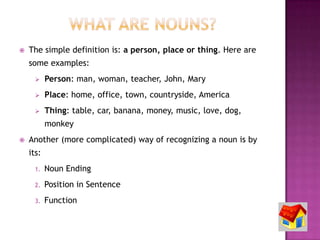
   The simple definition is: a person, place or thing. Here are
    some examples:
          Person: man, woman, teacher, John, Mary
          Place: home, office, town, countryside, America
          Thing: table, car, banana, money, music, love, dog,
           monkey
   Another (more complicated) way of recognizing a noun is by
    its:
      1.   Noun Ending
      2.   Position in Sentence
      3.   Function
   Countable nouns are easy to recognize. They are things
    that we can count. For example: “pen”. We can count
    pens. We can have one, two, three or more pens. Here
    are some more countable nouns:

        dog, cat, animal, man, person

        table, chair, suitcase, bag
   Uncountable nouns are substances, concepts etc that we
    cannot divide into separate elements. We cannot "count"
    them. For example, we cannot count "milk". We can count
    "bottles of milk" or "litres of milk", but we cannot count
    "milk" itself. Here are some more uncountable nouns:

         rice, sugar, butter, water,
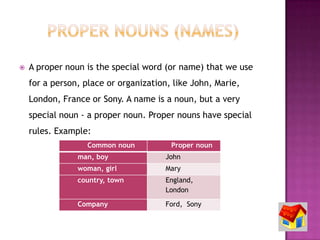
   A proper noun is the special word (or name) that we use
    for a person, place or organization, like John, Marie,
    London, France or Sony. A name is a noun, but a very
    special noun - a proper noun. Proper nouns have special
    rules. Example:
                   Common noun          Proper noun
                man, boy               John
                woman, girl            Mary
                country, town          England,
                                       London

                Company                Ford, Sony
   When we want to show that something belongs to
    somebody or something, we usually add 's to a singular
    noun and an apostrophe ' to a plural noun.


                          one ball         more than one ball

      one boy

                          the boy's ball   the boy's balls

      more than one boy

                          the boys' ball   the boys' balls
   As you know, a noun is a person, place or thing, and an
    adjective is a word that describes a noun:
         Adjective     noun
         clever        teacher            clever teacher


         small         office             small office
         black         horse              black horse


   Sometimes we use a noun to describe another noun. In
    that case, the first noun "acts as" an adjective.
          noun as adjective      noun

          history                teacher           history teacher

          ticket                 cinema            ticket cinema

          race                   horse             race horse
   A compound noun is a noun that is made with two or more
    words. A compound noun is usually [noun + noun] or
    [adjective + noun], but there are other combinations (see
    below). It is important to understand and recognize
    compound nouns. Each compound noun acts as a single unit
    and can be modified by adjectives and other nouns. There are
    three forms for compound nouns:

      1)   open or spaced - space between words (tennis shoe)

      2)   hyphenated - hyphen between words (six-pack)

      3)   closed or solid - no space or hyphen between words
           (bedroom)
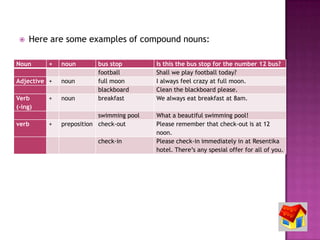
   Here are some examples of compound nouns:

Noun     +    noun       bus stop         Is this the bus stop for the number 12 bus?
                         football         Shall we play football today?
Adjective +   noun       full moon        I always feel crazy at full moon.
                         blackboard       Clean the blackboard please.
Verb     +    noun       breakfast        We always eat breakfast at 8am.
(-ing)
                          swimming pool   What a beautiful swimming pool!
verb     +    preposition check-out       Please remember that check-out is at 12
                                          noon.
                         check-in         Please check-in immediately in at Resentika
                                          hotel. There’s any spesial offer for all of you.
Thank You

Noun cluster

  • 1.
    Presented by: 1. Wahyono Hadi (105) 2. Lya Wahyuningsih (106)
  • 2.
     What are Nouns?  Countable and Uncontable Nouns  Countable Nouns  Uncountable Nouns  Proper Nouns (Names)  Possessive’s  Nouns as Adjective  Compound Nouns
  • 3.
    The simple definition is: a person, place or thing. Here are some examples:  Person: man, woman, teacher, John, Mary  Place: home, office, town, countryside, America  Thing: table, car, banana, money, music, love, dog, monkey  Another (more complicated) way of recognizing a noun is by its: 1. Noun Ending 2. Position in Sentence 3. Function
  • 4.
    Countable nouns are easy to recognize. They are things that we can count. For example: “pen”. We can count pens. We can have one, two, three or more pens. Here are some more countable nouns:  dog, cat, animal, man, person  table, chair, suitcase, bag
  • 5.
    Uncountable nouns are substances, concepts etc that we cannot divide into separate elements. We cannot "count" them. For example, we cannot count "milk". We can count "bottles of milk" or "litres of milk", but we cannot count "milk" itself. Here are some more uncountable nouns:  rice, sugar, butter, water,
  • 6.
    A proper noun is the special word (or name) that we use for a person, place or organization, like John, Marie, London, France or Sony. A name is a noun, but a very special noun - a proper noun. Proper nouns have special rules. Example: Common noun Proper noun man, boy John woman, girl Mary country, town England, London Company Ford, Sony
  • 7.
    When we want to show that something belongs to somebody or something, we usually add 's to a singular noun and an apostrophe ' to a plural noun. one ball more than one ball one boy the boy's ball the boy's balls more than one boy the boys' ball the boys' balls
  • 8.
    As you know, a noun is a person, place or thing, and an adjective is a word that describes a noun: Adjective noun clever teacher  clever teacher small office  small office black horse  black horse  Sometimes we use a noun to describe another noun. In that case, the first noun "acts as" an adjective. noun as adjective noun history teacher  history teacher ticket cinema  ticket cinema race horse  race horse
  • 9.
    A compound noun is a noun that is made with two or more words. A compound noun is usually [noun + noun] or [adjective + noun], but there are other combinations (see below). It is important to understand and recognize compound nouns. Each compound noun acts as a single unit and can be modified by adjectives and other nouns. There are three forms for compound nouns: 1) open or spaced - space between words (tennis shoe) 2) hyphenated - hyphen between words (six-pack) 3) closed or solid - no space or hyphen between words (bedroom)
  • 10.
    Here are some examples of compound nouns: Noun + noun bus stop Is this the bus stop for the number 12 bus? football Shall we play football today? Adjective + noun full moon I always feel crazy at full moon. blackboard Clean the blackboard please. Verb + noun breakfast We always eat breakfast at 8am. (-ing) swimming pool What a beautiful swimming pool! verb + preposition check-out Please remember that check-out is at 12 noon. check-in Please check-in immediately in at Resentika hotel. There’s any spesial offer for all of you.
  • 11.