Start the presentation by selecting “View show”
from the Slide Show menu. Work through
the presentation by left-clicking the mouse.
You can make notes as you go. Use the left
arrow key to return to an earlier slide.
If you prefer to print the slides, make sure you
follow these instructions:
Do not just click the print button.
1. Select print from the file menu.
2. Select handouts; six slides per page; pure black
& white.
3. Click OK.
Nouns
WHAT ARE NOUNS?
 Nouns are naming words.
 They name people, places and objects.
 They can also name ideas, emotions,
qualities and activities.
 Here are some examples of nouns:
 Peter, Elizabeth, driver, sister,
friend.
 Bristol, Severn, Brazil, pen, dog,
money.
 Love, beauty, industry, nature, greed,
pain.
Types of
noun
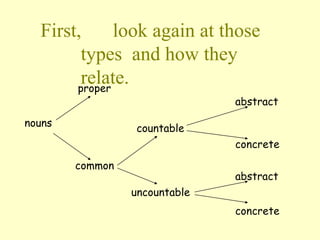
All nouns can be divided into common
and proper nouns.
Common nouns can then be divided
into countable and uncountable
nouns.
Both countable and uncountable nouns
can then be further divided into
concrete and abstract nouns.
We’ll look at each type in turn.
First, look again at those
types and how they
relate.
nouns
common
countable
proper
abstract
concrete
abstract
uncountable
concrete
Proper nouns
Proper nouns start with capital
letters.
They are the names of people, places,
times, organisations etc.
They refer to unique individuals.
Most are not found in the dictionary.
They often occur in pairs or groups.
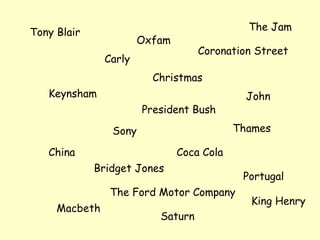
Here are some examples.
Tony Blair
Christmas
China
Thames
Keynsham
Sony
Coca Cola
Macbeth
President Bush
The Jam
Coronation Street
Saturn
Carly
John
Portugal
King Henry
Bridget Jones
The Ford Motor Company
Oxfam
Common nouns
All nouns which are not proper nouns
are common nouns.
A few examples: cup, art, paper, work,
frog, bicycle, atom, family, mind.
Common nouns are either countable or
uncountable.
Countable
nouns
 Use these tests for countable nouns:
 Countable (or just “count”) nouns can be
made plural: a tree… two trees; a man…
men; a pony… ponies.
 In the singular, they may have the
determiner a or an: a sausage; an
asterisk.
 We ask: How many words/pages/chairs?
 We say: A few minutes/friends/chips?
Uncountable nouns
 Use these tests for uncountable nouns:
 Uncountable (or non-count) nouns cannot be
made plural. We cannot say: two funs,
three advices or five furnitures.
 We never use a or an with them.
 We ask: How much money/time/milk?
(Not How many?)
 We say: A little help/effort. (Not A few.)
Dual category nouns
• Some nouns may be countable or
uncountable, depending on how we use
them.
• We buy a box of chocolates (countable) or
a bar of chocolate (uncountable).
• We ask: How much time? but How
many times? (where times =
occasions).
• We sit in front of a television (set)
to watch television (broadcasting).
Field-specific nouns
• Uncountable nouns are often turned into
countable nouns by specialists in a
particular field.They become part of the
jargon of that specialism.
• Grass is usually uncountable but botanists
and gardeners talk about grasses.
• Linguists sometimes talk about Englishes.
• Financiers refer to moneys or even
monies.
• Teas may be used to mean types of tea.
Remember that both countable and uncountable
nouns can be divided into concrete and
abstract nouns.
The distinction between concrete and abstract
nouns is the most important one of all when you are
analysing linguistic data. A lot of abstract nouns in
a text will have a big impact on its register.
The Plain English Campaign has an excellent website
which will tell you more about the stylistic impact
of abstract nouns.
Concrete nouns
• Concrete nouns are the words that most
people think of as nouns.
• They are mostly the names of objects and
animals (countable) and substances or
materials (uncountable).
• Cake, oxygen, iron, boy, dog, pen, glass,
pomegranate, earthworm and door are
all concrete nouns.
Abstract nouns
• Abstract nouns name ideas, feelings
and qualities.
• Most, though not all, are
uncountable.
• Many are derived from adjectives and
verbs and have characteristic
endings such as –ity, -ness, -ence,
and -tion.
• They are harder to recognise as
nouns than the concrete
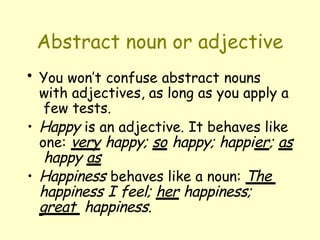
Abstract noun or adjective
• You won’t confuse abstract nouns
with adjectives, as long as you apply a
few tests.
• Happy is an adjective. It behaves like
one: very happy; so happy; happier; as
happy as
• Happiness behaves like a noun: The
happiness I feel; her happiness;
great happiness.
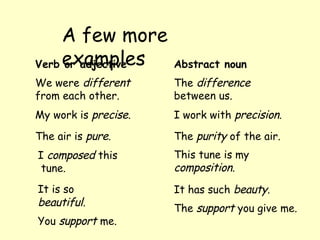
A few more
examples
Verb or adjective
We were different
from each other.
My work is precise.
The air is pure.
I composed this
tune.
It is so
beautiful.
You support me.
Abstract noun
The difference
between us.
I work with precision.
The purity of the air.
This tune is my
composition.
It has such beauty.
The support you give me.
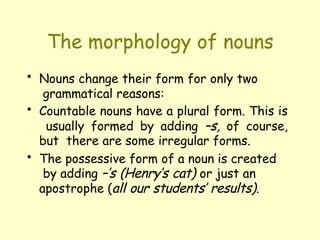
The morphology of nouns
• Nouns change their form for only two
grammatical reasons:
• Countable nouns have a plural form. This is
usually formed by adding –s, of course,
but there are some irregular forms.
• The possessive form of a noun is created
by adding –’s (Henry’s cat) or just an
apostrophe (all our students’ results).
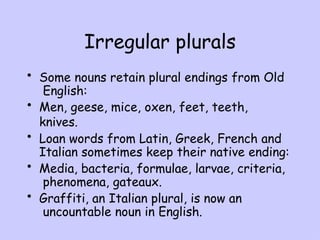
Irregular plurals
• Some nouns retain plural endings from Old
English:
• Men, geese, mice, oxen, feet, teeth,
knives.
• Loan words from Latin, Greek, French and
Italian sometimes keep their native ending:
• Media, bacteria, formulae, larvae, criteria,
phenomena, gateaux.
• Graffiti, an Italian plural, is now an
uncountable noun in English.
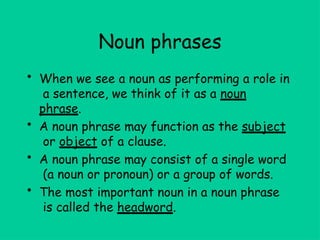
Noun phrases
• When we see a noun as performing a role in
a sentence, we think of it as a noun
phrase.
• A noun phrase may function as the subject
or object of a clause.
• A noun phrase may consist of a single word
(a noun or pronoun) or a group of words.
• The most important noun in a noun phrase
is called the headword.
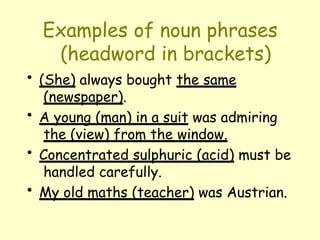
Examples of noun phrases
(headword in brackets)
• (She) always bought the same
(newspaper).
• A young (man) in a suit was admiring
the (view) from the window.
• Concentrated sulphuric (acid) must be
handled carefully.
• My old maths (teacher) was Austrian.
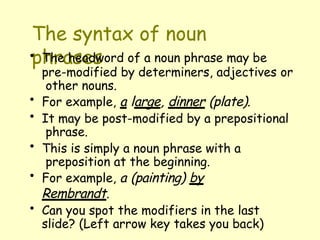
The syntax of noun
phrases
• The headword of a noun phrase may be
pre-modified by determiners, adjectives or
other nouns.
• For example, a large, dinner (plate).
• It may be post-modified by a prepositional
phrase.
• This is simply a noun phrase with a
preposition at the beginning.
• For example, a (painting) by
Rembrandt.
• Can you spot the modifiers in the last
slide? (Left arrow key takes you back)
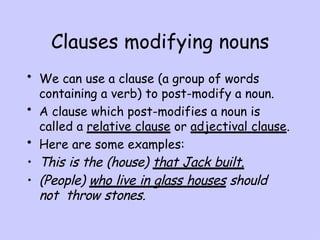
Clauses modifying nouns
• We can use a clause (a group of words
containing a verb) to post-modify a noun.
• A clause which post-modifies a noun is
called a relative clause or adjectival clause.
• Here are some examples:
• This is the (house) that Jack built.
• (People) who live in glass houses should
not throw stones.
That’s the end of the presentation on
nouns.
If you want to print, remember the
instructions:
1. Select “print” from the file
menu.
2. Select: hand-outs; six slides
per page; pure black and white.
3. Click “OK”.
This powerpoint was kindly donated
to
www.worldofteaching.com
http://www.worldofteaching.com is home to over a
thousand powerpoints submitted by teachers. This
is a completely free site and requires no
registration. Please visit and I hope it will help in
your teaching.

nouns explanation for children school projects

  • 1.
    Start the presentationby selecting “View show” from the Slide Show menu. Work through the presentation by left-clicking the mouse. You can make notes as you go. Use the left arrow key to return to an earlier slide. If you prefer to print the slides, make sure you follow these instructions: Do not just click the print button. 1. Select print from the file menu. 2. Select handouts; six slides per page; pure black & white. 3. Click OK. Nouns
  • 2.
    WHAT ARE NOUNS? Nouns are naming words.  They name people, places and objects.  They can also name ideas, emotions, qualities and activities.  Here are some examples of nouns:  Peter, Elizabeth, driver, sister, friend.  Bristol, Severn, Brazil, pen, dog, money.  Love, beauty, industry, nature, greed, pain.
  • 3.
    Types of noun All nounscan be divided into common and proper nouns. Common nouns can then be divided into countable and uncountable nouns. Both countable and uncountable nouns can then be further divided into concrete and abstract nouns. We’ll look at each type in turn.
  • 4.
    First, look againat those types and how they relate. nouns common countable proper abstract concrete abstract uncountable concrete
  • 5.
    Proper nouns Proper nounsstart with capital letters. They are the names of people, places, times, organisations etc. They refer to unique individuals. Most are not found in the dictionary. They often occur in pairs or groups. Here are some examples.
  • 6.
    Tony Blair Christmas China Thames Keynsham Sony Coca Cola Macbeth PresidentBush The Jam Coronation Street Saturn Carly John Portugal King Henry Bridget Jones The Ford Motor Company Oxfam
  • 7.
    Common nouns All nounswhich are not proper nouns are common nouns. A few examples: cup, art, paper, work, frog, bicycle, atom, family, mind. Common nouns are either countable or uncountable.
  • 8.
    Countable nouns  Use thesetests for countable nouns:  Countable (or just “count”) nouns can be made plural: a tree… two trees; a man… men; a pony… ponies.  In the singular, they may have the determiner a or an: a sausage; an asterisk.  We ask: How many words/pages/chairs?  We say: A few minutes/friends/chips?
  • 9.
    Uncountable nouns  Usethese tests for uncountable nouns:  Uncountable (or non-count) nouns cannot be made plural. We cannot say: two funs, three advices or five furnitures.  We never use a or an with them.  We ask: How much money/time/milk? (Not How many?)  We say: A little help/effort. (Not A few.)
  • 10.
    Dual category nouns •Some nouns may be countable or uncountable, depending on how we use them. • We buy a box of chocolates (countable) or a bar of chocolate (uncountable). • We ask: How much time? but How many times? (where times = occasions). • We sit in front of a television (set) to watch television (broadcasting).
  • 11.
    Field-specific nouns • Uncountablenouns are often turned into countable nouns by specialists in a particular field.They become part of the jargon of that specialism. • Grass is usually uncountable but botanists and gardeners talk about grasses. • Linguists sometimes talk about Englishes. • Financiers refer to moneys or even monies. • Teas may be used to mean types of tea.
  • 12.
    Remember that bothcountable and uncountable nouns can be divided into concrete and abstract nouns. The distinction between concrete and abstract nouns is the most important one of all when you are analysing linguistic data. A lot of abstract nouns in a text will have a big impact on its register. The Plain English Campaign has an excellent website which will tell you more about the stylistic impact of abstract nouns.
  • 13.
    Concrete nouns • Concretenouns are the words that most people think of as nouns. • They are mostly the names of objects and animals (countable) and substances or materials (uncountable). • Cake, oxygen, iron, boy, dog, pen, glass, pomegranate, earthworm and door are all concrete nouns.
  • 14.
    Abstract nouns • Abstractnouns name ideas, feelings and qualities. • Most, though not all, are uncountable. • Many are derived from adjectives and verbs and have characteristic endings such as –ity, -ness, -ence, and -tion. • They are harder to recognise as nouns than the concrete
  • 15.
    Abstract noun oradjective • You won’t confuse abstract nouns with adjectives, as long as you apply a few tests. • Happy is an adjective. It behaves like one: very happy; so happy; happier; as happy as • Happiness behaves like a noun: The happiness I feel; her happiness; great happiness.
  • 16.
    A few more examples Verbor adjective We were different from each other. My work is precise. The air is pure. I composed this tune. It is so beautiful. You support me. Abstract noun The difference between us. I work with precision. The purity of the air. This tune is my composition. It has such beauty. The support you give me.
  • 17.
    The morphology ofnouns • Nouns change their form for only two grammatical reasons: • Countable nouns have a plural form. This is usually formed by adding –s, of course, but there are some irregular forms. • The possessive form of a noun is created by adding –’s (Henry’s cat) or just an apostrophe (all our students’ results).
  • 18.
    Irregular plurals • Somenouns retain plural endings from Old English: • Men, geese, mice, oxen, feet, teeth, knives. • Loan words from Latin, Greek, French and Italian sometimes keep their native ending: • Media, bacteria, formulae, larvae, criteria, phenomena, gateaux. • Graffiti, an Italian plural, is now an uncountable noun in English.
  • 19.
    Noun phrases • Whenwe see a noun as performing a role in a sentence, we think of it as a noun phrase. • A noun phrase may function as the subject or object of a clause. • A noun phrase may consist of a single word (a noun or pronoun) or a group of words. • The most important noun in a noun phrase is called the headword.
  • 20.
    Examples of nounphrases (headword in brackets) • (She) always bought the same (newspaper). • A young (man) in a suit was admiring the (view) from the window. • Concentrated sulphuric (acid) must be handled carefully. • My old maths (teacher) was Austrian.
  • 21.
    The syntax ofnoun phrases • The headword of a noun phrase may be pre-modified by determiners, adjectives or other nouns. • For example, a large, dinner (plate). • It may be post-modified by a prepositional phrase. • This is simply a noun phrase with a preposition at the beginning. • For example, a (painting) by Rembrandt. • Can you spot the modifiers in the last slide? (Left arrow key takes you back)
  • 22.
    Clauses modifying nouns •We can use a clause (a group of words containing a verb) to post-modify a noun. • A clause which post-modifies a noun is called a relative clause or adjectival clause. • Here are some examples: • This is the (house) that Jack built. • (People) who live in glass houses should not throw stones.
  • 23.
    That’s the endof the presentation on nouns. If you want to print, remember the instructions: 1. Select “print” from the file menu. 2. Select: hand-outs; six slides per page; pure black and white. 3. Click “OK”.
  • 24.
    This powerpoint waskindly donated to www.worldofteaching.com http://www.worldofteaching.com is home to over a thousand powerpoints submitted by teachers. This is a completely free site and requires no registration. Please visit and I hope it will help in your teaching.