Is a word that 
modifies(describe) 
a noun or pronoun. 
brown 
loud
Pedro is a handsome boy. 
She is beautiful.
1. Which one? (yellow, the, that) 
2. What kind? (furry, plastic, special) 
3. How many? (sixteen, several, 
many) 
4. Whose? (Caroline's, his, its, 
John's)
It describes the 
qualities or 
characteristics of noun 
or pronoun.
A blue sky. 
A big house. 
A square table.
 Limits or points out a noun. 
 There are five kinds of 
them. 
Articles 
Demonstrative 
Possessive 
Indefinite 
Numerical adjectives
A 
An 
The 
“The”= definite article 
- it points out specific person, 
place, or thing. 
-can be used before both 
singular and plural nouns. 
Ex. The cat. 
The houses.
 A & an = Indefinite articles. 
-they do not points out as specific 
people, places, or things. 
-can only be used before singular 
nouns. 
EX. 
a book 
an elephant 
“A game” consonant 
sound. 
“An ant” vowel sound.
Modify a noun or a pronoun. 
Show ownerships of a noun. 
Answer the question whose? 
 Possessive pronouns such as my, 
her, his, your, its, our function 
as adjectives.
Examples: 
That is my folder. 
Those are their 
bicycles.
 Demonstrate or point out a noun . 
 They are the same words as the 
demonstrative pronouns. 
 there are four demonstratives: 
This 
That 
These 
Those 
Use this or that with singular nouns. 
Use these and those with plural nouns.
 The sweaters are in that drawer. 
 This boy is a member of the club. 
These filthy clothes need to be washed. 
Did you iron these shirts? 
Those boxes are full of junk. 
I always enjoy reading those books.
Tells us about the quantity of the 
noun. 
They often tell “how many” or “how 
much” of something. 
There are seventeen of them: 
All, any, another, both, each, either, 
few, little, many, more, most, much, 
neither, one, other, several, some.
 “Many of my friends have 
pets. 
The zoo has many animals. 
The pen has not much ink left.
They are words used to ask questions 
that indicate the noun that is being 
talked about. 
Three of them were also interrogative 
pronouns. 
Which 
What 
whose 
Example: 
Which bike is yours? 
“Which” describes the word
 Proper adjectives start with capital 
letters just like proper nouns. In fact, 
proper adjectives are made from 
proper nouns. 
 They normally answer the adjective question, What 
kind?
Proper noun 
America 
France 
China 
Japan 
Philippines 
Proper adjectives 
American 
French 
Chinese 
Japanese 
Filipino
 I am a Filipino citizen. 
 The German soldiers are brave. 
 Most people like to wear American 
shoes.
 Sometimes adjective complete certain verb and 
some after the nouns w/c they modify. 
Examples: 
The man is happy. 
The girl looks beautiful. 
 Some of the verbs that are often followed by 
adjectives are: is, am, are, was, were, fell, 
become, look, seem, grow.
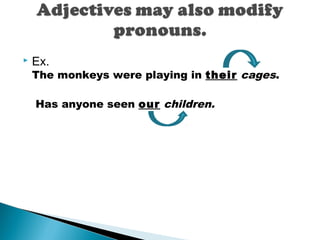
 Ex. 
The monkeys were playing in their cages. 
Has anyone seen our children.
 The same word may be used as a noun 
or as an adjective according to its use in 
the sentence. 
Examples: 
1.Leonia is a good girl. (adj.) 
The good is always rewarded. (noun) 
2. He is a wise man. (adj.) 
A word to the wise is enough. (noun)
 Before the noun it modifies ( usually a single word 
modifies) 
Example: 
Blue arm chair 
Ten dozen 
 After the noun it modifies ( usually a phrase or 
subordinate clause) 
Example: 
The girl in blue. 
The girl who is in the blue is the miss 
universe.
 After a linking verb in a S-LV-C pattern. 
Example: 
The boys are noisy. Adjectives 
S LV C 
 After a direct object in an S-TV-DO-OC 
pattern. 
 Example: 
The followers called their leader a hero. 
s TV DO OC ADJECTIVES
 Is the method by which an adjective may be made 
to express a greater or a lesser degree of the 
same quality.
1. Positive degree- stating the quality of one 
person, place, animal, or thing. 
2. Comparative degree- comparing two persons, 
places, animals, or things. 
3. Superlative degree- comparing three or more 
persons, places, animals, or things.
a. Adjectives having one or two syllables from their 
comparative degrees by adding er to the 
positive degree and to form their superlative 
degrees by adding est to the positive degree. 
Example: 
Tall- taller- tallest 
Narrow- narrower- narrowest
b. Adjectives having three or more syllables from their 
comparative degree by prefixing more to show a 
greater degree of quality and less to show a lesser 
degree of quality . To form the superlative degree prefix 
most to show the greatest of quality and least to show 
the lowest degree of quality. 
Ex. 
Beautiful- more beautiful- most beautiful 
or less beautiful- least beautiful.
c. Some adjectives from their comparatives and 
superlatives degree by changing the spelling. 
Example: 
Good- better- best 
Bad- worse- worst
d. Some adjectives ending in y form their 
comparative degrees by changing y to I and 
adding er; and to form their superlatives degrees 
by changing y to I and adding est. 
Example: 
Happy- happier- happiest 
Easy- easier- easiest
Positive Comparative Superlative 
ambitious more ambitious most ambitious 
cold colder coldest 
comfortable more 
 Positive 
 Comparative 
 Superlative 
 ambitious 
 more ambitious 
 most ambitious 
 cold 
 colder 
 coldest 
 comfortable 
 more comfortable 
 most comfortable 
comfortable 
most 
comfortable 
dry drier driest 
enchanting more 
enchanting most enchanting 
funny funnier funniest
Positive Comparative Superlative 
hot hotter hottest 
organized more organized most organized 
pretty prettier prettiest 
radiant more radiant most radiant 
sharp sharper sharpest
“OPSHACOM” 
1.Opinion: 
lazy, good, bad, nice, fine, simple, 
modern, ordinary, extraordinary, etc. 
2.Shape: 
round, square, rectangular, circle, 
triangle, 
3. Age: 
new, novel, old, latest, aged, fresh, 
stale, musty, decayed, recent etc. 
4.Colour: 
White, black, Red, Blue, Brown, 
Violet, Pink, Orange, Yellow.
5. Origin: Indian. American, 
Gujarati, Australian, British, 
English, Spanish, etc. 
6. Material: wooden, iron., metal, 
silver, golden, plastic, paper, 
liquid, rubber 
Examples: 
I have a nice square old brown 
Indian wooden table. 
She has a black and white T.V. 
( adjectives of same type are 
joined by ‘and’)

Name the adjectives

  • 2.
    Is a wordthat modifies(describe) a noun or pronoun. brown loud
  • 3.
    Pedro is ahandsome boy. She is beautiful.
  • 4.
    1. Which one?(yellow, the, that) 2. What kind? (furry, plastic, special) 3. How many? (sixteen, several, many) 4. Whose? (Caroline's, his, its, John's)
  • 6.
    It describes the qualities or characteristics of noun or pronoun.
  • 7.
    A blue sky. A big house. A square table.
  • 8.
     Limits orpoints out a noun.  There are five kinds of them. Articles Demonstrative Possessive Indefinite Numerical adjectives
  • 9.
    A An The “The”= definite article - it points out specific person, place, or thing. -can be used before both singular and plural nouns. Ex. The cat. The houses.
  • 10.
     A &an = Indefinite articles. -they do not points out as specific people, places, or things. -can only be used before singular nouns. EX. a book an elephant “A game” consonant sound. “An ant” vowel sound.
  • 11.
    Modify a nounor a pronoun. Show ownerships of a noun. Answer the question whose?  Possessive pronouns such as my, her, his, your, its, our function as adjectives.
  • 12.
    Examples: That ismy folder. Those are their bicycles.
  • 13.
     Demonstrate orpoint out a noun .  They are the same words as the demonstrative pronouns.  there are four demonstratives: This That These Those Use this or that with singular nouns. Use these and those with plural nouns.
  • 14.
     The sweatersare in that drawer.  This boy is a member of the club. These filthy clothes need to be washed. Did you iron these shirts? Those boxes are full of junk. I always enjoy reading those books.
  • 15.
    Tells us aboutthe quantity of the noun. They often tell “how many” or “how much” of something. There are seventeen of them: All, any, another, both, each, either, few, little, many, more, most, much, neither, one, other, several, some.
  • 16.
     “Many ofmy friends have pets. The zoo has many animals. The pen has not much ink left.
  • 17.
    They are wordsused to ask questions that indicate the noun that is being talked about. Three of them were also interrogative pronouns. Which What whose Example: Which bike is yours? “Which” describes the word
  • 18.
     Proper adjectivesstart with capital letters just like proper nouns. In fact, proper adjectives are made from proper nouns.  They normally answer the adjective question, What kind?
  • 19.
    Proper noun America France China Japan Philippines Proper adjectives American French Chinese Japanese Filipino
  • 20.
     I ama Filipino citizen.  The German soldiers are brave.  Most people like to wear American shoes.
  • 21.
     Sometimes adjectivecomplete certain verb and some after the nouns w/c they modify. Examples: The man is happy. The girl looks beautiful.  Some of the verbs that are often followed by adjectives are: is, am, are, was, were, fell, become, look, seem, grow.
  • 22.
     Ex. Themonkeys were playing in their cages. Has anyone seen our children.
  • 23.
     The sameword may be used as a noun or as an adjective according to its use in the sentence. Examples: 1.Leonia is a good girl. (adj.) The good is always rewarded. (noun) 2. He is a wise man. (adj.) A word to the wise is enough. (noun)
  • 24.
     Before thenoun it modifies ( usually a single word modifies) Example: Blue arm chair Ten dozen  After the noun it modifies ( usually a phrase or subordinate clause) Example: The girl in blue. The girl who is in the blue is the miss universe.
  • 25.
     After alinking verb in a S-LV-C pattern. Example: The boys are noisy. Adjectives S LV C  After a direct object in an S-TV-DO-OC pattern.  Example: The followers called their leader a hero. s TV DO OC ADJECTIVES
  • 27.
     Is themethod by which an adjective may be made to express a greater or a lesser degree of the same quality.
  • 28.
    1. Positive degree-stating the quality of one person, place, animal, or thing. 2. Comparative degree- comparing two persons, places, animals, or things. 3. Superlative degree- comparing three or more persons, places, animals, or things.
  • 29.
    a. Adjectives havingone or two syllables from their comparative degrees by adding er to the positive degree and to form their superlative degrees by adding est to the positive degree. Example: Tall- taller- tallest Narrow- narrower- narrowest
  • 30.
    b. Adjectives havingthree or more syllables from their comparative degree by prefixing more to show a greater degree of quality and less to show a lesser degree of quality . To form the superlative degree prefix most to show the greatest of quality and least to show the lowest degree of quality. Ex. Beautiful- more beautiful- most beautiful or less beautiful- least beautiful.
  • 31.
    c. Some adjectivesfrom their comparatives and superlatives degree by changing the spelling. Example: Good- better- best Bad- worse- worst
  • 32.
    d. Some adjectivesending in y form their comparative degrees by changing y to I and adding er; and to form their superlatives degrees by changing y to I and adding est. Example: Happy- happier- happiest Easy- easier- easiest
  • 33.
    Positive Comparative Superlative ambitious more ambitious most ambitious cold colder coldest comfortable more  Positive  Comparative  Superlative  ambitious  more ambitious  most ambitious  cold  colder  coldest  comfortable  more comfortable  most comfortable comfortable most comfortable dry drier driest enchanting more enchanting most enchanting funny funnier funniest
  • 34.
    Positive Comparative Superlative hot hotter hottest organized more organized most organized pretty prettier prettiest radiant more radiant most radiant sharp sharper sharpest
  • 36.
    “OPSHACOM” 1.Opinion: lazy,good, bad, nice, fine, simple, modern, ordinary, extraordinary, etc. 2.Shape: round, square, rectangular, circle, triangle, 3. Age: new, novel, old, latest, aged, fresh, stale, musty, decayed, recent etc. 4.Colour: White, black, Red, Blue, Brown, Violet, Pink, Orange, Yellow.
  • 37.
    5. Origin: Indian.American, Gujarati, Australian, British, English, Spanish, etc. 6. Material: wooden, iron., metal, silver, golden, plastic, paper, liquid, rubber Examples: I have a nice square old brown Indian wooden table. She has a black and white T.V. ( adjectives of same type are joined by ‘and’)