What is Perfect Aspect?
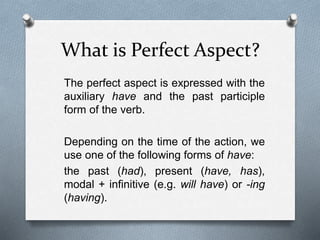
The perfect aspect is expressed with the
auxiliary have and the past participle
form of the verb.
Depending on the time of the action, we
use one of the following forms of have:
the past (had), present (have, has),
modal + infinitive (e.g. will have) or -ing
(having).
PRESENT PERFECT
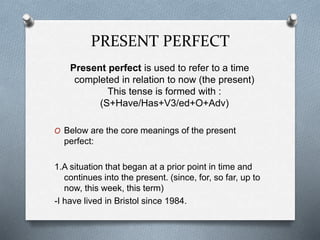
Present perfect is used to refer to a time
completed in relation to now (the present)
This tense is formed with :
(S+Have/Has+V3/ed+O+Adv)
O Below are the core meanings of the present
perfect:
1.A situation that began at a prior point in time and
continues into the present. (since, for, so far, up to
now, this week, this term)
-I have lived in Bristol since 1984.
2. An action occurring or not occurring at an
unspecific prior time that has current
relevance.
- They have moved into a new apartment.
3. A very recently completed action. (just,
recently, lately)
- Your driver has just arrived.
PAST PERFECT
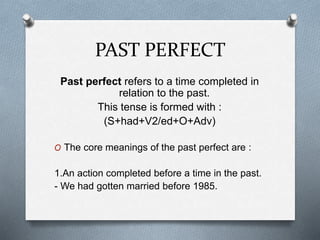
Past perfect refers to a time completed in
relation to the past.
This tense is formed with :
(S+had+V2/ed+O+Adv)
O The core meanings of the past perfect are :
1.An action completed before a time in the past.
- We had gotten married before 1985.
2. An action completed in the past prior to some
other past event.
- You had used that pen before it was lost.
3. Imaginative conditional in the subordinate
clause (referring to past time).
- If I had known you were in Banyuwangi, I
would have called you.
FUTURE PERFECT
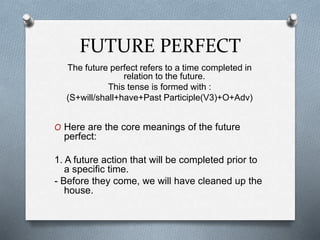
The future perfect refers to a time completed in
relation to the future.
This tense is formed with :
(S+will/shall+have+Past Participle(V3)+O+Adv)
O Here are the core meanings of the future
perfect:
1. A future action that will be completed prior to
a specific time.
- Before they come, we will have cleaned up the
house.
2. A state or accomplishment that will be
completed in the future prior to some other
time or event.
- By the time he graduates, he will have
completed five years of study
COMPARE AND CONTRAST
D. Simple Past VS Present Perfect
The past simple is used to talk about actions in the past that have
finished. It talks about 'then' and definitely excludes 'now'. The present
perfect simple to look back on actions in the past from the present. It
always includes 'now'.
1. Completed versus an incomplete action/ state.
- He played football. (Simple Past)
- He has played football.(Present Perfect)
2. A definite versus indefinite time.
-Did you cry? (She said that she has just broke up)
- Have you every cried?
3. No present relevance versus present relevance.
- Silvie ignored Agus a year ago.
- Silvie has ignored Agus to prevent a poverty.
E. Simple Past VS Past Perfect
These two tenses are both used to talk about
things that happened in the past. However we
use past perfect to talk about something that
happened before another action in the past,
which is usually expressed by the past simple.
- I ate my dinner.
- I had already eaten my dinner when he called.
(Past Perfect : In other words, First I ate my
dinner, then he called.)
F. Simple future VS Future Perfect
Simple future suggests that the event/activity
begins with the time mentioned. Future perfect marks an
event/activity that is complete prior to some other time or
other future event.
- I will do my homework by 6 a.m. (Simple Future)
- I will have done my homework by 6 a.m. (Future
Perfect)
CONCLUSION
From the discussions above, we can see
that the perfect aspect focuses on the
completion of an event. It expresses that the
action had, has or will have been completed
by a specific point in time (Perfect Tense).
REFERENCES
O www.ego4u.com/en/cram-
up/grammar/simpas-preper
O www.englishpage.com/verbpage/verbs25.htm
O www.edufind.com/english-grammar/past-
perfect-tense/
O www.edufind.com/english-grammar/present-
perfect/
O grammar.ccc.commnet.edu/grammar/tenses/f
uture_perfect.htm

Perfect Aspect

  • 1.
    What is PerfectAspect? The perfect aspect is expressed with the auxiliary have and the past participle form of the verb. Depending on the time of the action, we use one of the following forms of have: the past (had), present (have, has), modal + infinitive (e.g. will have) or -ing (having).
  • 2.
    PRESENT PERFECT Present perfectis used to refer to a time completed in relation to now (the present) This tense is formed with : (S+Have/Has+V3/ed+O+Adv) O Below are the core meanings of the present perfect: 1.A situation that began at a prior point in time and continues into the present. (since, for, so far, up to now, this week, this term) -I have lived in Bristol since 1984.
  • 3.
    2. An actionoccurring or not occurring at an unspecific prior time that has current relevance. - They have moved into a new apartment. 3. A very recently completed action. (just, recently, lately) - Your driver has just arrived.
  • 4.
    PAST PERFECT Past perfectrefers to a time completed in relation to the past. This tense is formed with : (S+had+V2/ed+O+Adv) O The core meanings of the past perfect are : 1.An action completed before a time in the past. - We had gotten married before 1985.
  • 5.
    2. An actioncompleted in the past prior to some other past event. - You had used that pen before it was lost. 3. Imaginative conditional in the subordinate clause (referring to past time). - If I had known you were in Banyuwangi, I would have called you.
  • 6.
    FUTURE PERFECT The futureperfect refers to a time completed in relation to the future. This tense is formed with : (S+will/shall+have+Past Participle(V3)+O+Adv) O Here are the core meanings of the future perfect: 1. A future action that will be completed prior to a specific time. - Before they come, we will have cleaned up the house.
  • 7.
    2. A stateor accomplishment that will be completed in the future prior to some other time or event. - By the time he graduates, he will have completed five years of study
  • 8.
    COMPARE AND CONTRAST D.Simple Past VS Present Perfect The past simple is used to talk about actions in the past that have finished. It talks about 'then' and definitely excludes 'now'. The present perfect simple to look back on actions in the past from the present. It always includes 'now'. 1. Completed versus an incomplete action/ state. - He played football. (Simple Past) - He has played football.(Present Perfect) 2. A definite versus indefinite time. -Did you cry? (She said that she has just broke up) - Have you every cried? 3. No present relevance versus present relevance. - Silvie ignored Agus a year ago. - Silvie has ignored Agus to prevent a poverty.
  • 9.
    E. Simple PastVS Past Perfect These two tenses are both used to talk about things that happened in the past. However we use past perfect to talk about something that happened before another action in the past, which is usually expressed by the past simple. - I ate my dinner. - I had already eaten my dinner when he called. (Past Perfect : In other words, First I ate my dinner, then he called.)
  • 10.
    F. Simple futureVS Future Perfect Simple future suggests that the event/activity begins with the time mentioned. Future perfect marks an event/activity that is complete prior to some other time or other future event. - I will do my homework by 6 a.m. (Simple Future) - I will have done my homework by 6 a.m. (Future Perfect)
  • 11.
    CONCLUSION From the discussionsabove, we can see that the perfect aspect focuses on the completion of an event. It expresses that the action had, has or will have been completed by a specific point in time (Perfect Tense).
  • 12.
    REFERENCES O www.ego4u.com/en/cram- up/grammar/simpas-preper O www.englishpage.com/verbpage/verbs25.htm Owww.edufind.com/english-grammar/past- perfect-tense/ O www.edufind.com/english-grammar/present- perfect/ O grammar.ccc.commnet.edu/grammar/tenses/f uture_perfect.htm