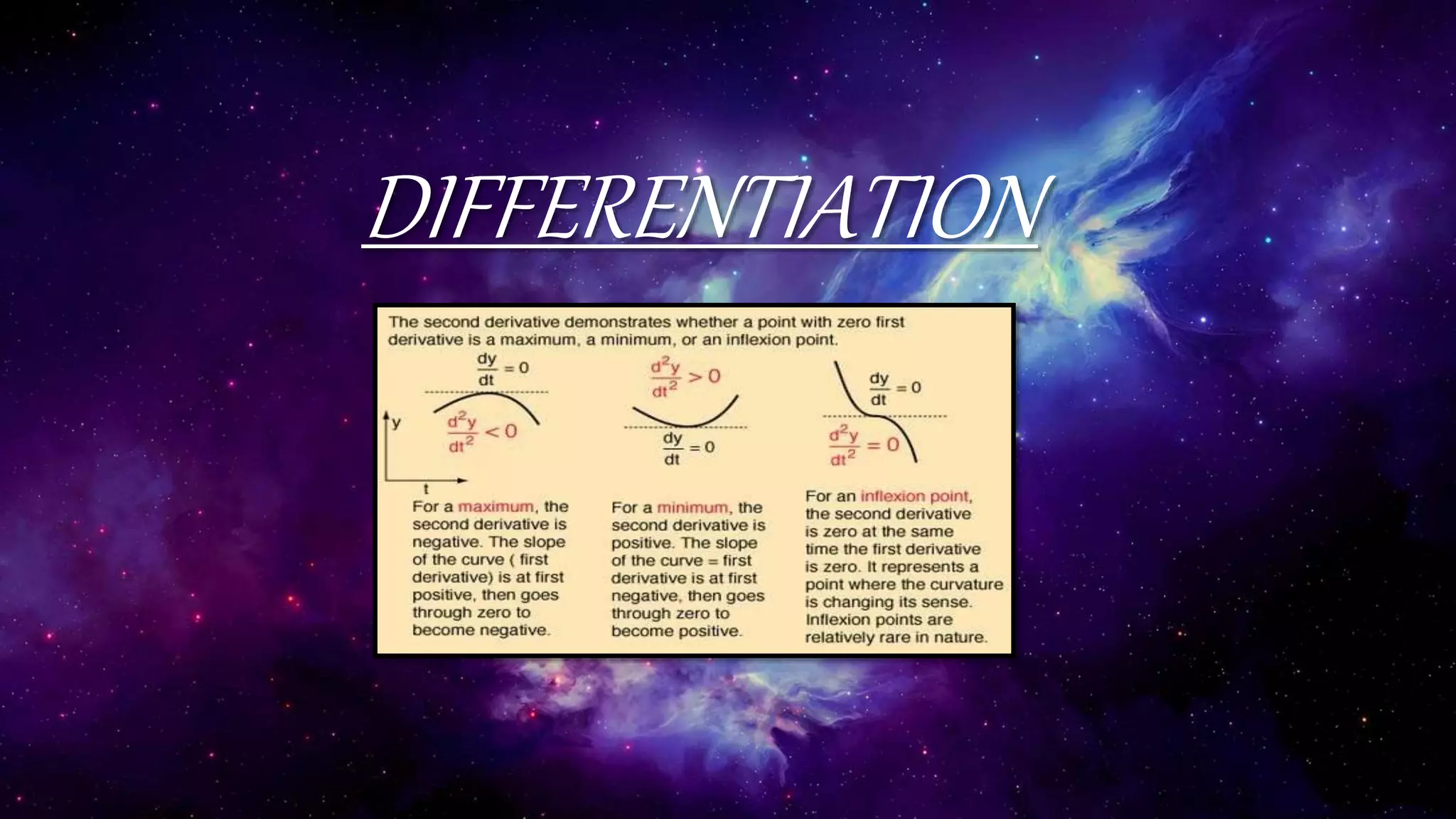
DIFFERENTIATION
 Roll22- Rishav Ghosh
 Roll 23- Rithika Shaw
 Roll24- Sagnik Basu
 Roll 25 – Sagnik Saha
 Roll26- Sayan Mandal
 Roll27- Sayan Roy
 Roll28- Sneha Bandyopadhyay
Our group members are:--
CONTENTS
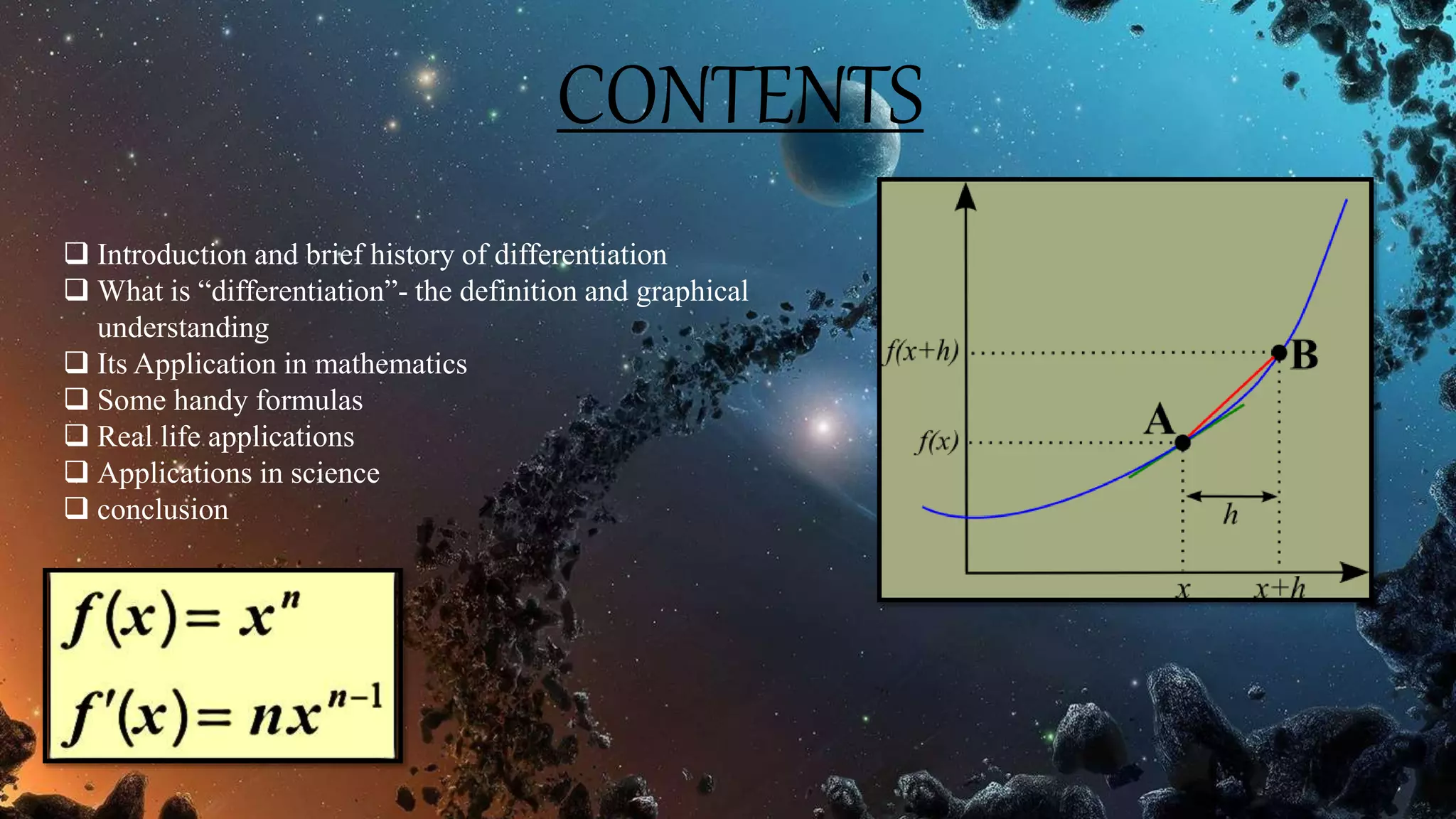
 Introduction and brief history of differentiation
 What is “differentiation”- the definition and graphical
understanding
 Its Application in mathematics
 Some handy formulas
 Real life applications
 Applications in science
 conclusion
AN INTRODUCTIONTO DERIVATIVE& DIFFERENTIATION
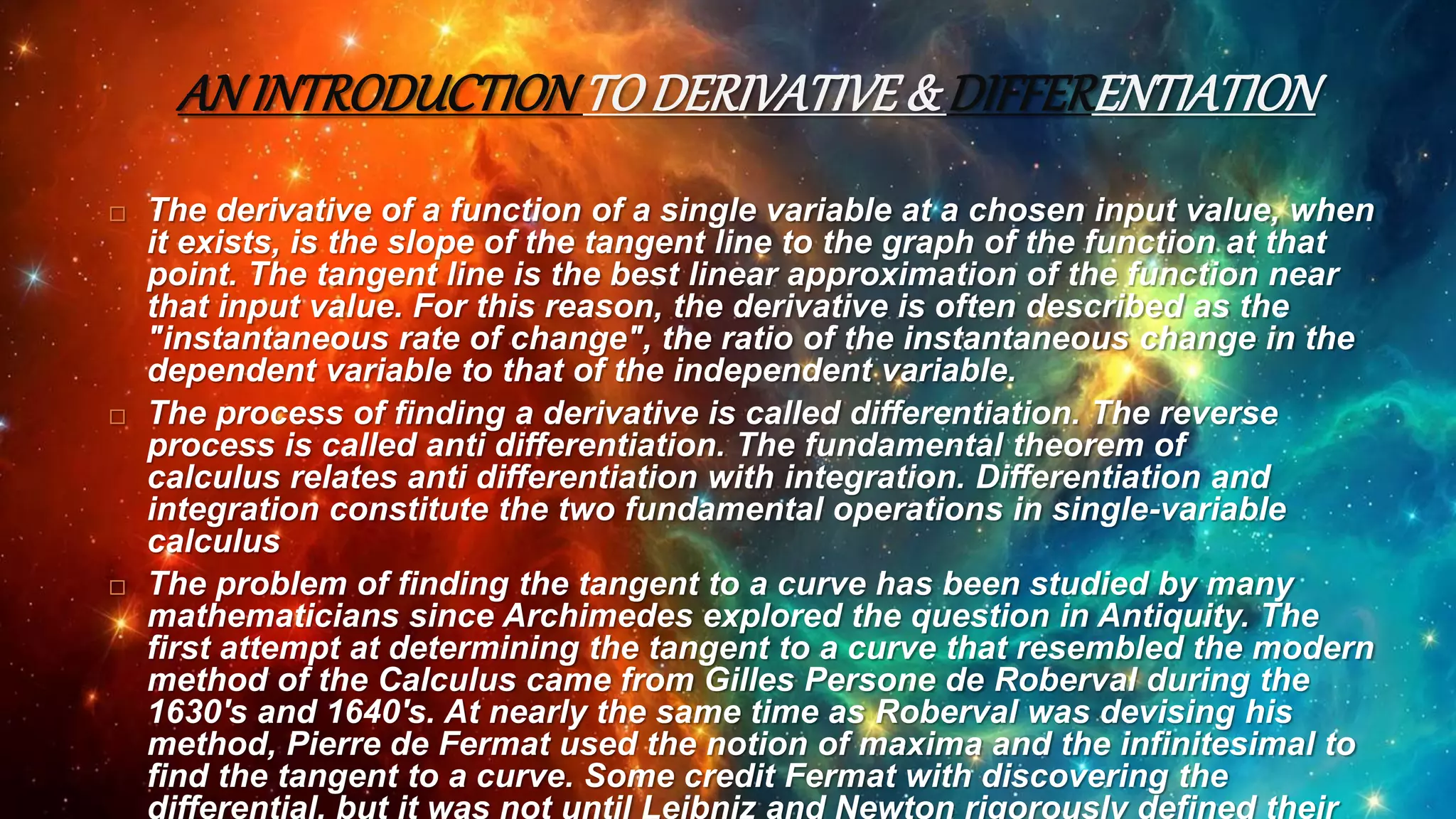
 The derivative of a function of a single variable at a chosen input value, when
it exists, is the slope of the tangent line to the graph of the function at that
point. The tangent line is the best linear approximation of the function near
that input value. For this reason, the derivative is often described as the
"instantaneous rate of change", the ratio of the instantaneous change in the
dependent variable to that of the independent variable.
 The process of finding a derivative is called differentiation. The reverse
process is called anti differentiation. The fundamental theorem of
calculus relates anti differentiation with integration. Differentiation and
integration constitute the two fundamental operations in single-variable
calculus
 The problem of finding the tangent to a curve has been studied by many
mathematicians since Archimedes explored the question in Antiquity. The
first attempt at determining the tangent to a curve that resembled the modern
method of the Calculus came from Gilles Persone de Roberval during the
1630's and 1640's. At nearly the same time as Roberval was devising his
method, Pierre de Fermat used the notion of maxima and the infinitesimal to
find the tangent to a curve. Some credit Fermat with discovering the
differential, but it was not until Leibniz and Newton rigorously defined their
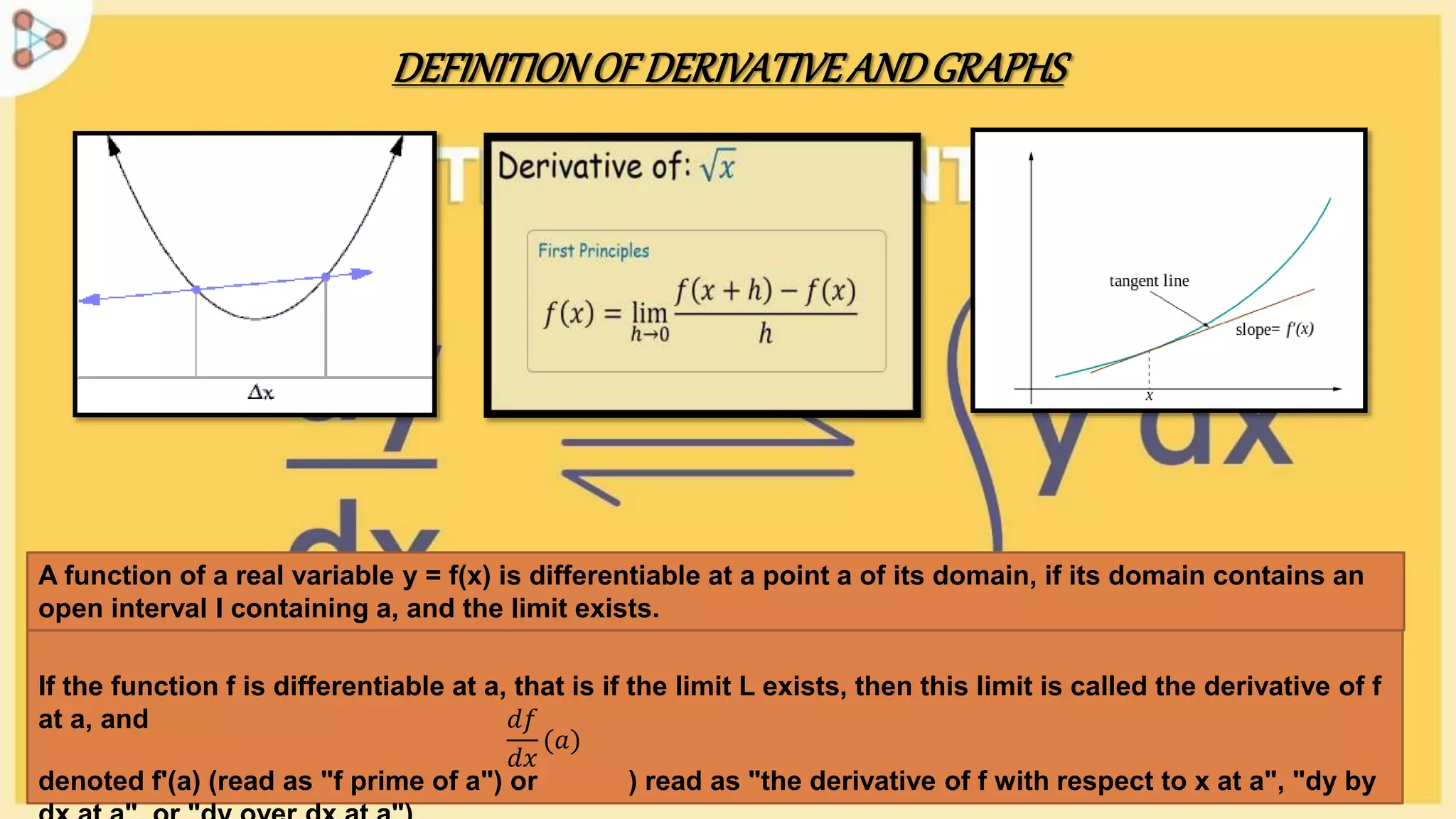
A function of a real variable y = f(x) is differentiable at a point a of its domain, if its domain contains an
open interval I containing a, and the limit exists.
If the function f is differentiable at a, that is if the limit L exists, then this limit is called the derivative of f
at a, and
denoted f'(a) (read as "f prime of a") or ) read as "the derivative of f with respect to x at a", "dy by
𝑑𝑓
𝑑𝑥
(𝑎)
DEFINITIONOFDERIVATIVEANDGRAPHS
Application of Differentiation in Mathematics
Differentiation in mathematics is basically process of finding derivative. In contrast to
the abstract nature of the theory behind it, the practical technique of differentiation
can be carried out by purely algebraic manipulations, using three basic rules of
derivatives and some rules of operations. The three basic derivatives are:-
i. algebraic functions
ii. trigonometric functions
iii. exponential functions.
For functions built up of combinations of these classes of functions, the theory
provides the following basic rules for differentiating the sum, product, or quotient of
any two functions f(x) and g(x) the derivatives of which are known (where a and b are
constants) and the other basic rule, called the chain rule, provides a way
to differentiate a composite function.
 Other uses of Differentiation in Mathematics are:-
i. By taking the derivative one may find the slope of a function
ii. It is used to solve problems including limits.
iii. It is used to find the local maxima and minima
Some Basic Formulas of Differentiation are:-
I. d(constant)/dx = 0
II. d(log x)/dx = 1/x
III. d(ex )/dx = ex
IV. d(x)/dx = 1
V. d(ax )/dx = ax
loga
VI. d(sin x)/dx = cos x
VII. d(cos x)/dx = -sin x
VIII. d(tan x)/dx = sec2x
IX. d(sec x)/dx = sec x . tan x
X. d(cosec x)/dx = - cosec x . Cot
x
XI. d(cot x)/dx = - cosec2x
XII. d(f). g/dx = f dg/dx +g
df/dx
XIII. d[(f)/(g)]/dx = {g(df/dx) –
f(dg/dx)}/g2
REAL LIFE APPLICATION OF DERIVATIVES
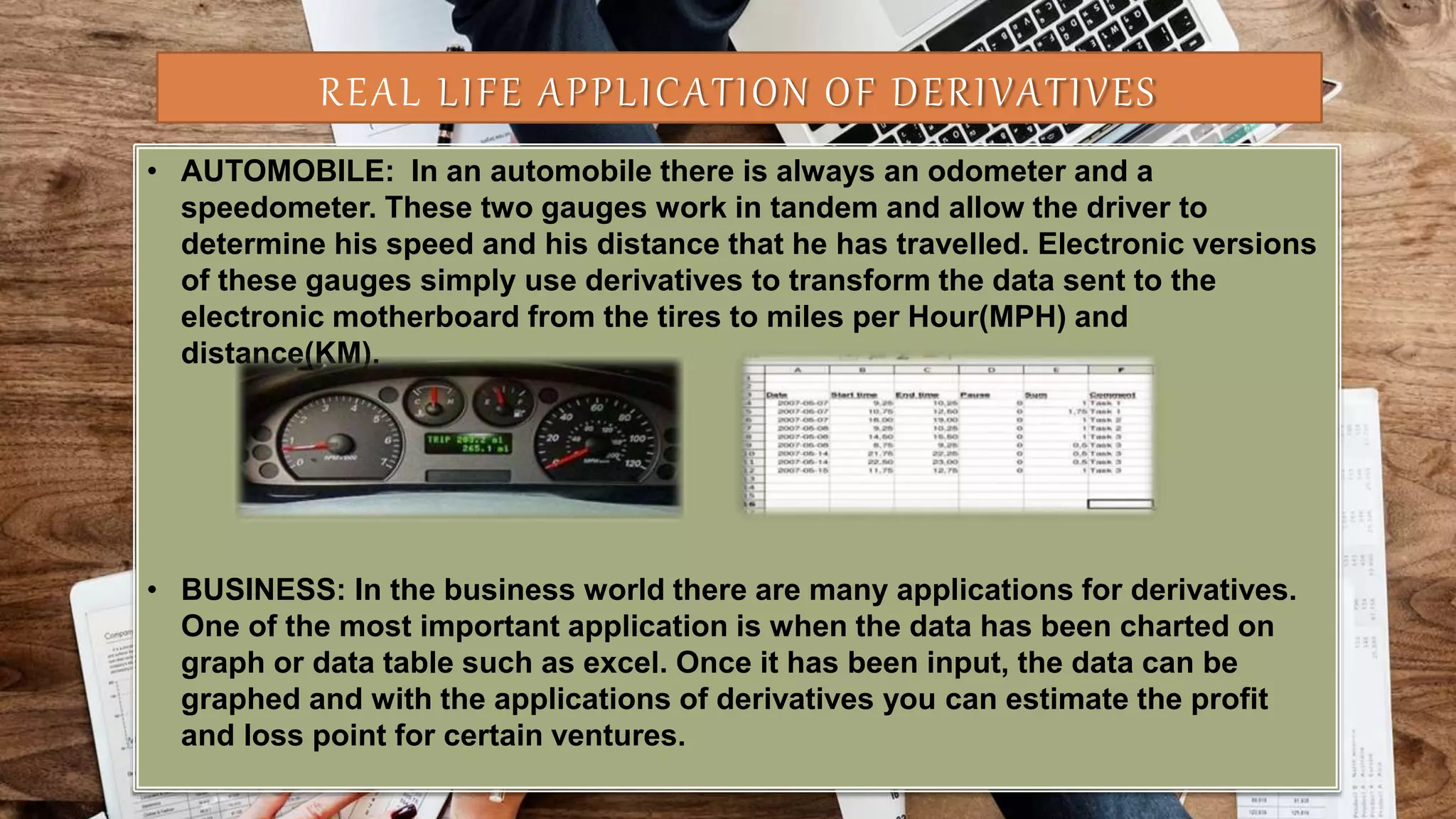
• AUTOMOBILE: In an automobile there is always an odometer and a
speedometer. These two gauges work in tandem and allow the driver to
determine his speed and his distance that he has travelled. Electronic versions
of these gauges simply use derivatives to transform the data sent to the
electronic motherboard from the tires to miles per Hour(MPH) and
distance(KM).
• BUSINESS: In the business world there are many applications for derivatives.
One of the most important application is when the data has been charted on
graph or data table such as excel. Once it has been input, the data can be
graphed and with the applications of derivatives you can estimate the profit
and loss point for certain ventures.
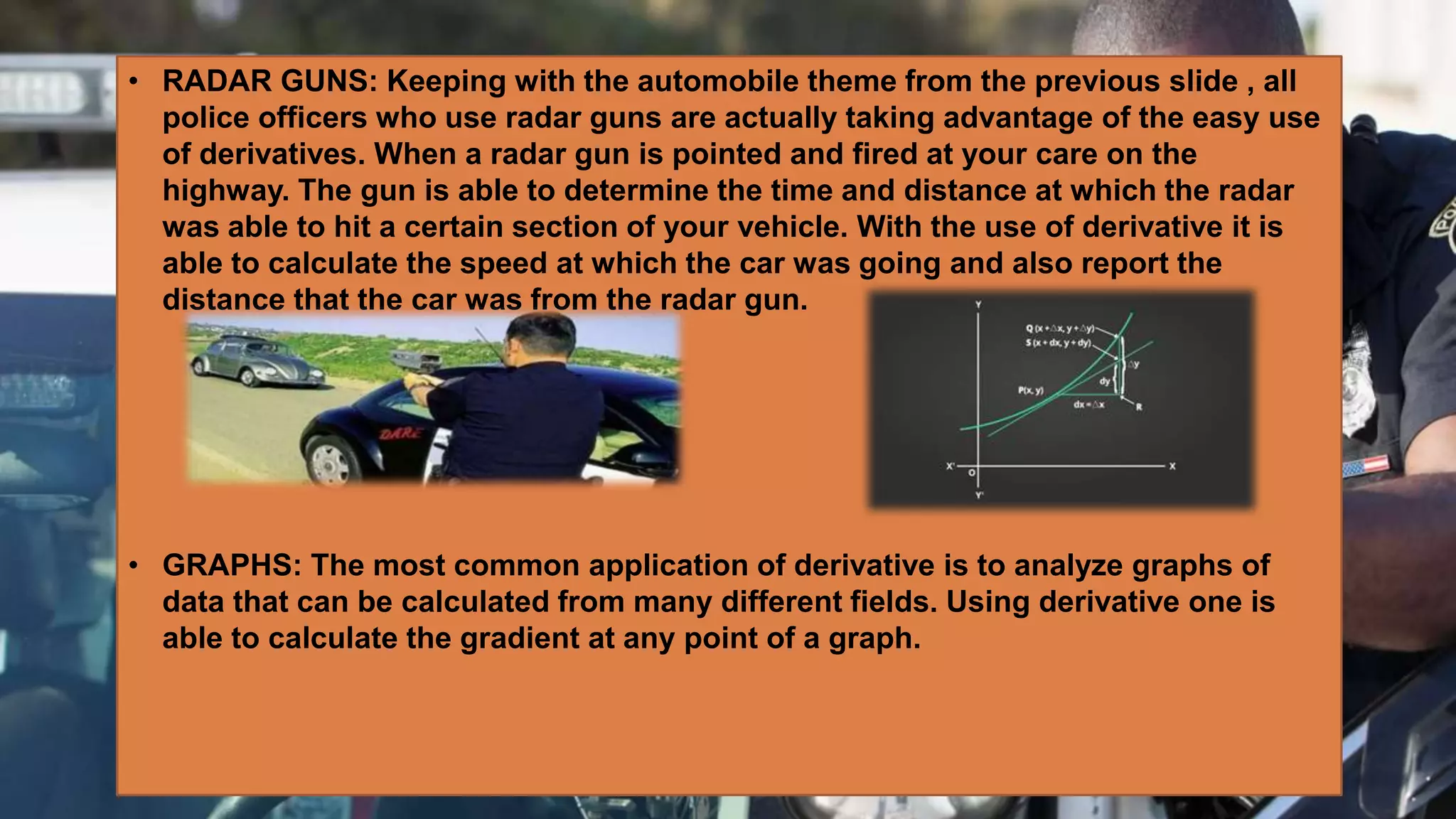
• RADAR GUNS: Keeping with the automobile theme from the previous slide , all
police officers who use radar guns are actually taking advantage of the easy use
of derivatives. When a radar gun is pointed and fired at your care on the
highway. The gun is able to determine the time and distance at which the radar
was able to hit a certain section of your vehicle. With the use of derivative it is
able to calculate the speed at which the car was going and also report the
distance that the car was from the radar gun.
• GRAPHS: The most common application of derivative is to analyze graphs of
data that can be calculated from many different fields. Using derivative one is
able to calculate the gradient at any point of a graph.
APPLICATION OF DERIVATIVES IN VARIOUS SCIENCES:-
 It can be used to determine the blood flow
at a particular instant in artery or vein
inside the human body.
 It is very much useful in determining the
bacterial growth . The bacteria undergoes
cell division and growth density is
observed under a short period of time the
data is collected and put to n(t) at any time
t:-dn1/dt=2n(t)/t has the solution at any
time =t
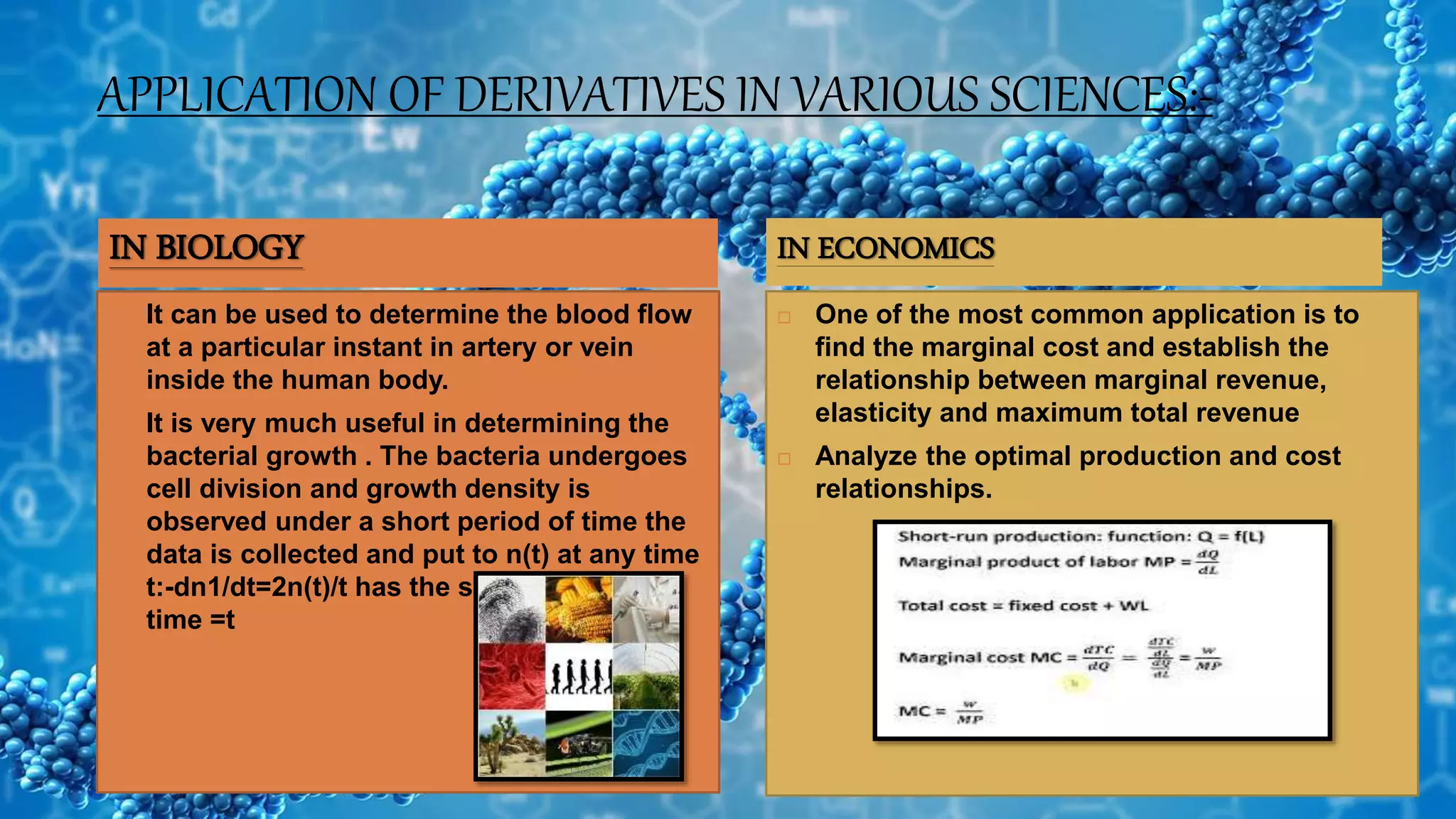
 One of the most common application is to
find the marginal cost and establish the
relationship between marginal revenue,
elasticity and maximum total revenue
 Analyze the optimal production and cost
relationships.
IN BIOLOGY IN ECONOMICS
APPLICATIONS OF DERIVATIVES IN VARIOUS SCIENCES:
●IN PHYSICS:
1. VELOCITY IS THE RATE OF CHANGE OF POSITION AND SO, MATHEMATICALLY VELOCITY IS THE DERIVATIVE OF
POSITION. THE SLOPE OF GRAPH POSITION V/S TIME WILL GIVE THE VELOCITY.
2. SIMILARLY, ACCELERATION IS THE RATE OF CHANGE OF VELOCITY SO, ACCELERATION IS THE DERIVATIVE OF
VELOCITY. THE SLOPE OF THE GRAPH VELOCITY V/S TIME WILL GIVE ACCELERATION.
3. NET FORCE IS THE RATE OF CHANGE OF MOMENTUM SO, THE DERIVATIVE OF AN OBJECT’S MOMENTUM WILL
GIVE THE NET FORCE ON THE BODY.
●IN CHEMISTRY:
1.IN CHEMISTRY, DERIVATIVES ARE USED TO CALCULATE INSTANTANEOUS RATE OF A REACTION. IT IS THE RATE
OF REACTION AT
ANY INSTANT OF TIME IS THE RATE OF CHANGE OF CONCENTRATION OF ANY ONE OF REACTANT OR PRODUCT AT
THAT PARTICULAR INSTANT. INSTANTANEOUSRATEOF REACTION= DX/DT
2. IN THERMODYNAMICS, DU= TDS– PDV
WHERE U = INTERNAL ENERGY, S = ENTROPY, V = VOLUME, T = TEMPERATURE, P = PRESSURE AND "D" DENOTES
THE TOTAL DIFFERENTIAL OF THE ASSOCIATED QUANTITY.
CONCLUSION:
Derivatives are constantly used in everyday life to help
measure how much something is changing. They're used
by the government in population censuses, various types
of sciences, and even in economics. Knowing how to use
derivatives, when to use them, and how to apply them in
everyday life can be a crucial part of any profession, so
learning early is always a good thing.
THANK
YOU

Maths Investigatory Project Class 12 on Differentiation

  • 2.
  • 3.
     Roll22- RishavGhosh  Roll 23- Rithika Shaw  Roll24- Sagnik Basu  Roll 25 – Sagnik Saha  Roll26- Sayan Mandal  Roll27- Sayan Roy  Roll28- Sneha Bandyopadhyay Our group members are:--
  • 4.
    CONTENTS  Introduction andbrief history of differentiation  What is “differentiation”- the definition and graphical understanding  Its Application in mathematics  Some handy formulas  Real life applications  Applications in science  conclusion
  • 5.
    AN INTRODUCTIONTO DERIVATIVE&DIFFERENTIATION  The derivative of a function of a single variable at a chosen input value, when it exists, is the slope of the tangent line to the graph of the function at that point. The tangent line is the best linear approximation of the function near that input value. For this reason, the derivative is often described as the "instantaneous rate of change", the ratio of the instantaneous change in the dependent variable to that of the independent variable.  The process of finding a derivative is called differentiation. The reverse process is called anti differentiation. The fundamental theorem of calculus relates anti differentiation with integration. Differentiation and integration constitute the two fundamental operations in single-variable calculus  The problem of finding the tangent to a curve has been studied by many mathematicians since Archimedes explored the question in Antiquity. The first attempt at determining the tangent to a curve that resembled the modern method of the Calculus came from Gilles Persone de Roberval during the 1630's and 1640's. At nearly the same time as Roberval was devising his method, Pierre de Fermat used the notion of maxima and the infinitesimal to find the tangent to a curve. Some credit Fermat with discovering the differential, but it was not until Leibniz and Newton rigorously defined their
  • 6.
    A function ofa real variable y = f(x) is differentiable at a point a of its domain, if its domain contains an open interval I containing a, and the limit exists. If the function f is differentiable at a, that is if the limit L exists, then this limit is called the derivative of f at a, and denoted f'(a) (read as "f prime of a") or ) read as "the derivative of f with respect to x at a", "dy by 𝑑𝑓 𝑑𝑥 (𝑎) DEFINITIONOFDERIVATIVEANDGRAPHS
  • 7.
    Application of Differentiationin Mathematics Differentiation in mathematics is basically process of finding derivative. In contrast to the abstract nature of the theory behind it, the practical technique of differentiation can be carried out by purely algebraic manipulations, using three basic rules of derivatives and some rules of operations. The three basic derivatives are:- i. algebraic functions ii. trigonometric functions iii. exponential functions. For functions built up of combinations of these classes of functions, the theory provides the following basic rules for differentiating the sum, product, or quotient of any two functions f(x) and g(x) the derivatives of which are known (where a and b are constants) and the other basic rule, called the chain rule, provides a way to differentiate a composite function.  Other uses of Differentiation in Mathematics are:- i. By taking the derivative one may find the slope of a function ii. It is used to solve problems including limits. iii. It is used to find the local maxima and minima
  • 8.
    Some Basic Formulasof Differentiation are:- I. d(constant)/dx = 0 II. d(log x)/dx = 1/x III. d(ex )/dx = ex IV. d(x)/dx = 1 V. d(ax )/dx = ax loga VI. d(sin x)/dx = cos x VII. d(cos x)/dx = -sin x VIII. d(tan x)/dx = sec2x IX. d(sec x)/dx = sec x . tan x X. d(cosec x)/dx = - cosec x . Cot x XI. d(cot x)/dx = - cosec2x XII. d(f). g/dx = f dg/dx +g df/dx XIII. d[(f)/(g)]/dx = {g(df/dx) – f(dg/dx)}/g2
  • 9.
    REAL LIFE APPLICATIONOF DERIVATIVES • AUTOMOBILE: In an automobile there is always an odometer and a speedometer. These two gauges work in tandem and allow the driver to determine his speed and his distance that he has travelled. Electronic versions of these gauges simply use derivatives to transform the data sent to the electronic motherboard from the tires to miles per Hour(MPH) and distance(KM). • BUSINESS: In the business world there are many applications for derivatives. One of the most important application is when the data has been charted on graph or data table such as excel. Once it has been input, the data can be graphed and with the applications of derivatives you can estimate the profit and loss point for certain ventures.
  • 10.
    • RADAR GUNS:Keeping with the automobile theme from the previous slide , all police officers who use radar guns are actually taking advantage of the easy use of derivatives. When a radar gun is pointed and fired at your care on the highway. The gun is able to determine the time and distance at which the radar was able to hit a certain section of your vehicle. With the use of derivative it is able to calculate the speed at which the car was going and also report the distance that the car was from the radar gun. • GRAPHS: The most common application of derivative is to analyze graphs of data that can be calculated from many different fields. Using derivative one is able to calculate the gradient at any point of a graph.
  • 11.
    APPLICATION OF DERIVATIVESIN VARIOUS SCIENCES:-  It can be used to determine the blood flow at a particular instant in artery or vein inside the human body.  It is very much useful in determining the bacterial growth . The bacteria undergoes cell division and growth density is observed under a short period of time the data is collected and put to n(t) at any time t:-dn1/dt=2n(t)/t has the solution at any time =t  One of the most common application is to find the marginal cost and establish the relationship between marginal revenue, elasticity and maximum total revenue  Analyze the optimal production and cost relationships. IN BIOLOGY IN ECONOMICS
  • 12.
    APPLICATIONS OF DERIVATIVESIN VARIOUS SCIENCES: ●IN PHYSICS: 1. VELOCITY IS THE RATE OF CHANGE OF POSITION AND SO, MATHEMATICALLY VELOCITY IS THE DERIVATIVE OF POSITION. THE SLOPE OF GRAPH POSITION V/S TIME WILL GIVE THE VELOCITY. 2. SIMILARLY, ACCELERATION IS THE RATE OF CHANGE OF VELOCITY SO, ACCELERATION IS THE DERIVATIVE OF VELOCITY. THE SLOPE OF THE GRAPH VELOCITY V/S TIME WILL GIVE ACCELERATION. 3. NET FORCE IS THE RATE OF CHANGE OF MOMENTUM SO, THE DERIVATIVE OF AN OBJECT’S MOMENTUM WILL GIVE THE NET FORCE ON THE BODY. ●IN CHEMISTRY: 1.IN CHEMISTRY, DERIVATIVES ARE USED TO CALCULATE INSTANTANEOUS RATE OF A REACTION. IT IS THE RATE OF REACTION AT ANY INSTANT OF TIME IS THE RATE OF CHANGE OF CONCENTRATION OF ANY ONE OF REACTANT OR PRODUCT AT THAT PARTICULAR INSTANT. INSTANTANEOUSRATEOF REACTION= DX/DT 2. IN THERMODYNAMICS, DU= TDS– PDV WHERE U = INTERNAL ENERGY, S = ENTROPY, V = VOLUME, T = TEMPERATURE, P = PRESSURE AND "D" DENOTES THE TOTAL DIFFERENTIAL OF THE ASSOCIATED QUANTITY.
  • 13.
    CONCLUSION: Derivatives are constantlyused in everyday life to help measure how much something is changing. They're used by the government in population censuses, various types of sciences, and even in economics. Knowing how to use derivatives, when to use them, and how to apply them in everyday life can be a crucial part of any profession, so learning early is always a good thing.
  • 14.