GULLAS COLLEGE OF MEDICINE
MANDAL, AJAY KUMAR
ABORTION
1. How will you define abortion?
 defined as the spontaneous or induced termination of pregnancy before fetal viability.
 miscarriage and abortion are terms used interchangeably in a medical context.
 Other terms: early pregnancy loss, wastage or failure.
 The National Center for Health Statistics, the Centers for Disease Control and Prevention and
WHO define abortion as pregnancy termination or loss before 20 weeks’ gestation or with a
fetus delivered weighing <500 g.
2. What are the factors that affect abortion?
Fetal factors
 Chromosomal abnormalities
 Hydropic degeneration of villi
 Multiple pregnancy
Maternal factors
 Maternal age
 Maternal infection: TORCH infections, malaria, ureoplasma, brucella, spirochaetes,
Chlamydia trachomatis see in 4% of abortions.
 Medical disorders: Diabetes mellitus, thyroid disease, celiac disease, anorexia/bulimia
nervosa, IBD, SLE
 Medications
 Cancer: Cancer survivors who were previously treated with abdominopelvic radiotherapy,
chemotherapy
 Nutrition: severe dietary deficiency and morbid obesity
 Surgical procedures: surgical procedures performed during early pregnancy do not increase
the risk for abortion, except if it involves early removal of the corpus luteum or the
ovary in which it resides.
 Social and behavioral factors: smoking, alcohol, excessive caffeine consumption
(approximately 5 cups of coffee per day—about 500 mg of caffeine)
 Occupational and environmental factors: environmental toxins such as arsenic, lead,
formaldehyde, benzene, and ethylene oxide; exposure to antineoplastic drugs, sterilizing
agents, and x-rays
 Immunologic factors: Antiphospholipid antibody syndrome, Inherited thrombophilias
 Uterine defects: Cervical incompetence, Mullerian anomalies (M/C uterine anomaly is
bicornuate uterine, but M/C associated with abortions is septate uterus), Large and multiple
submucous leiomyoma, Ashermann syndrome, DES exposure in utero.
3. What are clinical classification of abortion? Differentiate each?
Clinical Classification of Spontaneous Abortion
Types of
Abortions
Threatened
Abortion
Incomplete
Abortion
Complete
abortion
Inevitable
Abortion
Missed
Abortion
Septic
abortion
Definitions The process of
abortion has
started but has
not progressed
to a state from
which recovery
is impossible.
Here the entire
products of
conception are
not expelled but
a part is left
inside the
uterine cavity.
Here the
products
of
conception
are
expelled
en masse.
The process of
abortion has
progressed to a
state from
where
continuation of
pregnancy is
impossible.
When the fetus
is dead and
retained inside
the uterus for
a variable
period, it is
known as
missed
abortion.
Any abortion
associated
with clinical
evidences of
infection of
the uterus
and its
contents
Clinical
picture
Slight bleeding,
mild backache
or dull pain in
lower abdomen.
Bleeding,
History of
expulsion of a
fleshy mass per
vaginam
followed by
abdominal pain.
Bleeding
stopped,
abdominal
pain.
Bleeding and
pain, shock,
gross rupture of
membranes.
Absent or
minimal
bleeding
fever,
abdominal
pain, purulent
vaginal
discharge and
vomiting
Size of
uterus
Corresponds smaller smaller Equal or less smaller smaller
Internal OS closed open closed Open with
products of
conception felt
closed open
Ultrasound Live fetus,
subchorionic
hemorrhage
Retained
products
Cavity
empty
Dead fetus Dead fetus retained
products of
conception,
foreign body-
free fluid in
the
peritoneal
cavity (pelvic
abscess).
4. How will you define recurrent pregnancy loss?
Ans: Defined as a sequence of three or more consecutive spontaneous abortion before 20 weeks.
Some, however, consider two or more as a standard. It may be primary or secondary (having
previous viable birth). A woman procuring three consecutive induced abortions is not a habitual
aborter.
5. What is your management for each classification?
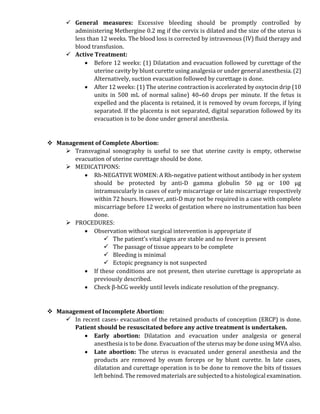
 Management of Threatened Abortion:
 Rest: The patient should be in bed for few days until bleeding stops. Prolonged
restriction of activity has got no therapeutic value.
 Drugs: Relief of pain may be ensured by some suitable pain medications
 Management of Inevitable Abortion:
 General measures: Excessive bleeding should be promptly controlled by
administering Methergine 0.2 mg if the cervix is dilated and the size of the uterus is
less than 12 weeks. The blood loss is corrected by intravenous (IV) fluid therapy and
blood transfusion.
 Active Treatment:
 Before 12 weeks: (1) Dilatation and evacuation followed by curettage of the
uterine cavity by blunt curette using analgesia or under general anesthesia. (2)
Alternatively, suction evacuation followed by curettage is done.
 After 12 weeks: (1) The uterine contraction is accelerated by oxytocin drip (10
units in 500 mL of normal saline) 40–60 drops per minute. If the fetus is
expelled and the placenta is retained, it is removed by ovum forceps, if lying
separated. If the placenta is not separated, digital separation followed by its
evacuation is to be done under general anesthesia.
 Management of Complete Abortion:
 Transvaginal sonography is useful to see that uterine cavity is empty, otherwise
evacuation of uterine curettage should be done.
 MEDICATIPONS:
 Rh-NEGATIVE WOMEN: A Rh-negative patient without antibody in her system
should be protected by anti-D gamma globulin 50 μg or 100 μg
intramuscularly in cases of early miscarriage or late miscarriage respectively
within 72 hours. However, anti-D may not be required in a case with complete
miscarriage before 12 weeks of gestation where no instrumentation has been
done.
 PROCEDURES:
 Observation without surgical intervention is appropriate if
 The patient’s vital signs are stable and no fever is present
 The passage of tissue appears to be complete
 Bleeding is minimal
 Ectopic pregnancy is not suspected
 If these conditions are not present, then uterine curettage is appropriate as
previously described.
 Check β-hCG weekly until levels indicate resolution of the pregnancy.
 Management of Incomplete Abortion:
 In recent cases- evacuation of the retained products of conception (ERCP) is done.
Patient should be resuscitated before any active treatment is undertaken.
 Early abortion: Dilatation and evacuation under analgesia or general
anesthesia is to be done. Evacuation of the uterus may be done using MVA also.
 Late abortion: The uterus is evacuated under general anesthesia and the
products are removed by ovum forceps or by blunt curette. In late cases,
dilatation and curettage operation is to be done to remove the bits of tissues
left behind. The removed materials are subjected to a histological examination.
 Medical management of incomplete miscarriage may be done. Tablet misoprostol 200
μg is used vaginally every 4 hours. Compared to surgical method, complications are
less with medical method.
 Surgical intervention: Curettage done if needed.
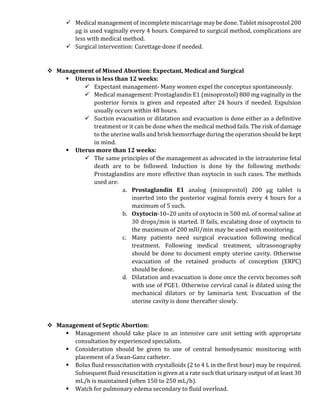
 Management of Missed Abortion: Expectant, Medical and Surgical
 Uterus is less than 12 weeks:
 Expectant management- Many women expel the conceptus spontaneously.
 Medical management: Prostaglandin E1 (misoprostol) 800 mg vaginally in the
posterior fornix is given and repeated after 24 hours if needed. Expulsion
usually occurs within 48 hours.
 Suction evacuation or dilatation and evacuation is done either as a definitive
treatment or it can be done when the medical method fails. The risk of damage
to the uterine walls and brisk hemorrhage during the operation should be kept
in mind.
 Uterus more than 12 weeks:
 The same principles of the management as advocated in the intrauterine fetal
death are to be followed. Induction is done by the following methods:
Prostaglandins are more effective than oxytocin in such cases. The methods
used are:
a. Prostaglandin E1 analog (misoprostol) 200 μg tablet is
inserted into the posterior vaginal fornix every 4 hours for a
maximum of 5 such.
b. Oxytocin-10–20 units of oxytocin in 500 mL of normal saline at
30 drops/min is started. If fails, escalating dose of oxytocin to
the maximum of 200 mlU/min may be used with monitoring.
c. Many patients need surgical evacuation following medical
treatment. Following medical treatment, ultrasonography
should be done to document empty uterine cavity. Otherwise
evacuation of the retained products of conception (ERPC)
should be done.
d. Dilatation and evacuation is done once the cervix becomes soft
with use of PGE1. Otherwise cervical canal is dilated using the
mechanical dilators or by laminaria tent. Evacuation of the
uterine cavity is done thereafter slowly.
 Management of Septic Abortion:
 Management should take place in an intensive care unit setting with appropriate
consultation by experienced specialists.
 Consideration should be given to use of central hemodynamic monitoring with
placement of a Swan-Ganz catheter.
 Bolus fluid resuscitation with crystalloids (2 to 4 L in the first hour) may be required.
Subsequent fluid resuscitation is given at a rate such that urinary output of at least 30
mL/h is maintained (often 150 to 250 mL/h).
 Watch for pulmonary edema secondary to fluid overload.
 Whole-blood transfusions may be given to maintain the hematocrit between 30% and
35%.
 Operative intervention may be necessary- Infected tissue may be removed by D&C
or D&E. Alternatively, laparotomy and total abdominal hysterectomy with bilateral
salpingooophorectomy may be necessary.
 Care can be individualized for low-risk patients: Low-risk patients are those with
a temperature less than 103°F, a small uterus, localized infection only, and no
indications of shock. These patients are best managed with intensive antibiotics.
Curettage should be done only if needed, but incomplete abortions should be
evacuated as soon as effective antibiotic levels have been achieved.
 Profuse or continued hemorrhage requires rapid intervention and awareness of
possible DIC.
 Medications
 Give tetanus toxoid, 0.5 mL subcutaneously, to immunized patients with a
history of self-induced abortion.
 Antibiotics for seriously ill patients include:
 Penicillin G sodium, 4 to 8 million U intravenously every 4 hours
 Ampicillin, 1 to 2 g intravenously every 4 hours
 Gentamicin sulfate, 1.5 mg/kg given by slow intravenous infusion every
8 hours, with careful monitoring of renal and eighth cranial nerve
function. Peak (30 minutes after dose is given) and trough (just before
dose is given) serum gentamicin levels should be ordered and dosage
adjusted as necessary. If possible, the use of nephrotoxic drugs in
oliguric patients should be avoided.
 Clindamycin, 600 mg intravenously every 6 hours
 For less seriously ill patients:
 Cefoxitin, 2 g intravenously every 6 hours.
 If Chlamydia is suspected, add doxycycline, 100 mg intravenously
every 12 hours.
THANK YOU!!!

Note On Abortion.docx

  • 1.
    GULLAS COLLEGE OFMEDICINE MANDAL, AJAY KUMAR ABORTION 1. How will you define abortion?  defined as the spontaneous or induced termination of pregnancy before fetal viability.  miscarriage and abortion are terms used interchangeably in a medical context.  Other terms: early pregnancy loss, wastage or failure.  The National Center for Health Statistics, the Centers for Disease Control and Prevention and WHO define abortion as pregnancy termination or loss before 20 weeks’ gestation or with a fetus delivered weighing <500 g. 2. What are the factors that affect abortion? Fetal factors  Chromosomal abnormalities  Hydropic degeneration of villi  Multiple pregnancy Maternal factors  Maternal age  Maternal infection: TORCH infections, malaria, ureoplasma, brucella, spirochaetes, Chlamydia trachomatis see in 4% of abortions.  Medical disorders: Diabetes mellitus, thyroid disease, celiac disease, anorexia/bulimia nervosa, IBD, SLE  Medications  Cancer: Cancer survivors who were previously treated with abdominopelvic radiotherapy, chemotherapy  Nutrition: severe dietary deficiency and morbid obesity  Surgical procedures: surgical procedures performed during early pregnancy do not increase the risk for abortion, except if it involves early removal of the corpus luteum or the ovary in which it resides.  Social and behavioral factors: smoking, alcohol, excessive caffeine consumption (approximately 5 cups of coffee per day—about 500 mg of caffeine)  Occupational and environmental factors: environmental toxins such as arsenic, lead, formaldehyde, benzene, and ethylene oxide; exposure to antineoplastic drugs, sterilizing agents, and x-rays  Immunologic factors: Antiphospholipid antibody syndrome, Inherited thrombophilias  Uterine defects: Cervical incompetence, Mullerian anomalies (M/C uterine anomaly is bicornuate uterine, but M/C associated with abortions is septate uterus), Large and multiple submucous leiomyoma, Ashermann syndrome, DES exposure in utero.
  • 2.
    3. What areclinical classification of abortion? Differentiate each? Clinical Classification of Spontaneous Abortion Types of Abortions Threatened Abortion Incomplete Abortion Complete abortion Inevitable Abortion Missed Abortion Septic abortion Definitions The process of abortion has started but has not progressed to a state from which recovery is impossible. Here the entire products of conception are not expelled but a part is left inside the uterine cavity. Here the products of conception are expelled en masse. The process of abortion has progressed to a state from where continuation of pregnancy is impossible. When the fetus is dead and retained inside the uterus for a variable period, it is known as missed abortion. Any abortion associated with clinical evidences of infection of the uterus and its contents Clinical picture Slight bleeding, mild backache or dull pain in lower abdomen. Bleeding, History of expulsion of a fleshy mass per vaginam followed by abdominal pain. Bleeding stopped, abdominal pain. Bleeding and pain, shock, gross rupture of membranes. Absent or minimal bleeding fever, abdominal pain, purulent vaginal discharge and vomiting Size of uterus Corresponds smaller smaller Equal or less smaller smaller Internal OS closed open closed Open with products of conception felt closed open Ultrasound Live fetus, subchorionic hemorrhage Retained products Cavity empty Dead fetus Dead fetus retained products of conception, foreign body- free fluid in the peritoneal cavity (pelvic abscess). 4. How will you define recurrent pregnancy loss? Ans: Defined as a sequence of three or more consecutive spontaneous abortion before 20 weeks. Some, however, consider two or more as a standard. It may be primary or secondary (having previous viable birth). A woman procuring three consecutive induced abortions is not a habitual aborter. 5. What is your management for each classification?  Management of Threatened Abortion:  Rest: The patient should be in bed for few days until bleeding stops. Prolonged restriction of activity has got no therapeutic value.  Drugs: Relief of pain may be ensured by some suitable pain medications  Management of Inevitable Abortion:
  • 3.
     General measures:Excessive bleeding should be promptly controlled by administering Methergine 0.2 mg if the cervix is dilated and the size of the uterus is less than 12 weeks. The blood loss is corrected by intravenous (IV) fluid therapy and blood transfusion.  Active Treatment:  Before 12 weeks: (1) Dilatation and evacuation followed by curettage of the uterine cavity by blunt curette using analgesia or under general anesthesia. (2) Alternatively, suction evacuation followed by curettage is done.  After 12 weeks: (1) The uterine contraction is accelerated by oxytocin drip (10 units in 500 mL of normal saline) 40–60 drops per minute. If the fetus is expelled and the placenta is retained, it is removed by ovum forceps, if lying separated. If the placenta is not separated, digital separation followed by its evacuation is to be done under general anesthesia.  Management of Complete Abortion:  Transvaginal sonography is useful to see that uterine cavity is empty, otherwise evacuation of uterine curettage should be done.  MEDICATIPONS:  Rh-NEGATIVE WOMEN: A Rh-negative patient without antibody in her system should be protected by anti-D gamma globulin 50 μg or 100 μg intramuscularly in cases of early miscarriage or late miscarriage respectively within 72 hours. However, anti-D may not be required in a case with complete miscarriage before 12 weeks of gestation where no instrumentation has been done.  PROCEDURES:  Observation without surgical intervention is appropriate if  The patient’s vital signs are stable and no fever is present  The passage of tissue appears to be complete  Bleeding is minimal  Ectopic pregnancy is not suspected  If these conditions are not present, then uterine curettage is appropriate as previously described.  Check β-hCG weekly until levels indicate resolution of the pregnancy.  Management of Incomplete Abortion:  In recent cases- evacuation of the retained products of conception (ERCP) is done. Patient should be resuscitated before any active treatment is undertaken.  Early abortion: Dilatation and evacuation under analgesia or general anesthesia is to be done. Evacuation of the uterus may be done using MVA also.  Late abortion: The uterus is evacuated under general anesthesia and the products are removed by ovum forceps or by blunt curette. In late cases, dilatation and curettage operation is to be done to remove the bits of tissues left behind. The removed materials are subjected to a histological examination.
  • 4.
     Medical managementof incomplete miscarriage may be done. Tablet misoprostol 200 μg is used vaginally every 4 hours. Compared to surgical method, complications are less with medical method.  Surgical intervention: Curettage done if needed.  Management of Missed Abortion: Expectant, Medical and Surgical  Uterus is less than 12 weeks:  Expectant management- Many women expel the conceptus spontaneously.  Medical management: Prostaglandin E1 (misoprostol) 800 mg vaginally in the posterior fornix is given and repeated after 24 hours if needed. Expulsion usually occurs within 48 hours.  Suction evacuation or dilatation and evacuation is done either as a definitive treatment or it can be done when the medical method fails. The risk of damage to the uterine walls and brisk hemorrhage during the operation should be kept in mind.  Uterus more than 12 weeks:  The same principles of the management as advocated in the intrauterine fetal death are to be followed. Induction is done by the following methods: Prostaglandins are more effective than oxytocin in such cases. The methods used are: a. Prostaglandin E1 analog (misoprostol) 200 μg tablet is inserted into the posterior vaginal fornix every 4 hours for a maximum of 5 such. b. Oxytocin-10–20 units of oxytocin in 500 mL of normal saline at 30 drops/min is started. If fails, escalating dose of oxytocin to the maximum of 200 mlU/min may be used with monitoring. c. Many patients need surgical evacuation following medical treatment. Following medical treatment, ultrasonography should be done to document empty uterine cavity. Otherwise evacuation of the retained products of conception (ERPC) should be done. d. Dilatation and evacuation is done once the cervix becomes soft with use of PGE1. Otherwise cervical canal is dilated using the mechanical dilators or by laminaria tent. Evacuation of the uterine cavity is done thereafter slowly.  Management of Septic Abortion:  Management should take place in an intensive care unit setting with appropriate consultation by experienced specialists.  Consideration should be given to use of central hemodynamic monitoring with placement of a Swan-Ganz catheter.  Bolus fluid resuscitation with crystalloids (2 to 4 L in the first hour) may be required. Subsequent fluid resuscitation is given at a rate such that urinary output of at least 30 mL/h is maintained (often 150 to 250 mL/h).  Watch for pulmonary edema secondary to fluid overload.
  • 5.
     Whole-blood transfusionsmay be given to maintain the hematocrit between 30% and 35%.  Operative intervention may be necessary- Infected tissue may be removed by D&C or D&E. Alternatively, laparotomy and total abdominal hysterectomy with bilateral salpingooophorectomy may be necessary.  Care can be individualized for low-risk patients: Low-risk patients are those with a temperature less than 103°F, a small uterus, localized infection only, and no indications of shock. These patients are best managed with intensive antibiotics. Curettage should be done only if needed, but incomplete abortions should be evacuated as soon as effective antibiotic levels have been achieved.  Profuse or continued hemorrhage requires rapid intervention and awareness of possible DIC.  Medications  Give tetanus toxoid, 0.5 mL subcutaneously, to immunized patients with a history of self-induced abortion.  Antibiotics for seriously ill patients include:  Penicillin G sodium, 4 to 8 million U intravenously every 4 hours  Ampicillin, 1 to 2 g intravenously every 4 hours  Gentamicin sulfate, 1.5 mg/kg given by slow intravenous infusion every 8 hours, with careful monitoring of renal and eighth cranial nerve function. Peak (30 minutes after dose is given) and trough (just before dose is given) serum gentamicin levels should be ordered and dosage adjusted as necessary. If possible, the use of nephrotoxic drugs in oliguric patients should be avoided.  Clindamycin, 600 mg intravenously every 6 hours  For less seriously ill patients:  Cefoxitin, 2 g intravenously every 6 hours.  If Chlamydia is suspected, add doxycycline, 100 mg intravenously every 12 hours. THANK YOU!!!