FABRIKAM
METROLOGY & QUALITY ASSURANCE
D e p a r t m e n t o f M e c h a n i c a l E n g i n e e r i n g
UNIVERSITY OF ENGINEERING & TECHNOLOGY LAHORE
Normal
Distribution
3
Table of contents
 Normal Distribution Curve
 Non-Normal Distribution
 Mathematical Definition
 Standard Deviation
 Characteristics of Normal Curve
 Normality Test
 Methods for Normality Test
 Example
 Practical Example
Normal Distribution Curve
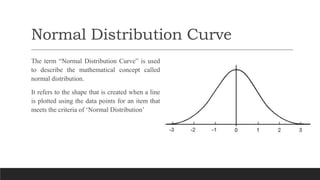
The term “Normal Distribution Curve” is used
to describe the mathematical concept called
normal distribution.
It refers to the shape that is created when a line
is plotted using the data points for an item that
meets the criteria of ‘Normal Distribution’
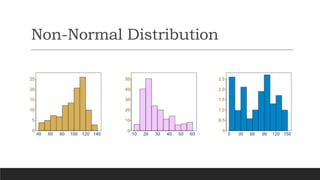
Non-Normal Distribution
Mathematical Definition
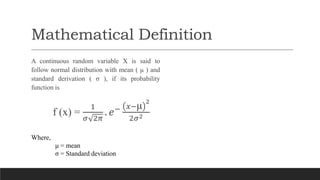
A continuous random variable X is said to
follow normal distribution with mean ( μ ) and
standard derivation ( σ ), if its probability
function is
f (x) =
1
𝜎 2𝜋
. 𝑒− 𝑥−μ 2
2𝜎2
Where,
μ = mean
σ = Standard deviation
Standard Deviation
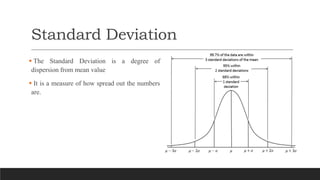
 The Standard Deviation is a degree of
dispersion from mean value
 It is a measure of how spread out the numbers
are.
Characteristics of Normal Distribution
1. Bell Curve
2. Mean, mode and median
3. Symmetry
4. Uni-nodal
5. Standard Deviation
6. The total area under the curve is 1
CHARACTERISTICS
1: Bell Curve
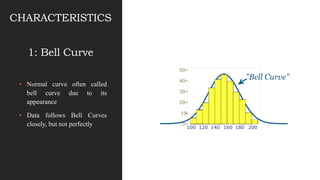
• Normal curve often called
bell curve due to its
appearance
• Data follows Bell Curves
closely, but not perfectly
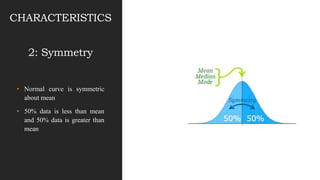
• Normal curve is symmetric
about mean
• 50% data is less than mean
and 50% data is greater than
mean
CHARACTERISTICS
2: Symmetry
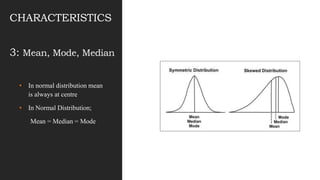
• In normal distribution mean
is always at centre
• In Normal Distribution;
Mean = Median = Mode
CHARACTERISTICS
3: Mean, Mode, Median
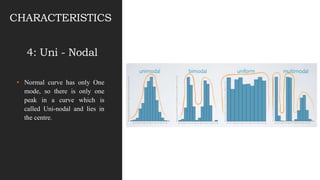
• Normal curve has only One
mode, so there is only one
peak in a curve which is
called Uni-nodal and lies in
the centre.
CHARACTERISTICS
4: Uni - Nodal
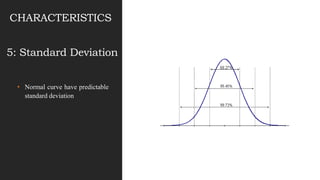
• Normal curve have predictable
standard deviation
CHARACTERISTICS
5: Standard Deviation
FABRIKAM
NORMALITY
TEST
14
Normality Test
Normality tests are used to determine if a data
set is well-modeled by a normal distribution
To compute how likely it is for a random
variable underlying the data set to be normally
distributed.
Need to make sure data is normally distributed
before using a normal distribution
FABRIKAM
METHODS FOR
NORMALITY TEST
1. Histogram
2. Skew & Kurtosis
3. Probability Plots
4. Chi-Square goodness of Fit
16
Normality Test Methods
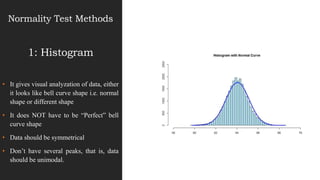
1: Histogram
• It gives visual analyzation of data, either
it looks like bell curve shape i.e. normal
shape or different shape
• It does NOT have to be “Perfect” bell
curve shape
• Data should be symmetrical
• Don’t have several peaks, that is, data
should be unimodal.
Normality Test Methods
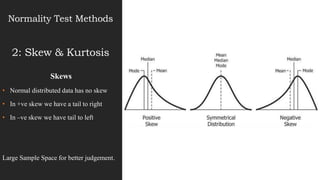
2: Skew & Kurtosis
Skews
• Normal distributed data has no skew
• In +ve skew we have a tail to right
• In –ve skew we have tail to left
Large Sample Space for better judgement.
Normality Test Methods
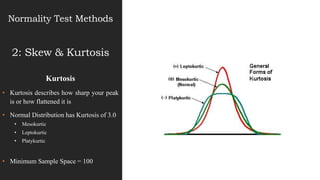
2: Skew & Kurtosis
Kurtosis
• Kurtosis describes how sharp your peak
is or how flattened it is
• Normal Distribution has Kurtosis of 3.0
• Mesokurtic
• Leptokurtic
• Platykurtic
• Minimum Sample Space = 100
Normality Test Methods
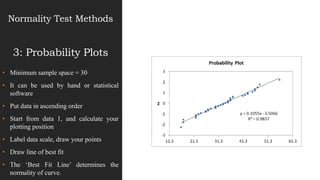
3: Probability Plots
• Minimum sample space = 30
• It can be used by hand or statistical
software
• Put data in ascending order
• Start from data 1, and calculate your
plotting position
• Label data scale, draw your points
• Draw line of best fit
• The ‘Best Fit Line’ determines the
normality of curve.
Normality Test
Methods
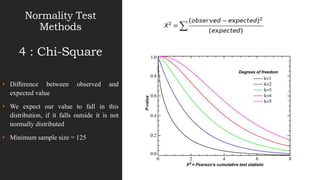
4 : Chi-Square
• Difference between observed and
expected value
• We expect our value to fall in this
distribution, if it falls outside it is not
normally distributed
• Minimum sample size = 125
Examples of Normal Distribution
• Height of people
• Measurement errors
• Blood pressure
• Point on a test
• IQ score
• Salaries
FABRIKAMFABRIKAM
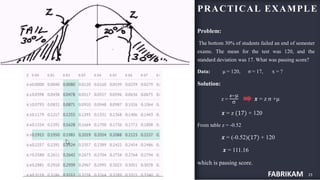
PRACTICAL EXAMPLE
Problem:
The bottom 30% of students failed an end of semester
exams. The mean for the test was 120, and the
standard deviation was 17. What was passing score?
Data: μ = 120, σ = 17, x = ?
Solution:
z =
𝒙−μ
σ
𝒙 = z σ +μ
𝒙 = z (17) + 120
From table z = -0.52
𝒙 = (-0.52)(17) + 120
𝒙 = 111.16
which is passing score.
23

Normal distribtion curve

  • 1.
    FABRIKAM METROLOGY & QUALITYASSURANCE D e p a r t m e n t o f M e c h a n i c a l E n g i n e e r i n g UNIVERSITY OF ENGINEERING & TECHNOLOGY LAHORE
  • 2.
  • 3.
    3 Table of contents Normal Distribution Curve  Non-Normal Distribution  Mathematical Definition  Standard Deviation  Characteristics of Normal Curve  Normality Test  Methods for Normality Test  Example  Practical Example
  • 4.
    Normal Distribution Curve Theterm “Normal Distribution Curve” is used to describe the mathematical concept called normal distribution. It refers to the shape that is created when a line is plotted using the data points for an item that meets the criteria of ‘Normal Distribution’
  • 5.
  • 6.
    Mathematical Definition A continuousrandom variable X is said to follow normal distribution with mean ( μ ) and standard derivation ( σ ), if its probability function is f (x) = 1 𝜎 2𝜋 . 𝑒− 𝑥−μ 2 2𝜎2 Where, μ = mean σ = Standard deviation
  • 7.
    Standard Deviation  TheStandard Deviation is a degree of dispersion from mean value  It is a measure of how spread out the numbers are.
  • 8.
    Characteristics of NormalDistribution 1. Bell Curve 2. Mean, mode and median 3. Symmetry 4. Uni-nodal 5. Standard Deviation 6. The total area under the curve is 1
  • 9.
    CHARACTERISTICS 1: Bell Curve •Normal curve often called bell curve due to its appearance • Data follows Bell Curves closely, but not perfectly
  • 10.
    • Normal curveis symmetric about mean • 50% data is less than mean and 50% data is greater than mean CHARACTERISTICS 2: Symmetry
  • 11.
    • In normaldistribution mean is always at centre • In Normal Distribution; Mean = Median = Mode CHARACTERISTICS 3: Mean, Mode, Median
  • 12.
    • Normal curvehas only One mode, so there is only one peak in a curve which is called Uni-nodal and lies in the centre. CHARACTERISTICS 4: Uni - Nodal
  • 13.
    • Normal curvehave predictable standard deviation CHARACTERISTICS 5: Standard Deviation
  • 14.
  • 15.
    Normality Test Normality testsare used to determine if a data set is well-modeled by a normal distribution To compute how likely it is for a random variable underlying the data set to be normally distributed. Need to make sure data is normally distributed before using a normal distribution
  • 16.
    FABRIKAM METHODS FOR NORMALITY TEST 1.Histogram 2. Skew & Kurtosis 3. Probability Plots 4. Chi-Square goodness of Fit 16
  • 17.
    Normality Test Methods 1:Histogram • It gives visual analyzation of data, either it looks like bell curve shape i.e. normal shape or different shape • It does NOT have to be “Perfect” bell curve shape • Data should be symmetrical • Don’t have several peaks, that is, data should be unimodal.
  • 18.
    Normality Test Methods 2:Skew & Kurtosis Skews • Normal distributed data has no skew • In +ve skew we have a tail to right • In –ve skew we have tail to left Large Sample Space for better judgement.
  • 19.
    Normality Test Methods 2:Skew & Kurtosis Kurtosis • Kurtosis describes how sharp your peak is or how flattened it is • Normal Distribution has Kurtosis of 3.0 • Mesokurtic • Leptokurtic • Platykurtic • Minimum Sample Space = 100
  • 20.
    Normality Test Methods 3:Probability Plots • Minimum sample space = 30 • It can be used by hand or statistical software • Put data in ascending order • Start from data 1, and calculate your plotting position • Label data scale, draw your points • Draw line of best fit • The ‘Best Fit Line’ determines the normality of curve.
  • 21.
    Normality Test Methods 4 :Chi-Square • Difference between observed and expected value • We expect our value to fall in this distribution, if it falls outside it is not normally distributed • Minimum sample size = 125
  • 22.
    Examples of NormalDistribution • Height of people • Measurement errors • Blood pressure • Point on a test • IQ score • Salaries
  • 23.
    FABRIKAMFABRIKAM PRACTICAL EXAMPLE Problem: The bottom30% of students failed an end of semester exams. The mean for the test was 120, and the standard deviation was 17. What was passing score? Data: μ = 120, σ = 17, x = ? Solution: z = 𝒙−μ σ 𝒙 = z σ +μ 𝒙 = z (17) + 120 From table z = -0.52 𝒙 = (-0.52)(17) + 120 𝒙 = 111.16 which is passing score. 23