





Chapter 3 - Introduction to Probability
Section 6 – Statistics Analysis
Presented By :
This Content is Copyright Reserved Rights Copyright 2025@PTAIndia
Agenda
 Introduction to Probability
 The Search for the High-Probability Trade
 Properties of Probability
 The Probability Distribution
This Content is Copyright Reserved Rights Copyright 2025@PTAIndia
Probability in Statistics
Presented By :
This Content is Copyright Reserved Rights Copyright 2025@PTAIndia
Probability in Statistics
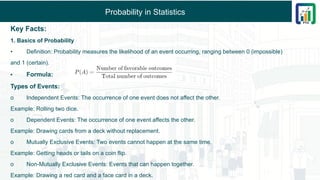
Key Facts:
1. Basics of Probability
• Definition: Probability measures the likelihood of an event occurring, ranging between 0 (impossible)
and 1 (certain).
• Formula:
Types of Events:
o Independent Events: The occurrence of one event does not affect the other.
Example: Rolling two dice.
o Dependent Events: The occurrence of one event affects the other.
Example: Drawing cards from a deck without replacement.
o Mutually Exclusive Events: Two events cannot happen at the same time.
Example: Getting heads or tails on a coin flip.
o Non-Mutually Exclusive Events: Events that can happen together.
Example: Drawing a red card and a face card in a deck.
Probability in Statistics
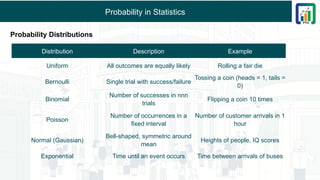
Probability Distributions
Distribution Description Example
Uniform All outcomes are equally likely Rolling a fair die
Bernoulli Single trial with success/failure
Tossing a coin (heads = 1, tails =
0)
Binomial
Number of successes in nnn
trials
Flipping a coin 10 times
Poisson
Number of occurrences in a
fixed interval
Number of customer arrivals in 1
hour
Normal (Gaussian)
Bell-shaped, symmetric around
mean
Heights of people, IQ scores
Exponential Time until an event occurs Time between arrivals of buses
Probability in Statistics
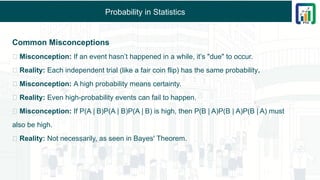
Common Misconceptions
🚫 Misconception: If an event hasn’t happened in a while, it’s "due" to occur.
✅ Reality: Each independent trial (like a fair coin flip) has the same probability.
🚫 Misconception: A high probability means certainty.
✅ Reality: Even high-probability events can fail to happen.
🚫 Misconception: If P(A B)P(A | B)P(A B) is high, then P(B A)P(B | A)P(B A) must
∣ ∣ ∣ ∣
also be high.
✅ Reality: Not necessarily, as seen in Bayes' Theorem.
Normal Distribution
Presented By :
This Content is Copyright Reserved Rights Copyright 2025@PTAIndia
Normal Distribution
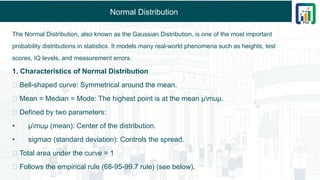
The Normal Distribution, also known as the Gaussian Distribution, is one of the most important
probability distributions in statistics. It models many real-world phenomena such as heights, test
scores, IQ levels, and measurement errors.
1. Characteristics of Normal Distribution
✅ Bell-shaped curve: Symmetrical around the mean.
✅ Mean = Median = Mode: The highest point is at the mean μmuμ.
✅ Defined by two parameters:
• μmuμ (mean): Center of the distribution.
• sigmaσ (standard deviation): Controls the spread.
✅ Total area under the curve = 1
✅ Follows the empirical rule (68-95-99.7 rule) (see below).
Normal Distribution
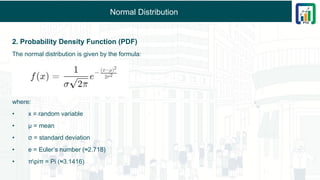
2. Probability Density Function (PDF)
The normal distribution is given by the formula:
where:
• x = random variable
• μ = mean
• σ = standard deviation
• e = Euler’s number (≈2.718)
• πpiπ = Pi (≈3.1416)
Normal Distribution
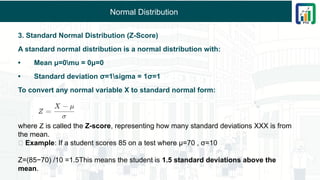
3. Standard Normal Distribution (Z-Score)
A standard normal distribution is a normal distribution with:
• Mean μ=0mu = 0μ=0
• Standard deviation σ=1sigma = 1σ=1
To convert any normal variable X to standard normal form:
where Z is called the Z-score, representing how many standard deviations XXX is from
the mean.
🔹 Example: If a student scores 85 on a test where μ=70 , σ=10
Z=(85−70​
) /10 =1.5This means the student is 1.5 standard deviations above the
mean.
Normal Distribution
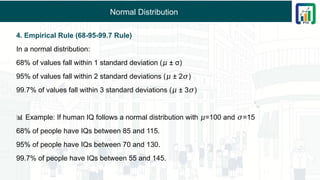
4. Empirical Rule (68-95-99.7 Rule)
In a normal distribution:
68% of values fall within 1 standard deviation ( ± σ)
𝜇
95% of values fall within 2 standard deviations ( ± 2 )
𝜇 𝜎
99.7% of values fall within 3 standard deviations ( ± 3 )
𝜇 𝜎
📊 Example: If human IQ follows a normal distribution with =100 and =15
𝜇 𝜎
68% of people have IQs between 85 and 115.
95% of people have IQs between 70 and 130.
99.7% of people have IQs between 55 and 145.
Normal Distribution
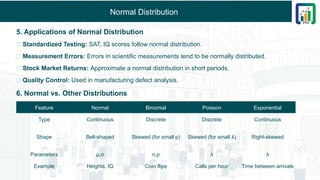
5. Applications of Normal Distribution
🔹 Standardized Testing: SAT, IQ scores follow normal distribution.
🔹 Measurement Errors: Errors in scientific measurements tend to be normally distributed.
🔹 Stock Market Returns: Approximate a normal distribution in short periods.
🔹 Quality Control: Used in manufacturing defect analysis.
6. Normal vs. Other Distributions
Feature Normal Binomial Poisson Exponential
Type Continuous Discrete Discrete Continuous
Shape Bell-shaped Skewed (for small p) Skewed (for small λ) Right-skewed
Parameters μ,σ n,p λ λ
Example Heights, IQ Coin flips Calls per hour Time between arrivals
Normal Distribution
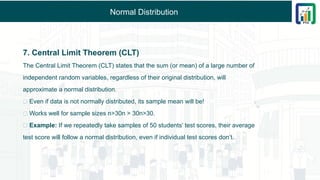
7. Central Limit Theorem (CLT)
The Central Limit Theorem (CLT) states that the sum (or mean) of a large number of
independent random variables, regardless of their original distribution, will
approximate a normal distribution.
✅ Even if data is not normally distributed, its sample mean will be!
✅ Works well for sample sizes n>30n > 30n>30.
🔹 Example: If we repeatedly take samples of 50 students’ test scores, their average
test score will follow a normal distribution, even if individual test scores don’t.
Normal Distribution
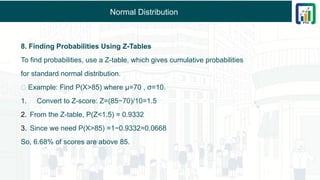
8. Finding Probabilities Using Z-Tables
To find probabilities, use a Z-table, which gives cumulative probabilities
for standard normal distribution.
📌 Example: Find P(X>85) where μ=70 , σ=10.
1. Convert to Z-score: Z=(85−70)/10=1.5
2. From the Z-table, P(Z<1.5) = 0.9332
3. Since we need P(X>85) =1−0.9332=0.0668
So, 6.68% of scores are above 85.
Skewness & Kurtosis
Presented By :
This Content is Copyright Reserved Rights Copyright 2025@PTAIndia
Skewness & Kurtosis
Skewness and Kurtosis are statistical measures that describe the shape of a probability distribution
compared to a normal distribution.
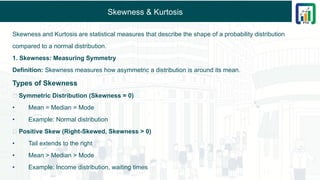
1. Skewness: Measuring Symmetry
Definition: Skewness measures how asymmetric a distribution is around its mean.
Types of Skewness
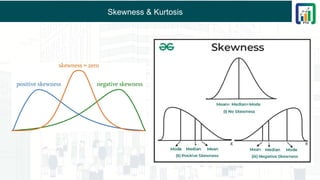
🔹 Symmetric Distribution (Skewness = 0)
• Mean = Median = Mode
• Example: Normal distribution
🔹 Positive Skew (Right-Skewed, Skewness > 0)
• Tail extends to the right
• Mean > Median > Mode
• Example: Income distribution, waiting times
Skewness & Kurtosis
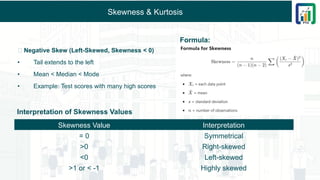
🔹 Negative Skew (Left-Skewed, Skewness < 0)
• Tail extends to the left
• Mean < Median < Mode
• Example: Test scores with many high scores
Skewness Value Interpretation
= 0 Symmetrical
>0 Right-skewed
<0 Left-skewed
>1 or < -1 Highly skewed
Interpretation of Skewness Values
Formula:
Skewness & Kurtosis
Kurtosis
Kurtosis: Measuring Tailedness
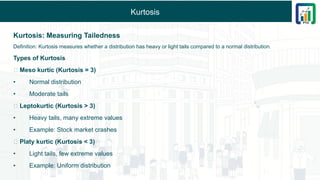
Definition: Kurtosis measures whether a distribution has heavy or light tails compared to a normal distribution.
Types of Kurtosis
🔹 Meso kurtic (Kurtosis = 3)
• Normal distribution
• Moderate tails
🔹 Leptokurtic (Kurtosis > 3)
• Heavy tails, many extreme values
• Example: Stock market crashes
🔹 Platy kurtic (Kurtosis < 3)
• Light tails, few extreme values
• Example: Uniform distribution
Kurtosis
Kurtosis
Types of Kurtosis
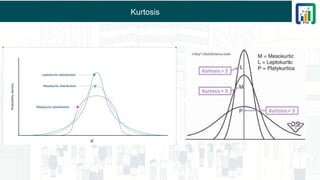
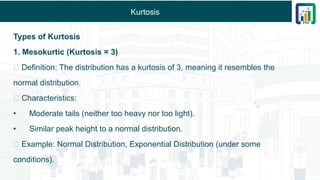
1. Mesokurtic (Kurtosis = 3)
✅ Definition: The distribution has a kurtosis of 3, meaning it resembles the
normal distribution.
✅ Characteristics:
• Moderate tails (neither too heavy nor too light).
• Similar peak height to a normal distribution.
✅ Example: Normal Distribution, Exponential Distribution (under some
conditions).
Kurtosis
Types of Kurtosis
2. Leptokurtic (Kurtosis > 3)
✅ Definition: The distribution has heavy tails, meaning more extreme values
(outliers) than a normal distribution.
✅ Characteristics:
• Higher peak and fatter tails.
• More frequent extreme values.
✅ Example: Stock market crashes, financial returns, insurance claims,
earthquake magnitudes.
Kurtosis
Types of Kurtosis
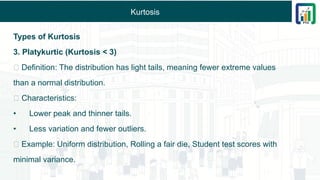
3. Platykurtic (Kurtosis < 3)
✅ Definition: The distribution has light tails, meaning fewer extreme values
than a normal distribution.
✅ Characteristics:
• Lower peak and thinner tails.
• Less variation and fewer outliers.
✅ Example: Uniform distribution, Rolling a fair die, Student test scores with
minimal variance.
Kurtosis
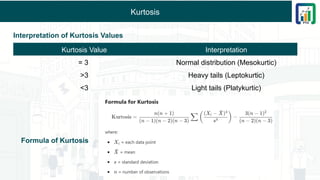
Interpretation of Kurtosis Values
Kurtosis Value Interpretation
= 3 Normal distribution (Mesokurtic)
>3 Heavy tails (Leptokurtic)
<3 Light tails (Platykurtic)
Formula of Kurtosis
Kurtosis
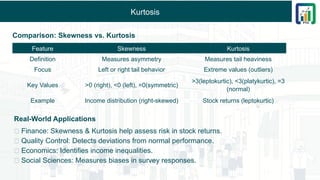
Comparison: Skewness vs. Kurtosis
Feature Skewness Kurtosis
Definition Measures asymmetry Measures tail heaviness
Focus Left or right tail behavior Extreme values (outliers)
Key Values >0 (right), <0 (left), =0(symmetric)
>3(leptokurtic), <3(platykurtic), =3
(normal)
Example Income distribution (right-skewed) Stock returns (leptokurtic)
Real-World Applications
🔹 Finance: Skewness & Kurtosis help assess risk in stock returns.
🔹 Quality Control: Detects deviations from normal performance.
🔹 Economics: Identifies income inequalities.
🔹 Social Sciences: Measures biases in survey responses.
Chapter 1 - Behavioral Finance
Next Section 7 - Behavioural Finance
Presented By :
This Content is Copyright Reserved Rights Copyright 2025@PTAIndia

Section 6 - Chapter 3 - Introduction to Probablity

  • 1.
    Chapter 3 -Introduction to Probability Section 6 – Statistics Analysis Presented By : This Content is Copyright Reserved Rights Copyright 2025@PTAIndia
  • 2.
    Agenda  Introduction toProbability  The Search for the High-Probability Trade  Properties of Probability  The Probability Distribution This Content is Copyright Reserved Rights Copyright 2025@PTAIndia
  • 3.
    Probability in Statistics PresentedBy : This Content is Copyright Reserved Rights Copyright 2025@PTAIndia
  • 4.
    Probability in Statistics KeyFacts: 1. Basics of Probability • Definition: Probability measures the likelihood of an event occurring, ranging between 0 (impossible) and 1 (certain). • Formula: Types of Events: o Independent Events: The occurrence of one event does not affect the other. Example: Rolling two dice. o Dependent Events: The occurrence of one event affects the other. Example: Drawing cards from a deck without replacement. o Mutually Exclusive Events: Two events cannot happen at the same time. Example: Getting heads or tails on a coin flip. o Non-Mutually Exclusive Events: Events that can happen together. Example: Drawing a red card and a face card in a deck.
  • 5.
    Probability in Statistics ProbabilityDistributions Distribution Description Example Uniform All outcomes are equally likely Rolling a fair die Bernoulli Single trial with success/failure Tossing a coin (heads = 1, tails = 0) Binomial Number of successes in nnn trials Flipping a coin 10 times Poisson Number of occurrences in a fixed interval Number of customer arrivals in 1 hour Normal (Gaussian) Bell-shaped, symmetric around mean Heights of people, IQ scores Exponential Time until an event occurs Time between arrivals of buses
  • 6.
    Probability in Statistics CommonMisconceptions 🚫 Misconception: If an event hasn’t happened in a while, it’s "due" to occur. ✅ Reality: Each independent trial (like a fair coin flip) has the same probability. 🚫 Misconception: A high probability means certainty. ✅ Reality: Even high-probability events can fail to happen. 🚫 Misconception: If P(A B)P(A | B)P(A B) is high, then P(B A)P(B | A)P(B A) must ∣ ∣ ∣ ∣ also be high. ✅ Reality: Not necessarily, as seen in Bayes' Theorem.
  • 7.
    Normal Distribution Presented By: This Content is Copyright Reserved Rights Copyright 2025@PTAIndia
  • 8.
    Normal Distribution The NormalDistribution, also known as the Gaussian Distribution, is one of the most important probability distributions in statistics. It models many real-world phenomena such as heights, test scores, IQ levels, and measurement errors. 1. Characteristics of Normal Distribution ✅ Bell-shaped curve: Symmetrical around the mean. ✅ Mean = Median = Mode: The highest point is at the mean μmuμ. ✅ Defined by two parameters: • μmuμ (mean): Center of the distribution. • sigmaσ (standard deviation): Controls the spread. ✅ Total area under the curve = 1 ✅ Follows the empirical rule (68-95-99.7 rule) (see below).
  • 9.
    Normal Distribution 2. ProbabilityDensity Function (PDF) The normal distribution is given by the formula: where: • x = random variable • μ = mean • σ = standard deviation • e = Euler’s number (≈2.718) • πpiπ = Pi (≈3.1416)
  • 10.
    Normal Distribution 3. StandardNormal Distribution (Z-Score) A standard normal distribution is a normal distribution with: • Mean μ=0mu = 0μ=0 • Standard deviation σ=1sigma = 1σ=1 To convert any normal variable X to standard normal form: where Z is called the Z-score, representing how many standard deviations XXX is from the mean. 🔹 Example: If a student scores 85 on a test where μ=70 , σ=10 Z=(85−70​ ) /10 =1.5This means the student is 1.5 standard deviations above the mean.
  • 11.
    Normal Distribution 4. EmpiricalRule (68-95-99.7 Rule) In a normal distribution: 68% of values fall within 1 standard deviation ( ± σ) 𝜇 95% of values fall within 2 standard deviations ( ± 2 ) 𝜇 𝜎 99.7% of values fall within 3 standard deviations ( ± 3 ) 𝜇 𝜎 📊 Example: If human IQ follows a normal distribution with =100 and =15 𝜇 𝜎 68% of people have IQs between 85 and 115. 95% of people have IQs between 70 and 130. 99.7% of people have IQs between 55 and 145.
  • 12.
    Normal Distribution 5. Applicationsof Normal Distribution 🔹 Standardized Testing: SAT, IQ scores follow normal distribution. 🔹 Measurement Errors: Errors in scientific measurements tend to be normally distributed. 🔹 Stock Market Returns: Approximate a normal distribution in short periods. 🔹 Quality Control: Used in manufacturing defect analysis. 6. Normal vs. Other Distributions Feature Normal Binomial Poisson Exponential Type Continuous Discrete Discrete Continuous Shape Bell-shaped Skewed (for small p) Skewed (for small λ) Right-skewed Parameters μ,σ n,p λ λ Example Heights, IQ Coin flips Calls per hour Time between arrivals
  • 13.
    Normal Distribution 7. CentralLimit Theorem (CLT) The Central Limit Theorem (CLT) states that the sum (or mean) of a large number of independent random variables, regardless of their original distribution, will approximate a normal distribution. ✅ Even if data is not normally distributed, its sample mean will be! ✅ Works well for sample sizes n>30n > 30n>30. 🔹 Example: If we repeatedly take samples of 50 students’ test scores, their average test score will follow a normal distribution, even if individual test scores don’t.
  • 14.
    Normal Distribution 8. FindingProbabilities Using Z-Tables To find probabilities, use a Z-table, which gives cumulative probabilities for standard normal distribution. 📌 Example: Find P(X>85) where μ=70 , σ=10. 1. Convert to Z-score: Z=(85−70)/10=1.5 2. From the Z-table, P(Z<1.5) = 0.9332 3. Since we need P(X>85) =1−0.9332=0.0668 So, 6.68% of scores are above 85.
  • 15.
    Skewness & Kurtosis PresentedBy : This Content is Copyright Reserved Rights Copyright 2025@PTAIndia
  • 16.
    Skewness & Kurtosis Skewnessand Kurtosis are statistical measures that describe the shape of a probability distribution compared to a normal distribution. 1. Skewness: Measuring Symmetry Definition: Skewness measures how asymmetric a distribution is around its mean. Types of Skewness 🔹 Symmetric Distribution (Skewness = 0) • Mean = Median = Mode • Example: Normal distribution 🔹 Positive Skew (Right-Skewed, Skewness > 0) • Tail extends to the right • Mean > Median > Mode • Example: Income distribution, waiting times
  • 17.
    Skewness & Kurtosis 🔹Negative Skew (Left-Skewed, Skewness < 0) • Tail extends to the left • Mean < Median < Mode • Example: Test scores with many high scores Skewness Value Interpretation = 0 Symmetrical >0 Right-skewed <0 Left-skewed >1 or < -1 Highly skewed Interpretation of Skewness Values Formula:
  • 18.
  • 19.
    Kurtosis Kurtosis: Measuring Tailedness Definition:Kurtosis measures whether a distribution has heavy or light tails compared to a normal distribution. Types of Kurtosis 🔹 Meso kurtic (Kurtosis = 3) • Normal distribution • Moderate tails 🔹 Leptokurtic (Kurtosis > 3) • Heavy tails, many extreme values • Example: Stock market crashes 🔹 Platy kurtic (Kurtosis < 3) • Light tails, few extreme values • Example: Uniform distribution
  • 20.
  • 21.
    Kurtosis Types of Kurtosis 1.Mesokurtic (Kurtosis = 3) ✅ Definition: The distribution has a kurtosis of 3, meaning it resembles the normal distribution. ✅ Characteristics: • Moderate tails (neither too heavy nor too light). • Similar peak height to a normal distribution. ✅ Example: Normal Distribution, Exponential Distribution (under some conditions).
  • 22.
    Kurtosis Types of Kurtosis 2.Leptokurtic (Kurtosis > 3) ✅ Definition: The distribution has heavy tails, meaning more extreme values (outliers) than a normal distribution. ✅ Characteristics: • Higher peak and fatter tails. • More frequent extreme values. ✅ Example: Stock market crashes, financial returns, insurance claims, earthquake magnitudes.
  • 23.
    Kurtosis Types of Kurtosis 3.Platykurtic (Kurtosis < 3) ✅ Definition: The distribution has light tails, meaning fewer extreme values than a normal distribution. ✅ Characteristics: • Lower peak and thinner tails. • Less variation and fewer outliers. ✅ Example: Uniform distribution, Rolling a fair die, Student test scores with minimal variance.
  • 24.
    Kurtosis Interpretation of KurtosisValues Kurtosis Value Interpretation = 3 Normal distribution (Mesokurtic) >3 Heavy tails (Leptokurtic) <3 Light tails (Platykurtic) Formula of Kurtosis
  • 25.
    Kurtosis Comparison: Skewness vs.Kurtosis Feature Skewness Kurtosis Definition Measures asymmetry Measures tail heaviness Focus Left or right tail behavior Extreme values (outliers) Key Values >0 (right), <0 (left), =0(symmetric) >3(leptokurtic), <3(platykurtic), =3 (normal) Example Income distribution (right-skewed) Stock returns (leptokurtic) Real-World Applications 🔹 Finance: Skewness & Kurtosis help assess risk in stock returns. 🔹 Quality Control: Detects deviations from normal performance. 🔹 Economics: Identifies income inequalities. 🔹 Social Sciences: Measures biases in survey responses.
  • 26.
    Chapter 1 -Behavioral Finance Next Section 7 - Behavioural Finance Presented By : This Content is Copyright Reserved Rights Copyright 2025@PTAIndia