ENERGY STRATEGY AND
ENERGY ECONOMICS
Solar Ponds
School of Energy and Power Engineering
XI’AN JIAOTONG UNIVERSITY
Contents
 Introduction
 Principle of Solar Ponds
 Types of Solar Ponds
 Salinity Gradient Solar Pond
 Design and Construction
 Settling the salinity Gradient
 Control and Maintenance
 Heat Extraction
 Saturated Solar Ponds
 Solar Gel and Membrane Ponds
 Shallow Solar Pond
Introduction
 Solar energy is regarded as one of the most promising substitutes for traditional
energy resources.
 Its intermittent and unstable nature is a major drawback, which leads to a disparity
between supply and demand.
 Thermal energy storage systems utilize either thermochemical reactions or the
sensible or latent heat capacity of materials to provide a heating or cooling resource.
 In sensible thermal storage, energy is stored by changing the temperature of the
storage material.
 Water is one of the best storage liquids for low-temperature heat storage
 One way to trap solar energy is through the use of solar ponds. Solar ponds are large
scale energy collectors with integral heat storage for supplying thermal energy.
Principle of Solar Ponds
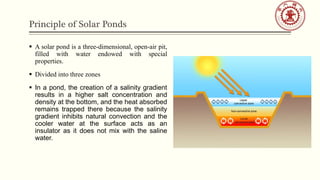
 A solar pond is a three-dimensional, open-air pit,
filled with water endowed with special
properties.
 Divided into three zones
 In a pond, the creation of a salinity gradient
results in a higher salt concentration and
density at the bottom, and the heat absorbed
remains trapped there because the salinity
gradient inhibits natural convection and the
cooler water at the surface acts as an
insulator as it does not mix with the saline
water.
Types of Solar Ponds
 Solar ponds can be classified according to four basic factors
1. Convecting or nonconvecting
2. Partitioned (multi-layered) or non-partitioned
3. Gelled or nongelled
4. Separate collector and storage or in-pond storage
Salinity Gradient Solar Pond
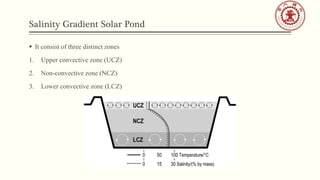
 It consist of three distinct zones
1. Upper convective zone (UCZ)
2. Non-convective zone (NCZ)
3. Lower convective zone (LCZ)
Design and Construction
 The availability of a salt source (salt or brine), freshwater, and enough land area
 Depth = 3 m
 Thickness = 1 m
 Radiation received = 20-25 %
 After heat losses = 15-20 %
 Rise of Temperature = 40-45 °C.
Design and Construction
 For example,
 The annual solar energy incident 7 GJ 𝑚−2
𝑎−1
 Annual load = 2800 GJ , Area = 400 𝑚2
 Multiply surface area by a factor of 5-10 to estimate surface area of solar pond
 The required solar pond area should be between 2000-4000 𝑚2
Design and Construction
 Several strategic considerations for construction
 Location of pond
 Earth excavation
 Lining
 Insulation
 Pond shape
 Local geology
Settling the Salinity Gradient
 Three methods for the establishment of the initial salt density gradient
1. Natural diffusion
2. Stacking
3. Redistribution
Settling the Salinity Gradient | Redistribution
 Scheme of the redistribution method and the density profile obtained during salinity gradient settling in
the 500 𝑚2
Escuzar Solar Pond.
Control and Maintenance
 Addition of saturated salt solution at the bottom
 Washing the surface with freshwater
 Monitoring and controlling disturbances such as algae blooms
 Maintaining high transparency
 Acidification
 Maintaining the pH in the salt gradient zone
 Using windbreaker to avoid surface turbulence
Heat Extraction
 There are three methods for extraction of heat
1. External heat exchanger
2. Internal heat exchangers
3. Internal heat exchanger at the gradient zone
Heat Extraction
 External heat exchanger
 An external heat exchanger is used to extract heat
from brine and the cooled brine is returned to the
bottom of the pond
 It includes the pumping hot brine from the LCZ
through a diffuser to prevent excessive velocity and
motion within the pond and thereby minimize erosion
of the gradient zone.
Heat Extraction
 Internal heat exchanger
 It involves a heat exchanger that is placed in the lower
convective zone of the pond.
 Its most appropriate position is just below the gradient
zone, so that the heat removal can stimulate
convection throughout the lower convective zone and
remove heat from its entire volume
 The low thermal conductivity of the plastic pipes is
compensated by increasing the heat transfer area on
the in-pond pipes; that is, by installing more pipes
and/or increasing the diameter of the pipes.
Heat Extraction
 Internal heat exchanger at the gradient zone
 In this method, heat is extracted from the NCZ as well as, or
instead of, the LCZ
 Theoretical and experimental investigation showed that heat
extraction from the NCZ increases overall thermal efficiency
by up to 55% compared with the conventional method of
heat extraction solely from the LCZ
Saturated Solar Ponds
 Saturated solar pond is designed to improve or reduce the level of maintenance of the salinity
gradient by making the pond saturated at all levels
 A number of salts besides 𝐾𝑁𝑂3 have been used and are found to be appropriate, these include
𝑁𝑎2𝐵4𝑂7 (borax), KAl(𝑆𝑂4) 2 , 𝐶𝑎𝐶𝑙2, 𝑀𝑔𝐶𝑙2, and 𝑁𝐻4𝑁𝑂3
 This gives these ponds the advantage of inherent stability
 Zero salt flux throughout the pond eliminates the need for addition of salt
 due to the high concentration in the bottom region a higher bottom temperature can be achieved
before the onset of boiling of the salt solution, thus increasing the thermal efficiency of the pond
Solar Gel and Membrane Ponds
 A solar gel or viscosity-stabilized pond is a nonconvective and nonsalt solar pond and was
proposed to minimize or eliminate evaporation losses from the surface by reduction of heat
losses.
 These ponds use a transparent polymer gel as a nonconvecting layer. The polymer gel has low
thermal conductivity.
 Materials suitable for viscosity-stabilized solar ponds should have high transmittance for solar
radiation, high efficiency of the chosen thickness, and should be capable of performing at
temperatures up to 60 °C. Polymers such as gum arabic, locust bean gum, starch, and gelatin
are all potentially useful materials for this configuration
 The disadvantage is the reduction of total transmission of sunlight to the bottom of the pond
 Three types of membranes are suggested for the membrane-stratified solar pond, which are
horizontal sheets, vertical tubes, and vertical sheets.
Shallow Ponds
 the depth of water in the SSP is relatively small, typically (4–15) cm
 An SSP is essentially a large water bag or pillow placed within an enclosure with a clear upper
glazing.
 Water is placed within the bag, which is generally constructed from clear upper plastic film and a
black lower plastic film, in such a way that the film is in contact with the top surface of the water,
and thus prevents the cooling effect due to evaporation.
 The black bottom of the pond absorbs solar radiation, as a result, the water gets heated.
 Solar energy collection efficiency is directly proportional to water depth, whereas water
temperature is inversely proportional to water depth.
 This type of pond is suitable for supplying warm water for household use and other low-
temperature applications, for example, laundries, textile factories, canned food factories,
greenhouses.
Advantages
 Environment friendly energy i.e. no pollution
 Reliable energy source
 Can be constructed according to the requirement
 No need of a separate collector from this thermal storage system
 Low maintenance cost
Disadvantages
 Space availability
 Salt and water supply needed
 Low efficiency due to:
 Heat losses
 Bottom losses
 Top losses
 Radiation losses
 Suggestions are recommendations are appreciated!
THANK YOU

Solar Ponds.pptx

  • 1.
    ENERGY STRATEGY AND ENERGYECONOMICS Solar Ponds School of Energy and Power Engineering XI’AN JIAOTONG UNIVERSITY
  • 2.
    Contents  Introduction  Principleof Solar Ponds  Types of Solar Ponds  Salinity Gradient Solar Pond  Design and Construction  Settling the salinity Gradient  Control and Maintenance  Heat Extraction  Saturated Solar Ponds  Solar Gel and Membrane Ponds  Shallow Solar Pond
  • 3.
    Introduction  Solar energyis regarded as one of the most promising substitutes for traditional energy resources.  Its intermittent and unstable nature is a major drawback, which leads to a disparity between supply and demand.  Thermal energy storage systems utilize either thermochemical reactions or the sensible or latent heat capacity of materials to provide a heating or cooling resource.  In sensible thermal storage, energy is stored by changing the temperature of the storage material.  Water is one of the best storage liquids for low-temperature heat storage  One way to trap solar energy is through the use of solar ponds. Solar ponds are large scale energy collectors with integral heat storage for supplying thermal energy.
  • 4.
    Principle of SolarPonds  A solar pond is a three-dimensional, open-air pit, filled with water endowed with special properties.  Divided into three zones  In a pond, the creation of a salinity gradient results in a higher salt concentration and density at the bottom, and the heat absorbed remains trapped there because the salinity gradient inhibits natural convection and the cooler water at the surface acts as an insulator as it does not mix with the saline water.
  • 5.
    Types of SolarPonds  Solar ponds can be classified according to four basic factors 1. Convecting or nonconvecting 2. Partitioned (multi-layered) or non-partitioned 3. Gelled or nongelled 4. Separate collector and storage or in-pond storage
  • 6.
    Salinity Gradient SolarPond  It consist of three distinct zones 1. Upper convective zone (UCZ) 2. Non-convective zone (NCZ) 3. Lower convective zone (LCZ)
  • 7.
    Design and Construction The availability of a salt source (salt or brine), freshwater, and enough land area  Depth = 3 m  Thickness = 1 m  Radiation received = 20-25 %  After heat losses = 15-20 %  Rise of Temperature = 40-45 °C.
  • 8.
    Design and Construction For example,  The annual solar energy incident 7 GJ 𝑚−2 𝑎−1  Annual load = 2800 GJ , Area = 400 𝑚2  Multiply surface area by a factor of 5-10 to estimate surface area of solar pond  The required solar pond area should be between 2000-4000 𝑚2
  • 9.
    Design and Construction Several strategic considerations for construction  Location of pond  Earth excavation  Lining  Insulation  Pond shape  Local geology
  • 10.
    Settling the SalinityGradient  Three methods for the establishment of the initial salt density gradient 1. Natural diffusion 2. Stacking 3. Redistribution
  • 11.
    Settling the SalinityGradient | Redistribution  Scheme of the redistribution method and the density profile obtained during salinity gradient settling in the 500 𝑚2 Escuzar Solar Pond.
  • 12.
    Control and Maintenance Addition of saturated salt solution at the bottom  Washing the surface with freshwater  Monitoring and controlling disturbances such as algae blooms  Maintaining high transparency  Acidification  Maintaining the pH in the salt gradient zone  Using windbreaker to avoid surface turbulence
  • 13.
    Heat Extraction  Thereare three methods for extraction of heat 1. External heat exchanger 2. Internal heat exchangers 3. Internal heat exchanger at the gradient zone
  • 14.
    Heat Extraction  Externalheat exchanger  An external heat exchanger is used to extract heat from brine and the cooled brine is returned to the bottom of the pond  It includes the pumping hot brine from the LCZ through a diffuser to prevent excessive velocity and motion within the pond and thereby minimize erosion of the gradient zone.
  • 15.
    Heat Extraction  Internalheat exchanger  It involves a heat exchanger that is placed in the lower convective zone of the pond.  Its most appropriate position is just below the gradient zone, so that the heat removal can stimulate convection throughout the lower convective zone and remove heat from its entire volume  The low thermal conductivity of the plastic pipes is compensated by increasing the heat transfer area on the in-pond pipes; that is, by installing more pipes and/or increasing the diameter of the pipes.
  • 16.
    Heat Extraction  Internalheat exchanger at the gradient zone  In this method, heat is extracted from the NCZ as well as, or instead of, the LCZ  Theoretical and experimental investigation showed that heat extraction from the NCZ increases overall thermal efficiency by up to 55% compared with the conventional method of heat extraction solely from the LCZ
  • 17.
    Saturated Solar Ponds Saturated solar pond is designed to improve or reduce the level of maintenance of the salinity gradient by making the pond saturated at all levels  A number of salts besides 𝐾𝑁𝑂3 have been used and are found to be appropriate, these include 𝑁𝑎2𝐵4𝑂7 (borax), KAl(𝑆𝑂4) 2 , 𝐶𝑎𝐶𝑙2, 𝑀𝑔𝐶𝑙2, and 𝑁𝐻4𝑁𝑂3  This gives these ponds the advantage of inherent stability  Zero salt flux throughout the pond eliminates the need for addition of salt  due to the high concentration in the bottom region a higher bottom temperature can be achieved before the onset of boiling of the salt solution, thus increasing the thermal efficiency of the pond
  • 18.
    Solar Gel andMembrane Ponds  A solar gel or viscosity-stabilized pond is a nonconvective and nonsalt solar pond and was proposed to minimize or eliminate evaporation losses from the surface by reduction of heat losses.  These ponds use a transparent polymer gel as a nonconvecting layer. The polymer gel has low thermal conductivity.  Materials suitable for viscosity-stabilized solar ponds should have high transmittance for solar radiation, high efficiency of the chosen thickness, and should be capable of performing at temperatures up to 60 °C. Polymers such as gum arabic, locust bean gum, starch, and gelatin are all potentially useful materials for this configuration  The disadvantage is the reduction of total transmission of sunlight to the bottom of the pond  Three types of membranes are suggested for the membrane-stratified solar pond, which are horizontal sheets, vertical tubes, and vertical sheets.
  • 19.
    Shallow Ponds  thedepth of water in the SSP is relatively small, typically (4–15) cm  An SSP is essentially a large water bag or pillow placed within an enclosure with a clear upper glazing.  Water is placed within the bag, which is generally constructed from clear upper plastic film and a black lower plastic film, in such a way that the film is in contact with the top surface of the water, and thus prevents the cooling effect due to evaporation.  The black bottom of the pond absorbs solar radiation, as a result, the water gets heated.  Solar energy collection efficiency is directly proportional to water depth, whereas water temperature is inversely proportional to water depth.  This type of pond is suitable for supplying warm water for household use and other low- temperature applications, for example, laundries, textile factories, canned food factories, greenhouses.
  • 20.
    Advantages  Environment friendlyenergy i.e. no pollution  Reliable energy source  Can be constructed according to the requirement  No need of a separate collector from this thermal storage system  Low maintenance cost
  • 21.
    Disadvantages  Space availability Salt and water supply needed  Low efficiency due to:  Heat losses  Bottom losses  Top losses  Radiation losses
  • 22.
     Suggestions arerecommendations are appreciated! THANK YOU

Editor's Notes

  • #2 NOTE: To change the image on this slide, select the picture and delete it. Then click the Pictures icon in the placeholder to insert your own image.